Cyclones,Hurricanes,
Typhoons
Named according toregion
a. Cyclones – formed over the
South Pacific Ocean and
Indian Ocean (moves
clockwise)
b. Hurricanes - formed over the
North Atlantic Ocean and
Northeast Pacific
3.
Cyclones, Hurricanes, Typhoons
c.Typhoons (bagyo) – form over
the Northwest Pacific Ocean
All produce similar effects
In general, “typhoon”, “hurricane”
and “cyclone” are called tropical
cyclone
typhoons are intense,rotating,
low-pressure storms
develop over warm, tropical
oceans
produce strong winds and heavy
rainfall
the appearance of the clouds in a
typhoon are in a spiral
arrangement; they are being
blown by winds in a counter-
clockwise direction
6.
In our country:
more typhoons pass by our
country from July through
October, although most of
the strongest typhoons
come on November
8.
In our country:
a tropical storm is divided into
five categories, namely
tropical depression, tropical
storm, severe tropical storm,
typhoon and supertyphoon
9.
Category based onthe
maximum wind speeds
Tropical Depression (TD) – 61 kph
Tropical Storm (TS) – 62 to 88 kph
Severe Tropical Storm (STS) – 89
to 117 kph
Typhoon/Cyclone – 118 to 220 kph
Super Typhoon (STY) – above 220
kph
For a typhoonto form, the
following conditions must be met:
a. warm air
b. large body of water (ocean)
c. water surface temperature of
26.5˚C or greater
d. low air pressure
12.
low-pressure area (LPA)
a region where the air
pressure is lower than that
of the surrounding regions
and cause water from
the ocean to evaporate
more and faster
13.
Movement & SpeedOf Tropical Cyclones
Over the Philippine Sea,
Tropical Cyclones tend to
move on a general west-
northwest (WNW) direction
with an average speed of
19-20 km/hr.
15.
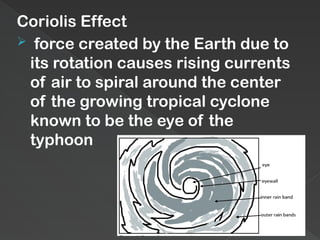
The Eye, Eyewall,Rainbands
The Eye - the clear, calm center of
storm, cool air descends into this
center (downdrafts)
Eyewall – ring of thunderstorms
close to eye and where the strongest
winds are located
Rainbands – curved groups of clouds
and thunderstorms, travel away from
eye in a spiral motion
16.
Coriolis Effect
forcecreated by the Earth due to
its rotation causes rising currents
of air to spiral around the center
of the growing tropical cyclone
known to be the eye of the
typhoon
17.
Coriolis Effect
tropicalcyclones in the northern
hemisphere rotate in a
counterclockwise direction while
tropical cyclones at the southern
hemisphere, rotate in a clockwise
direction
18.
PAGASA gives thefollowing
warnings and information when
there is a typhoon.
• Public Storm Warning Signals
(PSWS)
• gale warning
• amount of rainfall
• storm surge warning
19.
Gale warningis very important to
people who live near the sea.
Fishermen should always look at this
warning. If strong to gale force winds
are expected to affect a certain area,
fishing boats and other small sea craft
are advised not to venture out into the
sea because the gale may create big
waves which can easily destroy small
sea vessels.
a gale = a very strong wind
20.
Storm Surges
Occurwhen tropical cyclones reach land
Storm surge – raised swell of water
- 60 to 80 km across
Around 2 to 5 meters higher than normal
tides
Created by heavy winds and cause flooding
21.
Fujiwhara effect
sometimes referredto as Fujiwara
interaction or binary interaction, is
when two nearby cyclonic
vortices orbit
each other and close the
distance between the circulations
of their corresponding
low-pressure areas