 Chronology is very important in
History. It is how we order events
and important dates, by when they
happened in time.
In history we need to know
what period of time we are
talking about and how long ago
that was! Even better if we can
put that period of history into
context (understand what came
before it and what came after
it). This will help us build up a
complete picture of history
stretching back to when the
Anglo-Saxons ruled over
England.
LO:To define chronology and understand the difference between BCE and CE.
Learning Capabilities
Determined learner
Adaptable learner
Self-reliant learner
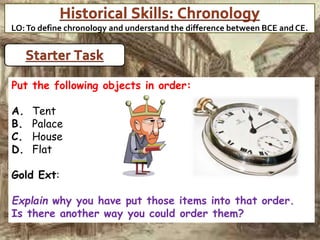
Put the following objects in order:
A. Tent
B. Palace
C. House
D. Flat
Gold Ext:
Explain why you have put those items into that order.
Is there another way you could order them?
LO:To define chronology and understand the difference between BCE and CE.
Chronologically order these dates:
A. 1981
B. 1899
C. 1950
D. 2007
 Chronology is very important in
History. It is how we order events
and important dates, by when they
happened in time.
LO:To define chronology and understand the difference between BCE and CE.
Now try and order these dates:
A. 49 BCE
B. 3 CE
C. 1490 CE
D. 109 BCE
What does BCE and CE mean?
First, match up the keywords on your sheet, then try to
order the dates above.
Ext:
What important event happened in Year 0?
A century is 100 years, so from Year 0 to 99
was the 1st century. The century we live in now is
the 21st century.
An easy way to check which century a date is in
is:
1. Check the year date is four digits (if it isnt
make it one by using a 0).
2. Look at the first two numbers of the year.
3. Add 1.
4. The answer is the century! 8 2 9
1 2 3 4
0 + 1 = ?
9th Century
LO: To define chronology and understand the difference between BCE and CE.
400 BCE 2015 CE
0
Jesus born
TASKS:
Draw the timeline above into your book across a horizontal page spread, it
needs to be 24 cm long, every 1cm is 100 years. Cut out your event cards
and place them where you think they would go on your timeline.
Onto your event cards, write which century the event happened in, e.g.
the Internet in 20th century.
We are going to be studying the Anglo-Saxon period. Label where you
think it might be placed on the timeline, and explain in a sentence why you
think it is located where you have placed it in time.
Gold task: Add events from your own life on to your timeline.
LO: To define chronology and understand the difference between BCE and CE.
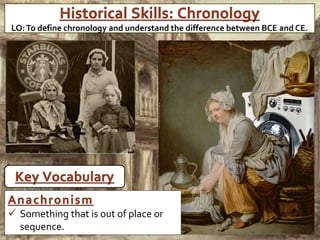
 Something that is out of place or
sequence.
LO:To define chronology and understand the difference between BCE and CE.
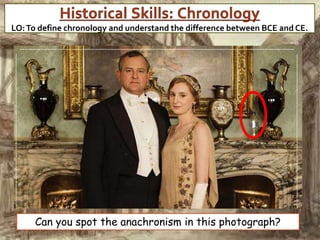
Can you spot the anachronism in this photograph?
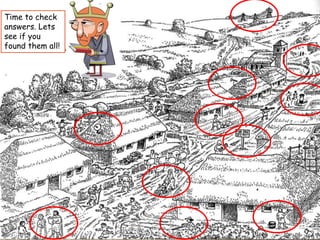
There are 11
anachronisms in this
picture…
Can you find them all?
LO:To define chronology and understand the difference between BCE and CE.
Time to check
answers. Lets
see if you
found them all!
Write this into your planners:
Create your own anachronism. You can sketch it or
use photographs to create a collage. It must be in
your History book.
Due date: ___________________
LO:To define chronology and understand the difference between BCE and CE.
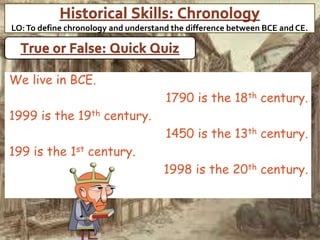
We live in BCE.
1790 is the 18th century.
1999 is the 19th century.
1450 is the 13th century.
199 is the 1st century.
1998 is the 20th century.
LO:To define chronology and understand the difference between BCE and CE.
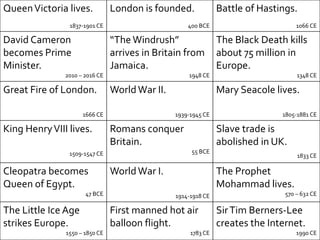
QueenVictoria lives.
1837-1901 CE
London is founded.
400 BCE
Battle of Hastings.
1066 CE
David Cameron
becomes Prime
Minister.
2010 – 2016 CE
“TheWindrush”
arrives in Britain from
Jamaica.
1948 CE
The Black Death kills
about 75 million in
Europe.
1348 CE
Great Fire of London.
1666 CE
WorldWar II.
1939-1945 CE
Mary Seacole lives.
1805-1881 CE
King HenryVIII lives.
1509-1547 CE
Romans conquer
Britain.
55 BCE
Slave trade is
abolished in UK.
1833 CE
Cleopatra becomes
Queen of Egypt.
47 BCE
WorldWar I.
1914-1918 CE
The Prophet
Mohammad lives.
570 – 632 CE
The Little Ice Age
strikes Europe.
1550 – 1850 CE
First manned hot air
balloon flight.
1783 CE
SirTim Berners-Lee
creates the Internet.
1990 CE

Chronology skills lesson

  • 1.
     Chronology isvery important in History. It is how we order events and important dates, by when they happened in time. In history we need to know what period of time we are talking about and how long ago that was! Even better if we can put that period of history into context (understand what came before it and what came after it). This will help us build up a complete picture of history stretching back to when the Anglo-Saxons ruled over England. LO:To define chronology and understand the difference between BCE and CE. Learning Capabilities Determined learner Adaptable learner Self-reliant learner
  • 2.
    Put the followingobjects in order: A. Tent B. Palace C. House D. Flat Gold Ext: Explain why you have put those items into that order. Is there another way you could order them? LO:To define chronology and understand the difference between BCE and CE.
  • 3.
    Chronologically order thesedates: A. 1981 B. 1899 C. 1950 D. 2007  Chronology is very important in History. It is how we order events and important dates, by when they happened in time. LO:To define chronology and understand the difference between BCE and CE.
  • 4.
    LO:To define chronologyand understand the difference between BCE and CE. Now try and order these dates: A. 49 BCE B. 3 CE C. 1490 CE D. 109 BCE What does BCE and CE mean? First, match up the keywords on your sheet, then try to order the dates above. Ext: What important event happened in Year 0?
  • 5.
    A century is100 years, so from Year 0 to 99 was the 1st century. The century we live in now is the 21st century. An easy way to check which century a date is in is: 1. Check the year date is four digits (if it isnt make it one by using a 0). 2. Look at the first two numbers of the year. 3. Add 1. 4. The answer is the century! 8 2 9 1 2 3 4 0 + 1 = ? 9th Century LO: To define chronology and understand the difference between BCE and CE.
  • 6.
    400 BCE 2015CE 0 Jesus born TASKS: Draw the timeline above into your book across a horizontal page spread, it needs to be 24 cm long, every 1cm is 100 years. Cut out your event cards and place them where you think they would go on your timeline. Onto your event cards, write which century the event happened in, e.g. the Internet in 20th century. We are going to be studying the Anglo-Saxon period. Label where you think it might be placed on the timeline, and explain in a sentence why you think it is located where you have placed it in time. Gold task: Add events from your own life on to your timeline. LO: To define chronology and understand the difference between BCE and CE.
  • 7.
     Something thatis out of place or sequence. LO:To define chronology and understand the difference between BCE and CE.
  • 8.
    LO:To define chronologyand understand the difference between BCE and CE. Can you spot the anachronism in this photograph?
  • 9.
    There are 11 anachronismsin this picture… Can you find them all? LO:To define chronology and understand the difference between BCE and CE.
  • 10.
    Time to check answers.Lets see if you found them all!
  • 11.
    Write this intoyour planners: Create your own anachronism. You can sketch it or use photographs to create a collage. It must be in your History book. Due date: ___________________ LO:To define chronology and understand the difference between BCE and CE.
  • 12.
    We live inBCE. 1790 is the 18th century. 1999 is the 19th century. 1450 is the 13th century. 199 is the 1st century. 1998 is the 20th century. LO:To define chronology and understand the difference between BCE and CE.
  • 13.
    QueenVictoria lives. 1837-1901 CE Londonis founded. 400 BCE Battle of Hastings. 1066 CE David Cameron becomes Prime Minister. 2010 – 2016 CE “TheWindrush” arrives in Britain from Jamaica. 1948 CE The Black Death kills about 75 million in Europe. 1348 CE Great Fire of London. 1666 CE WorldWar II. 1939-1945 CE Mary Seacole lives. 1805-1881 CE King HenryVIII lives. 1509-1547 CE Romans conquer Britain. 55 BCE Slave trade is abolished in UK. 1833 CE Cleopatra becomes Queen of Egypt. 47 BCE WorldWar I. 1914-1918 CE The Prophet Mohammad lives. 570 – 632 CE The Little Ice Age strikes Europe. 1550 – 1850 CE First manned hot air balloon flight. 1783 CE SirTim Berners-Lee creates the Internet. 1990 CE