Big Picture
Hard engineering
• Research task
Practice Question
• 6 mark question
Managing coasts - hard engineering
LO: To assess the costs and benefits of hard engineering
management strategies.
Hard engineering
 the use of concrete and
large artificial structures
by civil engineers to
defend land against
natural erosion
processes.
Key Vocabulary
Page 106 - 107
06 June 2019
 You can describe the costs and benefits of hard engineering management
strategies.
 You use a limited range of specialist terms
 You have a reasonable accuracy in the use of spelling, punctuation and grammar.
 You can compare the costs and benefits of hard engineering
management strategies.
 You use a good range of specialist terms
 You have a considerable accuracy in spelling, punctuation and grammar.
 You assess the costs and benefits of hard engineering management strategies.
 You use a wide range of specialist terms where appropriate.
 Accurate use of spelling, punctuation and grammar.
Learning Outcomes – Success Criteria
L3 - Detailed
Answer
L2 - Clear
Answer
L1 - Basic
Answer
Managing coasts - hard engineering
LO: To assess the costs and benefits of hard engineering management strategies.
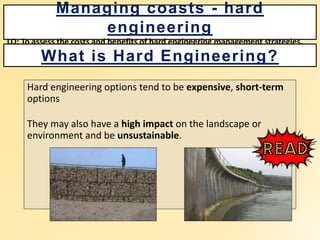
Hard engineering options tend to be expensive, short-term
options
They may also have a high impact on the landscape or
environment and be unsustainable.
Managing coasts - hard
engineering
LO: To assess the costs and benefits of hard engineering management strategies.
What is Hard Engineering?
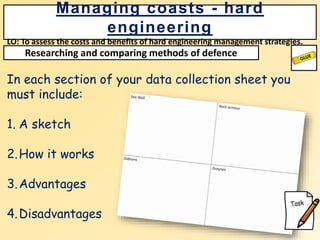
In each section of your data collection sheet you
must include:
1. A sketch
2.How it works
3.Advantages
4.Disadvantages
Researching and comparing methods of defence
Managing coasts - hard
engineering
LO: To assess the costs and benefits of hard engineering management strategies.
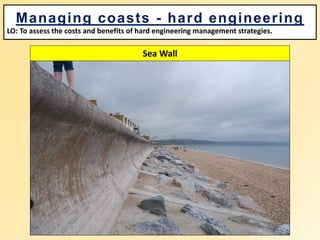
Sea Wall
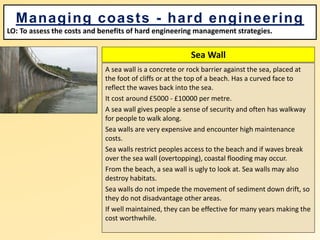
A sea wall is a concrete or rock barrier against the sea, placed at
the foot of cliffs or at the top of a beach. Has a curved face to
reflect the waves back into the sea.
It cost around £5000 - £10000 per metre.
A sea wall gives people a sense of security and often has walkway
for people to walk along.
Sea walls are very expensive and encounter high maintenance
costs.
Sea walls restrict peoples access to the beach and if waves break
over the sea wall (overtopping), coastal flooding may occur.
From the beach, a sea wall is ugly to look at. Sea walls may also
destroy habitats.
Sea walls do not impede the movement of sediment down drift, so
they do not disadvantage other areas.
If well maintained, they can be effective for many years making the
cost worthwhile.
Managing coasts - hard engineering
LO: To assess the costs and benefits of hard engineering management strategies.
Managing coasts - hard engineering
LO: To assess the costs and benefits of hard engineering management strategies.
Sea Wall
Managing coasts - hard engineering
LO: To assess the costs and benefits of hard engineering management strategies.
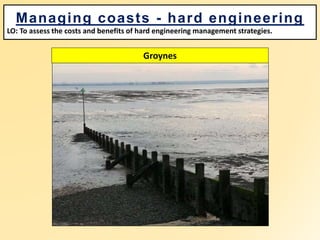
Groynes
Groynes are relatively cheap at £5000 each and if well maintained, can last up to 40 years.
Groynes are barriers which impede walking along a beach. They are also dangerous, as they have
deep water on one side and shallow on the other. This is a particular hazard to children who
might climb on them.
A larger beach, with more space for activities attracts more tourists which boosts the local
economy.
Rock groynes at Sandbanks, Poole, have concrete crests for people to walk along to reach a
viewing or fishing point. Groynes also act as windbreaks.
Groynes may be considered unattractive, especially old and degraded ones.
Managing coasts - hard engineering
LO: To assess the costs and benefits of hard engineering management strategies.
Managing coasts - hard engineering
LO: To assess the costs and benefits of hard engineering management strategies.
Groynes
Managing coasts - hard
engineering
LO: To assess the costs and benefits of hard engineering management strategies.
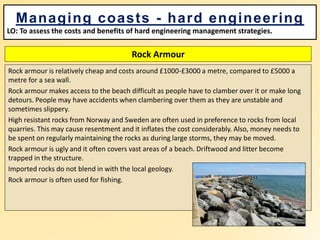
Rock Armour
Rock armour is relatively cheap and costs around £1000-£3000 a metre, compared to £5000 a
metre for a sea wall.
Rock armour makes access to the beach difficult as people have to clamber over it or make long
detours. People may have accidents when clambering over them as they are unstable and
sometimes slippery.
High resistant rocks from Norway and Sweden are often used in preference to rocks from local
quarries. This may cause resentment and it inflates the cost considerably. Also, money needs to
be spent on regularly maintaining the rocks as during large storms, they may be moved.
Rock armour is ugly and it often covers vast areas of a beach. Driftwood and litter become
trapped in the structure.
Imported rocks do not blend in with the local geology.
Rock armour is often used for fishing.
Managing coasts - hard engineering
LO: To assess the costs and benefits of hard engineering management strategies.
Managing coasts - hard engineering
LO: To assess the costs and benefits of hard engineering management strategies.
Rock Armour
Managing coasts - hard engineering
LO: To assess the costs and benefits of hard engineering management strategies.
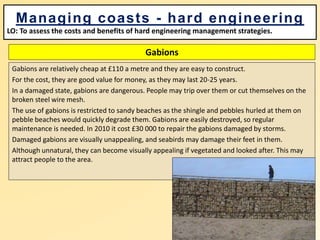
Gabions
Gabions are relatively cheap at £110 a metre and they are easy to construct.
For the cost, they are good value for money, as they may last 20-25 years.
In a damaged state, gabions are dangerous. People may trip over them or cut themselves on the
broken steel wire mesh.
The use of gabions is restricted to sandy beaches as the shingle and pebbles hurled at them on
pebble beaches would quickly degrade them. Gabions are easily destroyed, so regular
maintenance is needed. In 2010 it cost £30 000 to repair the gabions damaged by storms.
Damaged gabions are visually unappealing, and seabirds may damage their feet in them.
Although unnatural, they can become visually appealing if vegetated and looked after. This may
attract people to the area.
Managing coasts - hard engineering
LO: To assess the costs and benefits of hard engineering management strategies.
Managing coasts - hard engineering
LO: To assess the costs and benefits of hard engineering management strategies.
Gabions
Managing coasts - hard engineering
LO: To assess the costs and benefits of hard engineering management strategies.
COMMAND WORD
Explain: Give reasons why something happens. Answers
should set out the causes of a phenomenon and/or the
factors which influence its form/nature. This usually
requires an understanding of processes. Explanation is a
higher-level skill than description and this is often reflected
in its greater mark weighting. Set out purposes or reasons
KEY WORDS:
Sea wall
Rock armour
Gabions
Groynes
Longshore drift
Energy
Waves
DestructiveMark Scheme
Level 1 (Basic) 1-2 marks - Begins to explain. Statements are
simple and separate.
Level 2 (Clear) 3-4 marks – Clear explanation. Statements
are developed.
Level 3 (Detailed) 5-6 marks – Clear explanation. Statements
are developed and linked. Appropriate terminology used
throughout.
Exam Practice: Explain how hard engineering is used to protect coastal
areas from the effects of storm waves. [6 marks]
Use the model
answer that you
have been given:
1. Glue it in the
centre of a page
2. Around the edge
point out good
features about
the answer
Managing coasts - hard engineering
LO: To assess the costs and benefits of hard engineering management strategies.
Produced by Mr M Colclough
5) Evaluate how sustainable this protection method is
1) Identify the type of hard
engineering -
2) Describe how this stops the coast from eroding.
3) Explain how this method has
benefits for local people and the
environment.
4) Explain how this method could bring
problems for the local people and the
environment.
Managing coasts - hard engineering
LO: To assess the costs and benefits of hard engineering management strategies.
Complete this
extension task
evaluating a
seawall.
Produced by Mr M Colclough

10. hard engineering

  • 1.
    Big Picture Hard engineering •Research task Practice Question • 6 mark question Managing coasts - hard engineering LO: To assess the costs and benefits of hard engineering management strategies. Hard engineering  the use of concrete and large artificial structures by civil engineers to defend land against natural erosion processes. Key Vocabulary Page 106 - 107 06 June 2019
  • 2.
     You candescribe the costs and benefits of hard engineering management strategies.  You use a limited range of specialist terms  You have a reasonable accuracy in the use of spelling, punctuation and grammar.  You can compare the costs and benefits of hard engineering management strategies.  You use a good range of specialist terms  You have a considerable accuracy in spelling, punctuation and grammar.  You assess the costs and benefits of hard engineering management strategies.  You use a wide range of specialist terms where appropriate.  Accurate use of spelling, punctuation and grammar. Learning Outcomes – Success Criteria L3 - Detailed Answer L2 - Clear Answer L1 - Basic Answer Managing coasts - hard engineering LO: To assess the costs and benefits of hard engineering management strategies.
  • 4.
    Hard engineering optionstend to be expensive, short-term options They may also have a high impact on the landscape or environment and be unsustainable. Managing coasts - hard engineering LO: To assess the costs and benefits of hard engineering management strategies. What is Hard Engineering?
  • 5.
    In each sectionof your data collection sheet you must include: 1. A sketch 2.How it works 3.Advantages 4.Disadvantages Researching and comparing methods of defence Managing coasts - hard engineering LO: To assess the costs and benefits of hard engineering management strategies.
  • 6.
    Sea Wall A seawall is a concrete or rock barrier against the sea, placed at the foot of cliffs or at the top of a beach. Has a curved face to reflect the waves back into the sea. It cost around £5000 - £10000 per metre. A sea wall gives people a sense of security and often has walkway for people to walk along. Sea walls are very expensive and encounter high maintenance costs. Sea walls restrict peoples access to the beach and if waves break over the sea wall (overtopping), coastal flooding may occur. From the beach, a sea wall is ugly to look at. Sea walls may also destroy habitats. Sea walls do not impede the movement of sediment down drift, so they do not disadvantage other areas. If well maintained, they can be effective for many years making the cost worthwhile. Managing coasts - hard engineering LO: To assess the costs and benefits of hard engineering management strategies.
  • 7.
    Managing coasts -hard engineering LO: To assess the costs and benefits of hard engineering management strategies. Sea Wall
  • 8.
    Managing coasts -hard engineering LO: To assess the costs and benefits of hard engineering management strategies.
  • 9.
    Groynes Groynes are relativelycheap at £5000 each and if well maintained, can last up to 40 years. Groynes are barriers which impede walking along a beach. They are also dangerous, as they have deep water on one side and shallow on the other. This is a particular hazard to children who might climb on them. A larger beach, with more space for activities attracts more tourists which boosts the local economy. Rock groynes at Sandbanks, Poole, have concrete crests for people to walk along to reach a viewing or fishing point. Groynes also act as windbreaks. Groynes may be considered unattractive, especially old and degraded ones. Managing coasts - hard engineering LO: To assess the costs and benefits of hard engineering management strategies.
  • 10.
    Managing coasts -hard engineering LO: To assess the costs and benefits of hard engineering management strategies. Groynes
  • 11.
    Managing coasts -hard engineering LO: To assess the costs and benefits of hard engineering management strategies.
  • 12.
    Rock Armour Rock armouris relatively cheap and costs around £1000-£3000 a metre, compared to £5000 a metre for a sea wall. Rock armour makes access to the beach difficult as people have to clamber over it or make long detours. People may have accidents when clambering over them as they are unstable and sometimes slippery. High resistant rocks from Norway and Sweden are often used in preference to rocks from local quarries. This may cause resentment and it inflates the cost considerably. Also, money needs to be spent on regularly maintaining the rocks as during large storms, they may be moved. Rock armour is ugly and it often covers vast areas of a beach. Driftwood and litter become trapped in the structure. Imported rocks do not blend in with the local geology. Rock armour is often used for fishing. Managing coasts - hard engineering LO: To assess the costs and benefits of hard engineering management strategies.
  • 13.
    Managing coasts -hard engineering LO: To assess the costs and benefits of hard engineering management strategies. Rock Armour
  • 14.
    Managing coasts -hard engineering LO: To assess the costs and benefits of hard engineering management strategies.
  • 15.
    Gabions Gabions are relativelycheap at £110 a metre and they are easy to construct. For the cost, they are good value for money, as they may last 20-25 years. In a damaged state, gabions are dangerous. People may trip over them or cut themselves on the broken steel wire mesh. The use of gabions is restricted to sandy beaches as the shingle and pebbles hurled at them on pebble beaches would quickly degrade them. Gabions are easily destroyed, so regular maintenance is needed. In 2010 it cost £30 000 to repair the gabions damaged by storms. Damaged gabions are visually unappealing, and seabirds may damage their feet in them. Although unnatural, they can become visually appealing if vegetated and looked after. This may attract people to the area. Managing coasts - hard engineering LO: To assess the costs and benefits of hard engineering management strategies.
  • 16.
    Managing coasts -hard engineering LO: To assess the costs and benefits of hard engineering management strategies. Gabions
  • 17.
    Managing coasts -hard engineering LO: To assess the costs and benefits of hard engineering management strategies. COMMAND WORD Explain: Give reasons why something happens. Answers should set out the causes of a phenomenon and/or the factors which influence its form/nature. This usually requires an understanding of processes. Explanation is a higher-level skill than description and this is often reflected in its greater mark weighting. Set out purposes or reasons KEY WORDS: Sea wall Rock armour Gabions Groynes Longshore drift Energy Waves DestructiveMark Scheme Level 1 (Basic) 1-2 marks - Begins to explain. Statements are simple and separate. Level 2 (Clear) 3-4 marks – Clear explanation. Statements are developed. Level 3 (Detailed) 5-6 marks – Clear explanation. Statements are developed and linked. Appropriate terminology used throughout. Exam Practice: Explain how hard engineering is used to protect coastal areas from the effects of storm waves. [6 marks]
  • 18.
    Use the model answerthat you have been given: 1. Glue it in the centre of a page 2. Around the edge point out good features about the answer Managing coasts - hard engineering LO: To assess the costs and benefits of hard engineering management strategies.
  • 19.
    Produced by MrM Colclough 5) Evaluate how sustainable this protection method is 1) Identify the type of hard engineering - 2) Describe how this stops the coast from eroding. 3) Explain how this method has benefits for local people and the environment. 4) Explain how this method could bring problems for the local people and the environment. Managing coasts - hard engineering LO: To assess the costs and benefits of hard engineering management strategies. Complete this extension task evaluating a seawall.
  • 20.
    Produced by MrM Colclough

Editor's Notes

  • #19 AFTER CLASS HAS ATTEMPTED EXAM QUESTION: Give model answer and get them to write themselves a guide to ‘getting full marks in a 6 mark question’ IF THERE IS TIME!