Gait Disorders &
Analysis
A Roadmap to
Decision Making
Prof. Anisuddin Bhatti
Dr. Ziauddin University Hospital, Clifton
Webinar 27th September, 2020
Agenda
Preamble
• Gait: Defination, requirments,
terminology, cycle, compnents etc
• VAOGA: Video Assisted OBSERVATIONAL
Gait Analysis..
• VGA_Laboratoy: Videographic Gait
Laboratory Analysis.
• Gait Types_Orthoapedic Concern
• How effective is VAOGA.
• Case Presentations.
• Discussion_ Penalist.
• Q&A
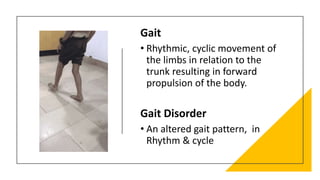
Gait
• Rhythmic, cyclic movement of
the limbs in relation to the
trunk resulting in forward
propulsion of the body.
Gait Disorder
• An altered gait pattern, in
Rhythm & cycle
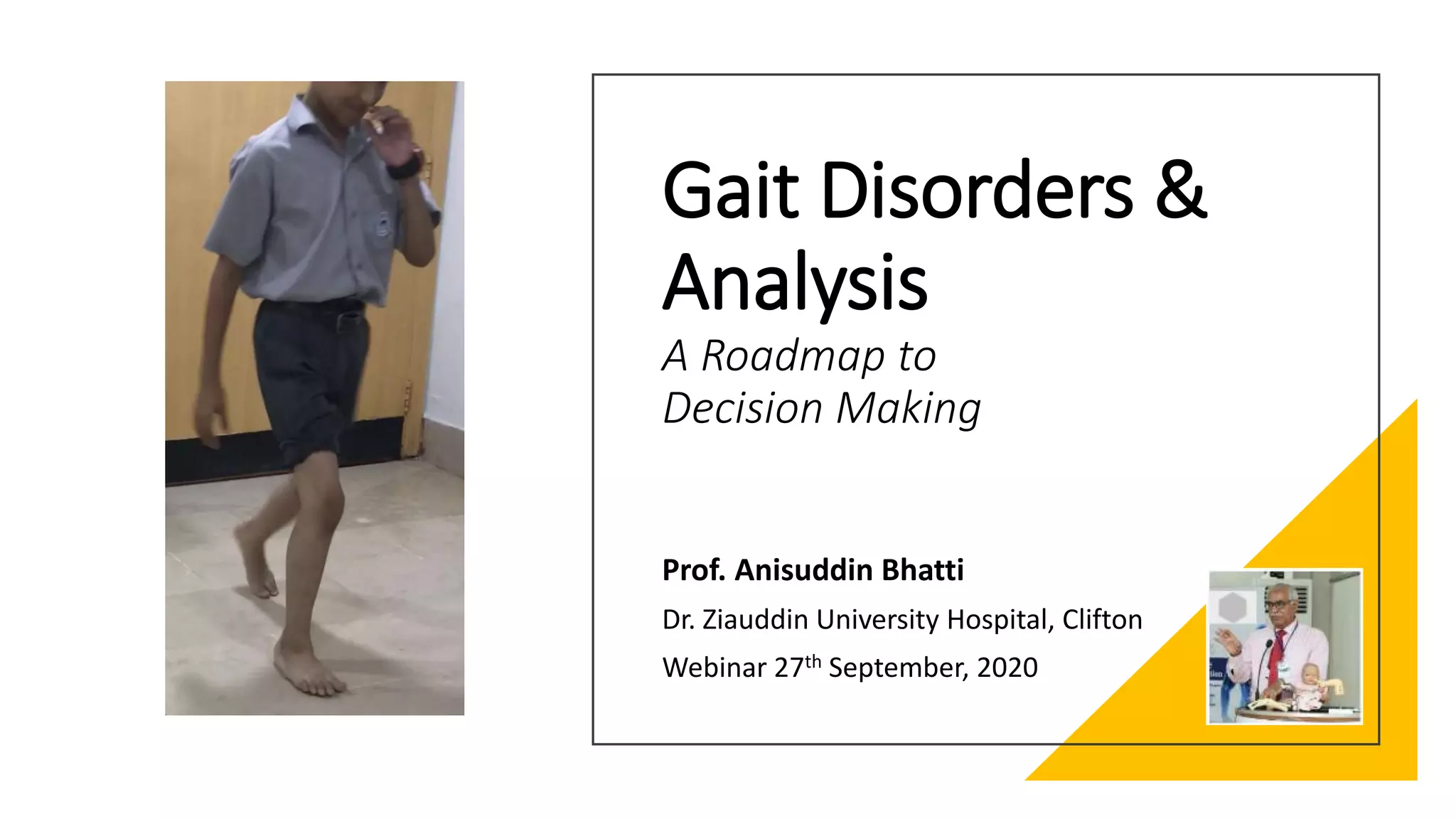
GAIT DISORDER_MAJOR REASONS:
• Deformities
• Weakness / Loss of motor control
• Pain: Inflamatory / infective disorder
• Multifactorial [common & Complex
with advancing age]
Prevelence increases with ageing
population and increasing morbidity
index
Look when he bears weight on left leg
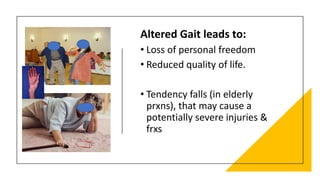
Altered Gait leads to:
• Loss of personal freedom
• Reduced quality of life.
• Tendency falls (in elderly
prxns), that may cause a
potentially severe injuries &
frxs
• Careful history taking &
examination focussed on:
oGait pattern
oPhysical examination
oNeurological assesment
oOrthopaedic evaluation
oGait Analysis [VAOGA]
• Objectives to
improve
oMobility
oIndependence,
oPrevent falls
oDetect underlying
causes
Assesment & Evaluation:
Two basic steps in the categorization of gait disorders and guideline for ancillary investigations and
therapeutic interventions includes:.
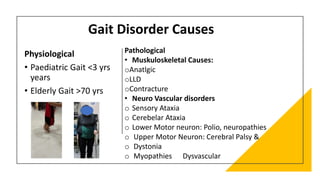
Gait Disorder Causes
Physiological
• Paediatric Gait <3 yrs
years
• Elderly Gait >70 yrs
Pathological
• Muskuloskeletal Causes:
oAnatlgic
oLLD
oContracture
• Neuro Vascular disorders
o Sensory Ataxia
o Cerebelar Ataxia
o Lower Motor neuron: Polio, neuropathies
o Upper Motor Neuron: Cerebral Palsy &
o Dystonia
o Myopathies Dysvascular
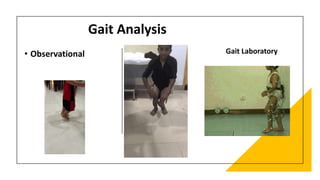
Gait Analysis
• Observational Gait Laboratory
Gait
Analysis
A systematic approach to:
• looking at trunk & each joint moving
in all three planes i,e. saggital,coronal
& transverse.
• Yield valuable information about
patient's condition & help in
establishing a treatment plan.
Benefits
of Gait
Analysis
• To diagnose mechanisms responsible
for gait disorders.
• To asses degree of disability.
• To evaluate the post treatment
improvement.
• Evaluate rate of deterioration in
progressive disorders.
• Quantification for clinical research.
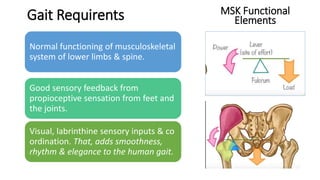
Gait Requirents
Normal functioning of musculoskeletal
system of lower limbs & spine.
Good sensory feedback from
propioceptive sensation from feet and
the joints.
Visual, labrinthine sensory inputs & co
ordination. That, adds smoothness,
rhythm & elegance to the human gait.
MSK Functional
Elements
Gait Cycle
• Period of time from one
heel strike to next heel
strike of the same limb
• Normally 1-2 sec
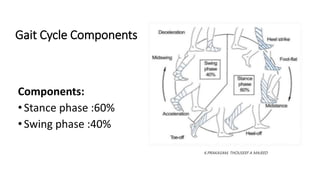
Gait Cycle Components
Components:
•Stance phase :60%
•Swing phase :40%
K.PRAKASAM, THOUSEEF A MAJEED
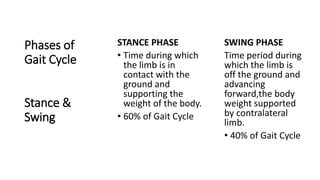
Phases of
Gait Cycle
Stance &
Swing
STANCE PHASE
• Time during which
the limb is in
contact with the
ground and
supporting the
weight of the body.
• 60% of Gait Cycle
SWING PHASE
Time period during
which the limb is
off the ground and
advancing
forward,the body
weight supported
by contralateral
limb.
• 40% of Gait Cycle
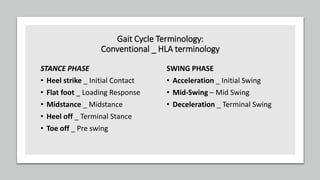
Gait Cycle Terminology:
Conventional _ HLA terminology
STANCE PHASE
• Heel strike _ Initial Contact
• Flat foot _ Loading Response
• Midstance _ Midstance
• Heel off _ Terminal Stance
• Toe off _ Pre swing
SWING PHASE
• Acceleration _ Initial Swing
• Mid-Swing – Mid Swing
• Deceleration _ Terminal Swing
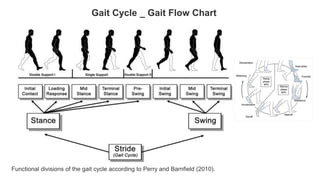
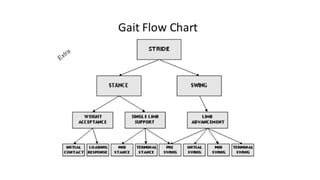
Functional divisions of the gait cycle according to Perry and Barnfield (2010).
Gait Cycle _ Gait Flow Chart
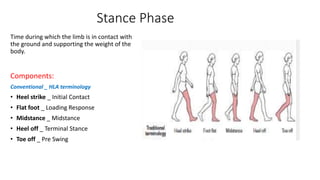
Stance Phase
Time during which the limb is in contact with
the ground and supporting the weight of the
body.
Components:
Conventional _ HLA terminology
• Heel strike _ Initial Contact
• Flat foot _ Loading Response
• Midstance _ Midstance
• Heel off _ Terminal Stance
• Toe off _ Pre Swing
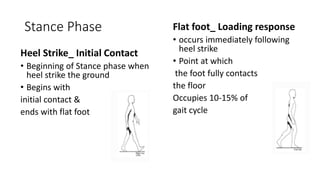
Stance Phase
Heel Strike_ Initial Contact
• Beginning of Stance phase when
heel strike the ground
• Begins with
initial contact &
ends with flat foot
Flat foot_ Loading response
• occurs immediately following
heel strike
• Point at which
the foot fully contacts
the floor
Occupies 10-15% of
gait cycle
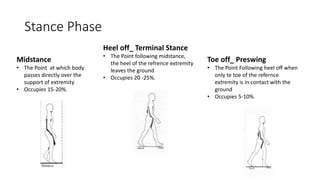
Stance Phase
Midstance
• The Point at which body
passes directly over the
support of extremity
• Occupies 15-20%.
Heel off_ Terminal Stance
• The Point following midstance,
the heel of the refrence extremity
leaves the ground
• Occupies 20 -25%.
Toe off_ Preswing
• The Point Following heel off when
only te toe of the refernce
extremity is in contact with the
ground
• Occupies 5-10%.
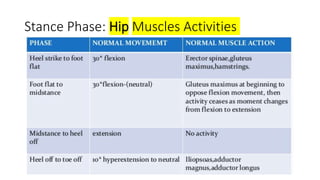
Stance Phase: Hip Muscles Activities
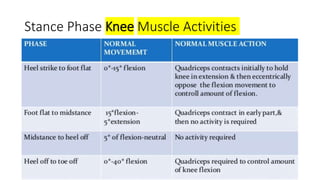
Stance Phase Knee Muscle Activities
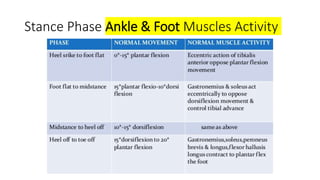
Stance Phase Ankle & Foot Muscles Activity
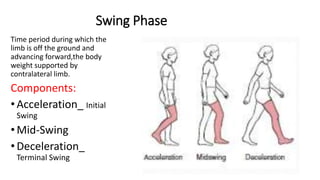
Swing Phase
Time period during which the
limb is off the ground and
advancing forward,the body
weight supported by
contralateral limb.
Components:
• Acceleration_ Initial
Swing
• Mid-Swing
• Deceleration_
Terminal Swing
Swing Phase
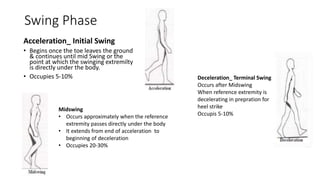
Acceleration_ Initial Swing
• Begins once the toe leaves the ground
& continues until mid Swing or the
point at which the swinging extremilty
is directly under the body.
• Occupies 5-10%
Midswing
• Occurs approximately when the reference
extremity passes directly under the body
• It extends from end of acceleration to
beginning of deceleration
• Occupies 20-30%
Deceleration_ Terminal Swing
Occurs after Midswing
When reference extremity is
decelerating in prepration for
heel strike
Occupis 5-10%
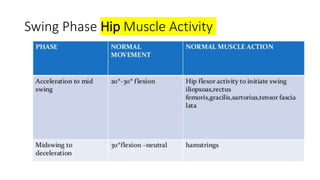
Swing Phase Hip Muscle Activity
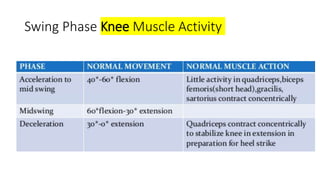
Swing Phase Knee Muscle Activity
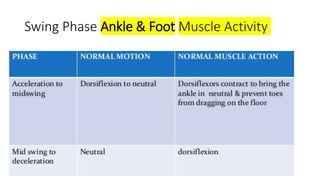
Swing Phase Ankle & Foot Muscle Activity
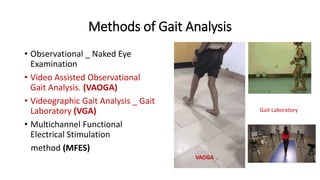
Methods of Gait Analysis
• Observational _ Naked Eye
Examination
• Video Assisted Observational
Gait Analysis. (VAOGA)
• Videographic Gait Analysis _ Gait
Laboratory (VGA)
• Multichannel Functional
Electrical Stimulation
method (MFES)
VAOGA
Gait Laboratory
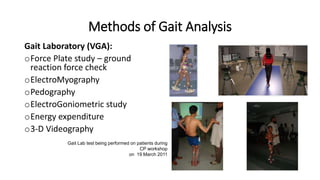
Methods of Gait Analysis
Gait Laboratory (VGA):
oForce Plate study – ground
reaction force check
oElectroMyography
oPedography
oElectroGoniometric study
oEnergy expenditure
o3-D Videography
Gait Lab test being performed on patients during
CP workshop
on 19 March 2011
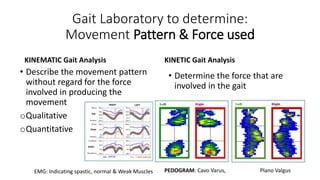
Gait Laboratory to determine:
Movement Pattern & Force used
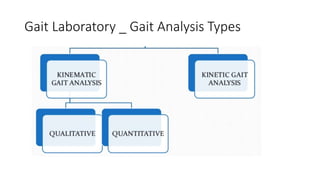
KINEMATIC Gait Analysis KINETIC Gait Analysis
• Determine the force that are
involved in the gait
• Describe the movement pattern
without regard for the force
involved in producing the
movement
oQualitative
oQuantitative
PEDOGRAM: Cavo Varus, Plano ValgusEMG: Indicating spastic, normal & Weak Muscles
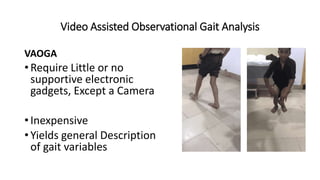
Video Assisted Observational Gait Analysis
VAOGA
• Require Little or no
supportive electronic
gadgets, Except a Camera
• Inexpensive
• Yields general Description
of gait variables
GAIT PATTERNS
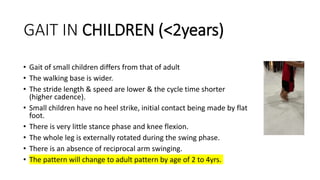
GAIT IN CHILDREN (<2years)
• Gait of small children differs from that of adult
• The walking base is wider.
• The stride length & speed are lower & the cycle time shorter
(higher cadence).
• Small children have no heel strike, initial contact being made by flat
foot.
• There is very little stance phase and knee flexion.
• The whole leg is externally rotated during the swing phase.
• There is an absence of reciprocal arm swinging.
• The pattern will change to adult pattern by age of 2 to 4yrs.
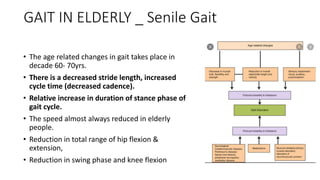
GAIT IN ELDERLY _ Senile Gait
• The age related changes in gait takes place in
decade 60- 70yrs.
• There is a decreased stride length, increased
cycle time (decreased cadence).
• Relative increase in duration of stance phase of
gait cycle.
• The speed almost always reduced in elderly
people.
• Reduction in total range of hip flexion &
extension,
• Reduction in swing phase and knee flexion
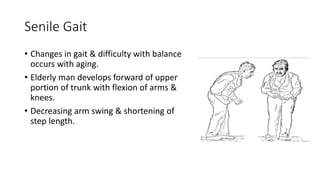
Senile Gait
• Changes in gait & difficulty with balance
occurs with aging.
• Elderly man develops forward of upper
portion of trunk with flexion of arms &
knees.
• Decreasing arm swing & shortening of
step length.
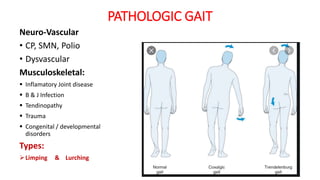
PATHOLOGIC GAIT
Neuro-Vascular
• CP, SMN, Polio
• Dysvascular
Musculoskeletal:
 Inflamatory Joint disease
 B & J Infection
 Tendinopathy
 Trauma
 Congenital / developmental
disorders
Types:
Limping & Lurching
PATHOLOGIC GAIT
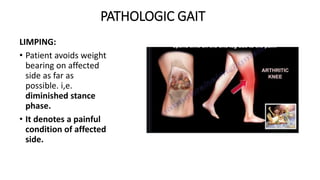
LIMPING:
• Patient avoids weight
bearing on affected
side as far as
possible. i,e.
diminished stance
phase.
• It denotes a painful
condition of affected
side.
PATHOLOGIC GAIT
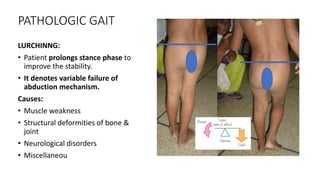
LURCHINNG:
• Patient prolongs stance phase to
improve the stability.
• It denotes variable failure of
abduction mechanism.
Causes:
• Muscle weakness
• Structural deformities of bone &
joint
• Neurological disorders
• Miscellaneou
Pathologic
Gaits
Limping &
Lurching
LIMPING:
• Antalgic gait
LURCHING:
• Waddling gait
• Trendelenberg gait
• Spastic Gait
LURCHING_PARALYTIC:
• High stepping gait
• Quadricep gait
• Gluteal medius gait
• Gluteal maximus gait
LURCHING_
STRUCTURAL
ABNORMALITIES
• Short limb gait
• In toeing gait
• Out toeing gait
• Knock knee gait
• Genu recurvatum
gait
• Stiff hip gait
• Festinant gait
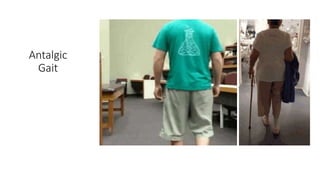
ANTALGIC GAIT_ Limp
• Gait pattern in which stance
phase on affected side is
shortened due to pain in the
weight bearing limb.
• There is corresponding increase
in stance phase on unaffected
side
• Common causes:
Osteoarthritis [Coxalgia], LCPD,
SCFE,Fractures, tendinitis
Antalgic
Gait
Trendelenburg Gait
Abduction Lurch
Waddling Gait
Backward Lurch
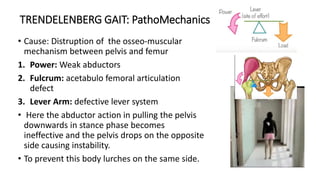
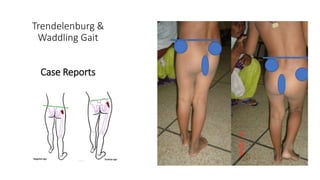
TRENDELENBERG GAIT: PathoMechanics
• Cause: Distruption of the osseo-muscular
mechanism between pelvis and femur
1. Power: Weak abductors
2. Fulcrum: acetabulo femoral articulation
defect
3. Lever Arm: defective lever system
• Here the abductor action in pulling the pelvis
downwards in stance phase becomes
ineffective and the pelvis drops on the opposite
side causing instability.
• To prevent this body lurches on the same side.
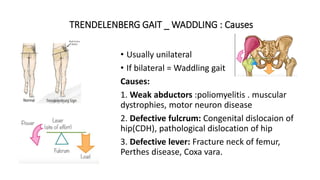
TRENDELENBERG GAIT _ WADDLING : Causes
• Usually unilateral
• If bilateral = Waddling gait
Causes:
1. Weak abductors :poliomyelitis . muscular
dystrophies, motor neuron disease
2. Defective fulcrum: Congenital dislocaion of
hip(CDH), pathological dislocation of hip
3. Defective lever: Fracture neck of femur,
Perthes disease, Coxa vara.
Trendelenburg &
Waddling Gait
Case Reports
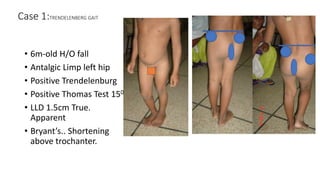
Case 1:TRENDELENBERG GAIT
• 6m-old H/O fall
• Antalgic Limp left hip
• Positive Trendelenburg
• Positive Thomas Test 150
• LLD 1.5cm True.
Apparent
• Bryant’s.. Shortening
above trochanter.
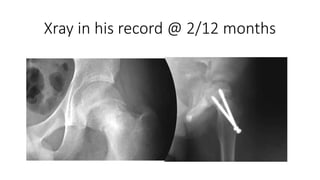
Xray in his record @ 2/12 months
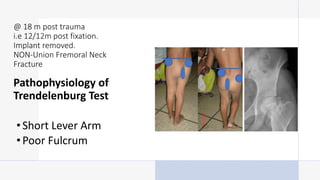
Pathophysiology of
Trendelenburg Test
•Short Lever Arm
•Poor Fulcrum
@ 18 m post trauma
i.e 12/12m post fixation.
Implant removed.
NON-Union Fremoral Neck
Fracture
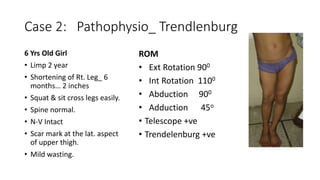
Case 2: Pathophysio_ Trendlenburg
6 Yrs Old Girl
• Limp 2 year
• Shortening of Rt. Leg_ 6
months… 2 inches
• Squat & sit cross legs easily.
• Spine normal.
• N-V Intact
• Scar mark at the lat. aspect
of upper thigh.
• Mild wasting.
ROM
• Ext Rotation 900
• Int Rotation 1100
• Abduction 900
• Adduction 45o
• Telescope +ve
• Trendelenburg +ve
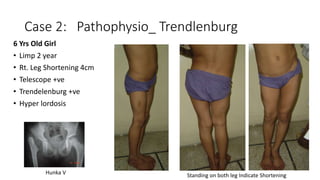
Case 2: Pathophysio_ Trendlenburg
6 Yrs Old Girl
• Limp 2 year
• Rt. Leg Shortening 4cm
• Telescope +ve
• Trendelenburg +ve
• Hyper lordosis
Standing on both leg Indicate ShorteningHunka V
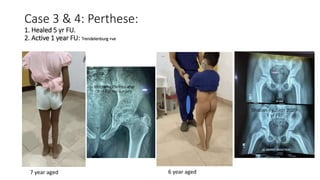
Case 3 & 4: Perthese:
1. Healed 5 yr FU.
2. Active 1 year FU: Trendelenburg +ve
7 year aged 6 year aged
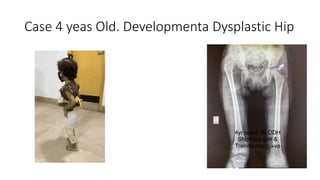
Case 4 yeas Old. Developmenta Dysplastic Hip
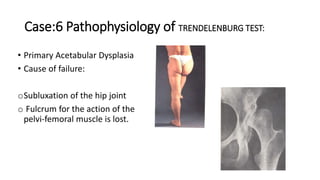
Case:6 Pathophysiology of TRENDELENBURG TEST:
• Primary Acetabular Dysplasia
• Cause of failure:
oSubluxation of the hip joint
o Fulcrum for the action of the
pelvi-femoral muscle is lost.
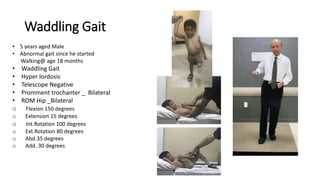
Waddling Gait
• 5 years aged Male
• Abnormal gait since he started
Walking@ age 18 months
• Waddling Gait
• Hyper lordosis
• Telescope Negative
• Prominent trochanter _ Bilateral
• ROM Hip _Bilateral
o Flexion 150 degrees
o Extension 15 degrees
o Int.Rotation 100 degrees
o Ext.Rotation 80 degrees
o Abd.35 degrees
o Add. 30 degrees
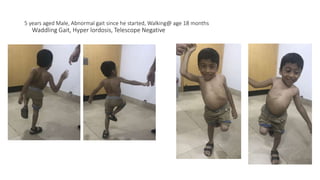
5 years aged Male, Abnormal gait since he started, Walking@ age 18 months
Waddling Gait, Hyper lordosis, Telescope Negative
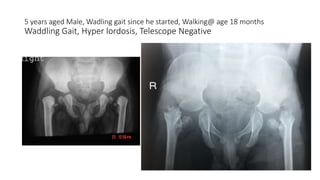
5 years aged Male, Wadling gait since he started, Walking@ age 18 months
Waddling Gait, Hyper lordosis, Telescope Negative
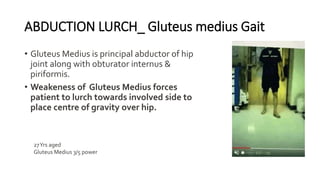
ABDUCTION LURCH_ Gluteus medius Gait
• Gluteus Medius is principal abductor of hip
joint along with obturator internus &
piriformis.
• Weakeness of Gluteus Medius forces
patient to lurch towards involved side to
place centre of gravity over hip.
27Yrs aged
Gluteus Medius 3/5 power
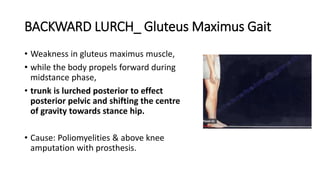
BACKWARD LURCH_ Gluteus Maximus Gait
• Weakness in gluteus maximus muscle,
• while the body propels forward during
midstance phase,
• trunk is lurched posterior to effect
posterior pelvic and shifting the centre
of gravity towards stance hip.
• Cause: Poliomyelities & above knee
amputation with prosthesis.
Spastic Gait Patterns
Cerebral Palsy
SPASTIC GAIT PATTERNS _ Cerebral palsy
• Circumduction Gait
• Scissoring Gait
• Ataxic
• Ethetoid
• Drunkers gait
• Chorioform Gait
• Hemiplegic Gait
o4 pattern
• Diplegic Gait
o4 pattern
Spastic Gait Patterns
• Different Gait patterns observed in CP depends on the involvement of
spasticity or contracture of different muscles:
• Variations relates to topographical type of CP
• Best seen in contrast between unilateral spastic CP and bilateral
spastic CP.
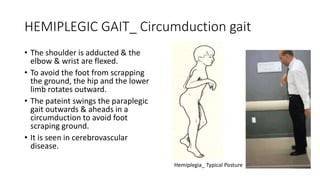
HEMIPLEGIC GAIT_ Circumduction gait
• The shoulder is adducted & the
elbow & wrist are flexed.
• To avoid the foot from scrapping
the ground, the hip and the lower
limb rotates outward.
• The pateint swings the paraplegic
gait outwards & aheads in a
circumduction to avoid foot
scraping ground.
• It is seen in cerebrovascular
disease.
Hemiplegia_ Typical Posture
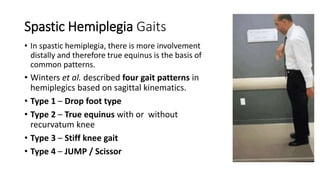
Spastic Hemiplegia Gaits
• In spastic hemiplegia, there is more involvement
distally and therefore true equinus is the basis of
common patterns.
• Winters et al. described four gait patterns in
hemiplegics based on sagittal kinematics.
• Type 1 – Drop foot type
• Type 2 – True equinus with or without
recurvatum knee
• Type 3 – Stiff knee gait
• Type 4 – JUMP / Scissor
Type II
True Equinus
hemiplegic gait.
(a): Right-sided
hemiplegia with ankle
equinus in stance [AP view].
(b): Right-sided
hemiplegia with ankle
equinus in stance [Lat view]
Equinus With
Recurvatu
Spastic Hemiplegia Gaits
• Type 3 – Stiff knee gait: Rectus Femoris over active
in Swing phase
• Type 4 – JUMP [Common in diplegics]
In sagittal plane, the ankle is in equinus, knee in
flexion, hip in flexion and anterior pelvic tilt is
present.
In coronal plane, there is hip adduction and
internal rotation.
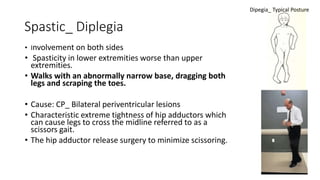
Spastic_ Diplegia
• Involvement on both sides
• Spasticity in lower extremities worse than upper
extremities.
• Walks with an abnormally narrow base, dragging both
legs and scraping the toes.
• Cause: CP_ Bilateral periventricular lesions
• Characteristic extreme tightness of hip adductors which
can cause legs to cross the midline referred to as a
scissors gait.
• The hip adductor release surgery to minimize scissoring.
Dipegia_ Typical Posture
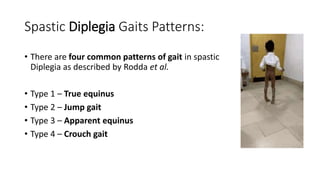
Spastic Diplegia Gaits Patterns:
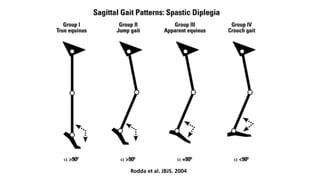
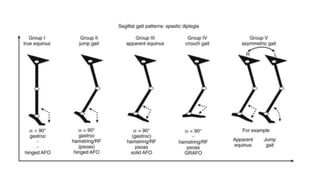
• There are four common patterns of gait in spastic
Diplegia as described by Rodda et al.
• Type 1 – True equinus
• Type 2 – Jump gait
• Type 3 – Apparent equinus
• Type 4 – Crouch gait
Rodda et al. JBJS. 2004
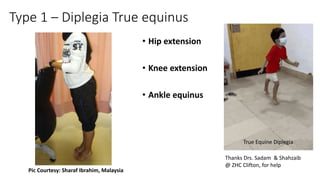
Type 1 – Diplegia True equinus
• Hip extension
• Knee extension
• Ankle equinus
Pic Courtesy: Sharaf Ibrahim, Malaysia
Thanks Drs. Sadam & Shahzaib
@ ZHC Clifton, for help
True Equine Diplegia
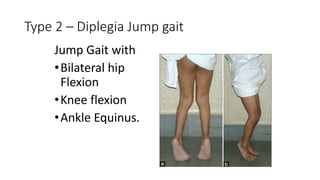
Type 2 – Diplegia Jump gait
Jump Gait with
•Bilateral hip
Flexion
•Knee flexion
•Ankle Equinus.
Apparent Equinus
[Dynamic Equinus]
• Hip flexion
• Knee flexion
• Ankle neutral..
plantigrade
Pic Courtesy: Prof. Sharaf Ibrahim, Malaysia
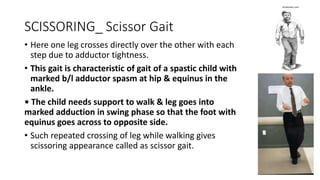
SCISSORING_ Scissor Gait
• Here one leg crosses directly over the other with each
step due to adductor tightness.
• This gait is characteristic of gait of a spastic child with
marked b/l adductor spasm at hip & equinus in the
ankle.
• The child needs support to walk & leg goes into
marked adduction in swing phase so that the foot with
equinus goes across to opposite side.
• Such repeated crossing of leg while walking gives
scissoring appearance called as scissor gait.
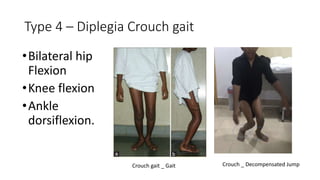
Type 4 – Diplegia Crouch gait
•Bilateral hip
Flexion
•Knee flexion
•Ankle
dorsiflexion.
Crouch _ Decompensated JumpCrouch gait _ Gait
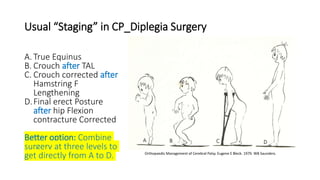
Usual “Staging” in CP_Diplegia Surgery
A. True Equinus
B. Crouch after TAL
C. Crouch corrected after
Hamstring F
Lengthening
D.Final erect Posture
after hip Flexion
contracture Corrected
Better option: Combine
surgery at three levels to
get directly from A to D. Orthopaedic Management of Cerebral Palsy. Eugene E Bleck. 1979. WB Saunders.
CEREBELLAR ATAXIC GAIT
Drunkers or Drunkard or Reeling Gait
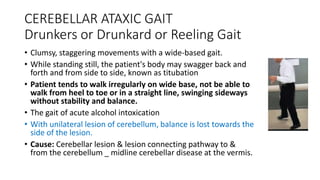
• Clumsy, staggering movements with a wide-based gait.
• While standing still, the patient's body may swagger back and
forth and from side to side, known as titubation
• Patient tends to walk irregularly on wide base, not be able to
walk from heel to toe or in a straight line, swinging sideways
without stability and balance.
• The gait of acute alcohol intoxication
• With unilateral lesion of cerebellum, balance is lost towards the
side of the lesion.
• Cause: Cerebellar lesion & lesion connecting pathway to &
from the cerebellum _ midline cerebellar disease at the vermis.
Cerebelar_ Ataxia
• Lack of Balance
• Uncoordinated Movement
• Dysmetria [Fig.A]
• Wide base _Sway as he walks.
[Fig B]
• Pes Valgus (flexible) common
CHOREIFORM_ Hyperkinetic GAIT:
• The patient will be having chorea
[Irregular, Jerky, Involuntary
movements] more in upper limbs &
has a unstable gait.
• Walking may accentuate their
baseline movement disorder.
• Seen in patients having
extrapyramidal symptoms
• Cause: Basal ganglia disorders including
Sydenham's chorea, Huntington's Disease and
other forms of chorea, athetosis or dystonia.
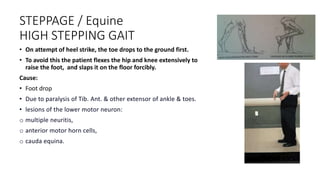
STEPPAGE / Equine
HIGH STEPPING GAIT
• On attempt of heel strike, the toe drops to the ground first.
• To avoid this the patient flexes the hip and knee extensively to
raise the foot, and slaps it on the floor forcibly.
Cause:
• Foot drop
• Due to paralysis of Tib. Ant. & other extensor of ankle & toes.
• lesions of the lower motor neuron:
o multiple neuritis,
o anterior motor horn cells,
o cauda equina.
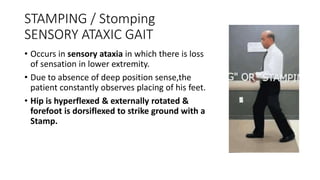
STAMPING / Stomping
SENSORY ATAXIC GAIT
• Occurs in sensory ataxia in which there is loss
of sensation in lower extremity.
• Due to absence of deep position sense,the
patient constantly observes placing of his feet.
• Hip is hyperflexed & externally rotated &
forefoot is dorsiflexed to strike ground with a
Stamp.
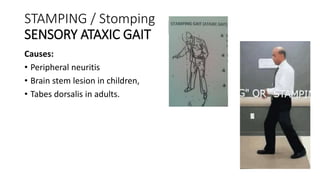
STAMPING / Stomping
SENSORY ATAXIC GAIT
Causes:
• Peripheral neuritis
• Brain stem lesion in children,
• Tabes dorsalis in adults.
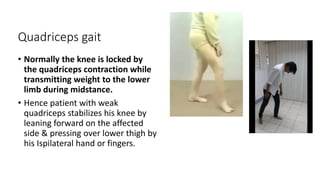
Quadriceps gait
• Normally the knee is locked by
the quadriceps contraction while
transmitting weight to the lower
limb during midstance.
• Hence patient with weak
quadriceps stabilizes his knee by
leaning forward on the affected
side & pressing over lower thigh by
his Ispilateral hand or fingers.
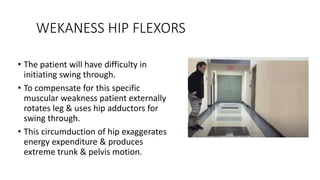
WEKANESS HIP FLEXORS
• The patient will have difficulty in
initiating swing through.
• To compensate for this specific
muscular weakness patient externally
rotates leg & uses hip adductors for
swing through.
• This circumduction of hip exaggerates
energy expenditure & produces
extreme trunk & pelvis motion.
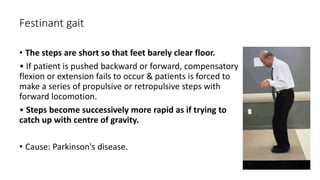
Festinant gait
• The steps are short so that feet barely clear floor.
• If patient is pushed backward or forward, compensatory
flexion or extension fails to occur & patients is forced to
make a series of propulsive or retropulsive steps with
forward locomotion.
• Steps become successively more rapid as if trying to
catch up with centre of gravity.
• Cause: Parkinson's disease.
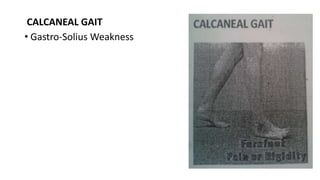
CALCANEAL GAIT
• Gastro-Solius Weakness
Non-Paralytic Disorders
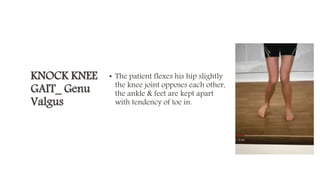
KNOCK KNEE
GAIT_ Genu
Valgus
• The patient flexes his hip slightly
the knee joint opposes each other,
the ankle & feet are kept apart
with tendency of toe in.
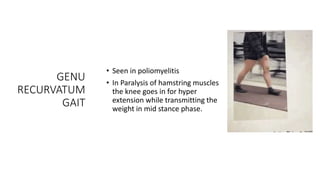
GENU
RECURVATUM
GAIT
• Seen in poliomyelitis
• In Paralysis of hamstring muscles
the knee goes in for hyper
extension while transmitting the
weight in mid stance phase.
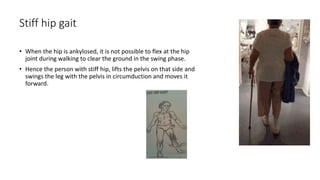
Stiff hip gait
• When the hip is ankylosed, it is not possible to flex at the hip
joint during walking to clear the ground in the swing phase.
• Hence the person with stiff hip, lifts the pelvis on that side and
swings the leg with the pelvis in circumduction and moves it
forward.
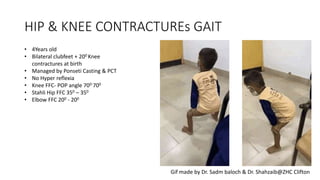
HIP & KNEE CONTRACTUREs GAIT
• 4Years old
• Bilateral clubfeet + 200 Knee
contractures at birth
• Managed by Ponseti Casting & PCT
• No Hyper reflexia
• Knee FFC- POP angle 700-700
• Stahli Hip FFC 350 – 350
• Elbow FFC 200 - 200
Gif made by Dr. Sadm baloch & Dr. Shahzaib@ZHC Clifton
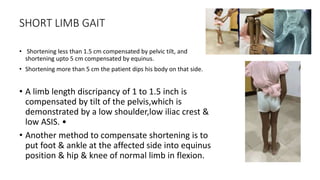
SHORT LIMB GAIT
• Shortening less than 1.5 cm compensated by pelvic tilt, and
shortening upto 5 cm compensated by equinus.
• Shortening more than 5 cm the patient dips his body on that side.
• A limb length discripancy of 1 to 1.5 inch is
compensated by tilt of the pelvis,which is
demonstrated by a low shoulder,low iliac crest &
low ASIS. •
• Another method to compensate shortening is to
put foot & ankle at the affected side into equinus
position & hip & knee of normal limb in flexion.
ALDERMAN’S GAIT:
• Patient walk with head and chest thrown
backward and protuberant abdomen and legs
thrown wide apart.
• Cause: Tuberculosis of spine Thoraco-lumber
Junction.
HYSTERICAL GAIT:
• Patient walks in a bizzare as if going to fall on
every step but seldom falls and walks cautiously.
Bibliographic Reference:
1. Orthopaedic Management of
Cerebral Palsy. Eugene E Bleck. 1979. WB Saunders.
2. Orthopaedic Management of Cerebral Palsy. 2nd Ed.
Helen W Horstmann & Eugene Bleck. 2007. Blackwell
Publication.
3. Cerebral Palsy. Freeman Miller. 2005. Springer
• 4. Multiple literature from google.com
• Videos prepared with Dr. Sadam Mazar Baloch & Dr.
Shahzaib Baloch Dr. Nida Hameed @ Dr. Ziuaddin
University, Karachi
Gait Laboratory _ Gait Analysis Types
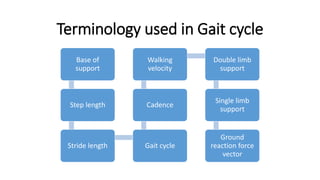
Terminology used in Gait cycle
Base of
support
Step length
Stride length Gait cycle
Cadence
Walking
velocity
Double limb
support
Single limb
support
Ground
reaction force
vector
Base
support
• Distance between a person’s feet
while standing or during ambulation.
• Provides balance & stability to
maintain erect posture.
• Normally 2-4 inches from heel to
heel.
Step
Length
&
Stride
Length
Step Length
• Linear distance along the line of
progression of one foot travelled during
one gait cycle.
• Approximately 15 inches.
Stride length
• Linear distance in the plane of
progression between successive point of
foot to floor contact of the same foot.
• Normally 27 – 32 inches.
Cadence
• It is measured as the number of steps
/ sec or per minute.
• Approximately 70 steps per minute
Gait Cycle
• Period of time from one heel strike to
next heel strike of the same limb
Cadence
Gait Cycle
Double
Limb
Support
• During normal gait, for a moment , two
lower extremities are in simultaneous
contact with the ground.
• During this period, both legs support the
body weight.
• Happens between push off & toe off on
same side and heel strike & foot flat on
the contra lateral side.

4_anisbhatti gait disorders

  • 1.
    Gait Disorders & Analysis ARoadmap to Decision Making Prof. Anisuddin Bhatti Dr. Ziauddin University Hospital, Clifton Webinar 27th September, 2020
  • 2.
    Agenda Preamble • Gait: Defination,requirments, terminology, cycle, compnents etc • VAOGA: Video Assisted OBSERVATIONAL Gait Analysis.. • VGA_Laboratoy: Videographic Gait Laboratory Analysis. • Gait Types_Orthoapedic Concern • How effective is VAOGA. • Case Presentations. • Discussion_ Penalist. • Q&A
  • 3.
    Gait • Rhythmic, cyclicmovement of the limbs in relation to the trunk resulting in forward propulsion of the body. Gait Disorder • An altered gait pattern, in Rhythm & cycle
  • 4.
    GAIT DISORDER_MAJOR REASONS: •Deformities • Weakness / Loss of motor control • Pain: Inflamatory / infective disorder • Multifactorial [common & Complex with advancing age] Prevelence increases with ageing population and increasing morbidity index Look when he bears weight on left leg
  • 5.
    Altered Gait leadsto: • Loss of personal freedom • Reduced quality of life. • Tendency falls (in elderly prxns), that may cause a potentially severe injuries & frxs
  • 6.
    • Careful historytaking & examination focussed on: oGait pattern oPhysical examination oNeurological assesment oOrthopaedic evaluation oGait Analysis [VAOGA] • Objectives to improve oMobility oIndependence, oPrevent falls oDetect underlying causes Assesment & Evaluation: Two basic steps in the categorization of gait disorders and guideline for ancillary investigations and therapeutic interventions includes:.
  • 7.
    Gait Disorder Causes Physiological •Paediatric Gait <3 yrs years • Elderly Gait >70 yrs Pathological • Muskuloskeletal Causes: oAnatlgic oLLD oContracture • Neuro Vascular disorders o Sensory Ataxia o Cerebelar Ataxia o Lower Motor neuron: Polio, neuropathies o Upper Motor Neuron: Cerebral Palsy & o Dystonia o Myopathies Dysvascular
  • 8.
  • 9.
    Gait Analysis A systematic approachto: • looking at trunk & each joint moving in all three planes i,e. saggital,coronal & transverse. • Yield valuable information about patient's condition & help in establishing a treatment plan.
  • 10.
    Benefits of Gait Analysis • Todiagnose mechanisms responsible for gait disorders. • To asses degree of disability. • To evaluate the post treatment improvement. • Evaluate rate of deterioration in progressive disorders. • Quantification for clinical research.
  • 11.
    Gait Requirents Normal functioningof musculoskeletal system of lower limbs & spine. Good sensory feedback from propioceptive sensation from feet and the joints. Visual, labrinthine sensory inputs & co ordination. That, adds smoothness, rhythm & elegance to the human gait. MSK Functional Elements
  • 12.
    Gait Cycle • Periodof time from one heel strike to next heel strike of the same limb • Normally 1-2 sec
  • 13.
    Gait Cycle Components Components: •Stancephase :60% •Swing phase :40% K.PRAKASAM, THOUSEEF A MAJEED
  • 14.
    Phases of Gait Cycle Stance& Swing STANCE PHASE • Time during which the limb is in contact with the ground and supporting the weight of the body. • 60% of Gait Cycle SWING PHASE Time period during which the limb is off the ground and advancing forward,the body weight supported by contralateral limb. • 40% of Gait Cycle
  • 15.
    Gait Cycle Terminology: Conventional_ HLA terminology STANCE PHASE • Heel strike _ Initial Contact • Flat foot _ Loading Response • Midstance _ Midstance • Heel off _ Terminal Stance • Toe off _ Pre swing SWING PHASE • Acceleration _ Initial Swing • Mid-Swing – Mid Swing • Deceleration _ Terminal Swing
  • 16.
    Functional divisions ofthe gait cycle according to Perry and Barnfield (2010). Gait Cycle _ Gait Flow Chart
  • 17.
    Stance Phase Time duringwhich the limb is in contact with the ground and supporting the weight of the body. Components: Conventional _ HLA terminology • Heel strike _ Initial Contact • Flat foot _ Loading Response • Midstance _ Midstance • Heel off _ Terminal Stance • Toe off _ Pre Swing
  • 18.
    Stance Phase Heel Strike_Initial Contact • Beginning of Stance phase when heel strike the ground • Begins with initial contact & ends with flat foot Flat foot_ Loading response • occurs immediately following heel strike • Point at which the foot fully contacts the floor Occupies 10-15% of gait cycle
  • 19.
    Stance Phase Midstance • ThePoint at which body passes directly over the support of extremity • Occupies 15-20%. Heel off_ Terminal Stance • The Point following midstance, the heel of the refrence extremity leaves the ground • Occupies 20 -25%. Toe off_ Preswing • The Point Following heel off when only te toe of the refernce extremity is in contact with the ground • Occupies 5-10%.
  • 20.
    Stance Phase: HipMuscles Activities
  • 21.
    Stance Phase KneeMuscle Activities
  • 22.
    Stance Phase Ankle& Foot Muscles Activity
  • 23.
    Swing Phase Time periodduring which the limb is off the ground and advancing forward,the body weight supported by contralateral limb. Components: • Acceleration_ Initial Swing • Mid-Swing • Deceleration_ Terminal Swing
  • 24.
    Swing Phase Acceleration_ InitialSwing • Begins once the toe leaves the ground & continues until mid Swing or the point at which the swinging extremilty is directly under the body. • Occupies 5-10% Midswing • Occurs approximately when the reference extremity passes directly under the body • It extends from end of acceleration to beginning of deceleration • Occupies 20-30% Deceleration_ Terminal Swing Occurs after Midswing When reference extremity is decelerating in prepration for heel strike Occupis 5-10%
  • 25.
    Swing Phase HipMuscle Activity
  • 26.
    Swing Phase KneeMuscle Activity
  • 27.
    Swing Phase Ankle& Foot Muscle Activity
  • 28.
    Methods of GaitAnalysis • Observational _ Naked Eye Examination • Video Assisted Observational Gait Analysis. (VAOGA) • Videographic Gait Analysis _ Gait Laboratory (VGA) • Multichannel Functional Electrical Stimulation method (MFES) VAOGA Gait Laboratory
  • 29.
    Methods of GaitAnalysis Gait Laboratory (VGA): oForce Plate study – ground reaction force check oElectroMyography oPedography oElectroGoniometric study oEnergy expenditure o3-D Videography Gait Lab test being performed on patients during CP workshop on 19 March 2011
  • 30.
    Gait Laboratory todetermine: Movement Pattern & Force used KINEMATIC Gait Analysis KINETIC Gait Analysis • Determine the force that are involved in the gait • Describe the movement pattern without regard for the force involved in producing the movement oQualitative oQuantitative PEDOGRAM: Cavo Varus, Plano ValgusEMG: Indicating spastic, normal & Weak Muscles
  • 31.
    Video Assisted ObservationalGait Analysis VAOGA • Require Little or no supportive electronic gadgets, Except a Camera • Inexpensive • Yields general Description of gait variables
  • 32.
  • 33.
    GAIT IN CHILDREN(<2years) • Gait of small children differs from that of adult • The walking base is wider. • The stride length & speed are lower & the cycle time shorter (higher cadence). • Small children have no heel strike, initial contact being made by flat foot. • There is very little stance phase and knee flexion. • The whole leg is externally rotated during the swing phase. • There is an absence of reciprocal arm swinging. • The pattern will change to adult pattern by age of 2 to 4yrs.
  • 34.
    GAIT IN ELDERLY_ Senile Gait • The age related changes in gait takes place in decade 60- 70yrs. • There is a decreased stride length, increased cycle time (decreased cadence). • Relative increase in duration of stance phase of gait cycle. • The speed almost always reduced in elderly people. • Reduction in total range of hip flexion & extension, • Reduction in swing phase and knee flexion
  • 35.
    Senile Gait • Changesin gait & difficulty with balance occurs with aging. • Elderly man develops forward of upper portion of trunk with flexion of arms & knees. • Decreasing arm swing & shortening of step length.
  • 36.
    PATHOLOGIC GAIT Neuro-Vascular • CP,SMN, Polio • Dysvascular Musculoskeletal:  Inflamatory Joint disease  B & J Infection  Tendinopathy  Trauma  Congenital / developmental disorders Types: Limping & Lurching
  • 37.
    PATHOLOGIC GAIT LIMPING: • Patientavoids weight bearing on affected side as far as possible. i,e. diminished stance phase. • It denotes a painful condition of affected side.
  • 38.
    PATHOLOGIC GAIT LURCHINNG: • Patientprolongs stance phase to improve the stability. • It denotes variable failure of abduction mechanism. Causes: • Muscle weakness • Structural deformities of bone & joint • Neurological disorders • Miscellaneou
  • 39.
    Pathologic Gaits Limping & Lurching LIMPING: • Antalgicgait LURCHING: • Waddling gait • Trendelenberg gait • Spastic Gait LURCHING_PARALYTIC: • High stepping gait • Quadricep gait • Gluteal medius gait • Gluteal maximus gait LURCHING_ STRUCTURAL ABNORMALITIES • Short limb gait • In toeing gait • Out toeing gait • Knock knee gait • Genu recurvatum gait • Stiff hip gait • Festinant gait
  • 40.
    ANTALGIC GAIT_ Limp •Gait pattern in which stance phase on affected side is shortened due to pain in the weight bearing limb. • There is corresponding increase in stance phase on unaffected side • Common causes: Osteoarthritis [Coxalgia], LCPD, SCFE,Fractures, tendinitis
  • 41.
  • 42.
  • 43.
    TRENDELENBERG GAIT: PathoMechanics •Cause: Distruption of the osseo-muscular mechanism between pelvis and femur 1. Power: Weak abductors 2. Fulcrum: acetabulo femoral articulation defect 3. Lever Arm: defective lever system • Here the abductor action in pulling the pelvis downwards in stance phase becomes ineffective and the pelvis drops on the opposite side causing instability. • To prevent this body lurches on the same side.
  • 44.
    TRENDELENBERG GAIT _WADDLING : Causes • Usually unilateral • If bilateral = Waddling gait Causes: 1. Weak abductors :poliomyelitis . muscular dystrophies, motor neuron disease 2. Defective fulcrum: Congenital dislocaion of hip(CDH), pathological dislocation of hip 3. Defective lever: Fracture neck of femur, Perthes disease, Coxa vara.
  • 45.
  • 46.
    Case 1:TRENDELENBERG GAIT •6m-old H/O fall • Antalgic Limp left hip • Positive Trendelenburg • Positive Thomas Test 150 • LLD 1.5cm True. Apparent • Bryant’s.. Shortening above trochanter.
  • 47.
    Xray in hisrecord @ 2/12 months
  • 48.
    Pathophysiology of Trendelenburg Test •ShortLever Arm •Poor Fulcrum @ 18 m post trauma i.e 12/12m post fixation. Implant removed. NON-Union Fremoral Neck Fracture
  • 49.
    Case 2: Pathophysio_Trendlenburg 6 Yrs Old Girl • Limp 2 year • Shortening of Rt. Leg_ 6 months… 2 inches • Squat & sit cross legs easily. • Spine normal. • N-V Intact • Scar mark at the lat. aspect of upper thigh. • Mild wasting. ROM • Ext Rotation 900 • Int Rotation 1100 • Abduction 900 • Adduction 45o • Telescope +ve • Trendelenburg +ve
  • 50.
    Case 2: Pathophysio_Trendlenburg 6 Yrs Old Girl • Limp 2 year • Rt. Leg Shortening 4cm • Telescope +ve • Trendelenburg +ve • Hyper lordosis Standing on both leg Indicate ShorteningHunka V
  • 51.
    Case 3 &4: Perthese: 1. Healed 5 yr FU. 2. Active 1 year FU: Trendelenburg +ve 7 year aged 6 year aged
  • 52.
    Case 4 yeasOld. Developmenta Dysplastic Hip
  • 53.
    Case:6 Pathophysiology ofTRENDELENBURG TEST: • Primary Acetabular Dysplasia • Cause of failure: oSubluxation of the hip joint o Fulcrum for the action of the pelvi-femoral muscle is lost.
  • 54.
    Waddling Gait • 5years aged Male • Abnormal gait since he started Walking@ age 18 months • Waddling Gait • Hyper lordosis • Telescope Negative • Prominent trochanter _ Bilateral • ROM Hip _Bilateral o Flexion 150 degrees o Extension 15 degrees o Int.Rotation 100 degrees o Ext.Rotation 80 degrees o Abd.35 degrees o Add. 30 degrees
  • 55.
    5 years agedMale, Abnormal gait since he started, Walking@ age 18 months Waddling Gait, Hyper lordosis, Telescope Negative
  • 56.
    5 years agedMale, Wadling gait since he started, Walking@ age 18 months Waddling Gait, Hyper lordosis, Telescope Negative
  • 57.
    ABDUCTION LURCH_ Gluteusmedius Gait • Gluteus Medius is principal abductor of hip joint along with obturator internus & piriformis. • Weakeness of Gluteus Medius forces patient to lurch towards involved side to place centre of gravity over hip. 27Yrs aged Gluteus Medius 3/5 power
  • 58.
    BACKWARD LURCH_ GluteusMaximus Gait • Weakness in gluteus maximus muscle, • while the body propels forward during midstance phase, • trunk is lurched posterior to effect posterior pelvic and shifting the centre of gravity towards stance hip. • Cause: Poliomyelities & above knee amputation with prosthesis.
  • 59.
  • 60.
    SPASTIC GAIT PATTERNS_ Cerebral palsy • Circumduction Gait • Scissoring Gait • Ataxic • Ethetoid • Drunkers gait • Chorioform Gait • Hemiplegic Gait o4 pattern • Diplegic Gait o4 pattern
  • 61.
    Spastic Gait Patterns •Different Gait patterns observed in CP depends on the involvement of spasticity or contracture of different muscles: • Variations relates to topographical type of CP • Best seen in contrast between unilateral spastic CP and bilateral spastic CP.
  • 62.
    HEMIPLEGIC GAIT_ Circumductiongait • The shoulder is adducted & the elbow & wrist are flexed. • To avoid the foot from scrapping the ground, the hip and the lower limb rotates outward. • The pateint swings the paraplegic gait outwards & aheads in a circumduction to avoid foot scraping ground. • It is seen in cerebrovascular disease. Hemiplegia_ Typical Posture
  • 63.
    Spastic Hemiplegia Gaits •In spastic hemiplegia, there is more involvement distally and therefore true equinus is the basis of common patterns. • Winters et al. described four gait patterns in hemiplegics based on sagittal kinematics. • Type 1 – Drop foot type • Type 2 – True equinus with or without recurvatum knee • Type 3 – Stiff knee gait • Type 4 – JUMP / Scissor
  • 64.
    Type II True Equinus hemiplegicgait. (a): Right-sided hemiplegia with ankle equinus in stance [AP view]. (b): Right-sided hemiplegia with ankle equinus in stance [Lat view] Equinus With Recurvatu
  • 65.
    Spastic Hemiplegia Gaits •Type 3 – Stiff knee gait: Rectus Femoris over active in Swing phase • Type 4 – JUMP [Common in diplegics] In sagittal plane, the ankle is in equinus, knee in flexion, hip in flexion and anterior pelvic tilt is present. In coronal plane, there is hip adduction and internal rotation.
  • 66.
    Spastic_ Diplegia • Involvementon both sides • Spasticity in lower extremities worse than upper extremities. • Walks with an abnormally narrow base, dragging both legs and scraping the toes. • Cause: CP_ Bilateral periventricular lesions • Characteristic extreme tightness of hip adductors which can cause legs to cross the midline referred to as a scissors gait. • The hip adductor release surgery to minimize scissoring. Dipegia_ Typical Posture
  • 67.
    Spastic Diplegia GaitsPatterns: • There are four common patterns of gait in spastic Diplegia as described by Rodda et al. • Type 1 – True equinus • Type 2 – Jump gait • Type 3 – Apparent equinus • Type 4 – Crouch gait
  • 68.
    Rodda et al.JBJS. 2004
  • 70.
    Type 1 –Diplegia True equinus • Hip extension • Knee extension • Ankle equinus Pic Courtesy: Sharaf Ibrahim, Malaysia Thanks Drs. Sadam & Shahzaib @ ZHC Clifton, for help True Equine Diplegia
  • 71.
    Type 2 –Diplegia Jump gait Jump Gait with •Bilateral hip Flexion •Knee flexion •Ankle Equinus.
  • 72.
    Apparent Equinus [Dynamic Equinus] •Hip flexion • Knee flexion • Ankle neutral.. plantigrade Pic Courtesy: Prof. Sharaf Ibrahim, Malaysia
  • 73.
    SCISSORING_ Scissor Gait •Here one leg crosses directly over the other with each step due to adductor tightness. • This gait is characteristic of gait of a spastic child with marked b/l adductor spasm at hip & equinus in the ankle. • The child needs support to walk & leg goes into marked adduction in swing phase so that the foot with equinus goes across to opposite side. • Such repeated crossing of leg while walking gives scissoring appearance called as scissor gait.
  • 74.
    Type 4 –Diplegia Crouch gait •Bilateral hip Flexion •Knee flexion •Ankle dorsiflexion. Crouch _ Decompensated JumpCrouch gait _ Gait
  • 75.
    Usual “Staging” inCP_Diplegia Surgery A. True Equinus B. Crouch after TAL C. Crouch corrected after Hamstring F Lengthening D.Final erect Posture after hip Flexion contracture Corrected Better option: Combine surgery at three levels to get directly from A to D. Orthopaedic Management of Cerebral Palsy. Eugene E Bleck. 1979. WB Saunders.
  • 76.
    CEREBELLAR ATAXIC GAIT Drunkersor Drunkard or Reeling Gait • Clumsy, staggering movements with a wide-based gait. • While standing still, the patient's body may swagger back and forth and from side to side, known as titubation • Patient tends to walk irregularly on wide base, not be able to walk from heel to toe or in a straight line, swinging sideways without stability and balance. • The gait of acute alcohol intoxication • With unilateral lesion of cerebellum, balance is lost towards the side of the lesion. • Cause: Cerebellar lesion & lesion connecting pathway to & from the cerebellum _ midline cerebellar disease at the vermis.
  • 77.
    Cerebelar_ Ataxia • Lackof Balance • Uncoordinated Movement • Dysmetria [Fig.A] • Wide base _Sway as he walks. [Fig B] • Pes Valgus (flexible) common
  • 78.
    CHOREIFORM_ Hyperkinetic GAIT: •The patient will be having chorea [Irregular, Jerky, Involuntary movements] more in upper limbs & has a unstable gait. • Walking may accentuate their baseline movement disorder. • Seen in patients having extrapyramidal symptoms • Cause: Basal ganglia disorders including Sydenham's chorea, Huntington's Disease and other forms of chorea, athetosis or dystonia.
  • 79.
    STEPPAGE / Equine HIGHSTEPPING GAIT • On attempt of heel strike, the toe drops to the ground first. • To avoid this the patient flexes the hip and knee extensively to raise the foot, and slaps it on the floor forcibly. Cause: • Foot drop • Due to paralysis of Tib. Ant. & other extensor of ankle & toes. • lesions of the lower motor neuron: o multiple neuritis, o anterior motor horn cells, o cauda equina.
  • 80.
    STAMPING / Stomping SENSORYATAXIC GAIT • Occurs in sensory ataxia in which there is loss of sensation in lower extremity. • Due to absence of deep position sense,the patient constantly observes placing of his feet. • Hip is hyperflexed & externally rotated & forefoot is dorsiflexed to strike ground with a Stamp.
  • 81.
    STAMPING / Stomping SENSORYATAXIC GAIT Causes: • Peripheral neuritis • Brain stem lesion in children, • Tabes dorsalis in adults.
  • 82.
    Quadriceps gait • Normallythe knee is locked by the quadriceps contraction while transmitting weight to the lower limb during midstance. • Hence patient with weak quadriceps stabilizes his knee by leaning forward on the affected side & pressing over lower thigh by his Ispilateral hand or fingers.
  • 83.
    WEKANESS HIP FLEXORS •The patient will have difficulty in initiating swing through. • To compensate for this specific muscular weakness patient externally rotates leg & uses hip adductors for swing through. • This circumduction of hip exaggerates energy expenditure & produces extreme trunk & pelvis motion.
  • 84.
    Festinant gait • Thesteps are short so that feet barely clear floor. • If patient is pushed backward or forward, compensatory flexion or extension fails to occur & patients is forced to make a series of propulsive or retropulsive steps with forward locomotion. • Steps become successively more rapid as if trying to catch up with centre of gravity. • Cause: Parkinson's disease.
  • 85.
  • 86.
  • 87.
    KNOCK KNEE GAIT_ Genu Valgus •The patient flexes his hip slightly the knee joint opposes each other, the ankle & feet are kept apart with tendency of toe in.
  • 88.
    GENU RECURVATUM GAIT • Seen inpoliomyelitis • In Paralysis of hamstring muscles the knee goes in for hyper extension while transmitting the weight in mid stance phase.
  • 89.
    Stiff hip gait •When the hip is ankylosed, it is not possible to flex at the hip joint during walking to clear the ground in the swing phase. • Hence the person with stiff hip, lifts the pelvis on that side and swings the leg with the pelvis in circumduction and moves it forward.
  • 90.
    HIP & KNEECONTRACTUREs GAIT • 4Years old • Bilateral clubfeet + 200 Knee contractures at birth • Managed by Ponseti Casting & PCT • No Hyper reflexia • Knee FFC- POP angle 700-700 • Stahli Hip FFC 350 – 350 • Elbow FFC 200 - 200 Gif made by Dr. Sadm baloch & Dr. Shahzaib@ZHC Clifton
  • 91.
    SHORT LIMB GAIT •Shortening less than 1.5 cm compensated by pelvic tilt, and shortening upto 5 cm compensated by equinus. • Shortening more than 5 cm the patient dips his body on that side. • A limb length discripancy of 1 to 1.5 inch is compensated by tilt of the pelvis,which is demonstrated by a low shoulder,low iliac crest & low ASIS. • • Another method to compensate shortening is to put foot & ankle at the affected side into equinus position & hip & knee of normal limb in flexion.
  • 92.
    ALDERMAN’S GAIT: • Patientwalk with head and chest thrown backward and protuberant abdomen and legs thrown wide apart. • Cause: Tuberculosis of spine Thoraco-lumber Junction. HYSTERICAL GAIT: • Patient walks in a bizzare as if going to fall on every step but seldom falls and walks cautiously.
  • 93.
    Bibliographic Reference: 1. OrthopaedicManagement of Cerebral Palsy. Eugene E Bleck. 1979. WB Saunders. 2. Orthopaedic Management of Cerebral Palsy. 2nd Ed. Helen W Horstmann & Eugene Bleck. 2007. Blackwell Publication. 3. Cerebral Palsy. Freeman Miller. 2005. Springer • 4. Multiple literature from google.com • Videos prepared with Dr. Sadam Mazar Baloch & Dr. Shahzaib Baloch Dr. Nida Hameed @ Dr. Ziuaddin University, Karachi
  • 96.
    Gait Laboratory _Gait Analysis Types
  • 97.
    Terminology used inGait cycle Base of support Step length Stride length Gait cycle Cadence Walking velocity Double limb support Single limb support Ground reaction force vector
  • 98.
    Base support • Distance betweena person’s feet while standing or during ambulation. • Provides balance & stability to maintain erect posture. • Normally 2-4 inches from heel to heel.
  • 99.
    Step Length & Stride Length Step Length • Lineardistance along the line of progression of one foot travelled during one gait cycle. • Approximately 15 inches. Stride length • Linear distance in the plane of progression between successive point of foot to floor contact of the same foot. • Normally 27 – 32 inches.
  • 100.
    Cadence • It ismeasured as the number of steps / sec or per minute. • Approximately 70 steps per minute Gait Cycle • Period of time from one heel strike to next heel strike of the same limb Cadence Gait Cycle
  • 101.
    Double Limb Support • During normalgait, for a moment , two lower extremities are in simultaneous contact with the ground. • During this period, both legs support the body weight. • Happens between push off & toe off on same side and heel strike & foot flat on the contra lateral side.

Editor's Notes

  • #48 Transcervical Delbet II, Delayed Union
  • #49 Non-Union AvN, absorption of neck …. MRI Rx: Preserve Femoral head