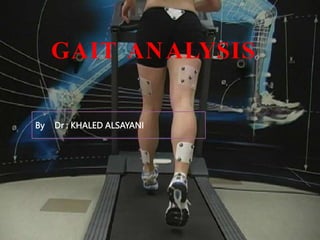
GAIT ANALYSIS
By Dr : KHALED ALSAYANI
Gait Analysis
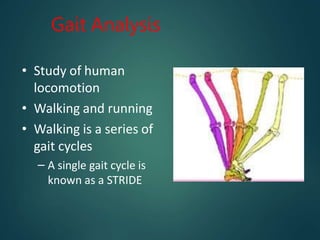
• Study of human
locomotion
• Walking and running
• Walking is a series of
gait cycles
– A single gait cycle is
known as a STRIDE
The Main Tasks of the Gait Cycle
• (1) Weight acceptance
– most demanding task in the gait cycle
– involves the transfer of body weight onto a limb
that has just finished swinging forward and has an
unstable alignment.
– Shock absorption and the maintenance of a
forward body progression
• (2) single limb support
– One limb must support the entire body weight
– Same limb must provide truncal stability while
bodily progression is continued.
• (3) limb advancement
– Requires foot clearance from the floor
– The limb swings through three positions as it
travels to its destination in front of the body.
Why Study Normal Gait?
• Loss of the ability to walk can result is significant
health problems (co-morbidities)
• Pain, injury, paralysis or tissue damage can alter
normal gait and lead to:
– further musculoskeletal problems (compensations)
– Cardiovascular and pulmonary problems (inactivity
due to pain)
– Psychological problems (depression)
• Sports, Exercise/Fitness, and Rehabilitation
Professionals must have a sound knowledge
of normal gait so they can accurately detect,
interpret, and ultimately correct deviations
and/or gait pathologies to restore “normal,”
pain-free function
• It is important to remember that each person
displays “normal” variations from the normal
pattern of walking
Normal Walking Requirements
• There are (4) major criteria essential to walking.
– Equilibrium
• the ability to assume an upright posture and
maintain balance.
– Locomotion
• the ability to initiate and maintain rhythmic
stepping
Walking Requirements
Cont’d
– Musculoskeletal Integrity
• normal bone, joint, and muscle function
– Neurological Control,
• must receive and send messages telling the
body how and when to move. (visual,
vestibular, auditory, sensorimotor input)
Gait Cycle or Stride
• A single gait cycle or stride is defined:
– Period when 1 foot contacts the ground to when that
same foot contacts the ground again
– Each stride has 2 phases:
• Stance Phase
– Foot in contact with the ground
• Swing Phase
– Foot NOT in contact with the ground
A Single Gait Cycle or
Stride
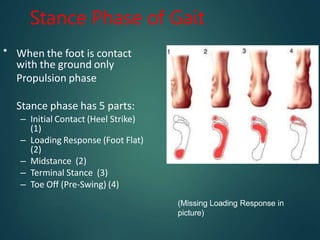
Stance Phase of Gait
• When the foot is contact
with the ground only
Propulsion phase
Stance phase has 5 parts:
– Initial Contact (Heel Strike)
(1)
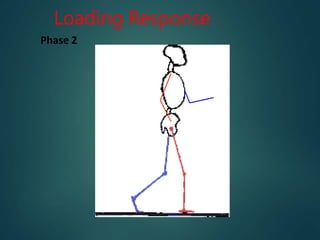
– Loading Response (Foot Flat)
(2)
– Midstance (2)
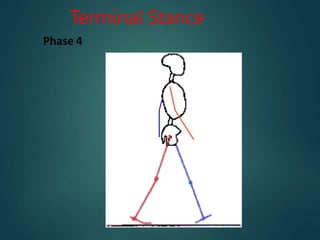
– Terminal Stance (3)
– Toe Off (Pre-Swing) (4)
(Missing Loading Response in
picture)
Motions during Stance
Phase
•
•
•
•
•
•
•
•
Shoulder flexes
Pelvis rotates right (transverse plane)
Spine rotates left
Hip extends, IRs
Knee flexes, extends
Ankle plantarflexes, dorsiflexes, plantarflexes
Foot pronates, supinates
Toes flex, extend, flex
Initial Contact
Phase 1
Loading Response
Phase 2
Midstance
Phase 3
Terminal Stance
Phase 4
Toe-Off
Phase 5
Stance Phase Characteristics
• During a single stride, there are 2 periods of
double limb support (both feet on ground):
– Loading response (right) & Toe Off (left)
– Loading response (left) & Toe Off (right)
Swing Phase
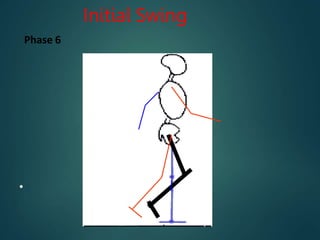
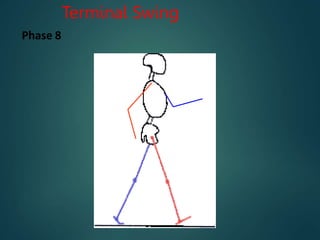
• When foot is NOT contacting the ground, it is
swinging!
• Limb advancement phase
• 3 parts of swing phase:
• Initial swing
• Midswing
• Terminal swing
Motions during Swing Phase
•
•
•
•
•
•
•
•
Shoulder extends
Spine rotates right
Pelvis rotates left (passive)
Hip flexes, ERs
Knee flexes, then extends
Ankle dorsiflexes
Foot supination (inversion)
Toes extend
Initial Swing
Phase 6
•
Midswing
Phase 7
Terminal Swing
Phase 8
ANALYSIS
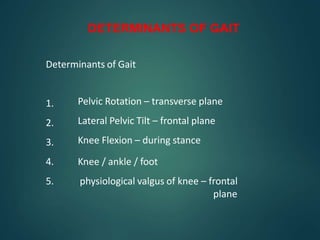
Determinants of Gait
1.
2.
3.
Pelvic Rotation – transverse plane
Lateral Pelvic Tilt – frontal plane
Knee Flexion – during stance
4.
5.
Knee / ankle / foot
physiological valgus of knee – frontal
plane
DETERMINANTS OF GAIT
• Visual gait analysis
Walk minimum 8m with different speed. It is simplest
gait analysis but has serious limitations
1 transitory, no permanent record
2 eye can not observe high speed events
3 possible to observe the motion not the
force
4- depend on the skills of the observer.
The best viewpoint for observation of gait
abnormality
• Side view : anterior and posterior trunk
bending, increased lumbar lordosis, steppage,
excessive knee flexion and extension, vaulting,
insufficient push off and dorsiflexion control .
• Front and behind view : circumduction, hip
hiking, vaulting, abnormal foot contact , hip
rotation and walking base
Anterior trunk bending Posterior
trunk bending
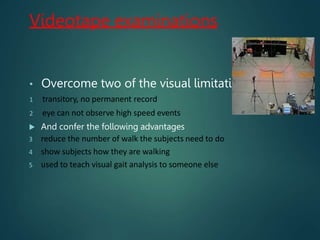
Videotape examinations
• Overcome two of the visual limitations
1 transitory, no permanent record
2 eye can not observe high speed events
 And confer the following advantages
3 reduce the number of walk the subjects need to do
4 show subjects how they are walking
5 used to teach visual gait analysis to someone else
,
wearable technology
To analyze the clinical and psychometric properties of
observational gait assessment scales in people with
neurological disorders.
The databases used for the literature search were MEDLINE, the
Cochrane Central Register of Controlled Trial, Web of Science, and
the Cumulative Index to Nursing and Allied Health. The search was
conducted between September 15 and November 30, 2014
 Studies that investigate and validate observational gait
assessment scales in people with central nervous
system disorders.
 After the literature search, 15 articles were included in
this review. Seven of the 15 articles studied the Tinetti
Gait Scale (TGS), 2 studied the Rivermead Visual Gait
Assessment (RVGA), 1 studied the Gait Assessment and
Intervention Tool (G.A.I.T.), 3 studied the Wisconsin
Gait Scale, and one of them compared the TGS and the
G.A.I.T.
 The scale that appears to be the most suitable for both
clinical practice and research is the G.A.I.T
 For those with Parkinson disease, the TGS showed
sensitivity
 and the Tinetti Performance-Oriented Mobility
Assessment (POMA) showed predictive capability for
falls
the aim was systematically review the available literature investigating
how wearable technology is being used for running gait analysis in
adults.
A systematic search of the literature was conducted in the following
scientific databases: PubMed, Scopus, Web of Science and
SPORTDiscus
A total of 131 articles were reviewed: 56 investigated the
validity of wearable technology, 22 examined the reliability
and 77 focused on applied use
 On average, studies used one wearable device to
examine running gait.
 Wearable locations were distributed among the shank,
shoe and waist
 The mean number of participants was 26 (± 27), with
an average age of 28.3 (± 7.0) years. Most studies took
place indoors (n = 93), using a treadmill (n = 62)
 Generally, wearables were found to be valid and
reliable tools for assessing running gait compared to
reference standards.

gait analysis.pptx

  • 1.
    GAIT ANALYSIS By Dr: KHALED ALSAYANI
  • 2.
    Gait Analysis • Studyof human locomotion • Walking and running • Walking is a series of gait cycles – A single gait cycle is known as a STRIDE
  • 3.
    The Main Tasksof the Gait Cycle • (1) Weight acceptance – most demanding task in the gait cycle – involves the transfer of body weight onto a limb that has just finished swinging forward and has an unstable alignment. – Shock absorption and the maintenance of a forward body progression
  • 4.
    • (2) singlelimb support – One limb must support the entire body weight – Same limb must provide truncal stability while bodily progression is continued. • (3) limb advancement – Requires foot clearance from the floor – The limb swings through three positions as it travels to its destination in front of the body.
  • 5.
    Why Study NormalGait? • Loss of the ability to walk can result is significant health problems (co-morbidities) • Pain, injury, paralysis or tissue damage can alter normal gait and lead to: – further musculoskeletal problems (compensations) – Cardiovascular and pulmonary problems (inactivity due to pain) – Psychological problems (depression)
  • 6.
    • Sports, Exercise/Fitness,and Rehabilitation Professionals must have a sound knowledge of normal gait so they can accurately detect, interpret, and ultimately correct deviations and/or gait pathologies to restore “normal,” pain-free function • It is important to remember that each person displays “normal” variations from the normal pattern of walking
  • 7.
    Normal Walking Requirements •There are (4) major criteria essential to walking. – Equilibrium • the ability to assume an upright posture and maintain balance. – Locomotion • the ability to initiate and maintain rhythmic stepping
  • 8.
    Walking Requirements Cont’d – MusculoskeletalIntegrity • normal bone, joint, and muscle function – Neurological Control, • must receive and send messages telling the body how and when to move. (visual, vestibular, auditory, sensorimotor input)
  • 9.
    Gait Cycle orStride • A single gait cycle or stride is defined: – Period when 1 foot contacts the ground to when that same foot contacts the ground again – Each stride has 2 phases: • Stance Phase – Foot in contact with the ground • Swing Phase – Foot NOT in contact with the ground
  • 11.
    A Single GaitCycle or Stride
  • 12.
    Stance Phase ofGait • When the foot is contact with the ground only Propulsion phase Stance phase has 5 parts: – Initial Contact (Heel Strike) (1) – Loading Response (Foot Flat) (2) – Midstance (2) – Terminal Stance (3) – Toe Off (Pre-Swing) (4) (Missing Loading Response in picture)
  • 13.
    Motions during Stance Phase • • • • • • • • Shoulderflexes Pelvis rotates right (transverse plane) Spine rotates left Hip extends, IRs Knee flexes, extends Ankle plantarflexes, dorsiflexes, plantarflexes Foot pronates, supinates Toes flex, extend, flex
  • 14.
  • 15.
  • 16.
  • 17.
  • 18.
  • 19.
    Stance Phase Characteristics •During a single stride, there are 2 periods of double limb support (both feet on ground): – Loading response (right) & Toe Off (left) – Loading response (left) & Toe Off (right)
  • 20.
    Swing Phase • Whenfoot is NOT contacting the ground, it is swinging! • Limb advancement phase • 3 parts of swing phase: • Initial swing • Midswing • Terminal swing
  • 21.
    Motions during SwingPhase • • • • • • • • Shoulder extends Spine rotates right Pelvis rotates left (passive) Hip flexes, ERs Knee flexes, then extends Ankle dorsiflexes Foot supination (inversion) Toes extend
  • 22.
  • 23.
  • 24.
  • 25.
  • 26.
    Determinants of Gait 1. 2. 3. PelvicRotation – transverse plane Lateral Pelvic Tilt – frontal plane Knee Flexion – during stance 4. 5. Knee / ankle / foot physiological valgus of knee – frontal plane DETERMINANTS OF GAIT
  • 27.
    • Visual gaitanalysis Walk minimum 8m with different speed. It is simplest gait analysis but has serious limitations 1 transitory, no permanent record 2 eye can not observe high speed events 3 possible to observe the motion not the force 4- depend on the skills of the observer.
  • 28.
    The best viewpointfor observation of gait abnormality • Side view : anterior and posterior trunk bending, increased lumbar lordosis, steppage, excessive knee flexion and extension, vaulting, insufficient push off and dorsiflexion control . • Front and behind view : circumduction, hip hiking, vaulting, abnormal foot contact , hip rotation and walking base
  • 29.
    Anterior trunk bendingPosterior trunk bending
  • 31.
    Videotape examinations • Overcometwo of the visual limitations 1 transitory, no permanent record 2 eye can not observe high speed events  And confer the following advantages 3 reduce the number of walk the subjects need to do 4 show subjects how they are walking 5 used to teach visual gait analysis to someone else ,
  • 32.
  • 33.
    To analyze theclinical and psychometric properties of observational gait assessment scales in people with neurological disorders. The databases used for the literature search were MEDLINE, the Cochrane Central Register of Controlled Trial, Web of Science, and the Cumulative Index to Nursing and Allied Health. The search was conducted between September 15 and November 30, 2014
  • 34.
     Studies thatinvestigate and validate observational gait assessment scales in people with central nervous system disorders.  After the literature search, 15 articles were included in this review. Seven of the 15 articles studied the Tinetti Gait Scale (TGS), 2 studied the Rivermead Visual Gait Assessment (RVGA), 1 studied the Gait Assessment and Intervention Tool (G.A.I.T.), 3 studied the Wisconsin Gait Scale, and one of them compared the TGS and the G.A.I.T.
  • 35.
     The scalethat appears to be the most suitable for both clinical practice and research is the G.A.I.T  For those with Parkinson disease, the TGS showed sensitivity  and the Tinetti Performance-Oriented Mobility Assessment (POMA) showed predictive capability for falls
  • 36.
    the aim wassystematically review the available literature investigating how wearable technology is being used for running gait analysis in adults. A systematic search of the literature was conducted in the following scientific databases: PubMed, Scopus, Web of Science and SPORTDiscus A total of 131 articles were reviewed: 56 investigated the validity of wearable technology, 22 examined the reliability and 77 focused on applied use
  • 37.
     On average,studies used one wearable device to examine running gait.  Wearable locations were distributed among the shank, shoe and waist  The mean number of participants was 26 (± 27), with an average age of 28.3 (± 7.0) years. Most studies took place indoors (n = 93), using a treadmill (n = 62)  Generally, wearables were found to be valid and reliable tools for assessing running gait compared to reference standards.