GAIT ANALYSIS
DR. MOHAMMAD TAQI EHSANI
PGY1 RESIDENT OF ORTHOPEDICS, FMIC
OUTLINE
 Phases of Gait
 Temporal Parameters
 Neurological Control of Gait
 Kinematics
 Kinetics
 Assess the Gait
 Abnormal Gaits
 Observing a child’s gait is an integral part of the orthopedics examination
 A systematic approach to gait analysis—that is, looking at the trunk and each
joint moving in all three planes (sagittal, coronal, and transverse)—can yield
valuable information about the patient’s condition and help in establishing a
treatment plan
 the patient needs to be as unclothed as deemed appropriate
 There should be adequate space for the child to walk comfortably and
naturally
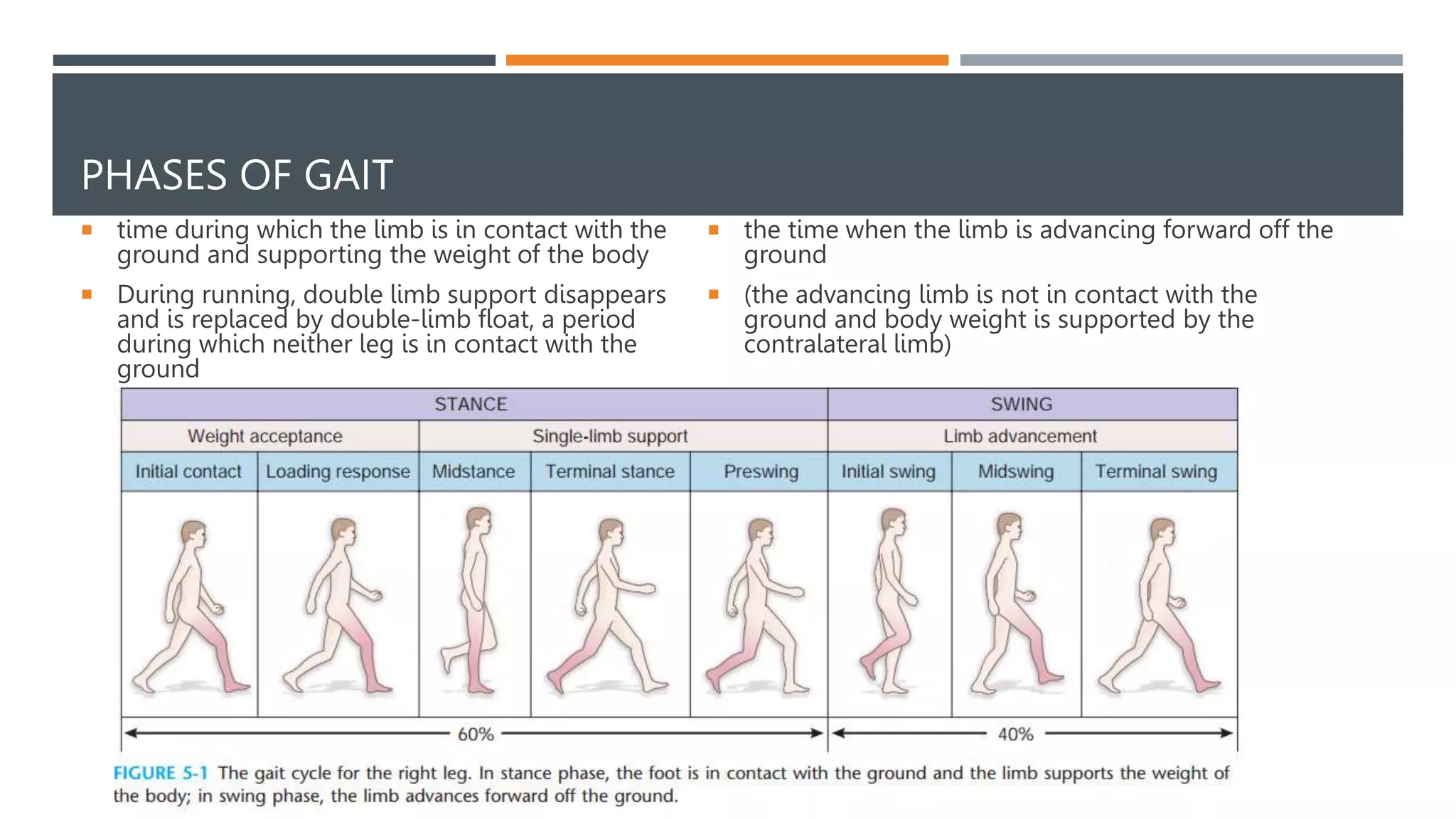
PHASES OF GAIT
 time during which the limb is in contact with the
ground and supporting the weight of the body
 During running, double limb support disappears
and is replaced by double-limb float, a period
during which neither leg is in contact with the
ground
 the time when the limb is advancing forward off the
ground
 (the advancing limb is not in contact with the
ground and body weight is supported by the
contralateral limb)
TEMPORAL PARAMETERS
Cadence: Normal 100-110 steps/min
Velocity: average walking speed+80m/min
NEUROLOGIC CONTROL OF GAIT
 The entire neurologic system plays a role in gait
 Most of the muscular actions that occur during gait are programmed as
involuntary reflex arcs involving all areas of the brain and spinal cord
 The extrapyramidal tracts are responsible for most complex, unconscious
pathways
 Voluntary modulation of gait (e.g., altering speed, stepping over an obstacle,
changing direction) is made possible through interaction of the motor cortex
 The cerebellum is important in controlling balance
 when the neurologic system is abnormal (e.g., in cerebral palsy), the delicate
control of gait is disturbed, leading to pathologic reflexes and abnormal
movements.
KINEMATICS
• defined as the study of the angular rotations of each joint
during movement
• In simpler terms, kinematics denotes the motions observed
and measured at the pelvis, hip, knee, and ankle during the
stance and swing phases of gait
• Kinematics can be observed in three planes—the sagittal
plane (flexion and extension), coronal plane (hip abduction
and adduction), and transverse plane (rotation of the hips,
tibiae, or feet)
• The data are collected by the three-dimensional tracking of
markers placed over bony landmarks by infrared cameras
positioned in the gait laboratory.
KINETICS
 Kinetics are the forces generated by the
muscles and
joints during gait.
 Kinetic data are reported as moments
(forces acting about a center of rotation) and
powers.
 These forces can be measured from force
plates in a gait
analysis laboratory
PEDOBAROGRAPHY
• Pedobarography is the measurement of plantar
pressures during gait
• Using specialized force plates with a high
number of sensors per area, the contact area
of the foot and pressure and timing of the
pressure can be documented
• Pressure data for the feet of younger children
demonstrate a number of differences compared
with those of adults.
• For example, younger children typically have
higher medial midfoot pressure, which
correlates clinically with lack of the longitudinal
arch of the foot.
ASSESS THE GAIT
HEEL TO TOE
We look for:
 Can maintain the streamline?
 Leaning to sides?
 Flapping on both side could be ATAXIA
ASSESS THE GAIT
WALKING IN HEELS
Primary muscles that keep your toe above the grounds are
dorsiflexors with innervated by deep fibular nerve
ASSESS THE GAIT
WALKING IN TOES
 Plantar flexors keeps the heel of the ground,
innervated by tibial nerve
ASSESS THE GAIT
Unterberger’s test or Fukuda stepping test
 Patient closes eyes and stretches arms out
in front
 Walks on spot for a minute
 The knees raised as high as possible
 Patients with vertigo will start to turn his
axis in particular direction
 Positive >45 degree
ABNORMAL GAITS
 Hemiplegic gait
 Diplegic gait
 Neuropathic gait
 Myopathic gait
 Parkinsonian gait
 Ataxic gait
 Sensory ataxic gait
 Choreiform gait
 Antalgic gait
HEMIPLEGIC GAIT
 Plegia or weakness on one side
 High flexor adductor tone,
circumdact the leg
DIPLEGIC GAIT
 Seen in CP patients
 Strong adductor tone (so thigh:
scissoring gait)
 Planter flexing
 flexion in arms
NEUROPATHIC GAIT
 Neuropathy
 Involvement of deep fibular nerve (lesion
or neuropathy)
 Can’t keep dorsiflexors in contracting
 High steppage or drag the foot
 Unilaterally: Deep fibular nerve lesion,
radiculopathy or nerve root compression of
L4-5
 Bilaterally: Diabetic neuropathy, Charcot-
Marie tooth disease
MYOPATHIC GAIT
 Myopathies, like positive
Trendelenburg sign
 Dermatomyositis, poliomyelitis,
sup. Gluteal nerve lesion, Duchenne
muscular dystrophy, proximal hip
muscle weakness
 Leaning, Hyper lordotic curve,
waddling gait
PARKINSONIAN GAIT
 Parkinson's disease, Parkinsonian’s
disease (drug induced)
 Very slow and small steps, tremor,
hunch back, when stopped its hard
to maintain themselves
 Positive retropulsion test
ATAXIC GAIT
 Cerebellar lesion
 Sever alcohol intoxication
 Wide stance, hunched over, falling to
sides
SENSORY ATAXIC GAIT
 Dorsoculomn lesions, particularly involving
proprioceptive sensation (body awareness sense,
tells us where our body parts are without having to
look for them) instead uses vibration
 Multiple sclerosis, Tabes Dorsalis, Tertiary Syphilis,
B12 Deficiency
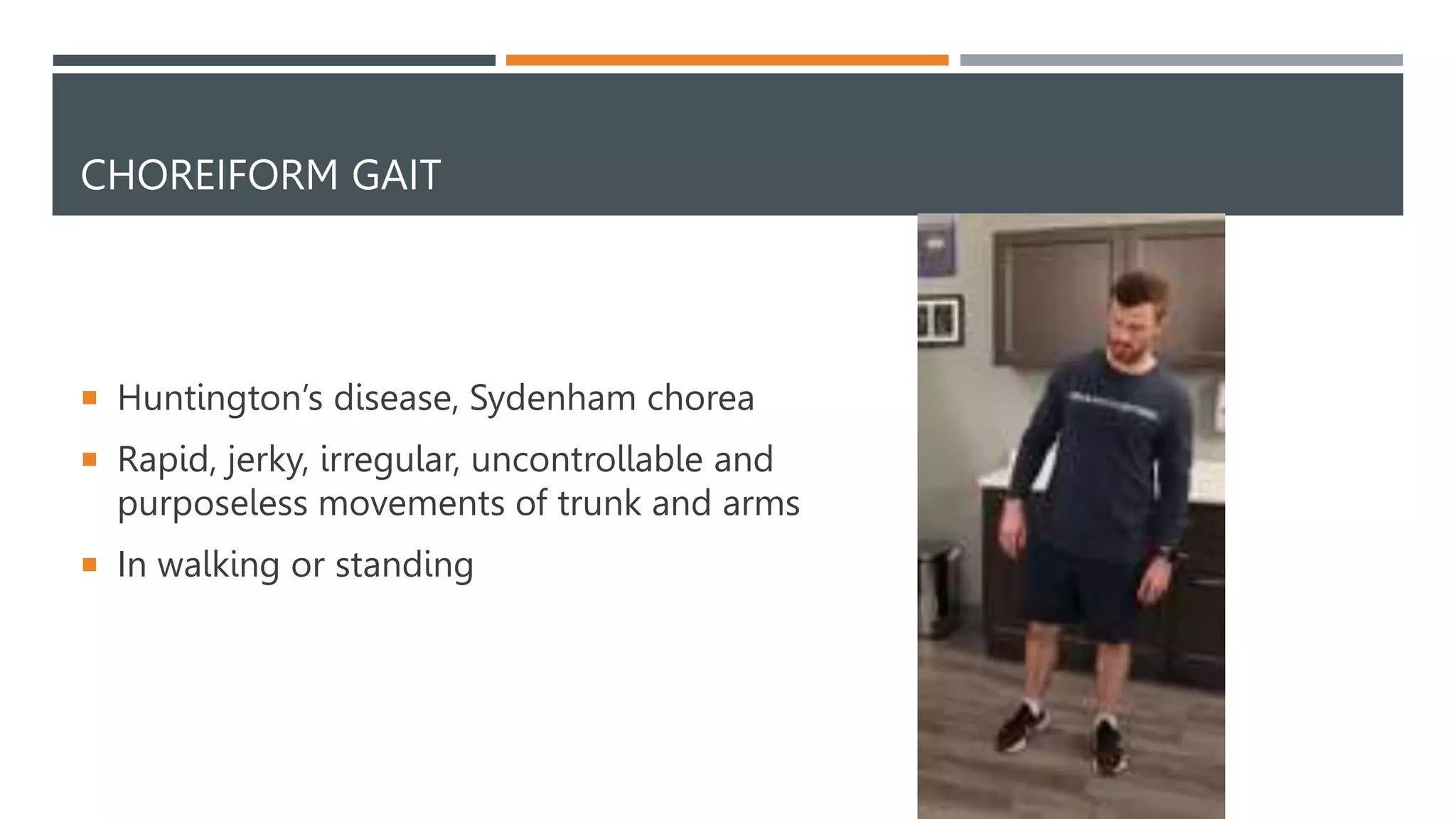
CHOREIFORM GAIT
 Huntington’s disease, Sydenham chorea
 Rapid, jerky, irregular, uncontrollable and
purposeless movements of trunk and arms
 In walking or standing
ANTALGIC GAIT
 Abnormal pattern of walking
secondary to pain that cause limp
 The stance phase is shortened
relative to swing phase
 good indication of weight-
bearing pain
THANKS
For your attention

Gait Analysis.pptx

  • 1.
    GAIT ANALYSIS DR. MOHAMMADTAQI EHSANI PGY1 RESIDENT OF ORTHOPEDICS, FMIC
  • 2.
    OUTLINE  Phases ofGait  Temporal Parameters  Neurological Control of Gait  Kinematics  Kinetics  Assess the Gait  Abnormal Gaits
  • 3.
     Observing achild’s gait is an integral part of the orthopedics examination  A systematic approach to gait analysis—that is, looking at the trunk and each joint moving in all three planes (sagittal, coronal, and transverse)—can yield valuable information about the patient’s condition and help in establishing a treatment plan  the patient needs to be as unclothed as deemed appropriate  There should be adequate space for the child to walk comfortably and naturally
  • 4.
    PHASES OF GAIT time during which the limb is in contact with the ground and supporting the weight of the body  During running, double limb support disappears and is replaced by double-limb float, a period during which neither leg is in contact with the ground  the time when the limb is advancing forward off the ground  (the advancing limb is not in contact with the ground and body weight is supported by the contralateral limb)
  • 6.
    TEMPORAL PARAMETERS Cadence: Normal100-110 steps/min Velocity: average walking speed+80m/min
  • 7.
    NEUROLOGIC CONTROL OFGAIT  The entire neurologic system plays a role in gait  Most of the muscular actions that occur during gait are programmed as involuntary reflex arcs involving all areas of the brain and spinal cord  The extrapyramidal tracts are responsible for most complex, unconscious pathways  Voluntary modulation of gait (e.g., altering speed, stepping over an obstacle, changing direction) is made possible through interaction of the motor cortex  The cerebellum is important in controlling balance  when the neurologic system is abnormal (e.g., in cerebral palsy), the delicate control of gait is disturbed, leading to pathologic reflexes and abnormal movements.
  • 8.
    KINEMATICS • defined asthe study of the angular rotations of each joint during movement • In simpler terms, kinematics denotes the motions observed and measured at the pelvis, hip, knee, and ankle during the stance and swing phases of gait • Kinematics can be observed in three planes—the sagittal plane (flexion and extension), coronal plane (hip abduction and adduction), and transverse plane (rotation of the hips, tibiae, or feet) • The data are collected by the three-dimensional tracking of markers placed over bony landmarks by infrared cameras positioned in the gait laboratory.
  • 9.
    KINETICS  Kinetics arethe forces generated by the muscles and joints during gait.  Kinetic data are reported as moments (forces acting about a center of rotation) and powers.  These forces can be measured from force plates in a gait analysis laboratory
  • 10.
    PEDOBAROGRAPHY • Pedobarography isthe measurement of plantar pressures during gait • Using specialized force plates with a high number of sensors per area, the contact area of the foot and pressure and timing of the pressure can be documented • Pressure data for the feet of younger children demonstrate a number of differences compared with those of adults. • For example, younger children typically have higher medial midfoot pressure, which correlates clinically with lack of the longitudinal arch of the foot.
  • 11.
    ASSESS THE GAIT HEELTO TOE We look for:  Can maintain the streamline?  Leaning to sides?  Flapping on both side could be ATAXIA
  • 12.
    ASSESS THE GAIT WALKINGIN HEELS Primary muscles that keep your toe above the grounds are dorsiflexors with innervated by deep fibular nerve
  • 13.
    ASSESS THE GAIT WALKINGIN TOES  Plantar flexors keeps the heel of the ground, innervated by tibial nerve
  • 14.
  • 15.
    Unterberger’s test orFukuda stepping test  Patient closes eyes and stretches arms out in front  Walks on spot for a minute  The knees raised as high as possible  Patients with vertigo will start to turn his axis in particular direction  Positive >45 degree
  • 17.
    ABNORMAL GAITS  Hemiplegicgait  Diplegic gait  Neuropathic gait  Myopathic gait  Parkinsonian gait  Ataxic gait  Sensory ataxic gait  Choreiform gait  Antalgic gait
  • 18.
    HEMIPLEGIC GAIT  Plegiaor weakness on one side  High flexor adductor tone, circumdact the leg
  • 19.
    DIPLEGIC GAIT  Seenin CP patients  Strong adductor tone (so thigh: scissoring gait)  Planter flexing  flexion in arms
  • 20.
    NEUROPATHIC GAIT  Neuropathy Involvement of deep fibular nerve (lesion or neuropathy)  Can’t keep dorsiflexors in contracting  High steppage or drag the foot  Unilaterally: Deep fibular nerve lesion, radiculopathy or nerve root compression of L4-5  Bilaterally: Diabetic neuropathy, Charcot- Marie tooth disease
  • 21.
    MYOPATHIC GAIT  Myopathies,like positive Trendelenburg sign  Dermatomyositis, poliomyelitis, sup. Gluteal nerve lesion, Duchenne muscular dystrophy, proximal hip muscle weakness  Leaning, Hyper lordotic curve, waddling gait
  • 22.
    PARKINSONIAN GAIT  Parkinson'sdisease, Parkinsonian’s disease (drug induced)  Very slow and small steps, tremor, hunch back, when stopped its hard to maintain themselves  Positive retropulsion test
  • 23.
    ATAXIC GAIT  Cerebellarlesion  Sever alcohol intoxication  Wide stance, hunched over, falling to sides
  • 24.
    SENSORY ATAXIC GAIT Dorsoculomn lesions, particularly involving proprioceptive sensation (body awareness sense, tells us where our body parts are without having to look for them) instead uses vibration  Multiple sclerosis, Tabes Dorsalis, Tertiary Syphilis, B12 Deficiency
  • 25.
    CHOREIFORM GAIT  Huntington’sdisease, Sydenham chorea  Rapid, jerky, irregular, uncontrollable and purposeless movements of trunk and arms  In walking or standing
  • 26.
    ANTALGIC GAIT  Abnormalpattern of walking secondary to pain that cause limp  The stance phase is shortened relative to swing phase  good indication of weight- bearing pain
  • 27.