A SURVEY OF
AMERICAN HISTORY
Unit 3: Reconstruction and Urbanization

Part 6: The Gilded Age
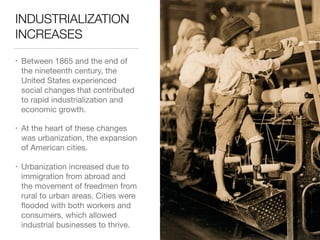
INDUSTRIALIZATION
INCREASES
• Between 1865 and the end of
the nineteenth century, the
United States experienced
social changes that contributed
to rapid industrialization and
economic growth.

• At the heart of these changes
was urbanization, the expansion
of American cities.

• Urbanization increased due to
immigration from abroad and
the movement of freedmen from
rural to urban areas. Cities were
flooded with both workers and
consumers, which allowed
industrial businesses to thrive.
THE GILDED AGE
• One of the results of this
industrialization was that
people who invested in
industrial businesses suddenly
became extraordinarily wealthy.

• These people were known as
the nouveau riche. As they
acquired their wealth, they
began to purchase palatial
houses and to live very
extravagant, opulent lifestyles.

• The period in which they did
this is known as ‘the Gilded
Age,’ a term coined by the
satirist Mark Twain.
CORNELIUS
VANDERBILT
• Acquired and built a small
railroad empire in upstate New
York, culminating in the
construction of New York’s
Grand Central Station in 1869.

• Also acquired railroad
properties in New Jersey,
Connecticut, and Michigan.

• Became the archetypal ‘railroad
baron,’ dedicated to the further
acquisition of property and the
expansion of his business.
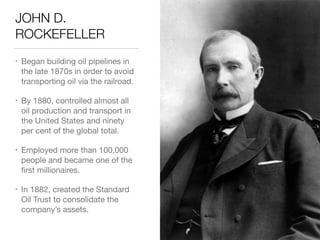
JOHN D.
ROCKEFELLER
• Founded Standard Oil in 1870,
one of the most profitable oil
refineries in the country.

• Colluded with the railroad
companies to transport refined
oil and kerosene to the South at
heavily discounted rates,
undercutting the purchasing
power of smaller refineries.

• By 1872, had purchased and
absorbed twenty-two out of
twenty-six oil refinery
competitors in Cleveland,
where Standard Oil was based.
JOHN D.
ROCKEFELLER
• Began building oil pipelines in
the late 1870s in order to avoid
transporting oil via the railroad. 

• By 1880, controlled almost all
oil production and transport in
the United States and ninety
per cent of the global total. 

• Employed more than 100,000
people and became one of the
first millionaires.

• In 1882, created the Standard
Oil Trust to consolidate the
company’s assets.
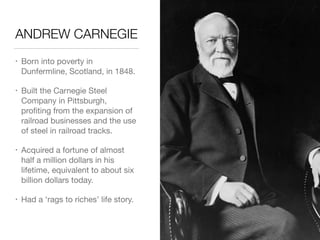
ANDREW CARNEGIE
• Born into poverty in
Dunfermline, Scotland, in 1848.

• Built the Carnegie Steel
Company in Pittsburgh,
profiting from the expansion of
railroad businesses and the use
of steel in railroad tracks.

• Acquired a fortune of almost
half a million dollars in his
lifetime, equivalent to about six
billion dollars today.

• Had a ‘rags to riches’ life story.
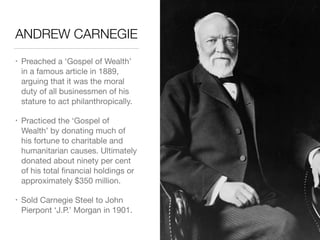
ANDREW CARNEGIE
• Preached a ‘Gospel of Wealth’
in a famous article in 1889,
arguing that it was the moral
duty of all businessmen of his
stature to act philanthropically.

• Practiced the ‘Gospel of
Wealth’ by donating much of
his fortune to charitable and
humanitarian causes. Ultimately
donated about ninety per cent
of his total financial holdings or
approximately $350 million.

• Sold Carnegie Steel to John
Pierpont ‘J.P.’ Morgan in 1901.
J.P. MORGAN
• In 1892, created General
Electric by arranging the merger
of two electricity companies,
Edison General Electric and
Thomas-Houston Electric.

• Was primarily a financier
involved in investing in new
companies and acquiring old
companies, rather than being
involved in a particular industry.

• Financed the creation of a new
steel company, then acquired
Carnegie Steel and merged it
with his own in 1901.
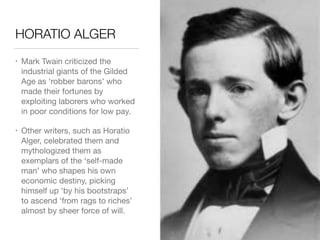
HORATIO ALGER
• Mark Twain criticized the
industrial giants of the Gilded
Age as ‘robber barons’ who
made their fortunes by
exploiting laborers who worked
in poor conditions for low pay.

• Other writers, such as Horatio
Alger, celebrated them and
mythologized them as
exemplars of the ‘self-made
man’ who shapes his own
economic destiny, picking
himself up ‘by his bootstraps’
to ascend ‘from rags to riches’
almost by sheer force of will.
THE HORATIO
ALGER NOVEL
• Alger wrote scores of cheap
pulp novels that all celebrated
the successes of hardworking,
clever young men.

• These novels were some of the
most popular of the late
nineteenth century.

• With his novels, Alger advanced
the idea that anyone could
‘make it in America,’ the land of
opportunity, if only they tried
hard enough, and, conversely,
the idea that the poor deserved
their misfortune because they
were not working hard enough.
A SURVEY OF
AMERICAN HISTORY
Unit 3: Reconstruction and Urbanization

Part 6: The Gilded Age

46 The Gilded Age

  • 1.
    A SURVEY OF AMERICANHISTORY Unit 3: Reconstruction and Urbanization Part 6: The Gilded Age
  • 2.
    INDUSTRIALIZATION INCREASES • Between 1865and the end of the nineteenth century, the United States experienced social changes that contributed to rapid industrialization and economic growth. • At the heart of these changes was urbanization, the expansion of American cities. • Urbanization increased due to immigration from abroad and the movement of freedmen from rural to urban areas. Cities were flooded with both workers and consumers, which allowed industrial businesses to thrive.
  • 3.
    THE GILDED AGE •One of the results of this industrialization was that people who invested in industrial businesses suddenly became extraordinarily wealthy. • These people were known as the nouveau riche. As they acquired their wealth, they began to purchase palatial houses and to live very extravagant, opulent lifestyles. • The period in which they did this is known as ‘the Gilded Age,’ a term coined by the satirist Mark Twain.
  • 4.
    CORNELIUS VANDERBILT • Acquired andbuilt a small railroad empire in upstate New York, culminating in the construction of New York’s Grand Central Station in 1869. • Also acquired railroad properties in New Jersey, Connecticut, and Michigan. • Became the archetypal ‘railroad baron,’ dedicated to the further acquisition of property and the expansion of his business.
  • 5.
    JOHN D. ROCKEFELLER • FoundedStandard Oil in 1870, one of the most profitable oil refineries in the country. • Colluded with the railroad companies to transport refined oil and kerosene to the South at heavily discounted rates, undercutting the purchasing power of smaller refineries. • By 1872, had purchased and absorbed twenty-two out of twenty-six oil refinery competitors in Cleveland, where Standard Oil was based.
  • 6.
    JOHN D. ROCKEFELLER • Beganbuilding oil pipelines in the late 1870s in order to avoid transporting oil via the railroad. • By 1880, controlled almost all oil production and transport in the United States and ninety per cent of the global total. • Employed more than 100,000 people and became one of the first millionaires. • In 1882, created the Standard Oil Trust to consolidate the company’s assets.
  • 7.
    ANDREW CARNEGIE • Borninto poverty in Dunfermline, Scotland, in 1848. • Built the Carnegie Steel Company in Pittsburgh, profiting from the expansion of railroad businesses and the use of steel in railroad tracks. • Acquired a fortune of almost half a million dollars in his lifetime, equivalent to about six billion dollars today. • Had a ‘rags to riches’ life story.
  • 8.
    ANDREW CARNEGIE • Preacheda ‘Gospel of Wealth’ in a famous article in 1889, arguing that it was the moral duty of all businessmen of his stature to act philanthropically. • Practiced the ‘Gospel of Wealth’ by donating much of his fortune to charitable and humanitarian causes. Ultimately donated about ninety per cent of his total financial holdings or approximately $350 million. • Sold Carnegie Steel to John Pierpont ‘J.P.’ Morgan in 1901.
  • 9.
    J.P. MORGAN • In1892, created General Electric by arranging the merger of two electricity companies, Edison General Electric and Thomas-Houston Electric. • Was primarily a financier involved in investing in new companies and acquiring old companies, rather than being involved in a particular industry. • Financed the creation of a new steel company, then acquired Carnegie Steel and merged it with his own in 1901.
  • 10.
    HORATIO ALGER • MarkTwain criticized the industrial giants of the Gilded Age as ‘robber barons’ who made their fortunes by exploiting laborers who worked in poor conditions for low pay. • Other writers, such as Horatio Alger, celebrated them and mythologized them as exemplars of the ‘self-made man’ who shapes his own economic destiny, picking himself up ‘by his bootstraps’ to ascend ‘from rags to riches’ almost by sheer force of will.
  • 11.
    THE HORATIO ALGER NOVEL •Alger wrote scores of cheap pulp novels that all celebrated the successes of hardworking, clever young men. • These novels were some of the most popular of the late nineteenth century. • With his novels, Alger advanced the idea that anyone could ‘make it in America,’ the land of opportunity, if only they tried hard enough, and, conversely, the idea that the poor deserved their misfortune because they were not working hard enough.
  • 12.
    A SURVEY OF AMERICANHISTORY Unit 3: Reconstruction and Urbanization Part 6: The Gilded Age