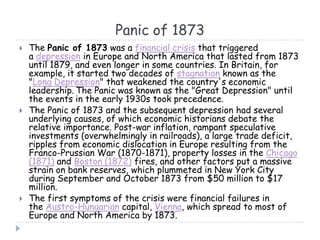
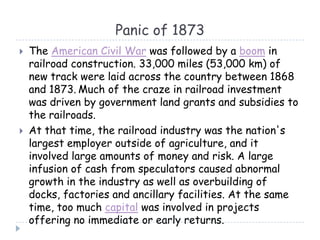
The panic of 1873 was a major international financial crisis that triggered a global economic depression. In the US, overexpansion of the railroad industry led to collapse as credit dried up. This spread to Europe after major bank failures in Vienna. Countries like Germany, Austria-Hungary, and the US had seen major economic booms in recent years fueled by inflation, speculation, and war indemnities, but the crises exposed underlying weaknesses as monetary policies tightened. The panic had severe social and political impacts such as widespread unemployment and unrest, and a shift away from Republican rule in the US. Recovery was slower in North America than Europe.


![Awareness of digital currency[1] (1).pptx](https://cdn.slidesharecdn.com/ss_thumbnails/awarenessofdigitalcurrency11-260125155504-b1badee4-thumbnail.jpg?width=640&height=640&fit=bounds)


