A SURVEY OF
AMERICAN HISTORY
Unit 2: Westward Expansion and Civil War

Part 17: The Civil War (I)
FOUR MORE
STATES SECEDE
• Abraham Lincoln responded to
the loss of Fort Sumter by
immediately calling for 75,000
volunteers to serve for three
months in a federal militia.

• This call for a militia had
unintended consequences,
particularly in the states known
as the Border States.

• The Border States were the
states that still allowed slavery
but had not seceded from the
Union: Arkansas, Tennessee,
North Carolina, and Virginia,
plus Delaware, Kentucky,
Maryland, and Missouri.
FOUR MORE
STATES SECEDE
• In response to Lincoln’s call for
a militia, Arkansas, Tennessee,
North Carolina, and Virginia
seceded from the Union and
joined the Confederate States.

• Their argument was that Lincoln
was preparing to act too
aggressively towards the states
that had already seceded,
rather than pursuing peace by
diplomatic means.

• By May 23, 1861, the CSA
consisted of eleven states.
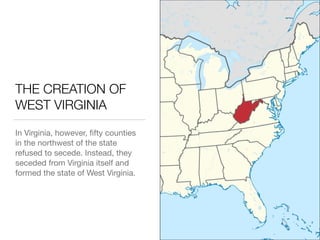
THE CREATION OF
WEST VIRGINIA
In Virginia, however, fifty counties
in the northwest of the state
refused to secede. Instead, they
seceded from Virginia itself and
formed the state of West Virginia.
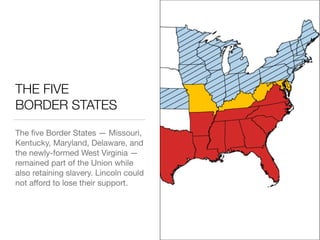
THE FIVE

BORDER STATES
The five Border States — Missouri,
Kentucky, Maryland, Delaware, and
the newly-formed West Virginia —
remained part of the Union while
also retaining slavery. Lincoln could
not afford to lose their support.
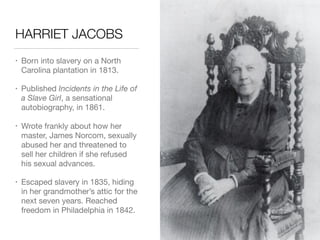
HARRIET JACOBS
• Born into slavery on a North
Carolina plantation in 1813.

• Published Incidents in the Life of
a Slave Girl, a sensational
autobiography, in 1861.

• Wrote frankly about how her
master, James Norcom, sexually
abused her and threatened to
sell her children if she refused
his sexual advances.

• Escaped slavery in 1835, hiding
in her grandmother’s attic for the
next seven years. Reached
freedom in Philadelphia in 1842.
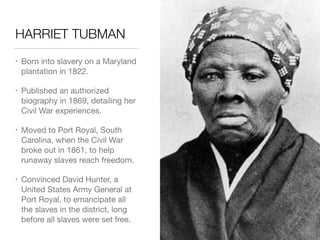
HARRIET TUBMAN
• Born into slavery on a Maryland
plantation in 1822.

• Published an authorized
biography in 1869, detailing her
Civil War experiences.

• Moved to Port Royal, South
Carolina, when the Civil War
broke out in 1861, to help
runaway slaves reach freedom.

• Convinced David Hunter, a
United States Army General at
Port Royal, to emancipate all
the slaves in the district, long
before all slaves were set free.
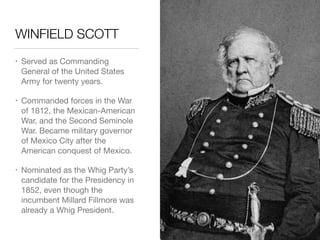
WINFIELD SCOTT
• Served as Commanding
General of the United States
Army for twenty years.

• Commanded forces in the War
of 1812, the Mexican-American
War, and the Second Seminole
War. Became military governor
of Mexico City after the
American conquest of Mexico.

• Nominated as the Whig Party’s
candidate for the Presidency in
1852, even though the
incumbent Millard Fillmore was
already a Whig President.
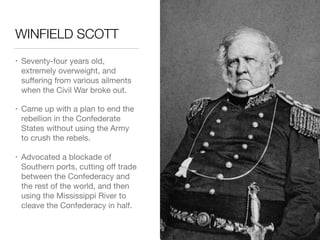
WINFIELD SCOTT
• Seventy-four years old,
extremely overweight, and
suffering from various ailments
when the Civil War broke out.

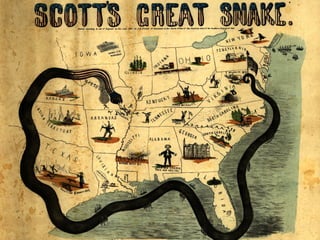
• Came up with a plan to end the
rebellion in the Confederate
States without using the Army
to crush the rebels.

• Advocated a blockade of
Southern ports, cutting off trade
between the Confederacy and
the rest of the world, and then
using the Mississippi River to
cleave the Confederacy in half.
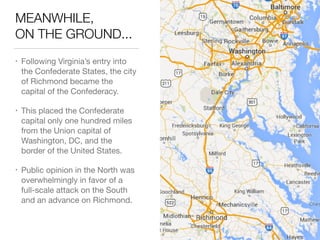
MEANWHILE,

ON THE GROUND...
• Following Virginia’s entry into
the Confederate States, the city
of Richmond became the
capital of the Confederacy.

• This placed the Confederate
capital only one hundred miles
from the Union capital of
Washington, DC, and the
border of the United States.

• Public opinion in the North was
overwhelmingly in favor of a
full-scale attack on the South
and an advance on Richmond.
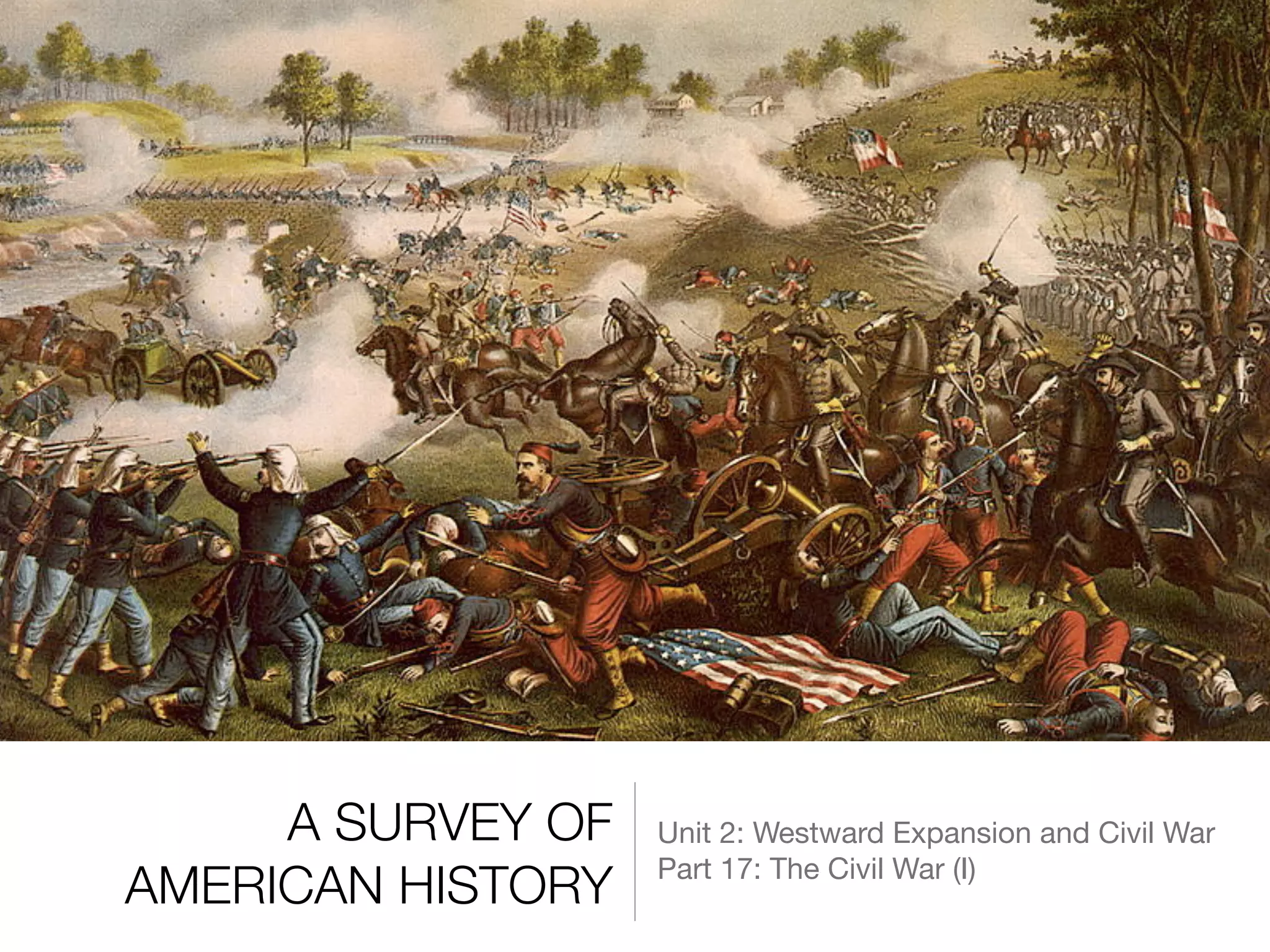
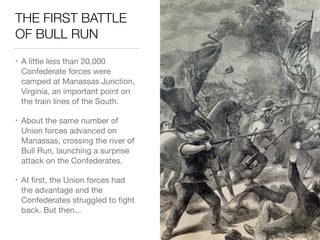
THE FIRST BATTLE
OF BULL RUN
• A little less than 20,000
Confederate forces were
camped at Manassas Junction,
Virginia, an important point on
the train lines of the South.

• About the same number of
Union forces advanced on
Manassas, crossing the river of
Bull Run, launching a surprise
attack on the Confederates.

• At first, the Union forces had
the advantage and the
Confederates struggled to fight
back. But then...
THE FIRST BATTLE
OF BULL RUN
• ...Confederate reinforcements
arrived via the railway running
through the Shenandoah Valley.

• These reinforcements
overwhelmed the Union forces,
sending them into disarray. The
Union forces retreated and
broke ranks, leaving the
Confederates to conquer them.

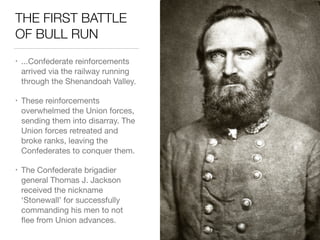
• The Confederate brigadier
general Thomas J. Jackson
received the nickname
‘Stonewall’ for successfully
commanding his men to not
flee from Union advances.
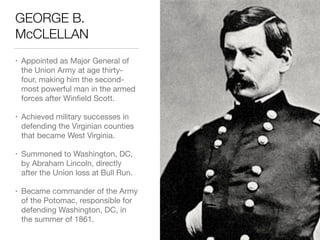
GEORGE B.
McCLELLAN
• Appointed as Major General of
the Union Army at age thirty-
four, making him the second-
most powerful man in the armed
forces after Winfield Scott.

• Achieved military successes in
defending the Virginian counties
that became West Virginia.

• Summoned to Washington, DC,
by Abraham Lincoln, directly
after the Union loss at Bull Run.

• Became commander of the Army
of the Potomac, responsible for
defending Washington, DC, in
the summer of 1861.
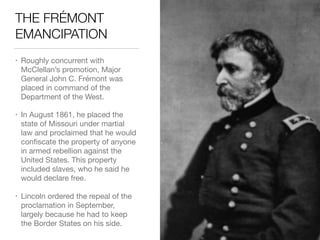
THE FRÉMONT
EMANCIPATION
• Roughly concurrent with
McClellan’s promotion, Major
General John C. Frémont was
placed in command of the
Department of the West.

• In August 1861, he placed the
state of Missouri under martial
law and proclaimed that he would
confiscate the property of anyone
in armed rebellion against the
United States. This property
included slaves, who he said he
would declare free.

• Lincoln ordered the repeal of the
proclamation in September,
largely because he had to keep
the Border States on his side.
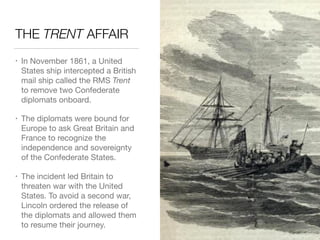
THE TRENT AFFAIR
• In November 1861, a United
States ship intercepted a British
mail ship called the RMS Trent
to remove two Confederate
diplomats onboard.

• The diplomats were bound for
Europe to ask Great Britain and
France to recognize the
independence and sovereignty
of the Confederate States.

• The incident led Britain to
threaten war with the United
States. To avoid a second war,
Lincoln ordered the release of
the diplomats and allowed them
to resume their journey.
A SURVEY OF
AMERICAN HISTORY
Unit 2: Westward Expansion and Civil War

Part 17: The Civil War (I)

37 The Civil War (I)

  • 1.
    A SURVEY OF AMERICANHISTORY Unit 2: Westward Expansion and Civil War Part 17: The Civil War (I)
  • 2.
    FOUR MORE STATES SECEDE •Abraham Lincoln responded to the loss of Fort Sumter by immediately calling for 75,000 volunteers to serve for three months in a federal militia. • This call for a militia had unintended consequences, particularly in the states known as the Border States. • The Border States were the states that still allowed slavery but had not seceded from the Union: Arkansas, Tennessee, North Carolina, and Virginia, plus Delaware, Kentucky, Maryland, and Missouri.
  • 3.
    FOUR MORE STATES SECEDE •In response to Lincoln’s call for a militia, Arkansas, Tennessee, North Carolina, and Virginia seceded from the Union and joined the Confederate States. • Their argument was that Lincoln was preparing to act too aggressively towards the states that had already seceded, rather than pursuing peace by diplomatic means. • By May 23, 1861, the CSA consisted of eleven states.
  • 4.
    THE CREATION OF WESTVIRGINIA In Virginia, however, fifty counties in the northwest of the state refused to secede. Instead, they seceded from Virginia itself and formed the state of West Virginia.
  • 5.
    THE FIVE
 BORDER STATES Thefive Border States — Missouri, Kentucky, Maryland, Delaware, and the newly-formed West Virginia — remained part of the Union while also retaining slavery. Lincoln could not afford to lose their support.
  • 6.
    HARRIET JACOBS • Borninto slavery on a North Carolina plantation in 1813. • Published Incidents in the Life of a Slave Girl, a sensational autobiography, in 1861. • Wrote frankly about how her master, James Norcom, sexually abused her and threatened to sell her children if she refused his sexual advances. • Escaped slavery in 1835, hiding in her grandmother’s attic for the next seven years. Reached freedom in Philadelphia in 1842.
  • 7.
    HARRIET TUBMAN • Borninto slavery on a Maryland plantation in 1822. • Published an authorized biography in 1869, detailing her Civil War experiences. • Moved to Port Royal, South Carolina, when the Civil War broke out in 1861, to help runaway slaves reach freedom. • Convinced David Hunter, a United States Army General at Port Royal, to emancipate all the slaves in the district, long before all slaves were set free.
  • 8.
    WINFIELD SCOTT • Servedas Commanding General of the United States Army for twenty years. • Commanded forces in the War of 1812, the Mexican-American War, and the Second Seminole War. Became military governor of Mexico City after the American conquest of Mexico. • Nominated as the Whig Party’s candidate for the Presidency in 1852, even though the incumbent Millard Fillmore was already a Whig President.
  • 9.
    WINFIELD SCOTT • Seventy-fouryears old, extremely overweight, and suffering from various ailments when the Civil War broke out. • Came up with a plan to end the rebellion in the Confederate States without using the Army to crush the rebels. • Advocated a blockade of Southern ports, cutting off trade between the Confederacy and the rest of the world, and then using the Mississippi River to cleave the Confederacy in half.
  • 11.
    MEANWHILE,
 ON THE GROUND... •Following Virginia’s entry into the Confederate States, the city of Richmond became the capital of the Confederacy. • This placed the Confederate capital only one hundred miles from the Union capital of Washington, DC, and the border of the United States. • Public opinion in the North was overwhelmingly in favor of a full-scale attack on the South and an advance on Richmond.
  • 12.
    THE FIRST BATTLE OFBULL RUN • A little less than 20,000 Confederate forces were camped at Manassas Junction, Virginia, an important point on the train lines of the South. • About the same number of Union forces advanced on Manassas, crossing the river of Bull Run, launching a surprise attack on the Confederates. • At first, the Union forces had the advantage and the Confederates struggled to fight back. But then...
  • 13.
    THE FIRST BATTLE OFBULL RUN • ...Confederate reinforcements arrived via the railway running through the Shenandoah Valley. • These reinforcements overwhelmed the Union forces, sending them into disarray. The Union forces retreated and broke ranks, leaving the Confederates to conquer them. • The Confederate brigadier general Thomas J. Jackson received the nickname ‘Stonewall’ for successfully commanding his men to not flee from Union advances.
  • 14.
    GEORGE B. McCLELLAN • Appointedas Major General of the Union Army at age thirty- four, making him the second- most powerful man in the armed forces after Winfield Scott. • Achieved military successes in defending the Virginian counties that became West Virginia. • Summoned to Washington, DC, by Abraham Lincoln, directly after the Union loss at Bull Run. • Became commander of the Army of the Potomac, responsible for defending Washington, DC, in the summer of 1861.
  • 15.
    THE FRÉMONT EMANCIPATION • Roughlyconcurrent with McClellan’s promotion, Major General John C. Frémont was placed in command of the Department of the West. • In August 1861, he placed the state of Missouri under martial law and proclaimed that he would confiscate the property of anyone in armed rebellion against the United States. This property included slaves, who he said he would declare free. • Lincoln ordered the repeal of the proclamation in September, largely because he had to keep the Border States on his side.
  • 16.
    THE TRENT AFFAIR •In November 1861, a United States ship intercepted a British mail ship called the RMS Trent to remove two Confederate diplomats onboard. • The diplomats were bound for Europe to ask Great Britain and France to recognize the independence and sovereignty of the Confederate States. • The incident led Britain to threaten war with the United States. To avoid a second war, Lincoln ordered the release of the diplomats and allowed them to resume their journey.
  • 17.
    A SURVEY OF AMERICANHISTORY Unit 2: Westward Expansion and Civil War Part 17: The Civil War (I)