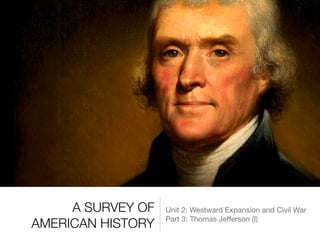
A SURVEY OF
AMERICAN HISTORY
Unit 2: Westward Expansion and Civil War

Part 3: Thomas Jefferson (I)
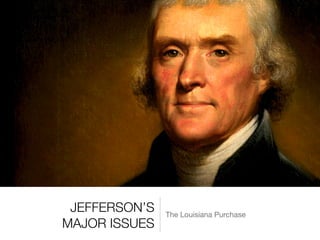
JEFFERSON’S

MAJOR ISSUES
The Louisiana Purchase
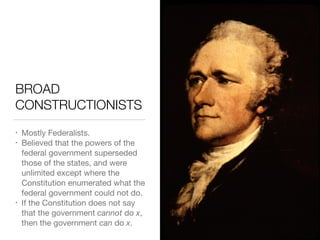
BROAD
CONSTRUCTIONISTS
• Mostly Federalists.

• Believed that the powers of the
federal government superseded
those of the states, and were
unlimited except where the
Constitution enumerated what the
federal government could not do.

• If the Constitution does not say
that the government cannot do x,
then the government can do x.
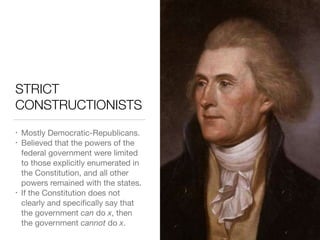
STRICT
CONSTRUCTIONISTS
• Mostly Democratic-Republicans.

• Believed that the powers of the
federal government were limited
to those explicitly enumerated in
the Constitution, and all other
powers remained with the states.

• If the Constitution does not
clearly and specifically say that
the government can do x, then
the government cannot do x.
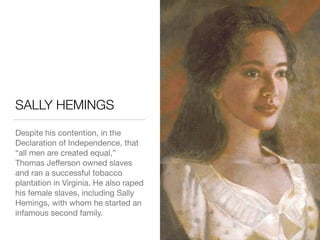
SALLY HEMINGS
Despite his contention, in the
Declaration of Independence, that
“all men are created equal,”
Thomas Jefferson owned slaves
and ran a successful tobacco
plantation in Virginia. He also raped
his female slaves, including Sally
Hemings, with whom he started an
infamous second family.
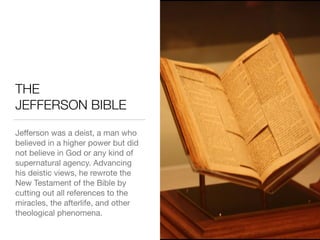
THE

JEFFERSON BIBLE
Jefferson was a deist, a man who
believed in a higher power but did
not believe in God or any kind of
supernatural agency. Advancing
his deistic views, he rewrote the
New Testament of the Bible by
cutting out all references to the
miracles, the afterlife, and other
theological phenomena.
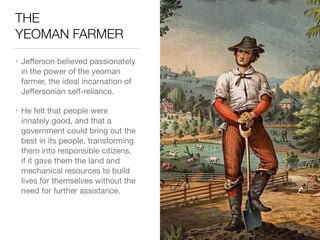
THE

YEOMAN FARMER
• Jefferson believed passionately
in the power of the yeoman
farmer, the ideal incarnation of
Jeffersonian self-reliance.

• He felt that people were
innately good, and that a
government could bring out the
best in its people, transforming
them into responsible citizens,
if it gave them the land and
mechanical resources to build
lives for themselves without the
need for further assistance.
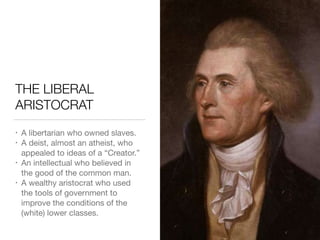
THE LIBERAL
ARISTOCRAT
• A libertarian who owned slaves.

• A deist, almost an atheist, who
appealed to ideas of a “Creator.”

• An intellectual who believed in
the good of the common man.

• A wealthy aristocrat who used
the tools of government to
improve the conditions of the
(white) lower classes.
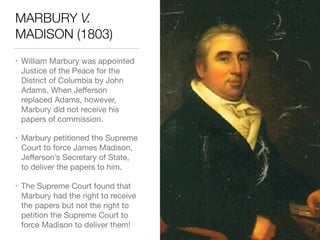
MARBURY V.
MADISON (1803)
• William Marbury was appointed
Justice of the Peace for the
District of Columbia by John
Adams. When Jefferson
replaced Adams, however,
Marbury did not receive his
papers of commission.

• Marbury petitioned the Supreme
Court to force James Madison,
Jefferson’s Secretary of State,
to deliver the papers to him.

• The Supreme Court found that
Marbury had the right to receive
the papers but not the right to
petition the Supreme Court to
force Madison to deliver them!
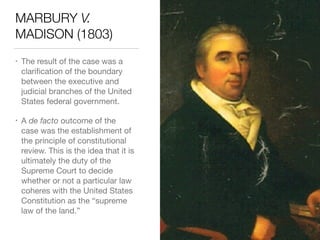
MARBURY V.
MADISON (1803)
• The result of the case was a
clarification of the boundary
between the executive and
judicial branches of the United
States federal government.

• A de facto outcome of the 

case was the establishment of
the principle of constitutional
review. This is the idea that it is
ultimately the duty of the
Supreme Court to decide
whether or not a particular law
coheres with the United States
Constitution as the “supreme
law of the land.”
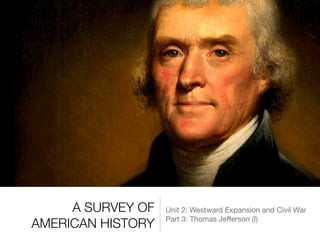
A SURVEY OF
AMERICAN HISTORY
Unit 2: Westward Expansion and Civil War

Part 3: Thomas Jefferson (I)

23 Thomas Jefferson (II)

  • 1.
    A SURVEY OF AMERICANHISTORY Unit 2: Westward Expansion and Civil War Part 3: Thomas Jefferson (I)
  • 2.
  • 3.
    BROAD CONSTRUCTIONISTS • Mostly Federalists. •Believed that the powers of the federal government superseded those of the states, and were unlimited except where the Constitution enumerated what the federal government could not do. • If the Constitution does not say that the government cannot do x, then the government can do x.
  • 4.
    STRICT CONSTRUCTIONISTS • Mostly Democratic-Republicans. •Believed that the powers of the federal government were limited to those explicitly enumerated in the Constitution, and all other powers remained with the states. • If the Constitution does not clearly and specifically say that the government can do x, then the government cannot do x.
  • 5.
    SALLY HEMINGS Despite hiscontention, in the Declaration of Independence, that “all men are created equal,” Thomas Jefferson owned slaves and ran a successful tobacco plantation in Virginia. He also raped his female slaves, including Sally Hemings, with whom he started an infamous second family.
  • 6.
    THE
 JEFFERSON BIBLE Jefferson wasa deist, a man who believed in a higher power but did not believe in God or any kind of supernatural agency. Advancing his deistic views, he rewrote the New Testament of the Bible by cutting out all references to the miracles, the afterlife, and other theological phenomena.
  • 7.
    THE
 YEOMAN FARMER • Jeffersonbelieved passionately in the power of the yeoman farmer, the ideal incarnation of Jeffersonian self-reliance. • He felt that people were innately good, and that a government could bring out the best in its people, transforming them into responsible citizens, if it gave them the land and mechanical resources to build lives for themselves without the need for further assistance.
  • 8.
    THE LIBERAL ARISTOCRAT • Alibertarian who owned slaves. • A deist, almost an atheist, who appealed to ideas of a “Creator.” • An intellectual who believed in the good of the common man. • A wealthy aristocrat who used the tools of government to improve the conditions of the (white) lower classes.
  • 9.
    MARBURY V. MADISON (1803) •William Marbury was appointed Justice of the Peace for the District of Columbia by John Adams. When Jefferson replaced Adams, however, Marbury did not receive his papers of commission. • Marbury petitioned the Supreme Court to force James Madison, Jefferson’s Secretary of State, to deliver the papers to him. • The Supreme Court found that Marbury had the right to receive the papers but not the right to petition the Supreme Court to force Madison to deliver them!
  • 10.
    MARBURY V. MADISON (1803) •The result of the case was a clarification of the boundary between the executive and judicial branches of the United States federal government. • A de facto outcome of the 
 case was the establishment of the principle of constitutional review. This is the idea that it is ultimately the duty of the Supreme Court to decide whether or not a particular law coheres with the United States Constitution as the “supreme law of the land.”
  • 11.
    A SURVEY OF AMERICANHISTORY Unit 2: Westward Expansion and Civil War Part 3: Thomas Jefferson (I)