Quick-write
“This, then, is held to be the duty of the man of wealth: First, to set an
example of modest, unostentatious living, shunning display or extravagance;
… and, after doing so, to consider all surplus [extra] revenues [profit] which
come to him simply as trust funds, which he is called upon to administer… to
produce the most beneficial results for the community—the man of wealth
thus becoming the mere trustee [authority over] and agent for his poorer
brethren, bringing to their service his superior wisdom, experience and ability
to administer, doing for them better than they would or could do for
themselves.”
     —From "Wealth", Andrew Carnegie, North American Review (1889)

Do you agree with this statement? Why? Explain.
Does this differ from your personal view on your
responsibility to your community?
Do you believe we have a responsibility to our community and
fellow human?
Robber Barons OR
Captains of Industry
    “The Good, The Bad, and The Ugly”
              Start of the Corporation
Robber Baron
              or
      Captain of Industry
 Determine whether the figure is a robber baron
 or captain industry or something in-between?

 Think about which of the individuals’ actions
 were those of a captain of industry? Or of a
 robber baron?


                                                  3
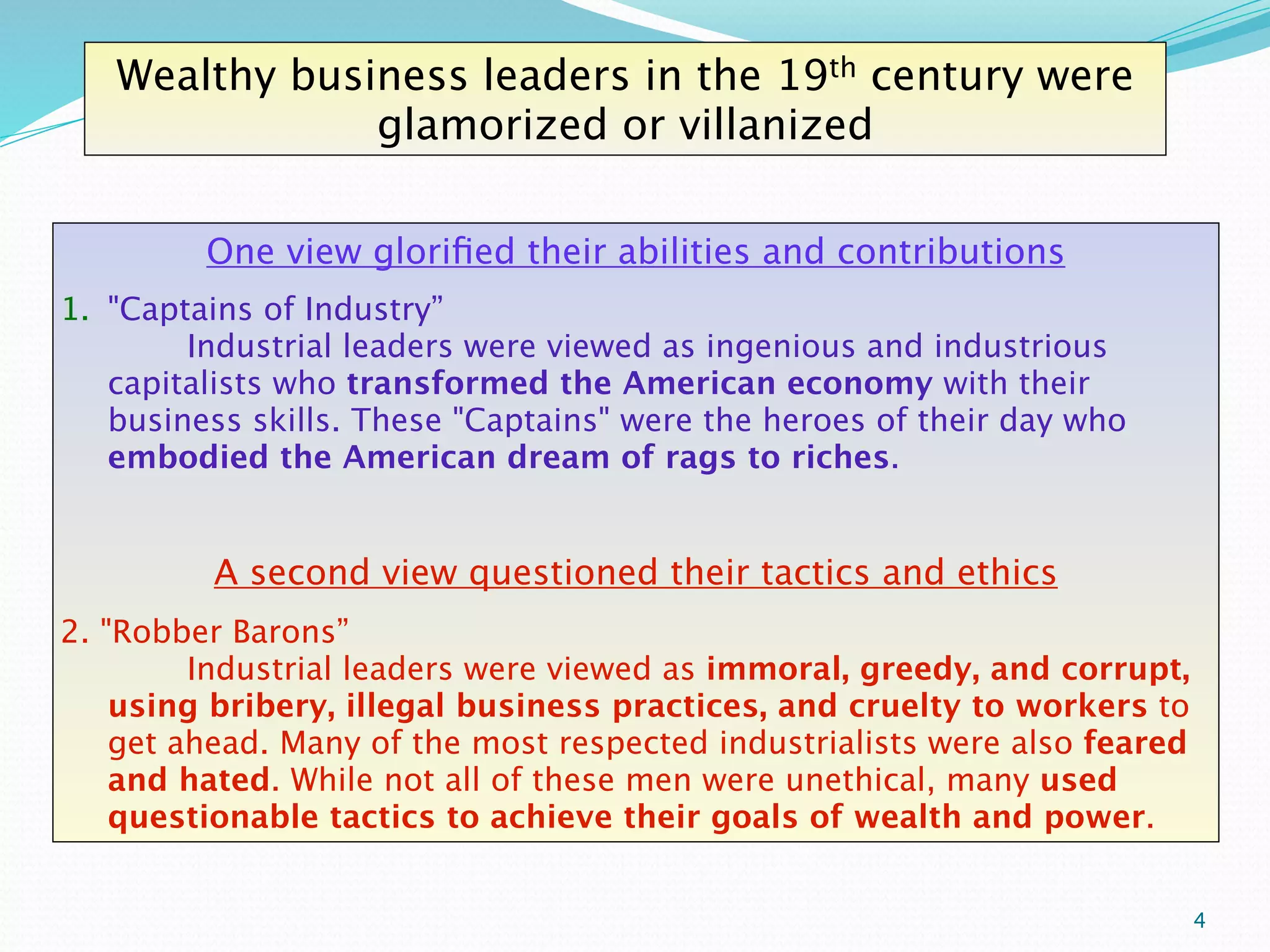
Wealthy business leaders in the 19th century were
               glamorized or villanized

         One view glorified their abilities and contributions
1. "Captains of Industry” 


    Industrial leaders were viewed as ingenious and industrious
   capitalists who transformed the American economy with their
   business skills. These "Captains" were the heroes of their day who
   embodied the American dream of rags to riches.


         A second view questioned their tactics and ethics
2. "Robber Barons” 


    Industrial leaders were viewed as immoral, greedy, and corrupt,
    using bribery, illegal business practices, and cruelty to workers to
    get ahead. Many of the most respected industrialists were also feared
    and hated. While not all of these men were unethical, many used
    questionable tactics to achieve their goals of wealth and power.


                                                                            4
Robber Barons
   Robber Baron is an insult term used to describe a class of enormously rich
               businessmen that emerged in the post civil war era.
                   Today they would be known as billionaires.
                 They were both admired and hated at the time.
  They used ruthless, immoral, and often illegal methods to create monopolies
  and develop overwhelming economic power and control over their industries.
In the late 1800’s a handful of these businessmen controlled over 90 percent of
                                 total U.S. wealth.
Some of the more commonly known industrial leaders and bankers who were
called Robber Barons include:   300                      279

 Andrew Carnegie
                                     225
 John D. Rockefeller                                                                    1865
                                                                                         1900
 Cornelius and William Vanderbilt   150
                                                                                         2004


 Jay Gould
                                      75
 J. Pierpont Morgan                                        22
                                                3
 Jim Fisk                             0
                                                    Total number of billionaires

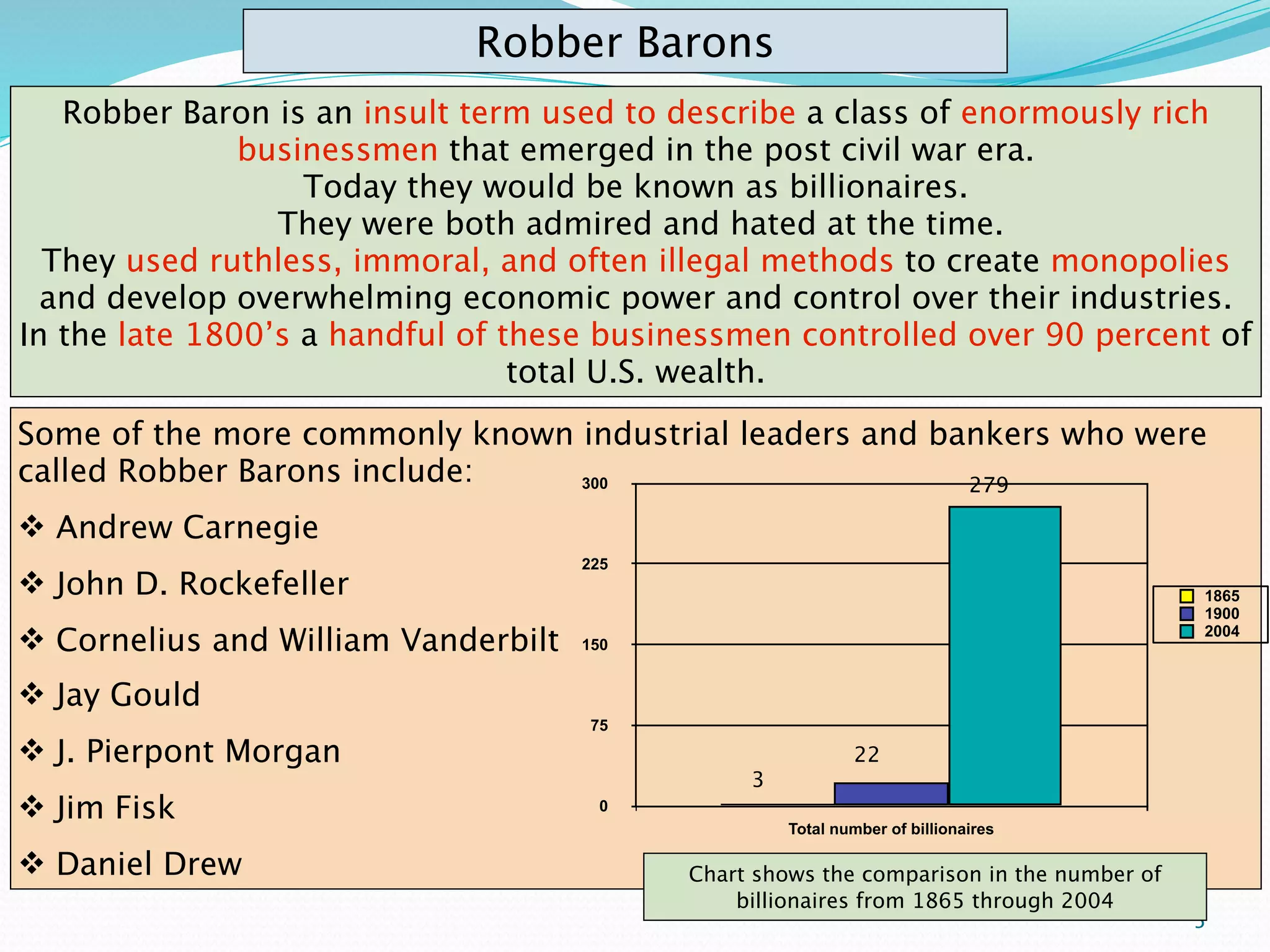
 Daniel Drew                              Chart shows the comparison in the number of
                                               billionaires from 1865 through 2004
                                                                                         5
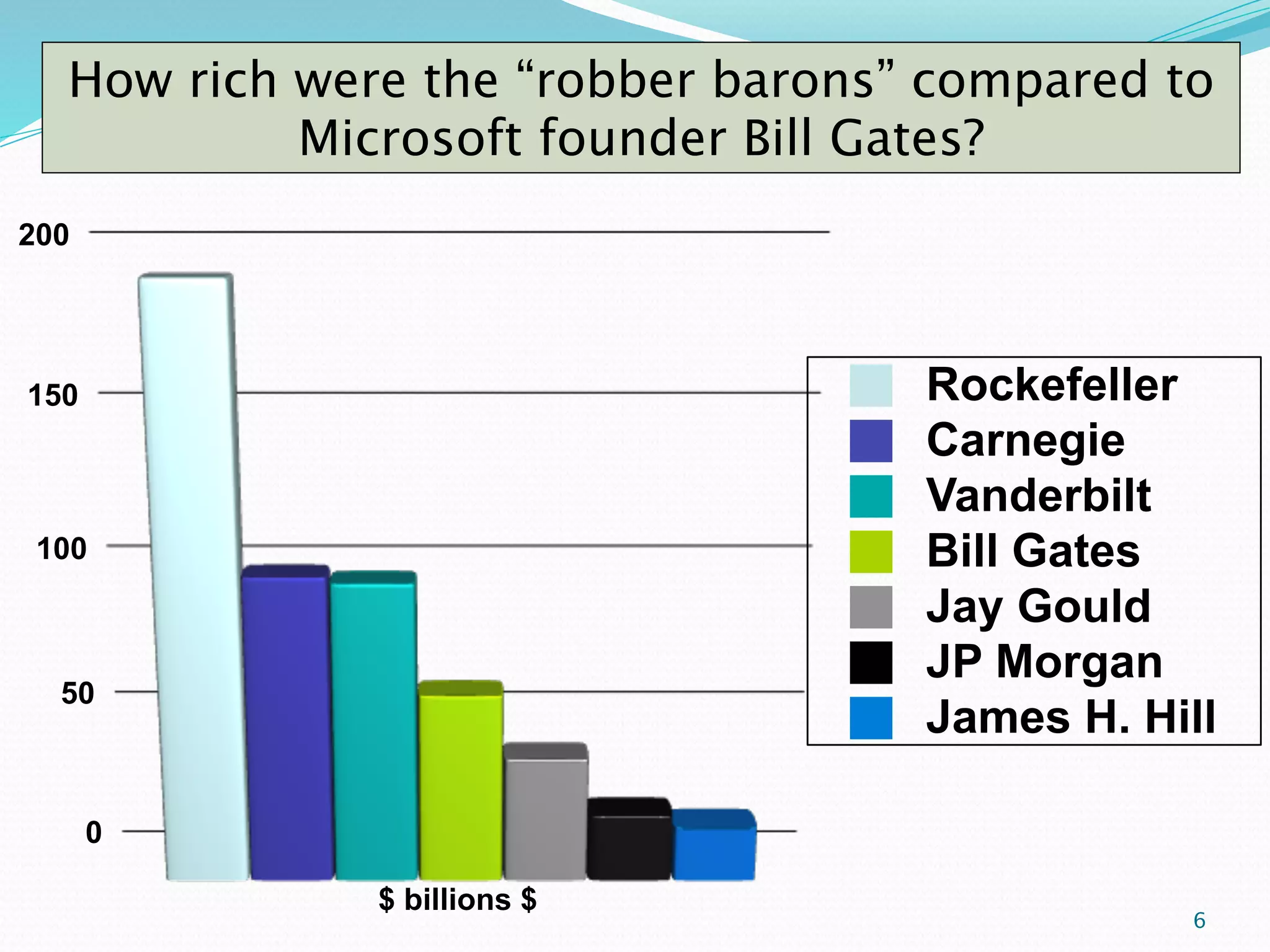
How rich were the “robber barons” compared to
           Microsoft founder Bill Gates?
200


150                                Rockefeller
                                   Carnegie
                                   Vanderbilt
 100                               Bill Gates
                                   Jay Gould
                                   JP Morgan
  50
                                   James H. Hill

      0

              $ billions $
                                              6
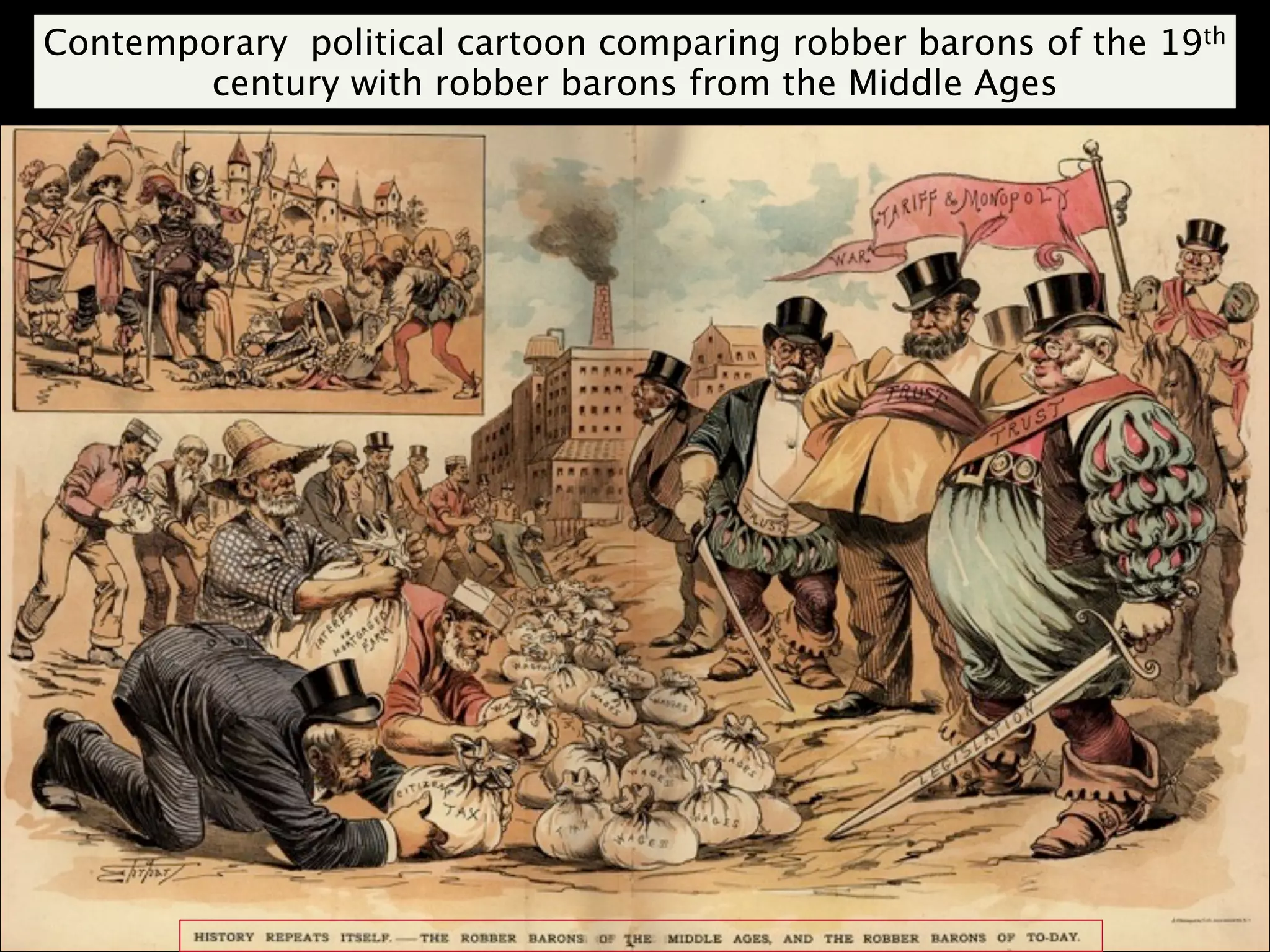
Contemporary political cartoon comparing robber barons of the 19th
        century with robber barons from the Middle Ages
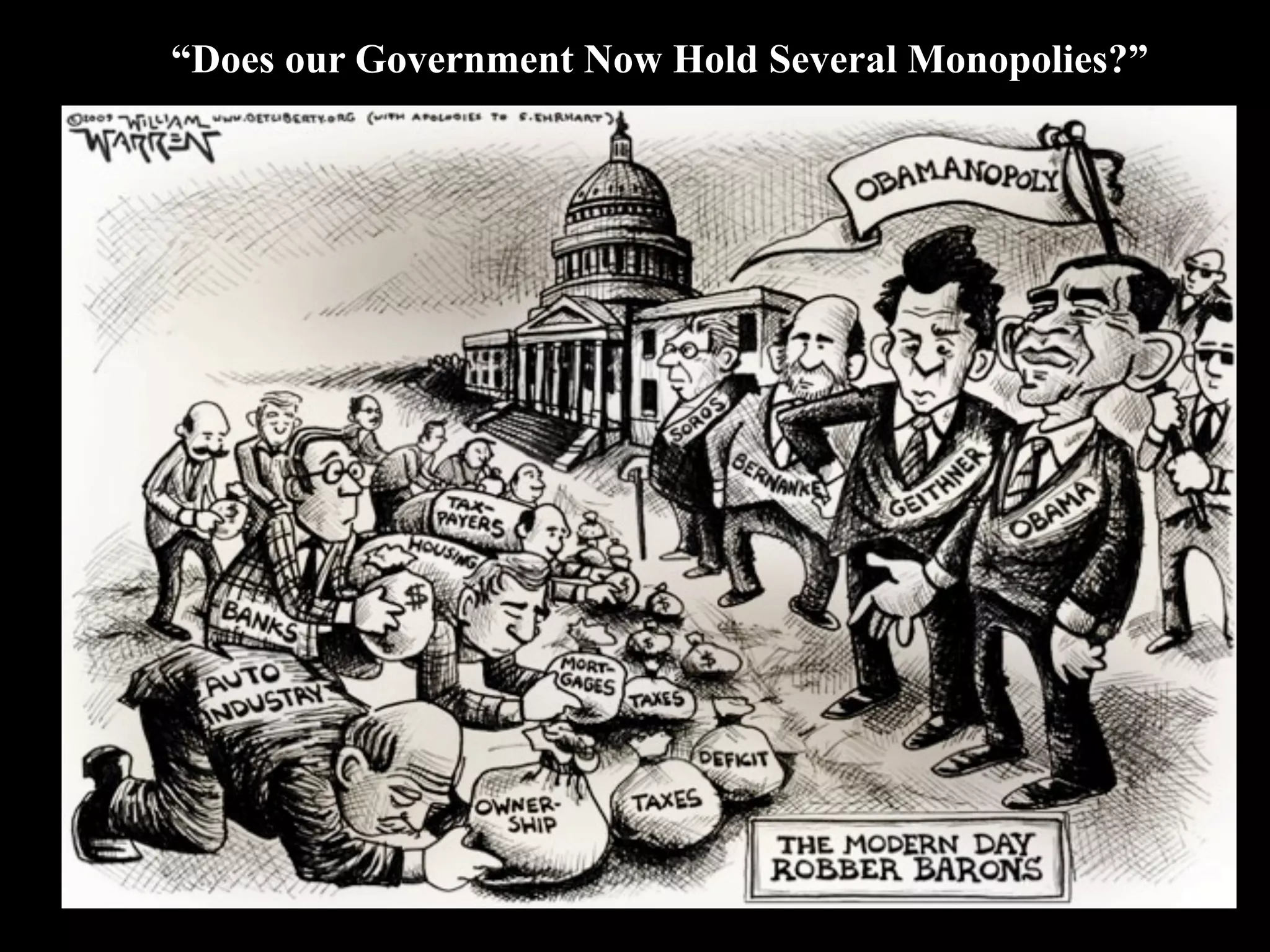
“Does our Government Now Hold Several Monopolies?”
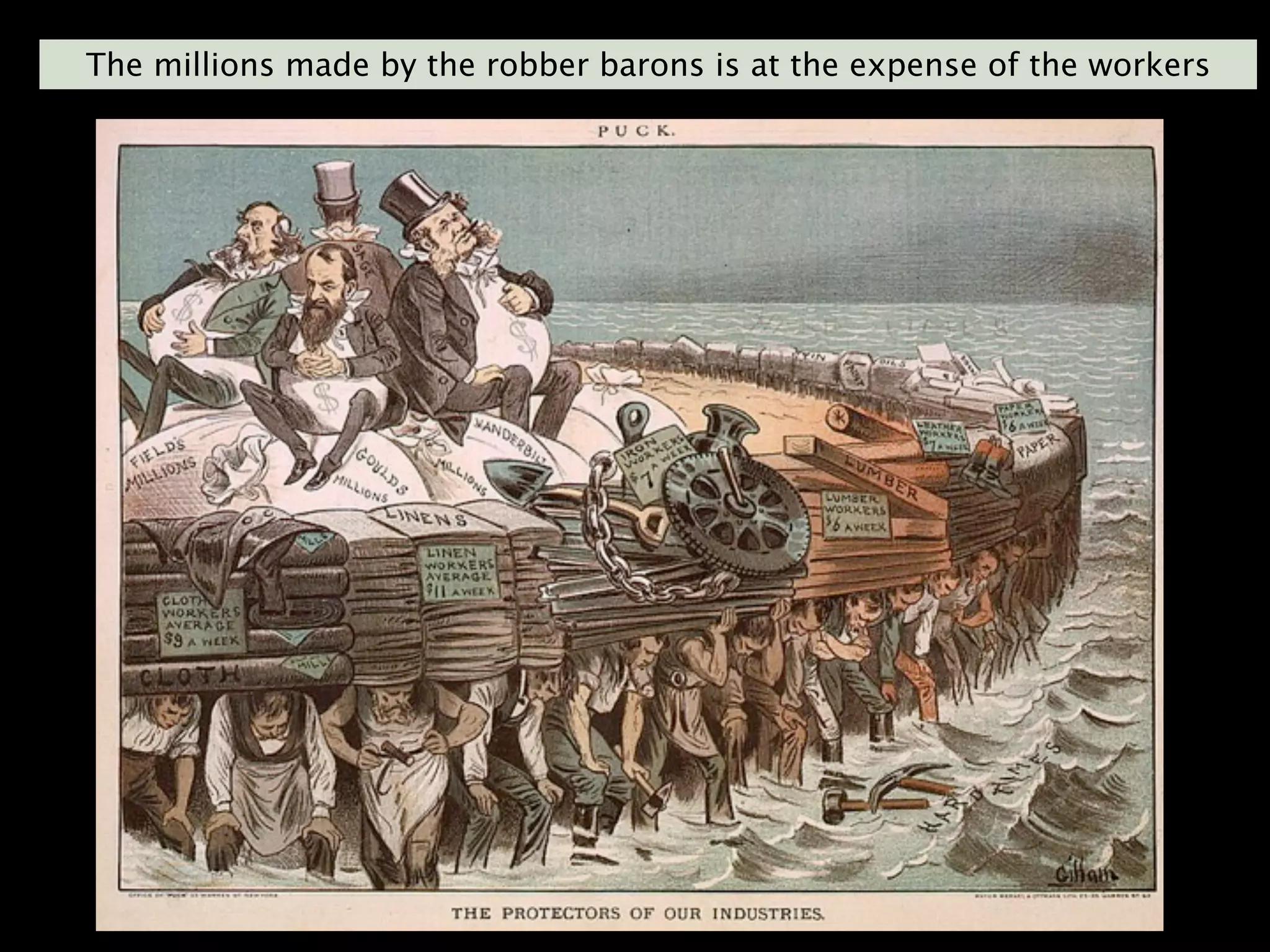
The millions made by the robber barons is at the expense of the workers
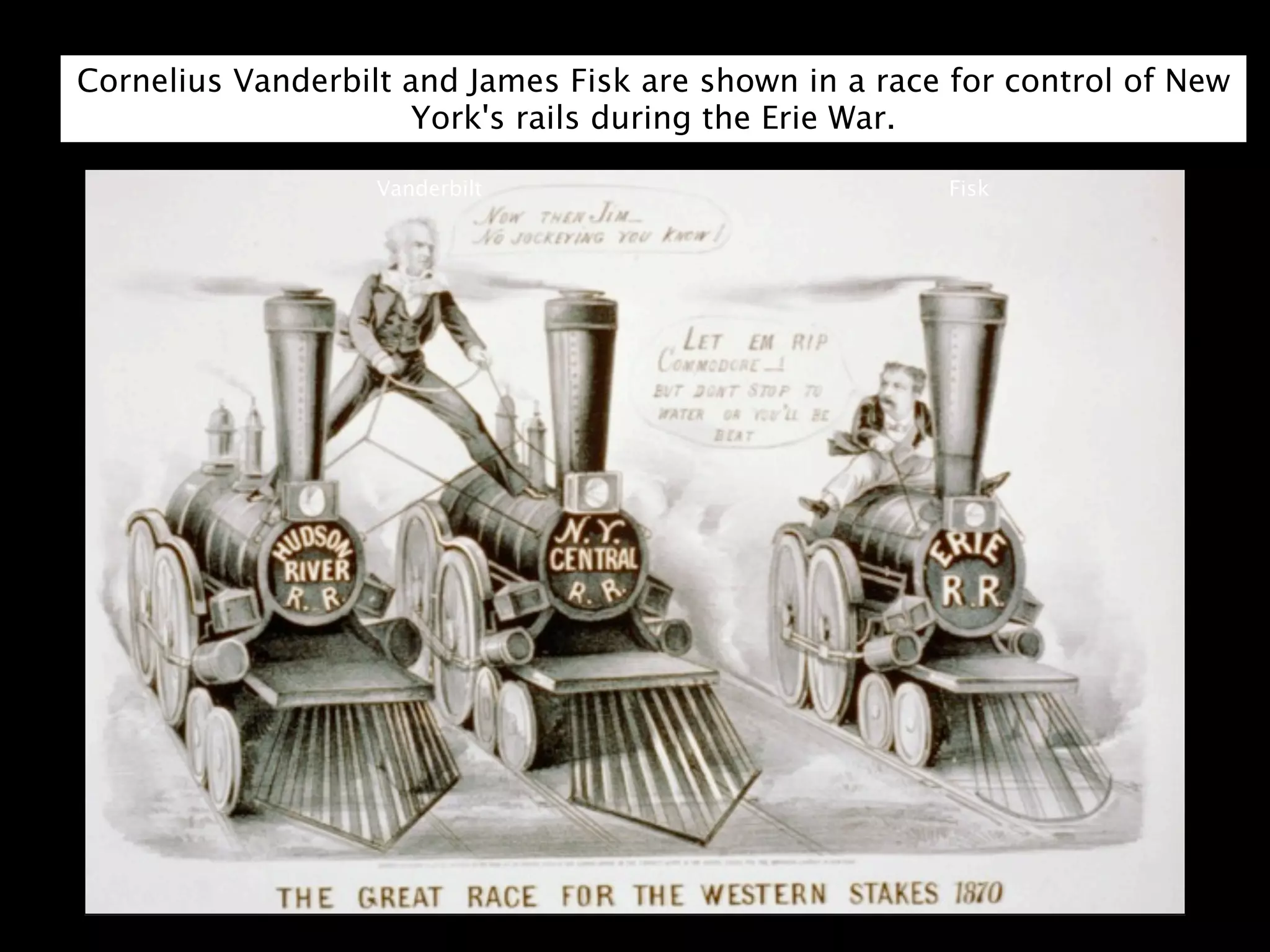
Cornelius Vanderbilt and James Fisk are shown in a race for control of New
                      York's rails during the Erie War.

                   Vanderbilt                          Fisk
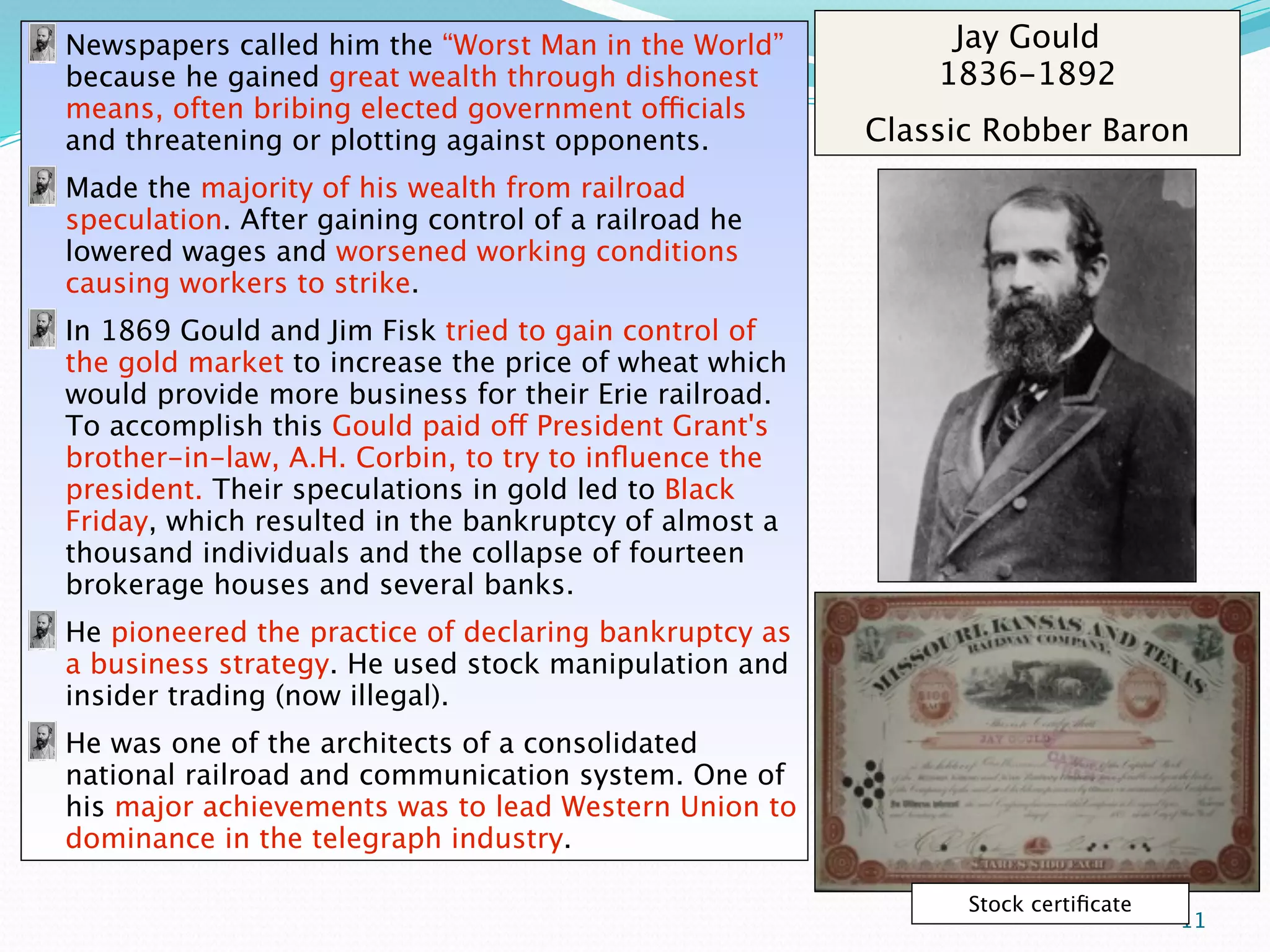
Newspapers called him the “Worst Man in the World”          Jay Gould
because he gained great wealth through dishonest           1836-1892
means, often bribing elected government officials
and threatening or plotting against opponents.         Classic Robber Baron
Made the majority of his wealth from railroad
speculation. After gaining control of a railroad he
lowered wages and worsened working conditions
causing workers to strike.
In 1869 Gould and Jim Fisk tried to gain control of
the gold market to increase the price of wheat which
would provide more business for their Erie railroad.
To accomplish this Gould paid off President Grant's
brother-in-law, A.H. Corbin, to try to influence the
president. Their speculations in gold led to Black
Friday, which resulted in the bankruptcy of almost a
thousand individuals and the collapse of fourteen
brokerage houses and several banks.
He pioneered the practice of declaring bankruptcy as
a business strategy. He used stock manipulation and
insider trading (now illegal).
He was one of the architects of a consolidated
national railroad and communication system. One of
his major achievements was to lead Western Union to
dominance in the telegraph industry.

                                                             Stock certificate
                                                                                11
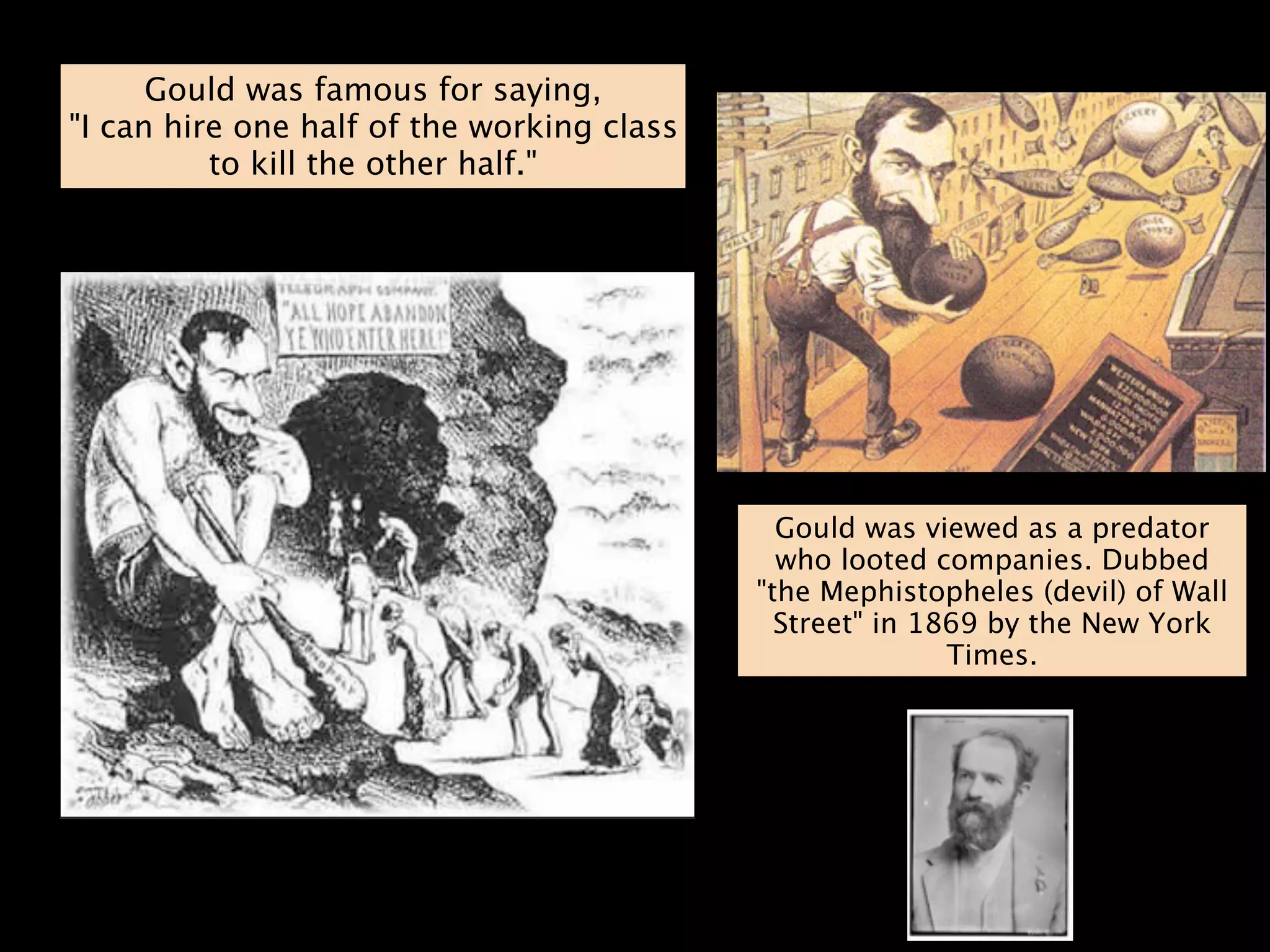
Gould was famous for saying,
"I can hire one half of the working class
          to kill the other half."


                                              Gould was viewed as a predator
                                              who looted companies. Dubbed
                                            "the Mephistopheles (devil) of Wall
                                              Street" in 1869 by the New York
                                                           Times.
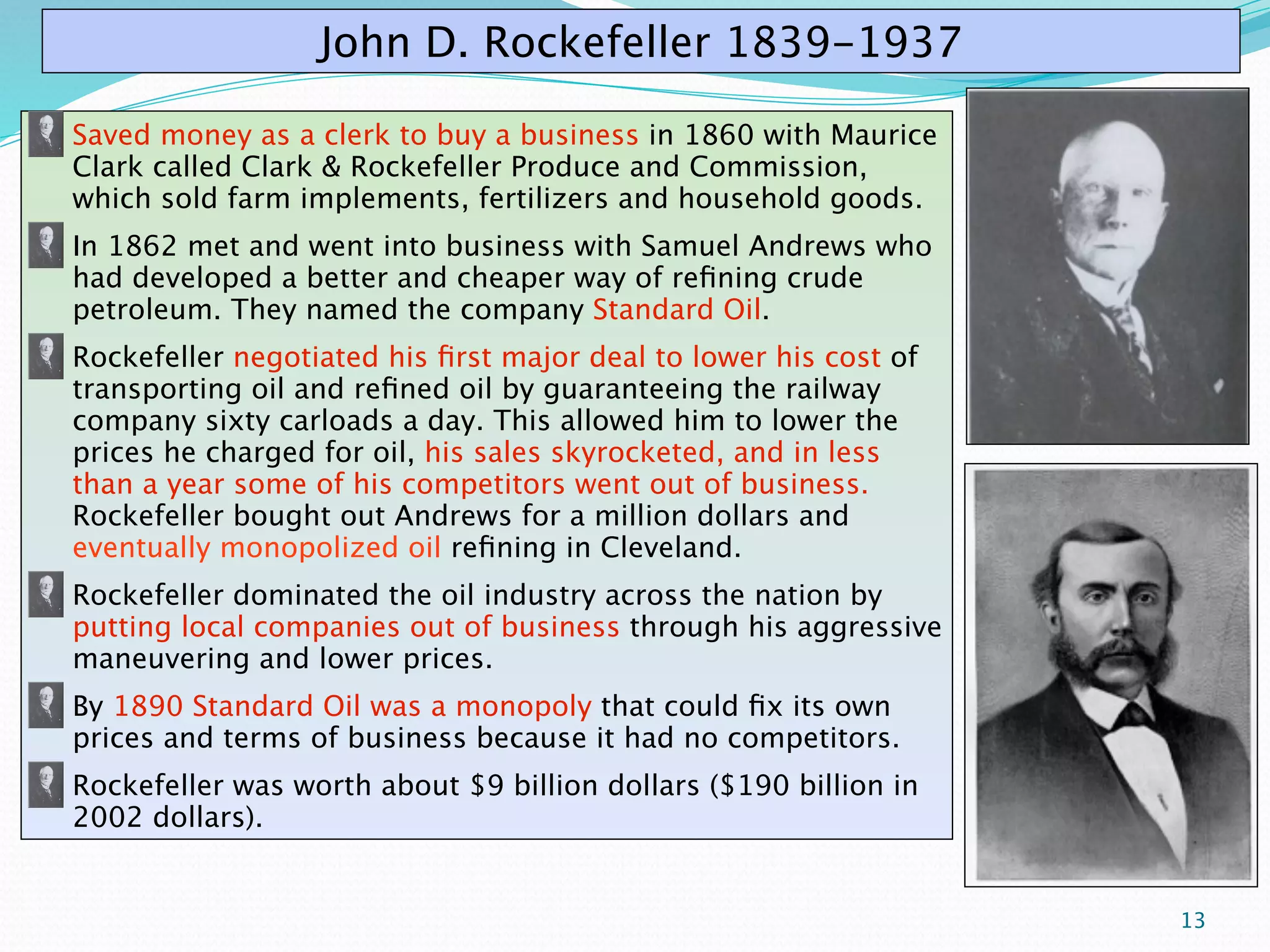
John D. Rockefeller 1839-1937

Saved money as a clerk to buy a business in 1860 with Maurice
Clark called Clark & Rockefeller Produce and Commission,
which sold farm implements, fertilizers and household goods.
In 1862 met and went into business with Samuel Andrews who
had developed a better and cheaper way of refining crude
petroleum. They named the company Standard Oil.
Rockefeller negotiated his first major deal to lower his cost of
transporting oil and refined oil by guaranteeing the railway
company sixty carloads a day. This allowed him to lower the
prices he charged for oil, his sales skyrocketed, and in less
than a year some of his competitors went out of business.
Rockefeller bought out Andrews for a million dollars and
eventually monopolized oil refining in Cleveland.
Rockefeller dominated the oil industry across the nation by
putting local companies out of business through his aggressive
maneuvering and lower prices.
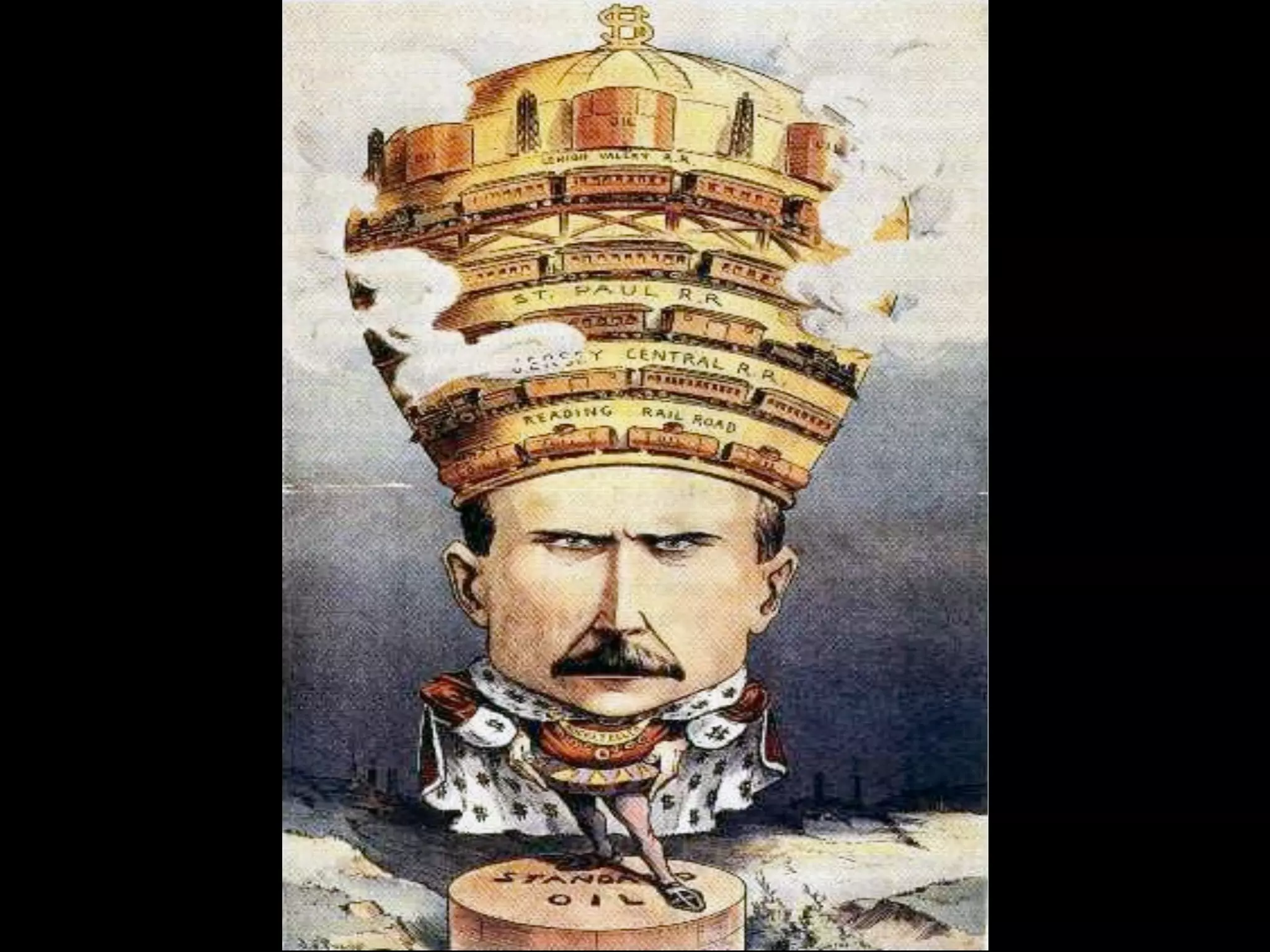
By 1890 Standard Oil was a monopoly that could fix its own
prices and terms of business because it had no competitors.
Rockefeller was worth about $9 billion dollars ($190 billion in
2002 dollars).


                                                                  13
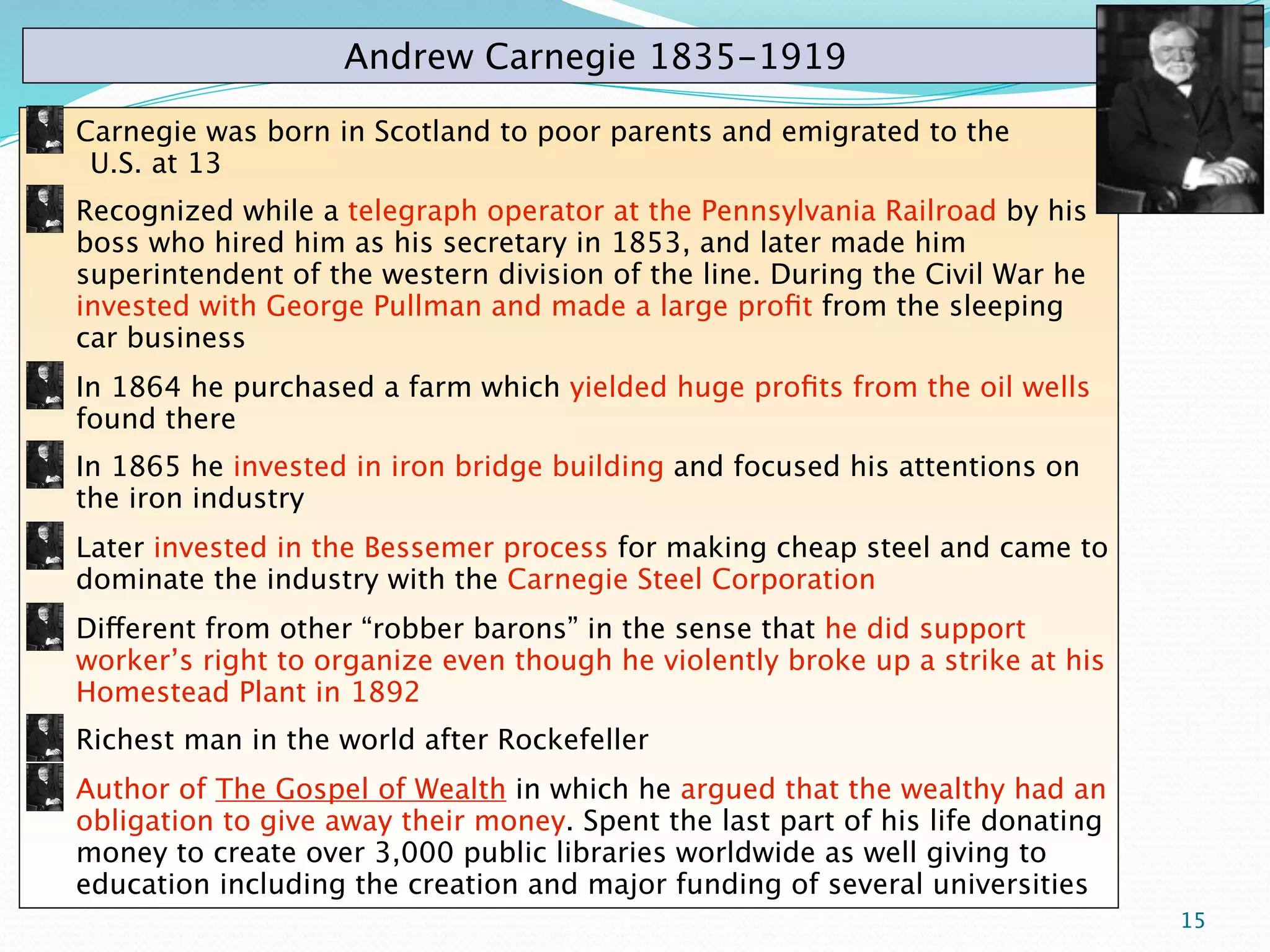
Andrew Carnegie 1835-1919

Carnegie was born in Scotland to poor parents and emigrated to the
 U.S. at 13
Recognized while a telegraph operator at the Pennsylvania Railroad by his
boss who hired him as his secretary in 1853, and later made him
superintendent of the western division of the line. During the Civil War he
invested with George Pullman and made a large profit from the sleeping
car business
In 1864 he purchased a farm which yielded huge profits from the oil wells
found there
In 1865 he invested in iron bridge building and focused his attentions on
the iron industry
Later invested in the Bessemer process for making cheap steel and came to
dominate the industry with the Carnegie Steel Corporation
Different from other “robber barons” in the sense that he did support
worker’s right to organize even though he violently broke up a strike at his
Homestead Plant in 1892
Richest man in the world after Rockefeller
Author of The Gospel of Wealth in which he argued that the wealthy had an
obligation to give away their money. Spent the last part of his life donating
money to create over 3,000 public libraries worldwide as well giving to
education including the creation and major funding of several universities
                                                                                15
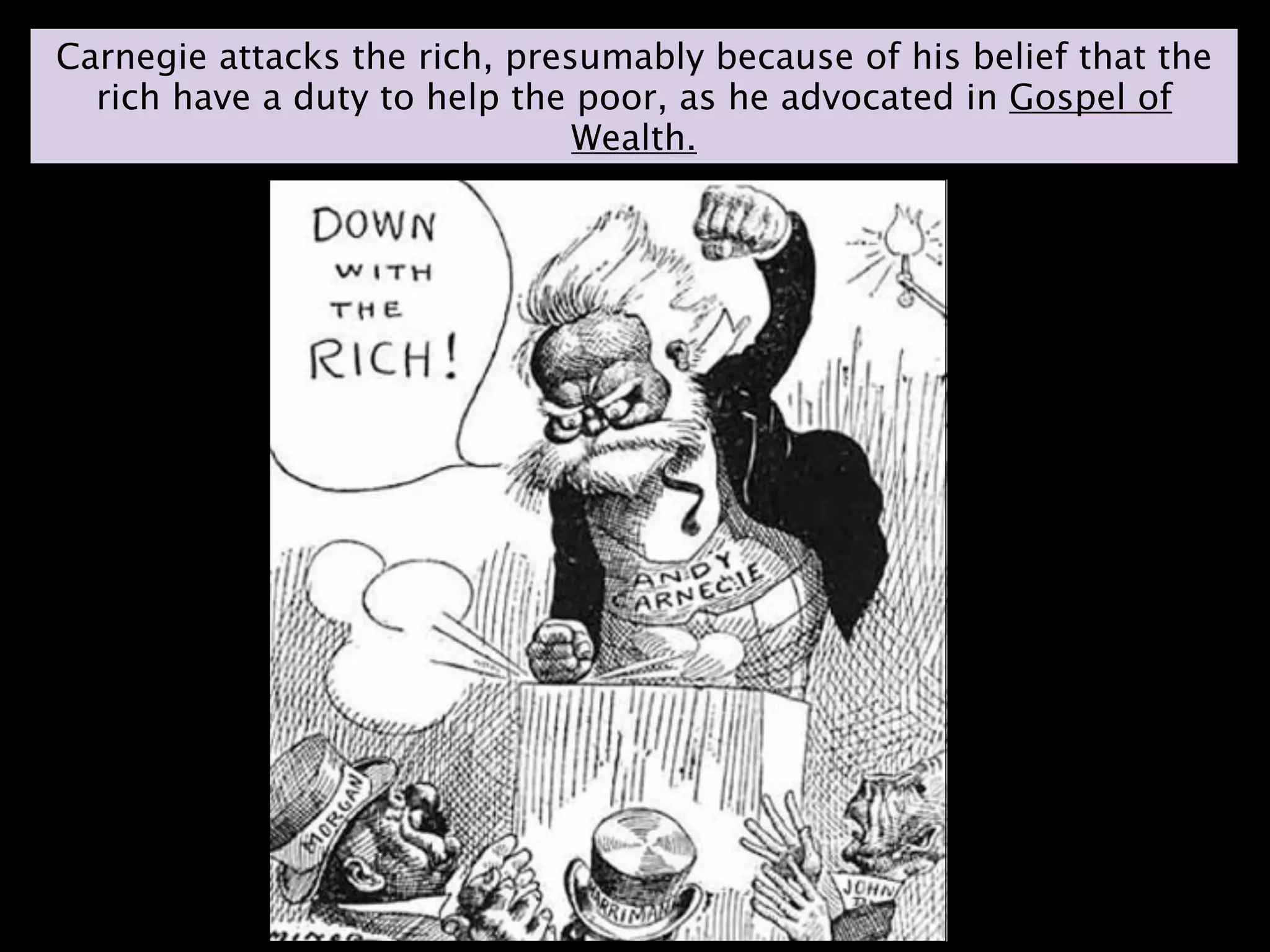
Carnegie attacks the rich, presumably because of his belief that the
  rich have a duty to help the poor, as he advocated in Gospel of
                               Wealth.
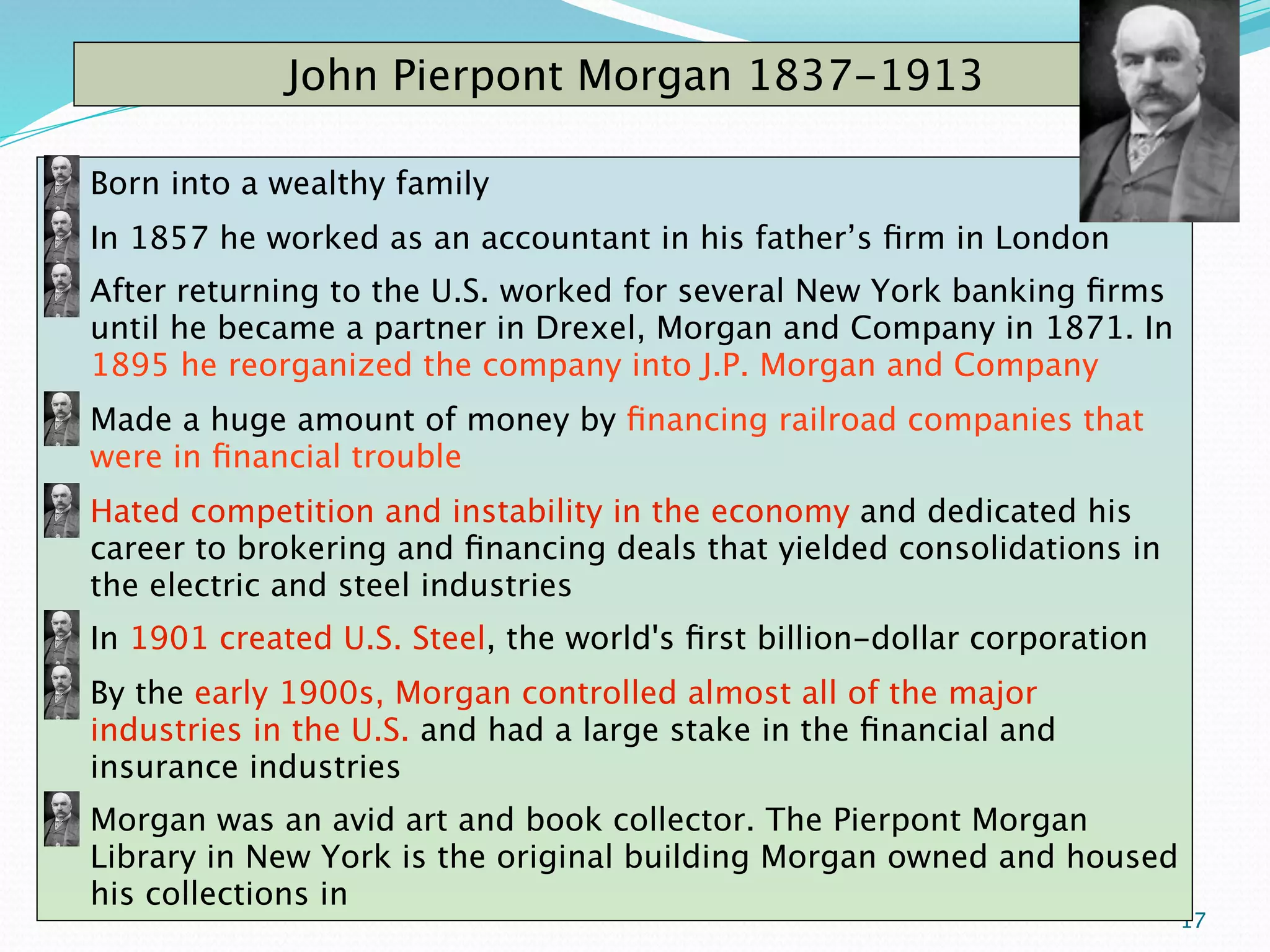
John Pierpont Morgan 1837-1913

Born into a wealthy family
In 1857 he worked as an accountant in his father’s firm in London
After returning to the U.S. worked for several New York banking firms
until he became a partner in Drexel, Morgan and Company in 1871. In
1895 he reorganized the company into J.P. Morgan and Company
Made a huge amount of money by financing railroad companies that
were in financial trouble
Hated competition and instability in the economy and dedicated his
career to brokering and financing deals that yielded consolidations in
the electric and steel industries
In 1901 created U.S. Steel, the world's first billion-dollar corporation
By the early 1900s, Morgan controlled almost all of the major
industries in the U.S. and had a large stake in the financial and
insurance industries
Morgan was an avid art and book collector. The Pierpont Morgan
Library in New York is the original building Morgan owned and housed
his collections in
                                                                          17
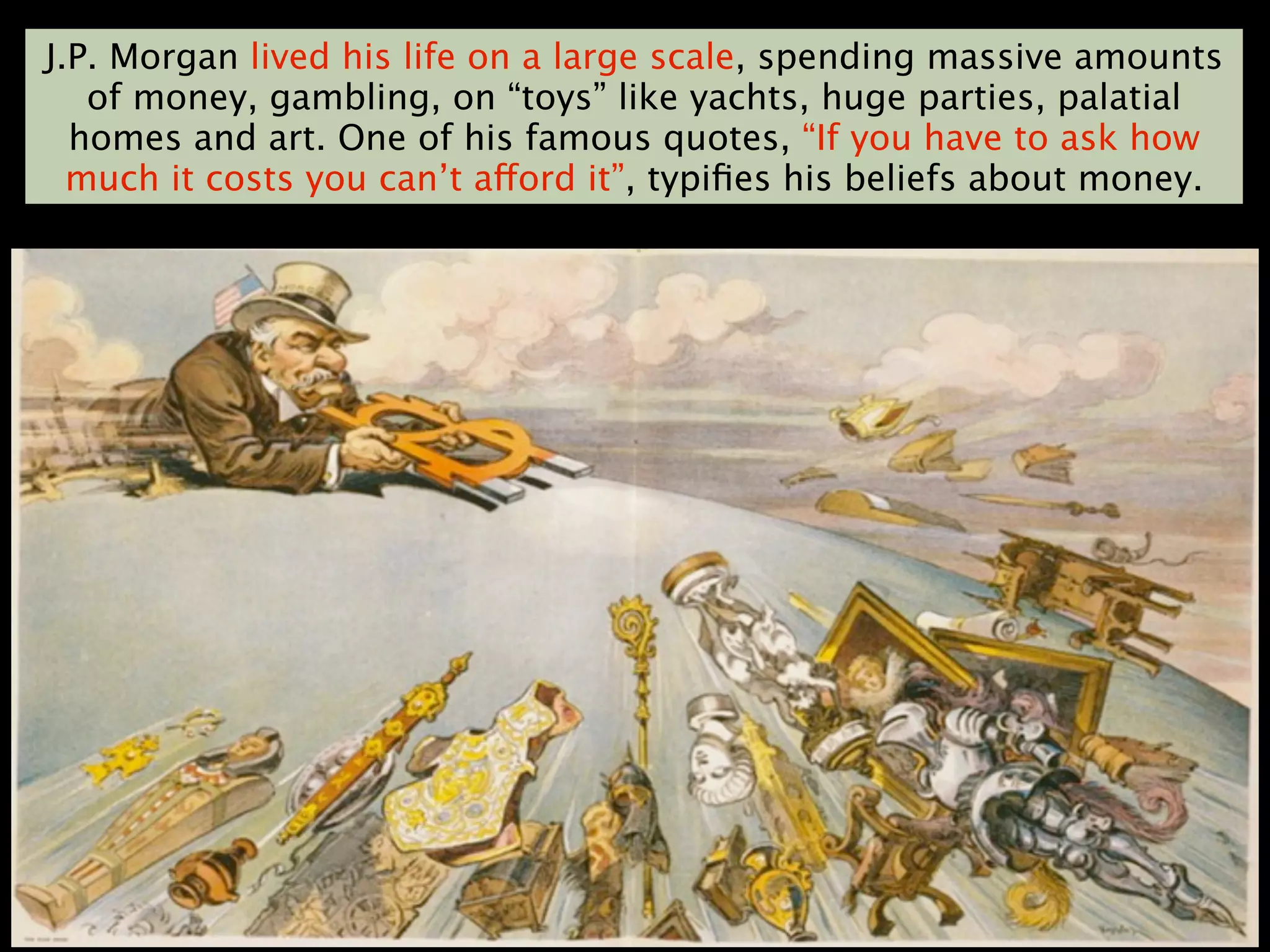
J.P. Morgan lived his life on a large scale, spending massive amounts
   of money, gambling, on “toys” like yachts, huge parties, palatial
  homes and art. One of his famous quotes, “If you have to ask how
  much it costs you can’t afford it”, typifies his beliefs about money.
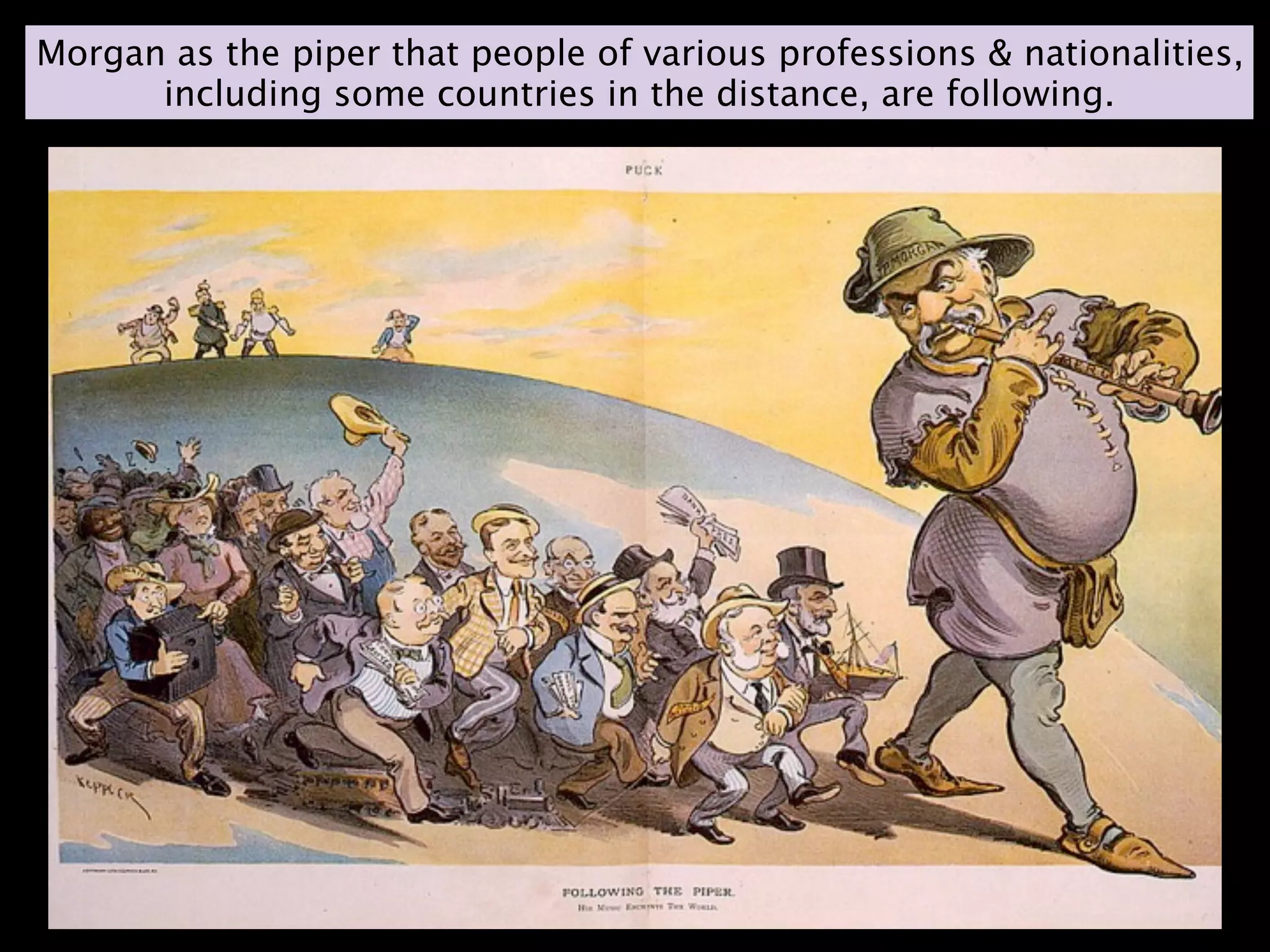
Morgan as the piper that people of various professions & nationalities,
      including some countries in the distance, are following.
Robber Barons or Captains of Industry?

   In your opinion which of the men
      we talked about today were
    “Robber Barons” and which were
        “Captains of Industry”?

Robber baronsor captainsofindustryppt

  • 1.
    Quick-write “This, then, isheld to be the duty of the man of wealth: First, to set an example of modest, unostentatious living, shunning display or extravagance; … and, after doing so, to consider all surplus [extra] revenues [profit] which come to him simply as trust funds, which he is called upon to administer… to produce the most beneficial results for the community—the man of wealth thus becoming the mere trustee [authority over] and agent for his poorer brethren, bringing to their service his superior wisdom, experience and ability to administer, doing for them better than they would or could do for themselves.” —From "Wealth", Andrew Carnegie, North American Review (1889) Do you agree with this statement? Why? Explain. Does this differ from your personal view on your responsibility to your community? Do you believe we have a responsibility to our community and fellow human?
  • 2.
    Robber Barons OR Captainsof Industry “The Good, The Bad, and The Ugly” Start of the Corporation
  • 3.
    Robber Baron or Captain of Industry  Determine whether the figure is a robber baron or captain industry or something in-between?  Think about which of the individuals’ actions were those of a captain of industry? Or of a robber baron? 3
  • 4.
    Wealthy business leadersin the 19th century were glamorized or villanized One view glorified their abilities and contributions 1. "Captains of Industry” Industrial leaders were viewed as ingenious and industrious capitalists who transformed the American economy with their business skills. These "Captains" were the heroes of their day who embodied the American dream of rags to riches. A second view questioned their tactics and ethics 2. "Robber Barons” Industrial leaders were viewed as immoral, greedy, and corrupt, using bribery, illegal business practices, and cruelty to workers to get ahead. Many of the most respected industrialists were also feared and hated. While not all of these men were unethical, many used questionable tactics to achieve their goals of wealth and power. 4
  • 5.
    Robber Barons Robber Baron is an insult term used to describe a class of enormously rich businessmen that emerged in the post civil war era. Today they would be known as billionaires. They were both admired and hated at the time. They used ruthless, immoral, and often illegal methods to create monopolies and develop overwhelming economic power and control over their industries. In the late 1800’s a handful of these businessmen controlled over 90 percent of total U.S. wealth. Some of the more commonly known industrial leaders and bankers who were called Robber Barons include: 300 279  Andrew Carnegie 225  John D. Rockefeller 1865 1900  Cornelius and William Vanderbilt 150 2004  Jay Gould 75  J. Pierpont Morgan 22 3  Jim Fisk 0 Total number of billionaires  Daniel Drew Chart shows the comparison in the number of billionaires from 1865 through 2004 5
  • 6.
    How rich werethe “robber barons” compared to Microsoft founder Bill Gates? 200 150 Rockefeller Carnegie Vanderbilt 100 Bill Gates Jay Gould JP Morgan 50 James H. Hill 0 $ billions $ 6
  • 7.
    Contemporary political cartooncomparing robber barons of the 19th century with robber barons from the Middle Ages
  • 8.
    “Does our GovernmentNow Hold Several Monopolies?”
  • 9.
    The millions madeby the robber barons is at the expense of the workers
  • 10.
    Cornelius Vanderbilt andJames Fisk are shown in a race for control of New York's rails during the Erie War. Vanderbilt Fisk
  • 11.
    Newspapers called himthe “Worst Man in the World” Jay Gould because he gained great wealth through dishonest 1836-1892 means, often bribing elected government officials and threatening or plotting against opponents. Classic Robber Baron Made the majority of his wealth from railroad speculation. After gaining control of a railroad he lowered wages and worsened working conditions causing workers to strike. In 1869 Gould and Jim Fisk tried to gain control of the gold market to increase the price of wheat which would provide more business for their Erie railroad. To accomplish this Gould paid off President Grant's brother-in-law, A.H. Corbin, to try to influence the president. Their speculations in gold led to Black Friday, which resulted in the bankruptcy of almost a thousand individuals and the collapse of fourteen brokerage houses and several banks. He pioneered the practice of declaring bankruptcy as a business strategy. He used stock manipulation and insider trading (now illegal). He was one of the architects of a consolidated national railroad and communication system. One of his major achievements was to lead Western Union to dominance in the telegraph industry. Stock certificate 11
  • 12.
    Gould was famousfor saying, "I can hire one half of the working class to kill the other half." Gould was viewed as a predator who looted companies. Dubbed "the Mephistopheles (devil) of Wall Street" in 1869 by the New York Times.
  • 13.
    John D. Rockefeller1839-1937 Saved money as a clerk to buy a business in 1860 with Maurice Clark called Clark & Rockefeller Produce and Commission, which sold farm implements, fertilizers and household goods. In 1862 met and went into business with Samuel Andrews who had developed a better and cheaper way of refining crude petroleum. They named the company Standard Oil. Rockefeller negotiated his first major deal to lower his cost of transporting oil and refined oil by guaranteeing the railway company sixty carloads a day. This allowed him to lower the prices he charged for oil, his sales skyrocketed, and in less than a year some of his competitors went out of business. Rockefeller bought out Andrews for a million dollars and eventually monopolized oil refining in Cleveland. Rockefeller dominated the oil industry across the nation by putting local companies out of business through his aggressive maneuvering and lower prices. By 1890 Standard Oil was a monopoly that could fix its own prices and terms of business because it had no competitors. Rockefeller was worth about $9 billion dollars ($190 billion in 2002 dollars). 13
  • 15.
    Andrew Carnegie 1835-1919 Carnegiewas born in Scotland to poor parents and emigrated to the U.S. at 13 Recognized while a telegraph operator at the Pennsylvania Railroad by his boss who hired him as his secretary in 1853, and later made him superintendent of the western division of the line. During the Civil War he invested with George Pullman and made a large profit from the sleeping car business In 1864 he purchased a farm which yielded huge profits from the oil wells found there In 1865 he invested in iron bridge building and focused his attentions on the iron industry Later invested in the Bessemer process for making cheap steel and came to dominate the industry with the Carnegie Steel Corporation Different from other “robber barons” in the sense that he did support worker’s right to organize even though he violently broke up a strike at his Homestead Plant in 1892 Richest man in the world after Rockefeller Author of The Gospel of Wealth in which he argued that the wealthy had an obligation to give away their money. Spent the last part of his life donating money to create over 3,000 public libraries worldwide as well giving to education including the creation and major funding of several universities 15
  • 16.
    Carnegie attacks therich, presumably because of his belief that the rich have a duty to help the poor, as he advocated in Gospel of Wealth.
  • 17.
    John Pierpont Morgan1837-1913 Born into a wealthy family In 1857 he worked as an accountant in his father’s firm in London After returning to the U.S. worked for several New York banking firms until he became a partner in Drexel, Morgan and Company in 1871. In 1895 he reorganized the company into J.P. Morgan and Company Made a huge amount of money by financing railroad companies that were in financial trouble Hated competition and instability in the economy and dedicated his career to brokering and financing deals that yielded consolidations in the electric and steel industries In 1901 created U.S. Steel, the world's first billion-dollar corporation By the early 1900s, Morgan controlled almost all of the major industries in the U.S. and had a large stake in the financial and insurance industries Morgan was an avid art and book collector. The Pierpont Morgan Library in New York is the original building Morgan owned and housed his collections in 17
  • 18.
    J.P. Morgan livedhis life on a large scale, spending massive amounts of money, gambling, on “toys” like yachts, huge parties, palatial homes and art. One of his famous quotes, “If you have to ask how much it costs you can’t afford it”, typifies his beliefs about money.
  • 19.
    Morgan as thepiper that people of various professions & nationalities, including some countries in the distance, are following.
  • 20.
    Robber Barons orCaptains of Industry?  In your opinion which of the men we talked about today were “Robber Barons” and which were “Captains of Industry”?