A SURVEY OF
AMERICAN HISTORY
Unit 2: Westward Expansion and Civil War

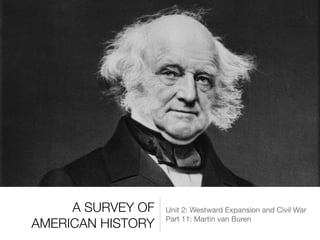
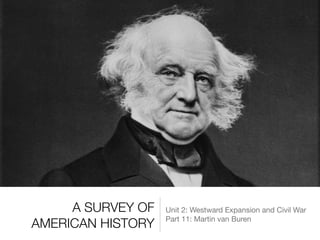
Part 11: Martin van Buren
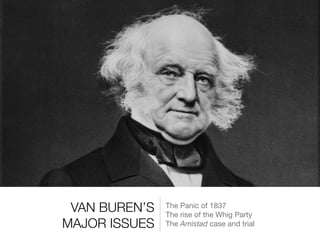
VAN BUREN’S

MAJOR ISSUES
The Panic of 1837

The rise of the Whig Party

The Amistad case and trial
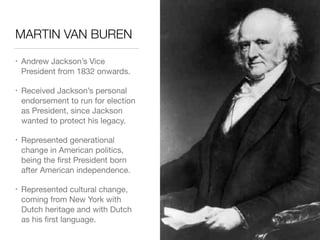
MARTIN VAN BUREN
• Andrew Jackson’s Vice
President from 1832 onwards.

• Received Jackson’s personal
endorsement to run for election
as President, since Jackson
wanted to protect his legacy.

• Represented generational
change in American politics,
being the first President born
after American independence.

• Represented cultural change,
coming from New York with
Dutch heritage and with Dutch
as his first language.
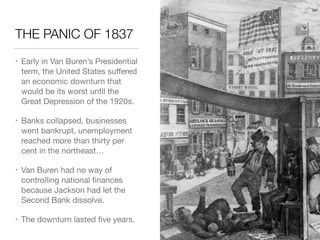
THE PANIC OF 1837
• Early in Van Buren’s Presidential
term, the United States suffered
an economic downturn that
would be its worst until the
Great Depression of the 1920s.

• Banks collapsed, businesses
went bankrupt, unemployment
reached more than thirty per
cent in the northeast…

• Van Buren had no way of
controlling national finances
because Jackson had let the
Second Bank dissolve.

• The downturn lasted five years.
THE LAND OF
OPPORTUNITY
• To help alleviate the pain of the
economic downturn, some
people began looking towards
the unsettled lands of the West.

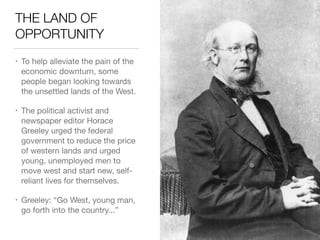
• The political activist and
newspaper editor Horace
Greeley urged the federal
government to reduce the price
of western lands and urged
young, unemployed men to
move west and start new, self-
reliant lives for themselves.

• Greeley: “Go West, young man,
go forth into the country...”
THE LAND OF
OPPORTUNITY
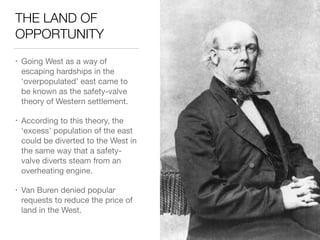
• Going West as a way of
escaping hardships in the
‘overpopulated’ east came to
be known as the safety-valve
theory of Western settlement.

• According to this theory, the
‘excess’ population of the east
could be diverted to the West in
the same way that a safety-
valve diverts steam from an
overheating engine.

• Van Buren denied popular
requests to reduce the price of
land in the West.
MEANWHILE,

IN MEXICO...
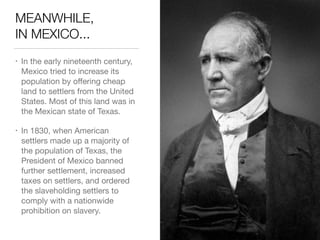
• In the early nineteenth century,
Mexico tried to increase its
population by offering cheap
land to settlers from the United
States. Most of this land was in
the Mexican state of Texas.

• In 1830, when American

settlers made up a majority of
the population of Texas, the
President of Mexico banned
further settlement, increased
taxes on settlers, and ordered
the slaveholding settlers to
comply with a nationwide
prohibition on slavery.
MEANWHILE,

IN MEXICO...
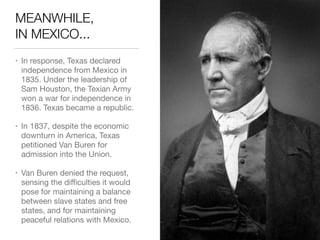
• In response, Texas declared
independence from Mexico in
1835. Under the leadership of
Sam Houston, the Texian Army
won a war for independence in
1836. Texas became a republic.

• In 1837, despite the economic
downturn in America, Texas
petitioned Van Buren for
admission into the Union.

• Van Buren denied the request,
sensing the difficulties it would
pose for maintaining a balance
between slave states and free
states, and for maintaining
peaceful relations with Mexico.
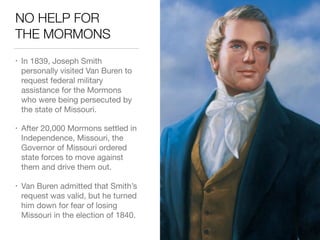
NO HELP FOR

THE MORMONS
• In 1839, Joseph Smith
personally visited Van Buren to
request federal military
assistance for the Mormons
who were being persecuted by
the state of Missouri.

• After 20,000 Mormons settled in
Independence, Missouri, the
Governor of Missouri ordered
state forces to move against
them and drive them out.

• Van Buren admitted that Smith’s
request was valid, but he turned
him down for fear of losing
Missouri in the election of 1840.
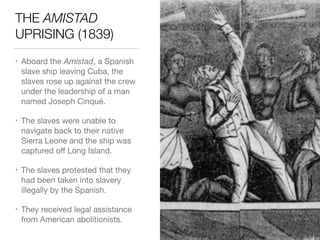
THE AMISTAD
UPRISING (1839)
• Aboard the Amistad, a Spanish
slave ship leaving Cuba, the
slaves rose up against the crew
under the leadership of a man
named Joseph Cinqué.

• The slaves were unable to
navigate back to their native
Sierra Leone and the ship was
captured off Long Island.

• The slaves protested that they
had been taken into slavery
illegally by the Spanish.

• They received legal assistance
from American abolitionists.
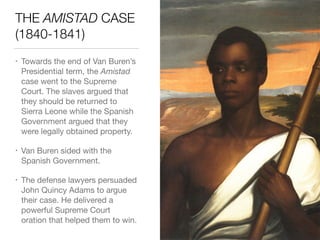
THE AMISTAD CASE
(1840-1841)
• Towards the end of Van Buren’s
Presidential term, the Amistad
case went to the Supreme
Court. The slaves argued that
they should be returned to
Sierra Leone while the Spanish
Government argued that they
were legally obtained property.

• Van Buren sided with the
Spanish Government.

• The defense lawyers persuaded
John Quincy Adams to argue
their case. He delivered a
powerful Supreme Court
oration that helped them to win.
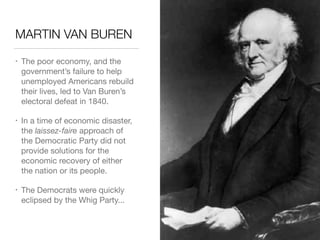
MARTIN VAN BUREN
• The poor economy, and the
government’s failure to help
unemployed Americans rebuild
their lives, led to Van Buren’s
electoral defeat in 1840.

• In a time of economic disaster,
the laissez-faire approach of 

the Democratic Party did not
provide solutions for the
economic recovery of either 

the nation or its people.

• The Democrats were quickly
eclipsed by the Whig Party...
A SURVEY OF
AMERICAN HISTORY
Unit 2: Westward Expansion and Civil War

Part 11: Martin van Buren

31 Martin van Buren

  • 1.
    A SURVEY OF AMERICANHISTORY Unit 2: Westward Expansion and Civil War Part 11: Martin van Buren
  • 2.
    VAN BUREN’S
 MAJOR ISSUES ThePanic of 1837 The rise of the Whig Party The Amistad case and trial
  • 3.
    MARTIN VAN BUREN •Andrew Jackson’s Vice President from 1832 onwards. • Received Jackson’s personal endorsement to run for election as President, since Jackson wanted to protect his legacy. • Represented generational change in American politics, being the first President born after American independence. • Represented cultural change, coming from New York with Dutch heritage and with Dutch as his first language.
  • 4.
    THE PANIC OF1837 • Early in Van Buren’s Presidential term, the United States suffered an economic downturn that would be its worst until the Great Depression of the 1920s. • Banks collapsed, businesses went bankrupt, unemployment reached more than thirty per cent in the northeast… • Van Buren had no way of controlling national finances because Jackson had let the Second Bank dissolve. • The downturn lasted five years.
  • 5.
    THE LAND OF OPPORTUNITY •To help alleviate the pain of the economic downturn, some people began looking towards the unsettled lands of the West. • The political activist and newspaper editor Horace Greeley urged the federal government to reduce the price of western lands and urged young, unemployed men to move west and start new, self- reliant lives for themselves. • Greeley: “Go West, young man, go forth into the country...”
  • 6.
    THE LAND OF OPPORTUNITY •Going West as a way of escaping hardships in the ‘overpopulated’ east came to be known as the safety-valve theory of Western settlement. • According to this theory, the ‘excess’ population of the east could be diverted to the West in the same way that a safety- valve diverts steam from an overheating engine. • Van Buren denied popular requests to reduce the price of land in the West.
  • 7.
    MEANWHILE,
 IN MEXICO... • Inthe early nineteenth century, Mexico tried to increase its population by offering cheap land to settlers from the United States. Most of this land was in the Mexican state of Texas. • In 1830, when American
 settlers made up a majority of the population of Texas, the President of Mexico banned further settlement, increased taxes on settlers, and ordered the slaveholding settlers to comply with a nationwide prohibition on slavery.
  • 8.
    MEANWHILE,
 IN MEXICO... • Inresponse, Texas declared independence from Mexico in 1835. Under the leadership of Sam Houston, the Texian Army won a war for independence in 1836. Texas became a republic. • In 1837, despite the economic downturn in America, Texas petitioned Van Buren for admission into the Union. • Van Buren denied the request, sensing the difficulties it would pose for maintaining a balance between slave states and free states, and for maintaining peaceful relations with Mexico.
  • 9.
    NO HELP FOR
 THEMORMONS • In 1839, Joseph Smith personally visited Van Buren to request federal military assistance for the Mormons who were being persecuted by the state of Missouri. • After 20,000 Mormons settled in Independence, Missouri, the Governor of Missouri ordered state forces to move against them and drive them out. • Van Buren admitted that Smith’s request was valid, but he turned him down for fear of losing Missouri in the election of 1840.
  • 10.
    THE AMISTAD UPRISING (1839) •Aboard the Amistad, a Spanish slave ship leaving Cuba, the slaves rose up against the crew under the leadership of a man named Joseph Cinqué. • The slaves were unable to navigate back to their native Sierra Leone and the ship was captured off Long Island. • The slaves protested that they had been taken into slavery illegally by the Spanish. • They received legal assistance from American abolitionists.
  • 11.
    THE AMISTAD CASE (1840-1841) •Towards the end of Van Buren’s Presidential term, the Amistad case went to the Supreme Court. The slaves argued that they should be returned to Sierra Leone while the Spanish Government argued that they were legally obtained property. • Van Buren sided with the Spanish Government. • The defense lawyers persuaded John Quincy Adams to argue their case. He delivered a powerful Supreme Court oration that helped them to win.
  • 12.
    MARTIN VAN BUREN •The poor economy, and the government’s failure to help unemployed Americans rebuild their lives, led to Van Buren’s electoral defeat in 1840. • In a time of economic disaster, the laissez-faire approach of 
 the Democratic Party did not provide solutions for the economic recovery of either 
 the nation or its people. • The Democrats were quickly eclipsed by the Whig Party...
  • 13.
    A SURVEY OF AMERICANHISTORY Unit 2: Westward Expansion and Civil War Part 11: Martin van Buren