A SURVEY OF
AMERICAN HISTORY
Unit 3: Reconstruction and Urbanization

Part 4: Ulysses S. Grant (II)
GRANT’S

MAJOR ISSUES
Immigration and the nativist backlash

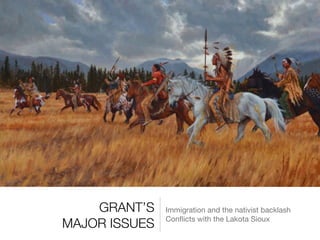
Conflicts with the Lakota Sioux
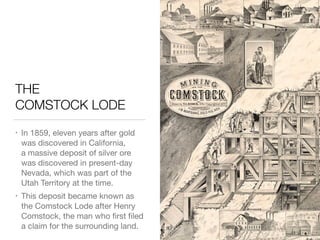
THE

COMSTOCK LODE
• In 1859, eleven years after gold
was discovered in California,

a massive deposit of silver ore
was discovered in present-day
Nevada, which was part of the
Utah Territory at the time.

• This deposit became known as
the Comstock Lode after Henry
Comstock, the man who first filed
a claim for the surrounding land.
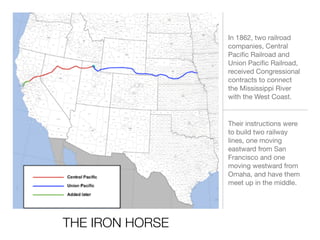
THE IRON HORSE
In 1862, two railroad
companies, Central
Pacific Railroad and
Union Pacific Railroad,
received Congressional
contracts to connect
the Mississippi River
with the West Coast.
Their instructions were
to build two railway
lines, one moving
eastward from San
Francisco and one
moving westward from
Omaha, and have them
meet up in the middle.
THE

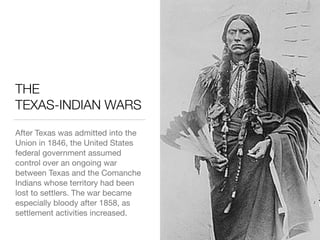
TEXAS-INDIAN WARS
After Texas was admitted into the
Union in 1846, the United States
federal government assumed
control over an ongoing war
between Texas and the Comanche
Indians whose territory had been
lost to settlers. The war became
especially bloody after 1858, as
settlement activities increased.
TRANSPORT, TREASURE, AND TRIBAL CONFLICTS
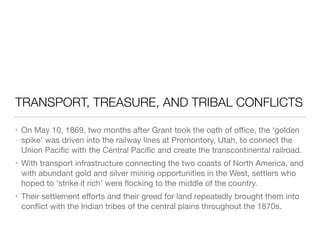
• On May 10, 1869, two months after Grant took the oath of office, the ‘golden
spike’ was driven into the railway lines at Promontory, Utah, to connect the
Union Pacific with the Central Pacific and create the transcontinental railroad.

• With transport infrastructure connecting the two coasts of North America, and
with abundant gold and silver mining opportunities in the West, settlers who
hoped to ‘strike it rich’ were flocking to the middle of the country.

• Their settlement efforts and their greed for land repeatedly brought them into
conflict with the Indian tribes of the central plains throughout the 1870s.
GEORGE ARMSTRONG
CUSTER
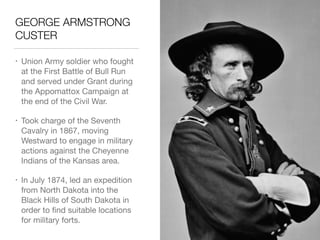
• Union Army soldier who fought
at the First Battle of Bull Run
and served under Grant during
the Appomattox Campaign at
the end of the Civil War.

• Took charge of the Seventh
Cavalry in 1867, moving
Westward to engage in military
actions against the Cheyenne
Indians of the Kansas area.

• In July 1874, led an expedition
from North Dakota into the
Black Hills of South Dakota in
order to find suitable locations
for military forts.
A GOLD RUSH IN
SOUTH DAKOTA
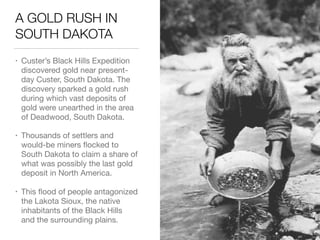
• Custer’s Black Hills Expedition
discovered gold near present-
day Custer, South Dakota. The
discovery sparked a gold rush
during which vast deposits of
gold were unearthed in the area
of Deadwood, South Dakota.

• Thousands of settlers and
would-be miners flocked to
South Dakota to claim a share of
what was possibly the last gold
deposit in North America.

• This flood of people antagonized
the Lakota Sioux, the native
inhabitants of the Black Hills
and the surrounding plains.
GRANT’S INDIAN
POLICY
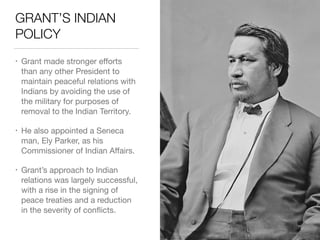
• Grant made stronger efforts
than any other President to
maintain peaceful relations with
Indians by avoiding the use of
the military for purposes of
removal to the Indian Territory.

• He also appointed a Seneca
man, Ely Parker, as his
Commissioner of Indian Affairs.

• Grant’s approach to Indian
relations was largely successful,
with a rise in the signing of
peace treaties and a reduction
in the severity of conflicts.
THE LAKOTA SIOUX
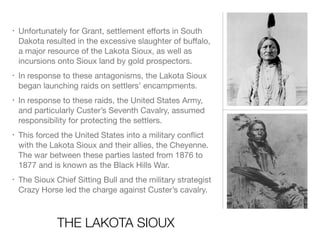
• Unfortunately for Grant, settlement efforts in South
Dakota resulted in the excessive slaughter of buffalo,

a major resource of the Lakota Sioux, as well as
incursions onto Sioux land by gold prospectors.

• In response to these antagonisms, the Lakota Sioux
began launching raids on settlers’ encampments.

• In response to these raids, the United States Army,
and particularly Custer’s Seventh Cavalry, assumed
responsibility for protecting the settlers.

• This forced the United States into a military conflict
with the Lakota Sioux and their allies, the Cheyenne.
The war between these parties lasted from 1876 to
1877 and is known as the Black Hills War.

• The Sioux Chief Sitting Bull and the military strategist
Crazy Horse led the charge against Custer’s cavalry.
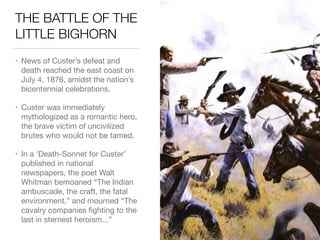
THE BATTLE OF THE
LITTLE BIGHORN
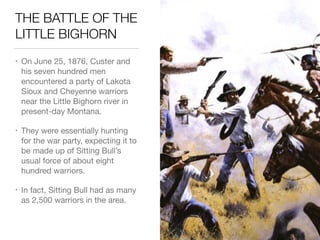
• On June 25, 1876, Custer and
his seven hundred men
encountered a party of Lakota
Sioux and Cheyenne warriors
near the Little Bighorn river in
present-day Montana.

• They were essentially hunting
for the war party, expecting it to
be made up of Sitting Bull’s
usual force of about eight
hundred warriors.

• In fact, Sitting Bull had as many
as 2,500 warriors in the area.
THE BATTLE OF THE
LITTLE BIGHORN
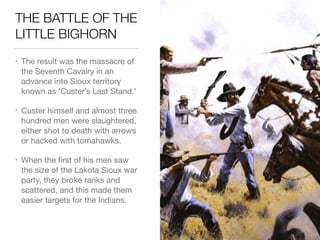
• The result was the massacre of
the Seventh Cavalry in an
advance into Sioux territory
known as ‘Custer’s Last Stand.’

• Custer himself and almost three
hundred men were slaughtered,
either shot to death with arrows
or hacked with tomahawks.

• When the first of his men saw
the size of the Lakota Sioux war
party, they broke ranks and
scattered, and this made them
easier targets for the Indians.
THE BATTLE OF THE
LITTLE BIGHORN
• News of Custer’s defeat and
death reached the east coast on
July 4, 1876, amidst the nation’s
bicentennial celebrations.

• Custer was immediately
mythologized as a romantic hero,
the brave victim of uncivilized
brutes who would not be tamed.

• In a ‘Death-Sonnet for Custer’
published in national
newspapers, the poet Walt
Whitman bemoaned “The Indian
ambuscade, the craft, the fatal
environment,” and mourned “The
cavalry companies fighting to the
last in sternest heroism...”
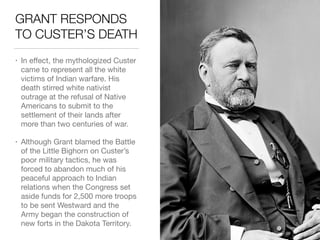
GRANT RESPONDS
TO CUSTER’S DEATH
• In effect, the mythologized Custer
came to represent all the white
victims of Indian warfare. His
death stirred white nativist
outrage at the refusal of Native
Americans to submit to the
settlement of their lands after
more than two centuries of war.

• Although Grant blamed the Battle
of the Little Bighorn on Custer’s
poor military tactics, he was
forced to abandon much of his
peaceful approach to Indian
relations when the Congress set
aside funds for 2,500 more troops
to be sent Westward and the
Army began the construction of
new forts in the Dakota Territory.
A SURVEY OF
AMERICAN HISTORY
Unit 3: Reconstruction and Urbanization

Part 4: Ulysses S. Grant (II)

44 Ulysses S. Grant (II)

  • 1.
    A SURVEY OF AMERICANHISTORY Unit 3: Reconstruction and Urbanization Part 4: Ulysses S. Grant (II)
  • 2.
    GRANT’S
 MAJOR ISSUES Immigration andthe nativist backlash Conflicts with the Lakota Sioux
  • 3.
    THE
 COMSTOCK LODE • In1859, eleven years after gold was discovered in California,
 a massive deposit of silver ore was discovered in present-day Nevada, which was part of the Utah Territory at the time. • This deposit became known as the Comstock Lode after Henry Comstock, the man who first filed a claim for the surrounding land.
  • 4.
    THE IRON HORSE In1862, two railroad companies, Central Pacific Railroad and Union Pacific Railroad, received Congressional contracts to connect the Mississippi River with the West Coast. Their instructions were to build two railway lines, one moving eastward from San Francisco and one moving westward from Omaha, and have them meet up in the middle.
  • 5.
    THE
 TEXAS-INDIAN WARS After Texaswas admitted into the Union in 1846, the United States federal government assumed control over an ongoing war between Texas and the Comanche Indians whose territory had been lost to settlers. The war became especially bloody after 1858, as settlement activities increased.
  • 6.
    TRANSPORT, TREASURE, ANDTRIBAL CONFLICTS • On May 10, 1869, two months after Grant took the oath of office, the ‘golden spike’ was driven into the railway lines at Promontory, Utah, to connect the Union Pacific with the Central Pacific and create the transcontinental railroad. • With transport infrastructure connecting the two coasts of North America, and with abundant gold and silver mining opportunities in the West, settlers who hoped to ‘strike it rich’ were flocking to the middle of the country. • Their settlement efforts and their greed for land repeatedly brought them into conflict with the Indian tribes of the central plains throughout the 1870s.
  • 7.
    GEORGE ARMSTRONG CUSTER • UnionArmy soldier who fought at the First Battle of Bull Run and served under Grant during the Appomattox Campaign at the end of the Civil War. • Took charge of the Seventh Cavalry in 1867, moving Westward to engage in military actions against the Cheyenne Indians of the Kansas area. • In July 1874, led an expedition from North Dakota into the Black Hills of South Dakota in order to find suitable locations for military forts.
  • 8.
    A GOLD RUSHIN SOUTH DAKOTA • Custer’s Black Hills Expedition discovered gold near present- day Custer, South Dakota. The discovery sparked a gold rush during which vast deposits of gold were unearthed in the area of Deadwood, South Dakota. • Thousands of settlers and would-be miners flocked to South Dakota to claim a share of what was possibly the last gold deposit in North America. • This flood of people antagonized the Lakota Sioux, the native inhabitants of the Black Hills and the surrounding plains.
  • 9.
    GRANT’S INDIAN POLICY • Grantmade stronger efforts than any other President to maintain peaceful relations with Indians by avoiding the use of the military for purposes of removal to the Indian Territory. • He also appointed a Seneca man, Ely Parker, as his Commissioner of Indian Affairs. • Grant’s approach to Indian relations was largely successful, with a rise in the signing of peace treaties and a reduction in the severity of conflicts.
  • 10.
    THE LAKOTA SIOUX •Unfortunately for Grant, settlement efforts in South Dakota resulted in the excessive slaughter of buffalo,
 a major resource of the Lakota Sioux, as well as incursions onto Sioux land by gold prospectors. • In response to these antagonisms, the Lakota Sioux began launching raids on settlers’ encampments. • In response to these raids, the United States Army, and particularly Custer’s Seventh Cavalry, assumed responsibility for protecting the settlers. • This forced the United States into a military conflict with the Lakota Sioux and their allies, the Cheyenne. The war between these parties lasted from 1876 to 1877 and is known as the Black Hills War. • The Sioux Chief Sitting Bull and the military strategist Crazy Horse led the charge against Custer’s cavalry.
  • 11.
    THE BATTLE OFTHE LITTLE BIGHORN • On June 25, 1876, Custer and his seven hundred men encountered a party of Lakota Sioux and Cheyenne warriors near the Little Bighorn river in present-day Montana. • They were essentially hunting for the war party, expecting it to be made up of Sitting Bull’s usual force of about eight hundred warriors. • In fact, Sitting Bull had as many as 2,500 warriors in the area.
  • 12.
    THE BATTLE OFTHE LITTLE BIGHORN • The result was the massacre of the Seventh Cavalry in an advance into Sioux territory known as ‘Custer’s Last Stand.’ • Custer himself and almost three hundred men were slaughtered, either shot to death with arrows or hacked with tomahawks. • When the first of his men saw the size of the Lakota Sioux war party, they broke ranks and scattered, and this made them easier targets for the Indians.
  • 13.
    THE BATTLE OFTHE LITTLE BIGHORN • News of Custer’s defeat and death reached the east coast on July 4, 1876, amidst the nation’s bicentennial celebrations. • Custer was immediately mythologized as a romantic hero, the brave victim of uncivilized brutes who would not be tamed. • In a ‘Death-Sonnet for Custer’ published in national newspapers, the poet Walt Whitman bemoaned “The Indian ambuscade, the craft, the fatal environment,” and mourned “The cavalry companies fighting to the last in sternest heroism...”
  • 14.
    GRANT RESPONDS TO CUSTER’SDEATH • In effect, the mythologized Custer came to represent all the white victims of Indian warfare. His death stirred white nativist outrage at the refusal of Native Americans to submit to the settlement of their lands after more than two centuries of war. • Although Grant blamed the Battle of the Little Bighorn on Custer’s poor military tactics, he was forced to abandon much of his peaceful approach to Indian relations when the Congress set aside funds for 2,500 more troops to be sent Westward and the Army began the construction of new forts in the Dakota Territory.
  • 15.
    A SURVEY OF AMERICANHISTORY Unit 3: Reconstruction and Urbanization Part 4: Ulysses S. Grant (II)