Exponential Growth and Decay
Chapter 4 Inverse, Exponential, and Logarithmic
Functions
Concepts and Objectives
⚫ Exponential Growth and Decay
⚫ Solve problems involving exponential growth and
decay.
⚫ Set up and solve exponential variation problems
using both common and natural logarithms.
⚫ Find half-life and doubling times.
Exponential Growth and Decay
⚫ The general equation of an exponential function is
y = abx
where a and b are constants.
⚫ Exponential growth occurs when b > 1.
⚫ Exponential decay occurs when 0 < b < 1.
⚫ The constant a is usually the starting value and b is the
percentage by which a is increasing or decreasing.
Exponential Growth and Decay
⚫ Example: In 2006, the population of a country was 70
million and growing at a rate of 1.9% per year.
Assuming the percentage growth rate remains constant,
express the population, P, of this country (in millions) as
a function of t, the number of years after 2006.
Exponential Growth and Decay
⚫ Example: In 2006, the population of a country was 70
million and growing at a rate of 1.9% per year.
Assuming the percentage growth rate remains constant,
express the population, P, of this country (in millions) as
a function of t, the number of years after 2006.
Starting quantity (a): 70
Growth rate (b): 1+0.019 = 1.019
Equation: P = 70(1.019)t
Exponential Growth and Decay
⚫ Example: A population of fish (P) starts at 8000 fish in
the year 2005 and decreases by 5.8% per year (t). What
is the predicted fish population in 2010?
Exponential Growth and Decay
⚫ Example: A population of fish (P) starts at 8000 fish in
the year 2005 and decreases by 5.8% per year (t). What
is the predicted fish population in 2010?
Starting quantity: 8000
Decay rate: 1 – 0.058 = 0.942
Equation: P = 8000(0.942)t
In 2010 (t = 5): P = 8000(0.942)5
= 5934 fish
Exponential Growth and Decay
⚫ If the relationship is continuously growing or decaying,
the equation can be written
y = aekx,
where a and k are constants and e is the base of the
natural logarithm.
⚫ Exponential growth occurs when k > 0
⚫ Exponential decay occurs when k < 0
Exponential Growth and Decay
⚫ Example: World poultry production was 77.2 million
tons in the year 2004 and increasing at a continuous rate
of 1.6% per year (t). Estimate world poultry production
(P) in the year 2010.
Exponential Growth and Decay
⚫ Example: World poultry production was 77.2 million
tons in the year 2004 and increasing at a continuous rate
of 1.6% per year (t). Estimate world poultry production
(P) in the year 2010.
Starting quantity: 77.2
Growth rate: 0.016
Equation: P = 77.2e0.016t
After 6 years: P = 77.2e(0.016)(6)
 84.98 million tons
Exponential Growth and Decay
⚫ How are you supposed to know which equation to use?!?
⚫ If you are given a formula, you don’t have to worry
about it—just use the formula they give you.
⚫ If the problem uses the word “continuous” or
“continuously”, use the equation with e.
⚫ If the rate isn’t given (and you are not solving for the
rate), it doesn’t matter which version you use.
⚫ If you’re still not sure, use the general form of the
exponential equation .( )x
y ab=
Exponential Variation
⚫ Example: In a bacteria culture, there were 2000 bacteria
on Tuesday. On Thursday, the number has increased to
4500. Predict the number of bacteria that will be in the
culture next Tuesday.
Exponential Variation
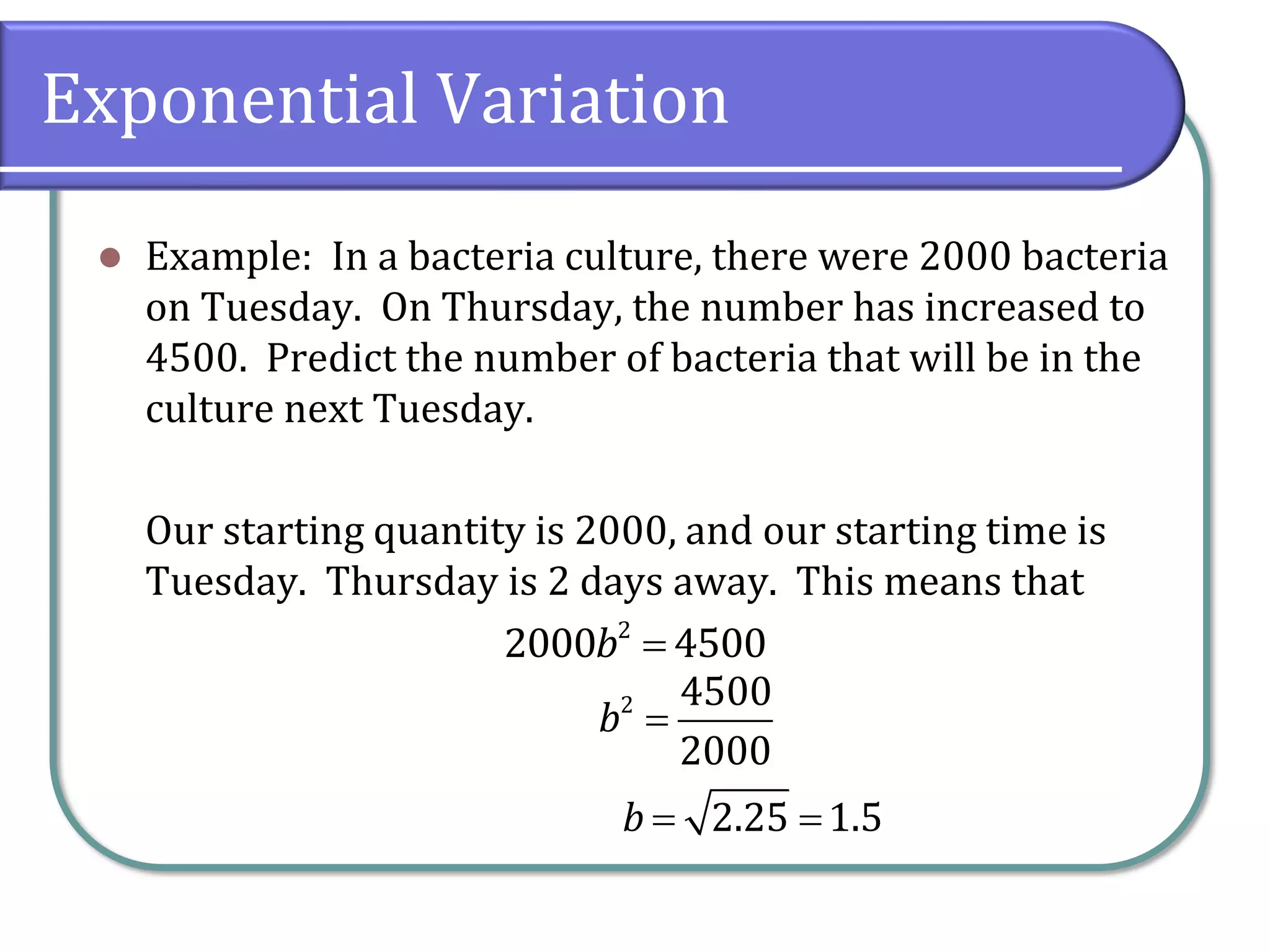
⚫ Example: In a bacteria culture, there were 2000 bacteria
on Tuesday. On Thursday, the number has increased to
4500. Predict the number of bacteria that will be in the
culture next Tuesday.
Our starting quantity is 2000, and our starting time is
Tuesday. Thursday is 2 days away. This means that
=2
2000 4500b
=2 4500
2000
b
= =2.25 1.5b
Exponential Variation
⚫ Example (cont.):
Thus, our equation is
After 7 days, there should be
( )= 7
2000 1.5C
34,172 colonies
( )=2000 1.5t
C
Exponential Variation
⚫ Example (cont.):
If we had wanted to use the natural log equation (e), it
would have worked much the same way:
( )
=
2
2000 4500
k
e
=2 4500
2000
k
e
=2
ln ln2.25k
e
=2 ln2.25k
= 
ln2.25
0.4055
2
k
( )( )
=
0.4055 7
2000C e
34,172 colonies
Half-Life and Doubling Time
⚫ Half-life refers to the length of time it takes for an
exponential decay to reach half of its starting quantity.
⚫ Doubling time refers to the length of time it takes for an
exponential growth to reach double its starting quantity.
⚫ Both of these problems are actually worked the same
way. Use the general equation unless the rate is
continuous; in that case, you would use the equation
with e. To find the half-life (or doubling time), let a = 1
and set the equation equal to ½ (or 2) and solve for t.
Half-Life and Doubling Time
⚫ Example: Find the half-life of
(a) tritium, which decays at a rate of 5.471% per year
(b) a radioactive substance which decays at a continuous
rate of 11% per minute.
Half-Life and Doubling Time
⚫ Example: Find the half-life of
(a) tritium, which decays at a rate of 5.471% per year
Since our decay rate is 0.05471, b will be 1–0.05471, or
0.94529.
=
1
0.94529
2
t
=log0.94529 log0.5t
=log0.94529 log0.5t
=
log0.5
log0.94529
t 12.32 years
Half-Life and Doubling Time
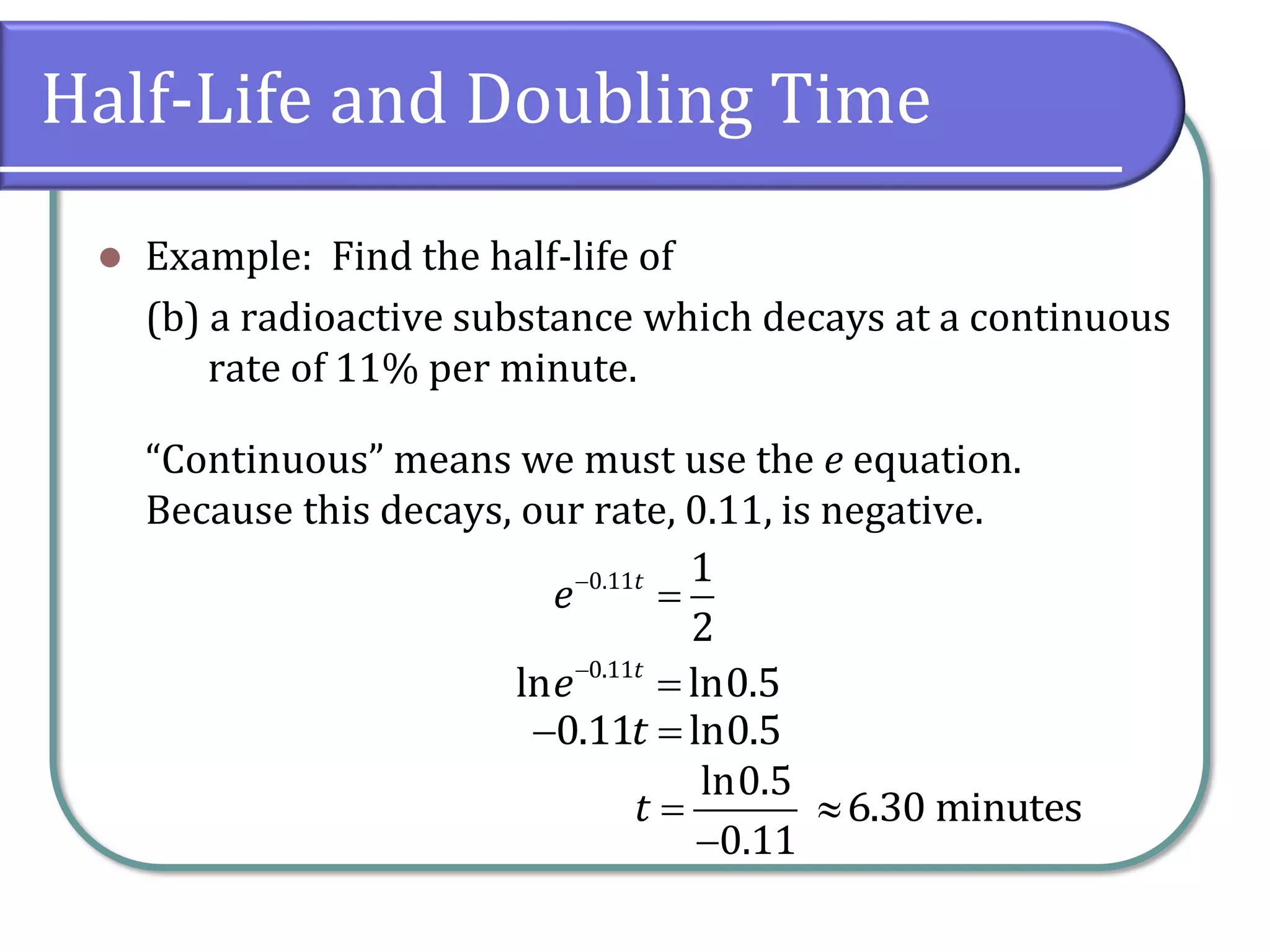
⚫ Example: Find the half-life of
(b) a radioactive substance which decays at a continuous
rate of 11% per minute.
“Continuous” means we must use the e equation.
Because this decays, our rate, 0.11, is negative.
−
=0.11 1
2
t
e
−
=0.11
ln ln0.5t
e
− =0.11 ln0.5t
=
−
ln0.5
0.11
t 6.30 minutes
Half-Life and Doubling Time
⚫ Example: If the half-life of 600 g of a radioactive
substance is 3 years, how much of the substance will be
present after 6 years?
Half-Life and Doubling Time
⚫ Example: If the half-life of 600 g of a radioactive
substance is 3 years, how much of the substance will be
present after 6 years?
Since the rate isn’t mentioned, it really doesn’t matter
which equation we use:
=3 1
2
b ( )
=
3 1
2
k
e
= 3
0.5b
=
ln0.5
3
k
( ) =
6
3
600 0.5 150 g ( ) 
 
 
=
ln0.5
6
3
600 150 ge
Classwork
⚫ College Algebra & Trigonometry
⚫ Page 475: 6, 8, 12, 14; page 464: 30-42 (even),
page 444: 72-78 (even)

4.6 Exponential Growth and Decay

  • 1.
    Exponential Growth andDecay Chapter 4 Inverse, Exponential, and Logarithmic Functions
  • 2.
    Concepts and Objectives ⚫Exponential Growth and Decay ⚫ Solve problems involving exponential growth and decay. ⚫ Set up and solve exponential variation problems using both common and natural logarithms. ⚫ Find half-life and doubling times.
  • 3.
    Exponential Growth andDecay ⚫ The general equation of an exponential function is y = abx where a and b are constants. ⚫ Exponential growth occurs when b > 1. ⚫ Exponential decay occurs when 0 < b < 1. ⚫ The constant a is usually the starting value and b is the percentage by which a is increasing or decreasing.
  • 4.
    Exponential Growth andDecay ⚫ Example: In 2006, the population of a country was 70 million and growing at a rate of 1.9% per year. Assuming the percentage growth rate remains constant, express the population, P, of this country (in millions) as a function of t, the number of years after 2006.
  • 5.
    Exponential Growth andDecay ⚫ Example: In 2006, the population of a country was 70 million and growing at a rate of 1.9% per year. Assuming the percentage growth rate remains constant, express the population, P, of this country (in millions) as a function of t, the number of years after 2006. Starting quantity (a): 70 Growth rate (b): 1+0.019 = 1.019 Equation: P = 70(1.019)t
  • 6.
    Exponential Growth andDecay ⚫ Example: A population of fish (P) starts at 8000 fish in the year 2005 and decreases by 5.8% per year (t). What is the predicted fish population in 2010?
  • 7.
    Exponential Growth andDecay ⚫ Example: A population of fish (P) starts at 8000 fish in the year 2005 and decreases by 5.8% per year (t). What is the predicted fish population in 2010? Starting quantity: 8000 Decay rate: 1 – 0.058 = 0.942 Equation: P = 8000(0.942)t In 2010 (t = 5): P = 8000(0.942)5 = 5934 fish
  • 8.
    Exponential Growth andDecay ⚫ If the relationship is continuously growing or decaying, the equation can be written y = aekx, where a and k are constants and e is the base of the natural logarithm. ⚫ Exponential growth occurs when k > 0 ⚫ Exponential decay occurs when k < 0
  • 9.
    Exponential Growth andDecay ⚫ Example: World poultry production was 77.2 million tons in the year 2004 and increasing at a continuous rate of 1.6% per year (t). Estimate world poultry production (P) in the year 2010.
  • 10.
    Exponential Growth andDecay ⚫ Example: World poultry production was 77.2 million tons in the year 2004 and increasing at a continuous rate of 1.6% per year (t). Estimate world poultry production (P) in the year 2010. Starting quantity: 77.2 Growth rate: 0.016 Equation: P = 77.2e0.016t After 6 years: P = 77.2e(0.016)(6)  84.98 million tons
  • 11.
    Exponential Growth andDecay ⚫ How are you supposed to know which equation to use?!? ⚫ If you are given a formula, you don’t have to worry about it—just use the formula they give you. ⚫ If the problem uses the word “continuous” or “continuously”, use the equation with e. ⚫ If the rate isn’t given (and you are not solving for the rate), it doesn’t matter which version you use. ⚫ If you’re still not sure, use the general form of the exponential equation .( )x y ab=
  • 12.
    Exponential Variation ⚫ Example:In a bacteria culture, there were 2000 bacteria on Tuesday. On Thursday, the number has increased to 4500. Predict the number of bacteria that will be in the culture next Tuesday.
  • 13.
    Exponential Variation ⚫ Example:In a bacteria culture, there were 2000 bacteria on Tuesday. On Thursday, the number has increased to 4500. Predict the number of bacteria that will be in the culture next Tuesday. Our starting quantity is 2000, and our starting time is Tuesday. Thursday is 2 days away. This means that =2 2000 4500b =2 4500 2000 b = =2.25 1.5b
  • 14.
    Exponential Variation ⚫ Example(cont.): Thus, our equation is After 7 days, there should be ( )= 7 2000 1.5C 34,172 colonies ( )=2000 1.5t C
  • 15.
    Exponential Variation ⚫ Example(cont.): If we had wanted to use the natural log equation (e), it would have worked much the same way: ( ) = 2 2000 4500 k e =2 4500 2000 k e =2 ln ln2.25k e =2 ln2.25k =  ln2.25 0.4055 2 k ( )( ) = 0.4055 7 2000C e 34,172 colonies
  • 16.
    Half-Life and DoublingTime ⚫ Half-life refers to the length of time it takes for an exponential decay to reach half of its starting quantity. ⚫ Doubling time refers to the length of time it takes for an exponential growth to reach double its starting quantity. ⚫ Both of these problems are actually worked the same way. Use the general equation unless the rate is continuous; in that case, you would use the equation with e. To find the half-life (or doubling time), let a = 1 and set the equation equal to ½ (or 2) and solve for t.
  • 17.
    Half-Life and DoublingTime ⚫ Example: Find the half-life of (a) tritium, which decays at a rate of 5.471% per year (b) a radioactive substance which decays at a continuous rate of 11% per minute.
  • 18.
    Half-Life and DoublingTime ⚫ Example: Find the half-life of (a) tritium, which decays at a rate of 5.471% per year Since our decay rate is 0.05471, b will be 1–0.05471, or 0.94529. = 1 0.94529 2 t =log0.94529 log0.5t =log0.94529 log0.5t = log0.5 log0.94529 t 12.32 years
  • 19.
    Half-Life and DoublingTime ⚫ Example: Find the half-life of (b) a radioactive substance which decays at a continuous rate of 11% per minute. “Continuous” means we must use the e equation. Because this decays, our rate, 0.11, is negative. − =0.11 1 2 t e − =0.11 ln ln0.5t e − =0.11 ln0.5t = − ln0.5 0.11 t 6.30 minutes
  • 20.
    Half-Life and DoublingTime ⚫ Example: If the half-life of 600 g of a radioactive substance is 3 years, how much of the substance will be present after 6 years?
  • 21.
    Half-Life and DoublingTime ⚫ Example: If the half-life of 600 g of a radioactive substance is 3 years, how much of the substance will be present after 6 years? Since the rate isn’t mentioned, it really doesn’t matter which equation we use: =3 1 2 b ( ) = 3 1 2 k e = 3 0.5b = ln0.5 3 k ( ) = 6 3 600 0.5 150 g ( )      = ln0.5 6 3 600 150 ge
  • 22.
    Classwork ⚫ College Algebra& Trigonometry ⚫ Page 475: 6, 8, 12, 14; page 464: 30-42 (even), page 444: 72-78 (even)