IB Biology Chapter 4 Notes: Carbon Cycle & Climate Change (4.3 & 4.4) NAME:
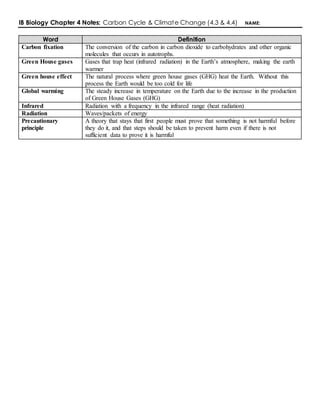
Word Definition
Carbon fixation The conversion of the carbon in carbon dioxide to carbohydrates and other organic
molecules that occurs in autotrophs.
Green House gases Gases that trap heat (infrared radiation) in the Earth’s atmosphere, making the earth
warmer
Green house effect The natural process where green house gases (GHG) heat the Earth. Without this
process the Earth would be too cold for life
Global warming The steady increase in temperature on the Earth due to the increase in the production
of Green House Gases (GHG)
Infrared Radiation with a frequency in the infrared range (heat radiation)
Radiation Waves/packets of energy
Precautionary
principle
A theory that stays that first people must prove that something is not harmful before
they do it, and that steps should be taken to prevent harm even if there is not
sufficient data to prove it is harmful
4.3.1 Autotrophs convert
carbon dioxide into
carbohydrates and other
carbon compounds.
4.3.2 In aquatic habitats
carbon dioxide is present as
a dissolved gas and
hydrogen carbonate ions.
4.3.3 Carbon dioxide
diffuses from the
atmosphere or water into
autotrophs.
4.3.4 Carbon dioxide is
produced by respiration and
diffuses out of organisms
into water or the
atmosphere.
4.3.5 Methane is produced
from organic matter in
anaerobic conditions by
methanogenic archaeans
and some diffuses into the
atmosphere.
4.3.6 Methane is oxidized
to carbon dioxide and water
in the atmosphere.
4.3.7 Peat forms when
organic matter is not fully
decomposed because of
anaerobic conditions in
waterlogged soils.
4.3.8 Partially decomposed
organic matter from past
geological eras was
converted into oil and gas
in porous rocks or into coal.
4.3.9 Carbon dioxide is
produced by the
combustion of biomass and
fossilized organic matter.
Describe what is meant by carbon ‘fixation’
What is methanogenesis?
Outline the types of anaerobic organisms that produce methane:
Describe what peat is and how it forms:
Describe the formation of coal:
Describe the formation of oil and natural gas:
What occurs in combustion?
Give examples of natural and human-caused combustion of organic matter:
4.3.10 Animals such as
reef-building corals and
mollusks have hard parts
that are composed of
calcium carbonate and can
become fossilized in
limestone.
4.3.13 Construct a diagram
of the carbon cycle.
4.3.11 Estimate carbon
fluxes due to processes in
the carbon cycle.
4.3.12 Analysis of data
from atmosphere
monitoring stations
showing annual
fluctuations.
4.4.1 Carbon dioxide and
water vapor are the most
significant greenhouse
gases.
4.4.2 Other gases,including
methane and nitrogen
oxides have less impact as
greenhouse gases.
Describe the formation of limestone:
Draw a diagram:
Complete the table of carbon flux estimates:
Process Flux (Gigatons/ year)
Photosynthesis
Cell respiration
Ocean uptake
Ocean loss
Deforestation
Burial in marine sediment
Combustion of fossil fuels
Describe how scientists monitor/ track atmospheric carbon dioxide:
What is a greenhouse gas?
What are sources of atmospheric carbon dioxide and water vapor?
4.4.3 The impact of a gas
depends on its ability to
absorb long-wave radiation
as well as on its
concentration in the
atmosphere.
4.4.4 The warmed Earth
emits longer-wave radiation
(heat).
4.4.5 Longer-wave
radiation is reabsorbed by
greenhouse gases which
retains the heat in the
atmosphere.
4.4.9 Correlations between
global temperatures and
carbon dioxide
concentrations on Earth.
4.4.6 Global temperatures
and climate patterns are
influenced by
concentrations of
greenhouse gases.
4.4.7 There is a correlation
between rising atmospheric
concentrations of carbon
dioxide since the start of
the industrial revolution
two hundred years ago and
average global
temperatures.
4.4.8 Recent increases in
atmospheric carbon dioxide
are largely due to increases
in the combustion of
fossilized organic matter.
4.4.10 Evaluate claims that
human activities are not
causing climate change.
4.4.11 Threats to coral reefs
from increasing
concentrations of dissolved
carbon dioxide.
Outline the two factors that determine the impact of a greenhouse gas:
Describe how the Earth’s surface absorbs and emits solar radiation:
Describe the greenhouse effect:
Outline the climate effects of higher greenhouse gas concentrations and global temperatures:
Describe the correlation between atmospheric carbon dioxide and temperature:
How is this related to the start of the industrial revolution?
Discuss claims that human activities are not related to climate change:
How does increasing carbon dioxide threaten coral reefs?

4.3 & 4.4 Notes

  • 1.
    IB Biology Chapter4 Notes: Carbon Cycle & Climate Change (4.3 & 4.4) NAME: Word Definition Carbon fixation The conversion of the carbon in carbon dioxide to carbohydrates and other organic molecules that occurs in autotrophs. Green House gases Gases that trap heat (infrared radiation) in the Earth’s atmosphere, making the earth warmer Green house effect The natural process where green house gases (GHG) heat the Earth. Without this process the Earth would be too cold for life Global warming The steady increase in temperature on the Earth due to the increase in the production of Green House Gases (GHG) Infrared Radiation with a frequency in the infrared range (heat radiation) Radiation Waves/packets of energy Precautionary principle A theory that stays that first people must prove that something is not harmful before they do it, and that steps should be taken to prevent harm even if there is not sufficient data to prove it is harmful
  • 2.
    4.3.1 Autotrophs convert carbondioxide into carbohydrates and other carbon compounds. 4.3.2 In aquatic habitats carbon dioxide is present as a dissolved gas and hydrogen carbonate ions. 4.3.3 Carbon dioxide diffuses from the atmosphere or water into autotrophs. 4.3.4 Carbon dioxide is produced by respiration and diffuses out of organisms into water or the atmosphere. 4.3.5 Methane is produced from organic matter in anaerobic conditions by methanogenic archaeans and some diffuses into the atmosphere. 4.3.6 Methane is oxidized to carbon dioxide and water in the atmosphere. 4.3.7 Peat forms when organic matter is not fully decomposed because of anaerobic conditions in waterlogged soils. 4.3.8 Partially decomposed organic matter from past geological eras was converted into oil and gas in porous rocks or into coal. 4.3.9 Carbon dioxide is produced by the combustion of biomass and fossilized organic matter. Describe what is meant by carbon ‘fixation’ What is methanogenesis? Outline the types of anaerobic organisms that produce methane: Describe what peat is and how it forms: Describe the formation of coal: Describe the formation of oil and natural gas: What occurs in combustion? Give examples of natural and human-caused combustion of organic matter:
  • 3.
    4.3.10 Animals suchas reef-building corals and mollusks have hard parts that are composed of calcium carbonate and can become fossilized in limestone. 4.3.13 Construct a diagram of the carbon cycle. 4.3.11 Estimate carbon fluxes due to processes in the carbon cycle. 4.3.12 Analysis of data from atmosphere monitoring stations showing annual fluctuations. 4.4.1 Carbon dioxide and water vapor are the most significant greenhouse gases. 4.4.2 Other gases,including methane and nitrogen oxides have less impact as greenhouse gases. Describe the formation of limestone: Draw a diagram: Complete the table of carbon flux estimates: Process Flux (Gigatons/ year) Photosynthesis Cell respiration Ocean uptake Ocean loss Deforestation Burial in marine sediment Combustion of fossil fuels Describe how scientists monitor/ track atmospheric carbon dioxide: What is a greenhouse gas? What are sources of atmospheric carbon dioxide and water vapor?
  • 4.
    4.4.3 The impactof a gas depends on its ability to absorb long-wave radiation as well as on its concentration in the atmosphere. 4.4.4 The warmed Earth emits longer-wave radiation (heat). 4.4.5 Longer-wave radiation is reabsorbed by greenhouse gases which retains the heat in the atmosphere. 4.4.9 Correlations between global temperatures and carbon dioxide concentrations on Earth. 4.4.6 Global temperatures and climate patterns are influenced by concentrations of greenhouse gases. 4.4.7 There is a correlation between rising atmospheric concentrations of carbon dioxide since the start of the industrial revolution two hundred years ago and average global temperatures. 4.4.8 Recent increases in atmospheric carbon dioxide are largely due to increases in the combustion of fossilized organic matter. 4.4.10 Evaluate claims that human activities are not causing climate change. 4.4.11 Threats to coral reefs from increasing concentrations of dissolved carbon dioxide. Outline the two factors that determine the impact of a greenhouse gas: Describe how the Earth’s surface absorbs and emits solar radiation: Describe the greenhouse effect: Outline the climate effects of higher greenhouse gas concentrations and global temperatures: Describe the correlation between atmospheric carbon dioxide and temperature: How is this related to the start of the industrial revolution? Discuss claims that human activities are not related to climate change: How does increasing carbon dioxide threaten coral reefs?