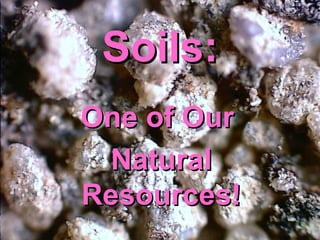
Soils: One of Our  Natural Resources!
Some call it dirt…..But it is  Soil !!! Soil is made of loose, weathered rock and organic material.
The rock material in soil contains three noticeable parts: sand, clay, and silt.
Soil, on the average, consists of 45% mineral, 25% water, 25% air and 5% organic matter. This is just an average!
There are thousands of different soils throughout the world. Five important factors influence the specific soil that develops.
Parent Material This refers to the minerals and organic materials present during the soil’s formation.
Parent Material Materials from volcanoes, sediment transported by wind, water, or glaciers are some examples.
Question Break!
Think about the soils in our area. Where do you think our “parent material” came from?
Our parent material is mainly Marine sediment (ocean in origin), or produced by steam-river action. It may be thousands of feet deep!
Climate The climate of a particular region can have a major influence on the rate of soil formation.
Climate Weathering processes like the cycles of freezing and thawing, along with wetting and drying vary with each region.
Living Organisms Both plants and animals help create soil.
Living Organisms As they die, organic matter incorporates with weathered parent material and becomes part of the soil.
Question Break!
Can you think of some organisms that might help mix and enrich the soil?
Living Organisms The actions of moles, earthworms, bacteria, fungi, and round worms mix and enrich the soil.
Topography The slope or hilliness of a region can have a major influence on the moisture and erosion of soils.
Topography In many regions, moist, poorly drained soils are located in low areas.
Topography Drier, well drained soils are often found in sloping hillsides. Erosion is often a problem here and can lead to lose of topsoil.
Time It takes hundreds of years to form one inch of soil from parent material.
Time Only the top few centimeters are productive in the sense of being able to sustain plant growth.
Time This is why  soil conservation  is so important!
Soil Profile In a cross-section of soil, various zones are formed.
O  Horizon: Organic Layer It consists of leaf litter and other organic material lying on the surface of the soil.
A  Horizon: Topsoil This layer is usually loose and crumbly with varying amounts of organic matter.
A  Horizon: Topsoil This is generally the most productive layer of the soil. Conservation efforts are focused here!
B  Horizon: Subsoils Subsoils are usually lighter in color, dense and low in organic matter.
C  Horizon: Transition This layer of transition is almost completely void of organic mater and is made up of partially weathered parent material.
Bedrock Below the C horizon the unweathered  bedrock will be found.
Last Question!
What would happen to land based life as we know it, if there was no soil layer?

Soils

  • 1.
    Soils: One ofOur Natural Resources!
  • 2.
    Some call itdirt…..But it is Soil !!! Soil is made of loose, weathered rock and organic material.
  • 3.
    The rock materialin soil contains three noticeable parts: sand, clay, and silt.
  • 4.
    Soil, on theaverage, consists of 45% mineral, 25% water, 25% air and 5% organic matter. This is just an average!
  • 5.
    There are thousandsof different soils throughout the world. Five important factors influence the specific soil that develops.
  • 6.
    Parent Material Thisrefers to the minerals and organic materials present during the soil’s formation.
  • 7.
    Parent Material Materialsfrom volcanoes, sediment transported by wind, water, or glaciers are some examples.
  • 8.
  • 9.
    Think about thesoils in our area. Where do you think our “parent material” came from?
  • 10.
    Our parent materialis mainly Marine sediment (ocean in origin), or produced by steam-river action. It may be thousands of feet deep!
  • 11.
    Climate The climateof a particular region can have a major influence on the rate of soil formation.
  • 12.
    Climate Weathering processeslike the cycles of freezing and thawing, along with wetting and drying vary with each region.
  • 13.
    Living Organisms Bothplants and animals help create soil.
  • 14.
    Living Organisms Asthey die, organic matter incorporates with weathered parent material and becomes part of the soil.
  • 15.
  • 16.
    Can you thinkof some organisms that might help mix and enrich the soil?
  • 17.
    Living Organisms Theactions of moles, earthworms, bacteria, fungi, and round worms mix and enrich the soil.
  • 18.
    Topography The slopeor hilliness of a region can have a major influence on the moisture and erosion of soils.
  • 19.
    Topography In manyregions, moist, poorly drained soils are located in low areas.
  • 20.
    Topography Drier, welldrained soils are often found in sloping hillsides. Erosion is often a problem here and can lead to lose of topsoil.
  • 21.
    Time It takeshundreds of years to form one inch of soil from parent material.
  • 22.
    Time Only thetop few centimeters are productive in the sense of being able to sustain plant growth.
  • 23.
    Time This iswhy soil conservation is so important!
  • 24.
    Soil Profile Ina cross-section of soil, various zones are formed.
  • 25.
    O Horizon:Organic Layer It consists of leaf litter and other organic material lying on the surface of the soil.
  • 26.
    A Horizon:Topsoil This layer is usually loose and crumbly with varying amounts of organic matter.
  • 27.
    A Horizon:Topsoil This is generally the most productive layer of the soil. Conservation efforts are focused here!
  • 28.
    B Horizon:Subsoils Subsoils are usually lighter in color, dense and low in organic matter.
  • 29.
    C Horizon:Transition This layer of transition is almost completely void of organic mater and is made up of partially weathered parent material.
  • 30.
    Bedrock Below theC horizon the unweathered bedrock will be found.
  • 31.
  • 32.
    What would happento land based life as we know it, if there was no soil layer?