By
Dr. Swatantra Kumar


                Dr. Swatantra Kumar, SSVGI, Bareilly
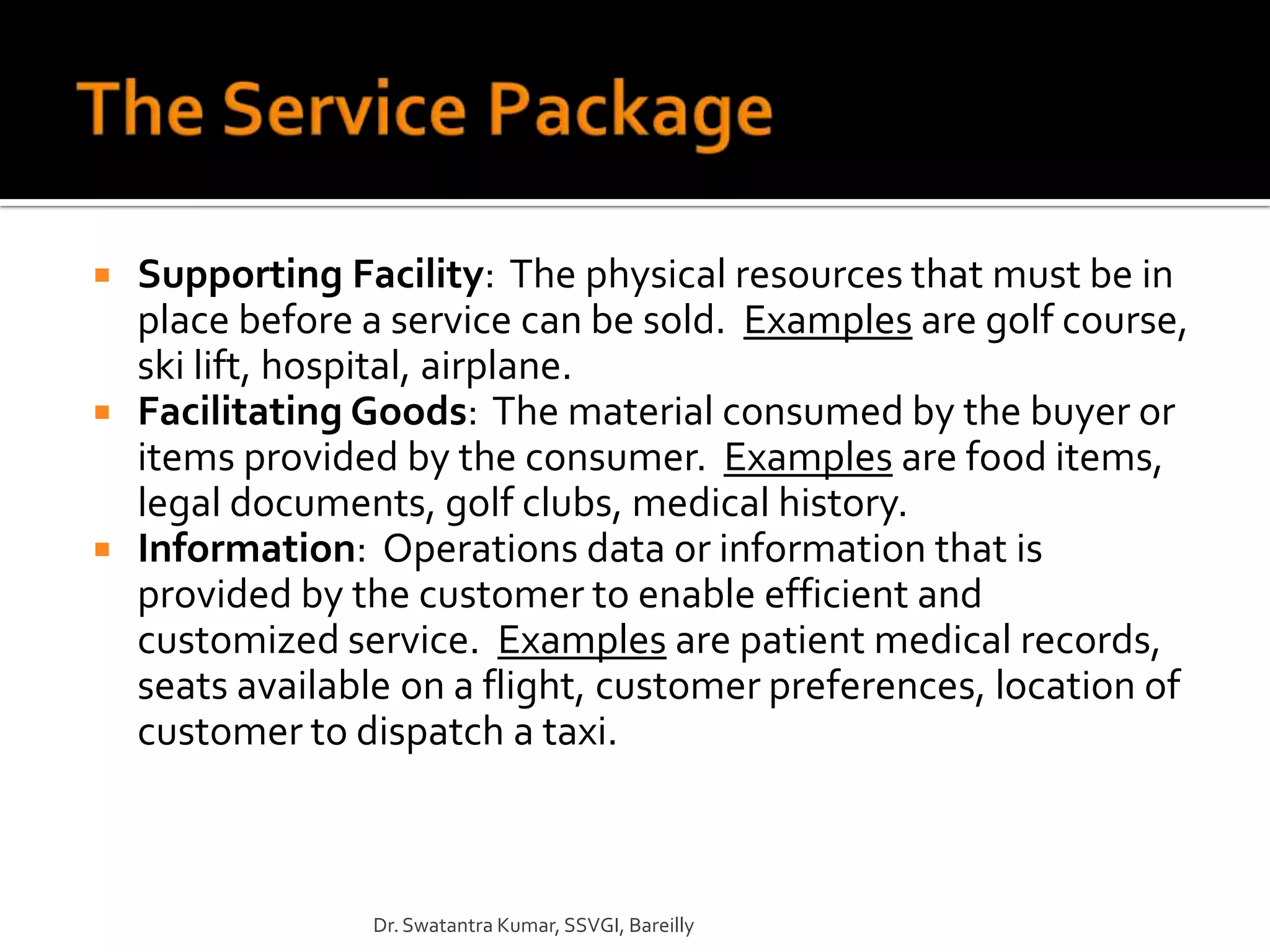
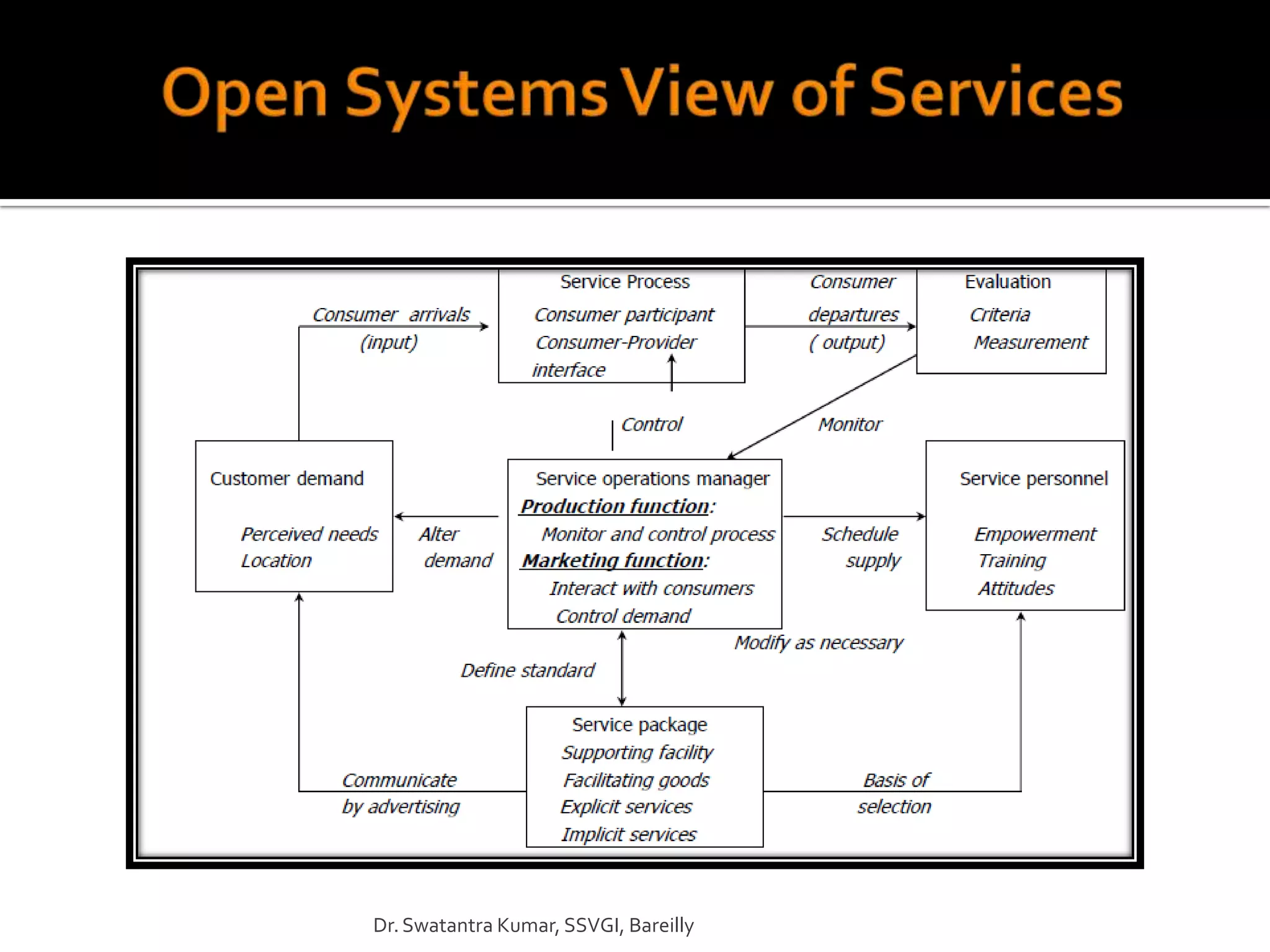
   Supporting Facility: The physical resources that must be in
    place before a service can be sold. Examples are golf course,
    ski lift, hospital, airplane.
   Facilitating Goods: The material consumed by the buyer or
    items provided by the consumer. Examples are food items,
    legal documents, golf clubs, medical history.
   Information: Operations data or information that is
    provided by the customer to enable efficient and
    customized service. Examples are patient medical records,
    seats available on a flight, customer preferences, location of
    customer to dispatch a taxi.


                 Dr. Swatantra Kumar, SSVGI, Bareilly
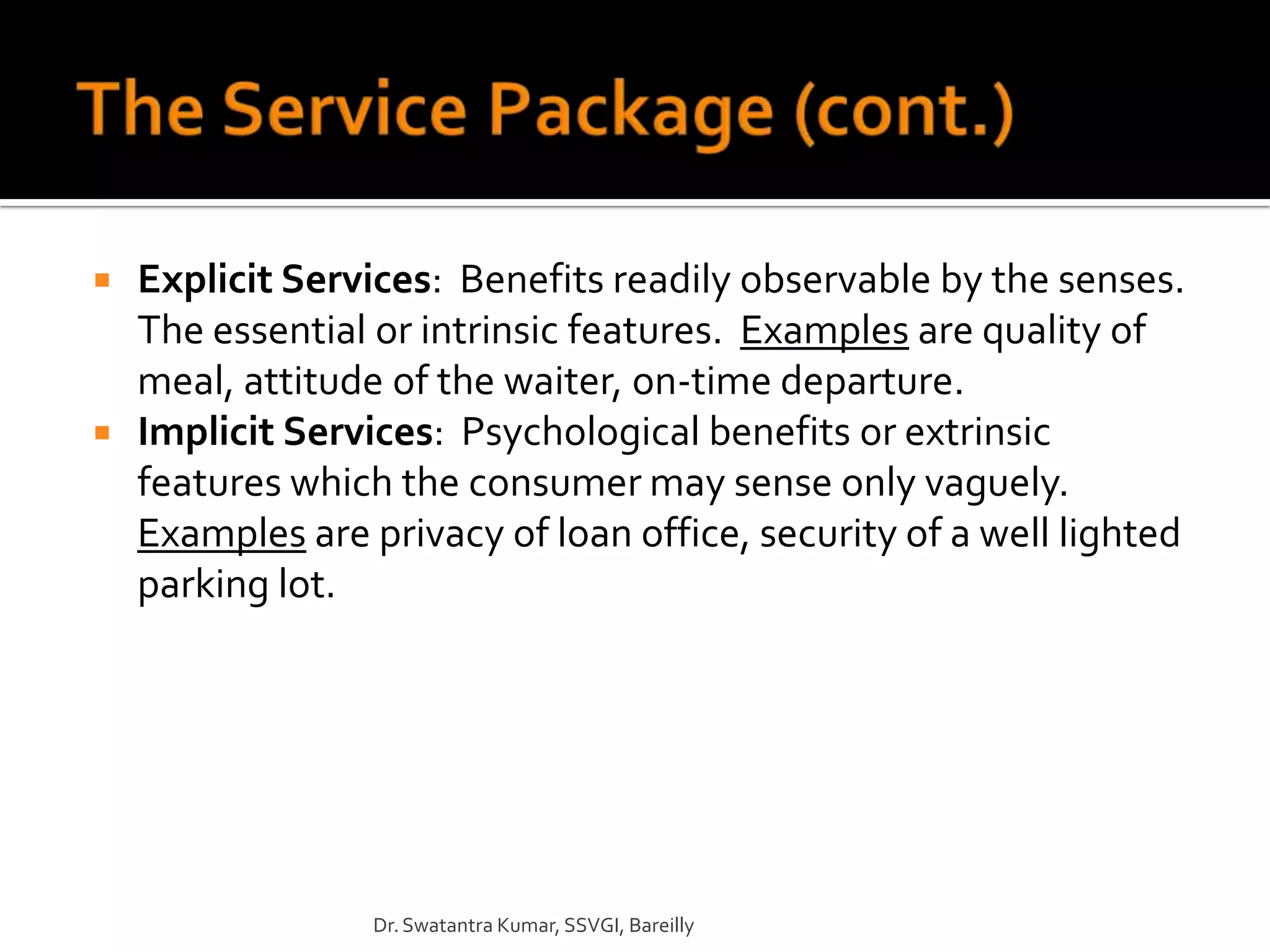
   Explicit Services: Benefits readily observable by the senses.
    The essential or intrinsic features. Examples are quality of
    meal, attitude of the waiter, on-time departure.
   Implicit Services: Psychological benefits or extrinsic
    features which the consumer may sense only vaguely.
    Examples are privacy of loan office, security of a well lighted
    parking lot.


                  Dr. Swatantra Kumar, SSVGI, Bareilly
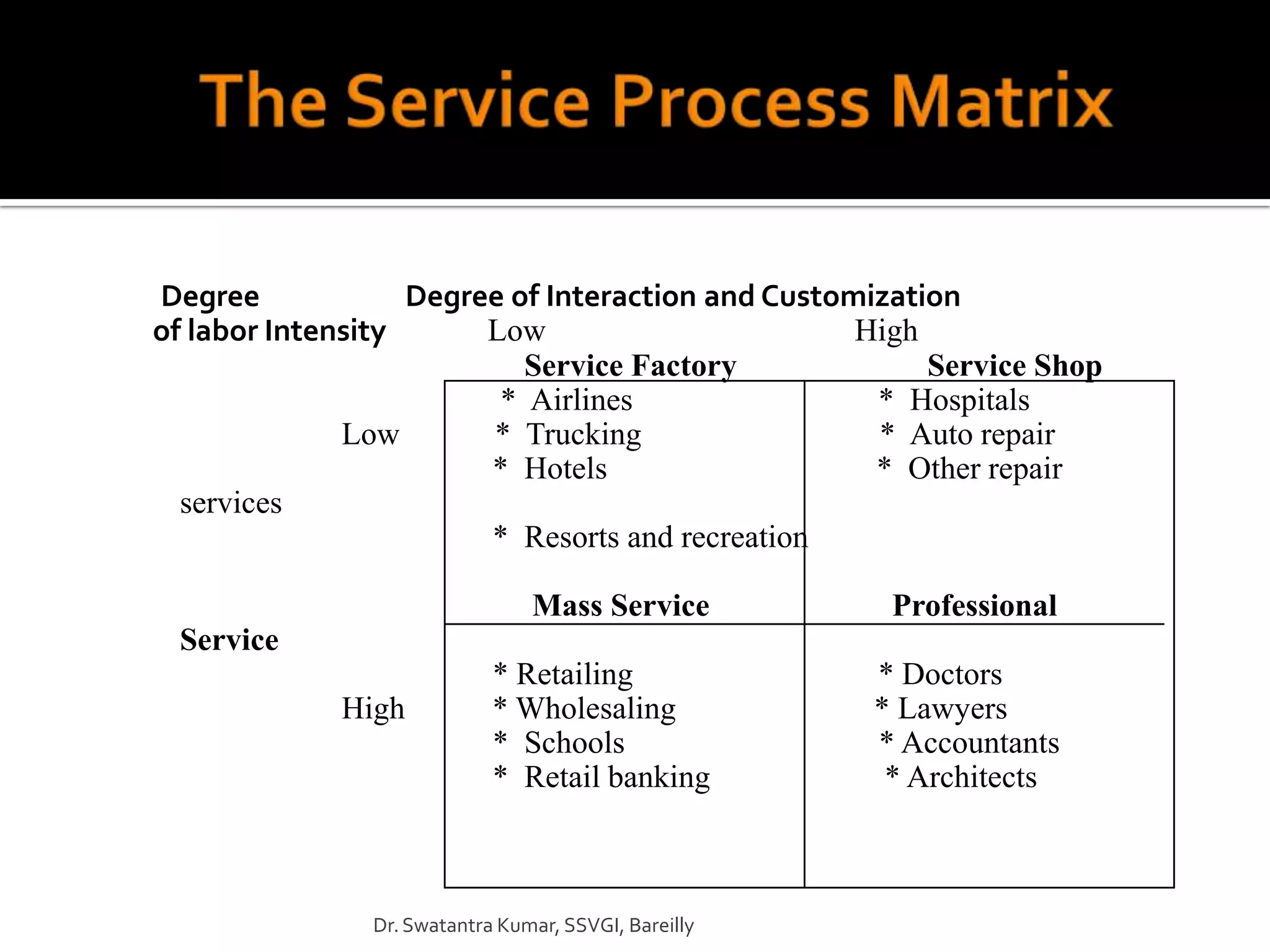
Degree             Degree of Interaction and Customization
of labor Intensity      Low                        High
                           Service Factory              Service Shop
                         * Airlines                 * Hospitals
              Low       * Trucking                  * Auto repair
                        * Hotels                    * Other repair
  services
                        * Resorts and recreation

                                Mass Service           Professional
 Service
                            * Retailing               * Doctors
             High           * Wholesaling             * Lawyers
                            * Schools                 * Accountants
                            * Retail banking           * Architects


               Dr. Swatantra Kumar, SSVGI, Bareilly
Dr. Swatantra Kumar, SSVGI, Bareilly
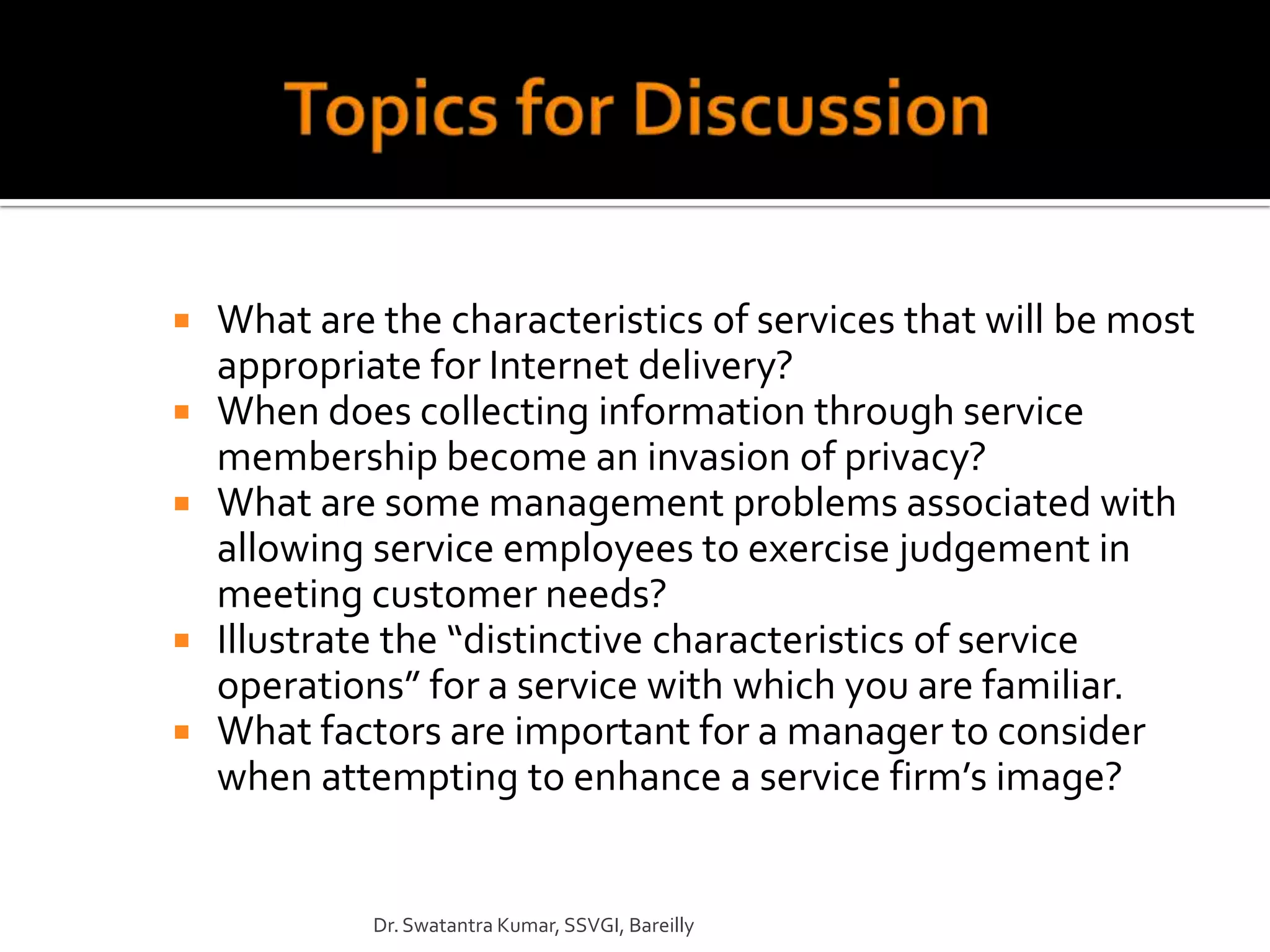
   What are the characteristics of services that will be most
    appropriate for Internet delivery?
   When does collecting information through service
    membership become an invasion of privacy?
   What are some management problems associated with
    allowing service employees to exercise judgement in
    meeting customer needs?
   Illustrate the “distinctive characteristics of service
    operations” for a service with which you are familiar.
   What factors are important for a manager to consider
    when attempting to enhance a service firm’s image?


             Dr. Swatantra Kumar, SSVGI, Bareilly
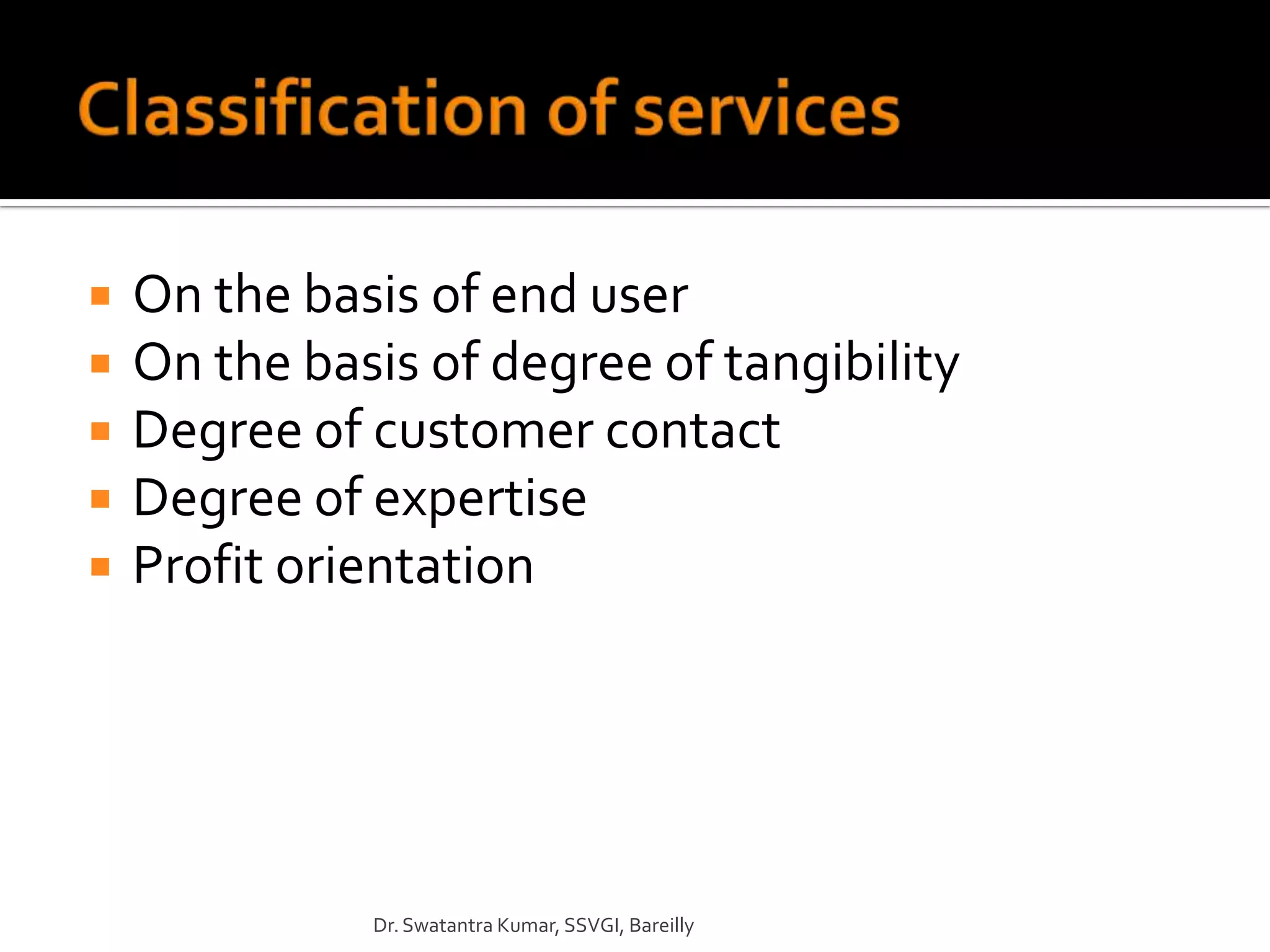
   On the basis of end user
   On the basis of degree of tangibility
   Degree of customer contact
   Degree of expertise
   Profit orientation


              Dr. Swatantra Kumar, SSVGI, Bareilly
   Business services
   Consumer services
   Govt.


             Dr. Swatantra Kumar, SSVGI, Bareilly
   Purely intangible
   Services with tangible inputs
   Products with service inputs


              Dr. Swatantra Kumar, SSVGI, Bareilly
   Low customer contact
   High Customer contact


             Dr. Swatantra Kumar, SSVGI, Bareilly
   High
   Moderate
   Low


               Dr. Swatantra Kumar, SSVGI, Bareilly
   For profit
   Not for profit


              Dr. Swatantra Kumar, SSVGI, Bareilly
   Goods are tangible whereas services are
    intangible
   Customers participate in many service
    processes, activities and transactions
   The demand for services is more difficult to
    predict than the demand for goods
   Services can not be stored as physical
    inventory
   Service management skills are paramount to
    a successful service encounter
              Dr. Swatantra Kumar, SSVGI, Bareilly
   Service facilities typically need to be in close
    proximity to the customer
   Patents do not protect services


               Dr. Swatantra Kumar, SSVGI, Bareilly
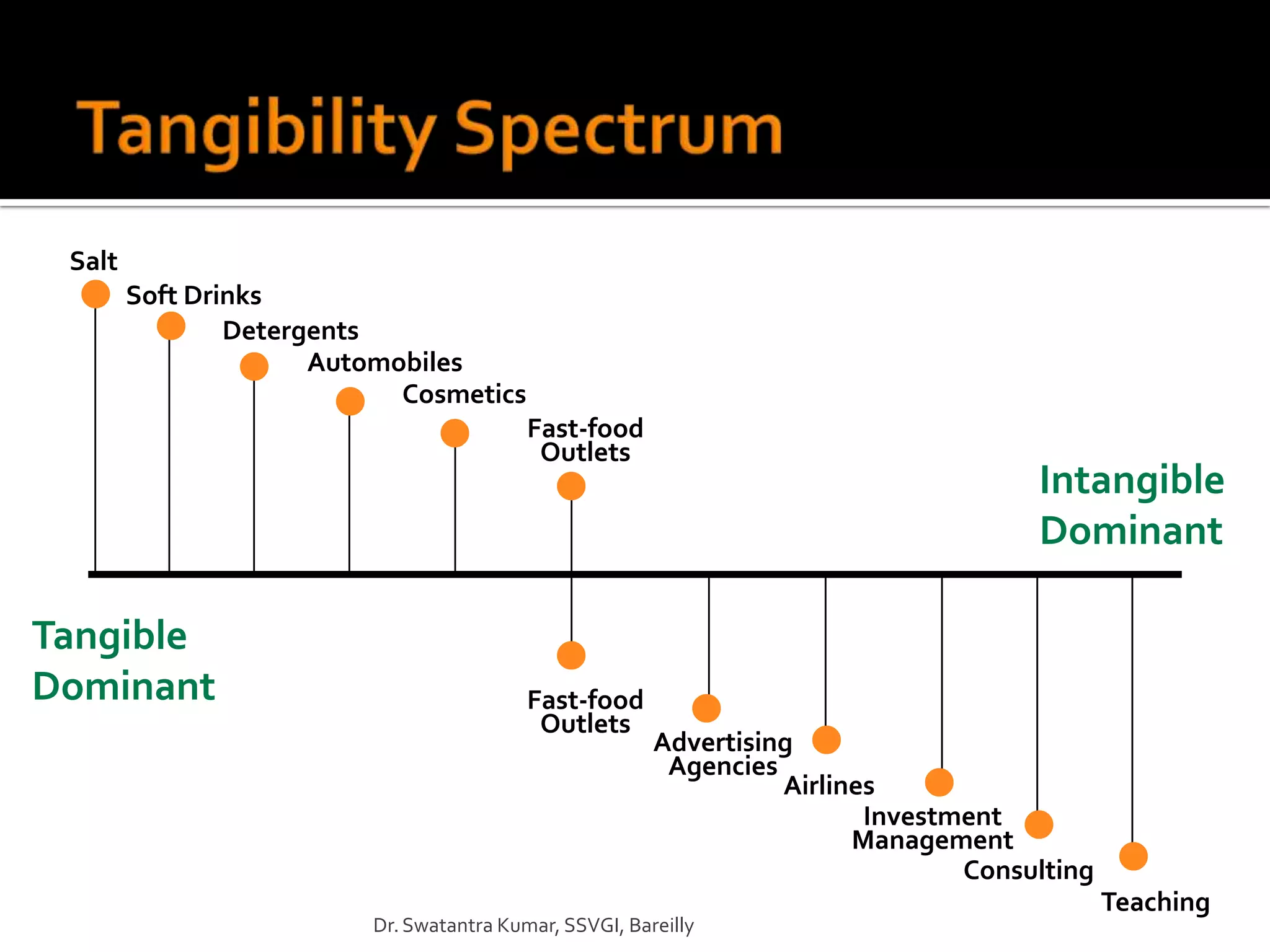
Salt
  Soft Drinks
      Detergents
             Automobiles
                CosmeticsFast-food
                        Outlets
                                                                             Intangible
                                                                              Dominant

Tangible
                                      
Dominant                           Fast-food
                                    Outlets          
                                                 Advertising
                                                  Agencies
                                                            
                                                           Airlines  
                                                                  Investment
                                                                 Management  
                                                                         Consulting    
                                                                                      Teaching
                  Dr. Swatantra Kumar, SSVGI, Bareilly
Dr. Swatantra Kumar, SSVGI, Bareilly
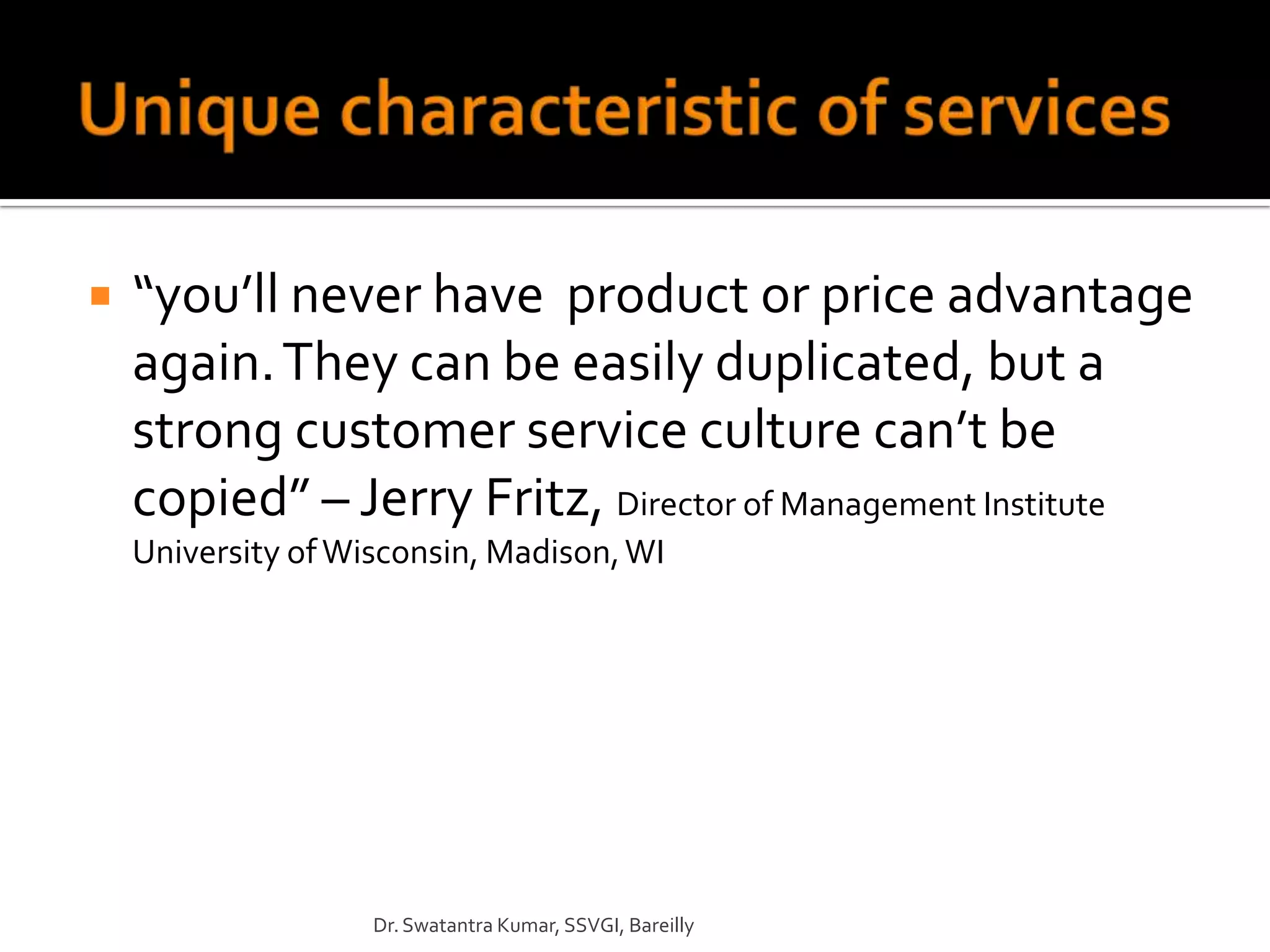
   “you’ll never have product or price advantage
    again. They can be easily duplicated, but a
    strong customer service culture can’t be
    copied” – Jerry Fritz, Director of Management Institute
    University of Wisconsin, Madison, WI


                    Dr. Swatantra Kumar, SSVGI, Bareilly
   Intangibility
   Perishability
   Heterogeneity/ non-standardization/
    variability
   inseparability


             Dr. Swatantra Kumar, SSVGI, Bareilly
   No possibility of the customer to see, touch
    or feel the service proposition before or
    during its purchase.
   No impulse purchase
   Very difficult to evaluate or measure quality
    in service
   The customer cannot stake any claim of
    ownership or possession of the service
    proposition: he can only experience the offer
              Dr. Swatantra Kumar, SSVGI, Bareilly
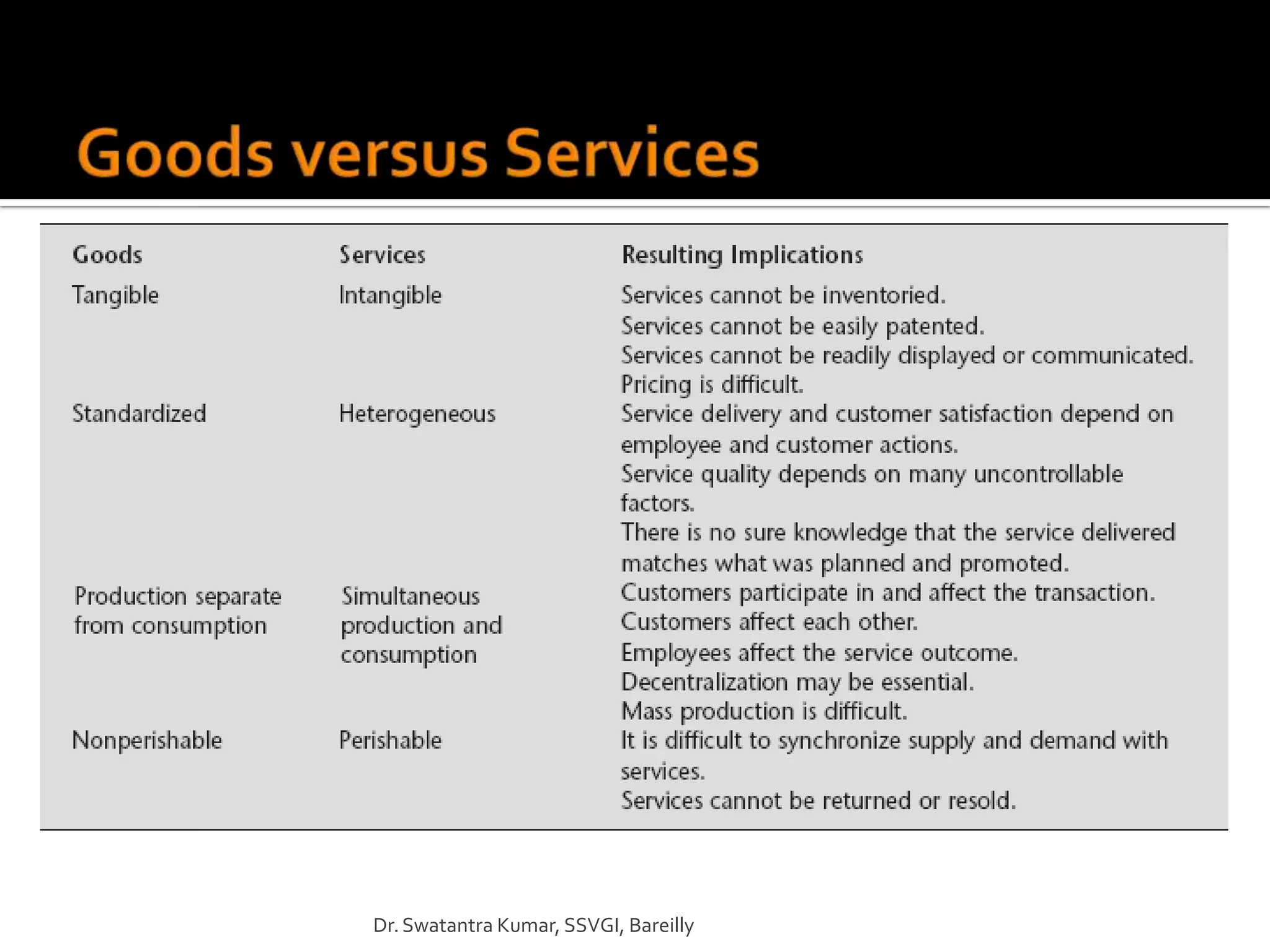
   Services cannot be inventoried

   Services cannot be easily patented

   Services cannot be readily displayed or
    communicated

   Pricing is difficult


                Dr. Swatantra Kumar, SSVGI, Bareilly
   Simultaneous production and consumption
   They can’t be stored and reproduced
   Example: Business school enrolments;
    cinema show; rail/air travel reservation, they
    all expire with time
   Time is irrecoverable and so as service


              Dr. Swatantra Kumar, SSVGI, Bareilly
   It is difficult to synchronize supply and
    demand with services

   Services cannot be returned or resold


               Dr. Swatantra Kumar, SSVGI, Bareilly
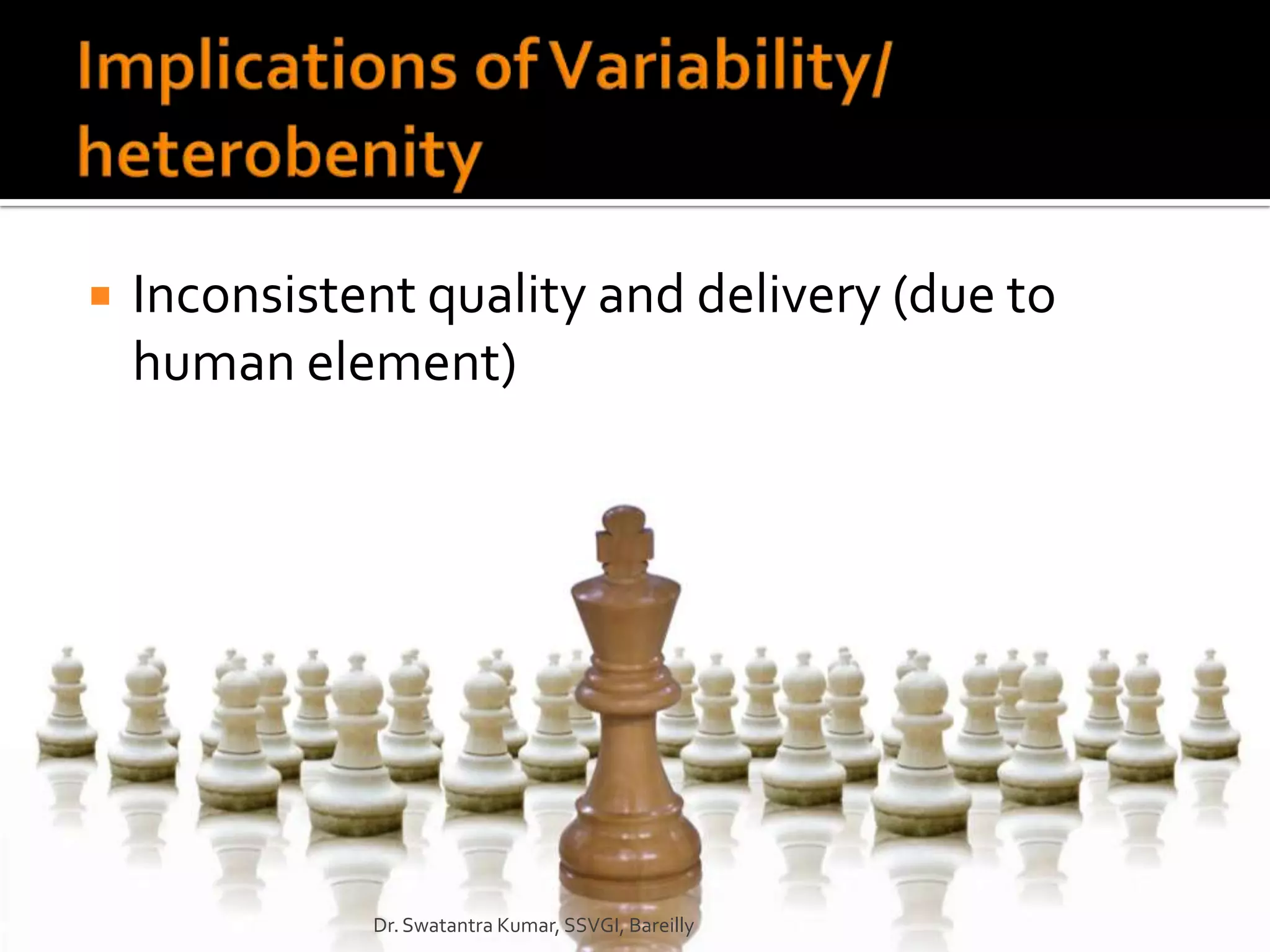
   Inconsistent quality and delivery (due to
    human element)


              Dr. Swatantra Kumar, SSVGI, Bareilly
   Service delivery and customer satisfaction
    depend on employee and customer actions

   Service quality depends on many
    uncontrollable factors

   There is no sure knowledge that the service
    delivered matches what was planned and
    promoted
              Dr. Swatantra Kumar, SSVGI, Bareilly
   We can’t have any new Gazals from
    Legendary Jagjit Singh (of course the old
    ones are preserved and can be reproduced)
   People is service (both provider and recipient
    are important)
   For heart surgery you need the doctor and
    the patient.


              Dr. Swatantra Kumar, SSVGI, Bareilly
   Customers participate in and affect the
    transaction

   Customers affect each other

   Employees affect the service outcome

   Mass production is difficult


              Dr. Swatantra Kumar, SSVGI, Bareilly
How to address the unique
characteristics of the service
          industry


      Dr. Swatantra Kumar, SSVGI, Bareilly
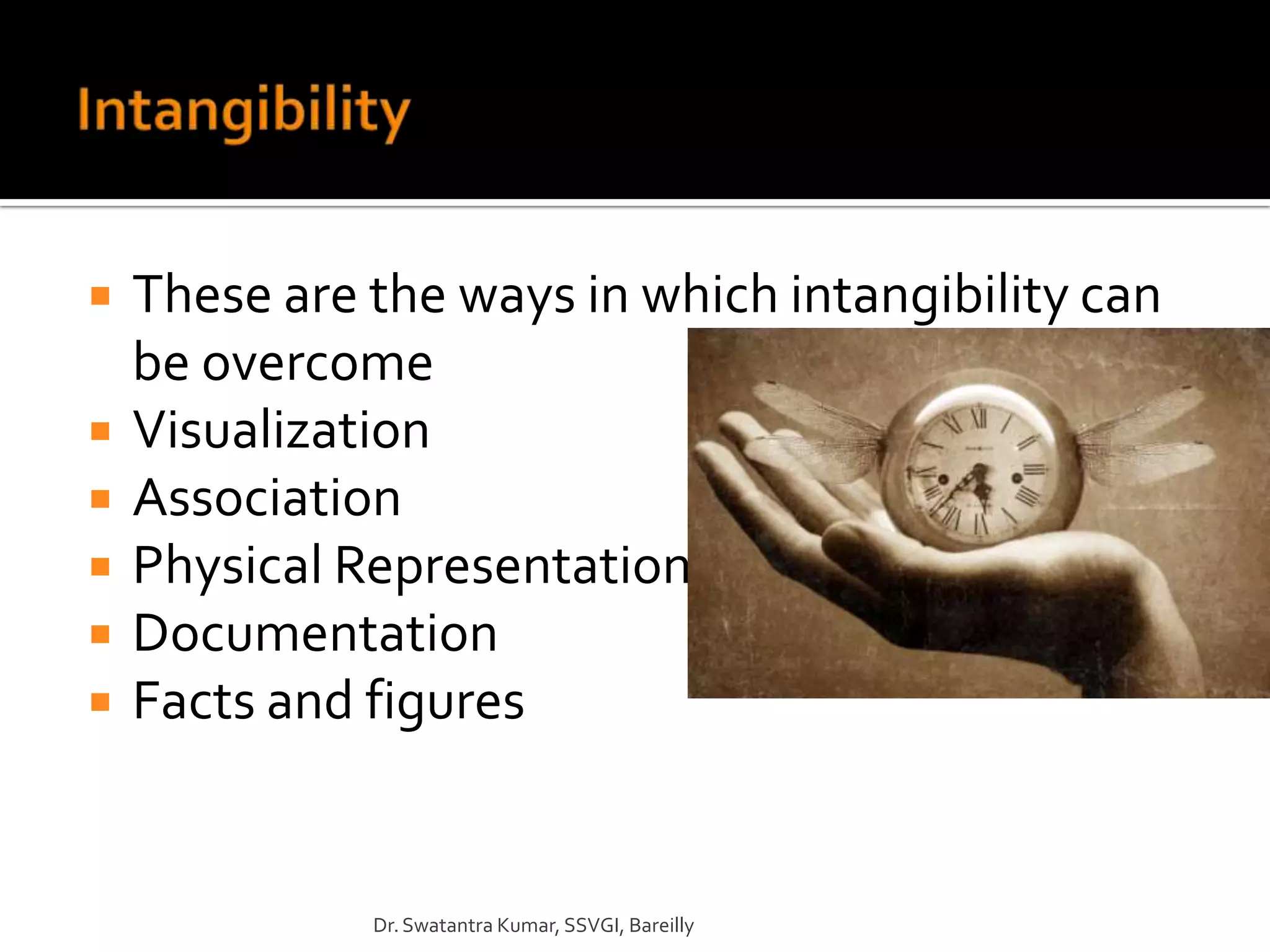
   These are the ways in which intangibility can
    be overcome
   Visualization
   Association
   Physical Representation
   Documentation
   Facts and figures


              Dr. Swatantra Kumar, SSVGI, Bareilly
   Beautiful looking internet sites
   Beautiful building and landscapes at
    institutions
   Well dressed staff at Hotels/hospitals
   Big offices of real estate brokers


              Dr. Swatantra Kumar, SSVGI, Bareilly
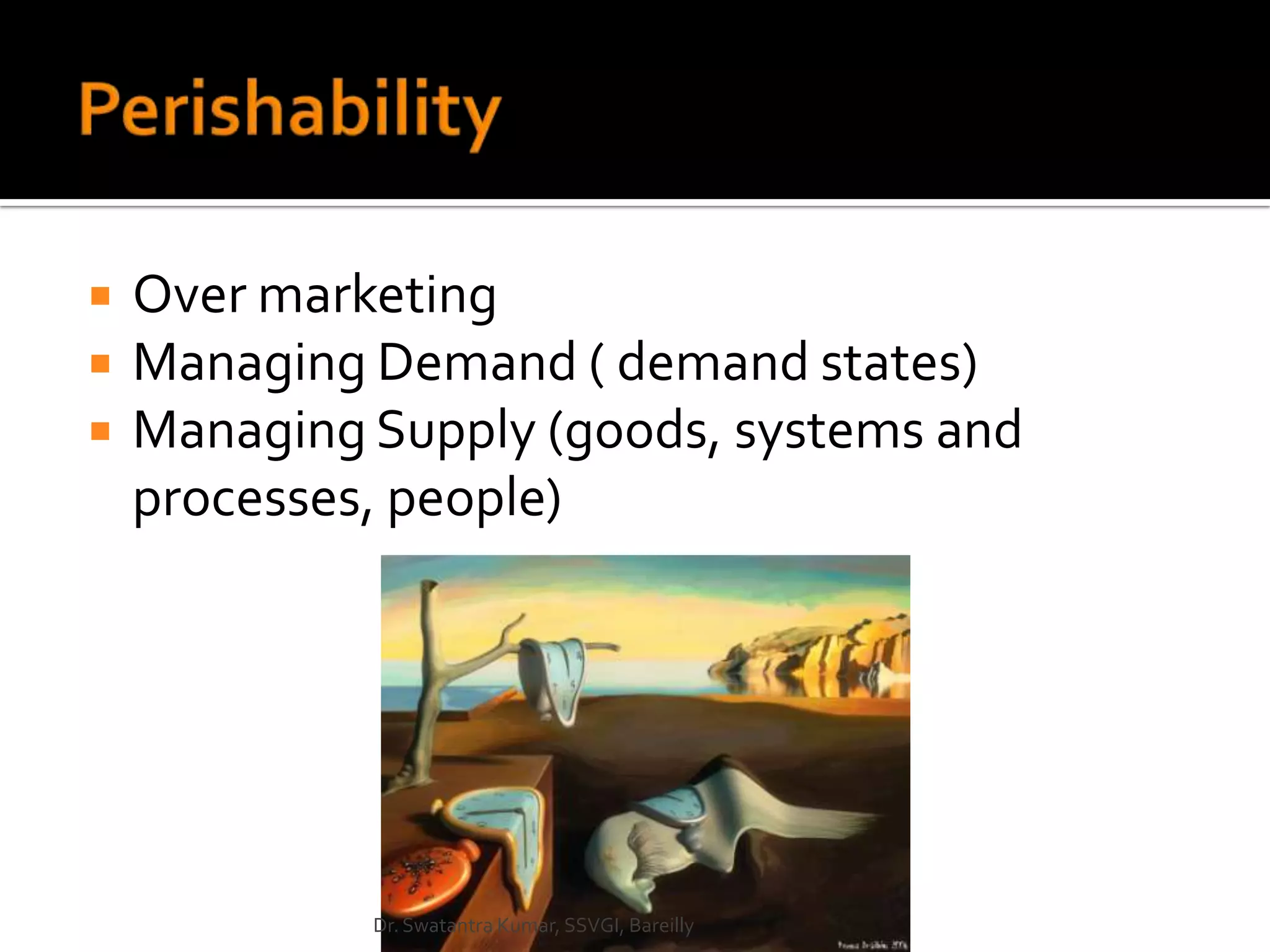
   Over marketing
   Managing Demand ( demand states)
   Managing Supply (goods, systems and
    processes, people)


             Dr. Swatantra Kumar, SSVGI, Bareilly
   Differential pricing at Cinema theaters
   Peak & off peak offers at Holiday resorts
   Happy hours at restaurant


              Dr. Swatantra Kumar, SSVGI, Bareilly
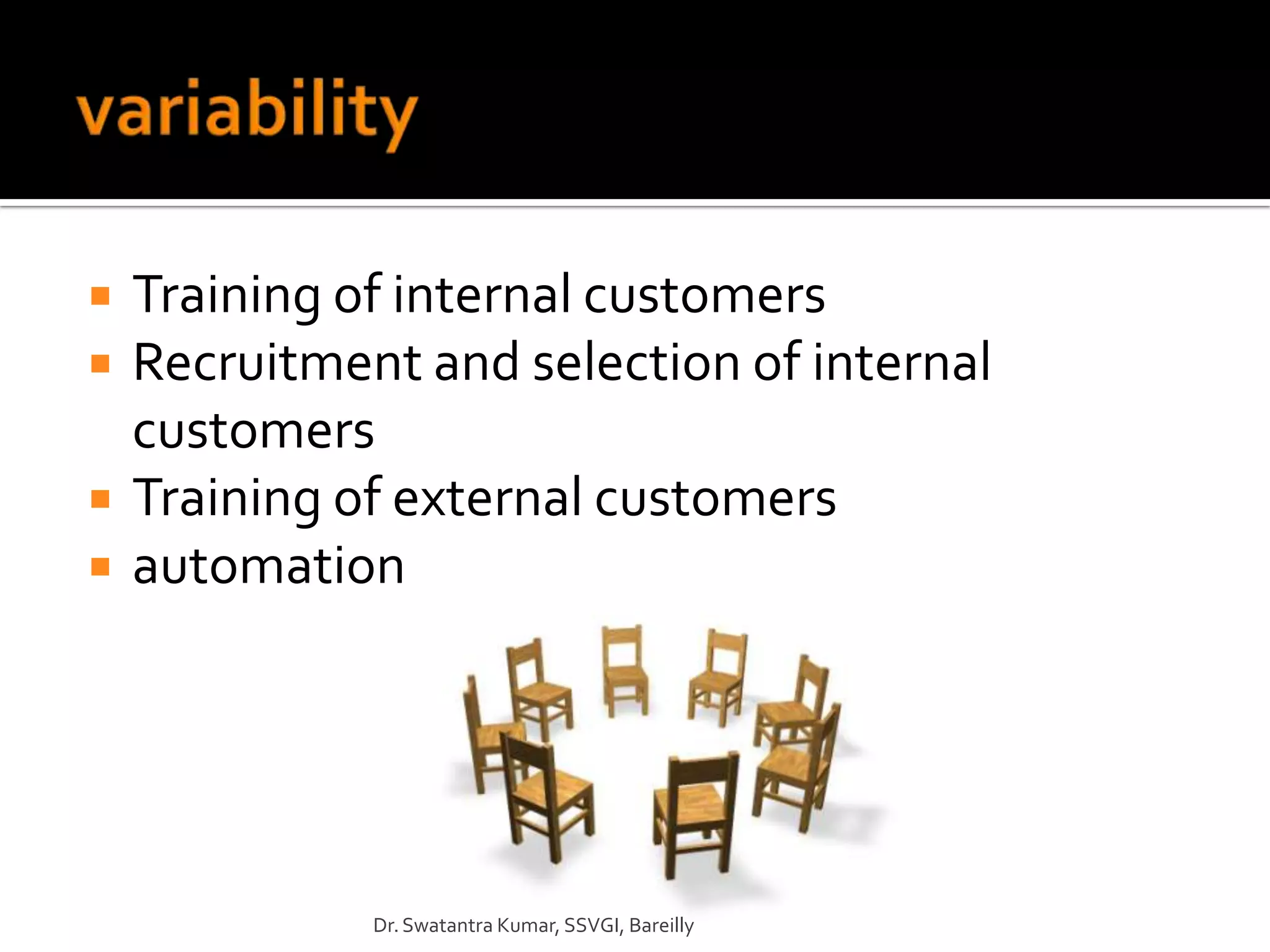
   Training of internal customers
   Recruitment and selection of internal
    customers
   Training of external customers
   automation


              Dr. Swatantra Kumar, SSVGI, Bareilly
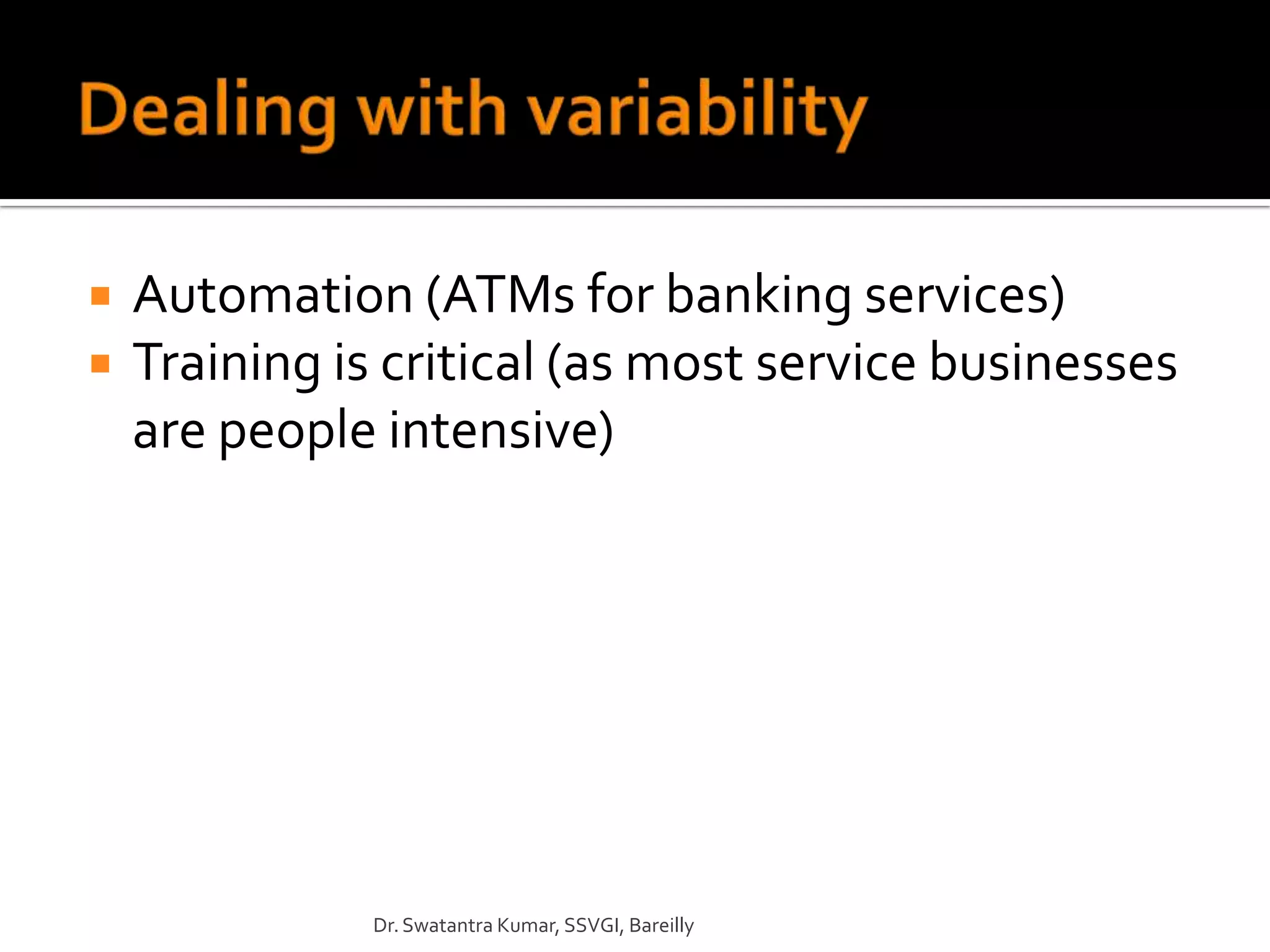
   Automation (ATMs for banking services)
   Training is critical (as most service businesses
    are people intensive)


               Dr. Swatantra Kumar, SSVGI, Bareilly
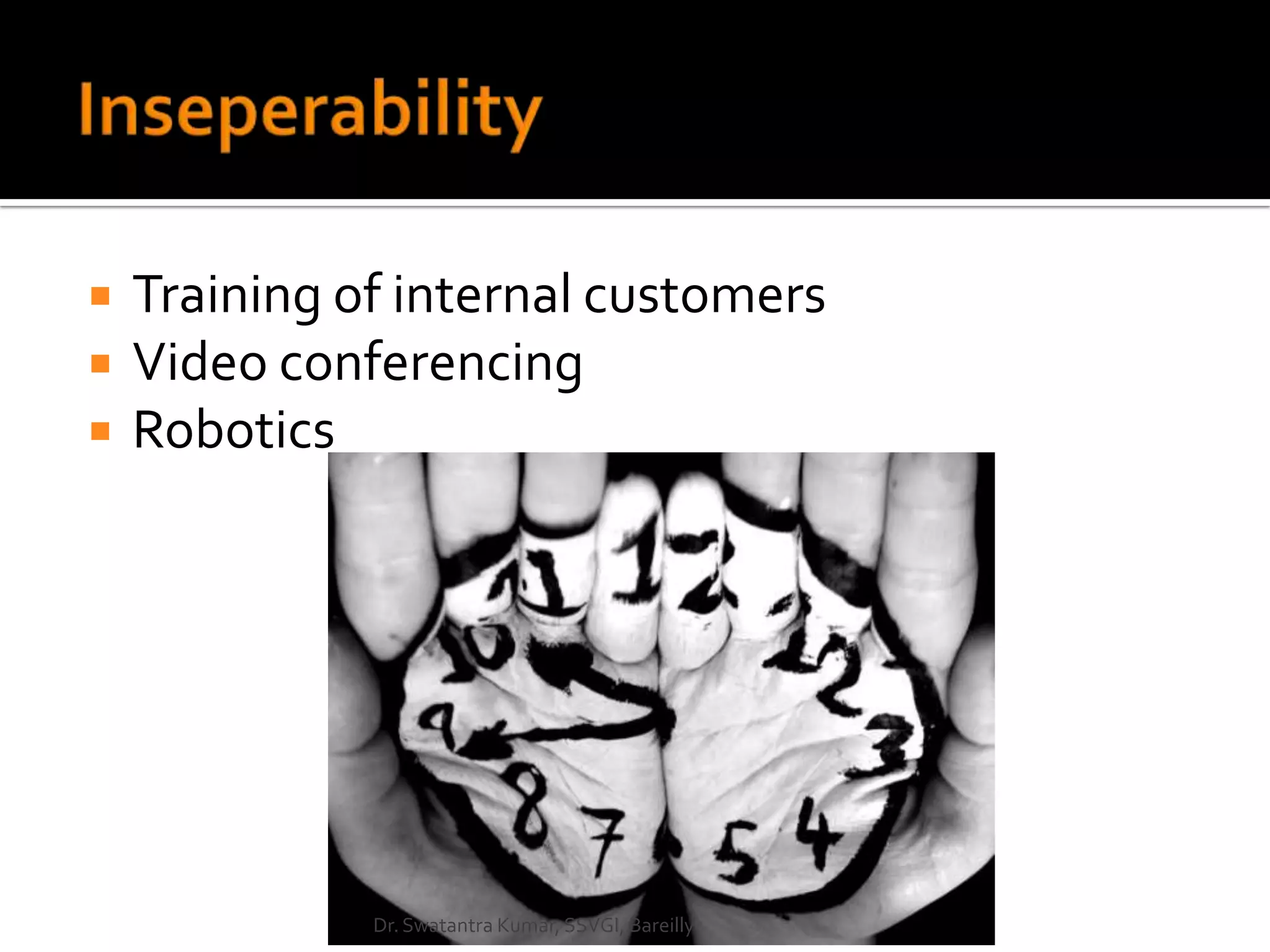
   Training of internal customers
   Video conferencing
   Robotics


              Dr. Swatantra Kumar, SSVGI, Bareilly
   All business organizations are functionally
    integrated.
   Hence functions overlap and interact
   Service operations and service marketing are
    intensely affected by each other as the
    production and consumption of services is
    simultaneous


              Dr. Swatantra Kumar, SSVGI, Bareilly
 All elements within the control of the firm that
 communicate the firm’s capabilities and image
 to customers or that influence customer
 satisfaction with the firm’s product and
 services:
     Product
     Price
     Place
     Promotion

              Dr. Swatantra Kumar, SSVGI, Bareilly
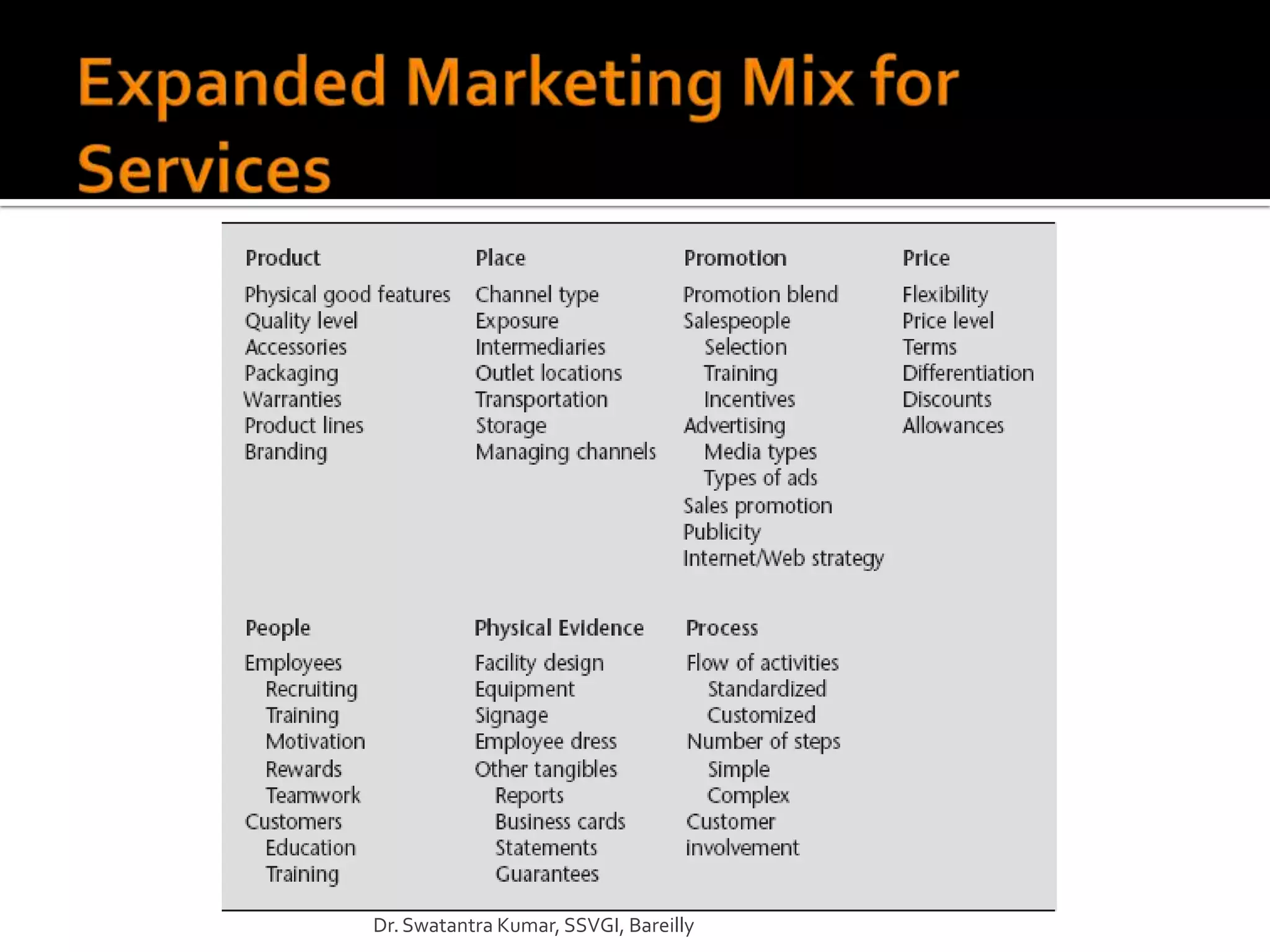
   Product
   Price
   Place
   Promotion
   People
      All human actors who play a part in service delivery and thus influence the
       buyer’s perceptions: namely, the firm’s personnel, the customer, and other
       customers in the service environment.
   Physical Evidence
      The environment in which the service is delivered and where the firm and
       customer interact, and any tangible components that facilitate performance or
       communication of the service.
   Process
      The actual procedures, mechanisms, and flow of activities by which the service
       is delivered—the service delivery and operating systems.


                        Dr. Swatantra Kumar, SSVGI, Bareilly
Dr. Swatantra Kumar, SSVGI, Bareilly
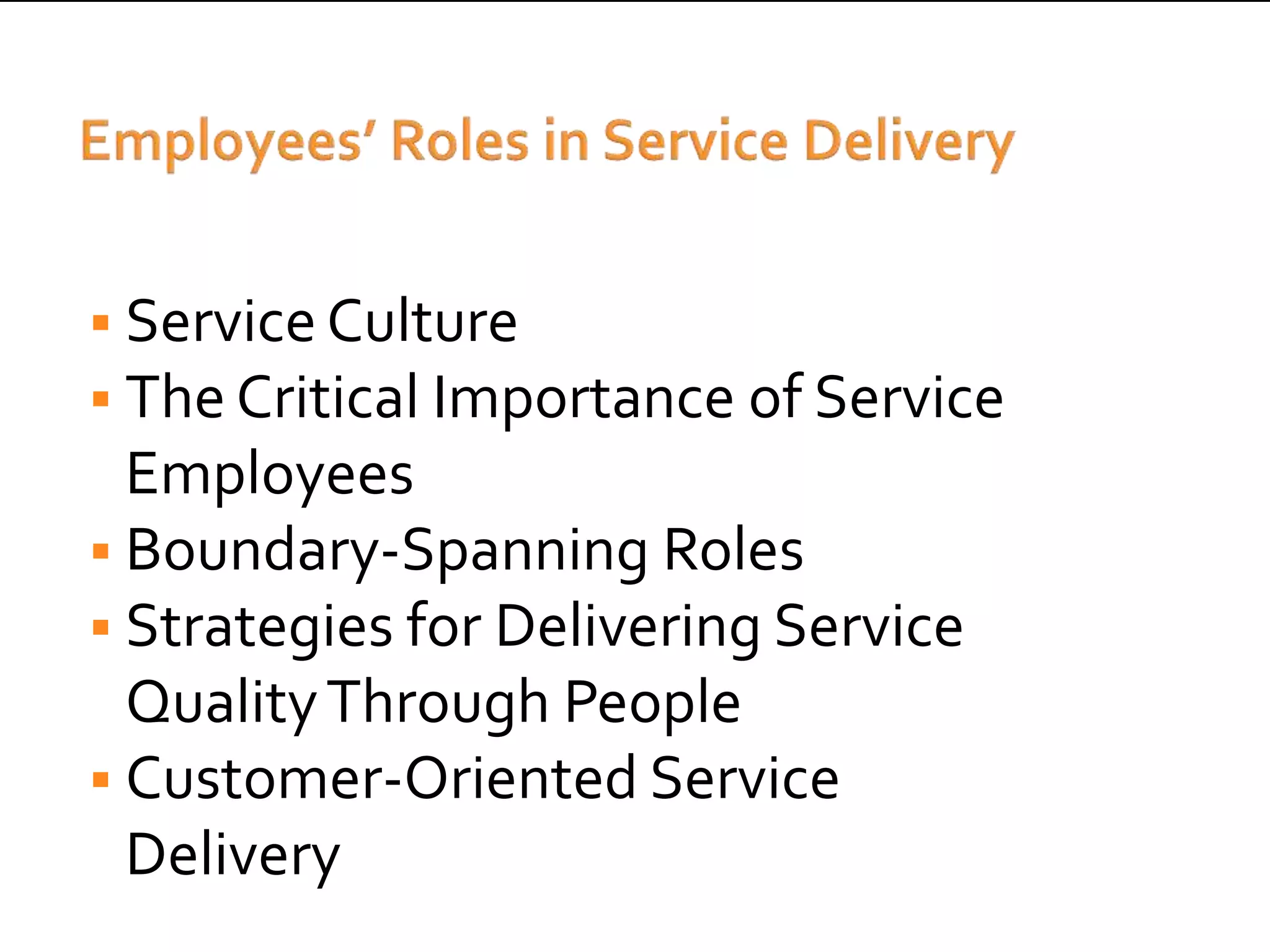
 Service Culture
 The Critical Importance of Service
  Employees
 Boundary-Spanning Roles
 Strategies for Delivering Service
  Quality Through People
 Customer-Oriented Service
  Delivery
           Dr. Swatantra Kumar, SSVGI, Bareilly
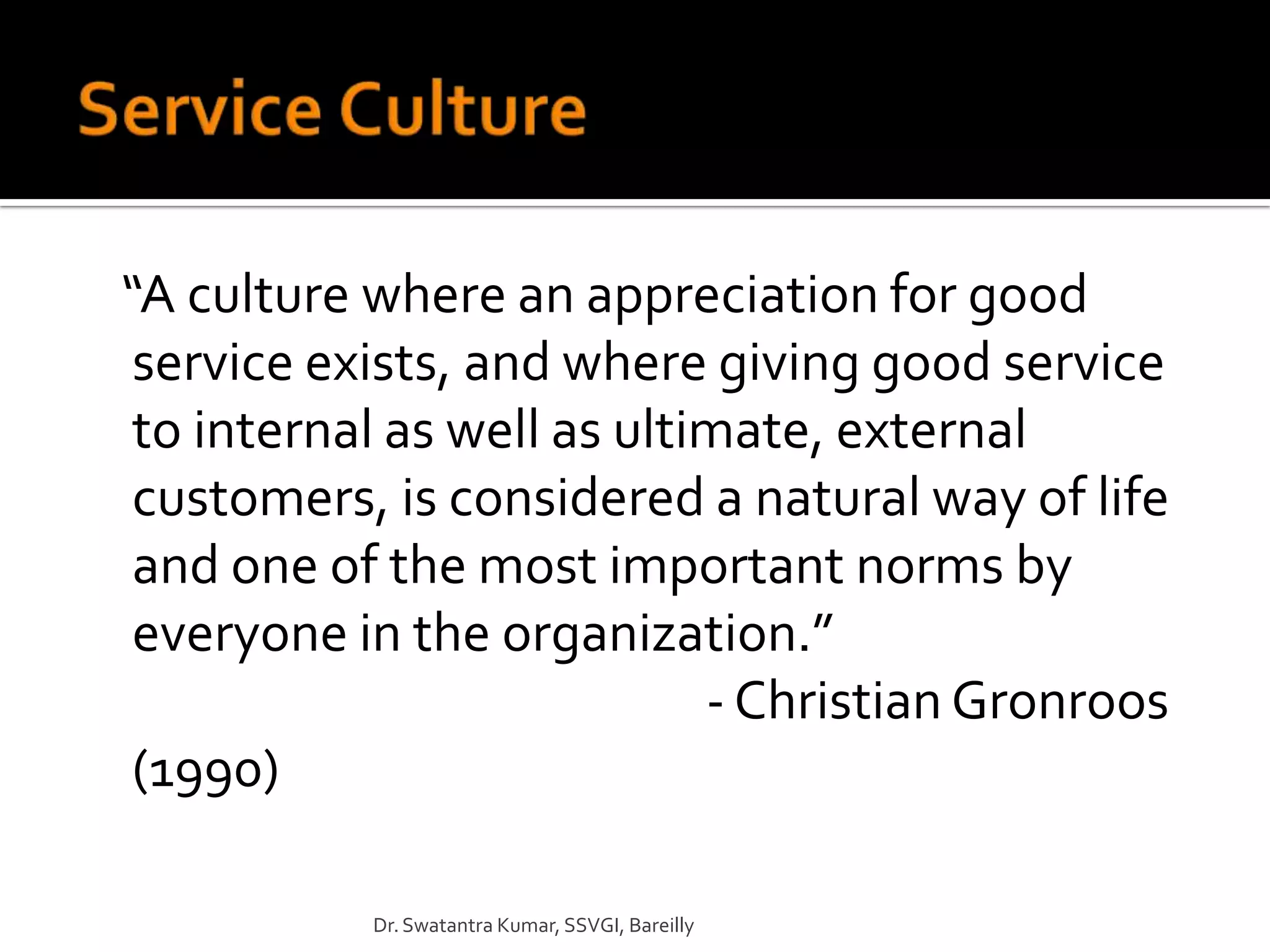
“A culture where an appreciation for good
 service exists, and where giving good service
 to internal as well as ultimate, external
 customers, is considered a natural way of life
 and one of the most important norms by
 everyone in the organization.”
                            - Christian Gronroos
 (1990)

           Dr. Swatantra Kumar, SSVGI, Bareilly
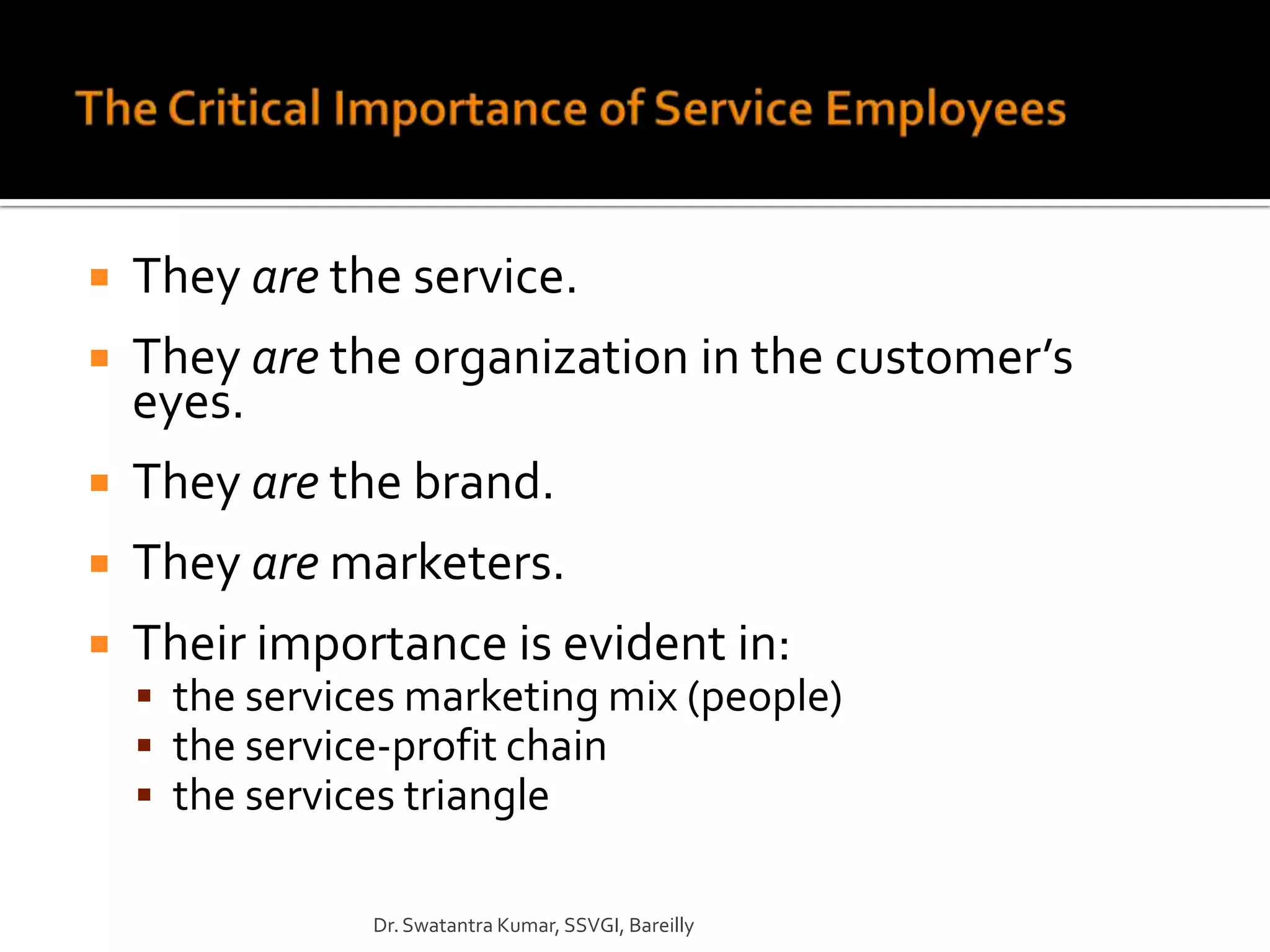
   They are the service.
   They are the organization in the customer’s
    eyes.
   They are the brand.
   They are marketers.
   Their importance is evident in:
     the services marketing mix (people)
     the service-profit chain
     the services triangle

                Dr. Swatantra Kumar, SSVGI, Bareilly
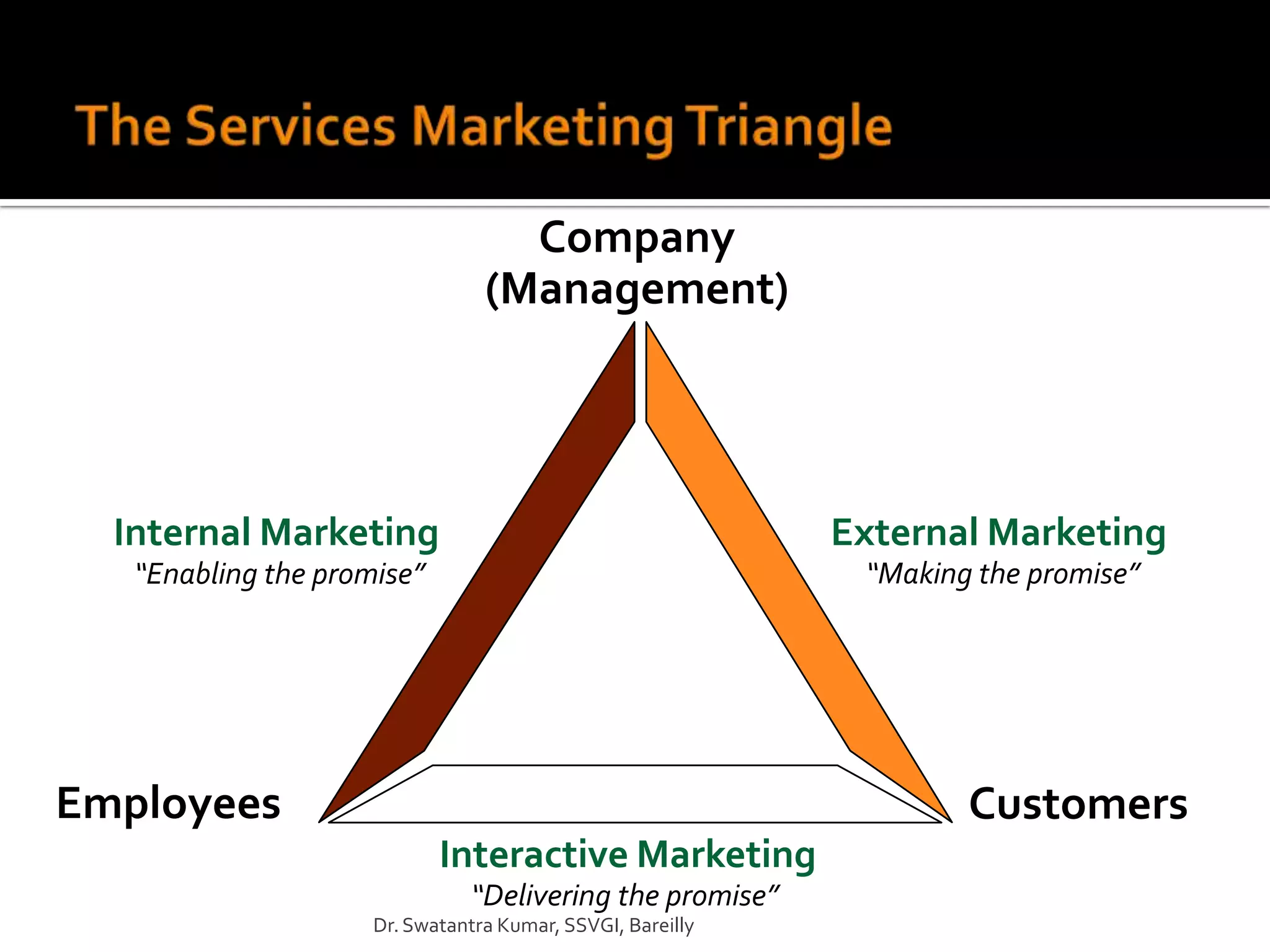
Company
                                 (Management)


  Internal Marketing                                        External Marketing
   “Enabling the promise”                                    “Making the promise”


Employees                                                           Customers
                            Interactive Marketing
                               “Delivering the promise”
                     Dr. Swatantra Kumar, SSVGI, Bareilly
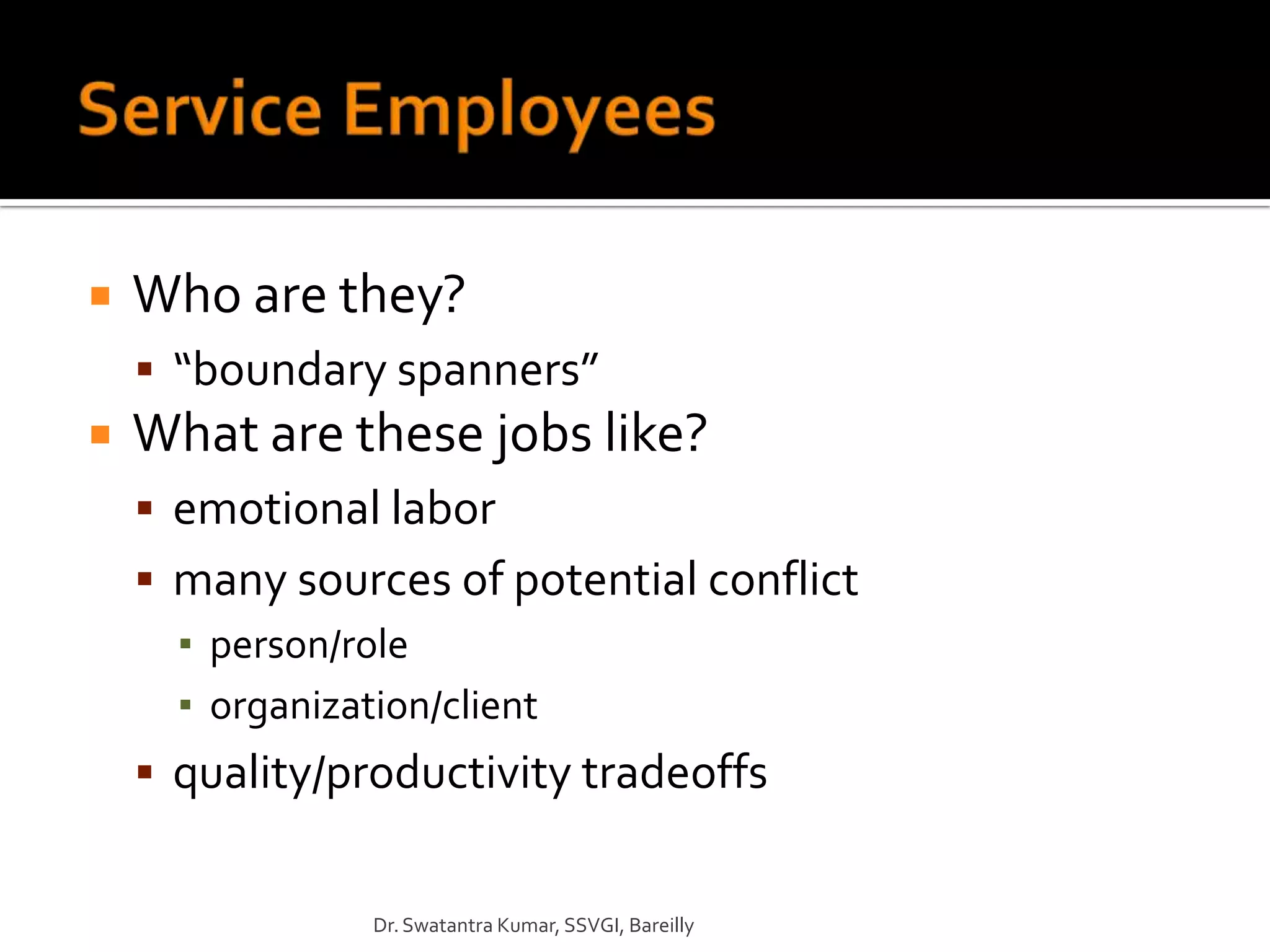
   Who are they?
     “boundary spanners”
   What are these jobs like?
     emotional labor
     many sources of potential conflict
      ▪ person/role
      ▪ organization/client
     quality/productivity tradeoffs


                Dr. Swatantra Kumar, SSVGI, Bareilly
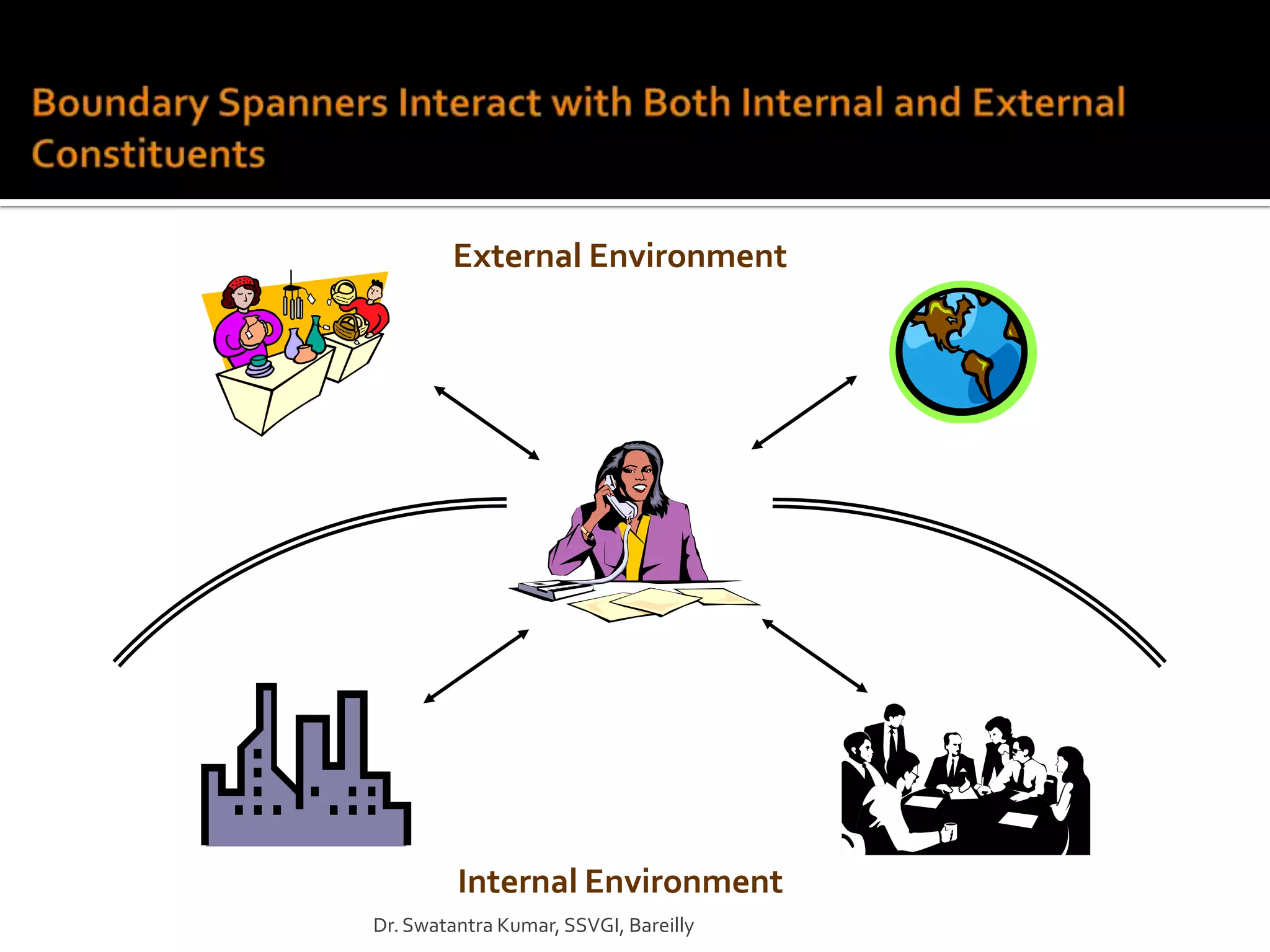
External Environment


         Internal Environment
Dr. Swatantra Kumar, SSVGI, Bareilly
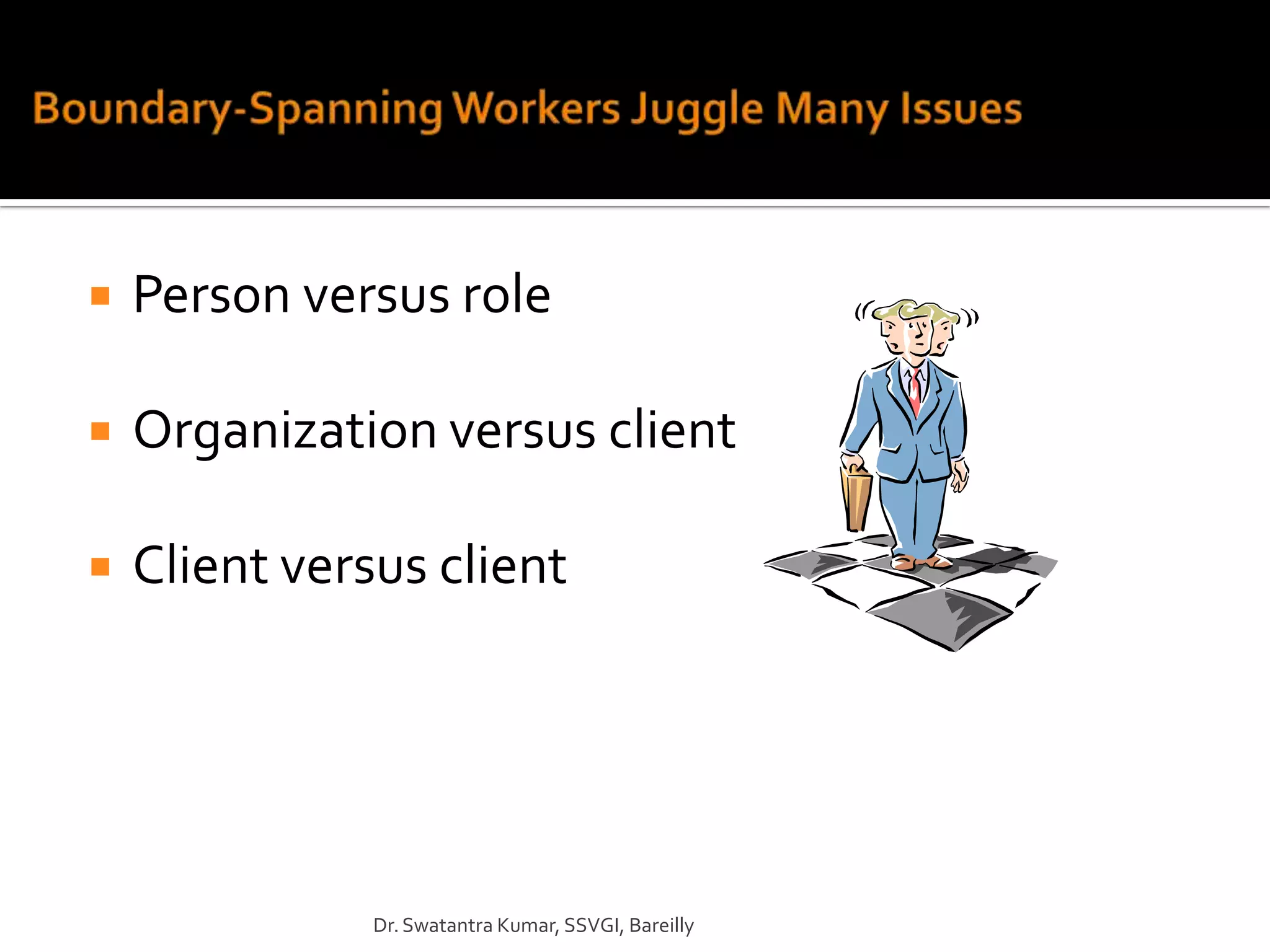
   Person versus role

   Organization versus client

   Client versus client


               Dr. Swatantra Kumar, SSVGI, Bareilly
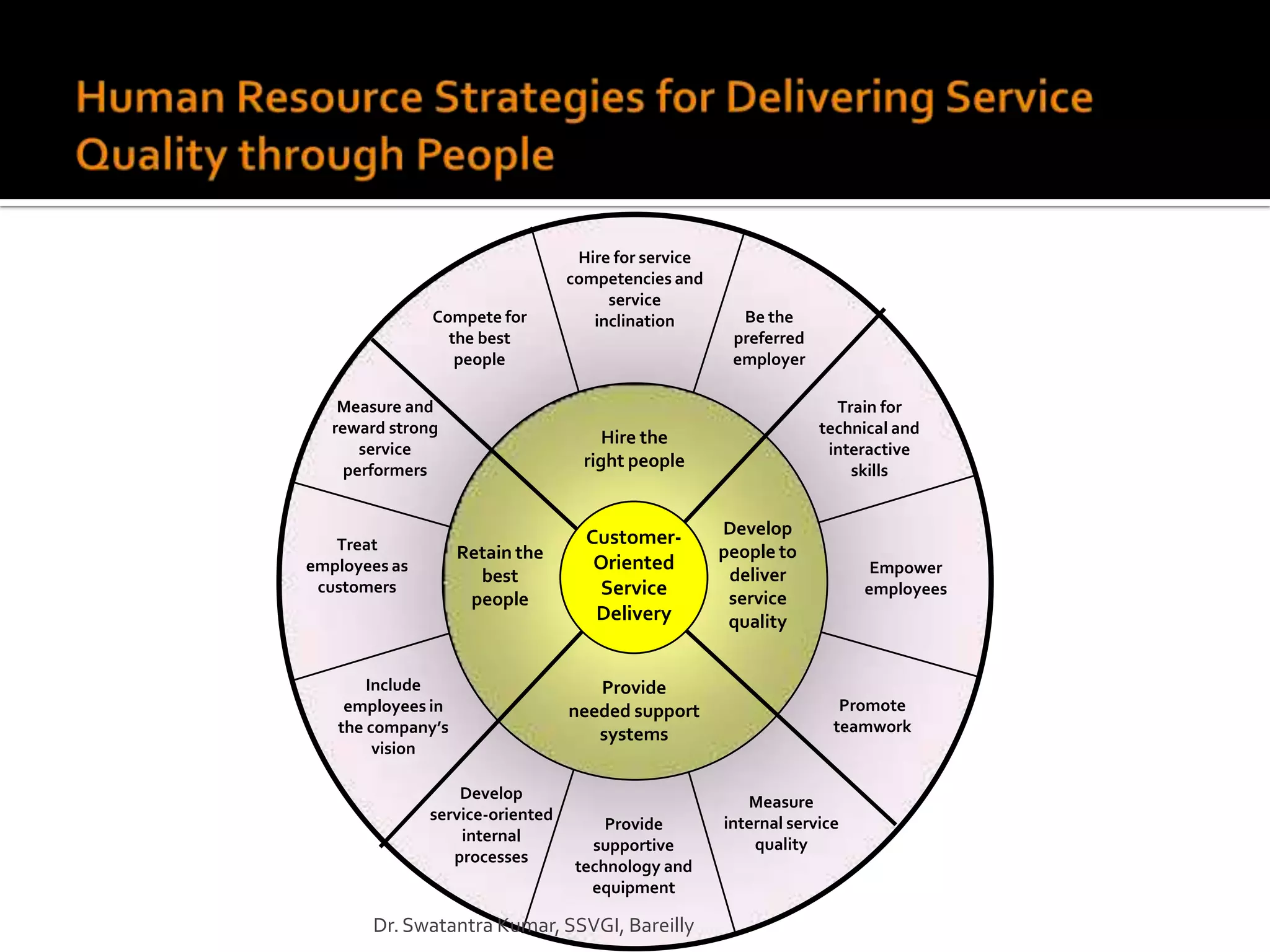
Hire for service
                                  competencies and
                                       service
               Compete for           inclination        Be the
                 the best                              preferred
                  people                               employer

    Measure and                                                      Train for
   reward strong                                                   technical and
                                       Hire the
       service                                                      interactive
     performers
                                    right people                       skills


                                    Customer-         Develop
   Treat           Retain the                         people to
employees as                         Oriented                             Empower
                     best                              deliver
 customers                           Service           service
                                                                         employees
                    people
                                     Delivery          quality


       Include                       Provide
    employees in                  needed support                      Promote
   the company’s                     systems                         teamwork
        vision

                   Develop                               Measure
               service-oriented                       internal service
                                       Provide
                   internal                               quality
                                     supportive
                  processes
                                   technology and
                                     equipment

        Dr. Swatantra Kumar, SSVGI, Bareilly
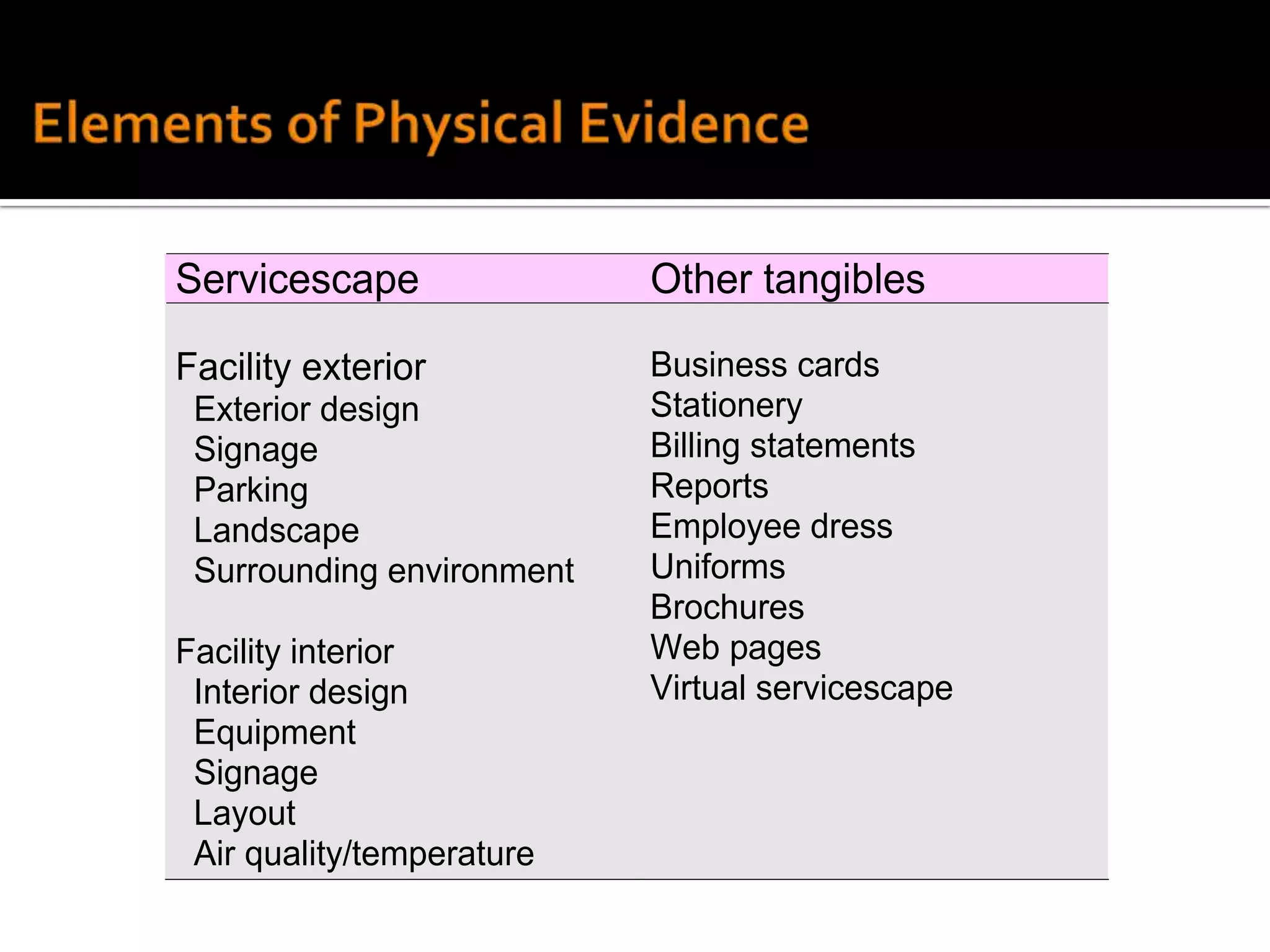
Servicescape               Other tangibles

Facility exterior          Business cards
 Exterior design           Stationery
 Signage                   Billing statements
 Parking                   Reports
 Landscape                 Employee dress
 Surrounding environment   Uniforms
                           Brochures
Facility interior          Web pages
 Interior design           Virtual servicescape
 Equipment
 Signage
 Layout
 Air quality/temperature
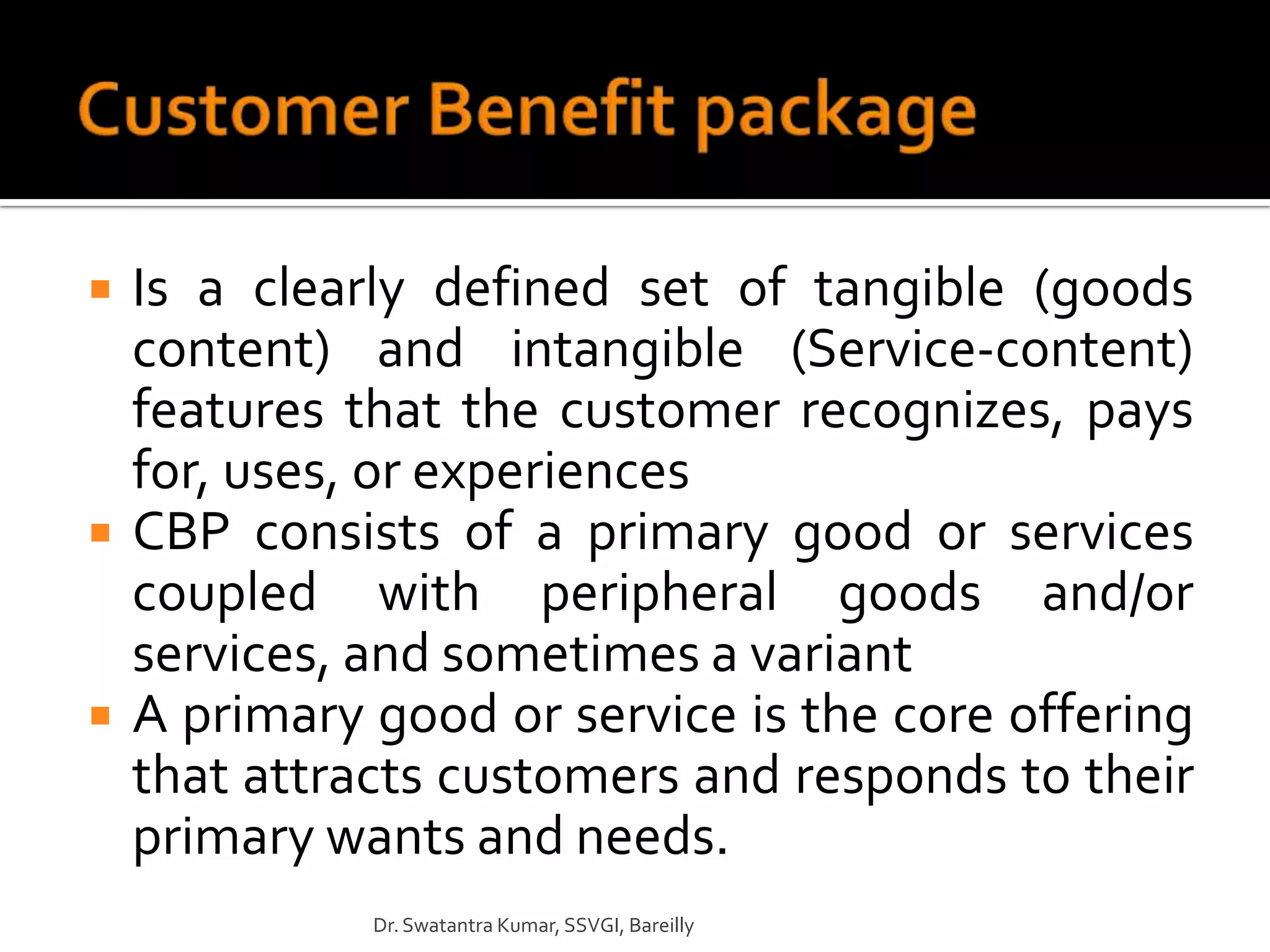
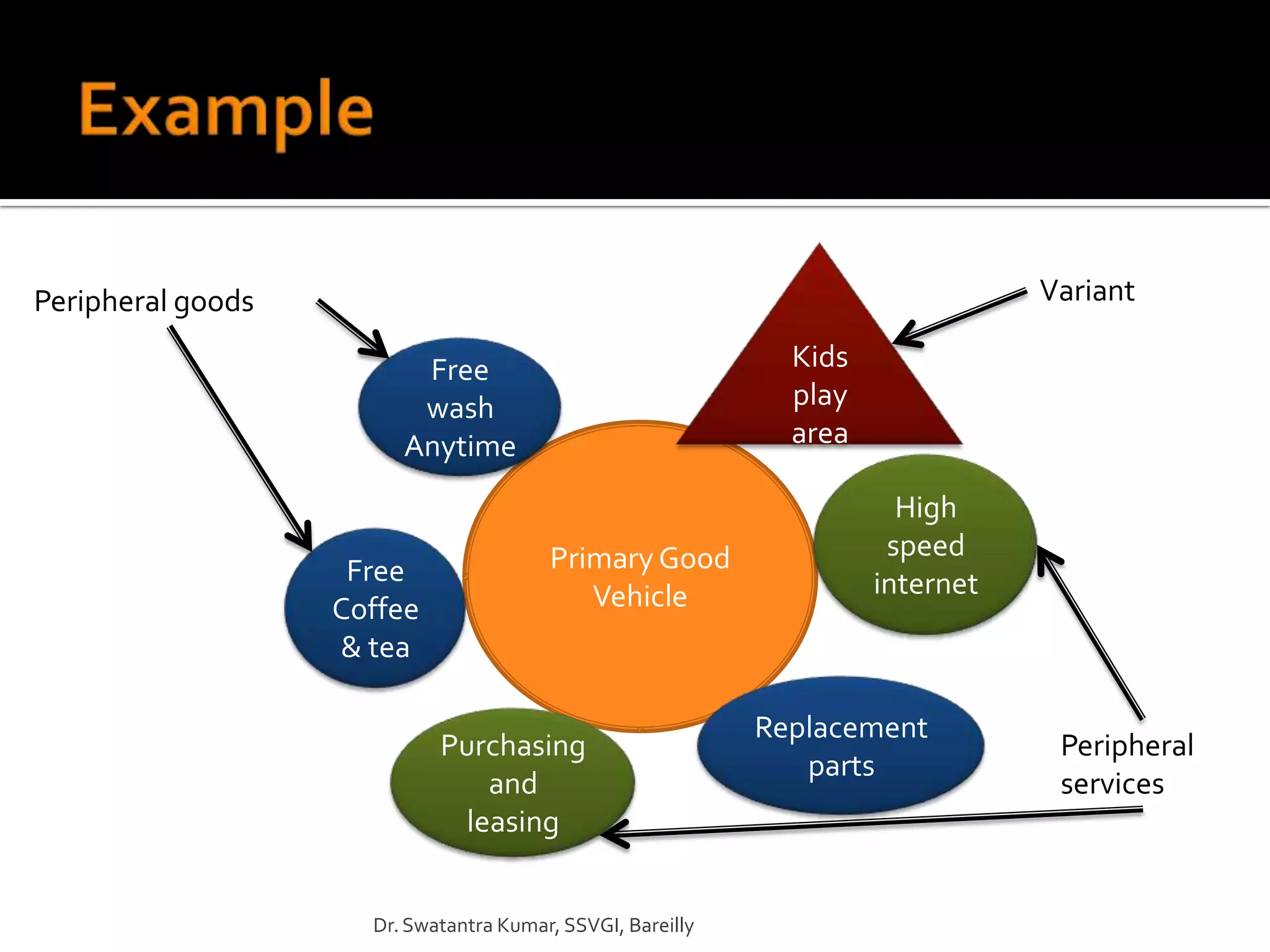
   Is a clearly defined set of tangible (goods
    content) and intangible (Service-content)
    features that the customer recognizes, pays
    for, uses, or experiences
   CBP consists of a primary good or services
    coupled with peripheral goods and/or
    services, and sometimes a variant
   A primary good or service is the core offering
    that attracts customers and responds to their
    primary wants and needs.
              Dr. Swatantra Kumar, SSVGI, Bareilly
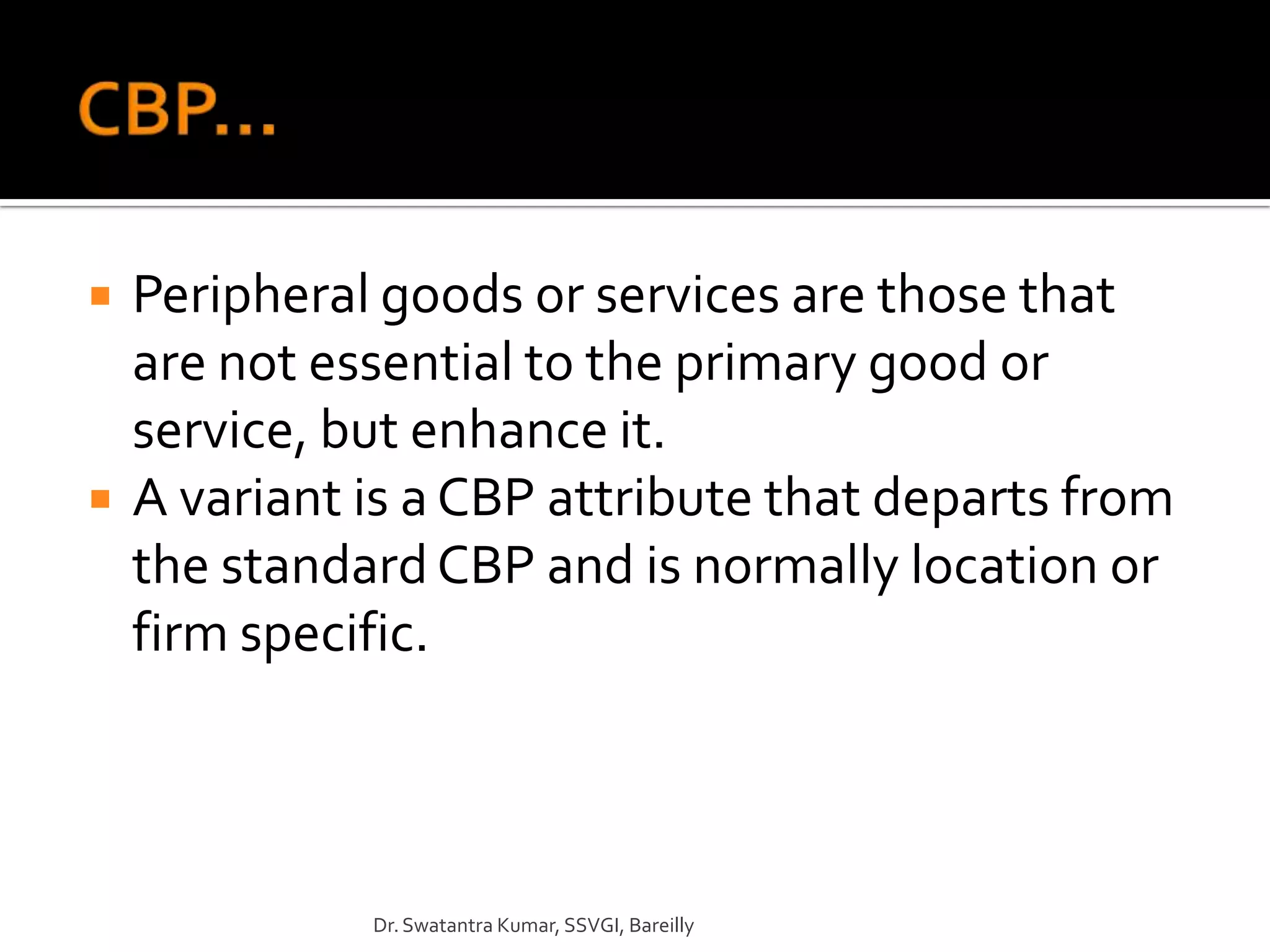
   Peripheral goods or services are those that
    are not essential to the primary good or
    service, but enhance it.
   A variant is a CBP attribute that departs from
    the standard CBP and is normally location or
    firm specific.


              Dr. Swatantra Kumar, SSVGI, Bareilly
Peripheral goods                                                                Variant

                         Free                                 Kids
                         wash                                 play
                        Anytime                               area

                                                                       High
                                        Primary Good                  speed
                    Free                                             internet
                   Coffee                  Vehicle
                   & tea

                                                            Replacement
                            Purchasing                                           Peripheral
                                                               parts
                                and                                              services
                              leasing


                     Dr. Swatantra Kumar, SSVGI, Bareilly
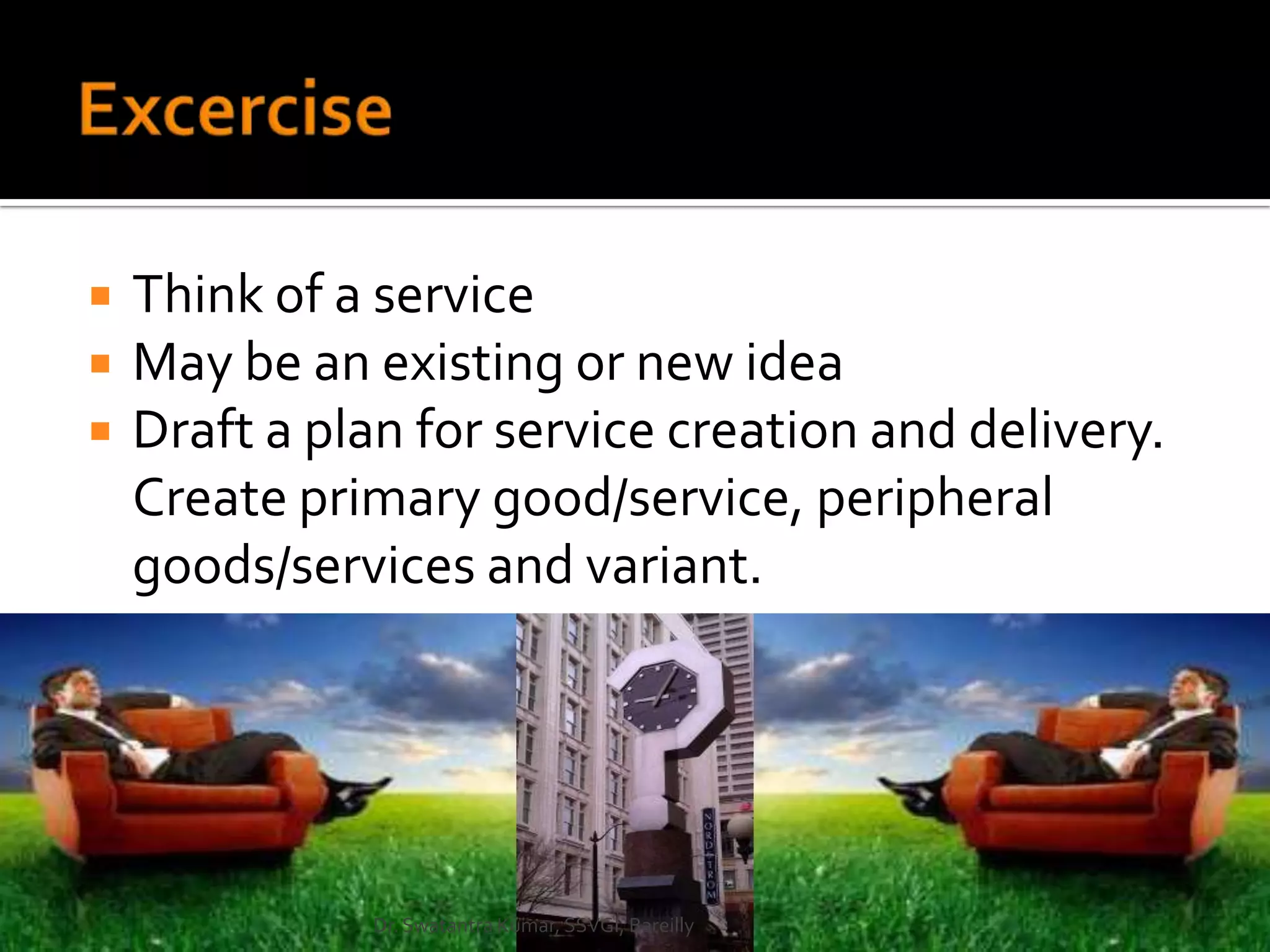
   Think of a service
   May be an existing or new idea
   Draft a plan for service creation and delivery.
    Create primary good/service, peripheral
    goods/services and variant.


              Dr. Swatantra Kumar, SSVGI, Bareilly
Dr. Swatantra Kumar, SSVGI, Bareilly

Operations in service industry 3

  • 1.
    By Dr. Swatantra Kumar Dr. Swatantra Kumar, SSVGI, Bareilly
  • 2.
    Supporting Facility: The physical resources that must be in place before a service can be sold. Examples are golf course, ski lift, hospital, airplane.  Facilitating Goods: The material consumed by the buyer or items provided by the consumer. Examples are food items, legal documents, golf clubs, medical history.  Information: Operations data or information that is provided by the customer to enable efficient and customized service. Examples are patient medical records, seats available on a flight, customer preferences, location of customer to dispatch a taxi. Dr. Swatantra Kumar, SSVGI, Bareilly
  • 3.
    Explicit Services: Benefits readily observable by the senses. The essential or intrinsic features. Examples are quality of meal, attitude of the waiter, on-time departure.  Implicit Services: Psychological benefits or extrinsic features which the consumer may sense only vaguely. Examples are privacy of loan office, security of a well lighted parking lot. Dr. Swatantra Kumar, SSVGI, Bareilly
  • 4.
    Degree Degree of Interaction and Customization of labor Intensity Low High Service Factory Service Shop * Airlines * Hospitals Low * Trucking * Auto repair * Hotels * Other repair services * Resorts and recreation Mass Service Professional Service * Retailing * Doctors High * Wholesaling * Lawyers * Schools * Accountants * Retail banking * Architects Dr. Swatantra Kumar, SSVGI, Bareilly
  • 5.
    Dr. Swatantra Kumar,SSVGI, Bareilly
  • 6.
    Dr. Swatantra Kumar,SSVGI, Bareilly
  • 7.
    Dr. Swatantra Kumar,SSVGI, Bareilly
  • 8.
    Dr. Swatantra Kumar,SSVGI, Bareilly
  • 9.
    What are the characteristics of services that will be most appropriate for Internet delivery?  When does collecting information through service membership become an invasion of privacy?  What are some management problems associated with allowing service employees to exercise judgement in meeting customer needs?  Illustrate the “distinctive characteristics of service operations” for a service with which you are familiar.  What factors are important for a manager to consider when attempting to enhance a service firm’s image? Dr. Swatantra Kumar, SSVGI, Bareilly
  • 10.
    On the basis of end user  On the basis of degree of tangibility  Degree of customer contact  Degree of expertise  Profit orientation Dr. Swatantra Kumar, SSVGI, Bareilly
  • 11.
    Business services  Consumer services  Govt. Dr. Swatantra Kumar, SSVGI, Bareilly
  • 12.
    Purely intangible  Services with tangible inputs  Products with service inputs Dr. Swatantra Kumar, SSVGI, Bareilly
  • 13.
    Low customer contact  High Customer contact Dr. Swatantra Kumar, SSVGI, Bareilly
  • 14.
    High  Moderate  Low Dr. Swatantra Kumar, SSVGI, Bareilly
  • 15.
    For profit  Not for profit Dr. Swatantra Kumar, SSVGI, Bareilly
  • 16.
    Goods are tangible whereas services are intangible  Customers participate in many service processes, activities and transactions  The demand for services is more difficult to predict than the demand for goods  Services can not be stored as physical inventory  Service management skills are paramount to a successful service encounter Dr. Swatantra Kumar, SSVGI, Bareilly
  • 17.
    Service facilities typically need to be in close proximity to the customer  Patents do not protect services Dr. Swatantra Kumar, SSVGI, Bareilly
  • 18.
    Salt  SoftDrinks  Detergents  Automobiles  CosmeticsFast-food  Outlets  Intangible Dominant Tangible  Dominant Fast-food Outlets  Advertising Agencies  Airlines  Investment Management  Consulting  Teaching Dr. Swatantra Kumar, SSVGI, Bareilly
  • 19.
    Dr. Swatantra Kumar,SSVGI, Bareilly
  • 20.
    “you’ll never have product or price advantage again. They can be easily duplicated, but a strong customer service culture can’t be copied” – Jerry Fritz, Director of Management Institute University of Wisconsin, Madison, WI Dr. Swatantra Kumar, SSVGI, Bareilly
  • 21.
    Intangibility  Perishability  Heterogeneity/ non-standardization/ variability  inseparability Dr. Swatantra Kumar, SSVGI, Bareilly
  • 22.
    No possibility of the customer to see, touch or feel the service proposition before or during its purchase.  No impulse purchase  Very difficult to evaluate or measure quality in service  The customer cannot stake any claim of ownership or possession of the service proposition: he can only experience the offer Dr. Swatantra Kumar, SSVGI, Bareilly
  • 23.
    Services cannot be inventoried  Services cannot be easily patented  Services cannot be readily displayed or communicated  Pricing is difficult Dr. Swatantra Kumar, SSVGI, Bareilly
  • 24.
    Simultaneous production and consumption  They can’t be stored and reproduced  Example: Business school enrolments; cinema show; rail/air travel reservation, they all expire with time  Time is irrecoverable and so as service Dr. Swatantra Kumar, SSVGI, Bareilly
  • 25.
    It is difficult to synchronize supply and demand with services  Services cannot be returned or resold Dr. Swatantra Kumar, SSVGI, Bareilly
  • 26.
    Inconsistent quality and delivery (due to human element) Dr. Swatantra Kumar, SSVGI, Bareilly
  • 27.
    Service delivery and customer satisfaction depend on employee and customer actions  Service quality depends on many uncontrollable factors  There is no sure knowledge that the service delivered matches what was planned and promoted Dr. Swatantra Kumar, SSVGI, Bareilly
  • 28.
    We can’t have any new Gazals from Legendary Jagjit Singh (of course the old ones are preserved and can be reproduced)  People is service (both provider and recipient are important)  For heart surgery you need the doctor and the patient. Dr. Swatantra Kumar, SSVGI, Bareilly
  • 29.
    Customers participate in and affect the transaction  Customers affect each other  Employees affect the service outcome  Mass production is difficult Dr. Swatantra Kumar, SSVGI, Bareilly
  • 30.
    How to addressthe unique characteristics of the service industry Dr. Swatantra Kumar, SSVGI, Bareilly
  • 31.
    These are the ways in which intangibility can be overcome  Visualization  Association  Physical Representation  Documentation  Facts and figures Dr. Swatantra Kumar, SSVGI, Bareilly
  • 32.
    Beautiful looking internet sites  Beautiful building and landscapes at institutions  Well dressed staff at Hotels/hospitals  Big offices of real estate brokers Dr. Swatantra Kumar, SSVGI, Bareilly
  • 33.
    Over marketing  Managing Demand ( demand states)  Managing Supply (goods, systems and processes, people) Dr. Swatantra Kumar, SSVGI, Bareilly
  • 34.
    Differential pricing at Cinema theaters  Peak & off peak offers at Holiday resorts  Happy hours at restaurant Dr. Swatantra Kumar, SSVGI, Bareilly
  • 35.
    Training of internal customers  Recruitment and selection of internal customers  Training of external customers  automation Dr. Swatantra Kumar, SSVGI, Bareilly
  • 36.
    Automation (ATMs for banking services)  Training is critical (as most service businesses are people intensive) Dr. Swatantra Kumar, SSVGI, Bareilly
  • 37.
    Training of internal customers  Video conferencing  Robotics Dr. Swatantra Kumar, SSVGI, Bareilly
  • 38.
    All business organizations are functionally integrated.  Hence functions overlap and interact  Service operations and service marketing are intensely affected by each other as the production and consumption of services is simultaneous Dr. Swatantra Kumar, SSVGI, Bareilly
  • 39.
     All elementswithin the control of the firm that communicate the firm’s capabilities and image to customers or that influence customer satisfaction with the firm’s product and services:  Product  Price  Place  Promotion Dr. Swatantra Kumar, SSVGI, Bareilly
  • 40.
    Product  Price  Place  Promotion  People  All human actors who play a part in service delivery and thus influence the buyer’s perceptions: namely, the firm’s personnel, the customer, and other customers in the service environment.  Physical Evidence  The environment in which the service is delivered and where the firm and customer interact, and any tangible components that facilitate performance or communication of the service.  Process  The actual procedures, mechanisms, and flow of activities by which the service is delivered—the service delivery and operating systems. Dr. Swatantra Kumar, SSVGI, Bareilly
  • 41.
    Dr. Swatantra Kumar,SSVGI, Bareilly
  • 42.
     Service Culture The Critical Importance of Service Employees  Boundary-Spanning Roles  Strategies for Delivering Service Quality Through People  Customer-Oriented Service Delivery Dr. Swatantra Kumar, SSVGI, Bareilly
  • 43.
    “A culture wherean appreciation for good service exists, and where giving good service to internal as well as ultimate, external customers, is considered a natural way of life and one of the most important norms by everyone in the organization.” - Christian Gronroos (1990) Dr. Swatantra Kumar, SSVGI, Bareilly
  • 44.
    They are the service.  They are the organization in the customer’s eyes.  They are the brand.  They are marketers.  Their importance is evident in:  the services marketing mix (people)  the service-profit chain  the services triangle Dr. Swatantra Kumar, SSVGI, Bareilly
  • 45.
    Company (Management) Internal Marketing External Marketing “Enabling the promise” “Making the promise” Employees Customers Interactive Marketing “Delivering the promise” Dr. Swatantra Kumar, SSVGI, Bareilly
  • 46.
    Who are they?  “boundary spanners”  What are these jobs like?  emotional labor  many sources of potential conflict ▪ person/role ▪ organization/client  quality/productivity tradeoffs Dr. Swatantra Kumar, SSVGI, Bareilly
  • 47.
    External Environment Internal Environment Dr. Swatantra Kumar, SSVGI, Bareilly
  • 48.
    Person versus role  Organization versus client  Client versus client Dr. Swatantra Kumar, SSVGI, Bareilly
  • 49.
    Hire for service competencies and service Compete for inclination Be the the best preferred people employer Measure and Train for reward strong technical and Hire the service interactive performers right people skills Customer- Develop Treat Retain the people to employees as Oriented Empower best deliver customers Service service employees people Delivery quality Include Provide employees in needed support Promote the company’s systems teamwork vision Develop Measure service-oriented internal service Provide internal quality supportive processes technology and equipment Dr. Swatantra Kumar, SSVGI, Bareilly
  • 50.
    Servicescape Other tangibles Facility exterior Business cards Exterior design Stationery Signage Billing statements Parking Reports Landscape Employee dress Surrounding environment Uniforms Brochures Facility interior Web pages Interior design Virtual servicescape Equipment Signage Layout Air quality/temperature
  • 51.
    Is a clearly defined set of tangible (goods content) and intangible (Service-content) features that the customer recognizes, pays for, uses, or experiences  CBP consists of a primary good or services coupled with peripheral goods and/or services, and sometimes a variant  A primary good or service is the core offering that attracts customers and responds to their primary wants and needs. Dr. Swatantra Kumar, SSVGI, Bareilly
  • 52.
    Peripheral goods or services are those that are not essential to the primary good or service, but enhance it.  A variant is a CBP attribute that departs from the standard CBP and is normally location or firm specific. Dr. Swatantra Kumar, SSVGI, Bareilly
  • 53.
    Peripheral goods Variant Free Kids wash play Anytime area High Primary Good speed Free internet Coffee Vehicle & tea Replacement Purchasing Peripheral parts and services leasing Dr. Swatantra Kumar, SSVGI, Bareilly
  • 54.
    Think of a service  May be an existing or new idea  Draft a plan for service creation and delivery. Create primary good/service, peripheral goods/services and variant. Dr. Swatantra Kumar, SSVGI, Bareilly
  • 55.
    Dr. Swatantra Kumar,SSVGI, Bareilly