Mato Grosso, Brazil near the Araguaia river

 This area was turned into a national park in 1939,
and so is not as ecologically damaged as other areas
                      of Brazil

 The mountain region hosts peaks over 6,000 feet
tall, so the flooding problems from rising sea levels
           and the nearby river is avoidable
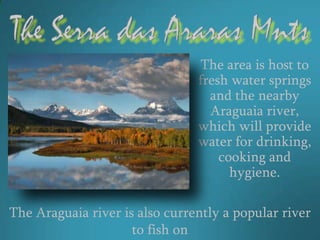
The area is host to
                                fresh water springs
                                  and the nearby
                                  Araguaia river,
                                which will provide
                                water for drinking,
                                    cooking and
                                      hygiene.

The Araguaia river is also currently a popular river
                     to fish on
Food
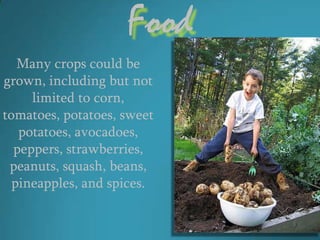
   Many crops could be
grown, including but not
     limited to corn,
tomatoes, potatoes, sweet
   potatoes, avocadoes,
  peppers, strawberries,
 peanuts, squash, beans,
  pineapples, and spices.
Terrain Farming
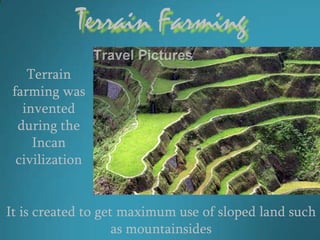
    Terrain
 farming was
   invented
  during the
     Incan
  civilization


It is created to get maximum use of sloped land such
                    as mountainsides
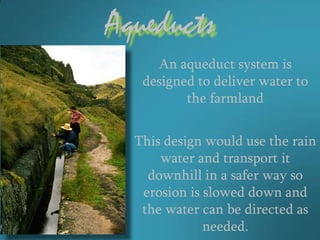
Aqueducts
     An aqueduct system is
   designed to deliver water to
          the farmland


  This design would use the rain
      water and transport it
    downhill in a safer way so
   erosion is slowed down and
   the water can be directed as
              needed.
How will we get fresh water?
We will build irrigation channels through the foothills that
  siphon rainwater & melt runoff to our civilization for
  collection. These will be supplemented by recharging
                          aquifers.
                         We will…
   …build a community well that collects groundwater.
… use Rainwater Catchment Systems (RCS) to supplement
                 & dilute collected runoff.
…use Bio-Sand Filters (BSF) to filter harmful pathogens out
                        of our water.
  …equip each household with a SOLVATTEN unit for
                   disinfection & storage.
…supply stores/outposts with Iodine & Chlorine solutions
                for small-scale disinfection
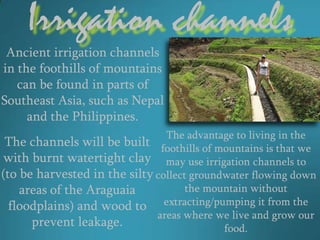
Irrigation channels
 Ancient irrigation channels
in the foothills of mountains
   can be found in parts of
Southeast Asia, such as Nepal
     and the Philippines.
                                The advantage to living in the
 The channels will be built foothills of mountains is that we
with burnt watertight clay may use irrigation channels to
(to be harvested in the silty collect groundwater flowing down
    areas of the Araguaia            the mountain without
  floodplains) and wood to extracting/pumping it from the
                              areas where we live and grow our
      prevent leakage.                      food.
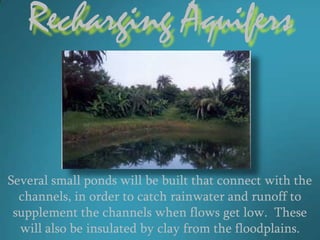
Recharging Aquifers


Several small ponds will be built that connect with the
  channels, in order to catch rainwater and runoff to
 supplement the channels when flows get low. These
  will also be insulated by clay from the floodplains.
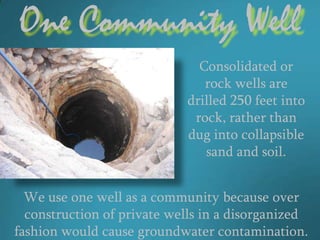
One Community Well
                              Consolidated or
                               rock wells are
                            drilled 250 feet into
                             rock, rather than
                            dug into collapsible
                               sand and soil.


  We use one well as a community because over
  construction of private wells in a disorganized
fashion would cause groundwater contamination.
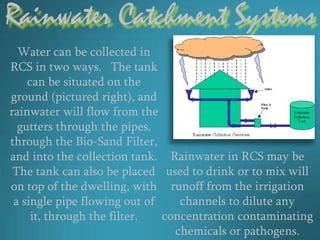
Rainwater Catchment Systems
  Water can be collected in
RCS in two ways. The tank
    can be situated on the
ground (pictured right), and
rainwater will flow from the
  gutters through the pipes,
through the Bio-Sand Filter,
and into the collection tank. Rainwater in RCS may be
 The tank can also be placed used to drink or to mix will
on top of the dwelling, with runoff from the irrigation
 a single pipe flowing out of    channels to dilute any
     it, through the filter.  concentration contaminating
                                chemicals or pathogens.
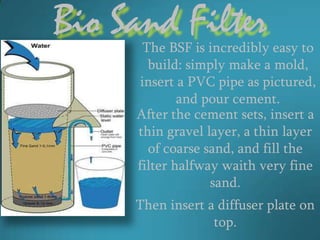
Bio Sand Filter
      The BSF is incredibly easy to
       build: simply make a mold,
     insert a PVC pipe as pictured,
             and pour cement.
     After the cement sets, insert a
     thin gravel layer, a thin layer
       of coarse sand, and fill the
     filter halfway waith very fine
                  sand.
     Then insert a diffuser plate on
                  top.
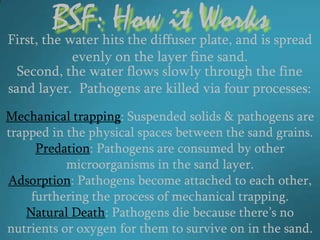
BSF:hits the diffuser Worksis spread
First, the water
                 How it plate, and
           evenly on the layer fine sand.
  Second, the water flows slowly through the fine
sand layer. Pathogens are killed via four processes:
Mechanical trapping: Suspended solids & pathogens are
trapped in the physical spaces between the sand grains.
      Predation: Pathogens are consumed by other
           microorganisms in the sand layer.
Adsorption: Pathogens become attached to each other,
     furthering the process of mechanical trapping.
    Natural Death: Pathogens die because there’s no
nutrients or oxygen for them to survive on in the sand.
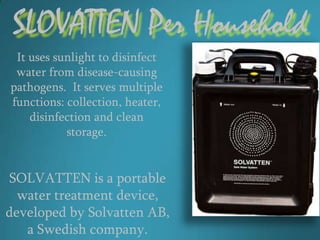
SLOVATTEN Per Household
 It uses sunlight to disinfect
 water from disease-causing
pathogens. It serves multiple
functions: collection, heater,
    disinfection and clean
           storage.


SOLVATTEN is a portable
  water treatment device,
developed by Solvatten AB,
   a Swedish company.
Things we must NOT do to maintain
      non-contaminated water
   Deforestation: Large-scale deforesting will disrupt the
   delicate ecosystem of the Araguaia River floodplains,
causing us to lose our “wash load,” or fine sediments (clay &
  silt) that help us insulate our water conduits & prevent
                   leakage into the ground.
Open defecation: We must have designated privies in which
 we bury our excrement—VERY far away from any water
   system components. Otherwise, fecal coliform will
 contaminate our groundwater and thus our runoff. Bad.
  Rampant groundwater extraction/over construction of
 wells: Or else we will kill our fertile soil and contaminate
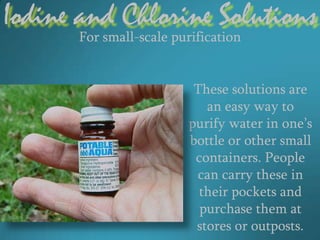
Iodine and Chlorine Solutions
       For small-scale purification


                          These solutions are
                            an easy way to
                         purify water in one’s
                         bottle or other small
                          containers. People
                          can carry these in
                           their pockets and
                           purchase them at
                          stores or outposts.
Run of the River Hyroelectricity
  is a type of hydroelectric generation whereby
     little or no water storage is provided. The
       limited storage areas in these plants are
      referred to as pondage. a plant without
 pondage has no storage and is therefore subject
  to seasonal river flows and serves as a peaking
   power plant while a plant with pondage can
   regulate water flow and serve as a base load
                     power plant.
Why This Works Here
Elevation of the Araras Mountains ranges from 80-
 150m (260 -490 ft) above sea level. Annual rainfall
over the flood basin is between 1,000-1,500 mm (39
   and 59in), with most of the rainfall occurring
           between November and March.
 The nearby rivers water levels rise between 2-5m
seasonally and the flood waters tend to flow slowly-
2-10cm/s (0.79 -3.9in/s) due to low gradients & high
      resistance offered by dense vegetation.
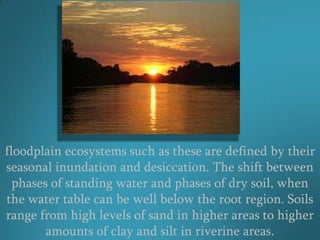
floodplain ecosystems such as these are defined by their
seasonal inundation and desiccation. The shift between
  phases of standing water and phases of dry soil, when
the water table can be well below the root region. Soils
range from high levels of sand in higher areas to higher
        amounts of clay and silt in riverine areas.
A 3° C global temperature rise by 2100 could
  increase the number of annual malaria cases
                by 50-80 million.
The largest changes will occur in areas adjacent to
 current risk areas, at both higher altitudes and
                     latitudes.
A temperature increase can convert areas that are
 malaria-free into areas that experience seasonal
                    epidemics
The effects of warmer weather on malaria might be
                    threefold:

 -Higher metabolic rates shorten gestation periods
boosting the numbers of mosquitoes as generations
               hatch more frequently;
   -Longer periods of warmth would allow the
        mosquitoes to be active for longer;
  -The metabolic rate of malaria parasites might
increase as well leading to higher parasite numbers
             carried by the mosquitoes.
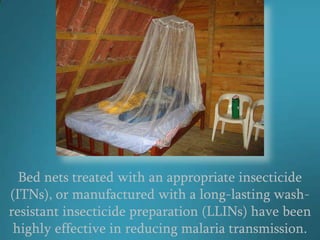
Bed nets treated with an appropriate insecticide
(ITNs), or manufactured with a long-lasting wash-
resistant insecticide preparation (LLINs) have been
 highly effective in reducing malaria transmission.
Drastic Times, Drastic Measures
                    Population control will be necessary
                         due to limited resources.
                     We will be implementing a "two
                              child policy."

 According to an article entitled "Global Swarming"
  by Daniel Engber, each family would have to cut
 back by one child in order to live in these changing
climate conditions. Thus we came to the conclusion
that two children are an appropriate amount to have
  to help farm the land as well as maintain survival
                        rates.
Penalties for Excessive Offspring
If a family has more than two children there will be
 a high tax that will have to be paid and the family
   will receive no extra land nor food for the extra
                       children.
Each family will have to survive with the sixty acres
    of land provided to them along with the roots,
         vegetables, and food that they make.
 Likewise, we will enforce a mandatory education on the
  effects of greenhouse gases, pollution & other harmful
    environmental conditions to each family and their
 offspring. Everyone will be tested on the subject matter
    once a year to ensure the material is being taught.

Climate change project

  • 1.
    Mato Grosso, Brazilnear the Araguaia river This area was turned into a national park in 1939, and so is not as ecologically damaged as other areas of Brazil The mountain region hosts peaks over 6,000 feet tall, so the flooding problems from rising sea levels and the nearby river is avoidable
  • 2.
    The area ishost to fresh water springs and the nearby Araguaia river, which will provide water for drinking, cooking and hygiene. The Araguaia river is also currently a popular river to fish on
  • 3.
    Food Many crops could be grown, including but not limited to corn, tomatoes, potatoes, sweet potatoes, avocadoes, peppers, strawberries, peanuts, squash, beans, pineapples, and spices.
  • 4.
    Terrain Farming Terrain farming was invented during the Incan civilization It is created to get maximum use of sloped land such as mountainsides
  • 5.
    Aqueducts An aqueduct system is designed to deliver water to the farmland This design would use the rain water and transport it downhill in a safer way so erosion is slowed down and the water can be directed as needed.
  • 6.
    How will weget fresh water? We will build irrigation channels through the foothills that siphon rainwater & melt runoff to our civilization for collection. These will be supplemented by recharging aquifers. We will… …build a community well that collects groundwater. … use Rainwater Catchment Systems (RCS) to supplement & dilute collected runoff. …use Bio-Sand Filters (BSF) to filter harmful pathogens out of our water. …equip each household with a SOLVATTEN unit for disinfection & storage. …supply stores/outposts with Iodine & Chlorine solutions for small-scale disinfection
  • 7.
    Irrigation channels Ancientirrigation channels in the foothills of mountains can be found in parts of Southeast Asia, such as Nepal and the Philippines. The advantage to living in the The channels will be built foothills of mountains is that we with burnt watertight clay may use irrigation channels to (to be harvested in the silty collect groundwater flowing down areas of the Araguaia the mountain without floodplains) and wood to extracting/pumping it from the areas where we live and grow our prevent leakage. food.
  • 8.
    Recharging Aquifers Several smallponds will be built that connect with the channels, in order to catch rainwater and runoff to supplement the channels when flows get low. These will also be insulated by clay from the floodplains.
  • 9.
    One Community Well Consolidated or rock wells are drilled 250 feet into rock, rather than dug into collapsible sand and soil. We use one well as a community because over construction of private wells in a disorganized fashion would cause groundwater contamination.
  • 10.
    Rainwater Catchment Systems Water can be collected in RCS in two ways. The tank can be situated on the ground (pictured right), and rainwater will flow from the gutters through the pipes, through the Bio-Sand Filter, and into the collection tank. Rainwater in RCS may be The tank can also be placed used to drink or to mix will on top of the dwelling, with runoff from the irrigation a single pipe flowing out of channels to dilute any it, through the filter. concentration contaminating chemicals or pathogens.
  • 11.
    Bio Sand Filter The BSF is incredibly easy to build: simply make a mold, insert a PVC pipe as pictured, and pour cement. After the cement sets, insert a thin gravel layer, a thin layer of coarse sand, and fill the filter halfway waith very fine sand. Then insert a diffuser plate on top.
  • 12.
    BSF:hits the diffuserWorksis spread First, the water How it plate, and evenly on the layer fine sand. Second, the water flows slowly through the fine sand layer. Pathogens are killed via four processes: Mechanical trapping: Suspended solids & pathogens are trapped in the physical spaces between the sand grains. Predation: Pathogens are consumed by other microorganisms in the sand layer. Adsorption: Pathogens become attached to each other, furthering the process of mechanical trapping. Natural Death: Pathogens die because there’s no nutrients or oxygen for them to survive on in the sand.
  • 13.
    SLOVATTEN Per Household It uses sunlight to disinfect water from disease-causing pathogens. It serves multiple functions: collection, heater, disinfection and clean storage. SOLVATTEN is a portable water treatment device, developed by Solvatten AB, a Swedish company.
  • 14.
    Things we mustNOT do to maintain non-contaminated water Deforestation: Large-scale deforesting will disrupt the delicate ecosystem of the Araguaia River floodplains, causing us to lose our “wash load,” or fine sediments (clay & silt) that help us insulate our water conduits & prevent leakage into the ground. Open defecation: We must have designated privies in which we bury our excrement—VERY far away from any water system components. Otherwise, fecal coliform will contaminate our groundwater and thus our runoff. Bad. Rampant groundwater extraction/over construction of wells: Or else we will kill our fertile soil and contaminate
  • 15.
    Iodine and ChlorineSolutions For small-scale purification These solutions are an easy way to purify water in one’s bottle or other small containers. People can carry these in their pockets and purchase them at stores or outposts.
  • 16.
    Run of theRiver Hyroelectricity is a type of hydroelectric generation whereby little or no water storage is provided. The limited storage areas in these plants are referred to as pondage. a plant without pondage has no storage and is therefore subject to seasonal river flows and serves as a peaking power plant while a plant with pondage can regulate water flow and serve as a base load power plant.
  • 18.
    Why This WorksHere Elevation of the Araras Mountains ranges from 80- 150m (260 -490 ft) above sea level. Annual rainfall over the flood basin is between 1,000-1,500 mm (39 and 59in), with most of the rainfall occurring between November and March. The nearby rivers water levels rise between 2-5m seasonally and the flood waters tend to flow slowly- 2-10cm/s (0.79 -3.9in/s) due to low gradients & high resistance offered by dense vegetation.
  • 19.
    floodplain ecosystems suchas these are defined by their seasonal inundation and desiccation. The shift between phases of standing water and phases of dry soil, when the water table can be well below the root region. Soils range from high levels of sand in higher areas to higher amounts of clay and silt in riverine areas.
  • 20.
    A 3° Cglobal temperature rise by 2100 could increase the number of annual malaria cases by 50-80 million. The largest changes will occur in areas adjacent to current risk areas, at both higher altitudes and latitudes. A temperature increase can convert areas that are malaria-free into areas that experience seasonal epidemics
  • 21.
    The effects ofwarmer weather on malaria might be threefold: -Higher metabolic rates shorten gestation periods boosting the numbers of mosquitoes as generations hatch more frequently; -Longer periods of warmth would allow the mosquitoes to be active for longer; -The metabolic rate of malaria parasites might increase as well leading to higher parasite numbers carried by the mosquitoes.
  • 22.
    Bed nets treatedwith an appropriate insecticide (ITNs), or manufactured with a long-lasting wash- resistant insecticide preparation (LLINs) have been highly effective in reducing malaria transmission.
  • 23.
    Drastic Times, DrasticMeasures Population control will be necessary due to limited resources. We will be implementing a "two child policy." According to an article entitled "Global Swarming" by Daniel Engber, each family would have to cut back by one child in order to live in these changing climate conditions. Thus we came to the conclusion that two children are an appropriate amount to have to help farm the land as well as maintain survival rates.
  • 24.
    Penalties for ExcessiveOffspring If a family has more than two children there will be a high tax that will have to be paid and the family will receive no extra land nor food for the extra children. Each family will have to survive with the sixty acres of land provided to them along with the roots, vegetables, and food that they make. Likewise, we will enforce a mandatory education on the effects of greenhouse gases, pollution & other harmful environmental conditions to each family and their offspring. Everyone will be tested on the subject matter once a year to ensure the material is being taught.

Editor's Notes