Chapter 3: Developing  Service Concepts:  Core and  Supplementary Elements
Overview of Chapter 3 Planning and Creating Services The Flower of Service Planning and Branding Service Products Development of New Services
Planning and Creating Services
Planning and Creating Services A service product comprises all elements of service performance, both tangible and intangible, that create value for customers The service concept is represented by: A core product Accompanied by supplementary services
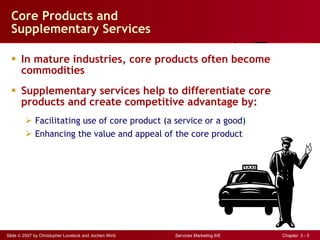
Core Products and  Supplementary Services In mature industries, core products often become commodities Supplementary services help to differentiate core products and create competitive advantage by: Facilitating use of core product (a service or a good) Enhancing the value and appeal of the core product
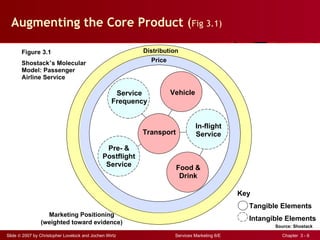
Augmenting the Core Product  ( Fig 3.1) Key Tangible Elements Intangible Elements Marketing Positioning (weighted toward evidence) Figure 3.1 Shostack ’ s Molecular Model: Passenger Airline Service Distribution Price Source: Shostack Pre- & Postflight Service Service Frequency In-flight Service Food & Drink Vehicle Transport
Augmenting the Core Product Are supplementary services needed to facilitate use of core product or simply to add extra appeal? Should customers be charged separately for each service element? Or should all elements be bundled at a single price?
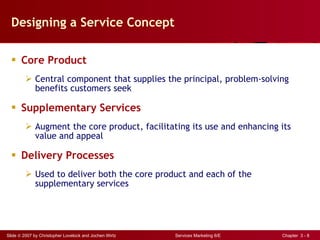
Designing a Service Concept Core Product Central component that supplies the principal, problem-solving benefits customers seek Supplementary Services Augment the core product, facilitating its use and enhancing its value and appeal Delivery Processes Used to deliver both the core product and each of the supplementary services
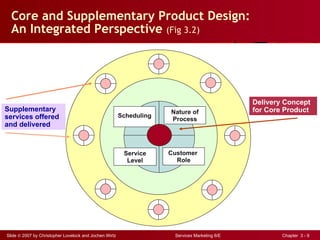
Core and Supplementary Product Design: An Integrated Perspective  (Fig 3.2) Scheduling Nature of Process Service Level Customer  Role Supplementary services offered and delivered Delivery Concept  for Core Product
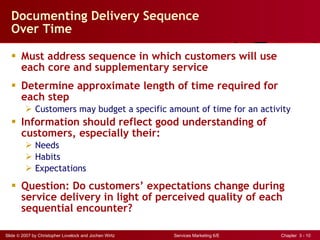
Documenting Delivery Sequence  Over Time Must address sequence in which customers will use  each core and supplementary service Determine approximate length of time required for each step Customers may budget a specific amount of time for an activity Information should reflect good understanding of customers, especially their:  Needs Habits Expectations Question: Do customers’ expectations change during service delivery in light of perceived quality of each sequential encounter?
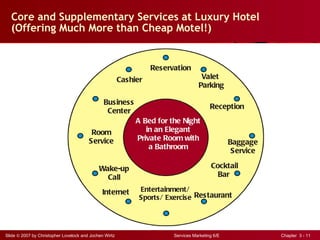
Core and Supplementary Services at Luxury Hotel  (Offering Much More than Cheap Motel!) Reservation Valet  Parking Reception Baggage Service Cocktail Bar  Restaurant Entertainment/ Sports/ Exercise Internet Wake-up Call Room Service Business Center Cashier A Bed for the Night in an Elegant Private Room with a Bathroom
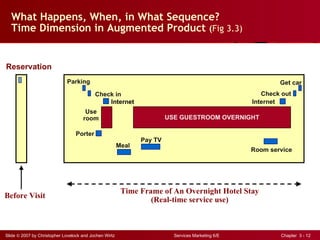
What Happens, When, in What Sequence?  Time Dimension in Augmented Product  ( Fig 3.3) Before Visit Reservation internet Parking Get car Check in Porter Use room Meal Pay TV Room service Internet Check out Time Frame of An Overnight Hotel Stay (Real-time service use) USE GUESTROOM OVERNIGHT Internet
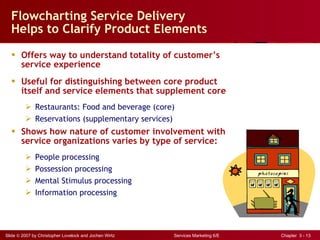
Flowcharting Service Delivery  Helps to Clarify Product Elements Offers way to understand totality of customer’s service experience Useful for distinguishing between core product itself and service elements that supplement core Restaurants: Food and beverage (core)  Reservations (supplementary services)  Shows how nature of customer involvement with service organizations varies by type of service: People processing Possession processing Mental Stimulus processing Information processing
Defining Core and Supplementary  Elements of Our Service Product How is our core product defined and what supplementary elements augment it? What product benefits create most value for customers? Is our service package differentiated from competition in meaningful ways for target customers? What are current levels of service on core product and each supplementary element?  Can we charge more for higher service levels? For example: Faster response and execution Better physical amenities Easier access Higher staffing levels Superior caliber personnel Alternatively, should we cut service levels and charge less?
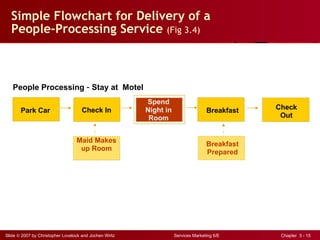
Simple Flowchart for Delivery of a People-Processing Service  (Fig 3.4) People Processing  –  Stay at  Motel Park Car Check In Spend Night in Room Breakfast Check Out Breakfast Prepared Maid Makes up Room
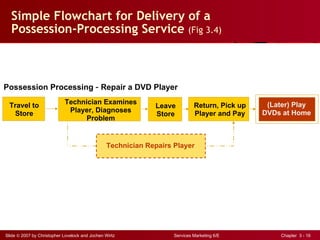
Simple Flowchart for Delivery of a  Possession-Processing Service  (Fig 3.4) Possession Processing  –  Repair a DVD Player Travel to Store Technician Examines Player, Diagnoses Problem Leave Store Return, Pick up Player and Pay Technician Repairs Player (Later) Play DVDs at Home
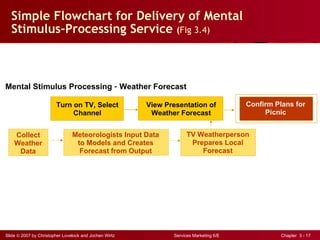
Simple Flowchart for Delivery of Mental  Stimulus-Processing Service  ( Fig 3.4) Mental Stimulus Processing  –  Weather Forecast Turn on TV, Select Channel View Presentation of Weather Forecast TV Weatherperson Prepares Local Forecast Confirm Plans for Picnic Meteorologists Input Data to Models and Creates Forecast from Output Collect Weather Data
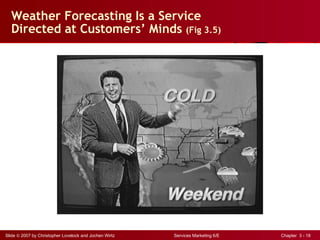
Weather Forecasting Is a Service Directed at Customers’ Minds  (Fig 3.5)
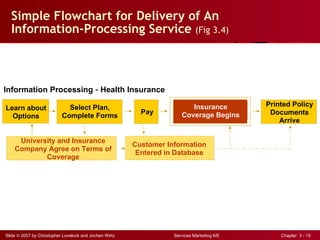
Simple Flowchart for Delivery of An  Information-Processing Service  (Fig 3.4) Information Processing  –  Health Insurance Learn about Options Select Plan, Complete Forms Pay Customer Information Entered in Database Printed Policy Documents Arrive Insurance Coverage Begins University and Insurance Company Agree on Terms of Coverage
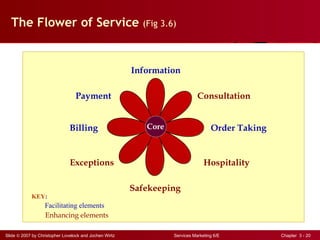
The Flower of Service  (Fig 3.6) Core Information Consultation Order Taking Hospitality Payment Billing Exceptions Safekeeping Facilitating elements Enhancing elements KEY :
How to Determine What Supplementary Services Should Be Offered Not every core product is surrounded by supplementary elements from all eight clusters Nature of product helps to determine: Which supplementary services must be offered Which might usefully be added to enhance value and ease of doing  business with  the organization People-processing and high-contact services tend to have more supplementary services Market positioning strategy helps to determine which supplementary services should be included  Firms that offer different levels of service often add extra supplementary services for each upgrade in service level
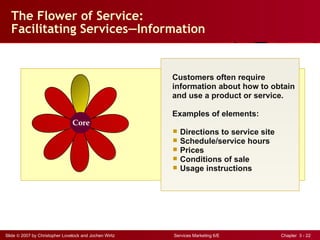
The Flower of Service:  Facilitating Services — Information Customers often require information about how to obtain and use a product or service.  Examples of elements: Directions to service site  Schedule/service hours Prices Conditions of sale Usage instructions Core
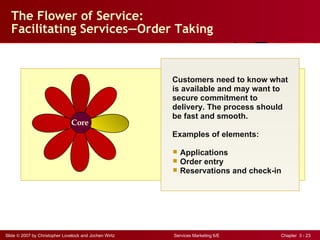
The Flower of Service: Facilitating Services — Order Taking Customers need to know what is available and may want to secure commitment to delivery. The process should be fast and smooth. Examples of elements: Applications Order entry Reservations and check-in Core
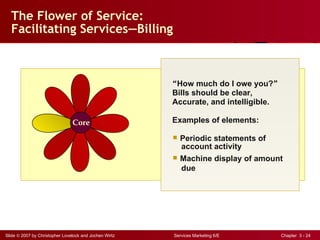
The Flower of Service: Facilitating Services — Billing “ How much do I owe you? ” Bills should be clear,  Accurate, and intelligible.  Examples of elements: Periodic statements of  account activity Machine display of amount  due Core
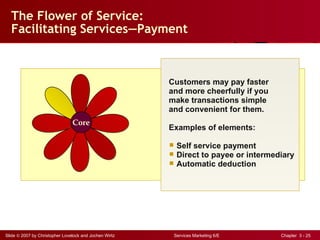
The Flower of Service: Facilitating Services — Payment Customers may pay faster  and more cheerfully if you make transactions simple and convenient for them. Examples of elements: Self service payment Direct to payee or intermediary Automatic deduction Core
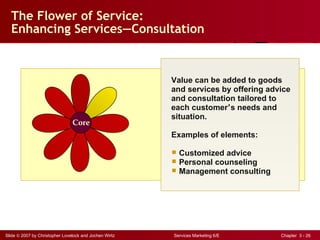
The Flower of Service: Enhancing Services — Consultation Value can be added to goods and services by offering advice and consultation tailored to each customer ’ s needs and situation. Examples of elements: Customized advice Personal counseling Management consulting Core
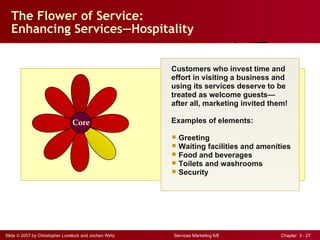
The Flower of Service: Enhancing Services — Hospitality Customers who invest time and effort in visiting a business and using its services deserve to be treated as welcome guests— after all, marketing invited them! Examples of elements: Greeting Waiting facilities and amenities Food and beverages Toilets and washrooms Security Core
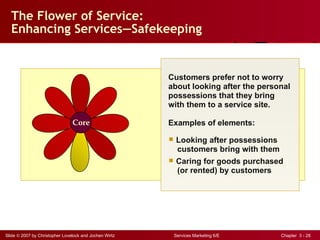
The Flower of Service: Enhancing Services — Safekeeping Customers prefer not to worry about looking after the personal possessions that they bring with them to a service site. Examples of elements: Looking after possessions  customers bring with them Caring for goods purchased  (or rented) by customers Core
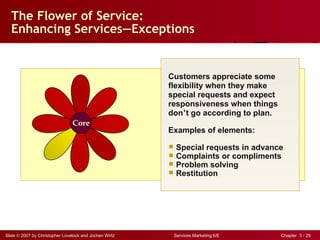
The Flower of Service: Enhancing Services — Exceptions Customers appreciate some  flexibility when they make special requests and expect responsiveness when things don ’ t go according to plan. Examples of elements: Special requests in advance Complaints or compliments Problem solving Restitution Core
Managerial Implications To develop product policy and pricing strategy, managers need to determine: Which supplementary services should be offered as a standard package accompanying the core Which supplementary elements could be offered as options for an extra charge In general, firms that compete on a low-cost, no-frills basis needs fewer supplementary elements than those marketing expensive, high-value-added services Each flower petal must receive consistent care and concern to remain fresh and appealing
Developing New Services
A Hierarchy of  New Service Categories (1)  Major service innovations New core products for previously undefined markets  Major process innovations Using new processes to deliver existing products with added benefits Product-line extensions Additions to current product lines Process-line extensions Alternative delivery procedures
A Hierarchy of  New Service Categories (2) Supplementary service innovations Addition of new or improved facilitating or enhancing elements Service improvements Modest changes in the performance of current products Style changes Visible changes in service design or scripts
Reengineering Service Processes Service processes affect not only customers, but also  cost, speed, and productivity with which desired outcome is achieved Reengineering involves analyzing and redesigning processes to achieve faster and better performance Running tasks in parallel instead of sequence can  reduce/eliminate dead time Examination of processes can lead to creation of alternative delivery methods that constitute new service concepts Add/eliminate supplementary services Resequence delivery of service elements Offer self-service options
Physical Goods as a Source Of New Service Ideas Services can be built around rentals: Alternatives to owning a physical good and/or doing work oneself Customers can  rent  goods — use and return for a fee — instead of purchasing them Customers can hire personnel to operate own or rented equipment Any new durable good may create need for after-sales services now and in future — possession processing Shipping Installation Problem-solving and consulting advice Cleaning and maintenance Upgrades Removal and disposal
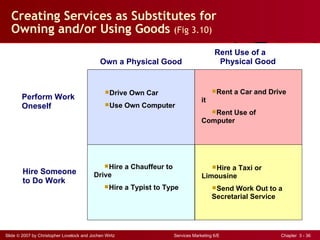
Creating Services as Substitutes for  Owning and/or Using Goods  (Fig 3.10) Drive Own Car Use Own Computer Rent a Car and Drive it Rent Use of Computer Hire a Chauffeur to Drive  Hire a Typist to Type  Hire a Taxi or Limousine  Send Work Out to a  Secretarial Service Own a Physical Good Rent Use of a  Physical Good Perform Work Oneself Hire Someone  to Do Work
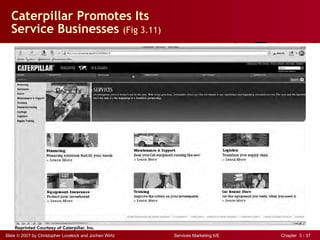
Caterpillar Promotes Its Service Businesses  (Fig 3.11) Reprinted Courtesy of Caterpillar, Inc.
Achieving Success in Developing New Services Services are not immune to high failure rates that plague new manufactured products “ dot.com” companies In developing new services  Core product is of secondary importance Ability to maintain quality of the total service offering is key Accompanying marketing support activities are vital Market knowledge is of utmost importance
Success Factors in  New Service Development Market synergy Good fit between new product and firm’s image/resources Advantage versus competition in meeting customers’ needs Strong support from firm during/after launch Firm understands customer purchase decision behavior Organizational factors Strong interfunctional cooperation and coordination Internal marketing to educate staff on new product and its  competition Employees understand importance of new services to firm Market research factors Scientific studies conducted early in development process Product concept well defined before undertaking field studies
Summary of Chapter 3:  Developing Service Concepts (1) Planning and creating services involve: Augmenting core product Designing core product, supplementary services, and delivery process Documenting delivery sequence over time with flowcharts Gaining insights from flowcharting Flower of service includes core product and two types of supplementary services: facilitating and enhancing Facilitating services  include information, order taking, billing, and payment Enhancing services  include consultation, hospitality, safekeeping, and exceptions Spectrum of branding alternatives exists for services Branded house Sub-brands Endorsed brands House of brands
Summary of Chapter 3:  Developing Service Concepts (2) Seven categories of new services: Major service innovations Major process innovations Product-line extensions Process-line extensions Supplementary service innovations Service improvements Style changes To develop new services, we can  Reengineer service processes Use physical goods as a source of new service ideas Use research to design new services Achieve success in developing new services

lovelock-ppt-chapter-03

  • 1.
    Chapter 3: Developing Service Concepts: Core and Supplementary Elements
  • 2.
    Overview of Chapter3 Planning and Creating Services The Flower of Service Planning and Branding Service Products Development of New Services
  • 3.
  • 4.
    Planning and CreatingServices A service product comprises all elements of service performance, both tangible and intangible, that create value for customers The service concept is represented by: A core product Accompanied by supplementary services
  • 5.
    Core Products and Supplementary Services In mature industries, core products often become commodities Supplementary services help to differentiate core products and create competitive advantage by: Facilitating use of core product (a service or a good) Enhancing the value and appeal of the core product
  • 6.
    Augmenting the CoreProduct ( Fig 3.1) Key Tangible Elements Intangible Elements Marketing Positioning (weighted toward evidence) Figure 3.1 Shostack ’ s Molecular Model: Passenger Airline Service Distribution Price Source: Shostack Pre- & Postflight Service Service Frequency In-flight Service Food & Drink Vehicle Transport
  • 7.
    Augmenting the CoreProduct Are supplementary services needed to facilitate use of core product or simply to add extra appeal? Should customers be charged separately for each service element? Or should all elements be bundled at a single price?
  • 8.
    Designing a ServiceConcept Core Product Central component that supplies the principal, problem-solving benefits customers seek Supplementary Services Augment the core product, facilitating its use and enhancing its value and appeal Delivery Processes Used to deliver both the core product and each of the supplementary services
  • 9.
    Core and SupplementaryProduct Design: An Integrated Perspective (Fig 3.2) Scheduling Nature of Process Service Level Customer Role Supplementary services offered and delivered Delivery Concept for Core Product
  • 10.
    Documenting Delivery Sequence Over Time Must address sequence in which customers will use each core and supplementary service Determine approximate length of time required for each step Customers may budget a specific amount of time for an activity Information should reflect good understanding of customers, especially their: Needs Habits Expectations Question: Do customers’ expectations change during service delivery in light of perceived quality of each sequential encounter?
  • 11.
    Core and SupplementaryServices at Luxury Hotel (Offering Much More than Cheap Motel!) Reservation Valet Parking Reception Baggage Service Cocktail Bar Restaurant Entertainment/ Sports/ Exercise Internet Wake-up Call Room Service Business Center Cashier A Bed for the Night in an Elegant Private Room with a Bathroom
  • 12.
    What Happens, When,in What Sequence? Time Dimension in Augmented Product ( Fig 3.3) Before Visit Reservation internet Parking Get car Check in Porter Use room Meal Pay TV Room service Internet Check out Time Frame of An Overnight Hotel Stay (Real-time service use) USE GUESTROOM OVERNIGHT Internet
  • 13.
    Flowcharting Service Delivery Helps to Clarify Product Elements Offers way to understand totality of customer’s service experience Useful for distinguishing between core product itself and service elements that supplement core Restaurants: Food and beverage (core) Reservations (supplementary services) Shows how nature of customer involvement with service organizations varies by type of service: People processing Possession processing Mental Stimulus processing Information processing
  • 14.
    Defining Core andSupplementary Elements of Our Service Product How is our core product defined and what supplementary elements augment it? What product benefits create most value for customers? Is our service package differentiated from competition in meaningful ways for target customers? What are current levels of service on core product and each supplementary element? Can we charge more for higher service levels? For example: Faster response and execution Better physical amenities Easier access Higher staffing levels Superior caliber personnel Alternatively, should we cut service levels and charge less?
  • 15.
    Simple Flowchart forDelivery of a People-Processing Service (Fig 3.4) People Processing – Stay at Motel Park Car Check In Spend Night in Room Breakfast Check Out Breakfast Prepared Maid Makes up Room
  • 16.
    Simple Flowchart forDelivery of a Possession-Processing Service (Fig 3.4) Possession Processing – Repair a DVD Player Travel to Store Technician Examines Player, Diagnoses Problem Leave Store Return, Pick up Player and Pay Technician Repairs Player (Later) Play DVDs at Home
  • 17.
    Simple Flowchart forDelivery of Mental Stimulus-Processing Service ( Fig 3.4) Mental Stimulus Processing – Weather Forecast Turn on TV, Select Channel View Presentation of Weather Forecast TV Weatherperson Prepares Local Forecast Confirm Plans for Picnic Meteorologists Input Data to Models and Creates Forecast from Output Collect Weather Data
  • 18.
    Weather Forecasting Isa Service Directed at Customers’ Minds (Fig 3.5)
  • 19.
    Simple Flowchart forDelivery of An Information-Processing Service (Fig 3.4) Information Processing – Health Insurance Learn about Options Select Plan, Complete Forms Pay Customer Information Entered in Database Printed Policy Documents Arrive Insurance Coverage Begins University and Insurance Company Agree on Terms of Coverage
  • 20.
    The Flower ofService (Fig 3.6) Core Information Consultation Order Taking Hospitality Payment Billing Exceptions Safekeeping Facilitating elements Enhancing elements KEY :
  • 21.
    How to DetermineWhat Supplementary Services Should Be Offered Not every core product is surrounded by supplementary elements from all eight clusters Nature of product helps to determine: Which supplementary services must be offered Which might usefully be added to enhance value and ease of doing business with the organization People-processing and high-contact services tend to have more supplementary services Market positioning strategy helps to determine which supplementary services should be included Firms that offer different levels of service often add extra supplementary services for each upgrade in service level
  • 22.
    The Flower ofService: Facilitating Services — Information Customers often require information about how to obtain and use a product or service. Examples of elements: Directions to service site Schedule/service hours Prices Conditions of sale Usage instructions Core
  • 23.
    The Flower ofService: Facilitating Services — Order Taking Customers need to know what is available and may want to secure commitment to delivery. The process should be fast and smooth. Examples of elements: Applications Order entry Reservations and check-in Core
  • 24.
    The Flower ofService: Facilitating Services — Billing “ How much do I owe you? ” Bills should be clear, Accurate, and intelligible. Examples of elements: Periodic statements of account activity Machine display of amount due Core
  • 25.
    The Flower ofService: Facilitating Services — Payment Customers may pay faster and more cheerfully if you make transactions simple and convenient for them. Examples of elements: Self service payment Direct to payee or intermediary Automatic deduction Core
  • 26.
    The Flower ofService: Enhancing Services — Consultation Value can be added to goods and services by offering advice and consultation tailored to each customer ’ s needs and situation. Examples of elements: Customized advice Personal counseling Management consulting Core
  • 27.
    The Flower ofService: Enhancing Services — Hospitality Customers who invest time and effort in visiting a business and using its services deserve to be treated as welcome guests— after all, marketing invited them! Examples of elements: Greeting Waiting facilities and amenities Food and beverages Toilets and washrooms Security Core
  • 28.
    The Flower ofService: Enhancing Services — Safekeeping Customers prefer not to worry about looking after the personal possessions that they bring with them to a service site. Examples of elements: Looking after possessions customers bring with them Caring for goods purchased (or rented) by customers Core
  • 29.
    The Flower ofService: Enhancing Services — Exceptions Customers appreciate some flexibility when they make special requests and expect responsiveness when things don ’ t go according to plan. Examples of elements: Special requests in advance Complaints or compliments Problem solving Restitution Core
  • 30.
    Managerial Implications Todevelop product policy and pricing strategy, managers need to determine: Which supplementary services should be offered as a standard package accompanying the core Which supplementary elements could be offered as options for an extra charge In general, firms that compete on a low-cost, no-frills basis needs fewer supplementary elements than those marketing expensive, high-value-added services Each flower petal must receive consistent care and concern to remain fresh and appealing
  • 31.
  • 32.
    A Hierarchy of New Service Categories (1) Major service innovations New core products for previously undefined markets Major process innovations Using new processes to deliver existing products with added benefits Product-line extensions Additions to current product lines Process-line extensions Alternative delivery procedures
  • 33.
    A Hierarchy of New Service Categories (2) Supplementary service innovations Addition of new or improved facilitating or enhancing elements Service improvements Modest changes in the performance of current products Style changes Visible changes in service design or scripts
  • 34.
    Reengineering Service ProcessesService processes affect not only customers, but also cost, speed, and productivity with which desired outcome is achieved Reengineering involves analyzing and redesigning processes to achieve faster and better performance Running tasks in parallel instead of sequence can reduce/eliminate dead time Examination of processes can lead to creation of alternative delivery methods that constitute new service concepts Add/eliminate supplementary services Resequence delivery of service elements Offer self-service options
  • 35.
    Physical Goods asa Source Of New Service Ideas Services can be built around rentals: Alternatives to owning a physical good and/or doing work oneself Customers can rent goods — use and return for a fee — instead of purchasing them Customers can hire personnel to operate own or rented equipment Any new durable good may create need for after-sales services now and in future — possession processing Shipping Installation Problem-solving and consulting advice Cleaning and maintenance Upgrades Removal and disposal
  • 36.
    Creating Services asSubstitutes for Owning and/or Using Goods (Fig 3.10) Drive Own Car Use Own Computer Rent a Car and Drive it Rent Use of Computer Hire a Chauffeur to Drive Hire a Typist to Type Hire a Taxi or Limousine Send Work Out to a Secretarial Service Own a Physical Good Rent Use of a Physical Good Perform Work Oneself Hire Someone to Do Work
  • 37.
    Caterpillar Promotes ItsService Businesses (Fig 3.11) Reprinted Courtesy of Caterpillar, Inc.
  • 38.
    Achieving Success inDeveloping New Services Services are not immune to high failure rates that plague new manufactured products “ dot.com” companies In developing new services Core product is of secondary importance Ability to maintain quality of the total service offering is key Accompanying marketing support activities are vital Market knowledge is of utmost importance
  • 39.
    Success Factors in New Service Development Market synergy Good fit between new product and firm’s image/resources Advantage versus competition in meeting customers’ needs Strong support from firm during/after launch Firm understands customer purchase decision behavior Organizational factors Strong interfunctional cooperation and coordination Internal marketing to educate staff on new product and its competition Employees understand importance of new services to firm Market research factors Scientific studies conducted early in development process Product concept well defined before undertaking field studies
  • 40.
    Summary of Chapter3: Developing Service Concepts (1) Planning and creating services involve: Augmenting core product Designing core product, supplementary services, and delivery process Documenting delivery sequence over time with flowcharts Gaining insights from flowcharting Flower of service includes core product and two types of supplementary services: facilitating and enhancing Facilitating services include information, order taking, billing, and payment Enhancing services include consultation, hospitality, safekeeping, and exceptions Spectrum of branding alternatives exists for services Branded house Sub-brands Endorsed brands House of brands
  • 41.
    Summary of Chapter3: Developing Service Concepts (2) Seven categories of new services: Major service innovations Major process innovations Product-line extensions Process-line extensions Supplementary service innovations Service improvements Style changes To develop new services, we can Reengineer service processes Use physical goods as a source of new service ideas Use research to design new services Achieve success in developing new services