Managing the Marketing Mix
                     Lecture 7
   Extending the Marketing Mix: Service Marketing

                  Dr. Martin J. Liu
                 Lecturer in Marketing

             Martin.Liu@Nottingham.edu.cn
Objectives

Learning              • Explore potential differences between products and
Objectives              services

The Difference        • Describe the elements and sub elements of the service
between Product and     extension to the marketing mix
Service

                      • Discuss the challenges services pose for marketing
Characteristics of
Service


Service Marketing
Mix
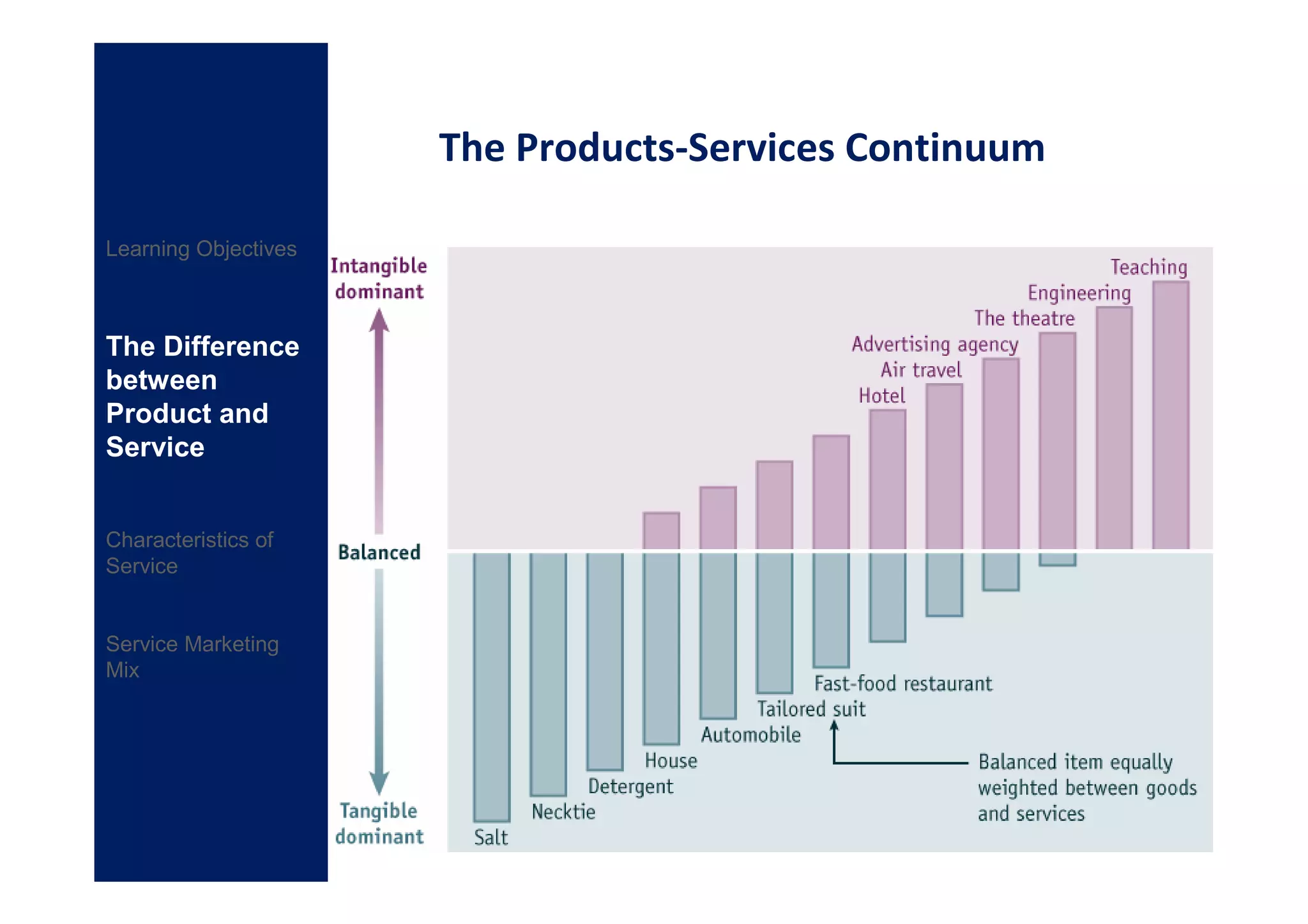
The Products-Services Continuum

Learning Objectives


The Difference
between
Product and
Service


Characteristics of
Service


Service Marketing
Mix
What is Service Marketing

Learning Objectives
                      • Examples: Defense, Postal, Education, health, Religious
                        Services, Hospitals, Airlines, Hotels, Law Firms,
The Difference          Entertainment, etc.
between
Product and
                      • Definition: Activity or benefit that one party can offer to
Service
                        another that is essentially intangible and does not result in
                        the ownership of anything. Its production may or may not
Characteristics of      be tied to a physical product
Service


Service Marketing
Mix
The Nature of Service

Learning Objectives
                      •   Regardless of the “product”, there is a services component to the
                          offerings of all firms

The Difference
                      •   In some cases, a service is the principal purpose of the transaction,
between                   as in the rental of a car, a haircut, or legal services -- we refer to
Product and               this as the core service
Service
                      •   In others, service is performed in support of the sale of a tangible
Characteristics of        product -- these are referred to as supplementary services
Service


Service Marketing
Mix
Differences between
                                         Products and Services
Learning Objectives
                      •   Customers do not obtain ownership of the intangible element of
                          the service product (i.e. service personnel and their performance
                          cannot be ‘owned’ by the customer).
The Difference
between
Product and
                      •   Intangible elements dominate value creation
Service


Characteristics of
                      •   There is greater involvement of customers in the production
Service                   process (i.e. customers are part of the performance, they interact
                          with the service provider).
Service Marketing
Mix
                      •   It is more difficult to maintain quality standards of service products
                          (i.e. individuals’ behaviour is hard to control and standardise).
Differences between
                                         Products and Services
Learning Objectives   •   Many services are difficult for customers to evaluate (i.e. there
                          may be elements of personal taste, experience, ability and mood
                          that affect customers’ evaluation).
The Difference
between               •   Absence of inventories for services (i.e. no use for unsold stock,
Product and               difficult to deal with sudden increases in demand).
Service

                      •   Importance of time factor (i.e. many services are delivered in real
Characteristics of        time so the consumer and provider must be together for the
Service                   service to occur).


Service Marketing     •   Delivery systems may involve both electronic and physical
Mix                       channels (i.e. different needs for staff behaviour management).
Differences between
                                    Products and Services
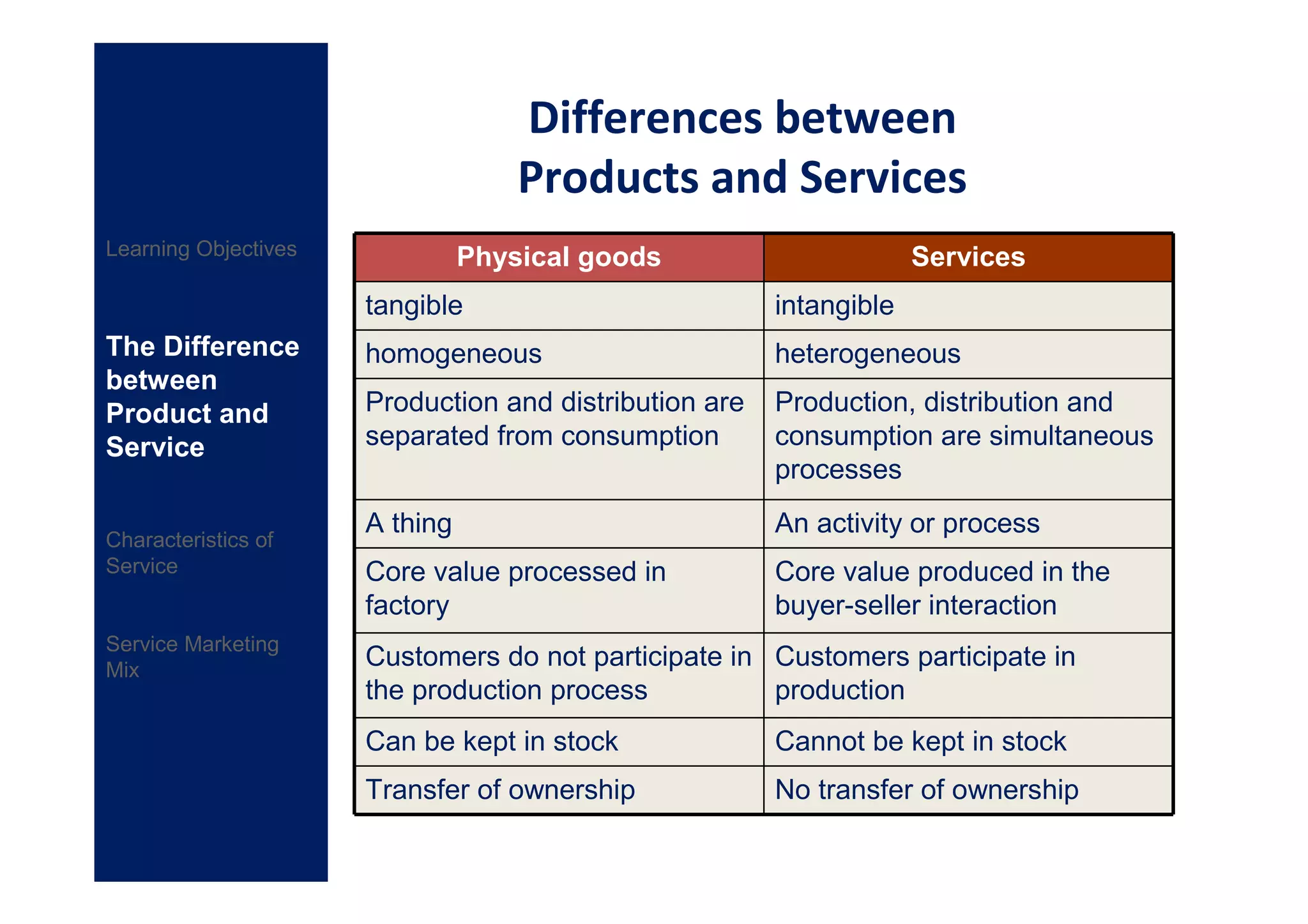
Learning Objectives             Physical goods                       Services
                      tangible                          intangible
The Difference        homogeneous                       heterogeneous
between
Product and           Production and distribution are   Production, distribution and
Service               separated from consumption        consumption are simultaneous
                                                        processes
                      A thing                           An activity or process
Characteristics of
Service               Core value processed in           Core value produced in the
                      factory                           buyer-seller interaction
Service Marketing
Mix
                      Customers do not participate in Customers participate in
                      the production process          production
                      Can be kept in stock              Cannot be kept in stock
                      Transfer of ownership             No transfer of ownership
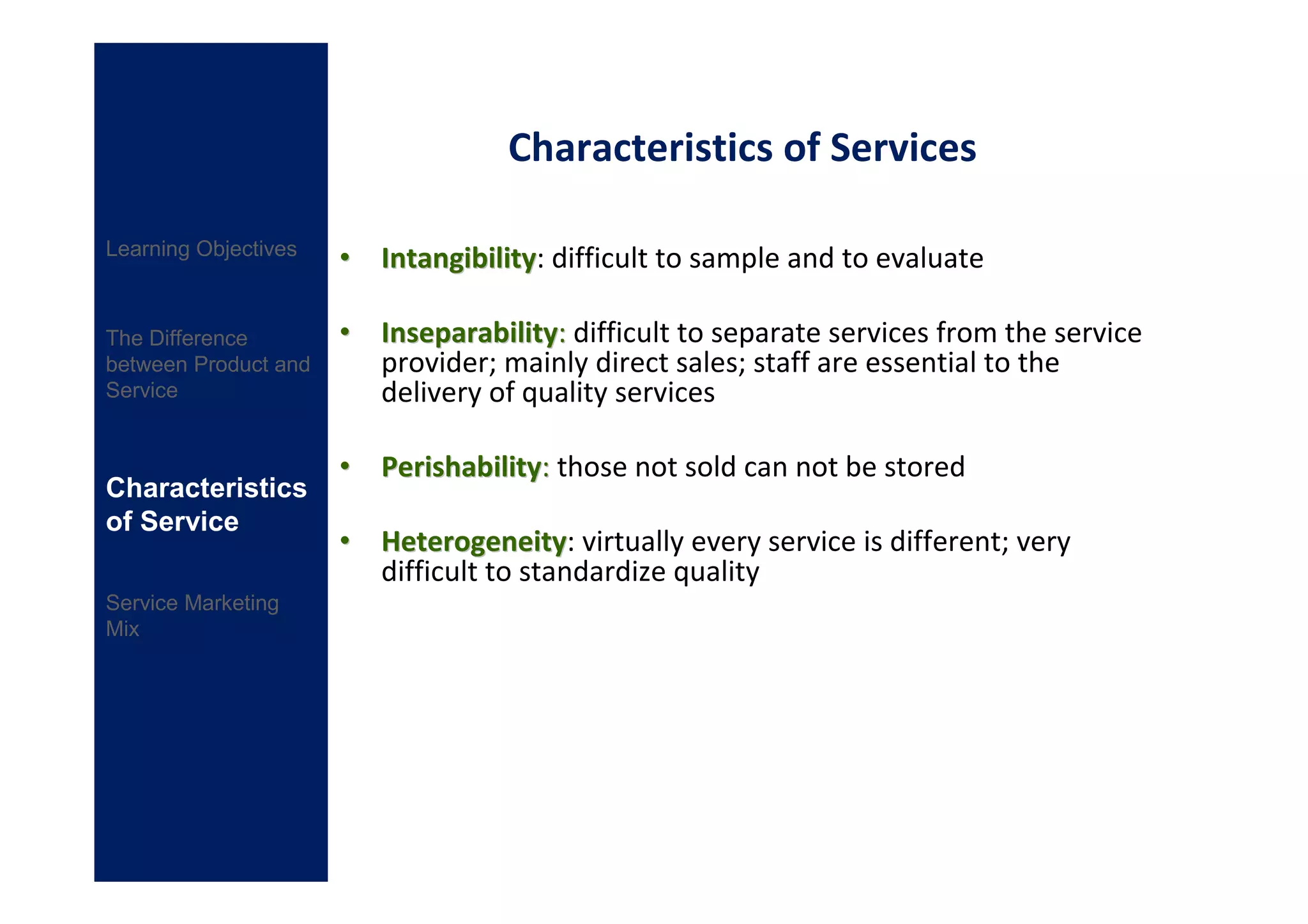
Characteristics of Services

Learning Objectives
                      • Intangibility: difficult to sample and to evaluate
                        Intangibility

The Difference        • Inseparability: difficult to separate services from the service
between Product and     provider; mainly direct sales; staff are essential to the
Service                 delivery of quality services

                      • Perishability: those not sold can not be stored
Characteristics
of Service
                      • Heterogeneity: virtually every service is different; very
                        Heterogeneity
                        difficult to standardize quality
Service Marketing
Mix
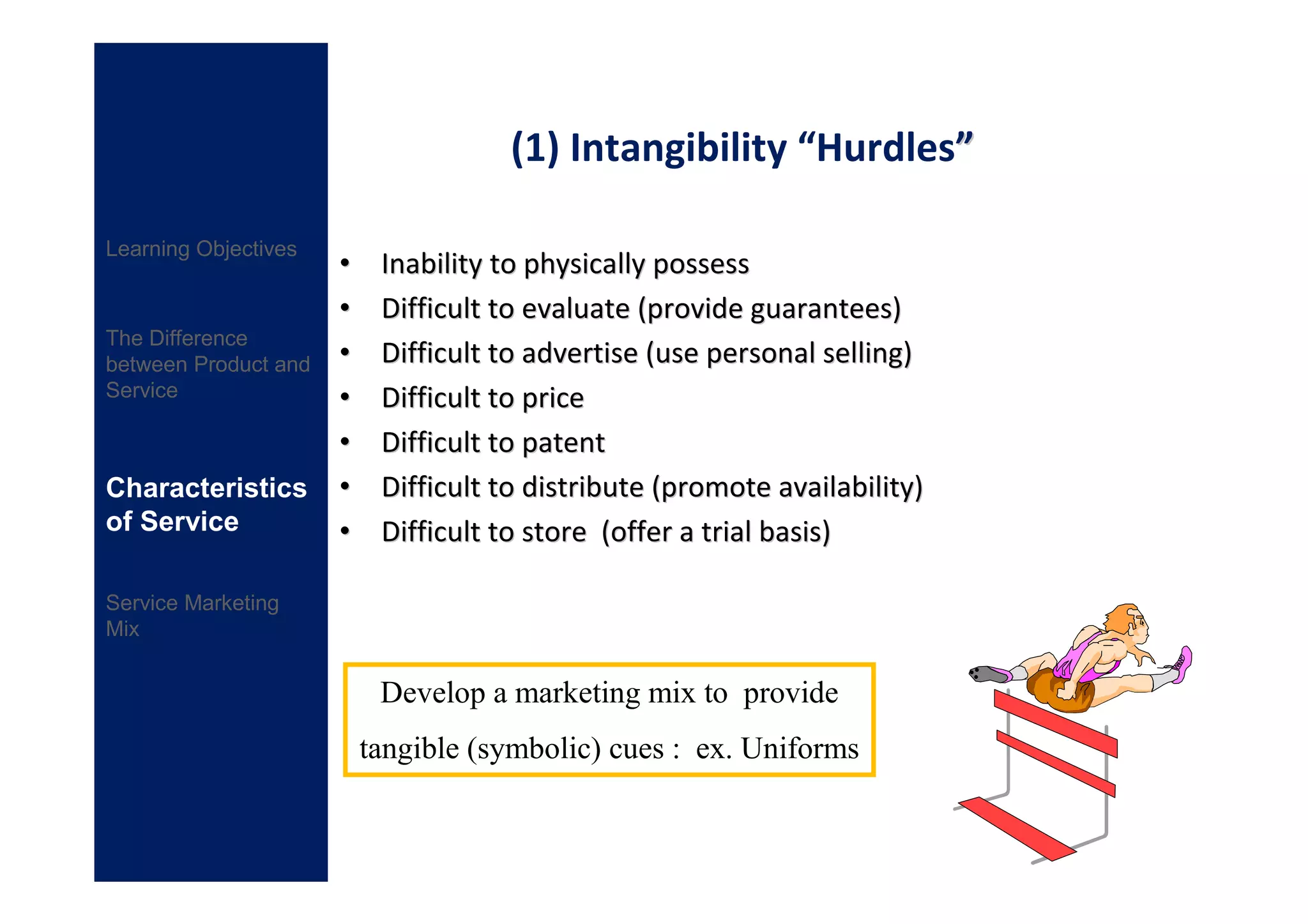
(1) Intangibility “Hurdles”

Learning Objectives
                      •    Inability to physically possess
                      •    Difficult to evaluate (provide guarantees)
The Difference
between Product and   •    Difficult to advertise (use personal selling)
Service               •    Difficult to price
                      •    Difficult to patent
Characteristics       •    Difficult to distribute (promote availability)
of Service            •    Difficult to store (offer a trial basis)

Service Marketing
Mix


                           Develop a marketing mix to provide
                          tangible (symbolic) cues : ex. Uniforms
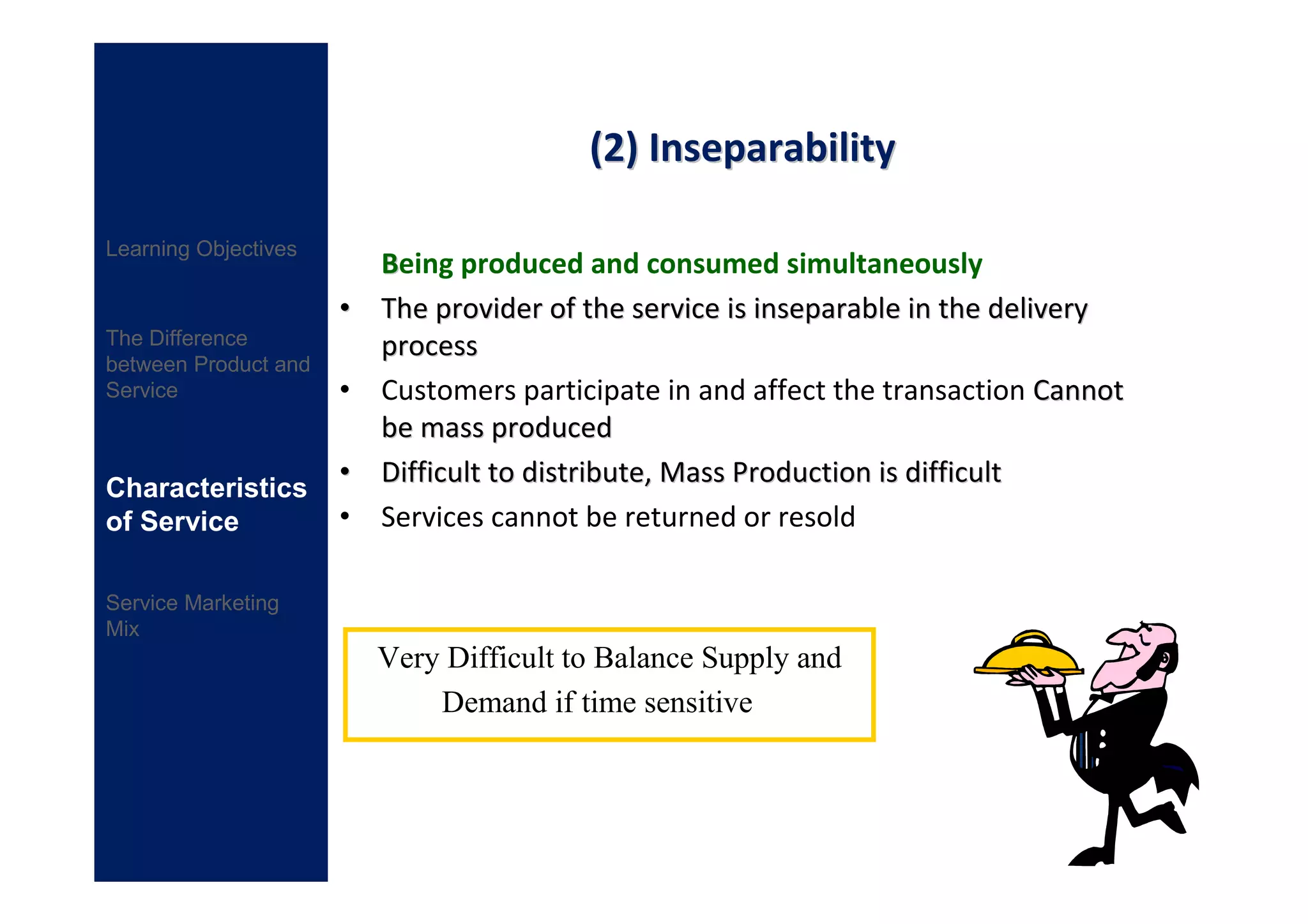
(2) Inseparability

Learning Objectives
                          Being produced and consumed simultaneously
                      •   The provider of the service is inseparable in the delivery
The Difference            process
between Product and
Service               •   Customers participate in and affect the transaction Cannot
                          be mass produced
Characteristics
                      •   Difficult to distribute, Mass Production is difficult
of Service            •   Services cannot be returned or resold

Service Marketing
Mix
                          Very Difficult to Balance Supply and
                              Demand if time sensitive
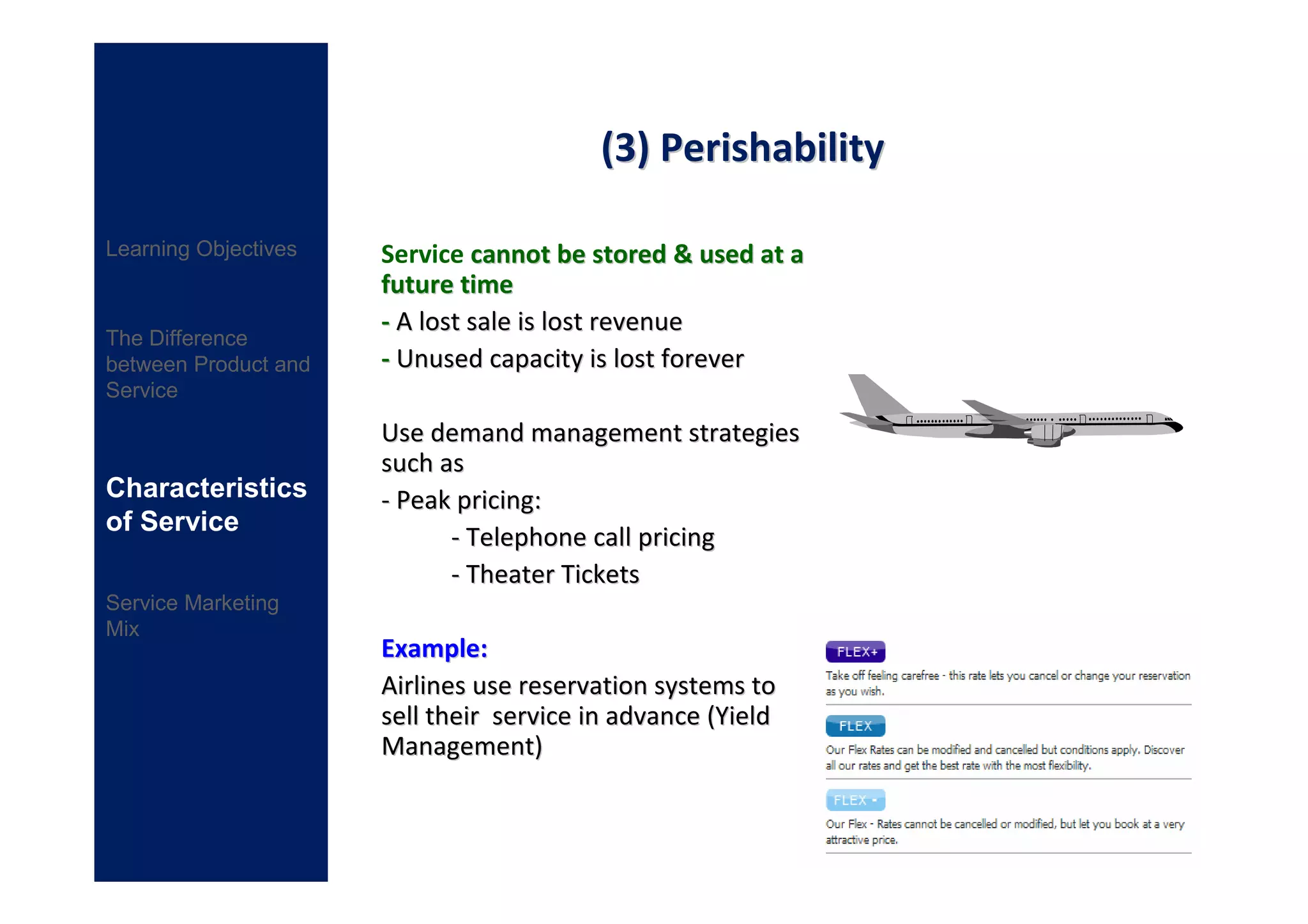
(3) Perishability

Learning Objectives   Service cannot be stored & used at a
                      future time
                      - A lost sale is lost revenue
The Difference
between Product and   - Unused capacity is lost forever
Service

                      Use demand management strategies
                      such as
Characteristics       - Peak pricing:
of Service
                            - Telephone call pricing
                            - Theater Tickets
Service Marketing
Mix
                      Example:
                      Airlines use reservation systems to
                      sell their service in advance (Yield
                      Management)
(4) Heterogeneity

Learning Objectives
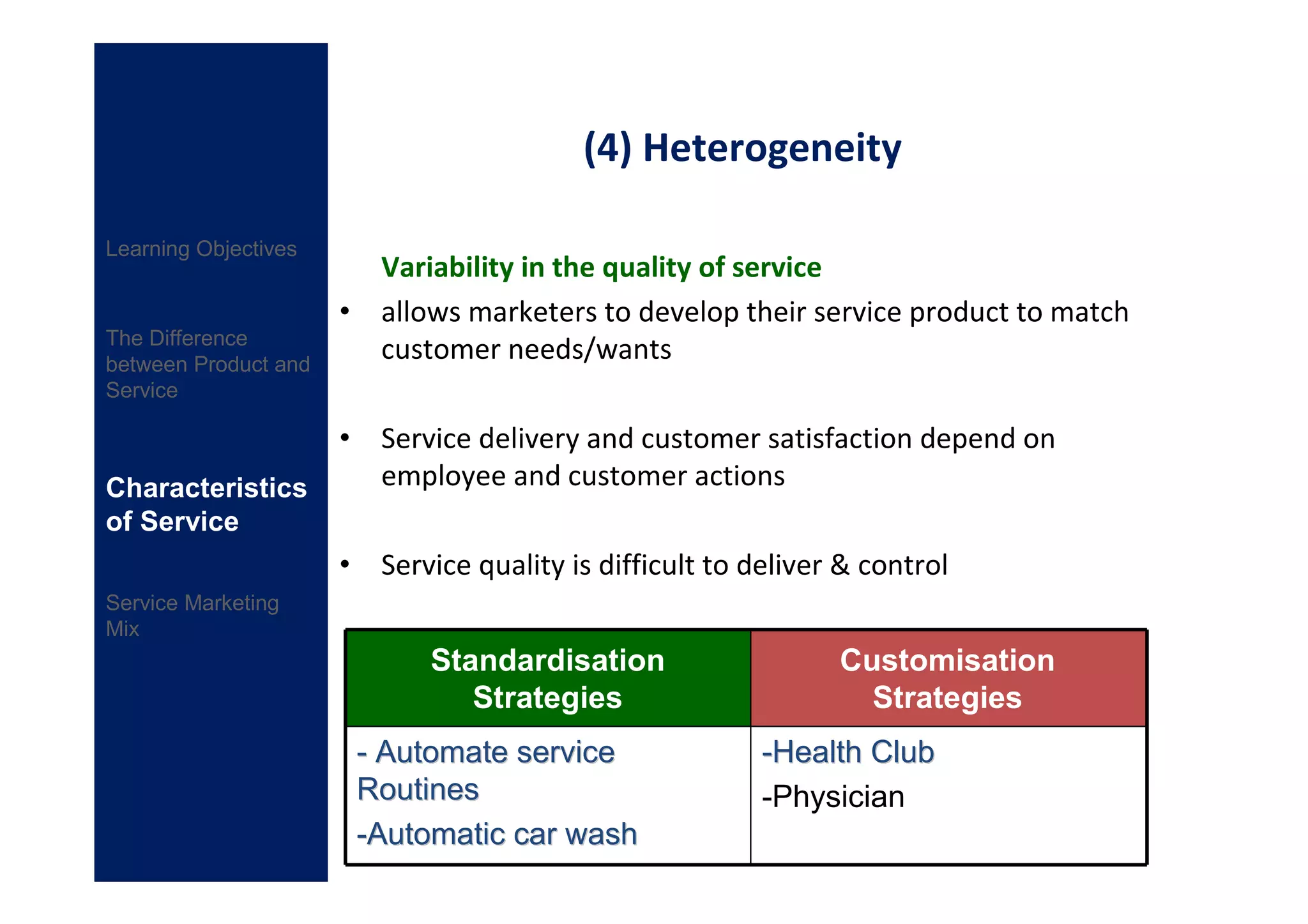
                        Variability in the quality of service
                      • allows marketers to develop their service product to match
The Difference
between Product and
                        customer needs/wants
Service

                      • Service delivery and customer satisfaction depend on
Characteristics         employee and customer actions
of Service
                      • Service quality is difficult to deliver & control
Service Marketing
Mix
                             Standardisation                   Customisation
                                Strategies                       Strategies
                       - Automate service                -Health Club
                       Routines                          -Physician
                       -Automatic car wash
Key Characteristics of
                                  An Effective Marketing Mix
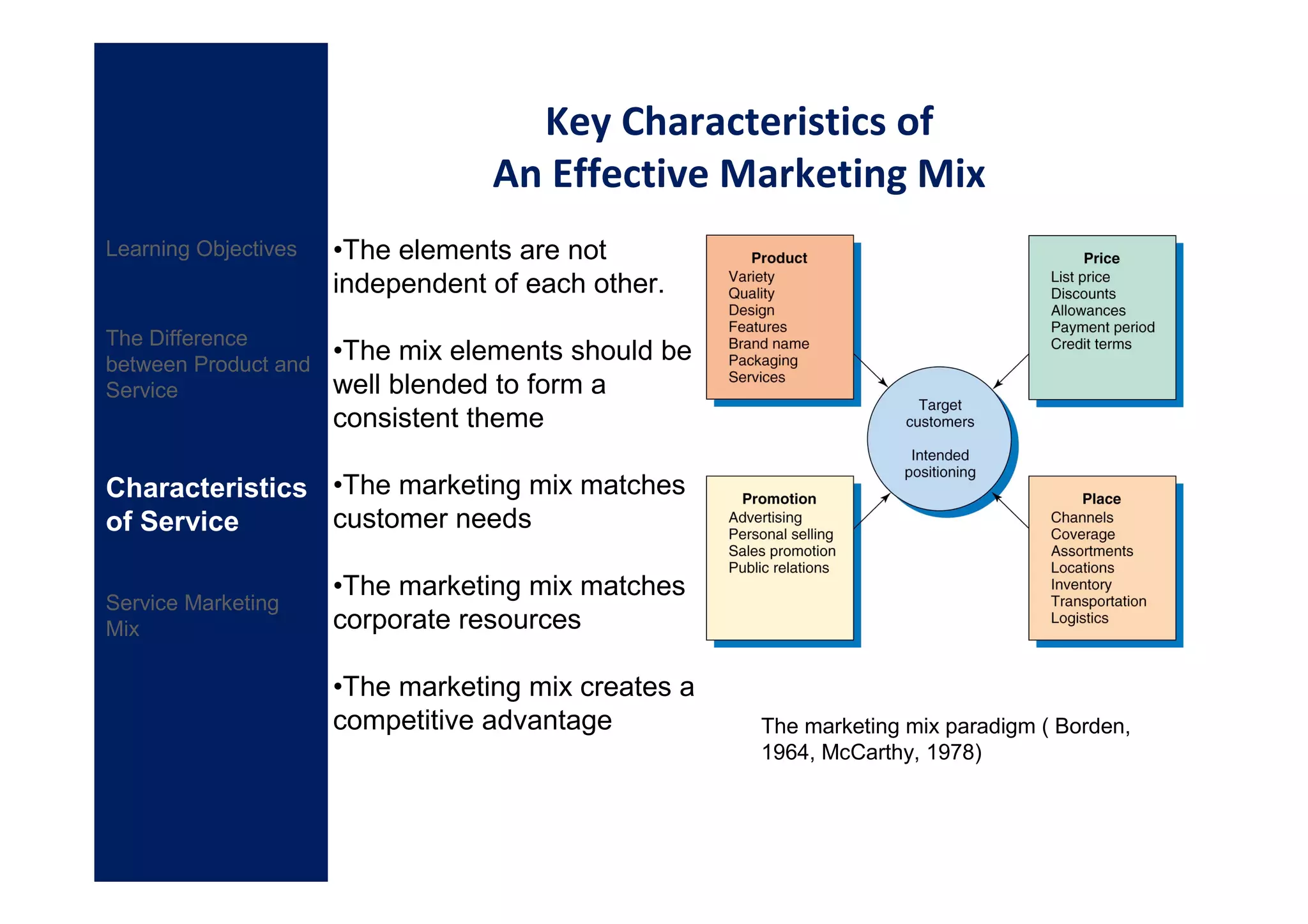
Learning Objectives   •The elements are not
                      independent of each other.
The Difference
between Product and
                      •The mix elements should be
Service               well blended to form a
                      consistent theme

Characteristics •The marketing mix matches
of Service      customer needs

                      •The marketing mix matches
Service Marketing
Mix                   corporate resources

                      •The marketing mix creates a
                      competitive advantage          The marketing mix paradigm ( Borden,
                                                     1964, McCarthy, 1978)
Service Extended Marketing Mix

Learning Objectives

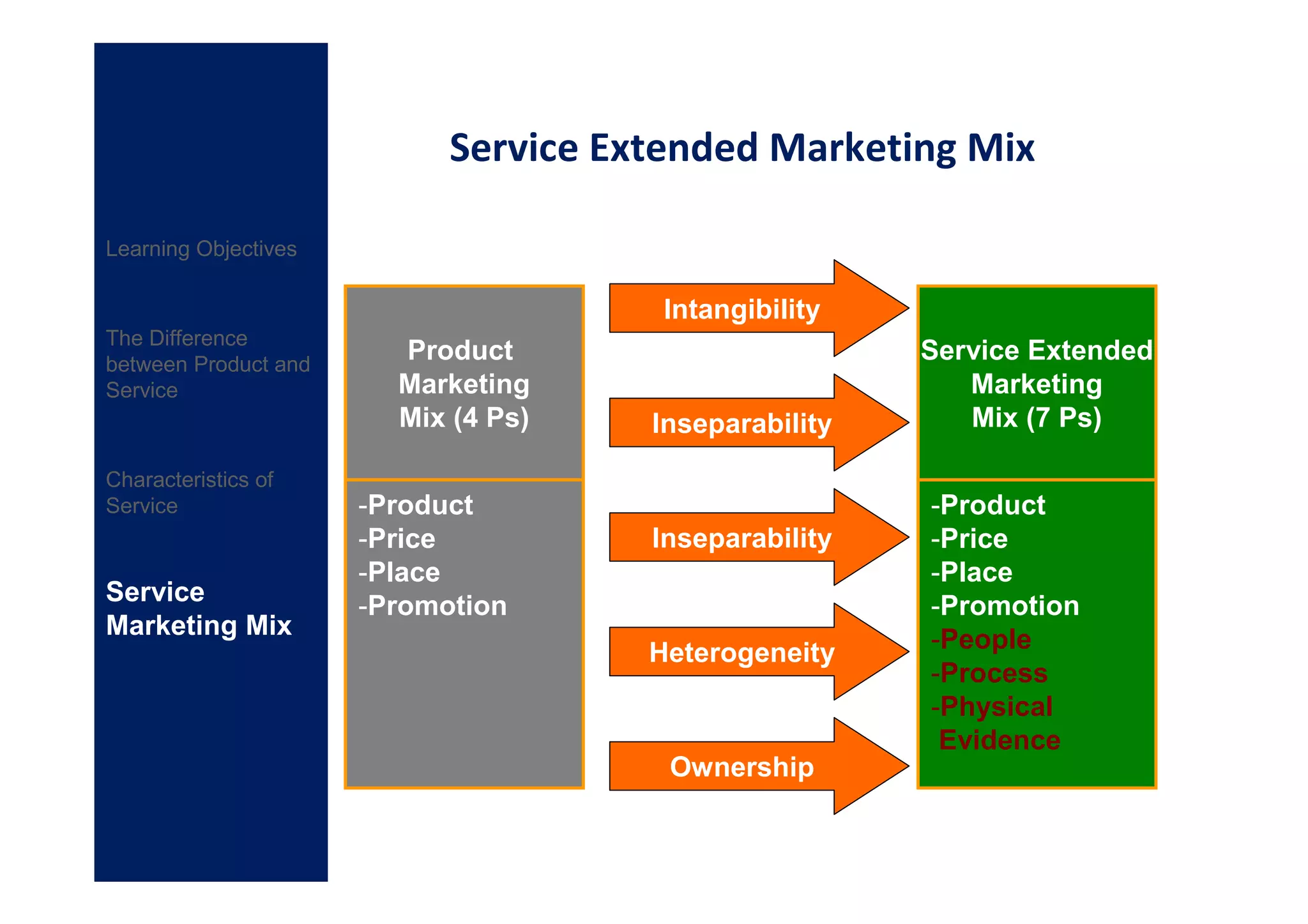
                                       Intangibility
The Difference
between Product and
                        Product                        Service Extended
Service                 Marketing                         Marketing
                        Mix (4 Ps)    Inseparability      Mix (7 Ps)

Characteristics of
Service               -Product                         -Product
                      -Price          Inseparability   -Price
                      -Place                           -Place
Service               -Promotion                       -Promotion
Marketing Mix                                          -People
                                      Heterogeneity
                                                       -Process
                                                       -Physical
                                                        Evidence
                                       Ownership
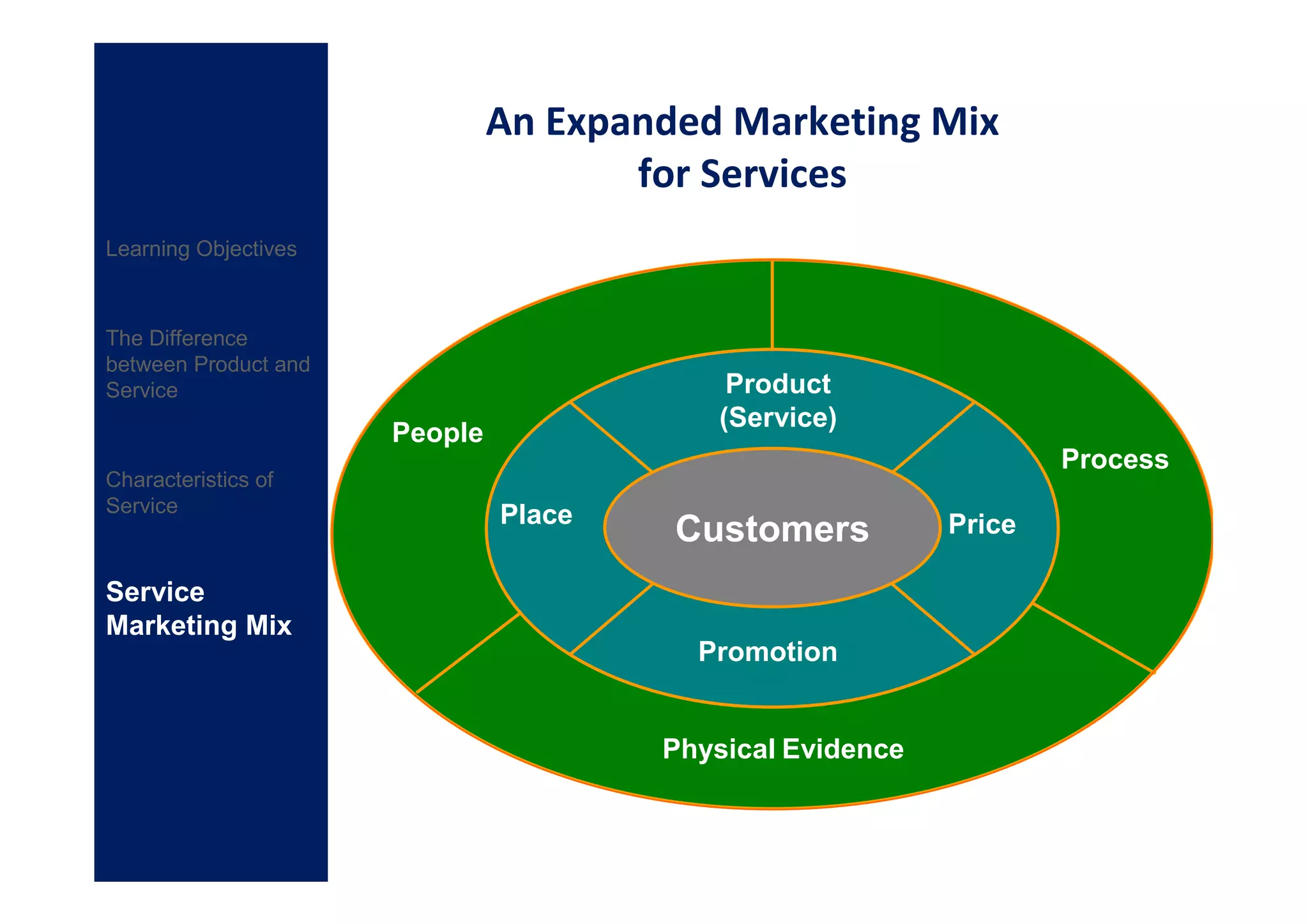
An Expanded Marketing Mix
                                      for Services
Learning Objectives


The Difference
between Product and
Service                                       Product
                                             (Service)
                      People
                                                                     Process
Characteristics of
Service                        Place &
                               Place      Customers
                                          Customers          Price
                                                             Price
                               Time      Customers
Service
Marketing Mix
                                           Promotion


                                         Physical Evidence
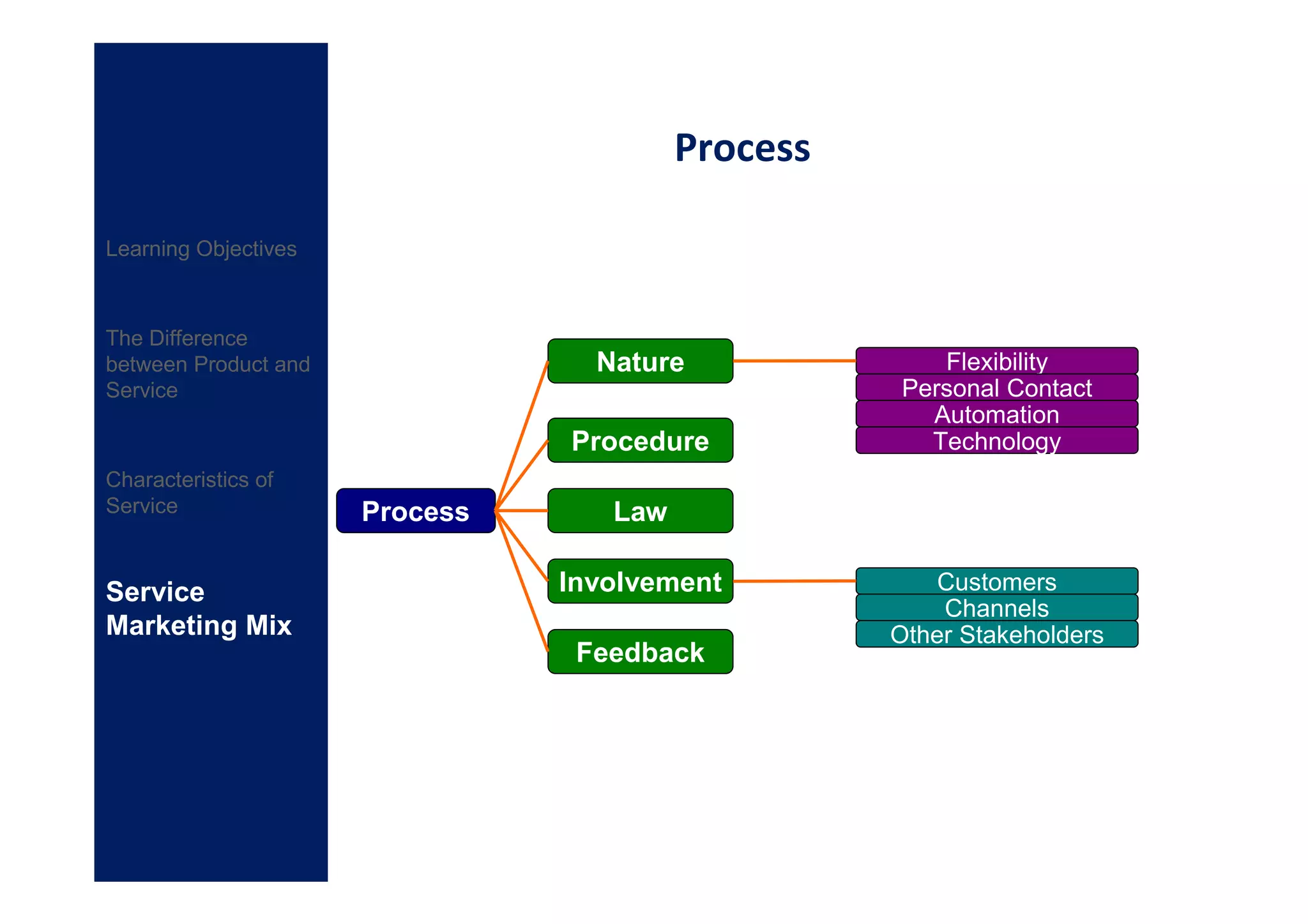
Process

Learning Objectives


The Difference
between Product and               Nature              Flexibility
Service                                            Personal Contact
                                                     Automation
                                Procedure            Technology
Characteristics of
Service               Process      Law

Service                         Involvement            Customers
                                                       Channels
Marketing Mix                                      Other Stakeholders
                                 Feedback
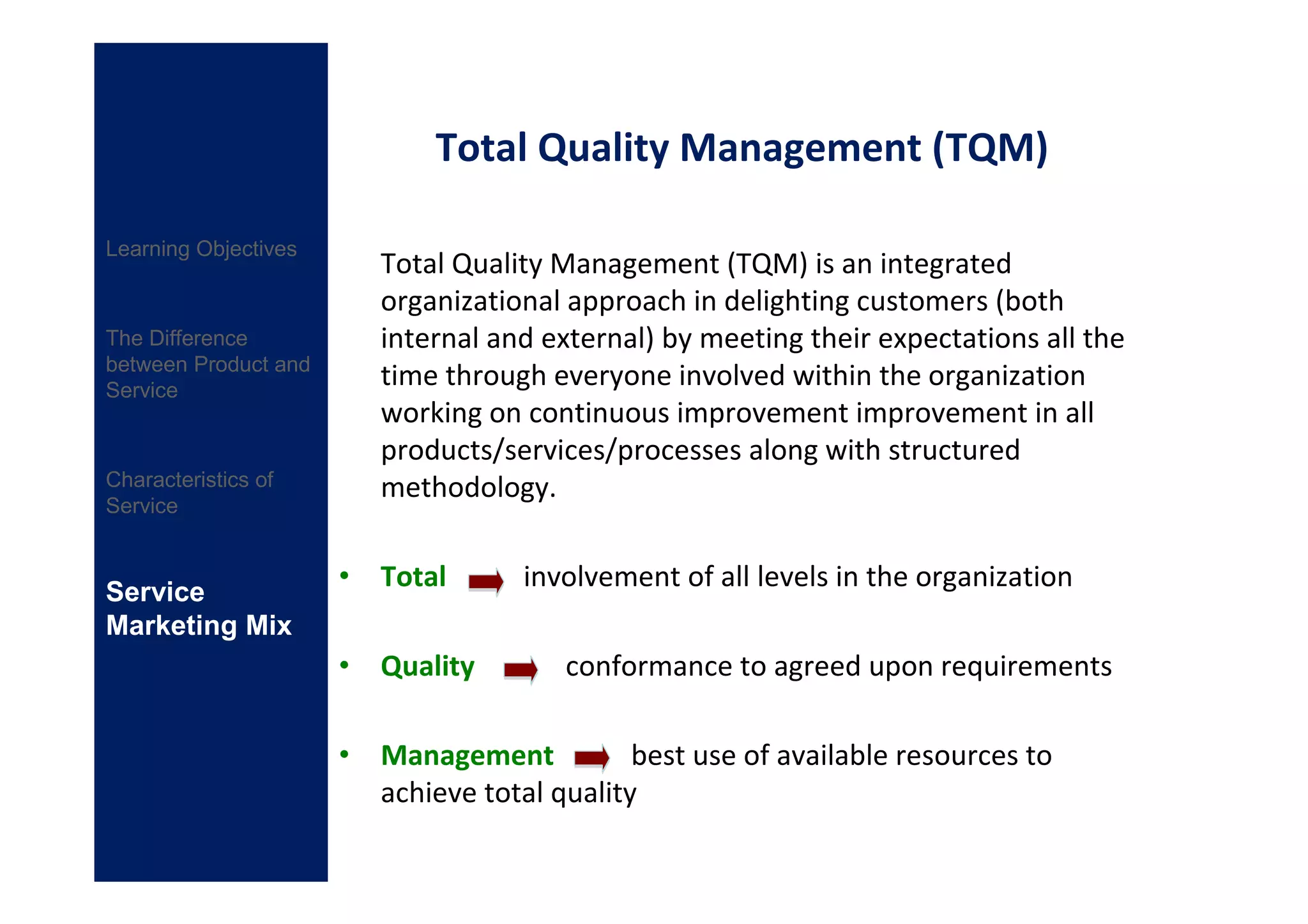
Total Quality Management (TQM)

Learning Objectives
                         Total Quality Management (TQM) is an integrated
                         organizational approach in delighting customers (both
The Difference           internal and external) by meeting their expectations all the
between Product and
Service
                         time through everyone involved within the organization
                         working on continuous improvement improvement in all
                         products/services/processes along with structured
Characteristics of       methodology.
Service


Service
                      • Total       involvement of all levels in the organization
Marketing Mix
                      • Quality         conformance to agreed upon requirements

                      • Management           best use of available resources to
                        achieve total quality
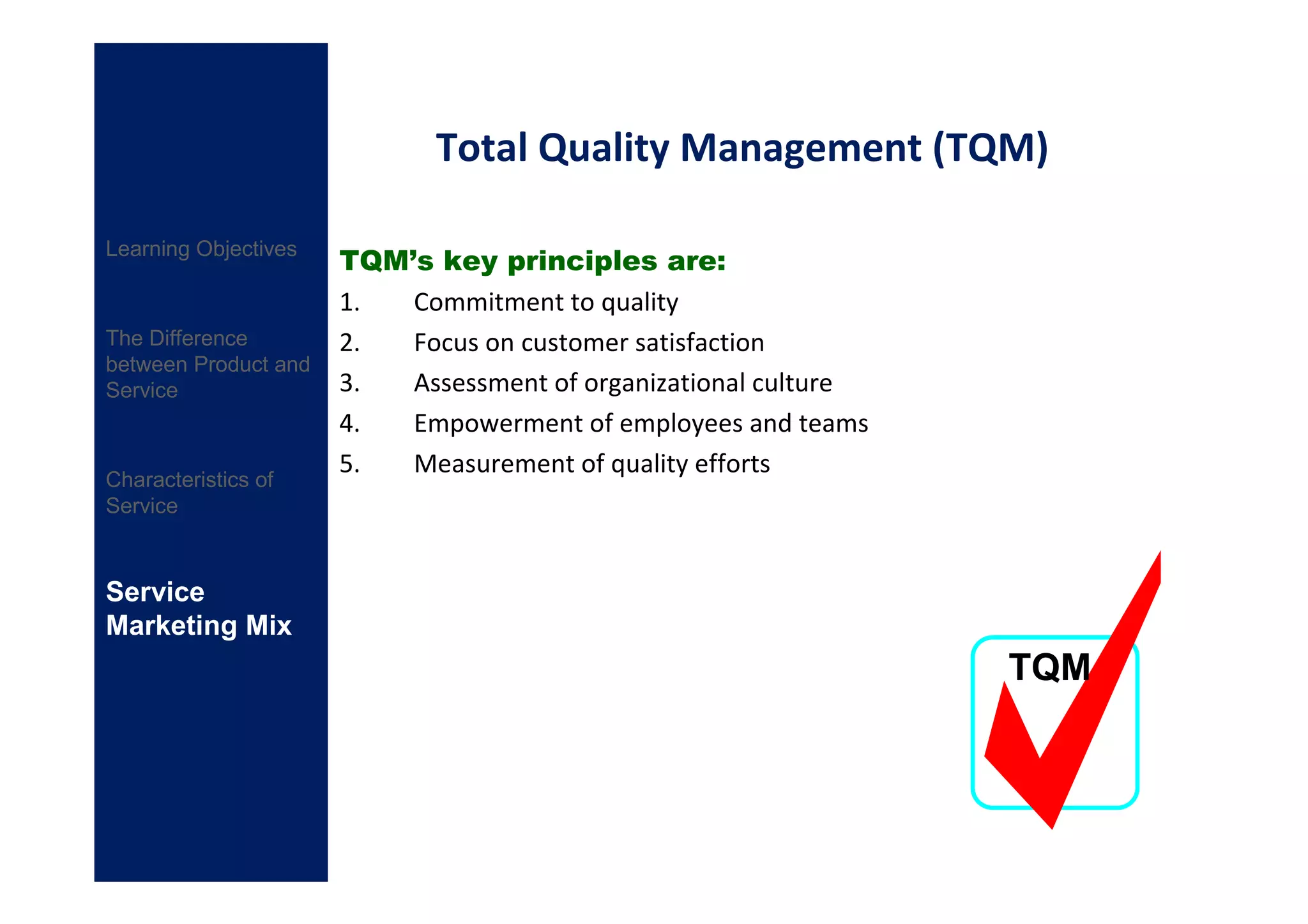
Total Quality Management (TQM)

                      TQM’s key principles are:
Learning Objectives

                      1.  Commitment to quality
The Difference        2.  Focus on customer satisfaction
between Product and
Service               3.  Assessment of organizational culture
                      4.  Empowerment of employees and teams
                      5.  Measurement of quality efforts
Characteristics of
Service


Service
Marketing Mix
                                                                 TQM
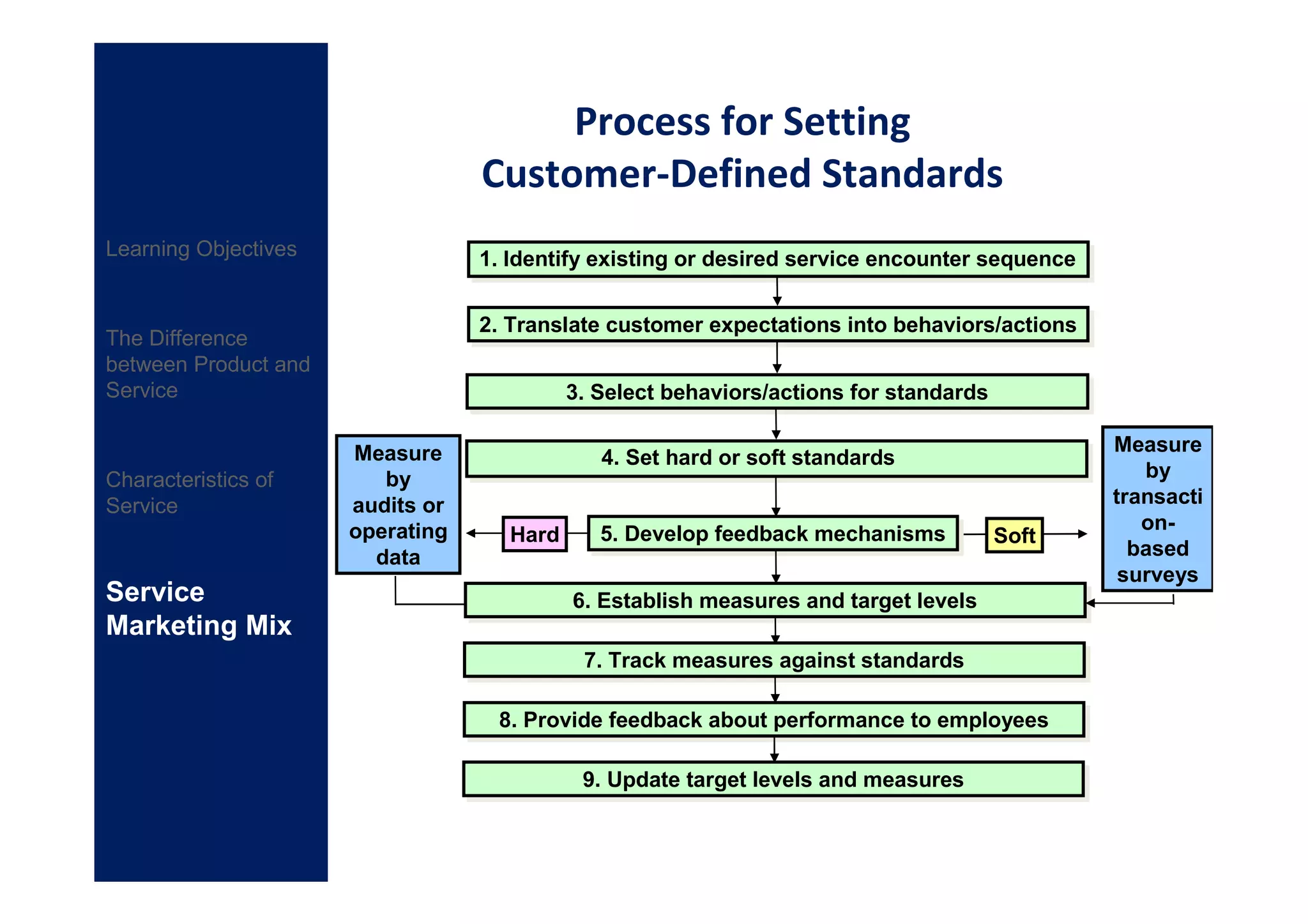
Process for Setting
                                  Customer-Defined Standards
Learning Objectives               1. Identify existing or desired service encounter sequence


                                  2. Translate customer expectations into behaviors/actions
                                  2. Translate customer expectations into behaviors/actions
The Difference
between Product and
Service                                    3. Select behaviors/actions for standards
                                           3. Select behaviors/actions for standards

                      Measure                                                                  Measure
                                              4. Set hard or soft standards
Characteristics of       by                                                                       by
Service               audits or                                                                transacti
                      operating                                                                   on-
                                    Hard      5. Develop feedback mechanisms
                                              5. Develop feedback mechanisms           Soft
                        data                                                                     based
                                                                                                surveys
Service                                    6. Establish measures and target levels
                                           6. Establish measures and target levels
Marketing Mix
                                            7. Track measures against standards
                                            7. Track measures against standards

                                   8. Provide feedback about performance to employees
                                   8. Provide feedback about performance to employees

                                            9. Update target levels and measures
                                            9. Update target levels and measures
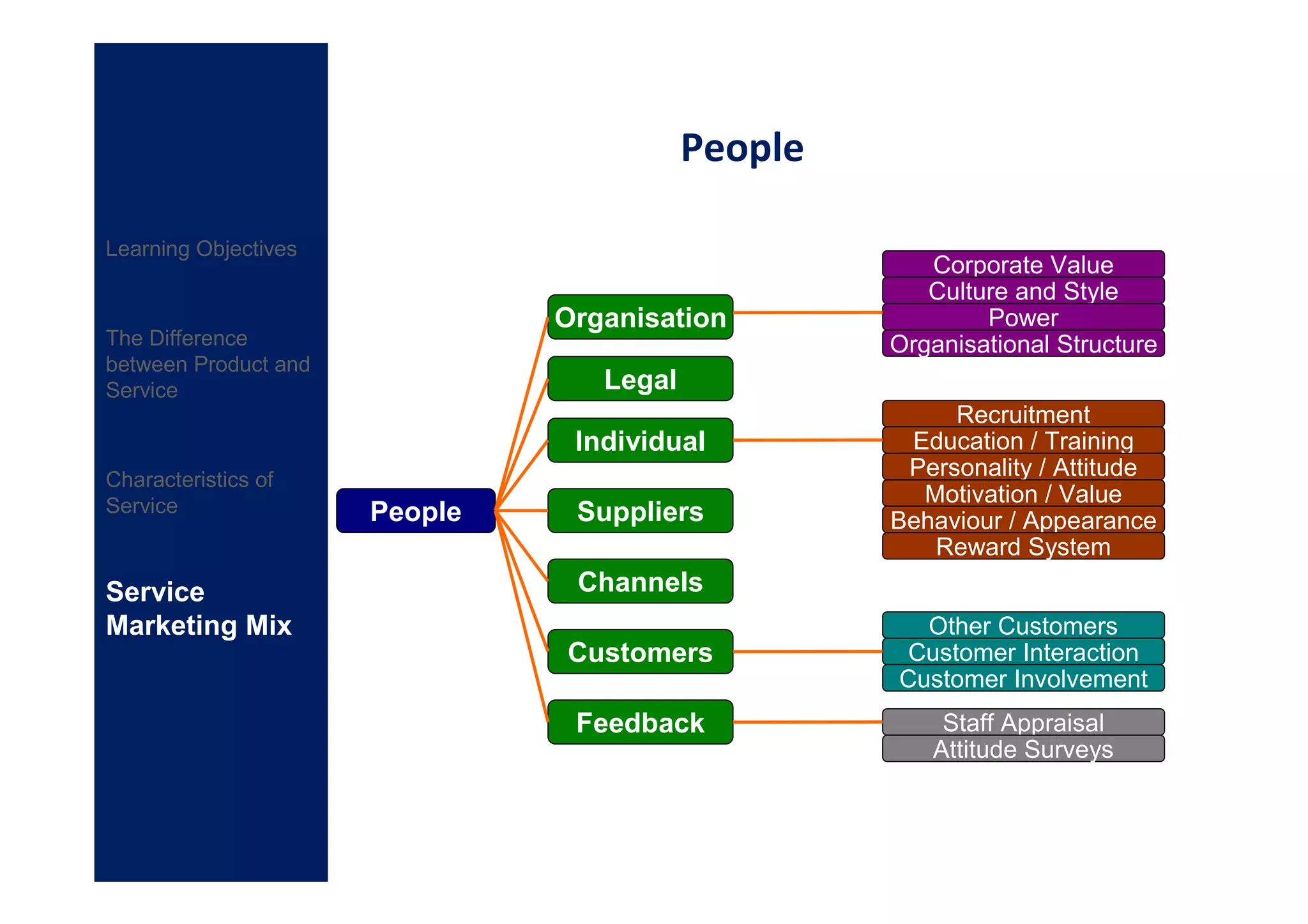
People

Learning Objectives
                                                      Corporate Value
                                                      Culture and Style
                               Organisation                Power
The Difference                                     Organisational Structure
between Product and
Service                           Legal
                                                        Recruitment
                                Individual          Education / Training
Characteristics of
                                                    Personality / Attitude
Service                                              Motivation / Value
                      People    Suppliers          Behaviour / Appearance
                                                      Reward System
Service                         Channels
Marketing Mix                                        Other Customers
                               Customers           Customer Interaction
                                                   Customer Involvement
                                Feedback               Staff Appraisal
                                                      Attitude Surveys
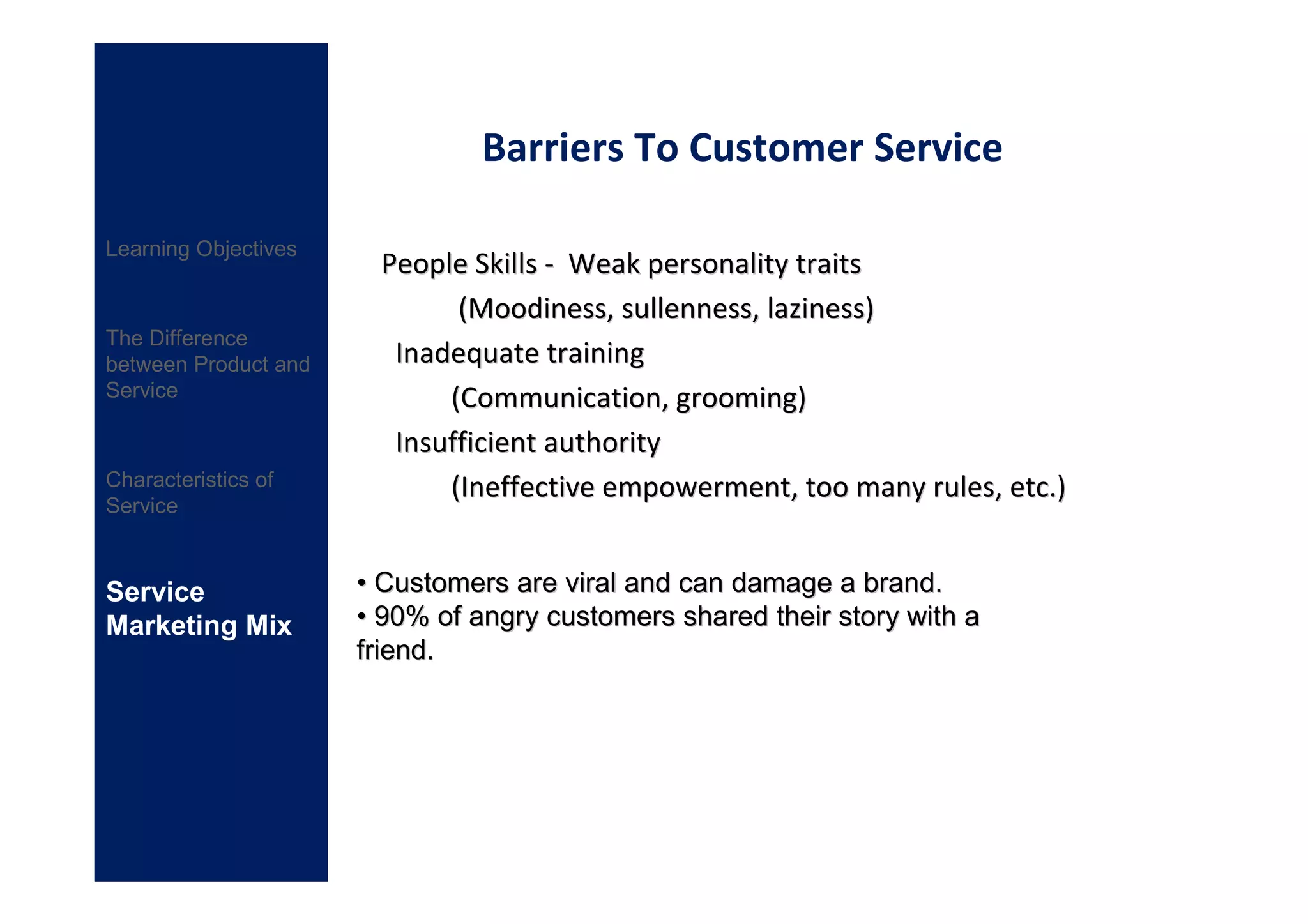
Barriers To Customer Service

Learning Objectives
                       People Skills - Weak personality traits
                             (Moodiness, sullenness, laziness)
The Difference
between Product and     Inadequate training
Service                     (Communication, grooming)
                        Insufficient authority
Characteristics of          (Ineffective empowerment, too many rules, etc.)
Service


Service               • Customers are viral and can damage a brand.
Marketing Mix         • 90% of angry customers shared their story with a
                      friend.
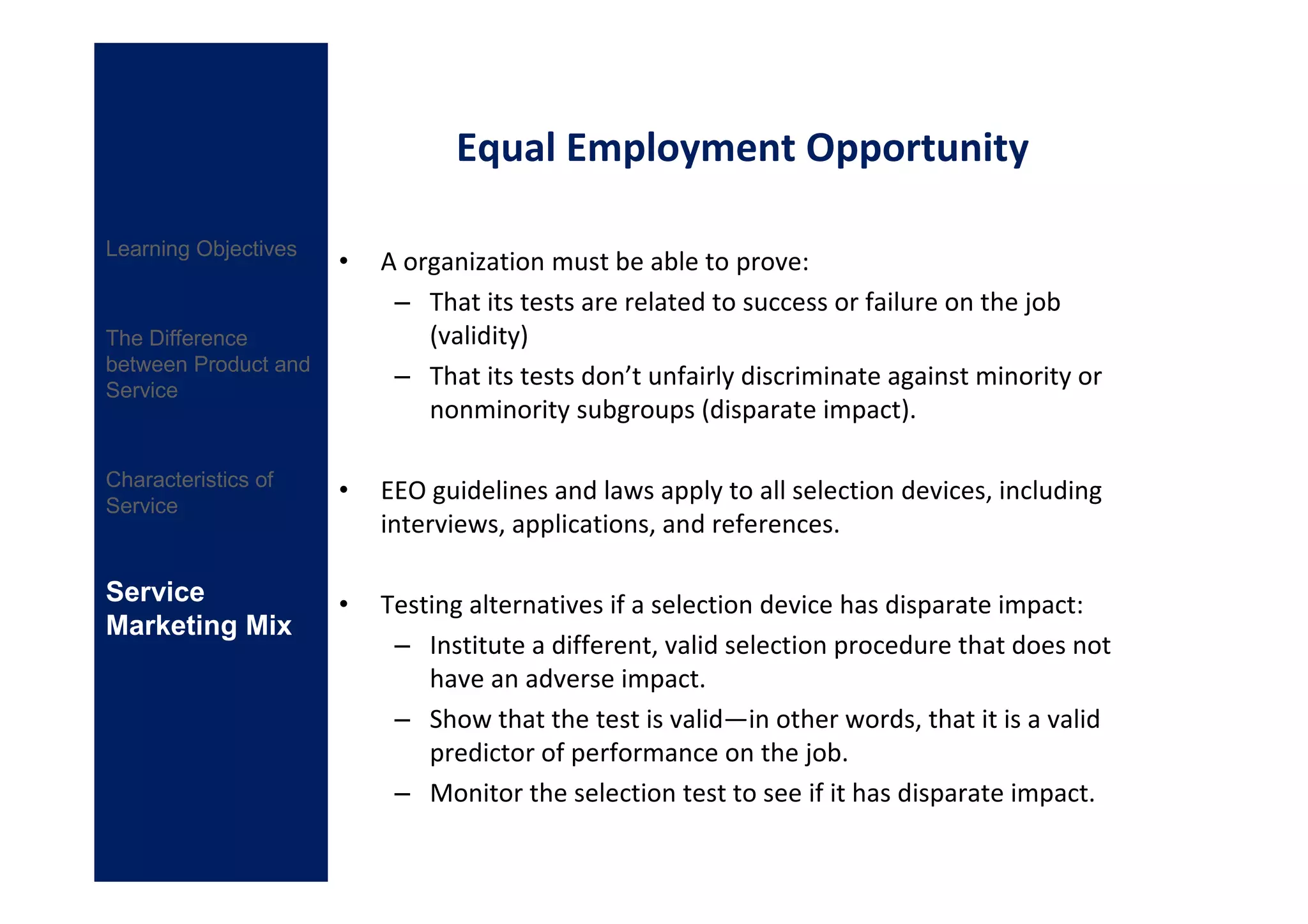
Equal Employment Opportunity

Learning Objectives
                      •   A organization must be able to prove:
                           – That its tests are related to success or failure on the job
The Difference                (validity)
between Product and
Service
                           – That its tests don’t unfairly discriminate against minority or
                              nonminority subgroups (disparate impact).

Characteristics of
                      •   EEO guidelines and laws apply to all selection devices, including
Service
                          interviews, applications, and references.

Service               •   Testing alternatives if a selection device has disparate impact:
Marketing Mix
                           – Institute a different, valid selection procedure that does not
                              have an adverse impact.
                           – Show that the test is valid—in other words, that it is a valid
                              predictor of performance on the job.
                           – Monitor the selection test to see if it has disparate impact.
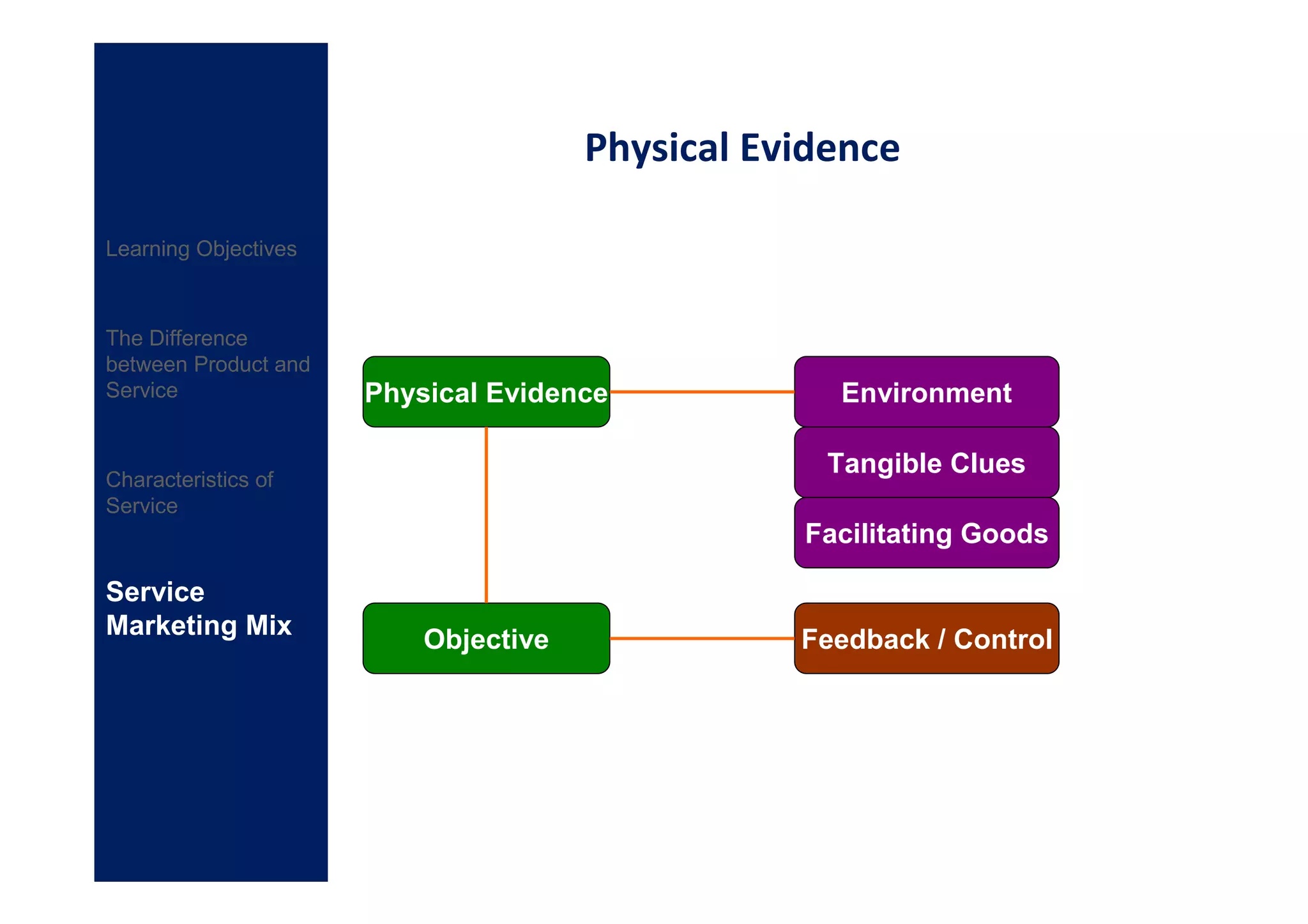
Physical Evidence

Learning Objectives


The Difference
between Product and
Service               Physical Evidence            Environment

                                                   Tangible Clues
Characteristics of
Service
                                                 Facilitating Goods

Service
Marketing Mix             Objective              Feedback / Control
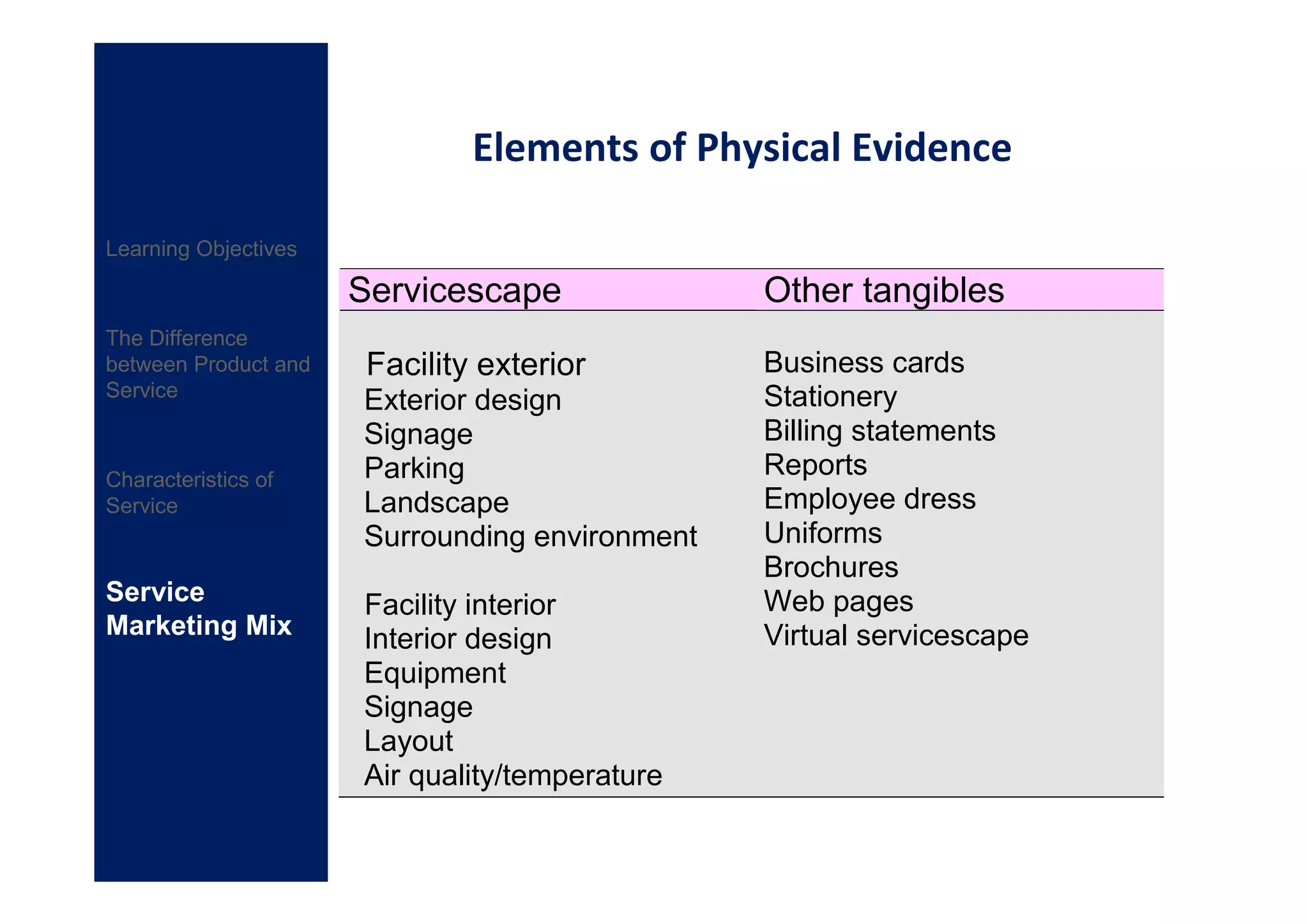
Elements of Physical Evidence

Learning Objectives

                      Servicescape              Other tangibles
The Difference
between Product and    Facility exterior        Business cards
Service                                         Stationery
                      Exterior design
                      Signage                   Billing statements
Characteristics of    Parking                   Reports
Service               Landscape                 Employee dress
                      Surrounding environment   Uniforms
                                                Brochures
Service               Facility interior         Web pages
Marketing Mix         Interior design           Virtual servicescape
                      Equipment
                      Signage
                      Layout
                      Air quality/temperature
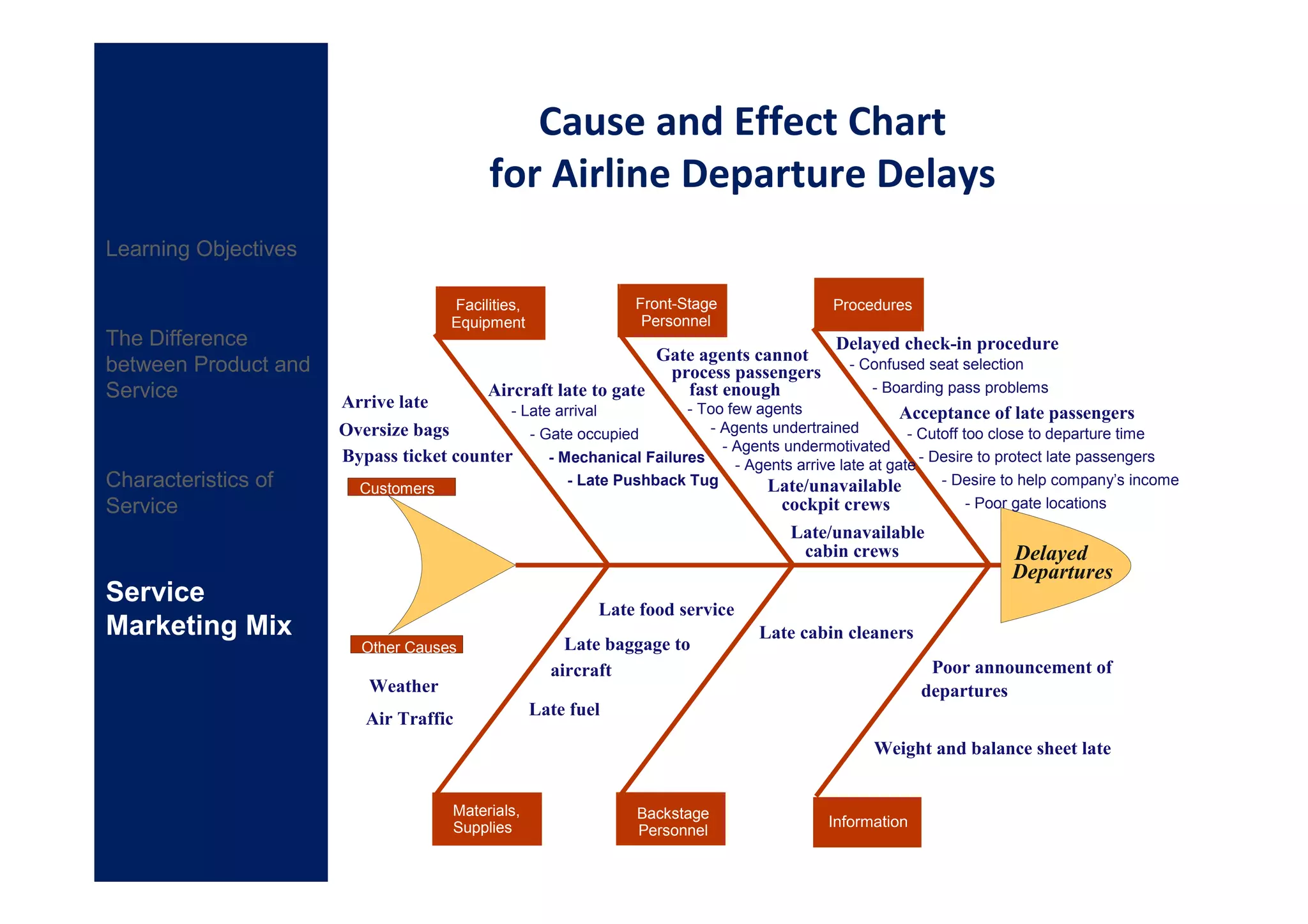
Cause and Effect Chart
                                           for Airline Departure Delays
Learning Objectives

                                      Facilities,               Front-Stage                 Procedures
                                      Equipment                  Personnel
The Difference                                                                               Delayed check-in procedure
                                                                 Gate agents cannot
between Product and                                               process passengers           - Confused seat selection
Service                                    Aircraft late to gate    fast enough                   - Boarding pass problems
                      Arrive late          - Late arrival           - Too few agents                 Acceptance of late passengers
                      Oversize bags           - Gate occupied          - Agents undertrained          - Cutoff too close to departure time
                                                                         - Agents undermotivated
                      Bypass ticket counter      - Mechanical Failures     - Agents arrive late at gate
                                                                                                        - Desire to protect late passengers
Characteristics of      Customers
                                                        - Late Pushback Tug        Late/unavailable   - Desire to help company’s income
Service                                                                             cockpit crews        - Poor gate locations
                                                                                     Late/unavailable
                                                                                       cabin crews               Delayed
                                                                                                                      Departures
Service
                                                            Late food service
Marketing Mix                                                                     Late cabin cleaners
                         Other Causes                   Late baggage to
                                                      aircraft                                            Poor announcement of
                          Weather                                                                        departures
                                                    Late fuel
                         Air Traffic
                                                                                                  Weight and balance sheet late


                                      Materials,                Backstage
                                      Supplies                  Personnel
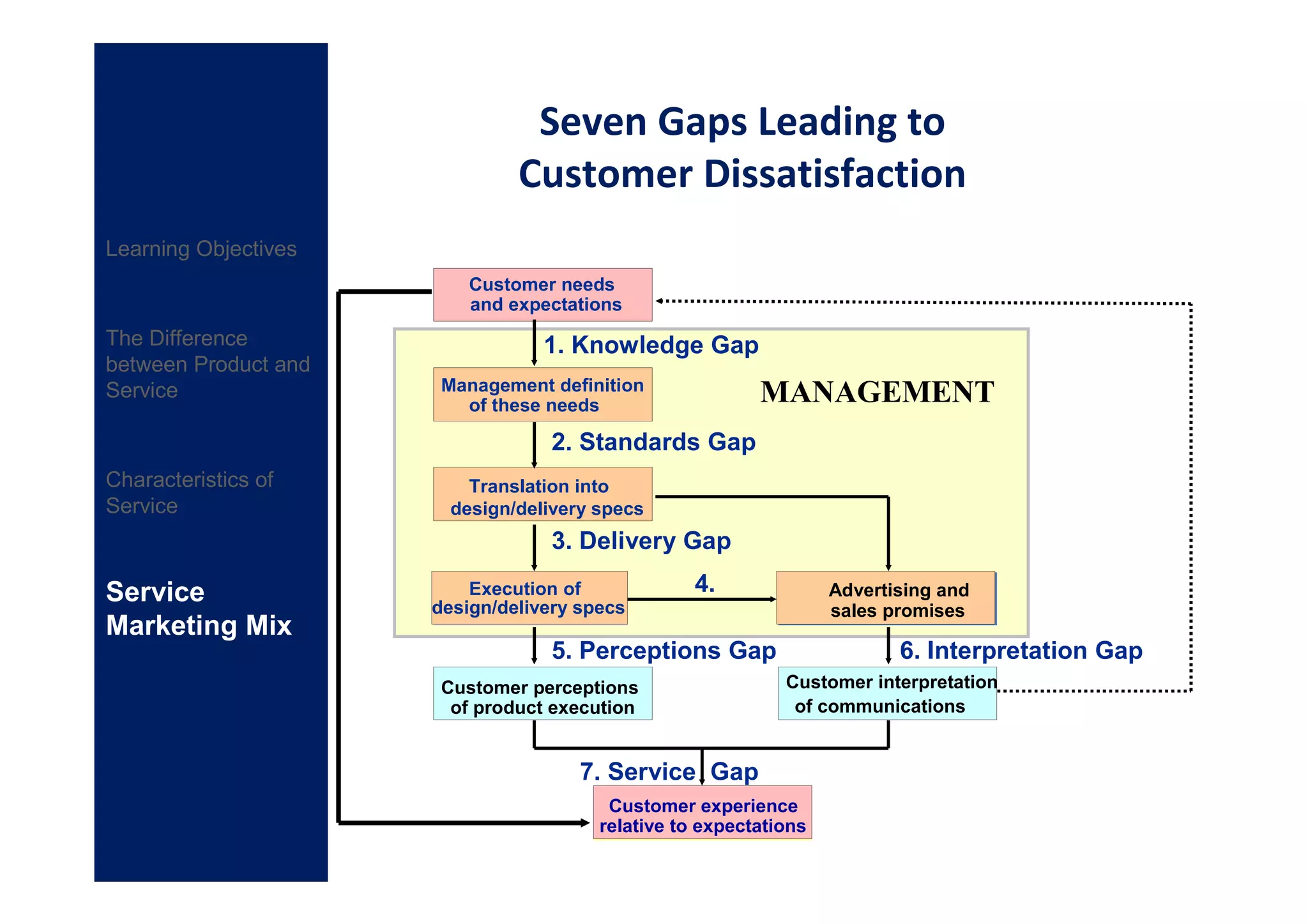
Seven Gaps Leading to
                               Customer Dissatisfaction
Learning Objectives
                          Customer needs
                          and expectations
The Difference                    1. Knowledge Gap
between Product and
                       Management definition
Service
                         of these needs
                                                          MANAGEMENT
                                   2. Standards Gap
Characteristics of        Translation into
Service                 design/delivery specs
                                   3. Delivery Gap

Service                   Execution of             4.              Advertising and
                      design/delivery specs                        sales promises
Marketing Mix
                                   5. Perceptions Gap                     6. Interpretation Gap
                       Customer perceptions                  Customer interpretation
                        of product execution                  of communications


                                      7. Service Gap
                                         Customer experience
                                        relative to expectations

mmm7

  • 1.
    Managing the MarketingMix Lecture 7 Extending the Marketing Mix: Service Marketing Dr. Martin J. Liu Lecturer in Marketing Martin.Liu@Nottingham.edu.cn
  • 2.
    Objectives Learning • Explore potential differences between products and Objectives services The Difference • Describe the elements and sub elements of the service between Product and extension to the marketing mix Service • Discuss the challenges services pose for marketing Characteristics of Service Service Marketing Mix
  • 3.
    The Products-Services Continuum LearningObjectives The Difference between Product and Service Characteristics of Service Service Marketing Mix
  • 4.
    What is ServiceMarketing Learning Objectives • Examples: Defense, Postal, Education, health, Religious Services, Hospitals, Airlines, Hotels, Law Firms, The Difference Entertainment, etc. between Product and • Definition: Activity or benefit that one party can offer to Service another that is essentially intangible and does not result in the ownership of anything. Its production may or may not Characteristics of be tied to a physical product Service Service Marketing Mix
  • 5.
    The Nature ofService Learning Objectives • Regardless of the “product”, there is a services component to the offerings of all firms The Difference • In some cases, a service is the principal purpose of the transaction, between as in the rental of a car, a haircut, or legal services -- we refer to Product and this as the core service Service • In others, service is performed in support of the sale of a tangible Characteristics of product -- these are referred to as supplementary services Service Service Marketing Mix
  • 6.
    Differences between Products and Services Learning Objectives • Customers do not obtain ownership of the intangible element of the service product (i.e. service personnel and their performance cannot be ‘owned’ by the customer). The Difference between Product and • Intangible elements dominate value creation Service Characteristics of • There is greater involvement of customers in the production Service process (i.e. customers are part of the performance, they interact with the service provider). Service Marketing Mix • It is more difficult to maintain quality standards of service products (i.e. individuals’ behaviour is hard to control and standardise).
  • 7.
    Differences between Products and Services Learning Objectives • Many services are difficult for customers to evaluate (i.e. there may be elements of personal taste, experience, ability and mood that affect customers’ evaluation). The Difference between • Absence of inventories for services (i.e. no use for unsold stock, Product and difficult to deal with sudden increases in demand). Service • Importance of time factor (i.e. many services are delivered in real Characteristics of time so the consumer and provider must be together for the Service service to occur). Service Marketing • Delivery systems may involve both electronic and physical Mix channels (i.e. different needs for staff behaviour management).
  • 8.
    Differences between Products and Services Learning Objectives Physical goods Services tangible intangible The Difference homogeneous heterogeneous between Product and Production and distribution are Production, distribution and Service separated from consumption consumption are simultaneous processes A thing An activity or process Characteristics of Service Core value processed in Core value produced in the factory buyer-seller interaction Service Marketing Mix Customers do not participate in Customers participate in the production process production Can be kept in stock Cannot be kept in stock Transfer of ownership No transfer of ownership
  • 9.
    Characteristics of Services LearningObjectives • Intangibility: difficult to sample and to evaluate Intangibility The Difference • Inseparability: difficult to separate services from the service between Product and provider; mainly direct sales; staff are essential to the Service delivery of quality services • Perishability: those not sold can not be stored Characteristics of Service • Heterogeneity: virtually every service is different; very Heterogeneity difficult to standardize quality Service Marketing Mix
  • 10.
    (1) Intangibility “Hurdles” LearningObjectives • Inability to physically possess • Difficult to evaluate (provide guarantees) The Difference between Product and • Difficult to advertise (use personal selling) Service • Difficult to price • Difficult to patent Characteristics • Difficult to distribute (promote availability) of Service • Difficult to store (offer a trial basis) Service Marketing Mix Develop a marketing mix to provide tangible (symbolic) cues : ex. Uniforms
  • 11.
    (2) Inseparability Learning Objectives Being produced and consumed simultaneously • The provider of the service is inseparable in the delivery The Difference process between Product and Service • Customers participate in and affect the transaction Cannot be mass produced Characteristics • Difficult to distribute, Mass Production is difficult of Service • Services cannot be returned or resold Service Marketing Mix Very Difficult to Balance Supply and Demand if time sensitive
  • 12.
    (3) Perishability Learning Objectives Service cannot be stored & used at a future time - A lost sale is lost revenue The Difference between Product and - Unused capacity is lost forever Service Use demand management strategies such as Characteristics - Peak pricing: of Service - Telephone call pricing - Theater Tickets Service Marketing Mix Example: Airlines use reservation systems to sell their service in advance (Yield Management)
  • 13.
    (4) Heterogeneity Learning Objectives Variability in the quality of service • allows marketers to develop their service product to match The Difference between Product and customer needs/wants Service • Service delivery and customer satisfaction depend on Characteristics employee and customer actions of Service • Service quality is difficult to deliver & control Service Marketing Mix Standardisation Customisation Strategies Strategies - Automate service -Health Club Routines -Physician -Automatic car wash
  • 14.
    Key Characteristics of An Effective Marketing Mix Learning Objectives •The elements are not independent of each other. The Difference between Product and •The mix elements should be Service well blended to form a consistent theme Characteristics •The marketing mix matches of Service customer needs •The marketing mix matches Service Marketing Mix corporate resources •The marketing mix creates a competitive advantage The marketing mix paradigm ( Borden, 1964, McCarthy, 1978)
  • 15.
    Service Extended MarketingMix Learning Objectives Intangibility The Difference between Product and Product Service Extended Service Marketing Marketing Mix (4 Ps) Inseparability Mix (7 Ps) Characteristics of Service -Product -Product -Price Inseparability -Price -Place -Place Service -Promotion -Promotion Marketing Mix -People Heterogeneity -Process -Physical Evidence Ownership
  • 16.
    An Expanded MarketingMix for Services Learning Objectives The Difference between Product and Service Product (Service) People Process Characteristics of Service Place & Place Customers Customers Price Price Time Customers Service Marketing Mix Promotion Physical Evidence
  • 17.
    Process Learning Objectives The Difference betweenProduct and Nature Flexibility Service Personal Contact Automation Procedure Technology Characteristics of Service Process Law Service Involvement Customers Channels Marketing Mix Other Stakeholders Feedback
  • 18.
    Total Quality Management(TQM) Learning Objectives Total Quality Management (TQM) is an integrated organizational approach in delighting customers (both The Difference internal and external) by meeting their expectations all the between Product and Service time through everyone involved within the organization working on continuous improvement improvement in all products/services/processes along with structured Characteristics of methodology. Service Service • Total involvement of all levels in the organization Marketing Mix • Quality conformance to agreed upon requirements • Management best use of available resources to achieve total quality
  • 19.
    Total Quality Management(TQM) TQM’s key principles are: Learning Objectives 1. Commitment to quality The Difference 2. Focus on customer satisfaction between Product and Service 3. Assessment of organizational culture 4. Empowerment of employees and teams 5. Measurement of quality efforts Characteristics of Service Service Marketing Mix TQM
  • 20.
    Process for Setting Customer-Defined Standards Learning Objectives 1. Identify existing or desired service encounter sequence 2. Translate customer expectations into behaviors/actions 2. Translate customer expectations into behaviors/actions The Difference between Product and Service 3. Select behaviors/actions for standards 3. Select behaviors/actions for standards Measure Measure 4. Set hard or soft standards Characteristics of by by Service audits or transacti operating on- Hard 5. Develop feedback mechanisms 5. Develop feedback mechanisms Soft data based surveys Service 6. Establish measures and target levels 6. Establish measures and target levels Marketing Mix 7. Track measures against standards 7. Track measures against standards 8. Provide feedback about performance to employees 8. Provide feedback about performance to employees 9. Update target levels and measures 9. Update target levels and measures
  • 21.
    People Learning Objectives Corporate Value Culture and Style Organisation Power The Difference Organisational Structure between Product and Service Legal Recruitment Individual Education / Training Characteristics of Personality / Attitude Service Motivation / Value People Suppliers Behaviour / Appearance Reward System Service Channels Marketing Mix Other Customers Customers Customer Interaction Customer Involvement Feedback Staff Appraisal Attitude Surveys
  • 22.
    Barriers To CustomerService Learning Objectives People Skills - Weak personality traits (Moodiness, sullenness, laziness) The Difference between Product and Inadequate training Service (Communication, grooming) Insufficient authority Characteristics of (Ineffective empowerment, too many rules, etc.) Service Service • Customers are viral and can damage a brand. Marketing Mix • 90% of angry customers shared their story with a friend.
  • 23.
    Equal Employment Opportunity LearningObjectives • A organization must be able to prove: – That its tests are related to success or failure on the job The Difference (validity) between Product and Service – That its tests don’t unfairly discriminate against minority or nonminority subgroups (disparate impact). Characteristics of • EEO guidelines and laws apply to all selection devices, including Service interviews, applications, and references. Service • Testing alternatives if a selection device has disparate impact: Marketing Mix – Institute a different, valid selection procedure that does not have an adverse impact. – Show that the test is valid—in other words, that it is a valid predictor of performance on the job. – Monitor the selection test to see if it has disparate impact.
  • 24.
    Physical Evidence Learning Objectives TheDifference between Product and Service Physical Evidence Environment Tangible Clues Characteristics of Service Facilitating Goods Service Marketing Mix Objective Feedback / Control
  • 25.
    Elements of PhysicalEvidence Learning Objectives Servicescape Other tangibles The Difference between Product and Facility exterior Business cards Service Stationery Exterior design Signage Billing statements Characteristics of Parking Reports Service Landscape Employee dress Surrounding environment Uniforms Brochures Service Facility interior Web pages Marketing Mix Interior design Virtual servicescape Equipment Signage Layout Air quality/temperature
  • 26.
    Cause and EffectChart for Airline Departure Delays Learning Objectives Facilities, Front-Stage Procedures Equipment Personnel The Difference Delayed check-in procedure Gate agents cannot between Product and process passengers - Confused seat selection Service Aircraft late to gate fast enough - Boarding pass problems Arrive late - Late arrival - Too few agents Acceptance of late passengers Oversize bags - Gate occupied - Agents undertrained - Cutoff too close to departure time - Agents undermotivated Bypass ticket counter - Mechanical Failures - Agents arrive late at gate - Desire to protect late passengers Characteristics of Customers - Late Pushback Tug Late/unavailable - Desire to help company’s income Service cockpit crews - Poor gate locations Late/unavailable cabin crews Delayed Departures Service Late food service Marketing Mix Late cabin cleaners Other Causes Late baggage to aircraft Poor announcement of Weather departures Late fuel Air Traffic Weight and balance sheet late Materials, Backstage Supplies Personnel
  • 27.
    Seven Gaps Leadingto Customer Dissatisfaction Learning Objectives Customer needs and expectations The Difference 1. Knowledge Gap between Product and Management definition Service of these needs MANAGEMENT 2. Standards Gap Characteristics of Translation into Service design/delivery specs 3. Delivery Gap Service Execution of 4. Advertising and design/delivery specs sales promises Marketing Mix 5. Perceptions Gap 6. Interpretation Gap Customer perceptions Customer interpretation of product execution of communications 7. Service Gap Customer experience relative to expectations