Research
Grace Gilbert
• After having a meeting with someone from the art gallery and my tutor as well as a couple
other students I have discussed my idea and decided to do a short documentary style video
where I interview different women and they answer the questions I ask them. Due to
coronavirus I have an idea where I get them people to ‘interview’ themselves and they film
themselves answering the questions. I would give them a set of instructions such as film
against a plain background because this way it would allow it to look similar and therefore a
more polished look. I want to go down the contemporary/ experimental route so I will have to
look at some examples to get a good idea of how I am to make it. I like the idea of starting it
with me setting up an interview so a behind the scenes type of thing because it makes it feel
as if you’re watching a process and I think it makes it more inclusive. I like the idea of doing a
talking heads type of thing so where the narrator talks directly to the camera usually shot from
the shoulders up. I like this idea however it does have the risk of being boring so that’s why I
want to include interviews to break up the narration. I came up with the idea of having different
parts of women’s faces in a mirror but the mirror is broken and cracked so I will have to search
for a tutorial on how to do this..
• “Participatory documentaries share many unifying characteristics that typically
focus on the director's role in the film:
1. The filmmaker is a character. In a participatory documentary, the filmmaker must
either be seen or heard at some point in the movie, giving them a presence that
is often as important as the primary subject.
2. The interviewer’s questions are included in the edit. In other documentary
genres, subjects answer interview questions, but the questions themselves are
edited out. In the participatory mode, the audience is allowed to see or hear the
filmmaker asking the questions. This establishes a clearer relationship between
the filmmaker and the interview subject, while also giving the viewer a more
"behind the scenes" look at how the filmmaker elicited the subject's responses.
3. The viewer is aligned with the filmmaker. The audience experiences the film
through the filmmaker's point of view, allowing them to intuit how the filmmaker
felt in the moment and consider how they might have reacted in the same
situation.”
• “The expository mode of documentary filmmaking has a few distinct
characteristics, such as:
1. Omniscient voice-over. One characteristic of expository documentaries is the
“voice of God” narration. This authoritative voice accompanies the
documentary’s images, defining the visuals for the audience, and explaining
rhetorical content to help make the film’s case. The voice-over conveys
information and does not provide personal accounts or subjective experiences
to share a narrative.
2. A “right” answer. Expository documentaries don’t leave much to subjectivity—
they want the audience to feel a certain way about the content they are seeing.
Rhetorical questions, recounts of history, and interviews are often presented to
support the film’s claims, along with any other relevant evidence.
3. Evidentiary editing. While visuals in the poetic mode documentaries are meant
for emotional or artistic purposes, expository filmmakers use images as a
means to support their claims. Images on-screen are explained or supported by
captions or commentary. This kind of editing style is also used for news
broadcasts.”
• “The reflexive documentary mode focuses on the relationship between the filmmaker
and the audience, pushing viewers to reflect on their perceptions and re-analyze
their notions of truth. Unlike the expository documentary, the reflexive mode does not
examine outside subject matter to which it exposes the documentary-making
process.
• The reflexive documentary does not attempt to provoke intense emotional responses
from the audience but encourages thoughtful consideration of the material. Since the
subject matter is often the process of documentary filmmaking itself, a
cinematographer will shoot behind the scene style footage of the entire film
production process, including editing, interviewing, and post-production.
• The reflexive documentary mode is similar to the participatory documentary in that
they both show involvement of the filmmaker, and usually make the cameraman and
camera part of the film. The reflexive documentary mode presents questions and
approaches topics with uncertainty, presenting a version of truth within a non-fiction
format.
• Reflexive documentaries will often show the camera or production crew to call
attention to the conventions of filmmaking, and present self-awareness to eliminate
biases about the film’s content or agenda.”
• Perry is an English contemporary artist, writer and broadcaster. He is known for his ceramic vases, tapestries and cross
dressing, as well as his observations of the contemporary arts scene, and for dissecting British "prejudices, fashions and
foibles.” Perry's vases have classical forms and are decorated in bright colours, depicting subjects at odds with their
attractive appearance. There is a strong autobiographical element in his work, in which images of Perry as “Claire”, his
female alter-ego, and "Alan Measles", his childhood teddy bear, often appear, so this will be something to consider when
finalising my idea.
• Contemporary - Contemporary art means modern art done after Pop art and Conceptual art. Another term, which really
means the same thing, is postmodern art. Yet another term, which goes wider than art, is Postmodernism. If I was to
interpret the meaning of contemporary into a film term I would say I like the idea of doing an experimental type of film
however I will have to look into existing products that do experimental documentaries.
• “Born into a working-class family, Perry was four years old when his father, Tom, left home after discovering his mother,
Jean, was having an affair with a milkman, whom she later married and who Perry has claimed was violent. Subsequently,
he spent an unhappy childhood moving between his parents and created a fantasy world based around his teddy in order
to cope with his sense of anxiety. He considers that a person’s early experiences are important in shaping their aesthetic
and sexuality.”
• My main inspiration for this project is his art piece ‘Melanie’ this ceramic piece echoes “fertility figures dating back more
than 25,000 years. By referencing these prehistoric celebrations of the female body, Perry’s portrait becomes a positive
image of an oversized woman. Added to this, Perry’s title of The Three Graces is a reference to a long history of
representations of idealised beauty, such as Antonio Canova’s famous sculpture (1814-17) of the same name. Layered on
to the figure of Melanie are painted and printed images of women, from supermodels to the Madonna, which show the
shifting view of what constitutes female perfection.” I want to look at women through the ages because this way it makes it
more relevant to the piece Melanie because there are fertility figures dating back centuries ago so I can look at women
through the ages which also ties into my interview idea.
Grayson Perry
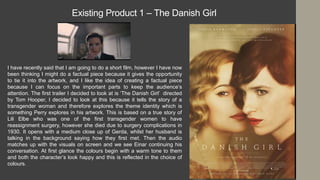
Existing Product 1 – The Danish Girl
I have recently said that I am going to do a short film, however I have now
been thinking I might do a factual piece because it gives the opportunity
to tie it into the artwork, and I like the idea of creating a factual piece
because I can focus on the important parts to keep the audience’s
attention. The first trailer I decided to look at is ‘The Danish Girl’ directed
by Tom Hooper, I decided to look at this because it tells the story of a
transgender woman and therefore explores the theme identity which is
something Perry explores in his artwork. This is based on a true story of
Lili Elbe who was one of the first transgender women to have
reassignment surgery, however she died due to surgery complications in
1930. It opens with a medium close up of Gerda, whilst her husband is
talking in the background saying how they first met. Then the audio
matches up with the visuals on screen and we see Einar continuing his
conversation. At first glance the colours begin with a warm tone to them
and both the character’s look happy and this is reflected in the choice of
colours.
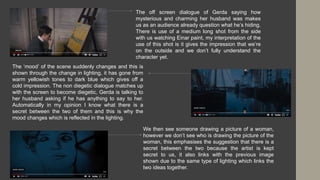
The off screen dialogue of Gerda saying how
mysterious and charming her husband was makes
us as an audience already question what he’s hiding.
There is use of a medium long shot from the side
with us watching Einar paint, my interpretation of the
use of this shot is it gives the impression that we’re
on the outside and we don’t fully understand the
character yet.
The ‘mood’ of the scene suddenly changes and this is
shown through the change in lighting, it has gone from
warm yellowish tones to dark blue which gives off a
cold impression. The non diegetic dialogue matches up
with the screen to become diegetic, Gerda is talking to
her husband asking if he has anything to say to her.
Automatically in my opinion I know what there is a
secret between the two of them and this is why the
mood changes which is reflected in the lighting.
We then see someone drawing a picture of a woman,
however we don’t see who is drawing the picture of the
woman, this emphasises the suggestion that there is a
secret between the two because the artist is kept
secret to us, it also links with the previous image
shown due to the same type of lighting which links the
two ideas together.
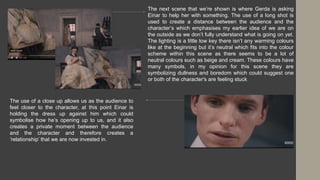
The next scene that we’re shown is where Gerda is asking
Einar to help her with something. The use of a long shot is
used to create a distance between the audience and the
character’s which emphasises my earlier idea of we are on
the outside as we don’t fully understand what is going on yet.
The lighting is a little low key there isn’t any warming colours
like at the beginning but it’s neutral which fits into the colour
scheme within this scene as there seems to be a lot of
neutral colours such as beige and cream. These colours have
many symbols, in my opinion for this scene they are
symbolizing dullness and boredom which could suggest one
or both of the character's are feeling stuck
The use of a close up allows us as the audience to
feel closer to the character, at this point Einar is
holding the dress up against him which could
symbolise how he’s opening up to us, and it also
creates a private moment between the audience
and the character and therefore creates a
‘relationship’ that we are now invested in.
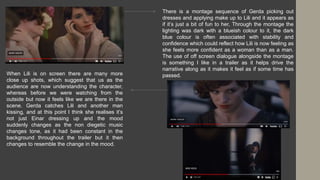
There is a montage sequence of Gerda picking out
dresses and applying make up to Lili and it appears as
if it’s just a bit of fun to her, Through the montage the
lighting was dark with a blueish colour to it, the dark
blue colour is often associated with stability and
confidence which could reflect how Lili is now feeling as
she feels more confident as a woman than as a man.
The use of off screen dialogue alongside the montage
is something I like in a trailer as it helps drive the
narrative along as it makes it feel as if some time has
passed.
When Lili is on screen there are many more
close up shots, which suggest that us as the
audience are now understanding the character,
whereas before we were watching from the
outside but now it feels like we are there in the
scene. Gerda catches Lili and another man
kissing, and at this point I think she realises it’s
not just Einar dressing up and the mood
suddenly changes as the non diegetic music
changes tone, as it had been constant in the
background throughout the trailer but it then
changes to resemble the change in the mood.
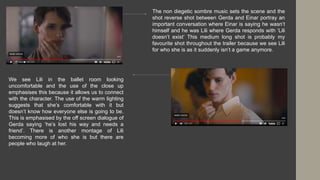
The non diegetic sombre music sets the scene and the
shot reverse shot between Gerda and Einar portray an
important conversation where Einar is saying he wasn’t
himself and he was Lili where Gerda responds with ‘Lili
doesn’t exist’ This medium long shot is probably my
favourite shot throughout the trailer because we see Lili
for who she is as it suddenly isn’t a game anymore.
We see Lili in the ballet room looking
uncomfortable and the use of the close up
emphasises this because it allows us to connect
with the character. The use of the warm lighting
suggests that she’s comfortable with it but
doesn’t know how everyone else is going to be.
This is emphasised by the off screen dialogue of
Gerda saying ‘he’s lost his way and needs a
friend’. There is another montage of Lili
becoming more of who she is but there are
people who laugh at her.
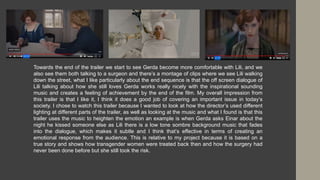
Towards the end of the trailer we start to see Gerda become more comfortable with Lili, and we
also see them both talking to a surgeon and there’s a montage of clips where we see Lili walking
down the street, what I like particularly about the end sequence is that the off screen dialogue of
Lili talking about how she still loves Gerda works really nicely with the inspirational sounding
music and creates a feeling of achievement by the end of the film. My overall impression from
this trailer is that I like it, I think it does a good job of covering an important issue in today’s
society. I chose to watch this trailer because I wanted to look at how the director’s used different
lighting at different parts of the trailer, as well as looking at the music and what I found is that this
trailer uses the music to heighten the emotion an example is when Gerda asks Einar about the
night he kissed someone else as Lili there is a low tone sombre background music that fades
into the dialogue, which makes it subtle and I think that’s effective in terms of creating an
emotional response from the audience. This is relative to my project because it is based on a
true story and shows how transgender women were treated back then and how the surgery had
never been done before but she still took the risk.
Audience Appeal
• The age rating for this film is a 15 on the ‘British Board of Film Classification’ an age rating
of 15 could include Dangerous behaviour for example, suicide, self-harming and it should
not dwell on detail which could be copied. Whether the depiction of easily accessible
weapons is acceptable will depend on factors such as realism, context and setting. The
work as a whole must not endorse discriminatory language or behaviour, although there
may be racist, homophobic or other discriminatory themes and language. Drug taking may
be shown but the work as a whole must not promote or encourage drug misuse for
example, through detailed instruction. The misuse of easily accessible and highly
dangerous substances for example, aerosols or solvents is unlikely to be acceptable.
There may be strong language as well as very strong language may be permitted,
depending on the manner in which it is used, who is using the language, its frequency
within the work as a whole and any special contextual justification. Statistics taken from a
research study (Stoll 2021) show that in 2018 63% of young adults enjoyed a romance
film which is what ‘The Danish Girl’ genre is so I think the age rating is correct for the type
of film it is. It also applies to the younger generation because it covers the topic of identity
and in particular gender dysphoria within a transgender woman which are current issues
in today’s society as there are still people out there who don’t agree with it, and therefore
it’s relevant for quite a few age groups as it can educate individuals who may not fully
understand the topic.
Existing Product 2 – Women in coffee
After looking at a film trailer I thought it would be beneficial to look at a short documentary, this short
documentary ran for around 12 minutes which is longer than what I want to do however the concept
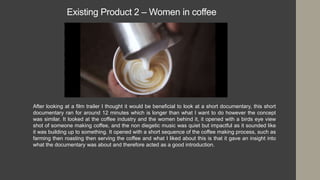
was similar. It looked at the coffee industry and the women behind it, it opened with a birds eye view
shot of someone making coffee, and the non diegetic music was quiet but impactful as it sounded like
it was building up to something. It opened with a short sequence of the coffee making process, such as
farming then roasting then serving the coffee and what I liked about this is that it gave an insight into
what the documentary was about and therefore acted as a good introduction.
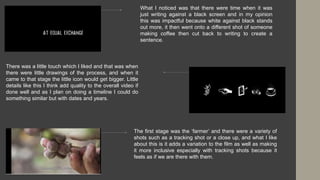
What I noticed was that there were time when it was
just writing against a black screen and in my opinion
this was impactful because white against black stands
out more, it then went onto a different shot of someone
making coffee then cut back to writing to create a
sentence.
There was a little touch which I liked and that was when
there were little drawings of the process, and when it
came to that stage the little icon would get bigger. Little
details like this I think add quality to the overall video if
done well and as I plan on doing a timeline I could do
something similar but with dates and years.
The first stage was the ‘farmer’ and there were a variety of
shots such as a tracking shot or a close up, and what I like
about this is it adds a variation to the film as well as making
it more inclusive especially with tracking shots because it
feels as if we are there with them.
It broke up the shots by cutting to an interview, I like this idea of
having different shots and then cutting to interviews, because I
think it makes it more entertaining as it also educates the viewer
because we get a personal insight into the business. I like how this
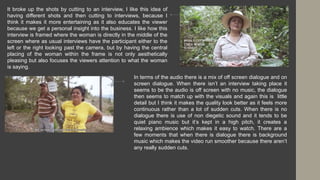
interview is framed where the woman is directly in the middle of the
screen where as usual interviews have the participant either to the
left or the right looking past the camera, but by having the central
placing of the woman within the frame is not only aesthetically
pleasing but also focuses the viewers attention to what the woman
is saying.
In terms of the audio there is a mix of off screen dialogue and on
screen dialogue. When there isn’t an interview taking place it
seems to be the audio is off screen with no music, the dialogue
then seems to match up with the visuals and again this is little
detail but I think it makes the quality look better as it feels more
continuous rather than a lot of sudden cuts. When there is no
dialogue there is use of non diegetic sound and it tends to be
quiet piano music but it’s kept in a high pitch, it creates a
relaxing ambience which makes it easy to watch. There are a
few moments that when there is dialogue there is background
music which makes the video run smoother because there aren’t
any really sudden cuts.
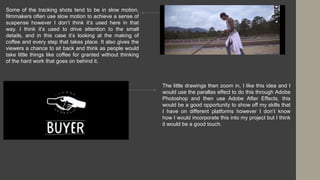
Some of the tracking shots tend to be in slow motion,
filmmakers often use slow motion to achieve a sense of
suspense however I don’t think it’s used here in that
way. I think it’s used to drive attention to the small
details, and in this case it’s looking at the making of
coffee and every step that takes place. It also gives the
viewers a chance to sit back and think as people would
take little things like coffee for granted without thinking
of the hard work that goes on behind it.
The little drawings then zoom in, I like this idea and I
would use the parallax effect to do this through Adobe
Photoshop and then use Adobe After Effects, this
would be a good opportunity to show off my skills that
I have on different platforms however I don’t know
how I would incorporate this into my project but I think
it would be a good touch.
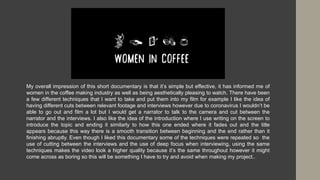
The next section is the buyers process, it starts with a
shot of an aeroplane wing then goes into a tracking shot
and what I like about this is that it feels like us as the
viewers are on the journey with the woman which overall
creates an inclusive feeling because this short
documentary is about the coffee making process and the
women behind it.
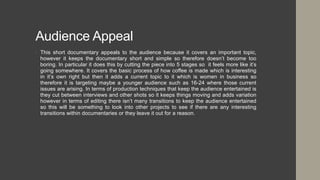
Another small detail that I have noticed is
that there tends to be shots where the
footage is out of focus and then it goes into
focus. This is usually something that people
try and avoid when making a film because
everything should be perfect however in my
opinion I think it works well with the theme of
the film. It also has the same affect as slow
motion because it draws attention to the little
details that go into coffee making.
My overall impression of this short documentary is that it’s simple but effective, it has informed me of
women in the coffee making industry as well as being aesthetically pleasing to watch. There have been
a few different techniques that I want to take and put them into my film for example I like the idea of
having different cuts between relevant footage and interviews however due to coronavirus I wouldn’t be
able to go out and film a lot but I would get a narrator to talk to the camera and cut between the
narrator and the interviews. I also like the idea of the introduction where I use writing on the screen to
introduce the topic and ending it similarly to how this one ended where it fades out and the title
appears because this way there is a smooth transition between beginning and the end rather than it
finishing abruptly. Even though I liked this documentary some of the techniques were repeated so the
use of cutting between the interviews and the use of deep focus when interviewing, using the same
techniques makes the video look a higher quality because it’s the same throughout however it might
come across as boring so this will be something I have to try and avoid when making my project..
Audience Appeal
• This short documentary appeals to the audience because it covers an important topic,
however it keeps the documentary short and simple so therefore doesn’t become too
boring. In particular it does this by cutting the piece into 5 stages so it feels more like it’s
going somewhere. It covers the basic process of how coffee is made which is interesting
in it’s own right but then it adds a current topic to it which is women in business so
therefore it is targeting maybe a younger audience such as 16-24 where those current
issues are arising. In terms of production techniques that keep the audience entertained is
they cut between interviews and other shots so it keeps things moving and adds variation
however in terms of editing there isn’t many transitions to keep the audience entertained
so this will be something to look into other projects to see if there are any interesting
transitions within documentaries or they leave it out for a reason.
Existing Product 3 – No crying at the dinner table
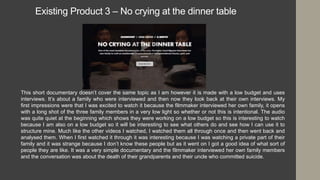
This short documentary doesn’t cover the same topic as I am however it is made with a low budget and uses
interviews. It’s about a family who were interviewed and then now they look back at their own interviews. My
first impressions were that I was excited to watch it because the filmmaker interviewed her own family, it opens
with a long shot of the three family members in a very low light so whether or not this is intentional. The audio
was quite quiet at the beginning which shows they were working on a low budget so this is interesting to watch
because I am also on a low budget so it will be interesting to see what others do and see how I can use it to
structure mine. Much like the other videos I watched, I watched them all through once and then went back and
analysed them. When I first watched it through it was interesting because I was watching a private part of their
family and it was strange because I don’t know these people but as it went on I got a good idea of what sort of
people they are like. It was a very simple documentary and the filmmaker interviewed her own family members
and the conversation was about the death of their grandparents and their uncle who committed suicide.
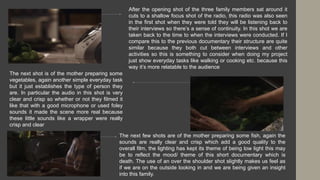
After the opening shot of the three family members sat around it
cuts to a shallow focus shot of the radio, this radio was also seen
in the first shot when they were told they will be listening back to
their interviews so there’s a sense of continuity. In this shot we are
taken back to the time to when the interviews were conducted. If I
compare this to the previous documentary their structure are quite
similar because they both cut between interviews and other
activities so this is something to consider when doing my project
just show everyday tasks like walking or cooking etc. because this
way it’s more relatable to the audience
The next shot is of the mother preparing some
vegetables, again another simple everyday task
but it just establishes the type of person they
are. In particular the audio in this shot is very
clear and crisp so whether or not they filmed it
like that with a good microphone or used foley
sounds it made the scene more real because
these little sounds like a wrapper were really
crisp and clear
The next few shots are of the mother preparing some fish, again the
sounds are really clear and crisp which add a good quality to the
overall film, the lighting has kept its theme of being low light this may
be to reflect the mood/ theme of this short documentary which is
death. The use of an over the shoulder shot slightly makes us feel as
if we are on the outside looking in and we are being given an insight
into this family.
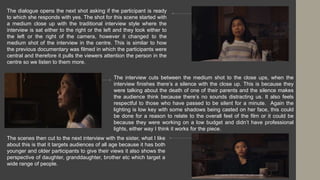
The dialogue opens the next shot asking if the participant is ready
to which she responds with yes. The shot for this scene started with
a medium close up with the traditional interview style where the
interview is sat either to the right or the left and they look either to
the left or the right of the camera, however it changed to the
medium shot of the interview in the centre. This is similar to how
the previous documentary was filmed in which the participants were
central and therefore it pulls the viewers attention the person in the
centre so we listen to them more.
The interview cuts between the medium shot to the close ups, when the
interview finishes there’s a silence with the close up. This is because they
were talking about the death of one of their parents and the silence makes
the audience think because there’s no sounds distracting us. It also feels
respectful to those who have passed to be silent for a minute. Again the
lighting is low key with some shadows being casted on her face, this could
be done for a reason to relate to the overall feel of the film or it could be
because they were working on a low budget and didn’t have professional
lights, either way I think it works for the piece.
The scenes then cut to the next interview with the sister, what I like
about this is that it targets audiences of all age because it has both
younger and older participants to give their views it also shows the
perspective of daughter, granddaughter, brother etc which target a
wide range of people.
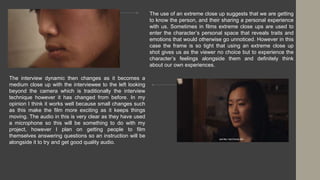
The use of an extreme close up suggests that we are getting
to know the person, and their sharing a personal experience
with us. Sometimes in films extreme close ups are used to
enter the character’s personal space that reveals traits and
emotions that would otherwise go unnoticed. However in this
case the frame is so tight that using an extreme close up
shot gives us as the viewer no choice but to experience the
character’s feelings alongside them and definitely think
about our own experiences.
The interview dynamic then changes as it becomes a
medium close up with the interviewee to the left looking
beyond the camera which is traditionally the interview
technique however it has changed from before. In my
opinion I think it works well because small changes such
as this make the film more exciting as it keeps things
moving. The audio in this is very clear as they have used
a microphone so this will be something to do with my
project, however I plan on getting people to film
themselves answering questions so an instruction will be
alongside it to try and get good quality audio.
When the interview resumes after a couple other shots the shot
has changed to a medium shot, where it’s shot from the shoulders
up. This is when she’s talking about losing her grandparents, this
could be seen as two ways the first being we are now distanced
from the interviewee so we can’t relate to her or in my opinion I
see it as it’s turned to a conversation rather than an interview,
because in the previous shot it feels like an interview whereas this
feels like a conversation because they are facing the camera and
seem relaxed and the cup creates a relaxing and casual
atmosphere.
So the first thing to note is that sometimes the
interviewer is asking the questions which is
uncommon in an interview, this is a negative aspect
of the documentary because its disjointed as the
interviewer doesn’t do this in all the interviews. The
use of lighting is the same throughout so this is a
continuous aspect. Similar to the previous interview
there is a mix between medium shots and medium
close ups
The extreme close up is used again but this time the lighting is slightly
lighter which is different to the rest of the film. So far we have seen the
interviewees outside of their interview which give us an insight into the type
of people they are. We are seeing the whole family and getting to know
their character a little better which fits into the theme of the project which is
death as they seem to be talking about relatives that have passed which is
a personal topic.
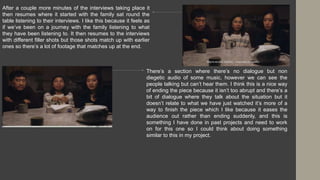
After a couple more minutes of the interviews taking place it
then resumes where it started with the family sat round the
table listening to their interviews. I like this because it feels as
if we’ve been on a journey with the family listening to what
they have been listening to. It then resumes to the interviews
with different filler shots but those shots match up with earlier
ones so there’s a lot of footage that matches up at the end.
There’s a section where there’s no dialogue but non
diegetic audio of some music, however we can see the
people talking but can’t hear them. I think this is a nice way
of ending the piece because it isn’t too abrupt and there’s a
bit of dialogue where they talk about the situation but it
doesn’t relate to what we have just watched it’s more of a
way to finish the piece which I like because it eases the
audience out rather than ending suddenly, and this is
something I have done in past projects and need to work
on for this one so I could think about doing something
similar to this in my project.
Audience Appeal
• My overall impression on this film is that I think it worked well, it was simple basic but was
shot nicely everything was in focus the lighting wasn’t too bad. I think it was good for me
specifically because I will only be interviewing a few people and that’s what this did it only
filmed three people but there was a lot to talk about which is something I have for mine.
This was 20 minutes long which is too long for my project I am for about 5 minutes maybe
longer because this will give me time to make sure the interviews are a good enough
length. If this was my project I might have added a few more sound effects when there
was silence however I think they did the silence for a reason. This short factual piece
would have a large target audience because they are covering a topic that everyone
experiences not just a select few, and they got people from different ages, gender so there
were different points of view which is what I plan on doing for my project I want people
from different ages.
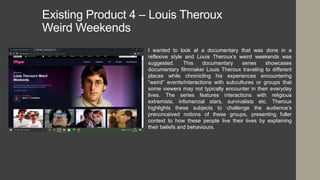
Existing Product 4 – Louis Theroux
Weird Weekends
I wanted to look at a documentary that was done in a
reflexive style and Louis Theroux’s weird weekends was
suggested. This documentary series showcases
documentary filmmaker Louis Theroux traveling to different
places while chronicling his experiences encountering
“weird” events/interactions with subcultures or groups that
some viewers may not typically encounter in their everyday
lives. The series features interactions with religious
extremists, infomercial stars, survivalists etc. Theroux
highlights these subjects to challenge the audience’s
preconceived notions of these groups, presenting fuller
context to how these people live their lives by explaining
their beliefs and behaviours.
• The episode opened with a medium close up of Theroux with one of the Christianity evangelists in the car so
we get a preview of what’s to come. The first thing that I noticed was that there were a few slide transitions
which is something I don’t see very often however this could be because it was made in 1998. There were
also quite a few hand held shots which gives an authentic feel to the episode, I don’t plan on doing any hand
held shots because I am going to set up the interviews instead of walking round to find people to interview.
What I like about Theroux is that throughout his documentary he tries to befriend the people that take part, he
also never voices his opinion so he remains unbiased but is also at the same time he questions things but in a
way that is extremely subtle and example of this would be when Marcus asks are they doing a positive or
negative story and he responds with ‘ we are going to do whatever that has on it’ and points to the camera.
Another example when questioning a born again Christian was he mentioned quite casually “You're all doing
very well out of this” this could be perceived to opening the viewers eyes to question what is happening and if
they do believe in god or are they doing it because the business is worth millions. During the interviews there
is use of shot reverse shot so we see listen to who is being seen on screen, he also engages with the people
an example would be when he is interviewing Marcus he offers to be in the radio show which makes Marcus
feel in charge but in reality Theroux is and he’s just reporting on the situation. When Louis is getting ready to
go live on TV he gets the makeup artist to open up to him and this is an important quality to a journalist
because they can manage to get people to open up because he befriends them. There are a few shots where
we see the camera crew both within Louis’ Crew and the TV crew. Despite Theroux remaining unbiased he
gets involved such as wearing one of the t-shirts with the slogan on which again emphasises how he ‘makes
friends’ with the interviewees. The interviews take place but aren’t structured for example Louis interviews
Randy in the car and so it feels more like a conversation but Louis is getting information out of him and asking
him questions but it comes across as a conversation, he also comes across as naïve and doesn’t know a lot
when in reality he knows what he’s doing when he’s talking to them and trying to get them to open up. This is
relevant to my documentary because I could have a conversation with one of the participants to get more
information from their answers as they would feel more relaxed about the situation.
Audience Appeal
• Overall I liked this documentary because it was a Louis Theroux documentary and he makes it
comedic because there’s sense of humour, he also goes in unbiased and comes out unbiased
but he still questions things so therefore we get information out of it. I liked how it was put
together because the interviews were taken as a conversation and was thought provoking as it
made me think about the whole Christianity religion. In terms of audio there was a mix between
non diegetic and diegetic sounds such as music at the beginning was non diegetic it was light
hearted and fun so it set the tone for the rest of the episode. There was also diegetic sound
and that was live music being played when ‘the family’ were playing guitar and singing on the
street it was a light hearted song and matched the song at the beginning in terms of them both
being joyful and fast paced. This was relevant to my documentary because there are small
things to take into consideration an example would be when Louis was talking to people he was
interviewing them but making it appear as a conversation and this way you get more out of the
person being interviewed because it is more casual and therefore they feel more comfortable
so when possible if I was to interview a family member I could sit down and just have a
conversation with them but include the questions. Again in this episode there was a mix
between off screen dialogue and on screen dialogue so this seems to be a convention
throughout documentaries so this will be something to look at when producing my project.
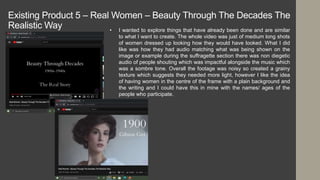
Existing Product 5 – Real Women – Beauty Through The Decades The
Realistic Way • I wanted to explore things that have already been done and are similar
to what I want to create. The whole video was just of medium long shots
of women dressed up looking how they would have looked. What I did
like was how they had audio matching what was being shown on the
image or example during the suffragette section there was non diegetic
audio of people shouting which was impactful alongside the music which
was a sombre tone. Overall the footage was noisy so created a grainy
texture which suggests they needed more light, however I like the idea
of having women in the centre of the frame with a plain background and
the writing and I could have this in mine with the names/ ages of the
people who participate.
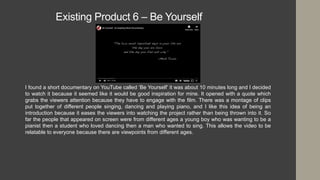
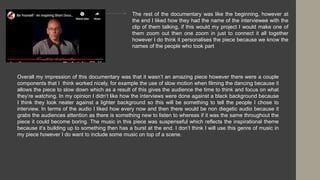
Existing Product 6 – Be Yourself
I found a short documentary on YouTube called ‘Be Yourself’ it was about 10 minutes long and I decided
to watch it because it seemed like it would be good inspiration for mine. It opened with a quote which
grabs the viewers attention because they have to engage with the film. There was a montage of clips
put together of different people singing, dancing and playing piano, and I like this idea of being an
introduction because it eases the viewers into watching the project rather than being thrown into it. So
far the people that appeared on screen were from different ages a young boy who was wanting to be a
pianist then a student who loved dancing then a man who wanted to sing. This allows the video to be
relatable to everyone because there are viewpoints from different ages.
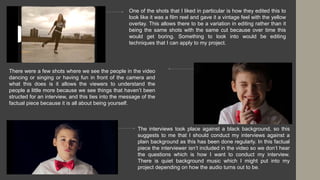
One of the shots that I liked in particular is how they edited this to
look like it was a film reel and gave it a vintage feel with the yellow
overlay. This allows there to be a variation in editing rather than it
being the same shots with the same cut because over time this
would get boring. Something to look into would be editing
techniques that I can apply to my project.
There were a few shots where we see the people in the video
dancing or singing or having fun in front of the camera and
what this does is it allows the viewers to understand the
people a little more because we see things that haven’t been
structed for an interview, and this ties into the message of the
factual piece because it is all about being yourself.
The interviews took place against a black background, so this
suggests to me that I should conduct my interviews against a
plain background as this has been done regularly. In this factual
piece the interviewer isn’t included in the video so we don’t hear
the questions which is how I want to conduct my interview.
There is quiet background music which I might put into my
project depending on how the audio turns out to be.
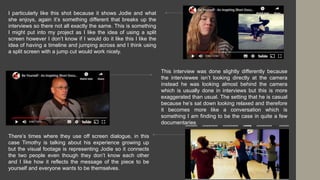
I particularly like this shot because it shows Jodie and what
she enjoys, again it’s something different that breaks up the
interviews so there not all exactly the same. This is something
I might put into my project as I like the idea of using a split
screen however I don’t know if I would do it like this I like the
idea of having a timeline and jumping across and I think using
a split screen with a jump cut would work nicely.
This interview was done slightly differently because
the interviewee isn’t looking directly at the camera
instead he was looking almost behind the camera
which is usually done in interviews but this is more
exaggerated than usual. The setting that he is casual
because he’s sat down looking relaxed and therefore
it becomes more like a conversation which is
something I am finding to be the case in quite a few
documentaries
There’s times where they use off screen dialogue, in this
case Timothy is talking about his experience growing up
but the visual footage is representing Jodie so it connects
the two people even though they don’t know each other
and I like how it reflects the message of the piece to be
yourself and everyone wants to be themselves.
The rest of the documentary was like the beginning, however at
the end I liked how they had the name of the interviewee with the
clip of them talking, if this would my project I would make one of
them zoom out then one zoom in just to connect it all together
however I do think it personalises the piece because we know the
names of the people who took part
Overall my impression of this documentary was that it wasn’t an amazing piece however there were a couple
components that I think worked nicely, for example the use of slow motion when filming the dancing because it
allows the piece to slow down which as a result of this gives the audience the time to think and focus on what
they’re watching. In my opinion I didn’t like how the interviews were done against a black background because
I think they look neater against a lighter background so this will be something to tell the people I chose to
interview. In terms of the audio I liked how every now and then there would be non diegetic audio because it
grabs the audiences attention as there is something new to listen to whereas if it was the same throughout the
piece it could become boring. The music in this piece was suspenseful which reflects the inspirational theme
because it’s building up to something then has a burst at the end. I don’t think I will use this genre of music in
my piece however I do want to include some music on top of a scene.
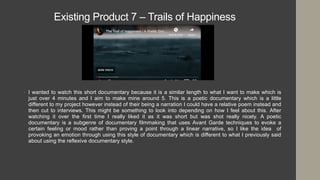
Existing Product 7 – Trails of Happiness
• I wanted to watch this short documentary because it is a similar length to what I want to make which is
just over 4 minutes and I aim to make mine around 5. This is a poetic documentary which is a little
different to my project however instead of their being a narration I could have a relative poem instead and
then cut to interviews. This might be something to look into depending on how I feel about this. After
watching it over the first time I really liked it as it was short but was shot really nicely. A poetic
documentary is a subgenre of documentary filmmaking that uses Avant Garde techniques to evoke a
certain feeling or mood rather than proving a point through a linear narrative, so I like the idea of
provoking an emotion through using this style of documentary which is different to what I previously said
about using the reflexive documentary style.
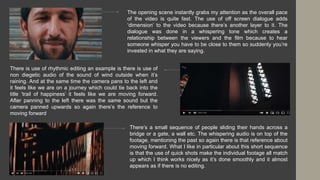
The opening scene instantly grabs my attention as the overall pace
of the video is quite fast. The use of off screen dialogue adds
‘dimension’ to the video because there’s another layer to it. The
dialogue was done in a whispering tone which creates a
relationship between the viewers and the film because to hear
someone whisper you have to be close to them so suddenly you’re
invested in what they are saying.
There is use of rhythmic editing an example is there is use of
non diegetic audio of the sound of wind outside when it’s
raining. And at the same time the camera pans to the left and
it feels like we are on a journey which could tie back into the
title ‘trail of happiness’ it feels like we are moving forward.
After panning to the left there was the same sound but the
camera panned upwards so again there’s the reference to
moving forward
There’s a small sequence of people sliding their hands across a
bridge or a gate, a wall etc. The whispering audio is on top of the
footage, mentioning the past so again there is that reference about
moving forward. What I like in particular about this short sequence
is that the use of quick shots make the individual footage all match
up which I think works nicely as it’s done smoothly and it almost
appears as if there is no editing.
There is a lot of movement that takes place in this
documentary an example is the shot of the ceiling but it spins,
and then the clock hands move. What stands out in particular
is the transitions because the camera pans down then the
next shot is the camera panning up and I really like this
because it’s a simple transition but it keeps things moving so
it doesn’t feel boring.
Another part that stood out to me was when we saw shots of
people, usually we start of with the medium close up and zoom
in but with this documentary the transition is a zoom out to
reveal the medium close up. The connotations associated with
this is that we are moving backwards which counteracts the
transitions we saw earlier which we moving forward etc.
The next few minutes are shots of different people, all
shot with a medium close up which connects them all
together, there is non diegetic music which sounds
inspirational and happy. Overall I think this documentary is
good and shot really nicely and particularly the movement
around the frame an example would be when their in a
building and walking round the square it jumps and
appears to be pictures but done as a video which I like.
Audience Appeal
• I liked this documentary, it was short but managed to convey emotions to me in that time
which is what a poetic documentary should do. I thought the use of transitions was done
really well as it kept the video moving so it never felt boring to watch. In terms of colour
there was a mix between cold blue colours and then yellow and oranges which gave a
warm feeling. There were a lot of repeated shots such as medium close ups on people but
I think this worked nicely because it connected everybody and what I noticed is that the
director was focusing on faces which helps get the audience to feel emotion because we
might be able to relate to those people. This relates to reception theory which I have
previously looked at which talks about depending on your background you might feel
differently, an example would be if you’re a wealthy westerner you might not find the
architecture appealing but if you grew up there you might find watching it nostalgic so it’s
all about what your own personal background is and how that can affect the way you view
things.
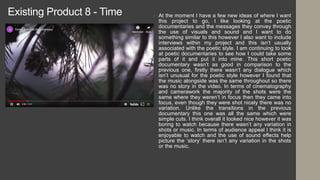
Existing Product 8 - Time • At the moment I have a few new ideas of where I want
this project to go, I like looking at the poetic
documentaries and the messages they convey through
the use of visuals and sound and I want to do
something similar to this however I also want to include
interviews within my project and this isn’t usually
associated with the poetic style. I am continuing to look
at poetic documentaries to see how I could take some
parts of it and put it into mine. This short poetic
documentary wasn’t as good in comparison to the
previous one, firstly there wasn’t any dialogue which
isn’t unusual for the poetic style however I found that
the music alongside was the same throughout so there
was no story in the video. In terms of cinematography
and camerawork the majority of the shots were the
same where they weren’t in focus then they came into
focus, even though they were shot nicely there was no
variation. Unlike the transitions in the previous
documentary this one was all the same which were
simple cuts. I think overall it looked nice however it was
boring to watch because there wasn’t any variation in
shots or music. In terms of audience appeal I think it is
enjoyable to watch and the use of sound effects help
picture the ‘story’ there isn’t any variation in the shots
or the music.
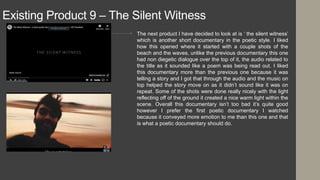
Existing Product 9 – The Silent Witness
The next product I have decided to look at is ‘ the silent witness’
which is another short documentary in the poetic style. I liked
how this opened where it started with a couple shots of the
beach and the waves, unlike the previous documentary this one
had non diegetic dialogue over the top of it, the audio related to
the title as it sounded like a poem was being read out. I liked
this documentary more than the previous one because it was
telling a story and I got that through the audio and the music on
top helped the story move on as it didn’t sound like it was on
repeat. Some of the shots were done really nicely with the light
reflecting off of the ground it created a nice warm light within the
scene. Overall this documentary isn’t too bad it’s quite good
however I prefer the first poetic documentary I watched
because it conveyed more emotion to me than this one and that
is what a poetic documentary should do.
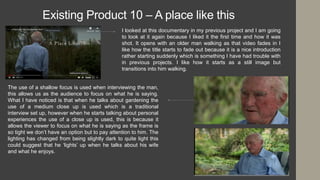
Existing Product 10 – A place like this
I looked at this documentary in my previous project and I am going
to look at it again because I liked it the first time and how it was
shot. It opens with an older man walking as that video fades in I
like how the title starts to fade out because it is a nice introduction
rather starting suddenly which is something I have had trouble with
in previous projects. I like how it starts as a still image but
transitions into him walking.
The use of a shallow focus is used when interviewing the man,
this allows us as the audience to focus on what he is saying.
What I have noticed is that when he talks about gardening the
use of a medium close up is used which is a traditional
interview set up, however when he starts talking about personal
experiences the use of a close up is used, this is because it
allows the viewer to focus on what he is saying as the frame is
so tight we don’t have an option but to pay attention to him. The
lighting has changed from being slightly dark to quite light this
could suggest that he ‘lights’ up when he talks about his wife
and what he enjoys.
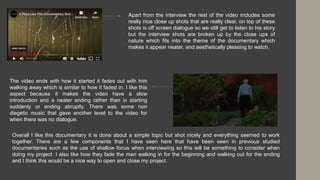
Apart from the interview the rest of the video includes some
really nice close up shots that are really clear, on top of these
shots is off screen dialogue so we still get to listen to his story
but the interview shots are broken up by the close ups of
nature which fits into the theme of the documentary which
makes it appear neater, and aesthetically pleasing to watch.
The video ends with how it started it fades out with him
walking away which is similar to how it faded in. I like this
aspect because it makes the video have a slow
introduction and a neater ending rather than in starting
suddenly or ending abruptly. There was some non
diegetic music that gave another level to the video for
when there was no dialogue.
Overall I like this documentary it is done about a simple topic but shot nicely and everything seemed to work
together. There are a few components that I have seen here that have been seen in previous studied
documentaries such as the use of shallow focus when interviewing so this will be something to consider when
doing my project. I also like how they fade the man walking in for the beginning and walking out for the ending
and I think this would be a nice way to open and close my project.
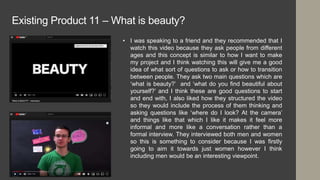
Existing Product 11 – What is beauty?
• I was speaking to a friend and they recommended that I
watch this video because they ask people from different
ages and this concept is similar to how I want to make
my project and I think watching this will give me a good
idea of what sort of questions to ask or how to transition
between people. They ask two main questions which are
‘what is beauty?’ and ‘what do you find beautiful about
yourself?’ and I think these are good questions to start
and end with, I also liked how they structured the video
so they would include the process of them thinking and
asking questions like ‘where do I look? At the camera’
and things like that which I like it makes it feel more
informal and more like a conversation rather than a
formal interview. They interviewed both men and women
so this is something to consider because I was firstly
going to aim it towards just women however I think
including men would be an interesting viewpoint.
• I just wanted to do a summary from what I have got form existing products. I started by looking at a film trailer
because I was wanting to make a short film however after some discussion I thought it would be better to do a
short documentary because I could involve interviews which would test my audio skills as the interviews are
going to be conducted without me being there due to COVID. Instead I will give instructions to try and get every
interview looking the same or as close as possible to being the same. I have learnt quite a lot from looking at
some existing products, the most beneficial is finding out that there was a lot of them where they cut between
interviews and other shots, I liked this because it allowed for the viewers to have a break so it wasn’t all one
and not the other so this is what I will do for my project. I also found that there seemed to be a lot of music
used in some which I wasn’t sure about at first but then the more I watched I started thinking that without the
music there isn’t any emotion behind it because music helps convey the emotion to the viewers so I plan on
including music in my project however not all the way through it otherwise the audience would get too use to it
and then then the emotion becomes lost. I like the idea of having it when there isn’t an interview taking place. I
haven’t talked about the colour through it however I did notice that there did still seem to be a colour scheme,
for example the last documentary I looked at was about gardening and his life, there was a green theme
running through it which made sense because it was about nature. Having one solid colour scheme helps keep
the film looking neater and gives it a better quality overall so this will be something to keep in mind when doing
my project. I like the idea of keeping to low tones so white/grey and if I was to use colour it wouldn’t be vivid it
would be kept at a low saturation. I want to have a ‘subject’ to talk about outside of the interviews and I think
looking at beauty standards for women and how they have changed throughout the years is a good one to look
at but it is a wide topic so I need to narrow it down which I will do later in this PowerPoint.
Summary
Audience Research
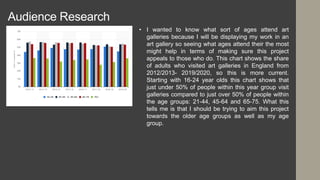
• I wanted to know what sort of ages attend art
galleries because I will be displaying my work in an
art gallery so seeing what ages attend their the most
might help in terms of making sure this project
appeals to those who do. This chart shows the share
of adults who visited art galleries in England from
2012/2013- 2019/2020, so this is more current.
Starting with 16-24 year olds this chart shows that
just under 50% of people within this year group visit
galleries compared to just over 50% of people within
the age groups: 21-44, 45-64 and 65-75. What this
tells me is that I should be trying to aim this project
towards the older age groups as well as my age
group.
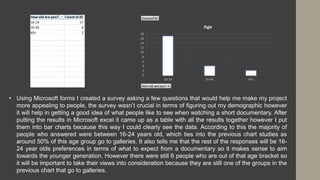
• Using Microsoft forms I created a survey asking a few questions that would help me make my project
more appealing to people, the survey wasn’t crucial in terms of figuring out my demographic however
it will help in getting a good idea of what people like to see when watching a short documentary. After
putting the results in Microsoft excel it came up as a table with all the results together however I put
them into bar charts because this way I could clearly see the data. According to this the majority of
people who answered were between 16-24 years old, which ties into the previous chart studies as
around 50% of this age group go to galleries. It also tells me that the rest of the responses will be 16-
24 year olds preferences in terms of what to expect from a documentary so it makes sense to aim
towards the younger generation. However there were still 6 people who are out of that age bracket so
it will be important to take their views into consideration because they are still one of the groups in the
previous chart that go to galleries.
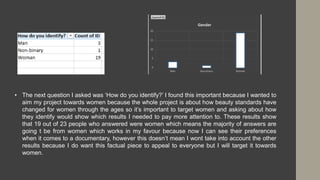
• The next question I asked was ‘How do you identify?’ I found this important because I wanted to
aim my project towards women because the whole project is about how beauty standards have
changed for women through the ages so it’s important to target women and asking about how
they identify would show which results I needed to pay more attention to. These results show
that 19 out of 23 people who answered were women which means the majority of answers are
going t be from women which works in my favour because now I can see their preferences
when it comes to a documentary, however this doesn’t mean I wont take into account the other
results because I do want this factual piece to appeal to everyone but I will target it towards
women.
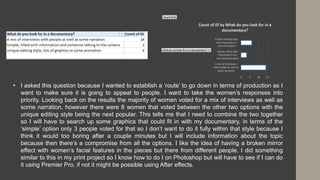
• I asked this question because I wanted to establish a ‘route’ to go down in terms of production as I
want to make sure it is going to appeal to people. I want to take the women’s responses into
priority. Looking back on the results the majority of women voted for a mix of interviews as well as
some narration, however there were 8 women that voted between the other two options with the
unique editing style being the next popular. This tells me that I need to combine the two together
so I will have to search up some graphics that could fit in with my documentary, in terms of the
‘simple’ option only 3 people voted for that so I don’t want to do it fully within that style because I
think it would too boring after a couple minutes but I will include information about the topic
because then there’s a compromise from all the options. I like the idea of having a broken mirror
effect with women’s facial features in the pieces but there from different people. I did something
similar to this in my print project so I know how to do I on Photoshop but will have to see if I can do
it using Premier Pro, if not it might be possible using After effects.
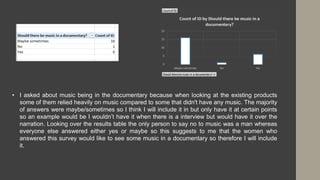
• I asked about music being in the documentary because when looking at the existing products
some of them relied heavily on music compared to some that didn't have any music. The majority
of answers were maybe/sometimes so I think I will include it in but only have it at certain points
so an example would be I wouldn’t have it when there is a interview but would have it over the
narration. Looking over the results table the only person to say no to music was a man whereas
everyone else answered either yes or maybe so this suggests to me that the women who
answered this survey would like to see some music in a documentary so therefore I will include
it.
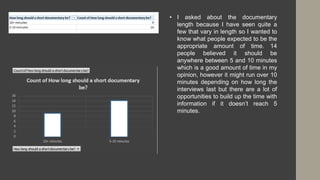
• I asked about the documentary
length because I have seen quite a
few that vary in length so I wanted to
know what people expected to be the
appropriate amount of time. 14
people believed it should be
anywhere between 5 and 10 minutes
which is a good amount of time in my
opinion, however it might run over 10
minutes depending on how long the
interviews last but there are a lot of
opportunities to build up the time with
information if it doesn’t reach 5
minutes.
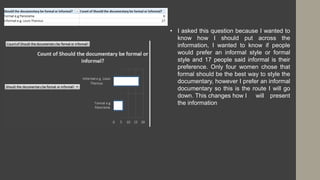
• I asked this question because I wanted to
know how I should put across the
information, I wanted to know if people
would prefer an informal style or formal
style and 17 people said informal is their
preference. Only four women chose that
formal should be the best way to style the
documentary, however I prefer an informal
documentary so this is the route I will go
down. This changes how I will present
the information
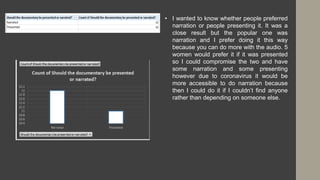
• I wanted to know whether people preferred
narration or people presenting it. It was a
close result but the popular one was
narration and I prefer doing it this way
because you can do more with the audio. 5
women would prefer it if it was presented
so I could compromise the two and have
some narration and some presenting
however due to coronavirus it would be
more accessible to do narration because
then I could do it if I couldn’t find anyone
rather than depending on someone else.
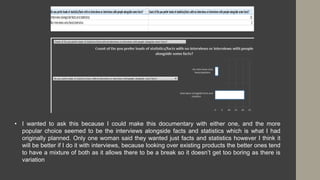
• I wanted to ask this because I could make this documentary with either one, and the more
popular choice seemed to be the interviews alongside facts and statistics which is what I had
originally planned. Only one woman said they wanted just facts and statistics however I think it
will be better if I do it with interviews, because looking over existing products the better ones tend
to have a mixture of both as it allows there to be a break so it doesn’t get too boring as there is
variation
Summary of Survey
• Looking back at the audience research I conducted I have a basic understanding of
what people are after and in particular women. I never referenced the ages of the
responses because I think it is important for my project not to have a target age
because I am looking at beauty standards and how they have changed throughout the
years so this could be interesting to younger viewers because they want to know how
things have changed but it could also attract older viewers because if they lived
through that time it could be nostalgic to watch as well as it would be interesting to see
how it compares to beauty standards now. I have found that women would like a
documentary between 5 and 10 minutes with music in but not heard all the time, as well
as having a mixture of interviews and statistics. The majority would also like a
documentary that is narrated instead of presented which is what I wanted to do
because it’s more accessible due to COVID. I still want to establish a more specific
audience which is why I am going to look at the psychographics, demographics and
maybe geographics as well as interview a couple people because this way I can talk
back and forth to them to get an understanding of what they expect from a
documentary.
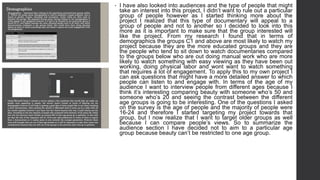
Demographics
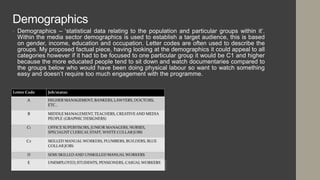
• Demographics – ‘statistical data relating to the population and particular groups within it’.
Within the media sector demographics is used to establish a target audience, this is based
on gender, income, education and occupation. Letter codes are often used to describe the
groups. My proposed factual piece, having looking at the demographics it could appeal to all
categories however if it had to be focused to one particular group it would be C1 and higher
because the more educated people tend to sit down and watch documentaries compared to
the groups below who would have been doing physical labour so want to watch something
easy and doesn’t require too much engagement with the programme.
Psychographics
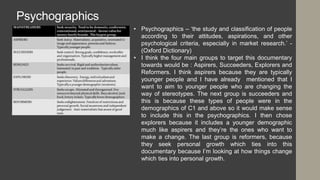
• Psychographics – ‘the study and classification of people
according to their attitudes, aspirations, and other
psychological criteria, especially in market research.’ -
(Oxford Dictionary)
• I think the four main groups to target this documentary
towards would be : Aspirers, Succeeders, Explorers and
Reformers. I think aspirers because they are typically
younger people and I have already mentioned that I
want to aim to younger people who are changing the
way of stereotypes. The next group is succeeders and
this is because these types of people were in the
demographics of C1 and above so it would make sense
to include this in the psychographics. I then chose
explorers because it includes a younger demographic
much like aspirers and they’re the ones who want to
make a change. The last group is reformers, because
they seek personal growth which ties into this
documentary because I’m looking at how things change
which ties into personal growth.
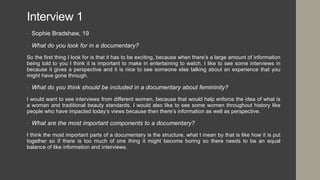
• Sophie Bradshaw, 19
• What do you look for in a documentary?
So the first thing I look for is that it has to be exciting, because when there’s a large amount of information
being told to you I think it is important to make in entertaining to watch. I like to see some interviews in
because it gives a perspective and it is nice to see someone else talking about an experience that you
might have gone through.
• What do you think should be included in a documentary about femininity?
I would want to see interviews from different women, because that would help enforce the idea of what is
a woman and traditional beauty standards. I would also like to see some women throughout history like
people who have impacted today’s views because then there’s information as well as perspective.
• What are the most important components to a documentary?
I think the most important parts of a documentary is the structure, what I mean by that is like how it is put
together so if there is too much of one thing it might become boring so there needs to be an equal
balance of like information and interviews.
Interview 1
Interview 2
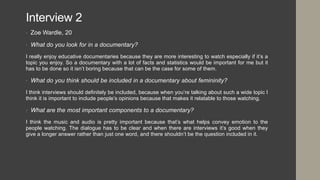
• Zoe Wardle, 20
• What do you look for in a documentary?
I really enjoy educative documentaries because they are more interesting to watch especially if it’s a
topic you enjoy. So a documentary with a lot of facts and statistics would be important for me but it
has to be done so it isn’t boring because that can be the case for some of them.
• What do you think should be included in a documentary about femininity?
I think interviews should definitely be included, because when you’re talking about such a wide topic I
think it is important to include people’s opinions because that makes it relatable to those watching.
• What are the most important components to a documentary?
I think the music and audio is pretty important because that’s what helps convey emotion to the
people watching. The dialogue has to be clear and when there are interviews it’s good when they
give a longer answer rather than just one word, and there shouldn’t be the question included in it.
Interview 3
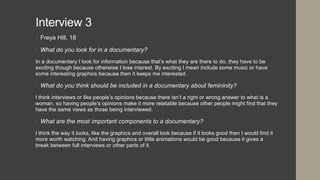
• Freya Hill, 18
• What do you look for in a documentary?
In a documentary I look for information because that’s what they are there to do, they have to be
exciting though because otherwise I lose interest. By exciting I mean include some music or have
some interesting graphics because then it keeps me interested.
• What do you think should be included in a documentary about femininity?
I think interviews or like people’s opinions because there isn’t a right or wrong answer to what is a
woman, so having people’s opinions make it more relatable because other people might find that they
have the same views as those being interviewed.
• What are the most important components to a documentary?
I think the way it looks, like the graphics and overall look because if it looks good then I would find it
more worth watching. And having graphics or little animations would be good because it gives a
break between full interviews or other parts of it.
Interview analysis
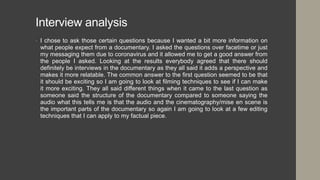
• I chose to ask those certain questions because I wanted a bit more information on
what people expect from a documentary. I asked the questions over facetime or just
my messaging them due to coronavirus and it allowed me to get a good answer from
the people I asked. Looking at the results everybody agreed that there should
definitely be interviews in the documentary as they all said it adds a perspective and
makes it more relatable. The common answer to the first question seemed to be that
it should be exciting so I am going to look at filming techniques to see if I can make
it more exciting. They all said different things when it came to the last question as
someone said the structure of the documentary compared to someone saying the
audio what this tells me is that the audio and the cinematography/mise en scene is
the important parts of the documentary so again I am going to look at a few editing
techniques that I can apply to my factual piece.
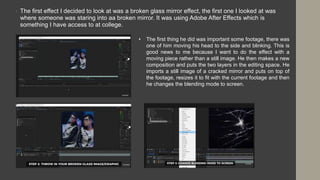
• The first effect I decided to look at was a broken glass mirror effect, the first one I looked at was
where someone was staring into aa broken mirror. It was using Adobe After Effects which is
something I have access to at college.
• The first thing he did was important some footage, there was
one of him moving his head to the side and blinking. This is
good news to me because I want to do the effect with a
moving piece rather than a still image. He then makes a new
composition and puts the two layers in the editing space. He
imports a still image of a cracked mirror and puts on top of
the footage, resizes it to fit with the current footage and then
he changes the blending mode to screen.
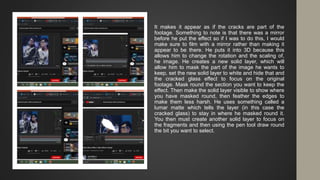
It makes it appear as if the cracks are part of the
footage. Something to note is that there was a mirror
before he put the effect so if I was to do this, I would
make sure to film with a mirror rather than making it
appear to be there. He puts it into 3D because this
allows him to change the rotation and the scaling of,
he image. He creates a new solid layer, which will
allow him to mask the part of the image he wants to
keep, set the new solid layer to white and hide that and
the cracked glass effect to focus on the original
footage. Mask round the section you want to keep the
effect. Then make the solid layer visible to show where
you have masked round, then feather the edges to
make them less harsh. He uses something called a
lumar matte which tells the layer (in this case the
cracked glass) to stay in where he masked round it.
You then must create another solid layer to focus on
the fragments and then using the pen tool draw round
the bit you want to select.
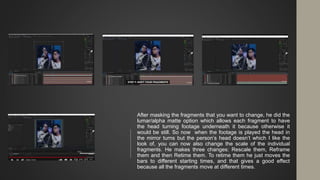
After masking the fragments that you want to change, he did the
lumar/alpha matte option which allows each fragment to have
the head turning footage underneath it because otherwise it
would be still. So now when the footage is played the head in
the mirror turns but the person’s head doesn’t which I like the
look of, you can now also change the scale of the individual
fragments. He makes three changes: Rescale them, Reframe
them and then Retime them. To retime them he just moves the
bars to different starting times, and that gives a good effect
because all the fragments move at different times.
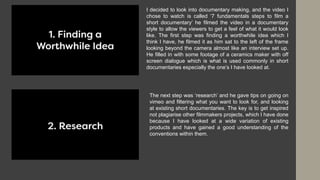
I decided to look into documentary making, and the video I
chose to watch is called ‘7 fundamentals steps to film a
short documentary’ he filmed the video in a documentary
style to allow the viewers to get a feel of what it would look
like. The first step was finding a worthwhile idea which I
think I have, he filmed it as him sat to the left of the frame
looking beyond the camera almost like an interview set up.
He filled in with some footage of a ceramics maker with off
screen dialogue which is what is used commonly in short
documentaries especially the one’s I have looked at.
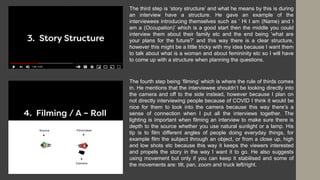
The next step was ‘research’ and he gave tips on going on
vimeo and filtering what you want to look for, and looking
at existing short documentaries. The key is to get inspired
not plagiarise other filmmakers projects, which I have done
because I have looked at a wide variation of existing
products and have gained a good understanding of the
conventions within them.
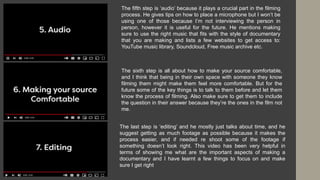
The third step is ‘story structure’ and what he means by this is during
an interview have a structure. He gave an example of the
interviewees introducing themselves such as ‘ Hi I am (Name) and I
am a (Occupation)’ which is a good start then the middle you could
interview them about their family etc and the end being ‘what are
your plans for the future?’ and this way there is a clear structure,
however this might be a little tricky with my idea because I want them
to talk about what is a woman and about femininity etc so I will have
to come up with a structure when planning the questions.
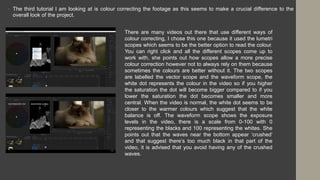
The fourth step being ‘filming’ which is where the rule of thirds comes
in. He mentions that the interviewee shouldn’t be looking directly into
the camera and off to the side instead, however because I plan on
not directly interviewing people because of COVID I think it would be
nice for them to look into the camera because this way there’s a
sense of connection when I put all the interviews together. The
lighting is important when filming an interview to make sure there is
depth to the source whether you use natural sunlight or a lamp. His
tip is to film different angles of people doing everyday things, for
example film the subject through an object, or from a close up, high
and low shots etc because this way it keeps the viewers interested
and propels the story in the way I want it to go. He also suggests
using movement but only if you can keep it stabilised and some of
the movements are: tilt, pan, zoom and truck left/right.
The fifth step is ‘audio’ because it plays a crucial part in the filming
process. He gives tips on how to place a microphone but I won’t be
using one of those because I’m not interviewing the person in
person, however it is useful for the future. He mentions making
sure to use the right music that fits with the style of documentary
that you are making and lists a few websites to get access to:
YouTube music library, Soundcloud, Free music archive etc.
The sixth step is all about how to make your source comfortable,
and I think that being in their own space with someone they know
filming them might make them feel more comfortable. But for the
future some of the key things is to talk to them before and let them
know the process of filming. Also make sure to get them to include
the question in their answer because they’re the ones in the film not
me.
The last step is ‘editing’ and he mostly just talks about time, and he
suggest getting as much footage as possible because it makes the
process easier, and if needed re shoot some of the footage if
something doesn’t look right. This video has been very helpful in
terms of showing me what are the important aspects of making a
documentary and I have learnt a few things to focus on and make
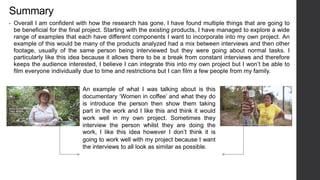
sure I get right
• The third tutorial I am looking at is colour correcting the footage as this seems to make a crucial difference to the
overall look of the project.
There are many videos out there that use different ways of
colour correcting, I chose this one because it used the lumetri
scopes which seems to be the better option to read the colour.
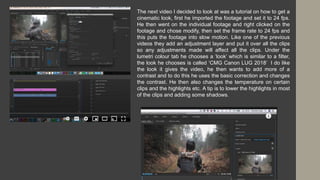
You can right click and all the different scopes come up to
work with, she points out how scopes allow a more precise
colour correction however not to always rely on them because
sometimes the colours are better without it. The two scopes
are labelled the vector scope and the waveform scope, the
white dot represents the colour in the video so if you higher
the saturation the dot will become bigger compared to if you
lower the saturation the dot becomes smaller and more
central. When the video is normal, the white dot seems to be
closer to the warmer colours which suggest that the white
balance is off. The waveform scope shows the exposure
levels in the video, there is a scale from 0-100 with 0
representing the blacks and 100 representing the whites. She
points out that the waves near the bottom appear ‘crushed’
and that suggest there’s too much black in that part of the
video, it is advised that you avoid having any of the crushed
waves.
She goes to another part of the video and the top of the
waveforms are flat which suggests there is a lot of detail lost in
the highlights. You can fix this when you go through the exposure
levels. She went back to the previous part where the white
balance is off, and suggests we can use the eyedropper tool to
correct it however it can’t always be trusted so she takes us
through the manual process. Firstly because the video looked too
warm she dragged the temperature towards the blue side, part of
the dot will start to move towards the middle and this is the part
that’s along the blue line and it needs to be in the middle as
much as possible without making the video blue, you do this with
the tint as well. When altering the shadows and the exposure etc
keep and eye of the waveform scope and try to remove any of
the crushed waves. Overall this tutorial was very useful because
it was basic colour correcting that I can use for my project.
I decided to watch another colour grading video, because this way I
have a good understanding with what to do. The first thing he did
was open the lumetri colour scopes, but this one has three scopes
instead of only two which the previous video had. There are three
words when colour grading: Hue which is the colour, Saturation
which is the intensity/vividness of a hue and then Luma which is the
brightness or shade of hue. The waveform scope helps correct
exposure, the RGB parade scope is helpful for correcting white
balance issues and then the vector scope corresponds with the
colour wheel. The first thing you do is correct the exposure of the
video, then you correct the white balance if there are any issues
and then lastly the saturation by either increasing or reducing it. In
this video he uses the basic correction panel to fix the exposure,
and the black control, controls the bottom or the darkest part on the
lumetri scope and the white controls the brightness or the very top
of the video.
The shadows control the area between the black and the white, it is
used if you want to change the shadows that are already seen. The
highlights is used near the top of the scope to reduce or create new
highlights within the video. When changing the blacks control it wants
to sit above 0 on the scope meanwhile with the whites it needs to sit
between 90 and 100 at the top. Using the RGB scope you can see
that the blue trace is elevated above the red and the green giving the
video a cooler tone. Unlike the other video this tutorial uses the white
balance eyedropper tool and what you do is just put it on something
in the frame that is white and it aligns the traces on the scopes. He
then changes it a little manually to get the best result as well as
changing the saturation a little. You can copy and paste the attributes
to other clips and then compare them to see if they match, it also
comes up in the scopes so they are side by side and if they don’t
match you can change it. Using the HSL secondary control you can
select certain parts that don’t loom like the rest.
Using the lumetri colour effect, you can mask a certain section. In
this case the person’s face was too dark compared to the rest of
the video. He feathers the mask a little so it isn’t too obvious then
he changes the shadows and the highlights. He uses the
teal/orange look because it makes it look better, go to the project
panel, right click and select adjustment layer from the drop down
menu then drag the adjustment layer over the rest of the clips so
any adjustments will be the same throughout. After selecting the
adjustment layer skip the basic correction and go to the curves
option, the bottom of the line is the shadows and the top is the
highlight. To get the teal in without altering the skin tone select the
HSL secondary panel and select the person’s face then invert it,
and then using the colour wheel introduce teal and it doesn’t
affect the person. To fix the shadows get another lumetri effect
and go down to the luma set curve then drag the bottom part to
the bottom of the square.
The next video I decided to look at was a tutorial on how to get a
cinematic look, first he imported the footage and set it to 24 fps.
He then went on the individual footage and right clicked on the
footage and chose modify, then set the frame rate to 24 fps and
this puts the footage into slow motion. Like one of the previous
videos they add an adjustment layer and put it over all the clips
so any adjustments made will affect all the clips. Under the
lumetri colour tab he chooses a ‘look’ which is similar to a filter,
the look he chooses is called ‘CMG Canon LUG 2018’ I do like
the look it gives the video, he then wants to add more of a
contrast and to do this he uses the basic correction and changes
the contrast. He then also changes the temperature on certain
clips and the highlights etc. A tip is to lower the highlights in most
of the clips and adding some shadows.
He uses PNG black box images to overlay on the video, which
I think works quite nicely however I might make them a bit
narrower but I think this will be something to add into my
project. He then goes onto alter the music, but he talks about
something called ‘film grain’ which you type into google and
copy and paste over all the clips, if it needs to be rescaled
then right click and chose scale to frame and then right click
again and nest it. Once the film grain is over the clips in effect
controls change the blend mode to overlay.
Summary of tutorials
• I have looked at 5 tutorials all together and each one has been very useful for when it
comes to make my project, I have looked at the broken glass effect which is something I
want to try and incorporate into my project at the end with the title or at the beginning, I
have also looked at 7 steps to creating a documentary which touched up on the
interviews which is something I am going to be doing in my project even though I’m not
going to be in person interviewing them. The two colour grading videos have been very
useful because now I have a good understanding of how to use the different scopes and
what to do to make it look good, and then the final video about the cinematic techniques
is useful because outside of the interviews I plan on doing different shots like someone
walking and keeping it simple, but by doing this I want to make sure it looks a good
quality because then the simple idea works. I think I have looked at the tutorials that will
be most beneficial and I think I have everything covered but if I think of a new one I can
always include it in the planning.
Script - Beauty standards in the
19th and 20th Century
1.“Youth.
2.Stature, neither too high nor two low.
3.Neither too fat nor too lean
4.Long hair, or prettily curled, fine and silky soft.
5.The skin smooth, delicate, and of a fine grain.
6.Lively white and red.
7.A smooth high forehead.
8.The temples not sunk in.
9.The eye-brows in arcade, like two lines.
10.The eyes blue, their orbits well-fashioned
11.The nose rather long than short.
12.The cheeks rounding away in softened profils, and dimpled.
13.An agreeable smile.
14.A small mouth.
15.Teeth, white, even and well set.
16.The chin rather round, plump, and ending with a dimple.
17.The ears small, and close to the head.
18.An agreeable voice.
19.A modest gait”
1. “1900’s - Cinched waists were accentuated by ruffled blouses for
ladies and their long hair was kept upswept as in previous
generations. Big hairstyles were also in style, leading some
women to use false hair to add volume to their elaborate hairdos.
2. 1920’s - A new femininity was sweeping the modern world as
ladies donned short hairstyles, short skirts, and androgynous
styles. Straight lines were very en vogue for ladies and curves
were out, referencing the new-found freedom many women felt
after World War I.
3. 1940’s - In the ’40s menswear was popular for ladies, not only
because so many women were joining up, but also because
some women had to make due with men’s clothes cut down and
re-sewn into more feminine fashions. The “natural” look was in for
women, with thick eyebrows that contrasted with the thin brows
of the ’30s. Despite the natural beauty image, face powder and
lipstick were essential to the concept of ’40s beauty. Stars like
Rita Hayworth and Veronica Lake made longer hair more
popular.
4. 1960’s - Androgynous looks were fashionable at the start of the
’60s. Young ladies embraced short hair and simple lines. At the
same time bouffant hairstyles were also making waves with
ladies. Pixie cuts like those on Twiggy and Goldie Hawn sparked
a trend for very short hair.
5. 1980’s - Big hair, bold makeup, and big shoulder pads defined
the decade of excess. Aerobics wear and fit bodies were
frequently featured in print, TV, and in films. The rise of
supermodels like Naomi Campbell and Cindy Crawford further
defined what we saw as beautiful..”
Summary
• Overall I am confident with how the research has gone, I have found multiple things that are going to
be beneficial for the final project. Starting with the existing products, I have managed to explore a wide
range of examples that each have different components I want to incorporate into my own project. An
example of this would be many of the products analyzed had a mix between interviews and then other
footage, usually of the same person being interviewed but they were going about normal tasks. I
particularly like this idea because it allows there to be a break from constant interviews and therefore
keeps the audience interested, I believe I can integrate this into my own project but I won’t be able to
film everyone individually due to time and restrictions but I can film a few people from my family.
An example of what I was talking about is this
documentary ‘Women in coffee’ and what they do
is introduce the person then show them taking
part in the work and I like this and think it would
work well in my own project. Sometimes they
interview the person whilst they are doing the
work, I like this idea however I don’t think it is
going to work well with my project because I want
the interviews to all look as similar as possible.
• I have also looked into audiences and the type of people that might
take an interest into this project, I didn’t want to rule out a particular
group of people however as I started thinking more about the
project I realized that this type of documentary will appeal to a
group of people and not to another so I decided to look into this
more as it is important to make sure that the group interested will
like the project. From my research I found that in terms of
demographics the groups C1 and above are most likely to watch my
project because they are the more educated groups and they are
the people who tend to sit down to watch documentaries compared
to the groups below who are out doing manual work who are more
likely to watch something with easy viewing as they have been out
working, doing physical labor and wont want to watch something
that requires a lot of engagement. To apply this to my own project I
can ask questions that might have a more detailed answer to which
people can listen to and engage with. In terms of the age of my
audience I want to interview people from different ages because I
think it’s interesting comparing beauty with someone who’s 50 and
someone who’s 20 and seeing the contrast between the different
age groups is going to be interesting. One of the questions I asked
on the survey is the age of people and the majority of people were
16-24 and therefore I started targeting my project towards that
group, but I now realize that I want to target older groups as well
because I can compare people’s views. So to summarize the
audience section I have decided not to aim to a particular age
group because beauty can’t be restricted to one age group.
• I looked at a few different effects that I thought might be helpful
in my project, I particularly like the broken mirror effect because
I think this can be interpreted differently by viewers. I think it will
make a good introduction with the title fading in over it, I don’t
want to do the exact same as the example discussed but
something similar. The next thing I looked at was the color
grading because this is something that I have always struggled
with when it comes to previous projects so I thought it would be
beneficial to have a look at a few tutorials. I think it might not be
too relevant to my project because I have asked people to film
against a plain background, although I want to film some other
footage which might need color correcting. Overall I think the
tutorials have been a beneficial insight into the post production
stage and I have gained a better understanding of what I could
do and how to execute it.
• I am happy with how the research has gone, I think I have
covered what I need to know for the next stages of my project.
The next stage is problem solving and I feel confident that I
know the direction of this project and as a result I can address
any issues moving forward. The tutorials have highlighted a key
problem that I can include in the problem solving section, and
this is going to be the software issue especially if the
restrictions don’t change in time for production.
Bibliography
 ‘Christianity’ (1998) Louis Theroux’s Weird Weekends, Series 1, Episode 1. BBC2, 15th January.
 ANON. (N/A). Demographic table. Available: https://jessicataylormedia.files.wordpress.com/2015/09/demographics-and-
psychographics-3-638.jpg. Last accessed 24th January 2021.
 ANON. (N/A). Grayson Perry. Available: https://en.wikipedia.org/wiki/Grayson_Perry. Last accessed 14th January 2021.
 ANON. (N/A). Melanie (The Three Graces). Available: https://www.artfund.org/supporting-museums/art-weve-helped-
buy/artwork/13092/melanie-the-three-graces Last accessed 15th January 2021.
 ANON. (N/A). Psychographic table. Available:
https://www.bing.com/images/search?view=detailV2&ccid=CHRBN7FF&id=5872347FDCBD5F2CC99308490B68C2D81F68907
B&thid=OIP.CHRBN7FFtqHxbUk3WccJKAHaFj&mediaurl=https%3a%2f%2f2239erskineemily.files.wordpress.c. Last accessed
24th January 2021.
 BBC Bitesize. (N/A). Target Audience. Available:
https://www.bbc.co.uk/bitesize/guides/zy24p39/revision/1#:~:text=A%20demographic%20audience%20profile%20defines%20gr
oups%20based%20on,codes%20are%20often%20used%20to%20describe%20the%20groups%3A. Last accessed 24th
January 2021.
 BBFC. (N/A). 15 – Suitable only for 15 years and over. Available: https://www.bbfc.co.uk/rating/15. Last accessed 14th January 2021.
 Bradshaw, Sophie. (2021) Research Interview (Conducted 25/01/2021)
 Cervants, J. (2017). 7 Fundamental Steps to Film a Short Documentary. Available: https://www.youtube.com/watch?v=XN8dIQ6vptc. Last
accessed 26th January 2021.
 Christian Maté Grab. (2018). How to get the CINEMATIC LOOK in Premiere Pro Tutorial. Available:
https://www.youtube.com/watch?v=xQJfFLJufYw. Last accessed 27th January 2021.
 Cinematic productions. (2016). The Silent Witness - A short poetic documentary || Cinematics - NIT Rourkela. Available:
https://www.youtube.com/watch?v=4zjZoDOFTAo. Last accessed 21st January 2021.
 Color grading central. (2019). Color Grading in Premiere Pro CC - Get Pro Film Look. Available:
https://www.youtube.com/watch?v=RvFCnVRcT3Q. Last accessed 26th January 2021.
 Equal Exchange. (2016). Women in coffee. Available: https://vimeo.com/165150528 Last accessed 16th January 2021.
 Heichelbech, R. (N/A). These 20th Century Beauty Standards Were Once Considered The Ideal. Available: https://liveplayeat.com/beauty-
ideals-20th-century/5/. Last accessed 28th January 2021.
 Hill, Freya. (2021) Research Interview (Conducted 25/01/2021)
 Leigh, J. (2012). Time - A poetic docuemntary. Available: https://www.youtube.com/watch?v=JSSqa9RD3mw. Last accessed 21st January 2021.
 Lila. (2019). How To Color Correct Like A PRO! | Learn Premiere Pro 2020 in 10 minutes. Available:
https://www.youtube.com/watch?v=PaYUbnjw8sU. Last accessed 26th January 2021.
 MasterClass. (2020). Guide to Participatory Mode: 3 Participatory Documentaries. Available: https://www.masterclass.com/articles/guide-to-
participatory-documentaries#what-is-participatory-documentary. Last accessed 19th January 2021.
 MasterClass. (2021). Film 101: Understanding Reflexive Documentary Mode. Available: https://www.masterclass.com/articles/understanding-
reflexive-documentary-mode#what-is-reflexive-documentary. Last accessed 19th January 2021.
 Movie Clips Trailers. (2015). The Danish Girl. Available: https://www.youtube.com/watch?v=d88APYIGkjk. Last accessed 14th January 2021.
 Murad, D. (2017). The Trail of Happiness | A Poetic Documentary. Available: https://www.youtube.com/watch?v=kDJ5MWCU31M. Last accessed
21st January 2021.
 Nguyen, C. (N/A). No crying at the dinner table. Available: https://www.shortoftheweek.com/2020/12/23/no-crying-dinner-
table/https://www.shortoftheweek.com/2020/12/23/no-crying-dinner-table/. Last accessed 19th January 2021.
 Noronha, S. (2014). "What is BEAUTY?"- Interviews. Available:
https://www.youtube.com/watch?fbclid=IwAR2anHeQFAYMjLxXT7I4A2iLjtRWSzRyctQhfi8ywubIsfTQkhWiconvang&v=1x-
N7hTlJO0&feature=youtu.be. Last accessed 23rd February 2021.
 Olufemii, J. (2020). Broken Mirror Effect | After Effects Tutorial. Available: https://www.youtube.com/watch?v=sb-t3plEaf8. Last accessed 26th
January 2021.
 Stoll, J. (2021). Most popular movie genres among adults in the United States as of December 2018, by age group. Available:
https://www.statista.com/statistics/949810/favorite-movie-genres-in-the-us-by-age/. Last accessed 14th January 2021.
 Tall Story Films. (2014). A Place Like This (Documentary Short Film). Available: https://www.youtube.com/watch?v=A_WzVVndUCY Last accessed
21st January 2021.
 Walton, G. (2014). Ideas of Female Beauty in the 1700 and 1800s. Available: https://www.geriwalton.com/ideas-of-female-beauty-in-1700-and-
1800s/. Last accessed 28th January 2021.
 Wardle, Zoe. (2021) Research Interview (Conducted 25/01/2021)
This research has helped me gain a better understanding of what I am making and how I want to make
it, I now have a clear vision of how I want to proceed with this project as every little bit I researched has
helped me move forward onto the problem solving stage.

4. research!

  • 1.
  • 2.
    • After havinga meeting with someone from the art gallery and my tutor as well as a couple other students I have discussed my idea and decided to do a short documentary style video where I interview different women and they answer the questions I ask them. Due to coronavirus I have an idea where I get them people to ‘interview’ themselves and they film themselves answering the questions. I would give them a set of instructions such as film against a plain background because this way it would allow it to look similar and therefore a more polished look. I want to go down the contemporary/ experimental route so I will have to look at some examples to get a good idea of how I am to make it. I like the idea of starting it with me setting up an interview so a behind the scenes type of thing because it makes it feel as if you’re watching a process and I think it makes it more inclusive. I like the idea of doing a talking heads type of thing so where the narrator talks directly to the camera usually shot from the shoulders up. I like this idea however it does have the risk of being boring so that’s why I want to include interviews to break up the narration. I came up with the idea of having different parts of women’s faces in a mirror but the mirror is broken and cracked so I will have to search for a tutorial on how to do this..
  • 3.
    • “Participatory documentariesshare many unifying characteristics that typically focus on the director's role in the film: 1. The filmmaker is a character. In a participatory documentary, the filmmaker must either be seen or heard at some point in the movie, giving them a presence that is often as important as the primary subject. 2. The interviewer’s questions are included in the edit. In other documentary genres, subjects answer interview questions, but the questions themselves are edited out. In the participatory mode, the audience is allowed to see or hear the filmmaker asking the questions. This establishes a clearer relationship between the filmmaker and the interview subject, while also giving the viewer a more "behind the scenes" look at how the filmmaker elicited the subject's responses. 3. The viewer is aligned with the filmmaker. The audience experiences the film through the filmmaker's point of view, allowing them to intuit how the filmmaker felt in the moment and consider how they might have reacted in the same situation.”
  • 4.
    • “The expositorymode of documentary filmmaking has a few distinct characteristics, such as: 1. Omniscient voice-over. One characteristic of expository documentaries is the “voice of God” narration. This authoritative voice accompanies the documentary’s images, defining the visuals for the audience, and explaining rhetorical content to help make the film’s case. The voice-over conveys information and does not provide personal accounts or subjective experiences to share a narrative. 2. A “right” answer. Expository documentaries don’t leave much to subjectivity— they want the audience to feel a certain way about the content they are seeing. Rhetorical questions, recounts of history, and interviews are often presented to support the film’s claims, along with any other relevant evidence. 3. Evidentiary editing. While visuals in the poetic mode documentaries are meant for emotional or artistic purposes, expository filmmakers use images as a means to support their claims. Images on-screen are explained or supported by captions or commentary. This kind of editing style is also used for news broadcasts.”
  • 5.
    • “The reflexivedocumentary mode focuses on the relationship between the filmmaker and the audience, pushing viewers to reflect on their perceptions and re-analyze their notions of truth. Unlike the expository documentary, the reflexive mode does not examine outside subject matter to which it exposes the documentary-making process. • The reflexive documentary does not attempt to provoke intense emotional responses from the audience but encourages thoughtful consideration of the material. Since the subject matter is often the process of documentary filmmaking itself, a cinematographer will shoot behind the scene style footage of the entire film production process, including editing, interviewing, and post-production. • The reflexive documentary mode is similar to the participatory documentary in that they both show involvement of the filmmaker, and usually make the cameraman and camera part of the film. The reflexive documentary mode presents questions and approaches topics with uncertainty, presenting a version of truth within a non-fiction format. • Reflexive documentaries will often show the camera or production crew to call attention to the conventions of filmmaking, and present self-awareness to eliminate biases about the film’s content or agenda.”
  • 6.
    • Perry isan English contemporary artist, writer and broadcaster. He is known for his ceramic vases, tapestries and cross dressing, as well as his observations of the contemporary arts scene, and for dissecting British "prejudices, fashions and foibles.” Perry's vases have classical forms and are decorated in bright colours, depicting subjects at odds with their attractive appearance. There is a strong autobiographical element in his work, in which images of Perry as “Claire”, his female alter-ego, and "Alan Measles", his childhood teddy bear, often appear, so this will be something to consider when finalising my idea. • Contemporary - Contemporary art means modern art done after Pop art and Conceptual art. Another term, which really means the same thing, is postmodern art. Yet another term, which goes wider than art, is Postmodernism. If I was to interpret the meaning of contemporary into a film term I would say I like the idea of doing an experimental type of film however I will have to look into existing products that do experimental documentaries. • “Born into a working-class family, Perry was four years old when his father, Tom, left home after discovering his mother, Jean, was having an affair with a milkman, whom she later married and who Perry has claimed was violent. Subsequently, he spent an unhappy childhood moving between his parents and created a fantasy world based around his teddy in order to cope with his sense of anxiety. He considers that a person’s early experiences are important in shaping their aesthetic and sexuality.” • My main inspiration for this project is his art piece ‘Melanie’ this ceramic piece echoes “fertility figures dating back more than 25,000 years. By referencing these prehistoric celebrations of the female body, Perry’s portrait becomes a positive image of an oversized woman. Added to this, Perry’s title of The Three Graces is a reference to a long history of representations of idealised beauty, such as Antonio Canova’s famous sculpture (1814-17) of the same name. Layered on to the figure of Melanie are painted and printed images of women, from supermodels to the Madonna, which show the shifting view of what constitutes female perfection.” I want to look at women through the ages because this way it makes it more relevant to the piece Melanie because there are fertility figures dating back centuries ago so I can look at women through the ages which also ties into my interview idea. Grayson Perry
  • 7.
    Existing Product 1– The Danish Girl I have recently said that I am going to do a short film, however I have now been thinking I might do a factual piece because it gives the opportunity to tie it into the artwork, and I like the idea of creating a factual piece because I can focus on the important parts to keep the audience’s attention. The first trailer I decided to look at is ‘The Danish Girl’ directed by Tom Hooper, I decided to look at this because it tells the story of a transgender woman and therefore explores the theme identity which is something Perry explores in his artwork. This is based on a true story of Lili Elbe who was one of the first transgender women to have reassignment surgery, however she died due to surgery complications in 1930. It opens with a medium close up of Gerda, whilst her husband is talking in the background saying how they first met. Then the audio matches up with the visuals on screen and we see Einar continuing his conversation. At first glance the colours begin with a warm tone to them and both the character’s look happy and this is reflected in the choice of colours.
  • 8.
    The off screendialogue of Gerda saying how mysterious and charming her husband was makes us as an audience already question what he’s hiding. There is use of a medium long shot from the side with us watching Einar paint, my interpretation of the use of this shot is it gives the impression that we’re on the outside and we don’t fully understand the character yet. The ‘mood’ of the scene suddenly changes and this is shown through the change in lighting, it has gone from warm yellowish tones to dark blue which gives off a cold impression. The non diegetic dialogue matches up with the screen to become diegetic, Gerda is talking to her husband asking if he has anything to say to her. Automatically in my opinion I know what there is a secret between the two of them and this is why the mood changes which is reflected in the lighting. We then see someone drawing a picture of a woman, however we don’t see who is drawing the picture of the woman, this emphasises the suggestion that there is a secret between the two because the artist is kept secret to us, it also links with the previous image shown due to the same type of lighting which links the two ideas together.
  • 9.
    The next scenethat we’re shown is where Gerda is asking Einar to help her with something. The use of a long shot is used to create a distance between the audience and the character’s which emphasises my earlier idea of we are on the outside as we don’t fully understand what is going on yet. The lighting is a little low key there isn’t any warming colours like at the beginning but it’s neutral which fits into the colour scheme within this scene as there seems to be a lot of neutral colours such as beige and cream. These colours have many symbols, in my opinion for this scene they are symbolizing dullness and boredom which could suggest one or both of the character's are feeling stuck The use of a close up allows us as the audience to feel closer to the character, at this point Einar is holding the dress up against him which could symbolise how he’s opening up to us, and it also creates a private moment between the audience and the character and therefore creates a ‘relationship’ that we are now invested in.
  • 10.
    There is amontage sequence of Gerda picking out dresses and applying make up to Lili and it appears as if it’s just a bit of fun to her, Through the montage the lighting was dark with a blueish colour to it, the dark blue colour is often associated with stability and confidence which could reflect how Lili is now feeling as she feels more confident as a woman than as a man. The use of off screen dialogue alongside the montage is something I like in a trailer as it helps drive the narrative along as it makes it feel as if some time has passed. When Lili is on screen there are many more close up shots, which suggest that us as the audience are now understanding the character, whereas before we were watching from the outside but now it feels like we are there in the scene. Gerda catches Lili and another man kissing, and at this point I think she realises it’s not just Einar dressing up and the mood suddenly changes as the non diegetic music changes tone, as it had been constant in the background throughout the trailer but it then changes to resemble the change in the mood.
  • 11.
    The non diegeticsombre music sets the scene and the shot reverse shot between Gerda and Einar portray an important conversation where Einar is saying he wasn’t himself and he was Lili where Gerda responds with ‘Lili doesn’t exist’ This medium long shot is probably my favourite shot throughout the trailer because we see Lili for who she is as it suddenly isn’t a game anymore. We see Lili in the ballet room looking uncomfortable and the use of the close up emphasises this because it allows us to connect with the character. The use of the warm lighting suggests that she’s comfortable with it but doesn’t know how everyone else is going to be. This is emphasised by the off screen dialogue of Gerda saying ‘he’s lost his way and needs a friend’. There is another montage of Lili becoming more of who she is but there are people who laugh at her.
  • 12.
    Towards the endof the trailer we start to see Gerda become more comfortable with Lili, and we also see them both talking to a surgeon and there’s a montage of clips where we see Lili walking down the street, what I like particularly about the end sequence is that the off screen dialogue of Lili talking about how she still loves Gerda works really nicely with the inspirational sounding music and creates a feeling of achievement by the end of the film. My overall impression from this trailer is that I like it, I think it does a good job of covering an important issue in today’s society. I chose to watch this trailer because I wanted to look at how the director’s used different lighting at different parts of the trailer, as well as looking at the music and what I found is that this trailer uses the music to heighten the emotion an example is when Gerda asks Einar about the night he kissed someone else as Lili there is a low tone sombre background music that fades into the dialogue, which makes it subtle and I think that’s effective in terms of creating an emotional response from the audience. This is relative to my project because it is based on a true story and shows how transgender women were treated back then and how the surgery had never been done before but she still took the risk.
  • 13.
    Audience Appeal • Theage rating for this film is a 15 on the ‘British Board of Film Classification’ an age rating of 15 could include Dangerous behaviour for example, suicide, self-harming and it should not dwell on detail which could be copied. Whether the depiction of easily accessible weapons is acceptable will depend on factors such as realism, context and setting. The work as a whole must not endorse discriminatory language or behaviour, although there may be racist, homophobic or other discriminatory themes and language. Drug taking may be shown but the work as a whole must not promote or encourage drug misuse for example, through detailed instruction. The misuse of easily accessible and highly dangerous substances for example, aerosols or solvents is unlikely to be acceptable. There may be strong language as well as very strong language may be permitted, depending on the manner in which it is used, who is using the language, its frequency within the work as a whole and any special contextual justification. Statistics taken from a research study (Stoll 2021) show that in 2018 63% of young adults enjoyed a romance film which is what ‘The Danish Girl’ genre is so I think the age rating is correct for the type of film it is. It also applies to the younger generation because it covers the topic of identity and in particular gender dysphoria within a transgender woman which are current issues in today’s society as there are still people out there who don’t agree with it, and therefore it’s relevant for quite a few age groups as it can educate individuals who may not fully understand the topic.
  • 14.
    Existing Product 2– Women in coffee After looking at a film trailer I thought it would be beneficial to look at a short documentary, this short documentary ran for around 12 minutes which is longer than what I want to do however the concept was similar. It looked at the coffee industry and the women behind it, it opened with a birds eye view shot of someone making coffee, and the non diegetic music was quiet but impactful as it sounded like it was building up to something. It opened with a short sequence of the coffee making process, such as farming then roasting then serving the coffee and what I liked about this is that it gave an insight into what the documentary was about and therefore acted as a good introduction.
  • 15.
    What I noticedwas that there were time when it was just writing against a black screen and in my opinion this was impactful because white against black stands out more, it then went onto a different shot of someone making coffee then cut back to writing to create a sentence. There was a little touch which I liked and that was when there were little drawings of the process, and when it came to that stage the little icon would get bigger. Little details like this I think add quality to the overall video if done well and as I plan on doing a timeline I could do something similar but with dates and years. The first stage was the ‘farmer’ and there were a variety of shots such as a tracking shot or a close up, and what I like about this is it adds a variation to the film as well as making it more inclusive especially with tracking shots because it feels as if we are there with them.
  • 16.
    It broke upthe shots by cutting to an interview, I like this idea of having different shots and then cutting to interviews, because I think it makes it more entertaining as it also educates the viewer because we get a personal insight into the business. I like how this interview is framed where the woman is directly in the middle of the screen where as usual interviews have the participant either to the left or the right looking past the camera, but by having the central placing of the woman within the frame is not only aesthetically pleasing but also focuses the viewers attention to what the woman is saying. In terms of the audio there is a mix of off screen dialogue and on screen dialogue. When there isn’t an interview taking place it seems to be the audio is off screen with no music, the dialogue then seems to match up with the visuals and again this is little detail but I think it makes the quality look better as it feels more continuous rather than a lot of sudden cuts. When there is no dialogue there is use of non diegetic sound and it tends to be quiet piano music but it’s kept in a high pitch, it creates a relaxing ambience which makes it easy to watch. There are a few moments that when there is dialogue there is background music which makes the video run smoother because there aren’t any really sudden cuts.
  • 17.
    Some of thetracking shots tend to be in slow motion, filmmakers often use slow motion to achieve a sense of suspense however I don’t think it’s used here in that way. I think it’s used to drive attention to the small details, and in this case it’s looking at the making of coffee and every step that takes place. It also gives the viewers a chance to sit back and think as people would take little things like coffee for granted without thinking of the hard work that goes on behind it. The little drawings then zoom in, I like this idea and I would use the parallax effect to do this through Adobe Photoshop and then use Adobe After Effects, this would be a good opportunity to show off my skills that I have on different platforms however I don’t know how I would incorporate this into my project but I think it would be a good touch.
  • 18.
    The next sectionis the buyers process, it starts with a shot of an aeroplane wing then goes into a tracking shot and what I like about this is that it feels like us as the viewers are on the journey with the woman which overall creates an inclusive feeling because this short documentary is about the coffee making process and the women behind it. Another small detail that I have noticed is that there tends to be shots where the footage is out of focus and then it goes into focus. This is usually something that people try and avoid when making a film because everything should be perfect however in my opinion I think it works well with the theme of the film. It also has the same affect as slow motion because it draws attention to the little details that go into coffee making.
  • 19.
    My overall impressionof this short documentary is that it’s simple but effective, it has informed me of women in the coffee making industry as well as being aesthetically pleasing to watch. There have been a few different techniques that I want to take and put them into my film for example I like the idea of having different cuts between relevant footage and interviews however due to coronavirus I wouldn’t be able to go out and film a lot but I would get a narrator to talk to the camera and cut between the narrator and the interviews. I also like the idea of the introduction where I use writing on the screen to introduce the topic and ending it similarly to how this one ended where it fades out and the title appears because this way there is a smooth transition between beginning and the end rather than it finishing abruptly. Even though I liked this documentary some of the techniques were repeated so the use of cutting between the interviews and the use of deep focus when interviewing, using the same techniques makes the video look a higher quality because it’s the same throughout however it might come across as boring so this will be something I have to try and avoid when making my project..
  • 20.
    Audience Appeal • Thisshort documentary appeals to the audience because it covers an important topic, however it keeps the documentary short and simple so therefore doesn’t become too boring. In particular it does this by cutting the piece into 5 stages so it feels more like it’s going somewhere. It covers the basic process of how coffee is made which is interesting in it’s own right but then it adds a current topic to it which is women in business so therefore it is targeting maybe a younger audience such as 16-24 where those current issues are arising. In terms of production techniques that keep the audience entertained is they cut between interviews and other shots so it keeps things moving and adds variation however in terms of editing there isn’t many transitions to keep the audience entertained so this will be something to look into other projects to see if there are any interesting transitions within documentaries or they leave it out for a reason.
  • 21.
    Existing Product 3– No crying at the dinner table This short documentary doesn’t cover the same topic as I am however it is made with a low budget and uses interviews. It’s about a family who were interviewed and then now they look back at their own interviews. My first impressions were that I was excited to watch it because the filmmaker interviewed her own family, it opens with a long shot of the three family members in a very low light so whether or not this is intentional. The audio was quite quiet at the beginning which shows they were working on a low budget so this is interesting to watch because I am also on a low budget so it will be interesting to see what others do and see how I can use it to structure mine. Much like the other videos I watched, I watched them all through once and then went back and analysed them. When I first watched it through it was interesting because I was watching a private part of their family and it was strange because I don’t know these people but as it went on I got a good idea of what sort of people they are like. It was a very simple documentary and the filmmaker interviewed her own family members and the conversation was about the death of their grandparents and their uncle who committed suicide.
  • 22.
    After the openingshot of the three family members sat around it cuts to a shallow focus shot of the radio, this radio was also seen in the first shot when they were told they will be listening back to their interviews so there’s a sense of continuity. In this shot we are taken back to the time to when the interviews were conducted. If I compare this to the previous documentary their structure are quite similar because they both cut between interviews and other activities so this is something to consider when doing my project just show everyday tasks like walking or cooking etc. because this way it’s more relatable to the audience The next shot is of the mother preparing some vegetables, again another simple everyday task but it just establishes the type of person they are. In particular the audio in this shot is very clear and crisp so whether or not they filmed it like that with a good microphone or used foley sounds it made the scene more real because these little sounds like a wrapper were really crisp and clear The next few shots are of the mother preparing some fish, again the sounds are really clear and crisp which add a good quality to the overall film, the lighting has kept its theme of being low light this may be to reflect the mood/ theme of this short documentary which is death. The use of an over the shoulder shot slightly makes us feel as if we are on the outside looking in and we are being given an insight into this family.
  • 23.
    The dialogue opensthe next shot asking if the participant is ready to which she responds with yes. The shot for this scene started with a medium close up with the traditional interview style where the interview is sat either to the right or the left and they look either to the left or the right of the camera, however it changed to the medium shot of the interview in the centre. This is similar to how the previous documentary was filmed in which the participants were central and therefore it pulls the viewers attention the person in the centre so we listen to them more. The interview cuts between the medium shot to the close ups, when the interview finishes there’s a silence with the close up. This is because they were talking about the death of one of their parents and the silence makes the audience think because there’s no sounds distracting us. It also feels respectful to those who have passed to be silent for a minute. Again the lighting is low key with some shadows being casted on her face, this could be done for a reason to relate to the overall feel of the film or it could be because they were working on a low budget and didn’t have professional lights, either way I think it works for the piece. The scenes then cut to the next interview with the sister, what I like about this is that it targets audiences of all age because it has both younger and older participants to give their views it also shows the perspective of daughter, granddaughter, brother etc which target a wide range of people.
  • 24.
    The use ofan extreme close up suggests that we are getting to know the person, and their sharing a personal experience with us. Sometimes in films extreme close ups are used to enter the character’s personal space that reveals traits and emotions that would otherwise go unnoticed. However in this case the frame is so tight that using an extreme close up shot gives us as the viewer no choice but to experience the character’s feelings alongside them and definitely think about our own experiences. The interview dynamic then changes as it becomes a medium close up with the interviewee to the left looking beyond the camera which is traditionally the interview technique however it has changed from before. In my opinion I think it works well because small changes such as this make the film more exciting as it keeps things moving. The audio in this is very clear as they have used a microphone so this will be something to do with my project, however I plan on getting people to film themselves answering questions so an instruction will be alongside it to try and get good quality audio.
  • 25.
    When the interviewresumes after a couple other shots the shot has changed to a medium shot, where it’s shot from the shoulders up. This is when she’s talking about losing her grandparents, this could be seen as two ways the first being we are now distanced from the interviewee so we can’t relate to her or in my opinion I see it as it’s turned to a conversation rather than an interview, because in the previous shot it feels like an interview whereas this feels like a conversation because they are facing the camera and seem relaxed and the cup creates a relaxing and casual atmosphere. So the first thing to note is that sometimes the interviewer is asking the questions which is uncommon in an interview, this is a negative aspect of the documentary because its disjointed as the interviewer doesn’t do this in all the interviews. The use of lighting is the same throughout so this is a continuous aspect. Similar to the previous interview there is a mix between medium shots and medium close ups The extreme close up is used again but this time the lighting is slightly lighter which is different to the rest of the film. So far we have seen the interviewees outside of their interview which give us an insight into the type of people they are. We are seeing the whole family and getting to know their character a little better which fits into the theme of the project which is death as they seem to be talking about relatives that have passed which is a personal topic.
  • 26.
    After a couplemore minutes of the interviews taking place it then resumes where it started with the family sat round the table listening to their interviews. I like this because it feels as if we’ve been on a journey with the family listening to what they have been listening to. It then resumes to the interviews with different filler shots but those shots match up with earlier ones so there’s a lot of footage that matches up at the end. There’s a section where there’s no dialogue but non diegetic audio of some music, however we can see the people talking but can’t hear them. I think this is a nice way of ending the piece because it isn’t too abrupt and there’s a bit of dialogue where they talk about the situation but it doesn’t relate to what we have just watched it’s more of a way to finish the piece which I like because it eases the audience out rather than ending suddenly, and this is something I have done in past projects and need to work on for this one so I could think about doing something similar to this in my project.
  • 27.
    Audience Appeal • Myoverall impression on this film is that I think it worked well, it was simple basic but was shot nicely everything was in focus the lighting wasn’t too bad. I think it was good for me specifically because I will only be interviewing a few people and that’s what this did it only filmed three people but there was a lot to talk about which is something I have for mine. This was 20 minutes long which is too long for my project I am for about 5 minutes maybe longer because this will give me time to make sure the interviews are a good enough length. If this was my project I might have added a few more sound effects when there was silence however I think they did the silence for a reason. This short factual piece would have a large target audience because they are covering a topic that everyone experiences not just a select few, and they got people from different ages, gender so there were different points of view which is what I plan on doing for my project I want people from different ages.
  • 28.
    Existing Product 4– Louis Theroux Weird Weekends I wanted to look at a documentary that was done in a reflexive style and Louis Theroux’s weird weekends was suggested. This documentary series showcases documentary filmmaker Louis Theroux traveling to different places while chronicling his experiences encountering “weird” events/interactions with subcultures or groups that some viewers may not typically encounter in their everyday lives. The series features interactions with religious extremists, infomercial stars, survivalists etc. Theroux highlights these subjects to challenge the audience’s preconceived notions of these groups, presenting fuller context to how these people live their lives by explaining their beliefs and behaviours.
  • 29.
    • The episodeopened with a medium close up of Theroux with one of the Christianity evangelists in the car so we get a preview of what’s to come. The first thing that I noticed was that there were a few slide transitions which is something I don’t see very often however this could be because it was made in 1998. There were also quite a few hand held shots which gives an authentic feel to the episode, I don’t plan on doing any hand held shots because I am going to set up the interviews instead of walking round to find people to interview. What I like about Theroux is that throughout his documentary he tries to befriend the people that take part, he also never voices his opinion so he remains unbiased but is also at the same time he questions things but in a way that is extremely subtle and example of this would be when Marcus asks are they doing a positive or negative story and he responds with ‘ we are going to do whatever that has on it’ and points to the camera. Another example when questioning a born again Christian was he mentioned quite casually “You're all doing very well out of this” this could be perceived to opening the viewers eyes to question what is happening and if they do believe in god or are they doing it because the business is worth millions. During the interviews there is use of shot reverse shot so we see listen to who is being seen on screen, he also engages with the people an example would be when he is interviewing Marcus he offers to be in the radio show which makes Marcus feel in charge but in reality Theroux is and he’s just reporting on the situation. When Louis is getting ready to go live on TV he gets the makeup artist to open up to him and this is an important quality to a journalist because they can manage to get people to open up because he befriends them. There are a few shots where we see the camera crew both within Louis’ Crew and the TV crew. Despite Theroux remaining unbiased he gets involved such as wearing one of the t-shirts with the slogan on which again emphasises how he ‘makes friends’ with the interviewees. The interviews take place but aren’t structured for example Louis interviews Randy in the car and so it feels more like a conversation but Louis is getting information out of him and asking him questions but it comes across as a conversation, he also comes across as naïve and doesn’t know a lot when in reality he knows what he’s doing when he’s talking to them and trying to get them to open up. This is relevant to my documentary because I could have a conversation with one of the participants to get more information from their answers as they would feel more relaxed about the situation.
  • 30.
    Audience Appeal • OverallI liked this documentary because it was a Louis Theroux documentary and he makes it comedic because there’s sense of humour, he also goes in unbiased and comes out unbiased but he still questions things so therefore we get information out of it. I liked how it was put together because the interviews were taken as a conversation and was thought provoking as it made me think about the whole Christianity religion. In terms of audio there was a mix between non diegetic and diegetic sounds such as music at the beginning was non diegetic it was light hearted and fun so it set the tone for the rest of the episode. There was also diegetic sound and that was live music being played when ‘the family’ were playing guitar and singing on the street it was a light hearted song and matched the song at the beginning in terms of them both being joyful and fast paced. This was relevant to my documentary because there are small things to take into consideration an example would be when Louis was talking to people he was interviewing them but making it appear as a conversation and this way you get more out of the person being interviewed because it is more casual and therefore they feel more comfortable so when possible if I was to interview a family member I could sit down and just have a conversation with them but include the questions. Again in this episode there was a mix between off screen dialogue and on screen dialogue so this seems to be a convention throughout documentaries so this will be something to look at when producing my project.
  • 31.
    Existing Product 5– Real Women – Beauty Through The Decades The Realistic Way • I wanted to explore things that have already been done and are similar to what I want to create. The whole video was just of medium long shots of women dressed up looking how they would have looked. What I did like was how they had audio matching what was being shown on the image or example during the suffragette section there was non diegetic audio of people shouting which was impactful alongside the music which was a sombre tone. Overall the footage was noisy so created a grainy texture which suggests they needed more light, however I like the idea of having women in the centre of the frame with a plain background and the writing and I could have this in mine with the names/ ages of the people who participate.
  • 32.
    Existing Product 6– Be Yourself I found a short documentary on YouTube called ‘Be Yourself’ it was about 10 minutes long and I decided to watch it because it seemed like it would be good inspiration for mine. It opened with a quote which grabs the viewers attention because they have to engage with the film. There was a montage of clips put together of different people singing, dancing and playing piano, and I like this idea of being an introduction because it eases the viewers into watching the project rather than being thrown into it. So far the people that appeared on screen were from different ages a young boy who was wanting to be a pianist then a student who loved dancing then a man who wanted to sing. This allows the video to be relatable to everyone because there are viewpoints from different ages.
  • 33.
    One of theshots that I liked in particular is how they edited this to look like it was a film reel and gave it a vintage feel with the yellow overlay. This allows there to be a variation in editing rather than it being the same shots with the same cut because over time this would get boring. Something to look into would be editing techniques that I can apply to my project. There were a few shots where we see the people in the video dancing or singing or having fun in front of the camera and what this does is it allows the viewers to understand the people a little more because we see things that haven’t been structed for an interview, and this ties into the message of the factual piece because it is all about being yourself. The interviews took place against a black background, so this suggests to me that I should conduct my interviews against a plain background as this has been done regularly. In this factual piece the interviewer isn’t included in the video so we don’t hear the questions which is how I want to conduct my interview. There is quiet background music which I might put into my project depending on how the audio turns out to be.
  • 34.
    I particularly likethis shot because it shows Jodie and what she enjoys, again it’s something different that breaks up the interviews so there not all exactly the same. This is something I might put into my project as I like the idea of using a split screen however I don’t know if I would do it like this I like the idea of having a timeline and jumping across and I think using a split screen with a jump cut would work nicely. This interview was done slightly differently because the interviewee isn’t looking directly at the camera instead he was looking almost behind the camera which is usually done in interviews but this is more exaggerated than usual. The setting that he is casual because he’s sat down looking relaxed and therefore it becomes more like a conversation which is something I am finding to be the case in quite a few documentaries There’s times where they use off screen dialogue, in this case Timothy is talking about his experience growing up but the visual footage is representing Jodie so it connects the two people even though they don’t know each other and I like how it reflects the message of the piece to be yourself and everyone wants to be themselves.
  • 35.
    The rest ofthe documentary was like the beginning, however at the end I liked how they had the name of the interviewee with the clip of them talking, if this would my project I would make one of them zoom out then one zoom in just to connect it all together however I do think it personalises the piece because we know the names of the people who took part Overall my impression of this documentary was that it wasn’t an amazing piece however there were a couple components that I think worked nicely, for example the use of slow motion when filming the dancing because it allows the piece to slow down which as a result of this gives the audience the time to think and focus on what they’re watching. In my opinion I didn’t like how the interviews were done against a black background because I think they look neater against a lighter background so this will be something to tell the people I chose to interview. In terms of the audio I liked how every now and then there would be non diegetic audio because it grabs the audiences attention as there is something new to listen to whereas if it was the same throughout the piece it could become boring. The music in this piece was suspenseful which reflects the inspirational theme because it’s building up to something then has a burst at the end. I don’t think I will use this genre of music in my piece however I do want to include some music on top of a scene.
  • 36.
    Existing Product 7– Trails of Happiness • I wanted to watch this short documentary because it is a similar length to what I want to make which is just over 4 minutes and I aim to make mine around 5. This is a poetic documentary which is a little different to my project however instead of their being a narration I could have a relative poem instead and then cut to interviews. This might be something to look into depending on how I feel about this. After watching it over the first time I really liked it as it was short but was shot really nicely. A poetic documentary is a subgenre of documentary filmmaking that uses Avant Garde techniques to evoke a certain feeling or mood rather than proving a point through a linear narrative, so I like the idea of provoking an emotion through using this style of documentary which is different to what I previously said about using the reflexive documentary style.
  • 37.
    The opening sceneinstantly grabs my attention as the overall pace of the video is quite fast. The use of off screen dialogue adds ‘dimension’ to the video because there’s another layer to it. The dialogue was done in a whispering tone which creates a relationship between the viewers and the film because to hear someone whisper you have to be close to them so suddenly you’re invested in what they are saying. There is use of rhythmic editing an example is there is use of non diegetic audio of the sound of wind outside when it’s raining. And at the same time the camera pans to the left and it feels like we are on a journey which could tie back into the title ‘trail of happiness’ it feels like we are moving forward. After panning to the left there was the same sound but the camera panned upwards so again there’s the reference to moving forward There’s a small sequence of people sliding their hands across a bridge or a gate, a wall etc. The whispering audio is on top of the footage, mentioning the past so again there is that reference about moving forward. What I like in particular about this short sequence is that the use of quick shots make the individual footage all match up which I think works nicely as it’s done smoothly and it almost appears as if there is no editing.
  • 38.
    There is alot of movement that takes place in this documentary an example is the shot of the ceiling but it spins, and then the clock hands move. What stands out in particular is the transitions because the camera pans down then the next shot is the camera panning up and I really like this because it’s a simple transition but it keeps things moving so it doesn’t feel boring. Another part that stood out to me was when we saw shots of people, usually we start of with the medium close up and zoom in but with this documentary the transition is a zoom out to reveal the medium close up. The connotations associated with this is that we are moving backwards which counteracts the transitions we saw earlier which we moving forward etc. The next few minutes are shots of different people, all shot with a medium close up which connects them all together, there is non diegetic music which sounds inspirational and happy. Overall I think this documentary is good and shot really nicely and particularly the movement around the frame an example would be when their in a building and walking round the square it jumps and appears to be pictures but done as a video which I like.
  • 39.
    Audience Appeal • Iliked this documentary, it was short but managed to convey emotions to me in that time which is what a poetic documentary should do. I thought the use of transitions was done really well as it kept the video moving so it never felt boring to watch. In terms of colour there was a mix between cold blue colours and then yellow and oranges which gave a warm feeling. There were a lot of repeated shots such as medium close ups on people but I think this worked nicely because it connected everybody and what I noticed is that the director was focusing on faces which helps get the audience to feel emotion because we might be able to relate to those people. This relates to reception theory which I have previously looked at which talks about depending on your background you might feel differently, an example would be if you’re a wealthy westerner you might not find the architecture appealing but if you grew up there you might find watching it nostalgic so it’s all about what your own personal background is and how that can affect the way you view things.
  • 40.
    Existing Product 8- Time • At the moment I have a few new ideas of where I want this project to go, I like looking at the poetic documentaries and the messages they convey through the use of visuals and sound and I want to do something similar to this however I also want to include interviews within my project and this isn’t usually associated with the poetic style. I am continuing to look at poetic documentaries to see how I could take some parts of it and put it into mine. This short poetic documentary wasn’t as good in comparison to the previous one, firstly there wasn’t any dialogue which isn’t unusual for the poetic style however I found that the music alongside was the same throughout so there was no story in the video. In terms of cinematography and camerawork the majority of the shots were the same where they weren’t in focus then they came into focus, even though they were shot nicely there was no variation. Unlike the transitions in the previous documentary this one was all the same which were simple cuts. I think overall it looked nice however it was boring to watch because there wasn’t any variation in shots or music. In terms of audience appeal I think it is enjoyable to watch and the use of sound effects help picture the ‘story’ there isn’t any variation in the shots or the music.
  • 41.
    Existing Product 9– The Silent Witness The next product I have decided to look at is ‘ the silent witness’ which is another short documentary in the poetic style. I liked how this opened where it started with a couple shots of the beach and the waves, unlike the previous documentary this one had non diegetic dialogue over the top of it, the audio related to the title as it sounded like a poem was being read out. I liked this documentary more than the previous one because it was telling a story and I got that through the audio and the music on top helped the story move on as it didn’t sound like it was on repeat. Some of the shots were done really nicely with the light reflecting off of the ground it created a nice warm light within the scene. Overall this documentary isn’t too bad it’s quite good however I prefer the first poetic documentary I watched because it conveyed more emotion to me than this one and that is what a poetic documentary should do.
  • 42.
    Existing Product 10– A place like this I looked at this documentary in my previous project and I am going to look at it again because I liked it the first time and how it was shot. It opens with an older man walking as that video fades in I like how the title starts to fade out because it is a nice introduction rather starting suddenly which is something I have had trouble with in previous projects. I like how it starts as a still image but transitions into him walking. The use of a shallow focus is used when interviewing the man, this allows us as the audience to focus on what he is saying. What I have noticed is that when he talks about gardening the use of a medium close up is used which is a traditional interview set up, however when he starts talking about personal experiences the use of a close up is used, this is because it allows the viewer to focus on what he is saying as the frame is so tight we don’t have an option but to pay attention to him. The lighting has changed from being slightly dark to quite light this could suggest that he ‘lights’ up when he talks about his wife and what he enjoys.
  • 43.
    Apart from theinterview the rest of the video includes some really nice close up shots that are really clear, on top of these shots is off screen dialogue so we still get to listen to his story but the interview shots are broken up by the close ups of nature which fits into the theme of the documentary which makes it appear neater, and aesthetically pleasing to watch. The video ends with how it started it fades out with him walking away which is similar to how it faded in. I like this aspect because it makes the video have a slow introduction and a neater ending rather than in starting suddenly or ending abruptly. There was some non diegetic music that gave another level to the video for when there was no dialogue. Overall I like this documentary it is done about a simple topic but shot nicely and everything seemed to work together. There are a few components that I have seen here that have been seen in previous studied documentaries such as the use of shallow focus when interviewing so this will be something to consider when doing my project. I also like how they fade the man walking in for the beginning and walking out for the ending and I think this would be a nice way to open and close my project.
  • 44.
    Existing Product 11– What is beauty? • I was speaking to a friend and they recommended that I watch this video because they ask people from different ages and this concept is similar to how I want to make my project and I think watching this will give me a good idea of what sort of questions to ask or how to transition between people. They ask two main questions which are ‘what is beauty?’ and ‘what do you find beautiful about yourself?’ and I think these are good questions to start and end with, I also liked how they structured the video so they would include the process of them thinking and asking questions like ‘where do I look? At the camera’ and things like that which I like it makes it feel more informal and more like a conversation rather than a formal interview. They interviewed both men and women so this is something to consider because I was firstly going to aim it towards just women however I think including men would be an interesting viewpoint.
  • 45.
    • I justwanted to do a summary from what I have got form existing products. I started by looking at a film trailer because I was wanting to make a short film however after some discussion I thought it would be better to do a short documentary because I could involve interviews which would test my audio skills as the interviews are going to be conducted without me being there due to COVID. Instead I will give instructions to try and get every interview looking the same or as close as possible to being the same. I have learnt quite a lot from looking at some existing products, the most beneficial is finding out that there was a lot of them where they cut between interviews and other shots, I liked this because it allowed for the viewers to have a break so it wasn’t all one and not the other so this is what I will do for my project. I also found that there seemed to be a lot of music used in some which I wasn’t sure about at first but then the more I watched I started thinking that without the music there isn’t any emotion behind it because music helps convey the emotion to the viewers so I plan on including music in my project however not all the way through it otherwise the audience would get too use to it and then then the emotion becomes lost. I like the idea of having it when there isn’t an interview taking place. I haven’t talked about the colour through it however I did notice that there did still seem to be a colour scheme, for example the last documentary I looked at was about gardening and his life, there was a green theme running through it which made sense because it was about nature. Having one solid colour scheme helps keep the film looking neater and gives it a better quality overall so this will be something to keep in mind when doing my project. I like the idea of keeping to low tones so white/grey and if I was to use colour it wouldn’t be vivid it would be kept at a low saturation. I want to have a ‘subject’ to talk about outside of the interviews and I think looking at beauty standards for women and how they have changed throughout the years is a good one to look at but it is a wide topic so I need to narrow it down which I will do later in this PowerPoint. Summary
  • 46.
    Audience Research • Iwanted to know what sort of ages attend art galleries because I will be displaying my work in an art gallery so seeing what ages attend their the most might help in terms of making sure this project appeals to those who do. This chart shows the share of adults who visited art galleries in England from 2012/2013- 2019/2020, so this is more current. Starting with 16-24 year olds this chart shows that just under 50% of people within this year group visit galleries compared to just over 50% of people within the age groups: 21-44, 45-64 and 65-75. What this tells me is that I should be trying to aim this project towards the older age groups as well as my age group.
  • 47.
    • Using Microsoftforms I created a survey asking a few questions that would help me make my project more appealing to people, the survey wasn’t crucial in terms of figuring out my demographic however it will help in getting a good idea of what people like to see when watching a short documentary. After putting the results in Microsoft excel it came up as a table with all the results together however I put them into bar charts because this way I could clearly see the data. According to this the majority of people who answered were between 16-24 years old, which ties into the previous chart studies as around 50% of this age group go to galleries. It also tells me that the rest of the responses will be 16- 24 year olds preferences in terms of what to expect from a documentary so it makes sense to aim towards the younger generation. However there were still 6 people who are out of that age bracket so it will be important to take their views into consideration because they are still one of the groups in the previous chart that go to galleries.
  • 48.
    • The nextquestion I asked was ‘How do you identify?’ I found this important because I wanted to aim my project towards women because the whole project is about how beauty standards have changed for women through the ages so it’s important to target women and asking about how they identify would show which results I needed to pay more attention to. These results show that 19 out of 23 people who answered were women which means the majority of answers are going t be from women which works in my favour because now I can see their preferences when it comes to a documentary, however this doesn’t mean I wont take into account the other results because I do want this factual piece to appeal to everyone but I will target it towards women.
  • 49.
    • I askedthis question because I wanted to establish a ‘route’ to go down in terms of production as I want to make sure it is going to appeal to people. I want to take the women’s responses into priority. Looking back on the results the majority of women voted for a mix of interviews as well as some narration, however there were 8 women that voted between the other two options with the unique editing style being the next popular. This tells me that I need to combine the two together so I will have to search up some graphics that could fit in with my documentary, in terms of the ‘simple’ option only 3 people voted for that so I don’t want to do it fully within that style because I think it would too boring after a couple minutes but I will include information about the topic because then there’s a compromise from all the options. I like the idea of having a broken mirror effect with women’s facial features in the pieces but there from different people. I did something similar to this in my print project so I know how to do I on Photoshop but will have to see if I can do it using Premier Pro, if not it might be possible using After effects.
  • 50.
    • I askedabout music being in the documentary because when looking at the existing products some of them relied heavily on music compared to some that didn't have any music. The majority of answers were maybe/sometimes so I think I will include it in but only have it at certain points so an example would be I wouldn’t have it when there is a interview but would have it over the narration. Looking over the results table the only person to say no to music was a man whereas everyone else answered either yes or maybe so this suggests to me that the women who answered this survey would like to see some music in a documentary so therefore I will include it.
  • 51.
    • I askedabout the documentary length because I have seen quite a few that vary in length so I wanted to know what people expected to be the appropriate amount of time. 14 people believed it should be anywhere between 5 and 10 minutes which is a good amount of time in my opinion, however it might run over 10 minutes depending on how long the interviews last but there are a lot of opportunities to build up the time with information if it doesn’t reach 5 minutes.
  • 52.
    • I askedthis question because I wanted to know how I should put across the information, I wanted to know if people would prefer an informal style or formal style and 17 people said informal is their preference. Only four women chose that formal should be the best way to style the documentary, however I prefer an informal documentary so this is the route I will go down. This changes how I will present the information
  • 53.
    • I wantedto know whether people preferred narration or people presenting it. It was a close result but the popular one was narration and I prefer doing it this way because you can do more with the audio. 5 women would prefer it if it was presented so I could compromise the two and have some narration and some presenting however due to coronavirus it would be more accessible to do narration because then I could do it if I couldn’t find anyone rather than depending on someone else.
  • 54.
    • I wantedto ask this because I could make this documentary with either one, and the more popular choice seemed to be the interviews alongside facts and statistics which is what I had originally planned. Only one woman said they wanted just facts and statistics however I think it will be better if I do it with interviews, because looking over existing products the better ones tend to have a mixture of both as it allows there to be a break so it doesn’t get too boring as there is variation
  • 55.
    Summary of Survey •Looking back at the audience research I conducted I have a basic understanding of what people are after and in particular women. I never referenced the ages of the responses because I think it is important for my project not to have a target age because I am looking at beauty standards and how they have changed throughout the years so this could be interesting to younger viewers because they want to know how things have changed but it could also attract older viewers because if they lived through that time it could be nostalgic to watch as well as it would be interesting to see how it compares to beauty standards now. I have found that women would like a documentary between 5 and 10 minutes with music in but not heard all the time, as well as having a mixture of interviews and statistics. The majority would also like a documentary that is narrated instead of presented which is what I wanted to do because it’s more accessible due to COVID. I still want to establish a more specific audience which is why I am going to look at the psychographics, demographics and maybe geographics as well as interview a couple people because this way I can talk back and forth to them to get an understanding of what they expect from a documentary.
  • 56.
    Demographics • Demographics –‘statistical data relating to the population and particular groups within it’. Within the media sector demographics is used to establish a target audience, this is based on gender, income, education and occupation. Letter codes are often used to describe the groups. My proposed factual piece, having looking at the demographics it could appeal to all categories however if it had to be focused to one particular group it would be C1 and higher because the more educated people tend to sit down and watch documentaries compared to the groups below who would have been doing physical labour so want to watch something easy and doesn’t require too much engagement with the programme.
  • 57.
    Psychographics • Psychographics –‘the study and classification of people according to their attitudes, aspirations, and other psychological criteria, especially in market research.’ - (Oxford Dictionary) • I think the four main groups to target this documentary towards would be : Aspirers, Succeeders, Explorers and Reformers. I think aspirers because they are typically younger people and I have already mentioned that I want to aim to younger people who are changing the way of stereotypes. The next group is succeeders and this is because these types of people were in the demographics of C1 and above so it would make sense to include this in the psychographics. I then chose explorers because it includes a younger demographic much like aspirers and they’re the ones who want to make a change. The last group is reformers, because they seek personal growth which ties into this documentary because I’m looking at how things change which ties into personal growth.
  • 58.
    • Sophie Bradshaw,19 • What do you look for in a documentary? So the first thing I look for is that it has to be exciting, because when there’s a large amount of information being told to you I think it is important to make in entertaining to watch. I like to see some interviews in because it gives a perspective and it is nice to see someone else talking about an experience that you might have gone through. • What do you think should be included in a documentary about femininity? I would want to see interviews from different women, because that would help enforce the idea of what is a woman and traditional beauty standards. I would also like to see some women throughout history like people who have impacted today’s views because then there’s information as well as perspective. • What are the most important components to a documentary? I think the most important parts of a documentary is the structure, what I mean by that is like how it is put together so if there is too much of one thing it might become boring so there needs to be an equal balance of like information and interviews. Interview 1
  • 59.
    Interview 2 • ZoeWardle, 20 • What do you look for in a documentary? I really enjoy educative documentaries because they are more interesting to watch especially if it’s a topic you enjoy. So a documentary with a lot of facts and statistics would be important for me but it has to be done so it isn’t boring because that can be the case for some of them. • What do you think should be included in a documentary about femininity? I think interviews should definitely be included, because when you’re talking about such a wide topic I think it is important to include people’s opinions because that makes it relatable to those watching. • What are the most important components to a documentary? I think the music and audio is pretty important because that’s what helps convey emotion to the people watching. The dialogue has to be clear and when there are interviews it’s good when they give a longer answer rather than just one word, and there shouldn’t be the question included in it.
  • 60.
    Interview 3 • FreyaHill, 18 • What do you look for in a documentary? In a documentary I look for information because that’s what they are there to do, they have to be exciting though because otherwise I lose interest. By exciting I mean include some music or have some interesting graphics because then it keeps me interested. • What do you think should be included in a documentary about femininity? I think interviews or like people’s opinions because there isn’t a right or wrong answer to what is a woman, so having people’s opinions make it more relatable because other people might find that they have the same views as those being interviewed. • What are the most important components to a documentary? I think the way it looks, like the graphics and overall look because if it looks good then I would find it more worth watching. And having graphics or little animations would be good because it gives a break between full interviews or other parts of it.
  • 61.
    Interview analysis • Ichose to ask those certain questions because I wanted a bit more information on what people expect from a documentary. I asked the questions over facetime or just my messaging them due to coronavirus and it allowed me to get a good answer from the people I asked. Looking at the results everybody agreed that there should definitely be interviews in the documentary as they all said it adds a perspective and makes it more relatable. The common answer to the first question seemed to be that it should be exciting so I am going to look at filming techniques to see if I can make it more exciting. They all said different things when it came to the last question as someone said the structure of the documentary compared to someone saying the audio what this tells me is that the audio and the cinematography/mise en scene is the important parts of the documentary so again I am going to look at a few editing techniques that I can apply to my factual piece.
  • 62.
    • The firsteffect I decided to look at was a broken glass mirror effect, the first one I looked at was where someone was staring into aa broken mirror. It was using Adobe After Effects which is something I have access to at college. • The first thing he did was important some footage, there was one of him moving his head to the side and blinking. This is good news to me because I want to do the effect with a moving piece rather than a still image. He then makes a new composition and puts the two layers in the editing space. He imports a still image of a cracked mirror and puts on top of the footage, resizes it to fit with the current footage and then he changes the blending mode to screen.
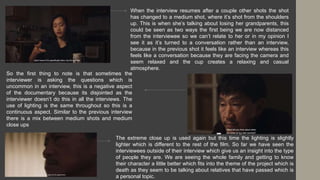
  • 63.
    It makes itappear as if the cracks are part of the footage. Something to note is that there was a mirror before he put the effect so if I was to do this, I would make sure to film with a mirror rather than making it appear to be there. He puts it into 3D because this allows him to change the rotation and the scaling of, he image. He creates a new solid layer, which will allow him to mask the part of the image he wants to keep, set the new solid layer to white and hide that and the cracked glass effect to focus on the original footage. Mask round the section you want to keep the effect. Then make the solid layer visible to show where you have masked round, then feather the edges to make them less harsh. He uses something called a lumar matte which tells the layer (in this case the cracked glass) to stay in where he masked round it. You then must create another solid layer to focus on the fragments and then using the pen tool draw round the bit you want to select.
  • 64.
    After masking thefragments that you want to change, he did the lumar/alpha matte option which allows each fragment to have the head turning footage underneath it because otherwise it would be still. So now when the footage is played the head in the mirror turns but the person’s head doesn’t which I like the look of, you can now also change the scale of the individual fragments. He makes three changes: Rescale them, Reframe them and then Retime them. To retime them he just moves the bars to different starting times, and that gives a good effect because all the fragments move at different times.
  • 65.
    I decided tolook into documentary making, and the video I chose to watch is called ‘7 fundamentals steps to film a short documentary’ he filmed the video in a documentary style to allow the viewers to get a feel of what it would look like. The first step was finding a worthwhile idea which I think I have, he filmed it as him sat to the left of the frame looking beyond the camera almost like an interview set up. He filled in with some footage of a ceramics maker with off screen dialogue which is what is used commonly in short documentaries especially the one’s I have looked at. The next step was ‘research’ and he gave tips on going on vimeo and filtering what you want to look for, and looking at existing short documentaries. The key is to get inspired not plagiarise other filmmakers projects, which I have done because I have looked at a wide variation of existing products and have gained a good understanding of the conventions within them.
  • 66.
    The third stepis ‘story structure’ and what he means by this is during an interview have a structure. He gave an example of the interviewees introducing themselves such as ‘ Hi I am (Name) and I am a (Occupation)’ which is a good start then the middle you could interview them about their family etc and the end being ‘what are your plans for the future?’ and this way there is a clear structure, however this might be a little tricky with my idea because I want them to talk about what is a woman and about femininity etc so I will have to come up with a structure when planning the questions. The fourth step being ‘filming’ which is where the rule of thirds comes in. He mentions that the interviewee shouldn’t be looking directly into the camera and off to the side instead, however because I plan on not directly interviewing people because of COVID I think it would be nice for them to look into the camera because this way there’s a sense of connection when I put all the interviews together. The lighting is important when filming an interview to make sure there is depth to the source whether you use natural sunlight or a lamp. His tip is to film different angles of people doing everyday things, for example film the subject through an object, or from a close up, high and low shots etc because this way it keeps the viewers interested and propels the story in the way I want it to go. He also suggests using movement but only if you can keep it stabilised and some of the movements are: tilt, pan, zoom and truck left/right.
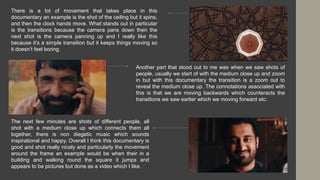
  • 67.
    The fifth stepis ‘audio’ because it plays a crucial part in the filming process. He gives tips on how to place a microphone but I won’t be using one of those because I’m not interviewing the person in person, however it is useful for the future. He mentions making sure to use the right music that fits with the style of documentary that you are making and lists a few websites to get access to: YouTube music library, Soundcloud, Free music archive etc. The sixth step is all about how to make your source comfortable, and I think that being in their own space with someone they know filming them might make them feel more comfortable. But for the future some of the key things is to talk to them before and let them know the process of filming. Also make sure to get them to include the question in their answer because they’re the ones in the film not me. The last step is ‘editing’ and he mostly just talks about time, and he suggest getting as much footage as possible because it makes the process easier, and if needed re shoot some of the footage if something doesn’t look right. This video has been very helpful in terms of showing me what are the important aspects of making a documentary and I have learnt a few things to focus on and make sure I get right
  • 68.
    • The thirdtutorial I am looking at is colour correcting the footage as this seems to make a crucial difference to the overall look of the project. There are many videos out there that use different ways of colour correcting, I chose this one because it used the lumetri scopes which seems to be the better option to read the colour. You can right click and all the different scopes come up to work with, she points out how scopes allow a more precise colour correction however not to always rely on them because sometimes the colours are better without it. The two scopes are labelled the vector scope and the waveform scope, the white dot represents the colour in the video so if you higher the saturation the dot will become bigger compared to if you lower the saturation the dot becomes smaller and more central. When the video is normal, the white dot seems to be closer to the warmer colours which suggest that the white balance is off. The waveform scope shows the exposure levels in the video, there is a scale from 0-100 with 0 representing the blacks and 100 representing the whites. She points out that the waves near the bottom appear ‘crushed’ and that suggest there’s too much black in that part of the video, it is advised that you avoid having any of the crushed waves.
  • 69.
    She goes toanother part of the video and the top of the waveforms are flat which suggests there is a lot of detail lost in the highlights. You can fix this when you go through the exposure levels. She went back to the previous part where the white balance is off, and suggests we can use the eyedropper tool to correct it however it can’t always be trusted so she takes us through the manual process. Firstly because the video looked too warm she dragged the temperature towards the blue side, part of the dot will start to move towards the middle and this is the part that’s along the blue line and it needs to be in the middle as much as possible without making the video blue, you do this with the tint as well. When altering the shadows and the exposure etc keep and eye of the waveform scope and try to remove any of the crushed waves. Overall this tutorial was very useful because it was basic colour correcting that I can use for my project.
  • 70.
    I decided towatch another colour grading video, because this way I have a good understanding with what to do. The first thing he did was open the lumetri colour scopes, but this one has three scopes instead of only two which the previous video had. There are three words when colour grading: Hue which is the colour, Saturation which is the intensity/vividness of a hue and then Luma which is the brightness or shade of hue. The waveform scope helps correct exposure, the RGB parade scope is helpful for correcting white balance issues and then the vector scope corresponds with the colour wheel. The first thing you do is correct the exposure of the video, then you correct the white balance if there are any issues and then lastly the saturation by either increasing or reducing it. In this video he uses the basic correction panel to fix the exposure, and the black control, controls the bottom or the darkest part on the lumetri scope and the white controls the brightness or the very top of the video.
  • 71.
    The shadows controlthe area between the black and the white, it is used if you want to change the shadows that are already seen. The highlights is used near the top of the scope to reduce or create new highlights within the video. When changing the blacks control it wants to sit above 0 on the scope meanwhile with the whites it needs to sit between 90 and 100 at the top. Using the RGB scope you can see that the blue trace is elevated above the red and the green giving the video a cooler tone. Unlike the other video this tutorial uses the white balance eyedropper tool and what you do is just put it on something in the frame that is white and it aligns the traces on the scopes. He then changes it a little manually to get the best result as well as changing the saturation a little. You can copy and paste the attributes to other clips and then compare them to see if they match, it also comes up in the scopes so they are side by side and if they don’t match you can change it. Using the HSL secondary control you can select certain parts that don’t loom like the rest.
  • 72.
    Using the lumetricolour effect, you can mask a certain section. In this case the person’s face was too dark compared to the rest of the video. He feathers the mask a little so it isn’t too obvious then he changes the shadows and the highlights. He uses the teal/orange look because it makes it look better, go to the project panel, right click and select adjustment layer from the drop down menu then drag the adjustment layer over the rest of the clips so any adjustments will be the same throughout. After selecting the adjustment layer skip the basic correction and go to the curves option, the bottom of the line is the shadows and the top is the highlight. To get the teal in without altering the skin tone select the HSL secondary panel and select the person’s face then invert it, and then using the colour wheel introduce teal and it doesn’t affect the person. To fix the shadows get another lumetri effect and go down to the luma set curve then drag the bottom part to the bottom of the square.
  • 73.
    The next videoI decided to look at was a tutorial on how to get a cinematic look, first he imported the footage and set it to 24 fps. He then went on the individual footage and right clicked on the footage and chose modify, then set the frame rate to 24 fps and this puts the footage into slow motion. Like one of the previous videos they add an adjustment layer and put it over all the clips so any adjustments made will affect all the clips. Under the lumetri colour tab he chooses a ‘look’ which is similar to a filter, the look he chooses is called ‘CMG Canon LUG 2018’ I do like the look it gives the video, he then wants to add more of a contrast and to do this he uses the basic correction and changes the contrast. He then also changes the temperature on certain clips and the highlights etc. A tip is to lower the highlights in most of the clips and adding some shadows.
  • 74.
    He uses PNGblack box images to overlay on the video, which I think works quite nicely however I might make them a bit narrower but I think this will be something to add into my project. He then goes onto alter the music, but he talks about something called ‘film grain’ which you type into google and copy and paste over all the clips, if it needs to be rescaled then right click and chose scale to frame and then right click again and nest it. Once the film grain is over the clips in effect controls change the blend mode to overlay.
  • 75.
    Summary of tutorials •I have looked at 5 tutorials all together and each one has been very useful for when it comes to make my project, I have looked at the broken glass effect which is something I want to try and incorporate into my project at the end with the title or at the beginning, I have also looked at 7 steps to creating a documentary which touched up on the interviews which is something I am going to be doing in my project even though I’m not going to be in person interviewing them. The two colour grading videos have been very useful because now I have a good understanding of how to use the different scopes and what to do to make it look good, and then the final video about the cinematic techniques is useful because outside of the interviews I plan on doing different shots like someone walking and keeping it simple, but by doing this I want to make sure it looks a good quality because then the simple idea works. I think I have looked at the tutorials that will be most beneficial and I think I have everything covered but if I think of a new one I can always include it in the planning.
  • 76.
    Script - Beautystandards in the 19th and 20th Century 1.“Youth. 2.Stature, neither too high nor two low. 3.Neither too fat nor too lean 4.Long hair, or prettily curled, fine and silky soft. 5.The skin smooth, delicate, and of a fine grain. 6.Lively white and red. 7.A smooth high forehead. 8.The temples not sunk in. 9.The eye-brows in arcade, like two lines. 10.The eyes blue, their orbits well-fashioned 11.The nose rather long than short. 12.The cheeks rounding away in softened profils, and dimpled. 13.An agreeable smile. 14.A small mouth. 15.Teeth, white, even and well set. 16.The chin rather round, plump, and ending with a dimple. 17.The ears small, and close to the head. 18.An agreeable voice. 19.A modest gait” 1. “1900’s - Cinched waists were accentuated by ruffled blouses for ladies and their long hair was kept upswept as in previous generations. Big hairstyles were also in style, leading some women to use false hair to add volume to their elaborate hairdos. 2. 1920’s - A new femininity was sweeping the modern world as ladies donned short hairstyles, short skirts, and androgynous styles. Straight lines were very en vogue for ladies and curves were out, referencing the new-found freedom many women felt after World War I. 3. 1940’s - In the ’40s menswear was popular for ladies, not only because so many women were joining up, but also because some women had to make due with men’s clothes cut down and re-sewn into more feminine fashions. The “natural” look was in for women, with thick eyebrows that contrasted with the thin brows of the ’30s. Despite the natural beauty image, face powder and lipstick were essential to the concept of ’40s beauty. Stars like Rita Hayworth and Veronica Lake made longer hair more popular. 4. 1960’s - Androgynous looks were fashionable at the start of the ’60s. Young ladies embraced short hair and simple lines. At the same time bouffant hairstyles were also making waves with ladies. Pixie cuts like those on Twiggy and Goldie Hawn sparked a trend for very short hair. 5. 1980’s - Big hair, bold makeup, and big shoulder pads defined the decade of excess. Aerobics wear and fit bodies were frequently featured in print, TV, and in films. The rise of supermodels like Naomi Campbell and Cindy Crawford further defined what we saw as beautiful..”
  • 77.
    Summary • Overall Iam confident with how the research has gone, I have found multiple things that are going to be beneficial for the final project. Starting with the existing products, I have managed to explore a wide range of examples that each have different components I want to incorporate into my own project. An example of this would be many of the products analyzed had a mix between interviews and then other footage, usually of the same person being interviewed but they were going about normal tasks. I particularly like this idea because it allows there to be a break from constant interviews and therefore keeps the audience interested, I believe I can integrate this into my own project but I won’t be able to film everyone individually due to time and restrictions but I can film a few people from my family. An example of what I was talking about is this documentary ‘Women in coffee’ and what they do is introduce the person then show them taking part in the work and I like this and think it would work well in my own project. Sometimes they interview the person whilst they are doing the work, I like this idea however I don’t think it is going to work well with my project because I want the interviews to all look as similar as possible.
  • 78.
    • I havealso looked into audiences and the type of people that might take an interest into this project, I didn’t want to rule out a particular group of people however as I started thinking more about the project I realized that this type of documentary will appeal to a group of people and not to another so I decided to look into this more as it is important to make sure that the group interested will like the project. From my research I found that in terms of demographics the groups C1 and above are most likely to watch my project because they are the more educated groups and they are the people who tend to sit down to watch documentaries compared to the groups below who are out doing manual work who are more likely to watch something with easy viewing as they have been out working, doing physical labor and wont want to watch something that requires a lot of engagement. To apply this to my own project I can ask questions that might have a more detailed answer to which people can listen to and engage with. In terms of the age of my audience I want to interview people from different ages because I think it’s interesting comparing beauty with someone who’s 50 and someone who’s 20 and seeing the contrast between the different age groups is going to be interesting. One of the questions I asked on the survey is the age of people and the majority of people were 16-24 and therefore I started targeting my project towards that group, but I now realize that I want to target older groups as well because I can compare people’s views. So to summarize the audience section I have decided not to aim to a particular age group because beauty can’t be restricted to one age group.
  • 79.
    • I lookedat a few different effects that I thought might be helpful in my project, I particularly like the broken mirror effect because I think this can be interpreted differently by viewers. I think it will make a good introduction with the title fading in over it, I don’t want to do the exact same as the example discussed but something similar. The next thing I looked at was the color grading because this is something that I have always struggled with when it comes to previous projects so I thought it would be beneficial to have a look at a few tutorials. I think it might not be too relevant to my project because I have asked people to film against a plain background, although I want to film some other footage which might need color correcting. Overall I think the tutorials have been a beneficial insight into the post production stage and I have gained a better understanding of what I could do and how to execute it. • I am happy with how the research has gone, I think I have covered what I need to know for the next stages of my project. The next stage is problem solving and I feel confident that I know the direction of this project and as a result I can address any issues moving forward. The tutorials have highlighted a key problem that I can include in the problem solving section, and this is going to be the software issue especially if the restrictions don’t change in time for production.
  • 80.
    Bibliography  ‘Christianity’ (1998)Louis Theroux’s Weird Weekends, Series 1, Episode 1. BBC2, 15th January.  ANON. (N/A). Demographic table. Available: https://jessicataylormedia.files.wordpress.com/2015/09/demographics-and- psychographics-3-638.jpg. Last accessed 24th January 2021.  ANON. (N/A). Grayson Perry. Available: https://en.wikipedia.org/wiki/Grayson_Perry. Last accessed 14th January 2021.  ANON. (N/A). Melanie (The Three Graces). Available: https://www.artfund.org/supporting-museums/art-weve-helped- buy/artwork/13092/melanie-the-three-graces Last accessed 15th January 2021.  ANON. (N/A). Psychographic table. Available: https://www.bing.com/images/search?view=detailV2&ccid=CHRBN7FF&id=5872347FDCBD5F2CC99308490B68C2D81F68907 B&thid=OIP.CHRBN7FFtqHxbUk3WccJKAHaFj&mediaurl=https%3a%2f%2f2239erskineemily.files.wordpress.c. Last accessed 24th January 2021.  BBC Bitesize. (N/A). Target Audience. Available: https://www.bbc.co.uk/bitesize/guides/zy24p39/revision/1#:~:text=A%20demographic%20audience%20profile%20defines%20gr oups%20based%20on,codes%20are%20often%20used%20to%20describe%20the%20groups%3A. Last accessed 24th January 2021.  BBFC. (N/A). 15 – Suitable only for 15 years and over. Available: https://www.bbfc.co.uk/rating/15. Last accessed 14th January 2021.  Bradshaw, Sophie. (2021) Research Interview (Conducted 25/01/2021)  Cervants, J. (2017). 7 Fundamental Steps to Film a Short Documentary. Available: https://www.youtube.com/watch?v=XN8dIQ6vptc. Last accessed 26th January 2021.
  • 81.
     Christian MatéGrab. (2018). How to get the CINEMATIC LOOK in Premiere Pro Tutorial. Available: https://www.youtube.com/watch?v=xQJfFLJufYw. Last accessed 27th January 2021.  Cinematic productions. (2016). The Silent Witness - A short poetic documentary || Cinematics - NIT Rourkela. Available: https://www.youtube.com/watch?v=4zjZoDOFTAo. Last accessed 21st January 2021.  Color grading central. (2019). Color Grading in Premiere Pro CC - Get Pro Film Look. Available: https://www.youtube.com/watch?v=RvFCnVRcT3Q. Last accessed 26th January 2021.  Equal Exchange. (2016). Women in coffee. Available: https://vimeo.com/165150528 Last accessed 16th January 2021.  Heichelbech, R. (N/A). These 20th Century Beauty Standards Were Once Considered The Ideal. Available: https://liveplayeat.com/beauty- ideals-20th-century/5/. Last accessed 28th January 2021.  Hill, Freya. (2021) Research Interview (Conducted 25/01/2021)  Leigh, J. (2012). Time - A poetic docuemntary. Available: https://www.youtube.com/watch?v=JSSqa9RD3mw. Last accessed 21st January 2021.  Lila. (2019). How To Color Correct Like A PRO! | Learn Premiere Pro 2020 in 10 minutes. Available: https://www.youtube.com/watch?v=PaYUbnjw8sU. Last accessed 26th January 2021.  MasterClass. (2020). Guide to Participatory Mode: 3 Participatory Documentaries. Available: https://www.masterclass.com/articles/guide-to- participatory-documentaries#what-is-participatory-documentary. Last accessed 19th January 2021.  MasterClass. (2021). Film 101: Understanding Reflexive Documentary Mode. Available: https://www.masterclass.com/articles/understanding- reflexive-documentary-mode#what-is-reflexive-documentary. Last accessed 19th January 2021.
  • 82.
     Movie ClipsTrailers. (2015). The Danish Girl. Available: https://www.youtube.com/watch?v=d88APYIGkjk. Last accessed 14th January 2021.  Murad, D. (2017). The Trail of Happiness | A Poetic Documentary. Available: https://www.youtube.com/watch?v=kDJ5MWCU31M. Last accessed 21st January 2021.  Nguyen, C. (N/A). No crying at the dinner table. Available: https://www.shortoftheweek.com/2020/12/23/no-crying-dinner- table/https://www.shortoftheweek.com/2020/12/23/no-crying-dinner-table/. Last accessed 19th January 2021.  Noronha, S. (2014). "What is BEAUTY?"- Interviews. Available: https://www.youtube.com/watch?fbclid=IwAR2anHeQFAYMjLxXT7I4A2iLjtRWSzRyctQhfi8ywubIsfTQkhWiconvang&v=1x- N7hTlJO0&feature=youtu.be. Last accessed 23rd February 2021.  Olufemii, J. (2020). Broken Mirror Effect | After Effects Tutorial. Available: https://www.youtube.com/watch?v=sb-t3plEaf8. Last accessed 26th January 2021.  Stoll, J. (2021). Most popular movie genres among adults in the United States as of December 2018, by age group. Available: https://www.statista.com/statistics/949810/favorite-movie-genres-in-the-us-by-age/. Last accessed 14th January 2021.  Tall Story Films. (2014). A Place Like This (Documentary Short Film). Available: https://www.youtube.com/watch?v=A_WzVVndUCY Last accessed 21st January 2021.  Walton, G. (2014). Ideas of Female Beauty in the 1700 and 1800s. Available: https://www.geriwalton.com/ideas-of-female-beauty-in-1700-and- 1800s/. Last accessed 28th January 2021.  Wardle, Zoe. (2021) Research Interview (Conducted 25/01/2021) This research has helped me gain a better understanding of what I am making and how I want to make it, I now have a clear vision of how I want to proceed with this project as every little bit I researched has helped me move forward onto the problem solving stage.