ESSAY RESEARCH
‘Disneyfied: The Psychological and emotional effect it
has on the development of young children’
Grace Gilbert
SUBHEADINGS
1. Relationships – For this subheading I could
talk about some of the issues that Disney
portray and I could tie it back to
relationships, future romantic relationships
and also family relationships. This will relate
to the psychological development
2. Behavioural – In this section I plan on talking
about how Disney can affect how the
children act, for example what toys they pick
as this seems to be a study that is done
quite often
3. Physical – Look at the way Disney portrays
female and male characters, discuss the
issues that could arise from their portrayals.
Relate this back to the question and tie it
back to how it could affect them emotionally
SOURCE #1 - GOOGLE BOOKS – DISNEY, PIX AR AND THE
HIDDEN MESSAGES OF CHILDREN’S FILMS, M. KEITH
BOOKER
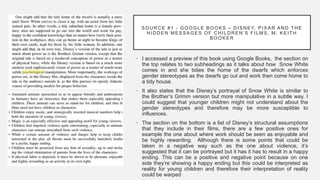
• I accessed a preview of this book using Google Books, the section on
the top relates to two subheadings as it talks about how Snow White
comes in and she tidies the home of the dwarfs which enforces
gender stereotypes as the dwarfs go out and work then come home to
a tidy house.
• It also states that the Disney’s portrayal of Snow White is similar to
the Brother’s Grimm version but more manipulative in a subtle way, I
could suggest that younger children might not understand about the
gender stereotypes and therefore may be more susceptible to
influences.
• The section on the bottom is a list of Disney’s structural assumptions
that they include in their films, there are a few positive ones for
example the one about where work should be seen as enjoyable and
be highly rewarding. Although there is some points that could be
taken in a negative way such as the one about violence, it’s
suggested that it can be portrayed but it has it has to result in a happy
ending. This can be a positive and negative point because on one
side they’re showing a happy ending but this could be interpreted as
reality for young children and therefore their interpretation of reality
could be warped
SOURCE #2 - THE PSYCHOSOCIAL IMPLICATIONS OF
DISNEY MOVIES
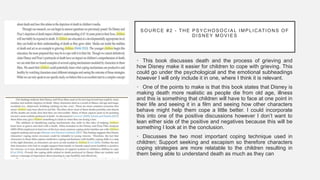
• This book discusses death and the process of grieving and
how Disney make it easier for children to cope with grieving. This
could go under the psychological and the emotional subheadings
however I will only include it in one, where I think it is relevant.
• One of the points to make is that this book states that Disney is
making death more realistic as people die from old age, illness
and this is something that children will have to face at one point in
their life and seeing it in a film and seeing how other characters
behave might help them cope a little better. I could incorporate
this into one of the positive discussions however I don’t want to
lean either side of the positive and negatives because this will be
something I look at in the conclusion.
• Discusses the two most important coping technique used in
children; Support seeking and escapism so therefore characters
coping strategies are more relatable to the children resulting in
them being able to understand death as much as they can
• Under the ‘physical’ section I want to discuss the issues of how Disney portray men and woman and how
they’re meant to look, I went onto the NHS website and they have looked at a study that was undertaken by
Brigham Young University, Texas Tech University and Linfield College in the US, and was funded by the
Women's Research Initiative.
• This longitudinal study looked at how Disney Princess media and merchandise might affect young children's
gender-specific behaviour, body image and positive social behaviour. Which investigated whether there was
any link between the amount of exposure to Disney Princesses – through film, merchandise, clothing and more
– and gender-specific behaviour, body image and social behaviour over the course of about a year.
• They started by taking baseline measurements of their gender-related behaviour, tracked their exposure to
Disney Princess material over a year, and tested them again for any changes. The adults filled in
questionnaires to establish their children's exposure to Disney Princesses: the amount of time spent watching
TV, and information revealing its potential effect on their gender-stereotypical behaviour, body image and social
behaviour.
• As expected, girls had a lot more princess exposure than boys in terms of watching more princess media and
identifying with princesses. For example, more than 61% of girls played with Disney Princess toys at least once
a week, compared with about 4% of boys. But for boys and girls, princess exposure was linked to higher female
gender-stereotypical behaviour on the toy preference task, as well as others measuring a similar thing. This
wasn't the case for male gender-stereotypical behaviour, body image or social behaviour.
• Watching more princess media, identifying with princesses and playing with princess toys over the course of a
year predicted stronger female gender-stereotypical behaviour at the end of the study, irrespective of the
starting level. High exposure to princesses predicted higher body esteem in boys and more social behaviour.
Whereas engagement with princesses was not associated with poor body esteem in girls. And a related finding
suggested that higher positive body image scores at the start of the study made it less likely that girls would
engage in a lot of princess media and merchandise a year later.
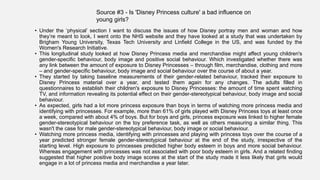
Source #3 - Is 'Disney Princess culture' a bad influence on
young girls?
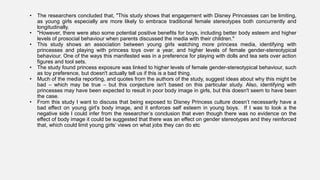
• The researchers concluded that, "This study shows that engagement with Disney Princesses can be limiting,
as young girls especially are more likely to embrace traditional female stereotypes both concurrently and
longitudinally.
• "However, there were also some potential positive benefits for boys, including better body esteem and higher
levels of prosocial behaviour when parents discussed the media with their children."
• This study shows an association between young girls watching more princess media, identifying with
princesses and playing with princess toys over a year, and higher levels of female gender-stereotypical
behaviour. One of the ways this manifested was in a preference for playing with dolls and tea sets over action
figures and tool sets.
• The study found princess exposure was linked to higher levels of female gender-stereotypical behaviour, such
as toy preference, but doesn't actually tell us if this is a bad thing.
• Much of the media reporting, and quotes from the authors of the study, suggest ideas about why this might be
bad – which may be true – but this conjecture isn't based on this particular study. Also, identifying with
princesses may have been expected to result in poor body image in girls, but this doesn't seem to have been
the case.
• From this study I want to discuss that being exposed to Disney Princess culture doesn’t necessarily have a
bad effect on young girl’s body image, and it enforces self esteem in young boys. If I was to look a the
negative side I could infer from the researcher’s conclusion that even though there was no evidence on the
effect of body image it could be suggested that there was an effect on gender stereotypes and they reinforced
that, which could limit young girls’ views on what jobs they can do etc
SOURCE #4 – THE
DECONSTURCTIONOF DISNEY
PRINCESSES
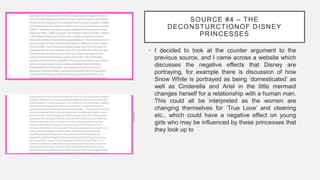
• I decided to look at the counter argument to the
previous source, and I came across a website which
discusses the negative effects that Disney are
portraying, for example there is discussion of how
Snow White is portrayed as being ‘domesticated’ as
well as Cinderella and Ariel in the little mermaid
changes herself for a relationship with a human man.
This could all be interpreted as the women are
changing themselves for ‘True Love’ and cleaning
etc., which could have a negative effect on young
girls who may be influenced by these princesses that
they look up to
SOURCE #5 – BODY IMAGE
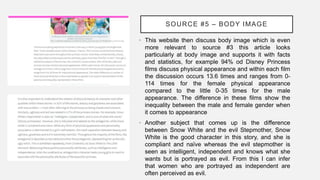
• This website then discuss body image which is even
more relevant to source #3 this article looks
particularly at body image and supports it with facts
and statistics, for example 94% od Disney Princess
films discuss physical appearance and within each film
the discussion occurs 13.6 times and ranges from 0-
114 times for the female physical appearance
compared to the little 0-35 times for the male
appearance. The difference in these films show the
inequality between the male and female gender when
it comes to appearance
• Another subject that comes up is the difference
between Snow White and the evil Stepmother, Snow
White is the good character in this story, and she is
compliant and naïve whereas the evil stepmother is
seen as intelligent, independent and knows what she
wants but is portrayed as evil. From this I can infer
that women who are portrayed as independent are
often perceived as evil.
SOURCE #6 – SOCIALIZATION OF CHILDREN
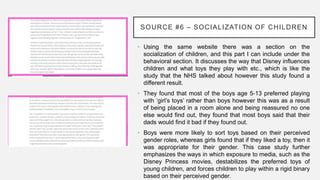
• Using the same website there was a section on the
socialization of children, and this part I can include under the
behavioral section. It discusses the way that Disney influences
children and what toys they play with etc., which is like the
study that the NHS talked about however this study found a
different result.
• They found that most of the boys age 5-13 preferred playing
with ‘girl’s toys’ rather than boys however this was as a result
of being placed in a room alone and being reassured no one
else would find out, they found that most boys said that their
dads would find it bad if they found out.
• Boys were more likely to sort toys based on their perceived
gender roles, whereas girls found that if they liked a toy, then it
was appropriate for their gender. This case study further
emphasizes the ways in which exposure to media, such as the
Disney Princess movies, destabilizes the preferred toys of
young children, and forces children to play within a rigid binary
based on their perceived gender.
SOURCE #7 –
SIMULACRA AND
SIMULATION
• I have decided to investigate a sociologist by
the name ‘Jean Baudrillard’. The postmodern
semiotic concept of "hyperreality“ was
contentiously coined by the French sociologist
Baudrillard. "hyperreality" is "the generation by
models of a real without origin or
reality"; hyperreality is a representation, a sign,
without an original referent.
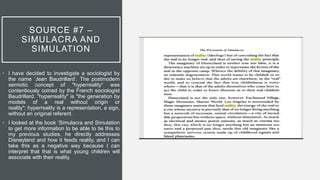
• I looked at the book ‘Simulacra and Simulation
to get more information to be able to tie this to
my previous studies, he directly addresses
Disneyland and how it feeds reality, and I can
take this as a negative way because I can
interpret that that is what young children will
associate with their reality.
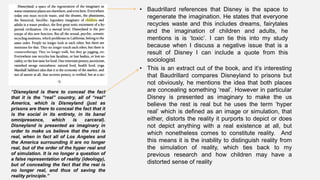
• Baudrillard references that Disney is the space to
regenerate the imagination. He states that everyone
recycles waste and this includes dreams, fairytales
and the imagination of children and adults, he
mentions is is ‘toxic’. I can tie this into my study
because when I discuss a negative issue that is a
result of Disney I can include a quote from this
sociologist
“Disneyland is there to conceal the fact
that it is the “real” country, all of “real”
America, which is Disneyland (just as
prisons are there to conceal the fact that it
is the social in its entirety, in its banal
omnipresence, which is carceral).
Disneyland is presented as imaginary in
order to make us believe that the rest is
real, when in fact all of Los Angeles and
the America surrounding it are no longer
real, but of the order of the hyper real and
of simulation. It is no longer a question of
a false representation of reality (ideology),
but of concealing the fact that the real is
no longer real, and thus of saving the
reality principle.”
• This is an extract out of the book, and it’s interesting
that Baudrillard compares Disneyland to prisons but
not obviously, he mentions the idea that both places
are concealing something ‘real’. However in particular
Disney is presented as imaginary to make the us
believe the rest is real but he uses the term ‘hyper
real’ which is defined as an image or simulation, that
either, distorts the reality it purports to depict or does
not depict anything with a real existence at all, but
which nonetheless comes to constitute reality. And
this means it is the inability to distinguish reality from
the simulation of reality, which ties back to my
previous research and how children may have a
distorted sense of reality
SOURCE #8 – USES AND GRATIFICATIONS
(UGT)
• I have decided to look at this theory because it looks at how people actively seek out
certain media to fit certain needs. UGT is an audience – centered approached to
understand mass media.
• The Uses and Gratifications theory assumes that the audience pick out certain media to
watch for five things:
• During the 1960s it became apparent that audiences made choices about how and when
they consumed media texts. Far from being a passive mass, audiences were made up of
individuals who actively consumed texts for different reasons and in different ways. James
Halloran, 1970 said that it let study move away from “thinking in terms of what the media
do to people” and substituted the idea of “what people do with the media”. Bluhmer and
Katz, 1974 expanded this theory suggesting a series of possible reasons why audience
members might consume a media text:
1. Diversion: escapism – from everyday problems and routine
2. Personal relationships: using the media for emotional and other interaction e.g.
substituting soap operas for family life, can you think of any other examples?
3. Personal Identity: constructing their own identity from characters in media texts, and
learning behavior and values
4. Surveillance: information gathering e.g. the news, educational programs, weather reports,
financial news, holiday bargains
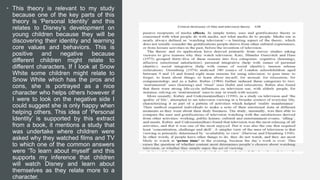
• This theory is relevant to my study
because one of the key parts of this
theory is ‘Personal Identity’ and this
relates to Disney’s development on
young children because they will be
discovering their identity and learning
core values and behaviors. This is
positive and negative because
different children might relate to
different characters, If I look at Snow
White some children might relate to
Snow White which has the pros and
cons, she is portrayed as a nice
character who helps others however if
I were to look on the negative side I
could suggest she is only happy when
helping others. This idea of ‘Personal
Identity’ is supported by this extract
from a book, it mentions a study that
was undertake where children were
asked why they watched films and TV
to which one of the common answers
were ‘To learn about myself’ and this
supports my inference that children
will watch Disney and learn about
themselves as they relate more to a
character.
SOURCE
#9 –
AUDIENCE
THEORY
‘Audience theory is an element of thinking that
developed within academic literary theory and
cultural studies . With a specific focus on
rhetoric, some, such as Walter Ong have
suggested that the audience is a construct
made up by the rhetoric and the rhetorical
situation the text is addressing. ’
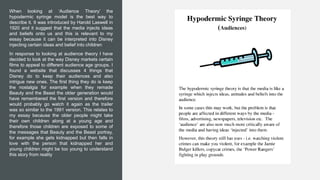
When looking at ‘Audience Theory’ the
hypodermic syringe model is the best way to
describe it. It was introduced by Harold Laswell in
1920 and it suggest that the media injects ideas
and beliefs onto us and this is relevant to my
essay because it can be interpreted into Disney
injecting certain ideas and belief into children
In response to looking at audience theory I have
decided to look at the way Disney markets certain
films to appeal to different audience age groups. I
found a website that discusses 4 things that
Disney do to keep their audiences and also
intrigue new ones. The first thing they do is keep
the nostalgia for example when they remade
Beauty and the Beast the older generation would
have remembered the first version and therefore
would probably go watch it again as the trailer
was so similar to the 1991 version. This relates to
my essay because the older people might take
their own children along at a young age and
therefore those children are exposed to some of
the messages that Beauty and the Beast portray,
for example she gets kidnapped but then falls in
love with the person that kidnapped her and
young children might be too young to understand
this story from reality
Dominant Reader - The audience who take in the work as given by the director
with no extra notes attached. For example a parent implying on the child to clean
their room is a direct message. The child understands the messages properly and
it is the media producers have conveyed it with a bald head, black cloak, sunken
eyes, cold and cruel voice, and a threatening presence to his surroundings.
Negotiated Reader - The audiences who thought they know and are aware of
the acts made in the film are wrong but accept it because there is a reason behind
it. Therefore accepting the author’s message even though it goes against the
audiences’ personal convictions. For example, many video games/comics has
contents are against our personal views but we still read, enjoy and accept the
content given the situation depicted on it for example fictions like zombie
hunting, etc.
Oppositional Reader - The audience has no acceptance for the author’s takes
on the concept of the film or the subject it handled. It can be morally wrong,
emotionally disturbing, contents of violence, religious belief, political outlooks
etc., which will make the audience, reject the idea. For example, in 1970-1980 was
an era in Indian Films they showed smoking as a sign of prestige, image, wealth,
power and flourishing happiness whereas, the reality states otherwise, for it
causes cancer.
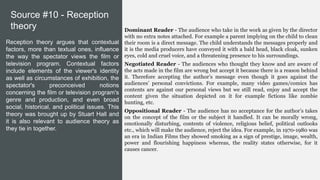
Reception theory argues that contextual
factors, more than textual ones, influence
the way the spectator views the film or
television program. Contextual factors
include elements of the viewer's identity
as well as circumstances of exhibition, the
spectator's preconceived notions
concerning the film or television program's
genre and production, and even broad
social, historical, and political issues. This
theory was brought up by Stuart Hall and
it is also relevant to audience theory as
they tie in together.
Source #10 - Reception
theory
SOURCE#11- BECHDEL TESTY
• Found in 1985, and first appeared in Alison Bechdel's comic strips. The
Bechdel test is an analysis of how women are portrayed in popular
culture, I will specifically be looking at Disney films. To pass the test the
film must meet three requirements: It must have at least two named
female characters, the second requirement is that they must talk to each
other, then the last requirement is that they have to talk about something
other than a man.
1. ANON. (N/A). Uses and Gratifications Theory. Available: https://revisionworld.com/a2-level-level-revision/media-studies-
level-revision/uses-and-gratifications-theory. Last accessed 13th October 2020.
2. ANON. (N/A). Reception Theory. Available: https://www.communicationtheory.org/reception-theory/. Last accessed 3rd
November 2020.
3. Baudrillard, J. (1994). Simulacra and Simulation. Available:
https://books.google.co.uk/books/about/Simulacra_and_Simulation.html?id=9Z9biHaoLZIC&redir_esc=y. Last accessed
13th October 2020.
4. Bazian. (2016). Is 'Disney Princess culture' a bad influence on young girls?. Available:
https://www.nhs.uk/news/pregnancy-and-child/is-disney-princess-culture-a-bad-influence-on-young-girls/. Last accessed
5th October 2020.
5. Booker, K. (2010). Disney, Pixar, and the Hidden Messages of Children's Films. Available:
https://books.google.co.uk/books?id=jD9_0jxVmqUC&dq=disneys+hidden+message&source=gbs_navlinks_s. Last
accessed 5th October 2020.
6. Dundes, L. (2019). The Psychosocial Implications of Disney Movies. Available:
https://books.google.co.uk/books?id=88ehDwAAQBAJ&dq=disneys+hidden+message&source=gbs_navlinks_s. Last
accessed 5th October 2020.
7. Hatheway, E. (N/A). Body Image. Available: https://sites.middlebury.edu/disneyprincesses/body-image/. Last accessed
6th October 2020.
8. June, L. (2016). Disney Princesses: Good for Boys, Bad for Girls. Available: https://www.thecut.com/2016/06/disney-
princesses-good-for-boys-bad-for-
Thisgirls.html#:~:text=Disney%20Princesses%3A%20Good%20for%20Boys%2C%20Bad%20for%20Girls.,And%20nearl
y%20all%20children%2C%20it%20sug. Last accessed 4th December 2020.
9. Wolfe, C. (N/A). Socialization of Children. Available: https://sites.middlebury.edu/disneyprincesses/socialization-of-
children/. Last accessed 6th October 2020.
10.Zurcher, J, Webb, S, Robinson, T. (2018). The Portrayal of Families across Generations in Disney Animated Films.
Available: https://www.mdpi.com/2076-0760/7/3/47/htm. Last accessed 6th October 2020.
11. Khandelwal, T. (2016). Moana Is Disney’s Most Feminist Film. Available: https://www.shethepeople.tv/news/moana-is-
disneys-most-feminist-film/. Last accessed 10th December 2020.

Essay research final

  • 1.
    ESSAY RESEARCH ‘Disneyfied: ThePsychological and emotional effect it has on the development of young children’ Grace Gilbert
  • 2.
    SUBHEADINGS 1. Relationships –For this subheading I could talk about some of the issues that Disney portray and I could tie it back to relationships, future romantic relationships and also family relationships. This will relate to the psychological development 2. Behavioural – In this section I plan on talking about how Disney can affect how the children act, for example what toys they pick as this seems to be a study that is done quite often 3. Physical – Look at the way Disney portrays female and male characters, discuss the issues that could arise from their portrayals. Relate this back to the question and tie it back to how it could affect them emotionally
  • 3.
    SOURCE #1 -GOOGLE BOOKS – DISNEY, PIX AR AND THE HIDDEN MESSAGES OF CHILDREN’S FILMS, M. KEITH BOOKER • I accessed a preview of this book using Google Books, the section on the top relates to two subheadings as it talks about how Snow White comes in and she tidies the home of the dwarfs which enforces gender stereotypes as the dwarfs go out and work then come home to a tidy house. • It also states that the Disney’s portrayal of Snow White is similar to the Brother’s Grimm version but more manipulative in a subtle way, I could suggest that younger children might not understand about the gender stereotypes and therefore may be more susceptible to influences. • The section on the bottom is a list of Disney’s structural assumptions that they include in their films, there are a few positive ones for example the one about where work should be seen as enjoyable and be highly rewarding. Although there is some points that could be taken in a negative way such as the one about violence, it’s suggested that it can be portrayed but it has it has to result in a happy ending. This can be a positive and negative point because on one side they’re showing a happy ending but this could be interpreted as reality for young children and therefore their interpretation of reality could be warped
  • 4.
    SOURCE #2 -THE PSYCHOSOCIAL IMPLICATIONS OF DISNEY MOVIES • This book discusses death and the process of grieving and how Disney make it easier for children to cope with grieving. This could go under the psychological and the emotional subheadings however I will only include it in one, where I think it is relevant. • One of the points to make is that this book states that Disney is making death more realistic as people die from old age, illness and this is something that children will have to face at one point in their life and seeing it in a film and seeing how other characters behave might help them cope a little better. I could incorporate this into one of the positive discussions however I don’t want to lean either side of the positive and negatives because this will be something I look at in the conclusion. • Discusses the two most important coping technique used in children; Support seeking and escapism so therefore characters coping strategies are more relatable to the children resulting in them being able to understand death as much as they can
  • 5.
    • Under the‘physical’ section I want to discuss the issues of how Disney portray men and woman and how they’re meant to look, I went onto the NHS website and they have looked at a study that was undertaken by Brigham Young University, Texas Tech University and Linfield College in the US, and was funded by the Women's Research Initiative. • This longitudinal study looked at how Disney Princess media and merchandise might affect young children's gender-specific behaviour, body image and positive social behaviour. Which investigated whether there was any link between the amount of exposure to Disney Princesses – through film, merchandise, clothing and more – and gender-specific behaviour, body image and social behaviour over the course of about a year. • They started by taking baseline measurements of their gender-related behaviour, tracked their exposure to Disney Princess material over a year, and tested them again for any changes. The adults filled in questionnaires to establish their children's exposure to Disney Princesses: the amount of time spent watching TV, and information revealing its potential effect on their gender-stereotypical behaviour, body image and social behaviour. • As expected, girls had a lot more princess exposure than boys in terms of watching more princess media and identifying with princesses. For example, more than 61% of girls played with Disney Princess toys at least once a week, compared with about 4% of boys. But for boys and girls, princess exposure was linked to higher female gender-stereotypical behaviour on the toy preference task, as well as others measuring a similar thing. This wasn't the case for male gender-stereotypical behaviour, body image or social behaviour. • Watching more princess media, identifying with princesses and playing with princess toys over the course of a year predicted stronger female gender-stereotypical behaviour at the end of the study, irrespective of the starting level. High exposure to princesses predicted higher body esteem in boys and more social behaviour. Whereas engagement with princesses was not associated with poor body esteem in girls. And a related finding suggested that higher positive body image scores at the start of the study made it less likely that girls would engage in a lot of princess media and merchandise a year later. Source #3 - Is 'Disney Princess culture' a bad influence on young girls?
  • 6.
    • The researchersconcluded that, "This study shows that engagement with Disney Princesses can be limiting, as young girls especially are more likely to embrace traditional female stereotypes both concurrently and longitudinally. • "However, there were also some potential positive benefits for boys, including better body esteem and higher levels of prosocial behaviour when parents discussed the media with their children." • This study shows an association between young girls watching more princess media, identifying with princesses and playing with princess toys over a year, and higher levels of female gender-stereotypical behaviour. One of the ways this manifested was in a preference for playing with dolls and tea sets over action figures and tool sets. • The study found princess exposure was linked to higher levels of female gender-stereotypical behaviour, such as toy preference, but doesn't actually tell us if this is a bad thing. • Much of the media reporting, and quotes from the authors of the study, suggest ideas about why this might be bad – which may be true – but this conjecture isn't based on this particular study. Also, identifying with princesses may have been expected to result in poor body image in girls, but this doesn't seem to have been the case. • From this study I want to discuss that being exposed to Disney Princess culture doesn’t necessarily have a bad effect on young girl’s body image, and it enforces self esteem in young boys. If I was to look a the negative side I could infer from the researcher’s conclusion that even though there was no evidence on the effect of body image it could be suggested that there was an effect on gender stereotypes and they reinforced that, which could limit young girls’ views on what jobs they can do etc
  • 7.
    SOURCE #4 –THE DECONSTURCTIONOF DISNEY PRINCESSES • I decided to look at the counter argument to the previous source, and I came across a website which discusses the negative effects that Disney are portraying, for example there is discussion of how Snow White is portrayed as being ‘domesticated’ as well as Cinderella and Ariel in the little mermaid changes herself for a relationship with a human man. This could all be interpreted as the women are changing themselves for ‘True Love’ and cleaning etc., which could have a negative effect on young girls who may be influenced by these princesses that they look up to
  • 8.
    SOURCE #5 –BODY IMAGE • This website then discuss body image which is even more relevant to source #3 this article looks particularly at body image and supports it with facts and statistics, for example 94% od Disney Princess films discuss physical appearance and within each film the discussion occurs 13.6 times and ranges from 0- 114 times for the female physical appearance compared to the little 0-35 times for the male appearance. The difference in these films show the inequality between the male and female gender when it comes to appearance • Another subject that comes up is the difference between Snow White and the evil Stepmother, Snow White is the good character in this story, and she is compliant and naïve whereas the evil stepmother is seen as intelligent, independent and knows what she wants but is portrayed as evil. From this I can infer that women who are portrayed as independent are often perceived as evil.
  • 9.
    SOURCE #6 –SOCIALIZATION OF CHILDREN • Using the same website there was a section on the socialization of children, and this part I can include under the behavioral section. It discusses the way that Disney influences children and what toys they play with etc., which is like the study that the NHS talked about however this study found a different result. • They found that most of the boys age 5-13 preferred playing with ‘girl’s toys’ rather than boys however this was as a result of being placed in a room alone and being reassured no one else would find out, they found that most boys said that their dads would find it bad if they found out. • Boys were more likely to sort toys based on their perceived gender roles, whereas girls found that if they liked a toy, then it was appropriate for their gender. This case study further emphasizes the ways in which exposure to media, such as the Disney Princess movies, destabilizes the preferred toys of young children, and forces children to play within a rigid binary based on their perceived gender.
  • 10.
    SOURCE #7 – SIMULACRAAND SIMULATION • I have decided to investigate a sociologist by the name ‘Jean Baudrillard’. The postmodern semiotic concept of "hyperreality“ was contentiously coined by the French sociologist Baudrillard. "hyperreality" is "the generation by models of a real without origin or reality"; hyperreality is a representation, a sign, without an original referent. • I looked at the book ‘Simulacra and Simulation to get more information to be able to tie this to my previous studies, he directly addresses Disneyland and how it feeds reality, and I can take this as a negative way because I can interpret that that is what young children will associate with their reality.
  • 11.
    • Baudrillard referencesthat Disney is the space to regenerate the imagination. He states that everyone recycles waste and this includes dreams, fairytales and the imagination of children and adults, he mentions is is ‘toxic’. I can tie this into my study because when I discuss a negative issue that is a result of Disney I can include a quote from this sociologist “Disneyland is there to conceal the fact that it is the “real” country, all of “real” America, which is Disneyland (just as prisons are there to conceal the fact that it is the social in its entirety, in its banal omnipresence, which is carceral). Disneyland is presented as imaginary in order to make us believe that the rest is real, when in fact all of Los Angeles and the America surrounding it are no longer real, but of the order of the hyper real and of simulation. It is no longer a question of a false representation of reality (ideology), but of concealing the fact that the real is no longer real, and thus of saving the reality principle.” • This is an extract out of the book, and it’s interesting that Baudrillard compares Disneyland to prisons but not obviously, he mentions the idea that both places are concealing something ‘real’. However in particular Disney is presented as imaginary to make the us believe the rest is real but he uses the term ‘hyper real’ which is defined as an image or simulation, that either, distorts the reality it purports to depict or does not depict anything with a real existence at all, but which nonetheless comes to constitute reality. And this means it is the inability to distinguish reality from the simulation of reality, which ties back to my previous research and how children may have a distorted sense of reality
  • 12.
    SOURCE #8 –USES AND GRATIFICATIONS (UGT) • I have decided to look at this theory because it looks at how people actively seek out certain media to fit certain needs. UGT is an audience – centered approached to understand mass media. • The Uses and Gratifications theory assumes that the audience pick out certain media to watch for five things: • During the 1960s it became apparent that audiences made choices about how and when they consumed media texts. Far from being a passive mass, audiences were made up of individuals who actively consumed texts for different reasons and in different ways. James Halloran, 1970 said that it let study move away from “thinking in terms of what the media do to people” and substituted the idea of “what people do with the media”. Bluhmer and Katz, 1974 expanded this theory suggesting a series of possible reasons why audience members might consume a media text: 1. Diversion: escapism – from everyday problems and routine 2. Personal relationships: using the media for emotional and other interaction e.g. substituting soap operas for family life, can you think of any other examples? 3. Personal Identity: constructing their own identity from characters in media texts, and learning behavior and values 4. Surveillance: information gathering e.g. the news, educational programs, weather reports, financial news, holiday bargains
  • 13.
    • This theoryis relevant to my study because one of the key parts of this theory is ‘Personal Identity’ and this relates to Disney’s development on young children because they will be discovering their identity and learning core values and behaviors. This is positive and negative because different children might relate to different characters, If I look at Snow White some children might relate to Snow White which has the pros and cons, she is portrayed as a nice character who helps others however if I were to look on the negative side I could suggest she is only happy when helping others. This idea of ‘Personal Identity’ is supported by this extract from a book, it mentions a study that was undertake where children were asked why they watched films and TV to which one of the common answers were ‘To learn about myself’ and this supports my inference that children will watch Disney and learn about themselves as they relate more to a character.
  • 14.
    SOURCE #9 – AUDIENCE THEORY ‘Audience theoryis an element of thinking that developed within academic literary theory and cultural studies . With a specific focus on rhetoric, some, such as Walter Ong have suggested that the audience is a construct made up by the rhetoric and the rhetorical situation the text is addressing. ’
  • 15.
    When looking at‘Audience Theory’ the hypodermic syringe model is the best way to describe it. It was introduced by Harold Laswell in 1920 and it suggest that the media injects ideas and beliefs onto us and this is relevant to my essay because it can be interpreted into Disney injecting certain ideas and belief into children In response to looking at audience theory I have decided to look at the way Disney markets certain films to appeal to different audience age groups. I found a website that discusses 4 things that Disney do to keep their audiences and also intrigue new ones. The first thing they do is keep the nostalgia for example when they remade Beauty and the Beast the older generation would have remembered the first version and therefore would probably go watch it again as the trailer was so similar to the 1991 version. This relates to my essay because the older people might take their own children along at a young age and therefore those children are exposed to some of the messages that Beauty and the Beast portray, for example she gets kidnapped but then falls in love with the person that kidnapped her and young children might be too young to understand this story from reality
  • 16.
    Dominant Reader -The audience who take in the work as given by the director with no extra notes attached. For example a parent implying on the child to clean their room is a direct message. The child understands the messages properly and it is the media producers have conveyed it with a bald head, black cloak, sunken eyes, cold and cruel voice, and a threatening presence to his surroundings. Negotiated Reader - The audiences who thought they know and are aware of the acts made in the film are wrong but accept it because there is a reason behind it. Therefore accepting the author’s message even though it goes against the audiences’ personal convictions. For example, many video games/comics has contents are against our personal views but we still read, enjoy and accept the content given the situation depicted on it for example fictions like zombie hunting, etc. Oppositional Reader - The audience has no acceptance for the author’s takes on the concept of the film or the subject it handled. It can be morally wrong, emotionally disturbing, contents of violence, religious belief, political outlooks etc., which will make the audience, reject the idea. For example, in 1970-1980 was an era in Indian Films they showed smoking as a sign of prestige, image, wealth, power and flourishing happiness whereas, the reality states otherwise, for it causes cancer. Reception theory argues that contextual factors, more than textual ones, influence the way the spectator views the film or television program. Contextual factors include elements of the viewer's identity as well as circumstances of exhibition, the spectator's preconceived notions concerning the film or television program's genre and production, and even broad social, historical, and political issues. This theory was brought up by Stuart Hall and it is also relevant to audience theory as they tie in together. Source #10 - Reception theory
  • 17.
    SOURCE#11- BECHDEL TESTY •Found in 1985, and first appeared in Alison Bechdel's comic strips. The Bechdel test is an analysis of how women are portrayed in popular culture, I will specifically be looking at Disney films. To pass the test the film must meet three requirements: It must have at least two named female characters, the second requirement is that they must talk to each other, then the last requirement is that they have to talk about something other than a man.
  • 18.
    1. ANON. (N/A).Uses and Gratifications Theory. Available: https://revisionworld.com/a2-level-level-revision/media-studies- level-revision/uses-and-gratifications-theory. Last accessed 13th October 2020. 2. ANON. (N/A). Reception Theory. Available: https://www.communicationtheory.org/reception-theory/. Last accessed 3rd November 2020. 3. Baudrillard, J. (1994). Simulacra and Simulation. Available: https://books.google.co.uk/books/about/Simulacra_and_Simulation.html?id=9Z9biHaoLZIC&redir_esc=y. Last accessed 13th October 2020. 4. Bazian. (2016). Is 'Disney Princess culture' a bad influence on young girls?. Available: https://www.nhs.uk/news/pregnancy-and-child/is-disney-princess-culture-a-bad-influence-on-young-girls/. Last accessed 5th October 2020. 5. Booker, K. (2010). Disney, Pixar, and the Hidden Messages of Children's Films. Available: https://books.google.co.uk/books?id=jD9_0jxVmqUC&dq=disneys+hidden+message&source=gbs_navlinks_s. Last accessed 5th October 2020. 6. Dundes, L. (2019). The Psychosocial Implications of Disney Movies. Available: https://books.google.co.uk/books?id=88ehDwAAQBAJ&dq=disneys+hidden+message&source=gbs_navlinks_s. Last accessed 5th October 2020. 7. Hatheway, E. (N/A). Body Image. Available: https://sites.middlebury.edu/disneyprincesses/body-image/. Last accessed 6th October 2020. 8. June, L. (2016). Disney Princesses: Good for Boys, Bad for Girls. Available: https://www.thecut.com/2016/06/disney- princesses-good-for-boys-bad-for- Thisgirls.html#:~:text=Disney%20Princesses%3A%20Good%20for%20Boys%2C%20Bad%20for%20Girls.,And%20nearl y%20all%20children%2C%20it%20sug. Last accessed 4th December 2020. 9. Wolfe, C. (N/A). Socialization of Children. Available: https://sites.middlebury.edu/disneyprincesses/socialization-of- children/. Last accessed 6th October 2020. 10.Zurcher, J, Webb, S, Robinson, T. (2018). The Portrayal of Families across Generations in Disney Animated Films. Available: https://www.mdpi.com/2076-0760/7/3/47/htm. Last accessed 6th October 2020. 11. Khandelwal, T. (2016). Moana Is Disney’s Most Feminist Film. Available: https://www.shethepeople.tv/news/moana-is- disneys-most-feminist-film/. Last accessed 10th December 2020.