Contextual Research
Grace Gilbert
Contextual Statement
• For this project I am wanting to make either a short film or short documentary because this is the area
that I enjoy the most and I have chosen to do at university so I think it is going to be beneficial to
create something in the video platform. I have been influenced by a piece from the artist Grayson
Perry, the piece is called ‘Melanie’ and she is part of ‘the three graces’ and they are three pieces that
represent women who might not fit into the ideal beauty standards. This made me think that it would
be a good opportunity to either do a documentary or a film looking into this topic because it’s an
important conversation. I want to make this project because I think it is important to talk about these
issues especially body image etc. because things aren’t going to change unless we educate people
and discuss how it can be dangerous to make women fit into one category. This project will be shown
at York Art Gallery alongside other students work so I am going to look at other pieces that Perry has
done although Melanie has stood out to me so I like the idea of using this piece to influence my own
work. I plan on exploring a few different directors to understand a little more about creating my own
unique ‘style’ of film, I am going to look at some director’s that I like because that’s where I get my
inspiration from. For this project I want specify it around Perry’s artwork and explore some of the
themes that are seen throughout his work, at a first glance they seem to be
gender/stereotypes/identity so doing a short film exploring these topics would allow me to tie this
project into the exhibition. I am looking forward to doing this project because we didn’t have the
chance to make anything last year due to the coronavirus restrictions and I think if I go with the theme
of ‘Melanie’ I can talk about a lot of topics that are relevant and I enjoy. If the restrictions continue it is
going to be difficult interviewing people however I can address this later when I know more
information about moving forward and I have a solid idea of what I am going to do.
Research Intentions
In this PowerPoint my intentions are to look at certain film directors and look at
the different styles each director has, by doing this I hope to find my own unique
style that I can apply to my FMP and future work. I will also be looking at some
effects and techniques that I can use when it comes to production such as certain
post production effects or lighting tips etc and I will do this by searching tutorials
on YouTube and link them so when it comes to experiments I have a collection of
things to try out. Additionally I am doing this FMP for a Grayson Perry art
exhibition showing some of his work so I will do a bit of research about the artist
and pick out certain pieces of art to inspire my project so then I can take the
research further in the project research. I will also be doing some idea generation
to explore my different options and how they relate to pieces of Perry’s art, I don’t
plan on getting a set idea but a brief idea of what I want it to be about and I might
compromise
Idea 1
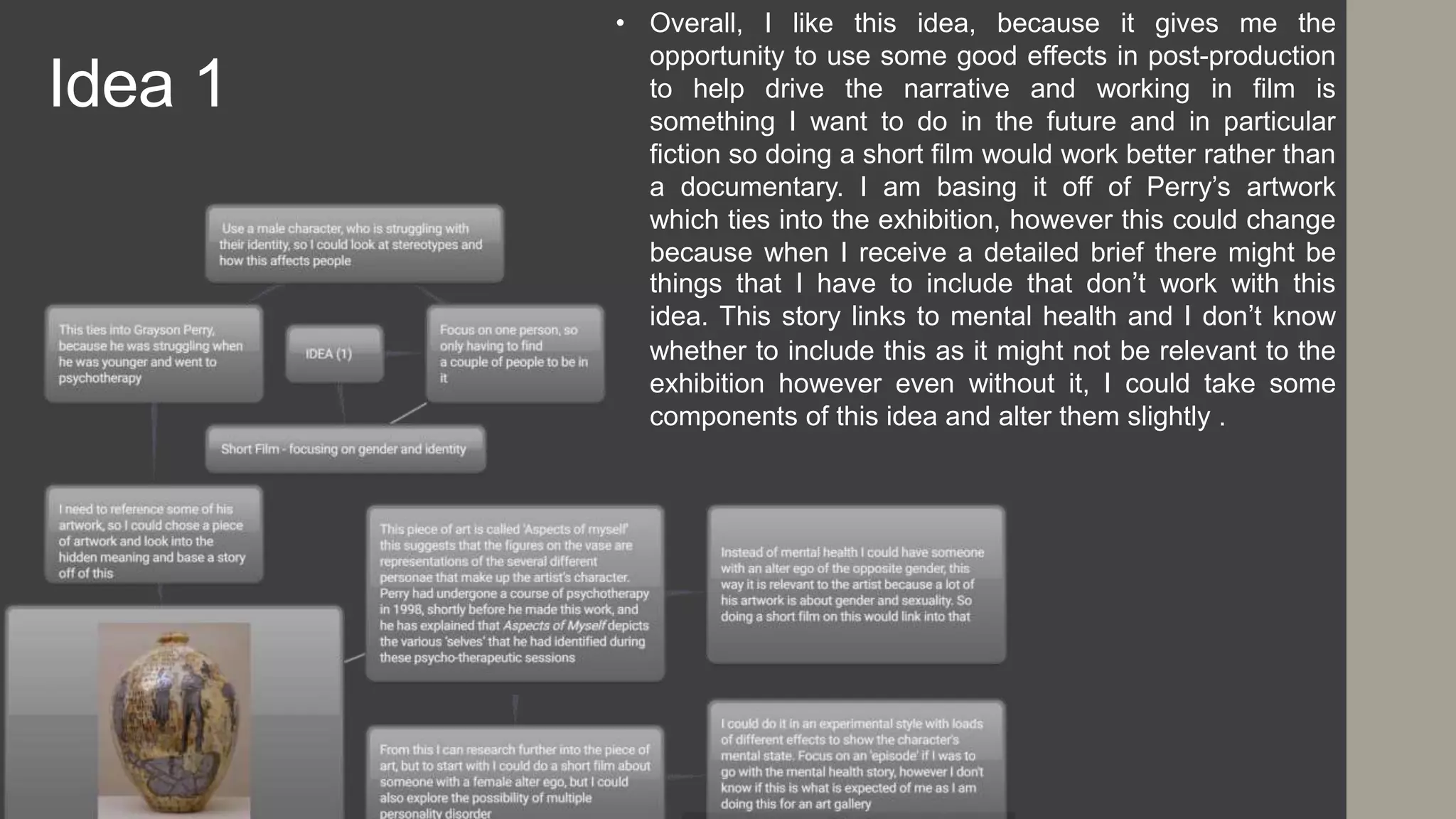
• Overall, I like this idea, because it gives me the
opportunity to use some good effects in post-production
to help drive the narrative and working in film is
something I want to do in the future and in particular
fiction so doing a short film would work better rather than
a documentary. I am basing it off of Perry’s artwork
which ties into the exhibition, however this could change
because when I receive a detailed brief there might be
things that I have to include that don’t work with this
idea. This story links to mental health and I don’t know
whether to include this as it might not be relevant to the
exhibition however even without it, I could take some
components of this idea and alter them slightly .
Idea 2
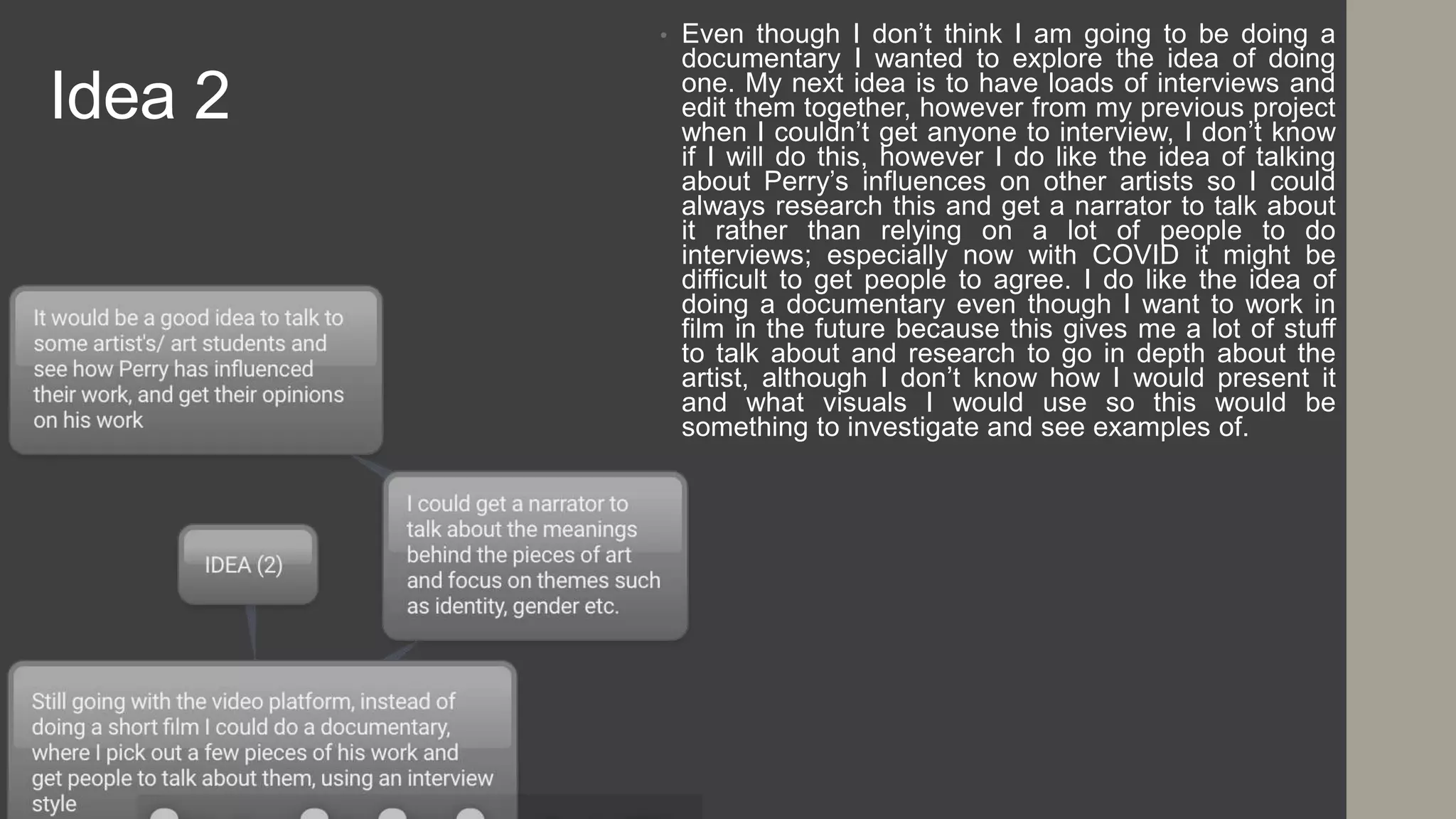
• Even though I don’t think I am going to be doing a
documentary I wanted to explore the idea of doing
one. My next idea is to have loads of interviews and
edit them together, however from my previous project
when I couldn’t get anyone to interview, I don’t know
if I will do this, however I do like the idea of talking
about Perry’s influences on other artists so I could
always research this and get a narrator to talk about
it rather than relying on a lot of people to do
interviews; especially now with COVID it might be
difficult to get people to agree. I do like the idea of
doing a documentary even though I want to work in
film in the future because this gives me a lot of stuff
to talk about and research to go in depth about the
artist, although I don’t know how I would present it
and what visuals I would use so this would be
something to investigate and see examples of.
Idea 3
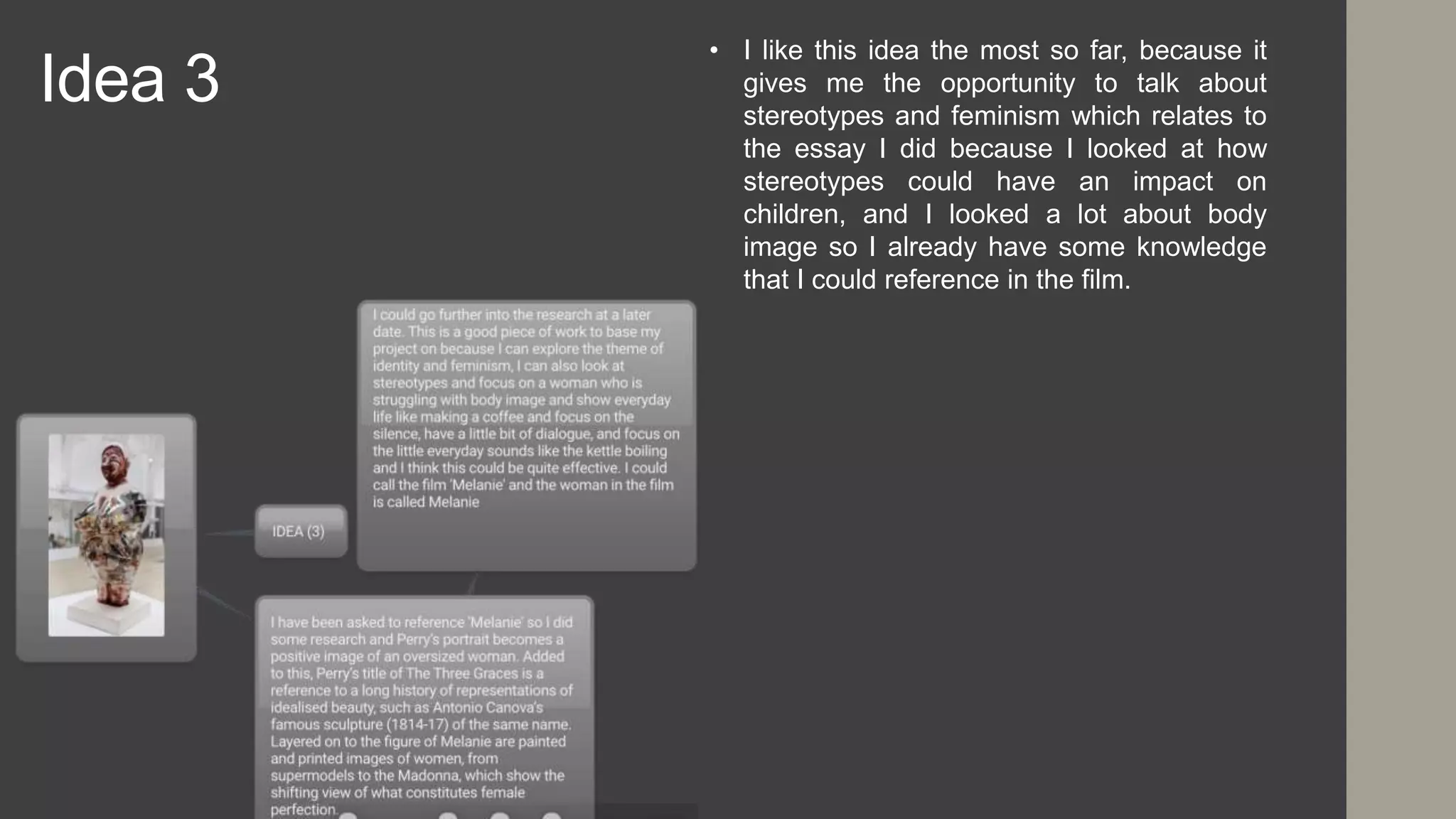
• I like this idea the most so far, because it
gives me the opportunity to talk about
stereotypes and feminism which relates to
the essay I did because I looked at how
stereotypes could have an impact on
children, and I looked a lot about body
image so I already have some knowledge
that I could reference in the film.
Idea 4
• This idea has taken influence from the third idea, however instead of a
short film I like the idea of creating a short documentary where I interview
different people and ask them questions about beauty and what makes a
person beautiful. I could do it like a talking heads type of thing where I
get a lot of people and film them the same so the interviews look the
same. I like this idea because it starts a conversation about an important
topic, and I want to execute the interviews to appear as a conversation
rather than a strict interview. I like the idea of having something
alongside the interviews such as a narrator talking about how beauty
standards have changed through different centuries, because this way I
can cut between the two so it doesn’t get too boring for the audience.
Zach Snyder
• I have decided to look at Snyder because after some research I have found that
he uses comics etc to create an original storyboard, which is similar to what I
will be doing which is taking a piece of artwork and using it to inspire my short
film btu still keeping it relevant to the artist. Snyder effectively converts the
feeling of reading a comic book to a visceral, action-packed filmgoing
experience. Also Snyder uses snap shots frequently throughout his films and this
is where it is a quick zoom in or zoom out. And for a director whose stories come
from comic books and graphic novels, who so frequently combines fantasy with
versions of the real world, snap zooms serve to ground that fantasy to reality.
This is all relevant to my FMP because looking at the process of how Snyder
takes a comic book and then turns it into a storyboard with a script etc will help
me with my pre-production process and figuring out how I can incorporate
specific artwork into my film.
Guillermo del Toro
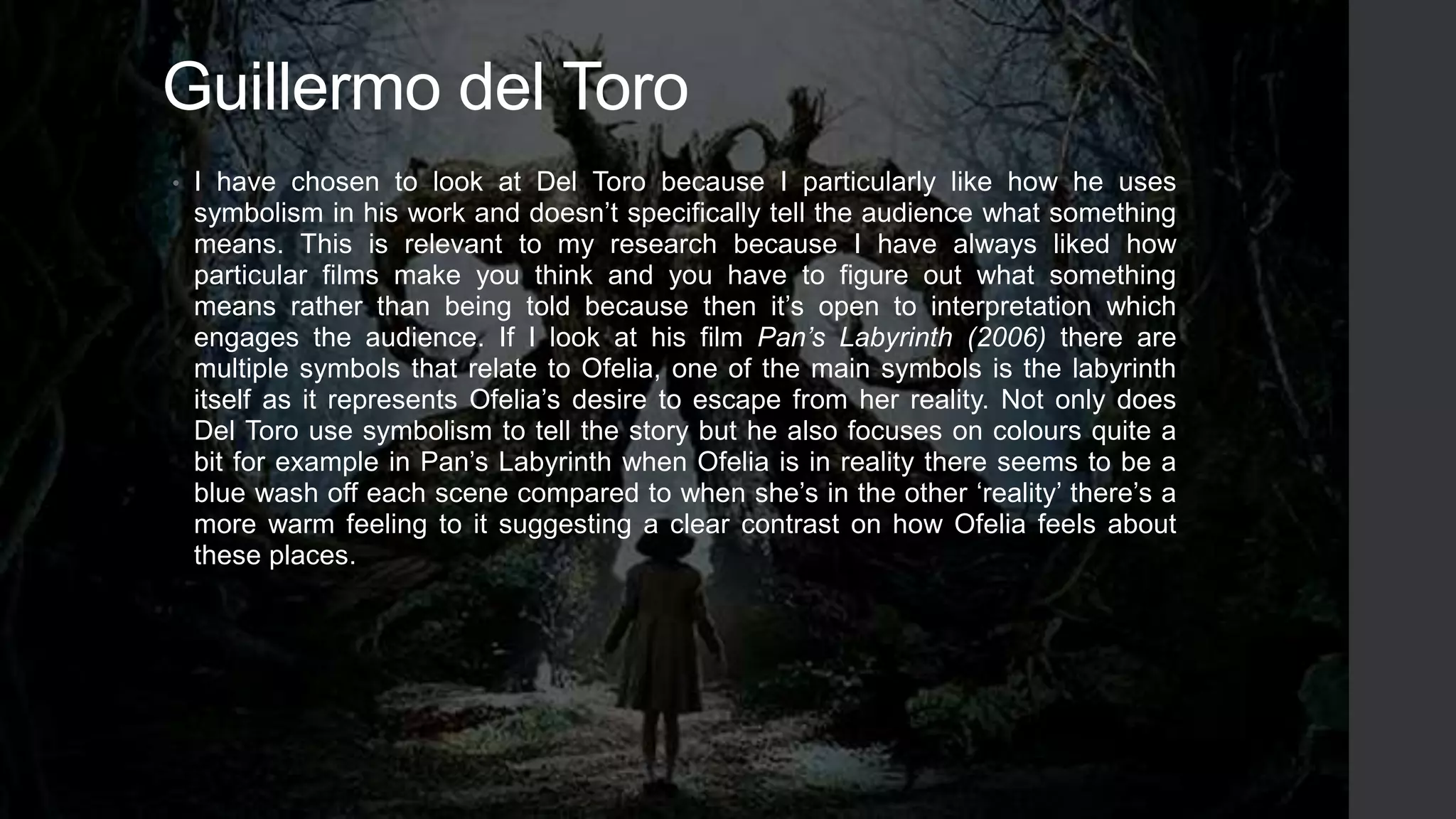
• I have chosen to look at Del Toro because I particularly like how he uses
symbolism in his work and doesn’t specifically tell the audience what something
means. This is relevant to my research because I have always liked how
particular films make you think and you have to figure out what something
means rather than being told because then it’s open to interpretation which
engages the audience. If I look at his film Pan’s Labyrinth (2006) there are
multiple symbols that relate to Ofelia, one of the main symbols is the labyrinth
itself as it represents Ofelia’s desire to escape from her reality. Not only does
Del Toro use symbolism to tell the story but he also focuses on colours quite a
bit for example in Pan’s Labyrinth when Ofelia is in reality there seems to be a
blue wash off each scene compared to when she’s in the other ‘reality’ there’s a
more warm feeling to it suggesting a clear contrast on how Ofelia feels about
these places.
Martin Scorsese
• Whenever the source of music or sound comes from the
world on screen you may safely refer to it as "diegetic
sound." This may seem like an obvious concept, but the
use of diegetic sound helps to reinforce a more realistic
tone. Scorsese will often blend diegetic sound with non-
diegetic, or transition from the musical source on screen
to the recording on the soundtrack. This helps to
intertwine his formalist use of cinematic techniques
with his realist approach to plot, characters, dialogue,
and violence. Additionally if I look at his camera
techniques he uses large camera moves such as pans,
tilts, zooms which help builds the cinematic experience.
Scorsese films feature worlds, plots, and characters that
are highly stylized representations of the specific topic
of a particular film. It all combines to create something
that many would consider highly authentic. The magic
of his films arise from his bold manipulations of formal
techniques such as editing, camera movement, sound,
performance direction, and the drastic story events. All
of this exaggerated techniques combine to create a
heightened, dramatic world that, ironically, comes
across as authentic and highly realistic.
Christopher Nolan
• I watched a video similar to the Scorsese one but it was Christopher
Nolan talking about 5 key things he does when directing. The first
one was Non linear timelines, an example he gave was his film
Memento (2000) with this he drew a diagram and explained it as
through the film he cuts between colour and black and white and
then they meet up at the end of the film. The second was intercutting
scenes an example of this would be in Dunkirk (2017) when they are
planning to shoot a jet and it cuts between the plane and then a
captain and what this does is it builds suspense and shows the story
from different points of view. The third was scene geography and
Nolan stated that he no longer walks round set when filming he stays
behind the main camera to focus on the story and see which point of
view the story should be told by. The fourth was inserts which was
an interesting part because something so trivial such as a piece of
paper with a note on it can help by telling the story. And the last was
lens proximity in which Nolan mentions don’t use the zoom on the
lens but get closer to the actor an example of this would be in
Insomnia (2002) where there was a close up on the character Will
and the actor (Al Pacino) was surprised to see where the camera
was because it was so close to his face.
Review of Directors
• Looking at each off the four directors I have established some sort of idea on
what I like to include when making a film; for example I like the way Del Toro
uses colour and symbolism to tell a story because that’s what I like when
watching a film as I think it makes the viewers come up with their own ideas so I
like the idea of it being open to interpretation. Combined with this I like how
Scorsese uses large shots such as tilts, pans etc to create a fictional world and
by doing this in my opinion it immerses the audience to create a better cinematic
experience, then there’s Nolan’s film techniques and I like the idea of using
inserts such as letters or a diary to help tell a story because it can help tell the
story quicker than usual and considering I’m only doing a short film it would be a
beneficial idea to guide the story in the right direction. All these director’s have
made films different to each other with their own unique way of doing things and
combining all the things I like about their style I have managed to create an
outline of they way I want to make this FMP film.
Grayson Perry • As I am doing a project that ties into Grayson Perry’s
artwork it would be beneficial to look more into the
artist. Perry is an English contemporary artist, writer
and broadcaster. He is known for his ceramic vases,
tapestries and cross-dressing, as well as his
observations of the contemporary arts scene, and for
dissecting British "prejudices, fashions and foibles“.
His artwork often explores themes relating to gender,
identity, sexuality, etc. so this is something to consider
as I will base my short film on one of these themes
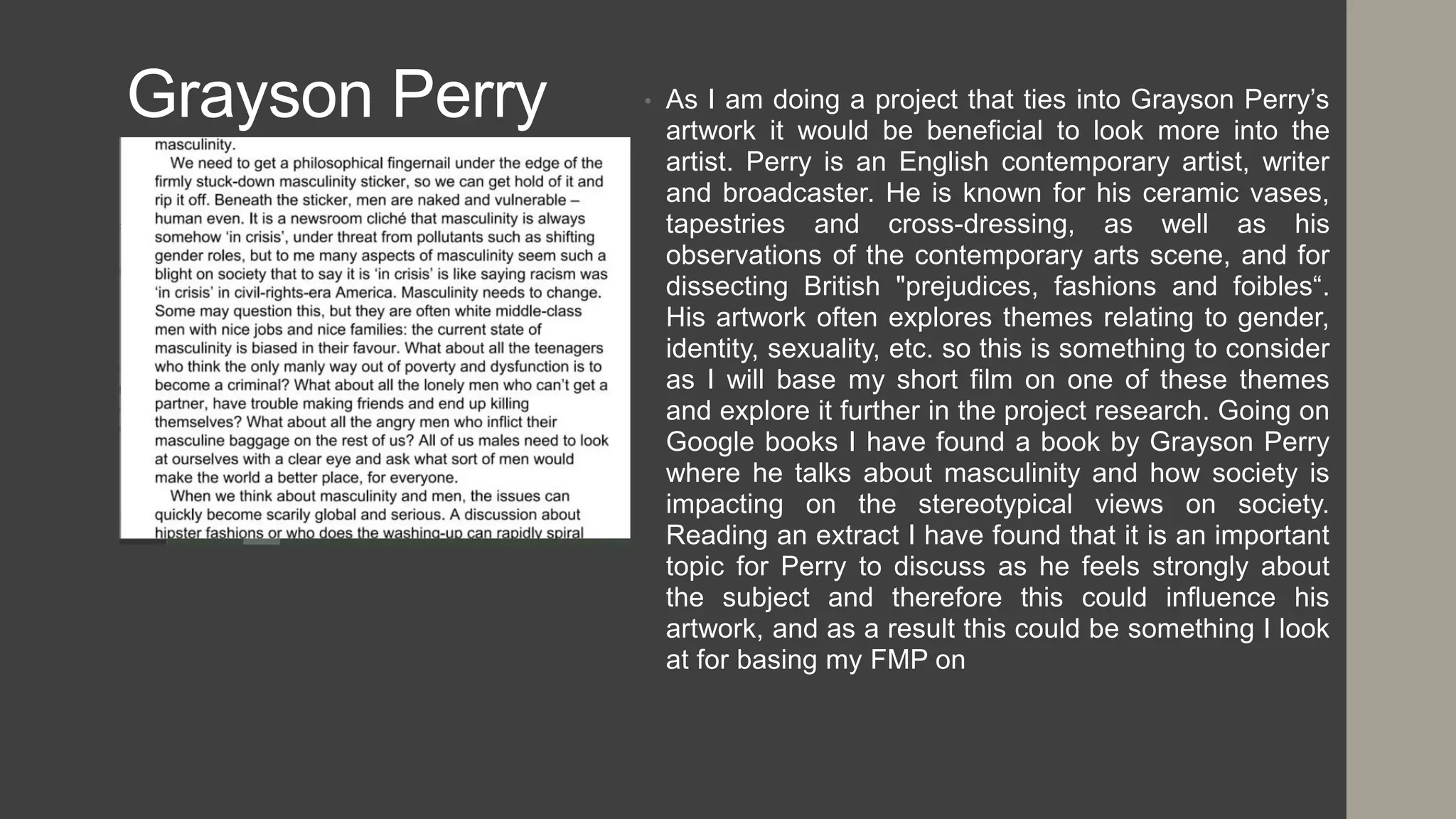
and explore it further in the project research. Going on
Google books I have found a book by Grayson Perry
where he talks about masculinity and how society is
impacting on the stereotypical views on society.
Reading an extract I have found that it is an important
topic for Perry to discuss as he feels strongly about
the subject and therefore this could influence his
artwork, and as a result this could be something I look
at for basing my FMP on
• In particular I am going to be looking at his ceramics work, and they
mostly depict images of child abuse or violence they also comment on
the consumerism, class, media and politics. Aspects of Myself is a
large glazed ovoid-shaped vase that tapers to a narrow neck at its
top. The vase has a patchy gold and yellow glaze on its surface onto
which are painted an array of figures of varying sizes in dark outline,
coloured in with a blue metallic glaze which gives the piece a sombre
feeling. Each figure stands or sits alone and looks out at the viewer,
and some of these characters appear in ordinary poses in everyday
settings for example, a teenage boy holds a bunch of flowers and a
man rides a motorcycle while others are of a more sinister nature,
such as the tied up woman shown towards the bottom of one side of
the vase. Among the blue figures are painted numerous tiny red and
brown bodies wearing dresses, which multiply and become more
mummy-like in appearance towards the neck of the vase. From this
piece of work I can infer that Perry made it in relation to his
personalities so his alter ego Claire could represent the woman tied
up suggesting when he was younger he felt like he had to keep that
side of him hidden or ‘tied up’
• This piece of art is called ‘Melanie’ and this ceramic piece shows
women dating back more than 25,000 years. By referencing
these prehistoric celebrations of the female body, Perry’s portrait
becomes a positive image of an oversized woman. Added to
this, Perry’s title of The Three Graces is a reference to a long
history of representations of idealised beauty, such as Antonio
Canova’s famous sculpture (1814-17) of the same name.
Layered on to the figure of Melanie are painted and printed
images of women, from supermodels to the Madonna, which
show the shifting view of what constitutes female perfection.
From this piece of art I can infer that Perry is all about changing
the stereotypes whether it’s how society views masculinity or the
view of women in the modern day. This suggests that I can look
at the theme of identity/stereotypes and how they are impacting
society.
Film Theory
• The first theory I will look at is the Mise en scene and what this includes. Using the website
‘Masterclass’ I came across a detailed explanation of what mise en scene includes and
how it affects what is being shown…
• Lighting: Lighting is often the tool that conveys mood most clearly. High-key lighting, often
used in musicals and romantic comedies, relies on hard light to minimize shadows. Low-
key lighting, often used in horror movies, features a high-contrast lighting pattern to both
brighten and darken parts of the frame.
• Shot blocking and camera placement: Blocking is working with performers to figure out
their body positions, gestures, and movements on stage. In cinema, blocking also involves
working out the placement and movements of the camera, and can impact the lighting, set
design, and more. Both shot blocking and camera placement are effective tools that convey
things like characters’ status and relationships to the audience.
• Actors: Actors, their performances, and their performance styles are crucial parts of mise
en scene. When an actor is on screen, they’re typically the focal point, so their presence
carries a lot of weight for the overall look of the story.
• Location: The location of the scene sets the mood and supports the action. For example,
in a scene in which a man proposes to his girlfriend, a domestic setting sets a completely
different tone than a public one.
• Set design: Set design refers to everything the audience sees within a particular scene.
These details help build out the world of the location and add even more context to the
story. If it’s a dorm room, are there books and notebooks on the desk to indicate studying?
Or are there pizza boxes and red cups to indicate a party?
• Composition: Composition is the deliberate selection of frames and camera angles that
make up a shot. Manipulating composition can accentuate the emotional themes of the
story and communicate a sense of meaning to the audience.
• Depth of space: The depth of space is the distance between people, props, and
scenery, both in relation to one another and the camera. Much like shot blocking, it
can tell the audience a lot about the tone of the scene and the status of the
characters. Is the space shallow or deep?
• Film stock: The film stock refers to the appearance of the movie on the screen. Is it
in black and white, or colour? Is the film fine-grain, or grainy? Each tells a different
story.
• Costumes: Costumes are the clothes actors wear and how they’re tailored to fit
them. For costumes to be effective, a costume designer must know which colours
look right on a character, and then reconcile this with the colours suited to the actor
playing the part and the colour palette of the production design.
• The next thing I am going to look at is the types of film theory…
• Feminist: Feminist film theory studies representations of women in cinema. A
foundational work of feminist film theory is Laura Mulvey’s 1975 essay “Visual
Pleasure and Narrative Cinema,” in which she coined the term “male gaze.”
Feminist theory may investigate how filmmakers objectify and sexualize female
characters without regard for their subjectivity.
• Marxist: Marxist film theory studies the representation of power structures and
class struggle in film. In Marxist readings of a film, the theorist may focus on
protagonists fighting for the needs of a group against the powers of capital.
• Psychoanalytic: Psychoanalytic film theory emphasizes the study of the human
psyche, analysing the effect of things like narcissism, sexual desire, or
unconscious thoughts on a character’s movement through a narrative.
• Queer: Queer emphasizes queer subject matter and subtexts in film, exploring
how sexual orientation and gender identity manifest in cinema.
• Auteur: Auteur theory assumes that the director is the primary artistic visionary
of a film. This theory functions under the belief that the best films are made by
filmmakers with a unique, personal vision who write and direct their own films.
Colour Theory
1. Colour harmony: Color harmony describes colour pairings that are visually pleasing and
provide a sense of visual order. Color schemes based on complementary and analogous
colours are generally perceived as harmonious. But, since humans respond to colours
differently depending on personal preferences and life experiences, there are no
universally “right” colours for achieving harmony.
2. Color temperature: Colour temperature deals with breaking colour down into warm colours
which is associated with sunset and daylight and cool colours which is associated with
overcast light. Experimenting with combinations of warm and cool colours can help you
mix colours to achieve a particular effect.
3. Color context: Colours appear to behave differently when viewed in different contexts. For
instance, a rusty orange may seem dull and subdued when placed beside a vivid yellow,
but when paired with a dark purple, the orange suddenly seems much brighter.
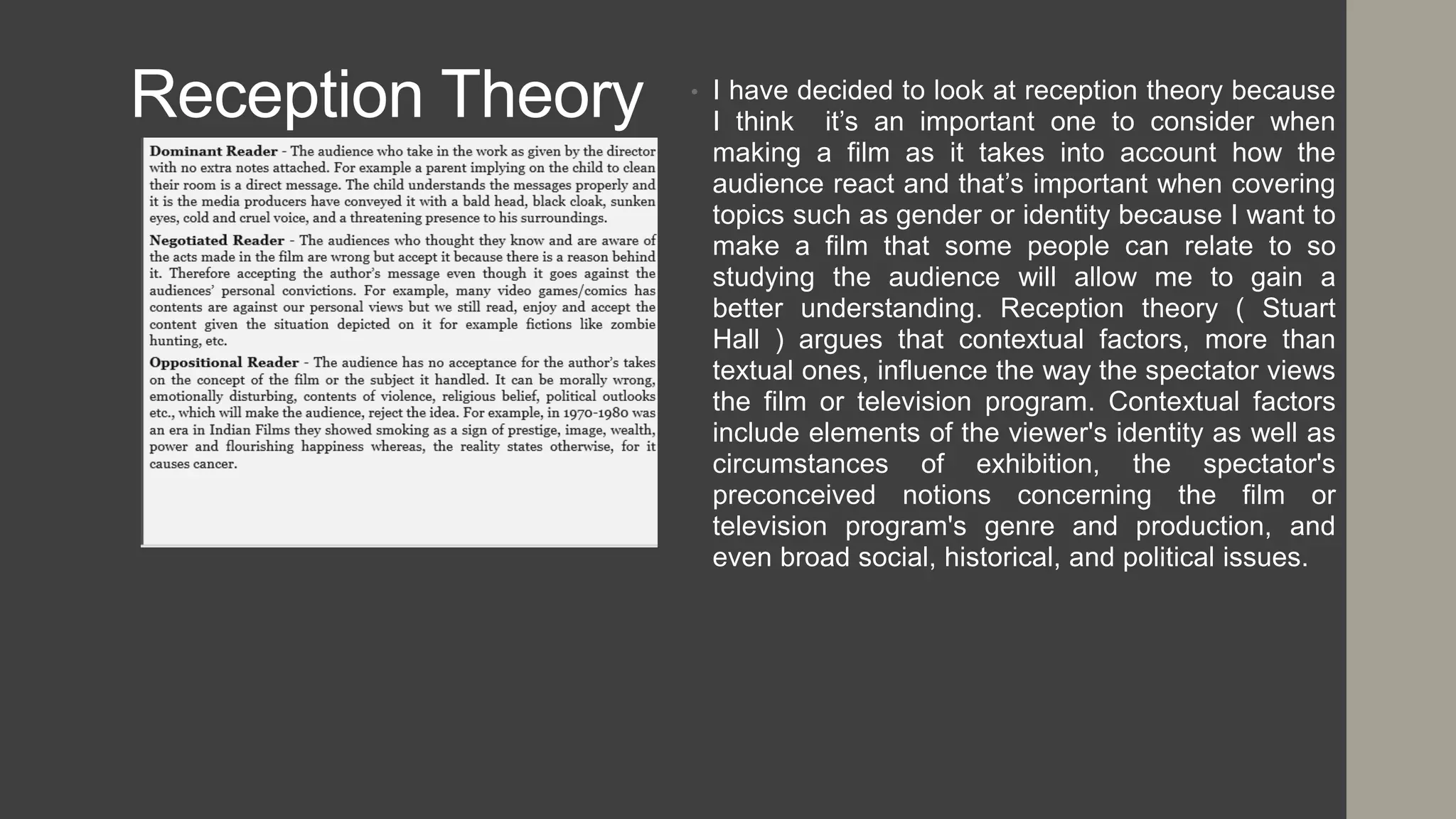
Reception Theory • I have decided to look at reception theory because
I think it’s an important one to consider when
making a film as it takes into account how the
audience react and that’s important when covering
topics such as gender or identity because I want to
make a film that some people can relate to so
studying the audience will allow me to gain a
better understanding. Reception theory ( Stuart
Hall ) argues that contextual factors, more than
textual ones, influence the way the spectator views
the film or television program. Contextual factors
include elements of the viewer's identity as well as
circumstances of exhibition, the spectator's
preconceived notions concerning the film or
television program's genre and production, and
even broad social, historical, and political issues.
Bibliography
1. ANON. (N/A). Melanie (The Three Graces). Available: https://www.artfund.org/supporting-museums/art-weve-helped-buy/artwork/13092/melanie-the-
three-graces. Last accessed 6th January 2021.
2. MasterClass. (2020). Color Theory Basics. Available: https://www.masterclass.com/articles/color-theory-basics-understanding-the-color-wheel#what-is-a-
color-wheel. Last accessed 6th January 2021.
3. MasterClass. (2020). Film Theory Guide: 5 Types of Film Theory. Available: https://www.masterclass.com/articles/film-theory-guide#what-is-film-theory.
Last accessed 6th January 2021.
4. MasterClass. (2020). What Is Mise en Scène in Film?. Available: https://www.masterclass.com/articles/what-is-mise-en-scene-in-film#what-is-mise-en-
scne. Last accessed 6th January 2021.
5. Perry, G. (2016). The Descent of Man. Available: https://www.google.co.uk/books/edition/The_Descent_of_Man/z44sDAAAQBAJ?hl=en&gbpv=0. Last
accessed 6th January 2021.
6. StudioBinder. (2019). Christopher Nolan: A Filmmaker’s Guide to Nolan’s Directing Style. Available: https://www.studiobinder.com/blog/christopher-nolan-
directing-visual-style/. Last accessed 5th January 2021.
7. StudioBinder. (2020). Martin Scorsese Directed Movies: Interviews and Quotes on his Filmmaking Techniques. Available:
https://www.studiobinder.com/blog/martin-scorsese-style-of-filmmaking/. Last accessed 5th January 2021.
8. StudioBinder. (2020). Zack Snyder’s Directing Style: What We Can Learn from Zack Snyder’s Movies. Available: https://www.studiobinder.com/blog/zack-
snyder-movies-directing-style/. Last accessed 5th January 2021.
9. TATE. (N/A). 'Aspects of Myself', Grayson Perry. Available: https://www.tate.org.uk/art/artworks/perry-aspects-of-myself-t07904#. Last accessed 6th
January 2021.

3. context research

  • 1.
  • 2.
    Contextual Statement • Forthis project I am wanting to make either a short film or short documentary because this is the area that I enjoy the most and I have chosen to do at university so I think it is going to be beneficial to create something in the video platform. I have been influenced by a piece from the artist Grayson Perry, the piece is called ‘Melanie’ and she is part of ‘the three graces’ and they are three pieces that represent women who might not fit into the ideal beauty standards. This made me think that it would be a good opportunity to either do a documentary or a film looking into this topic because it’s an important conversation. I want to make this project because I think it is important to talk about these issues especially body image etc. because things aren’t going to change unless we educate people and discuss how it can be dangerous to make women fit into one category. This project will be shown at York Art Gallery alongside other students work so I am going to look at other pieces that Perry has done although Melanie has stood out to me so I like the idea of using this piece to influence my own work. I plan on exploring a few different directors to understand a little more about creating my own unique ‘style’ of film, I am going to look at some director’s that I like because that’s where I get my inspiration from. For this project I want specify it around Perry’s artwork and explore some of the themes that are seen throughout his work, at a first glance they seem to be gender/stereotypes/identity so doing a short film exploring these topics would allow me to tie this project into the exhibition. I am looking forward to doing this project because we didn’t have the chance to make anything last year due to the coronavirus restrictions and I think if I go with the theme of ‘Melanie’ I can talk about a lot of topics that are relevant and I enjoy. If the restrictions continue it is going to be difficult interviewing people however I can address this later when I know more information about moving forward and I have a solid idea of what I am going to do.
  • 3.
    Research Intentions In thisPowerPoint my intentions are to look at certain film directors and look at the different styles each director has, by doing this I hope to find my own unique style that I can apply to my FMP and future work. I will also be looking at some effects and techniques that I can use when it comes to production such as certain post production effects or lighting tips etc and I will do this by searching tutorials on YouTube and link them so when it comes to experiments I have a collection of things to try out. Additionally I am doing this FMP for a Grayson Perry art exhibition showing some of his work so I will do a bit of research about the artist and pick out certain pieces of art to inspire my project so then I can take the research further in the project research. I will also be doing some idea generation to explore my different options and how they relate to pieces of Perry’s art, I don’t plan on getting a set idea but a brief idea of what I want it to be about and I might compromise
  • 4.
    Idea 1 • Overall,I like this idea, because it gives me the opportunity to use some good effects in post-production to help drive the narrative and working in film is something I want to do in the future and in particular fiction so doing a short film would work better rather than a documentary. I am basing it off of Perry’s artwork which ties into the exhibition, however this could change because when I receive a detailed brief there might be things that I have to include that don’t work with this idea. This story links to mental health and I don’t know whether to include this as it might not be relevant to the exhibition however even without it, I could take some components of this idea and alter them slightly .
  • 5.
    Idea 2 • Eventhough I don’t think I am going to be doing a documentary I wanted to explore the idea of doing one. My next idea is to have loads of interviews and edit them together, however from my previous project when I couldn’t get anyone to interview, I don’t know if I will do this, however I do like the idea of talking about Perry’s influences on other artists so I could always research this and get a narrator to talk about it rather than relying on a lot of people to do interviews; especially now with COVID it might be difficult to get people to agree. I do like the idea of doing a documentary even though I want to work in film in the future because this gives me a lot of stuff to talk about and research to go in depth about the artist, although I don’t know how I would present it and what visuals I would use so this would be something to investigate and see examples of.
  • 6.
    Idea 3 • Ilike this idea the most so far, because it gives me the opportunity to talk about stereotypes and feminism which relates to the essay I did because I looked at how stereotypes could have an impact on children, and I looked a lot about body image so I already have some knowledge that I could reference in the film.
  • 7.
    Idea 4 • Thisidea has taken influence from the third idea, however instead of a short film I like the idea of creating a short documentary where I interview different people and ask them questions about beauty and what makes a person beautiful. I could do it like a talking heads type of thing where I get a lot of people and film them the same so the interviews look the same. I like this idea because it starts a conversation about an important topic, and I want to execute the interviews to appear as a conversation rather than a strict interview. I like the idea of having something alongside the interviews such as a narrator talking about how beauty standards have changed through different centuries, because this way I can cut between the two so it doesn’t get too boring for the audience.
  • 8.
    Zach Snyder • Ihave decided to look at Snyder because after some research I have found that he uses comics etc to create an original storyboard, which is similar to what I will be doing which is taking a piece of artwork and using it to inspire my short film btu still keeping it relevant to the artist. Snyder effectively converts the feeling of reading a comic book to a visceral, action-packed filmgoing experience. Also Snyder uses snap shots frequently throughout his films and this is where it is a quick zoom in or zoom out. And for a director whose stories come from comic books and graphic novels, who so frequently combines fantasy with versions of the real world, snap zooms serve to ground that fantasy to reality. This is all relevant to my FMP because looking at the process of how Snyder takes a comic book and then turns it into a storyboard with a script etc will help me with my pre-production process and figuring out how I can incorporate specific artwork into my film.
  • 9.
    Guillermo del Toro •I have chosen to look at Del Toro because I particularly like how he uses symbolism in his work and doesn’t specifically tell the audience what something means. This is relevant to my research because I have always liked how particular films make you think and you have to figure out what something means rather than being told because then it’s open to interpretation which engages the audience. If I look at his film Pan’s Labyrinth (2006) there are multiple symbols that relate to Ofelia, one of the main symbols is the labyrinth itself as it represents Ofelia’s desire to escape from her reality. Not only does Del Toro use symbolism to tell the story but he also focuses on colours quite a bit for example in Pan’s Labyrinth when Ofelia is in reality there seems to be a blue wash off each scene compared to when she’s in the other ‘reality’ there’s a more warm feeling to it suggesting a clear contrast on how Ofelia feels about these places.
  • 10.
    Martin Scorsese • Wheneverthe source of music or sound comes from the world on screen you may safely refer to it as "diegetic sound." This may seem like an obvious concept, but the use of diegetic sound helps to reinforce a more realistic tone. Scorsese will often blend diegetic sound with non- diegetic, or transition from the musical source on screen to the recording on the soundtrack. This helps to intertwine his formalist use of cinematic techniques with his realist approach to plot, characters, dialogue, and violence. Additionally if I look at his camera techniques he uses large camera moves such as pans, tilts, zooms which help builds the cinematic experience. Scorsese films feature worlds, plots, and characters that are highly stylized representations of the specific topic of a particular film. It all combines to create something that many would consider highly authentic. The magic of his films arise from his bold manipulations of formal techniques such as editing, camera movement, sound, performance direction, and the drastic story events. All of this exaggerated techniques combine to create a heightened, dramatic world that, ironically, comes across as authentic and highly realistic.
  • 11.
    Christopher Nolan • Iwatched a video similar to the Scorsese one but it was Christopher Nolan talking about 5 key things he does when directing. The first one was Non linear timelines, an example he gave was his film Memento (2000) with this he drew a diagram and explained it as through the film he cuts between colour and black and white and then they meet up at the end of the film. The second was intercutting scenes an example of this would be in Dunkirk (2017) when they are planning to shoot a jet and it cuts between the plane and then a captain and what this does is it builds suspense and shows the story from different points of view. The third was scene geography and Nolan stated that he no longer walks round set when filming he stays behind the main camera to focus on the story and see which point of view the story should be told by. The fourth was inserts which was an interesting part because something so trivial such as a piece of paper with a note on it can help by telling the story. And the last was lens proximity in which Nolan mentions don’t use the zoom on the lens but get closer to the actor an example of this would be in Insomnia (2002) where there was a close up on the character Will and the actor (Al Pacino) was surprised to see where the camera was because it was so close to his face.
  • 12.
    Review of Directors •Looking at each off the four directors I have established some sort of idea on what I like to include when making a film; for example I like the way Del Toro uses colour and symbolism to tell a story because that’s what I like when watching a film as I think it makes the viewers come up with their own ideas so I like the idea of it being open to interpretation. Combined with this I like how Scorsese uses large shots such as tilts, pans etc to create a fictional world and by doing this in my opinion it immerses the audience to create a better cinematic experience, then there’s Nolan’s film techniques and I like the idea of using inserts such as letters or a diary to help tell a story because it can help tell the story quicker than usual and considering I’m only doing a short film it would be a beneficial idea to guide the story in the right direction. All these director’s have made films different to each other with their own unique way of doing things and combining all the things I like about their style I have managed to create an outline of they way I want to make this FMP film.
  • 13.
    Grayson Perry •As I am doing a project that ties into Grayson Perry’s artwork it would be beneficial to look more into the artist. Perry is an English contemporary artist, writer and broadcaster. He is known for his ceramic vases, tapestries and cross-dressing, as well as his observations of the contemporary arts scene, and for dissecting British "prejudices, fashions and foibles“. His artwork often explores themes relating to gender, identity, sexuality, etc. so this is something to consider as I will base my short film on one of these themes and explore it further in the project research. Going on Google books I have found a book by Grayson Perry where he talks about masculinity and how society is impacting on the stereotypical views on society. Reading an extract I have found that it is an important topic for Perry to discuss as he feels strongly about the subject and therefore this could influence his artwork, and as a result this could be something I look at for basing my FMP on
  • 14.
    • In particularI am going to be looking at his ceramics work, and they mostly depict images of child abuse or violence they also comment on the consumerism, class, media and politics. Aspects of Myself is a large glazed ovoid-shaped vase that tapers to a narrow neck at its top. The vase has a patchy gold and yellow glaze on its surface onto which are painted an array of figures of varying sizes in dark outline, coloured in with a blue metallic glaze which gives the piece a sombre feeling. Each figure stands or sits alone and looks out at the viewer, and some of these characters appear in ordinary poses in everyday settings for example, a teenage boy holds a bunch of flowers and a man rides a motorcycle while others are of a more sinister nature, such as the tied up woman shown towards the bottom of one side of the vase. Among the blue figures are painted numerous tiny red and brown bodies wearing dresses, which multiply and become more mummy-like in appearance towards the neck of the vase. From this piece of work I can infer that Perry made it in relation to his personalities so his alter ego Claire could represent the woman tied up suggesting when he was younger he felt like he had to keep that side of him hidden or ‘tied up’
  • 15.
    • This pieceof art is called ‘Melanie’ and this ceramic piece shows women dating back more than 25,000 years. By referencing these prehistoric celebrations of the female body, Perry’s portrait becomes a positive image of an oversized woman. Added to this, Perry’s title of The Three Graces is a reference to a long history of representations of idealised beauty, such as Antonio Canova’s famous sculpture (1814-17) of the same name. Layered on to the figure of Melanie are painted and printed images of women, from supermodels to the Madonna, which show the shifting view of what constitutes female perfection. From this piece of art I can infer that Perry is all about changing the stereotypes whether it’s how society views masculinity or the view of women in the modern day. This suggests that I can look at the theme of identity/stereotypes and how they are impacting society.
  • 16.
    Film Theory • Thefirst theory I will look at is the Mise en scene and what this includes. Using the website ‘Masterclass’ I came across a detailed explanation of what mise en scene includes and how it affects what is being shown… • Lighting: Lighting is often the tool that conveys mood most clearly. High-key lighting, often used in musicals and romantic comedies, relies on hard light to minimize shadows. Low- key lighting, often used in horror movies, features a high-contrast lighting pattern to both brighten and darken parts of the frame. • Shot blocking and camera placement: Blocking is working with performers to figure out their body positions, gestures, and movements on stage. In cinema, blocking also involves working out the placement and movements of the camera, and can impact the lighting, set design, and more. Both shot blocking and camera placement are effective tools that convey things like characters’ status and relationships to the audience.
  • 17.
    • Actors: Actors,their performances, and their performance styles are crucial parts of mise en scene. When an actor is on screen, they’re typically the focal point, so their presence carries a lot of weight for the overall look of the story. • Location: The location of the scene sets the mood and supports the action. For example, in a scene in which a man proposes to his girlfriend, a domestic setting sets a completely different tone than a public one. • Set design: Set design refers to everything the audience sees within a particular scene. These details help build out the world of the location and add even more context to the story. If it’s a dorm room, are there books and notebooks on the desk to indicate studying? Or are there pizza boxes and red cups to indicate a party? • Composition: Composition is the deliberate selection of frames and camera angles that make up a shot. Manipulating composition can accentuate the emotional themes of the story and communicate a sense of meaning to the audience.
  • 18.
    • Depth ofspace: The depth of space is the distance between people, props, and scenery, both in relation to one another and the camera. Much like shot blocking, it can tell the audience a lot about the tone of the scene and the status of the characters. Is the space shallow or deep? • Film stock: The film stock refers to the appearance of the movie on the screen. Is it in black and white, or colour? Is the film fine-grain, or grainy? Each tells a different story. • Costumes: Costumes are the clothes actors wear and how they’re tailored to fit them. For costumes to be effective, a costume designer must know which colours look right on a character, and then reconcile this with the colours suited to the actor playing the part and the colour palette of the production design.
  • 19.
    • The nextthing I am going to look at is the types of film theory… • Feminist: Feminist film theory studies representations of women in cinema. A foundational work of feminist film theory is Laura Mulvey’s 1975 essay “Visual Pleasure and Narrative Cinema,” in which she coined the term “male gaze.” Feminist theory may investigate how filmmakers objectify and sexualize female characters without regard for their subjectivity. • Marxist: Marxist film theory studies the representation of power structures and class struggle in film. In Marxist readings of a film, the theorist may focus on protagonists fighting for the needs of a group against the powers of capital. • Psychoanalytic: Psychoanalytic film theory emphasizes the study of the human psyche, analysing the effect of things like narcissism, sexual desire, or unconscious thoughts on a character’s movement through a narrative. • Queer: Queer emphasizes queer subject matter and subtexts in film, exploring how sexual orientation and gender identity manifest in cinema. • Auteur: Auteur theory assumes that the director is the primary artistic visionary of a film. This theory functions under the belief that the best films are made by filmmakers with a unique, personal vision who write and direct their own films.
  • 20.
    Colour Theory 1. Colourharmony: Color harmony describes colour pairings that are visually pleasing and provide a sense of visual order. Color schemes based on complementary and analogous colours are generally perceived as harmonious. But, since humans respond to colours differently depending on personal preferences and life experiences, there are no universally “right” colours for achieving harmony. 2. Color temperature: Colour temperature deals with breaking colour down into warm colours which is associated with sunset and daylight and cool colours which is associated with overcast light. Experimenting with combinations of warm and cool colours can help you mix colours to achieve a particular effect. 3. Color context: Colours appear to behave differently when viewed in different contexts. For instance, a rusty orange may seem dull and subdued when placed beside a vivid yellow, but when paired with a dark purple, the orange suddenly seems much brighter.
  • 21.
    Reception Theory •I have decided to look at reception theory because I think it’s an important one to consider when making a film as it takes into account how the audience react and that’s important when covering topics such as gender or identity because I want to make a film that some people can relate to so studying the audience will allow me to gain a better understanding. Reception theory ( Stuart Hall ) argues that contextual factors, more than textual ones, influence the way the spectator views the film or television program. Contextual factors include elements of the viewer's identity as well as circumstances of exhibition, the spectator's preconceived notions concerning the film or television program's genre and production, and even broad social, historical, and political issues.
  • 22.
    Bibliography 1. ANON. (N/A).Melanie (The Three Graces). Available: https://www.artfund.org/supporting-museums/art-weve-helped-buy/artwork/13092/melanie-the- three-graces. Last accessed 6th January 2021. 2. MasterClass. (2020). Color Theory Basics. Available: https://www.masterclass.com/articles/color-theory-basics-understanding-the-color-wheel#what-is-a- color-wheel. Last accessed 6th January 2021. 3. MasterClass. (2020). Film Theory Guide: 5 Types of Film Theory. Available: https://www.masterclass.com/articles/film-theory-guide#what-is-film-theory. Last accessed 6th January 2021. 4. MasterClass. (2020). What Is Mise en Scène in Film?. Available: https://www.masterclass.com/articles/what-is-mise-en-scene-in-film#what-is-mise-en- scne. Last accessed 6th January 2021. 5. Perry, G. (2016). The Descent of Man. Available: https://www.google.co.uk/books/edition/The_Descent_of_Man/z44sDAAAQBAJ?hl=en&gbpv=0. Last accessed 6th January 2021. 6. StudioBinder. (2019). Christopher Nolan: A Filmmaker’s Guide to Nolan’s Directing Style. Available: https://www.studiobinder.com/blog/christopher-nolan- directing-visual-style/. Last accessed 5th January 2021. 7. StudioBinder. (2020). Martin Scorsese Directed Movies: Interviews and Quotes on his Filmmaking Techniques. Available: https://www.studiobinder.com/blog/martin-scorsese-style-of-filmmaking/. Last accessed 5th January 2021. 8. StudioBinder. (2020). Zack Snyder’s Directing Style: What We Can Learn from Zack Snyder’s Movies. Available: https://www.studiobinder.com/blog/zack- snyder-movies-directing-style/. Last accessed 5th January 2021. 9. TATE. (N/A). 'Aspects of Myself', Grayson Perry. Available: https://www.tate.org.uk/art/artworks/perry-aspects-of-myself-t07904#. Last accessed 6th January 2021.