Experiments
Your Name
Process
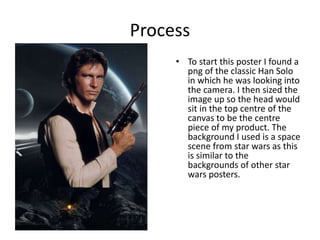
• To start this poster I found a
png of the classic Han Solo
in which he was looking into
the camera. I then sized the
image up so the head would
sit in the top centre of the
canvas to be the centre
piece of my product. The
background I used is a space
scene from star wars as this
is similar to the
backgrounds of other star
wars posters.
Process
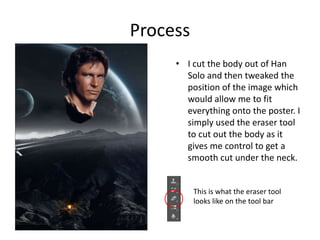
• I cut the body out of Han
Solo and then tweaked the
position of the image which
would allow me to fit
everything onto the poster. I
simply used the eraser tool
to cut out the body as it
gives me control to get a
smooth cut under the neck.
This is what the eraser tool
looks like on the tool bar
Process
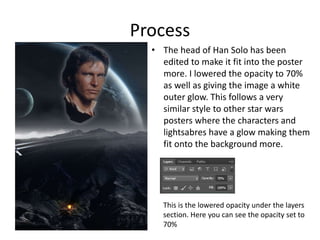
• The head of Han Solo has been
edited to make it fit into the poster
more. I lowered the opacity to 70%
as well as giving the image a white
outer glow. This follows a very
similar style to other star wars
posters where the characters and
lightsabres have a glow making them
fit onto the background more.
This is the lowered opacity under the layers
section. Here you can see the opacity set to
70%
Process
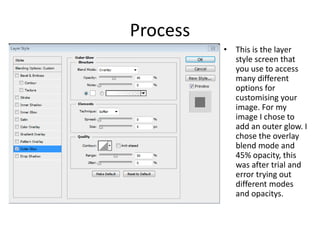
• This is the layer
style screen that
you use to access
many different
options for
customising your
image. For my
image I chose to
add an outer glow. I
chose the overlay
blend mode and
45% opacity, this
was after trial and
error trying out
different modes
and opacitys.
Process
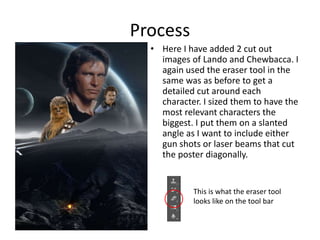
• Here I have added 2 cut out
images of Lando and Chewbacca. I
again used the eraser tool in the
same was as before to get a
detailed cut around each
character. I sized them to have the
most relevant characters the
biggest. I put them on a slanted
angle as I want to include either
gun shots or laser beams that cut
the poster diagonally.
This is what the eraser tool
looks like on the tool bar
Process
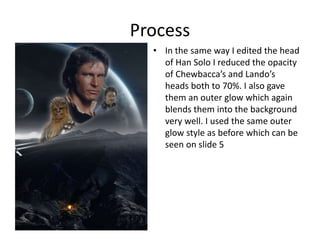
• In the same way I edited the head
of Han Solo I reduced the opacity
of Chewbacca’s and Lando’s
heads both to 70%. I also gave
them an outer glow which again
blends them into the background
very well. I used the same outer
glow style as before which can be
seen on slide 5
Process
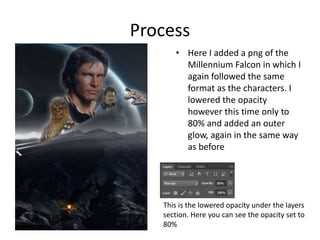
• Here I added a png of the
Millennium Falcon in which I
again followed the same
format as the characters. I
lowered the opacity
however this time only to
80% and added an outer
glow, again in the same way
as before
This is the lowered opacity under the layers
section. Here you can see the opacity set to
80%
Process
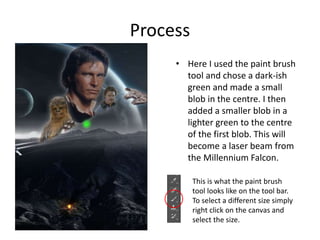
• Here I used the paint brush
tool and chose a dark-ish
green and made a small
blob in the centre. I then
added a smaller blob in a
lighter green to the centre
of the first blob. This will
become a laser beam from
the Millennium Falcon.
This is what the paint brush
tool looks like on the tool bar.
To select a different size simply
right click on the canvas and
select the size.
Process
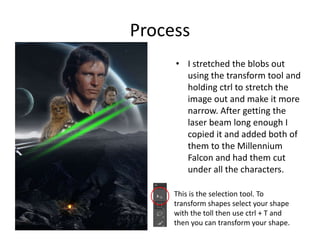
• I stretched the blobs out
using the transform tool and
holding ctrl to stretch the
image out and make it more
narrow. After getting the
laser beam long enough I
copied it and added both of
them to the Millennium
Falcon and had them cut
under all the characters.
This is the selection tool. To
transform shapes select your shape
with the toll then use ctrl + T and
then you can transform your shape.
Process
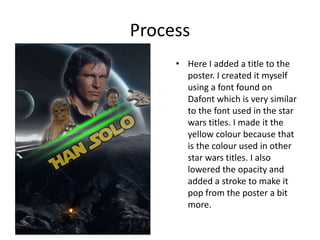
• Here I added a title to the
poster. I created it myself
using a font found on
Dafont which is very similar
to the font used in the star
wars titles. I made it the
yellow colour because that
is the colour used in other
star wars titles. I also
lowered the opacity and
added a stroke to make it
pop from the poster a bit
more.
Process
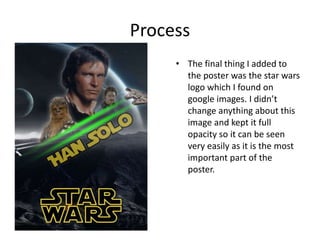
• The final thing I added to
the poster was the star wars
logo which I found on
google images. I didn’t
change anything about this
image and kept it full
opacity so it can be seen
very easily as it is the most
important part of the
poster.
Reflection
• What elements of your experiments will you include in your final product?
In my final product I will most likely be using the laser beam technique I used in
this poster by creating coloured brush circles and stretching them out to give a
laser beam effect. For my poster I will use these in more neutral colour such as
white to give the effect of gun shots or bullets.
Another element I may use is the lowering of the opacity on images to make
them fit into the background more. As well as adding an outer glow to the images
that also blend them into the background as well.
Process
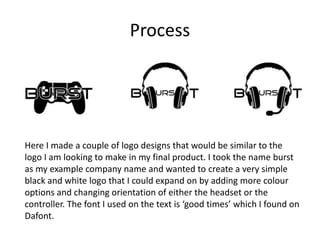
Here I made a couple of logo designs that would be similar to the
logo I am looking to make in my final product. I took the name burst
as my example company name and wanted to create a very simple
black and white logo that I could expand on by adding more colour
options and changing orientation of either the headset or the
controller. The font I used on the text is ‘good times’ which I found on
Dafont.
Process
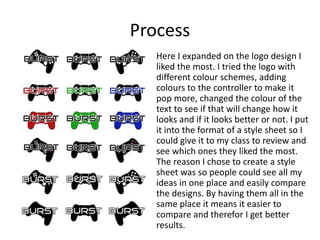
Here I expanded on the logo design I
liked the most. I tried the logo with
different colour schemes, adding
colours to the controller to make it
pop more, changed the colour of the
text to see if that will change how it
looks and if it looks better or not. I put
it into the format of a style sheet so I
could give it to my class to review and
see which ones they liked the most.
The reason I chose to create a style
sheet was so people could see all my
ideas in one place and easily compare
the designs. By having them all in the
same place it means it easier to
compare and therefor I get better
results.
Reflection
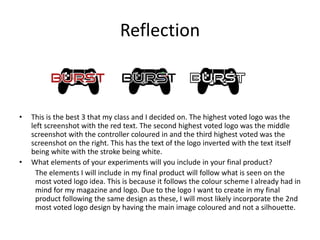
• This is the best 3 that my class and I decided on. The highest voted logo was the
left screenshot with the red text. The second highest voted logo was the middle
screenshot with the controller coloured in and the third highest voted was the
screenshot on the right. This has the text of the logo inverted with the text itself
being white with the stroke being white.
• What elements of your experiments will you include in your final product?
The elements I will include in my final product will follow what is seen on the
most voted logo idea. This is because it follows the colour scheme I already had in
mind for my magazine and logo. Due to the logo I want to create in my final
product following the same design as these, I will most likely incorporate the 2nd
most voted logo design by having the main image coloured and not a silhouette.
Process
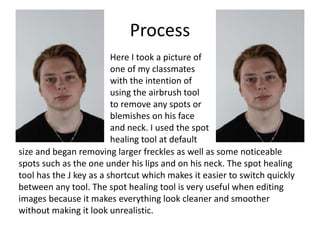
Here I took a picture of
one of my classmates
with the intention of
using the airbrush tool
to remove any spots or
blemishes on his face
and neck. I used the spot
healing tool at default
size and began removing larger freckles as well as some noticeable
spots such as the one under his lips and on his neck. The spot healing
tool has the J key as a shortcut which makes it easier to switch quickly
between any tool. The spot healing tool is very useful when editing
images because it makes everything look cleaner and smoother
without making it look unrealistic.
Process
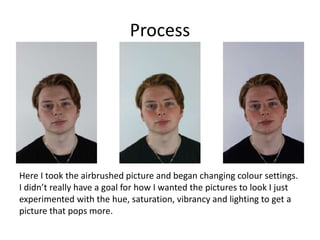
Here I took the airbrushed picture and began changing colour settings.
I didn’t really have a goal for how I wanted the pictures to look I just
experimented with the hue, saturation, vibrancy and lighting to get a
picture that pops more.
Reflection
• What elements of your experiments will you include in your final product?
In my final product I will be taking photos for my magazine, website and maybe
my poster. I will take all my photos in the studio and then I will use the airbrush,
spot healing tool and change the colours and lighting all in post production.
Although I haven’t followed any specific settings in order to change how the
image looks I will still be able to create a similar effect just by experimenting with
the sliders and settings. This will be useful in my FMP because it creates a cleaner
and more professional looking image with still keeping facial features and
noticeable details such as freckles. If I was to remove the freckles it would be
seen as very fake picture.

4. Production Experiments

  • 1.
  • 2.
    Process • To startthis poster I found a png of the classic Han Solo in which he was looking into the camera. I then sized the image up so the head would sit in the top centre of the canvas to be the centre piece of my product. The background I used is a space scene from star wars as this is similar to the backgrounds of other star wars posters.
  • 3.
    Process • I cutthe body out of Han Solo and then tweaked the position of the image which would allow me to fit everything onto the poster. I simply used the eraser tool to cut out the body as it gives me control to get a smooth cut under the neck. This is what the eraser tool looks like on the tool bar
  • 4.
    Process • The headof Han Solo has been edited to make it fit into the poster more. I lowered the opacity to 70% as well as giving the image a white outer glow. This follows a very similar style to other star wars posters where the characters and lightsabres have a glow making them fit onto the background more. This is the lowered opacity under the layers section. Here you can see the opacity set to 70%
  • 5.
    Process • This isthe layer style screen that you use to access many different options for customising your image. For my image I chose to add an outer glow. I chose the overlay blend mode and 45% opacity, this was after trial and error trying out different modes and opacitys.
  • 6.
    Process • Here Ihave added 2 cut out images of Lando and Chewbacca. I again used the eraser tool in the same was as before to get a detailed cut around each character. I sized them to have the most relevant characters the biggest. I put them on a slanted angle as I want to include either gun shots or laser beams that cut the poster diagonally. This is what the eraser tool looks like on the tool bar
  • 7.
    Process • In thesame way I edited the head of Han Solo I reduced the opacity of Chewbacca’s and Lando’s heads both to 70%. I also gave them an outer glow which again blends them into the background very well. I used the same outer glow style as before which can be seen on slide 5
  • 8.
    Process • Here Iadded a png of the Millennium Falcon in which I again followed the same format as the characters. I lowered the opacity however this time only to 80% and added an outer glow, again in the same way as before This is the lowered opacity under the layers section. Here you can see the opacity set to 80%
  • 9.
    Process • Here Iused the paint brush tool and chose a dark-ish green and made a small blob in the centre. I then added a smaller blob in a lighter green to the centre of the first blob. This will become a laser beam from the Millennium Falcon. This is what the paint brush tool looks like on the tool bar. To select a different size simply right click on the canvas and select the size.
  • 10.
    Process • I stretchedthe blobs out using the transform tool and holding ctrl to stretch the image out and make it more narrow. After getting the laser beam long enough I copied it and added both of them to the Millennium Falcon and had them cut under all the characters. This is the selection tool. To transform shapes select your shape with the toll then use ctrl + T and then you can transform your shape.
  • 11.
    Process • Here Iadded a title to the poster. I created it myself using a font found on Dafont which is very similar to the font used in the star wars titles. I made it the yellow colour because that is the colour used in other star wars titles. I also lowered the opacity and added a stroke to make it pop from the poster a bit more.
  • 12.
    Process • The finalthing I added to the poster was the star wars logo which I found on google images. I didn’t change anything about this image and kept it full opacity so it can be seen very easily as it is the most important part of the poster.
  • 13.
    Reflection • What elementsof your experiments will you include in your final product? In my final product I will most likely be using the laser beam technique I used in this poster by creating coloured brush circles and stretching them out to give a laser beam effect. For my poster I will use these in more neutral colour such as white to give the effect of gun shots or bullets. Another element I may use is the lowering of the opacity on images to make them fit into the background more. As well as adding an outer glow to the images that also blend them into the background as well.
  • 14.
    Process Here I madea couple of logo designs that would be similar to the logo I am looking to make in my final product. I took the name burst as my example company name and wanted to create a very simple black and white logo that I could expand on by adding more colour options and changing orientation of either the headset or the controller. The font I used on the text is ‘good times’ which I found on Dafont.
  • 15.
    Process Here I expandedon the logo design I liked the most. I tried the logo with different colour schemes, adding colours to the controller to make it pop more, changed the colour of the text to see if that will change how it looks and if it looks better or not. I put it into the format of a style sheet so I could give it to my class to review and see which ones they liked the most. The reason I chose to create a style sheet was so people could see all my ideas in one place and easily compare the designs. By having them all in the same place it means it easier to compare and therefor I get better results.
  • 16.
    Reflection • This isthe best 3 that my class and I decided on. The highest voted logo was the left screenshot with the red text. The second highest voted logo was the middle screenshot with the controller coloured in and the third highest voted was the screenshot on the right. This has the text of the logo inverted with the text itself being white with the stroke being white. • What elements of your experiments will you include in your final product? The elements I will include in my final product will follow what is seen on the most voted logo idea. This is because it follows the colour scheme I already had in mind for my magazine and logo. Due to the logo I want to create in my final product following the same design as these, I will most likely incorporate the 2nd most voted logo design by having the main image coloured and not a silhouette.
  • 17.
    Process Here I tooka picture of one of my classmates with the intention of using the airbrush tool to remove any spots or blemishes on his face and neck. I used the spot healing tool at default size and began removing larger freckles as well as some noticeable spots such as the one under his lips and on his neck. The spot healing tool has the J key as a shortcut which makes it easier to switch quickly between any tool. The spot healing tool is very useful when editing images because it makes everything look cleaner and smoother without making it look unrealistic.
  • 18.
    Process Here I tookthe airbrushed picture and began changing colour settings. I didn’t really have a goal for how I wanted the pictures to look I just experimented with the hue, saturation, vibrancy and lighting to get a picture that pops more.
  • 19.
    Reflection • What elementsof your experiments will you include in your final product? In my final product I will be taking photos for my magazine, website and maybe my poster. I will take all my photos in the studio and then I will use the airbrush, spot healing tool and change the colours and lighting all in post production. Although I haven’t followed any specific settings in order to change how the image looks I will still be able to create a similar effect just by experimenting with the sliders and settings. This will be useful in my FMP because it creates a cleaner and more professional looking image with still keeping facial features and noticeable details such as freckles. If I was to remove the freckles it would be seen as very fake picture.

Editor's Notes

  • #3 Discuss the tools and processes used in your experiments
  • #4 Discuss the tools and processes used in your experiments
  • #5 Discuss the tools and processes used in your experiments
  • #6 Discuss the tools and processes used in your experiments
  • #7 Discuss the tools and processes used in your experiments
  • #8 Discuss the tools and processes used in your experiments
  • #9 Discuss the tools and processes used in your experiments
  • #10 Discuss the tools and processes used in your experiments
  • #11 Discuss the tools and processes used in your experiments
  • #12 Discuss the tools and processes used in your experiments
  • #13 Discuss the tools and processes used in your experiments
  • #15 Discuss the tools and processes used in your experiments
  • #16 Discuss the tools and processes used in your experiments
  • #18 Discuss the tools and processes used in your experiments
  • #19 Discuss the tools and processes used in your experiments