Mapping: Latitude and Longitude


          KHS Oceanography
Latitude and Longitude
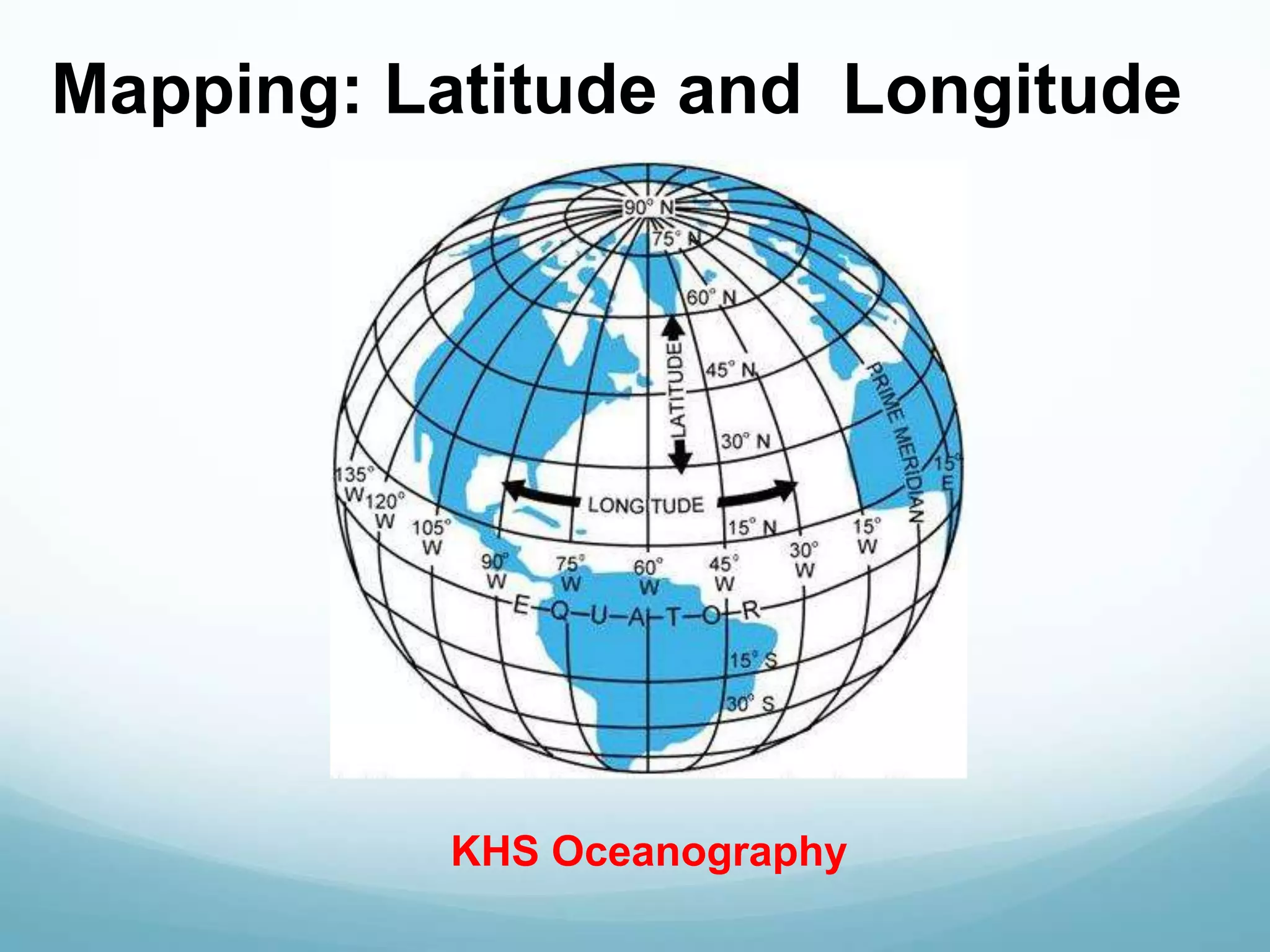
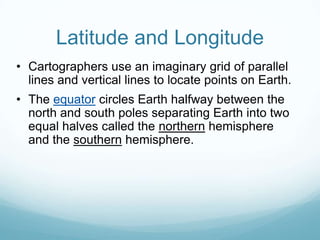
• Cartographers use an imaginary grid of parallel
  lines and vertical lines to locate points on Earth.
• The equator circles Earth halfway between the
  north and south poles separating Earth into two
  equal halves called the northern hemisphere
  and the southern hemisphere.
Latitude
 Lines of latitude are lines running parallel to the equator.

• Latitude is the distance in degrees north or south of the
  equator.
Latitude
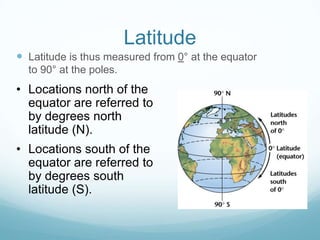
 Latitude is thus measured from 0° at the equator
  to 90° at the poles.
• Locations north of the
  equator are referred to
  by degrees north
  latitude (N).
• Locations south of the
  equator are referred to
  by degrees south
  latitude (S).
Degrees of Latitude
                      Latitude
  – Each degree of latitude is equivalent to about
    111 km ( ) on Earth’s surface. 1° = 70 miles
  – To locate positions on Earth more precisely,
    cartographers break down degrees of latitude into
    60 smaller units, called minutes (´). 1' = 1.2 miles
  – A minute of latitude can be further divided into
    seconds (´´). 1" = .02 miles
  – Longitude is also divided into degrees, minutes,
    and seconds.
Longitude
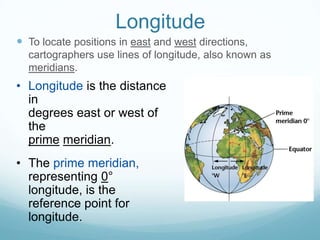
 To locate positions in east and west directions,
  cartographers use lines of longitude, also known as
  meridians.
• Longitude is the distance
  in
  degrees east or west of
  the
  prime meridian.
• The prime meridian,
  representing 0°
  longitude, is the
  reference point for
  longitude.
Longitude
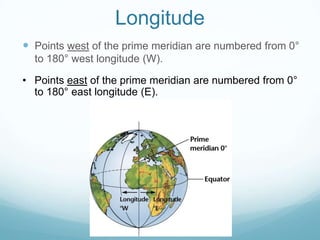
 Points west of the prime meridian are numbered from 0°
  to 180° west longitude (W).

• Points east of the prime meridian are numbered from 0°
  to 180° east longitude (E).

4 longitude and latitude

  • 1.
    Mapping: Latitude andLongitude KHS Oceanography
  • 2.
    Latitude and Longitude •Cartographers use an imaginary grid of parallel lines and vertical lines to locate points on Earth. • The equator circles Earth halfway between the north and south poles separating Earth into two equal halves called the northern hemisphere and the southern hemisphere.
  • 3.
    Latitude  Lines oflatitude are lines running parallel to the equator. • Latitude is the distance in degrees north or south of the equator.
  • 4.
    Latitude  Latitude isthus measured from 0° at the equator to 90° at the poles. • Locations north of the equator are referred to by degrees north latitude (N). • Locations south of the equator are referred to by degrees south latitude (S).
  • 5.
    Degrees of Latitude Latitude – Each degree of latitude is equivalent to about 111 km ( ) on Earth’s surface. 1° = 70 miles – To locate positions on Earth more precisely, cartographers break down degrees of latitude into 60 smaller units, called minutes (´). 1' = 1.2 miles – A minute of latitude can be further divided into seconds (´´). 1" = .02 miles – Longitude is also divided into degrees, minutes, and seconds.
  • 6.
    Longitude  To locatepositions in east and west directions, cartographers use lines of longitude, also known as meridians. • Longitude is the distance in degrees east or west of the prime meridian. • The prime meridian, representing 0° longitude, is the reference point for longitude.
  • 7.
    Longitude  Points westof the prime meridian are numbered from 0° to 180° west longitude (W). • Points east of the prime meridian are numbered from 0° to 180° east longitude (E).