Systematic vs. Regional Geography
Prepared By: Jedgule Revnnath
M.A Geography II
University Of Pune
Dept - Geography
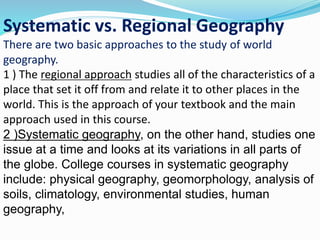
Systematic vs. Regional Geography
There are two basic approaches to the study of world
geography.
1 ) The regional approach studies all of the characteristics of a
place that set it off from and relate it to other places in the
world. This is the approach of your textbook and the main
approach used in this course.
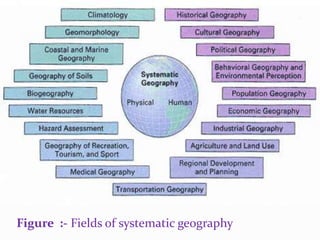
2 )Systematic geography, on the other hand, studies one
issue at a time and looks at its variations in all parts of
the globe. College courses in systematic geography
include: physical geography, geomorphology, analysis of
soils, climatology, environmental studies, human
geography,
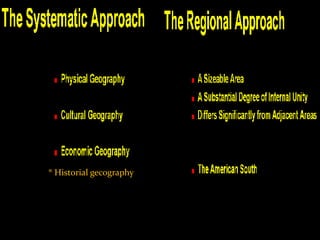
® Historial gecography
The ‘systematic versus regional dualism’ had been there in the ancient
and medieval periods as well but became prominent particularly after
the classic work of Bernard ravenous (1622-1650), a German scholar.
He divided geography into;
1) General and 2) specific according to him ‘general geography studies
the earth in general, describing its various phenomena. Such a study
provides the discipline with general laws and theories.
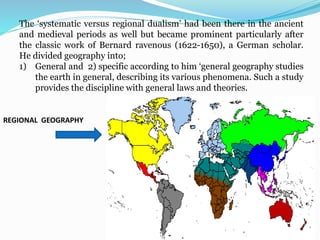
REGIONAL GEOGRAPHY
Figure :- Fields of systematic geography
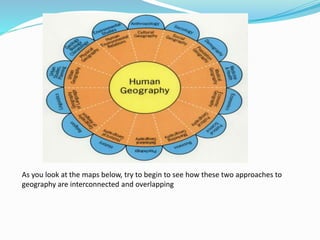
As you look at the maps below, try to begin to see how these two approaches to
geography are interconnected and overlapping
The development of geography during the first half of the 20th
century has been marked by an increasing interest in regional
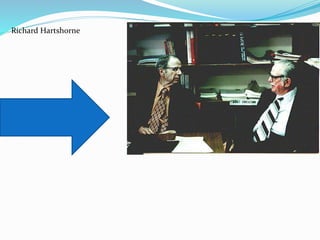
geography. The climax was witnessed in the views of Richard
Hartshorne (1899-1992) and Alfred hettner (1859-1942), when
the concept of geography as a chorological science was advocated
by full force. This led to the development of concept of geography
as a science of areal differed ntiation. The idea of region was
further streng thened by its usage in different forms, as e.g. ‘pay
sag’ in France (blache), lands chaft’ in Germany and landscape in
America (Carl sauer). Moreover, this was period when the
possibilistic thinking was at its peak. At this climax phase this
argument took the form of the old ‘hen and egg story. One group
believed that the core of geography was regional; whereas the
others believed that systematic geography was really
indispensable. The compromise could reach only by the
ecological approach to geography.
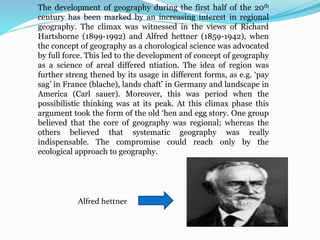
Alfred hettner
Richard Hartshorne
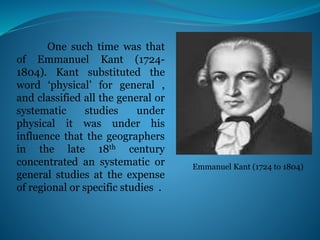
One such time was that
of Emmanuel Kant (1724-
1804). Kant substituted the
word ‘physical’ for general ,
and classified all the general or
systematic studies under
physical it was under his
influence that the geographers
in the late 18th century
concentrated an systematic or
general studies at the expense
of regional or specific studies .
Emmanuel Kant (1724 to 1804)
The dualism between systematic and regional
approaches came to be accepted less and less with
time. Various armaments were put forward for this.
Firstly, the earth’s shell is filled with a multiplicity
of heterogeneous phenomena of varying nature.
At the same time the surface is also divided into a
number of areas or places distinguished from each
other in terms of some measurable aspects (natural
or manmade ) - thus the totality of the phenomena
at any given place is not a single integration but
rather a complex of inter related segments .
The geographical studies require the use of
both types of approaches of area study. Because
the systematic geography attempts to formulate
the rules and laws, which may later be applied to
regional studies. On the other hand, the regional
geography servos as the basis for explanation. It
also provides data for analysis to the systematic
studies. Thus, it is appropriate to say that the
systematic and regional approaches are
complementary to each other. They are
inseparable and indispensable. In fact, one leads
to the other and vice.
Presentation thouth

Presentation thouth

  • 1.
    Systematic vs. RegionalGeography Prepared By: Jedgule Revnnath M.A Geography II University Of Pune Dept - Geography
  • 2.
    Systematic vs. RegionalGeography There are two basic approaches to the study of world geography. 1 ) The regional approach studies all of the characteristics of a place that set it off from and relate it to other places in the world. This is the approach of your textbook and the main approach used in this course. 2 )Systematic geography, on the other hand, studies one issue at a time and looks at its variations in all parts of the globe. College courses in systematic geography include: physical geography, geomorphology, analysis of soils, climatology, environmental studies, human geography,
  • 3.
  • 4.
    The ‘systematic versusregional dualism’ had been there in the ancient and medieval periods as well but became prominent particularly after the classic work of Bernard ravenous (1622-1650), a German scholar. He divided geography into; 1) General and 2) specific according to him ‘general geography studies the earth in general, describing its various phenomena. Such a study provides the discipline with general laws and theories. REGIONAL GEOGRAPHY
  • 5.
    Figure :- Fieldsof systematic geography
  • 6.
    As you lookat the maps below, try to begin to see how these two approaches to geography are interconnected and overlapping
  • 7.
    The development ofgeography during the first half of the 20th century has been marked by an increasing interest in regional geography. The climax was witnessed in the views of Richard Hartshorne (1899-1992) and Alfred hettner (1859-1942), when the concept of geography as a chorological science was advocated by full force. This led to the development of concept of geography as a science of areal differed ntiation. The idea of region was further streng thened by its usage in different forms, as e.g. ‘pay sag’ in France (blache), lands chaft’ in Germany and landscape in America (Carl sauer). Moreover, this was period when the possibilistic thinking was at its peak. At this climax phase this argument took the form of the old ‘hen and egg story. One group believed that the core of geography was regional; whereas the others believed that systematic geography was really indispensable. The compromise could reach only by the ecological approach to geography. Alfred hettner
  • 8.
  • 9.
    One such timewas that of Emmanuel Kant (1724- 1804). Kant substituted the word ‘physical’ for general , and classified all the general or systematic studies under physical it was under his influence that the geographers in the late 18th century concentrated an systematic or general studies at the expense of regional or specific studies . Emmanuel Kant (1724 to 1804)
  • 10.
    The dualism betweensystematic and regional approaches came to be accepted less and less with time. Various armaments were put forward for this. Firstly, the earth’s shell is filled with a multiplicity of heterogeneous phenomena of varying nature. At the same time the surface is also divided into a number of areas or places distinguished from each other in terms of some measurable aspects (natural or manmade ) - thus the totality of the phenomena at any given place is not a single integration but rather a complex of inter related segments .
  • 11.
    The geographical studiesrequire the use of both types of approaches of area study. Because the systematic geography attempts to formulate the rules and laws, which may later be applied to regional studies. On the other hand, the regional geography servos as the basis for explanation. It also provides data for analysis to the systematic studies. Thus, it is appropriate to say that the systematic and regional approaches are complementary to each other. They are inseparable and indispensable. In fact, one leads to the other and vice.