Depositional Shorelines
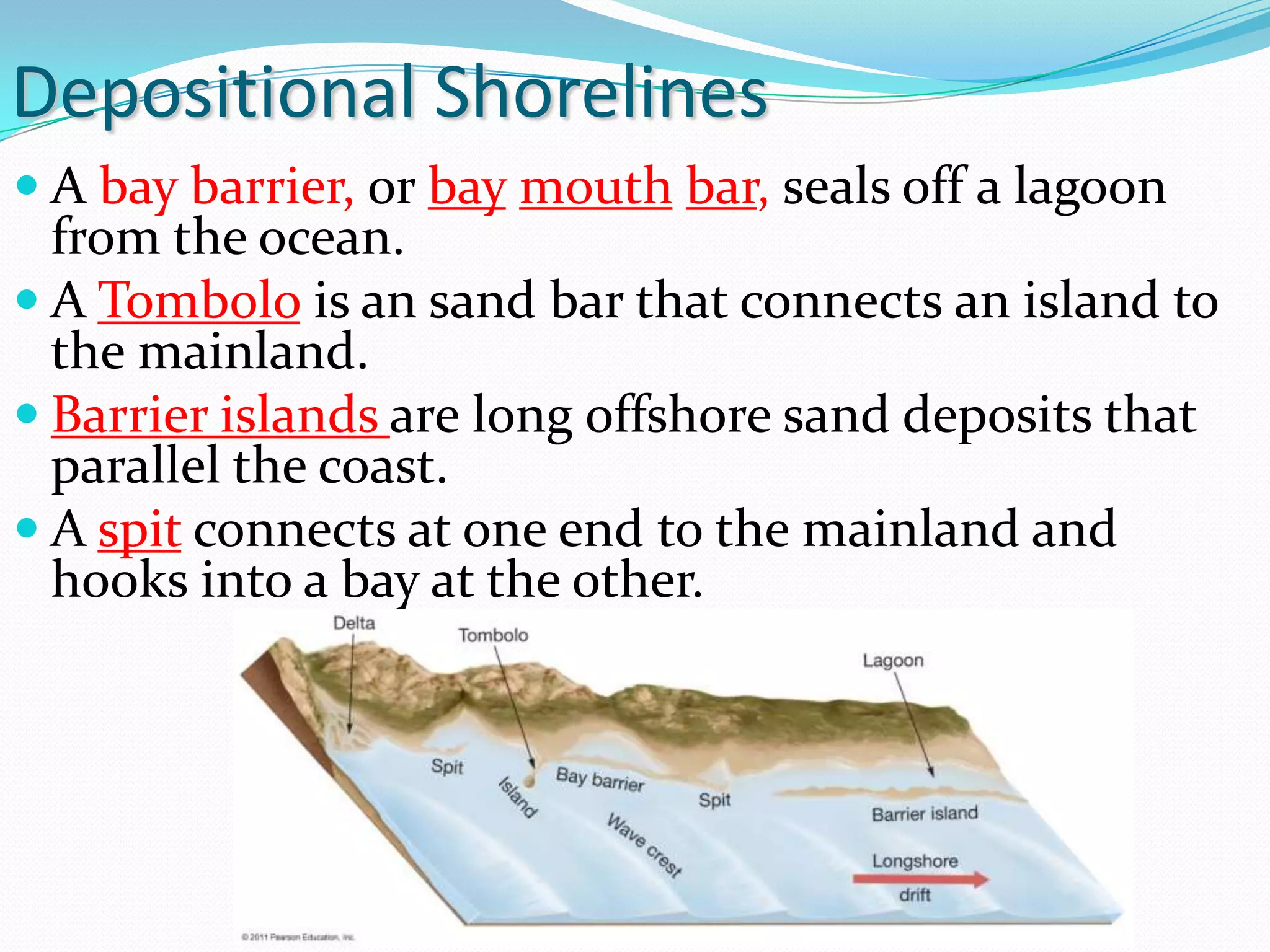
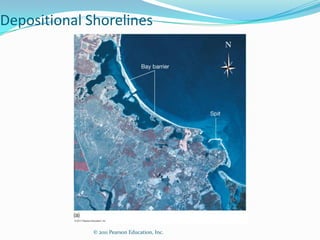
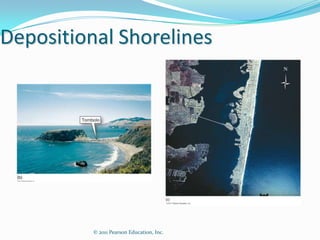
 A bay barrier, or bay mouth bar, seals off a lagoon
  from the ocean.
 A Tombolo is an sand bar that connects an island to
  the mainland.
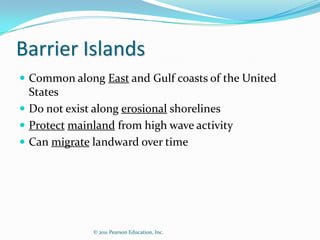
 Barrier islands are long offshore sand deposits that
  parallel the coast.
 A spit connects at one end to the mainland and
  hooks into a bay at the other.


                © 2011 Pearson Education, Inc.
Depositional Shorelines


              © 2011 Pearson Education, Inc.
Depositional Shorelines


         Tombolo                           Barrier
                                           island


          © 2011 Pearson Education, Inc.
Barrier Islands
 Common along East and Gulf coasts of the United
  States
 Do not exist along erosional shorelines
 Protect mainland from high wave activity
 Can migrate landward over time


              © 2011 Pearson Education, Inc.
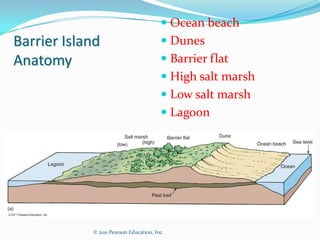
 Ocean beach
Barrier Island                           Dunes
Anatomy                                  Barrier flat
                                         High salt marsh
                                         Low salt marsh
                                         Lagoon


            © 2011 Pearson Education, Inc.
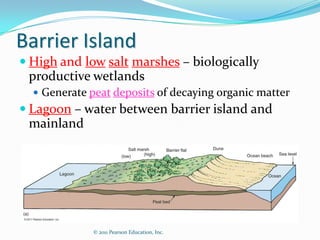
Barrier Island
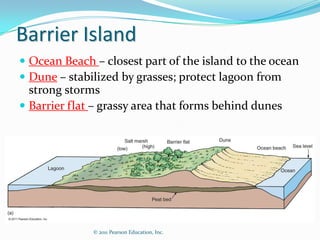
 Ocean Beach – closest part of the island to the ocean
 Dune – stabilized by grasses; protect lagoon from
  strong storms
 Barrier flat – grassy area that forms behind dunes


              © 2011 Pearson Education, Inc.
Barrier Island
 High and low salt marshes – biologically
 productive wetlands
   Generate peat deposits of decaying organic matter
 Lagoon – water between barrier island and
 mainland


             © 2011 Pearson Education, Inc.
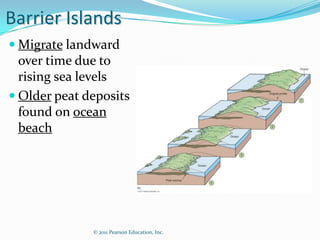
Barrier Islands
 Migrate landward
  over time due to
  rising sea levels
 Older peat deposits
  found on ocean
  beach


              © 2011 Pearson Education, Inc.
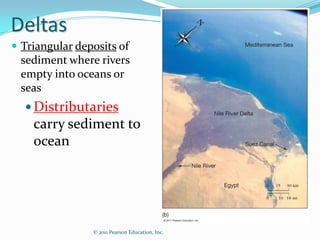
Deltas
 Triangular deposits of
 sediment where rivers
 empty into oceans or
 seas
   Distributaries
    carry sediment to
    ocean


                © 2011 Pearson Education, Inc.
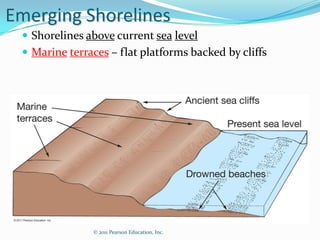
Emerging Shorelines
  Shorelines above current sea level
  Marine terraces – flat platforms backed by cliffs


               © 2011 Pearson Education, Inc.
Submerging Shorelines
  Shoreline below current sea level
  Features include
     Drowned beaches
     Submerged dune topography
     Drowned river valleys (estuaries)


               © 2011 Pearson Education, Inc.
Changing Sea Level
 Two major processes can change sea level:
  Local tectonic processes
  Global (eustatic) changes in sea level


              © 2011 Pearson Education, Inc.
Changing Sea Level
 1. Local tectonic processes
    Example: the Pacific coast of the United
     States is currently being uplifted.
    Isostatic adjustments – rebound of Earth’s
     crust after removal of heavy loads or sinking
     with application of heavy loads
      Ice-loading from glaciers during ice ages


             © 2011 Pearson Education, Inc.
Changing Sea Level
 2. Global (eustatic) changes in sea level
    Sea level changes worldwide due to
     Change in…
     a. amount of available sea water
     b. in ocean basin capacity


             © 2011 Pearson Education, Inc.
Eustatic Changes in Sea Level
Some Mechanisms
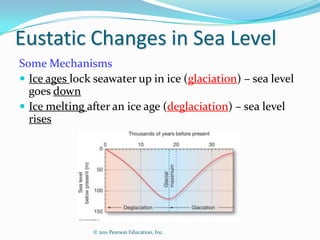
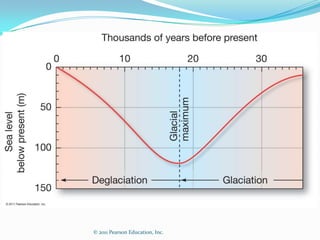
 Ice ages lock seawater up in ice (glaciation) – sea level
  goes down
 Ice melting after an ice age (deglaciation) – sea level
  rises


               © 2011 Pearson Education, Inc.
© 2011 Pearson Education, Inc.
Pleistocene Epoch and Today
 From about 2 million to 10,000 years ago, a series of
  four ice ages affected Earth.
 Sea level was at least 120 meters
  (400 feet) below today’s sea level.
 If all remaining ice on Earth melted today, sea level
  would rise another 70 meters (230 feet).


               © 2011 Pearson Education, Inc.
Global Warming and Changing Sea Level
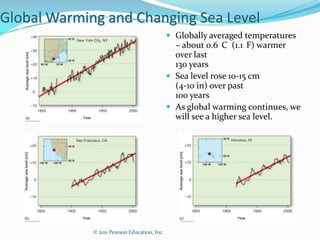
                                               Globally averaged temperatures
                                                – about 0.6 C (1.1 F) warmer
                                                over last
                                                130 years
                                               Sea level rose 10-15 cm
                                                (4-10 in) over past
                                                100 years
                                               As global warming continues, we
                                                will see a higher sea level.


             © 2011 Pearson Education, Inc.

Notes - Shorelines

  • 1.
    Depositional Shorelines  Abay barrier, or bay mouth bar, seals off a lagoon from the ocean.  A Tombolo is an sand bar that connects an island to the mainland.  Barrier islands are long offshore sand deposits that parallel the coast.  A spit connects at one end to the mainland and hooks into a bay at the other. © 2011 Pearson Education, Inc.
  • 2.
    Depositional Shorelines © 2011 Pearson Education, Inc.
  • 4.
    Depositional Shorelines Tombolo Barrier island © 2011 Pearson Education, Inc.
  • 5.
    Barrier Islands  Commonalong East and Gulf coasts of the United States  Do not exist along erosional shorelines  Protect mainland from high wave activity  Can migrate landward over time © 2011 Pearson Education, Inc.
  • 6.
     Ocean beach BarrierIsland  Dunes Anatomy  Barrier flat  High salt marsh  Low salt marsh  Lagoon © 2011 Pearson Education, Inc.
  • 7.
    Barrier Island  OceanBeach – closest part of the island to the ocean  Dune – stabilized by grasses; protect lagoon from strong storms  Barrier flat – grassy area that forms behind dunes © 2011 Pearson Education, Inc.
  • 8.
    Barrier Island  Highand low salt marshes – biologically productive wetlands  Generate peat deposits of decaying organic matter  Lagoon – water between barrier island and mainland © 2011 Pearson Education, Inc.
  • 9.
    Barrier Islands  Migratelandward over time due to rising sea levels  Older peat deposits found on ocean beach © 2011 Pearson Education, Inc.
  • 10.
    Deltas  Triangular depositsof sediment where rivers empty into oceans or seas  Distributaries carry sediment to ocean © 2011 Pearson Education, Inc.
  • 11.
    Emerging Shorelines Shorelines above current sea level  Marine terraces – flat platforms backed by cliffs © 2011 Pearson Education, Inc.
  • 12.
    Submerging Shorelines Shoreline below current sea level  Features include  Drowned beaches  Submerged dune topography  Drowned river valleys (estuaries) © 2011 Pearson Education, Inc.
  • 13.
    Changing Sea Level Two major processes can change sea level:  Local tectonic processes  Global (eustatic) changes in sea level © 2011 Pearson Education, Inc.
  • 14.
    Changing Sea Level 1. Local tectonic processes  Example: the Pacific coast of the United States is currently being uplifted.  Isostatic adjustments – rebound of Earth’s crust after removal of heavy loads or sinking with application of heavy loads  Ice-loading from glaciers during ice ages © 2011 Pearson Education, Inc.
  • 15.
    Changing Sea Level 2. Global (eustatic) changes in sea level  Sea level changes worldwide due to Change in… a. amount of available sea water b. in ocean basin capacity © 2011 Pearson Education, Inc.
  • 16.
    Eustatic Changes inSea Level Some Mechanisms  Ice ages lock seawater up in ice (glaciation) – sea level goes down  Ice melting after an ice age (deglaciation) – sea level rises © 2011 Pearson Education, Inc.
  • 17.
    © 2011 PearsonEducation, Inc.
  • 18.
    Pleistocene Epoch andToday  From about 2 million to 10,000 years ago, a series of four ice ages affected Earth.  Sea level was at least 120 meters (400 feet) below today’s sea level.  If all remaining ice on Earth melted today, sea level would rise another 70 meters (230 feet). © 2011 Pearson Education, Inc.
  • 19.
    Global Warming andChanging Sea Level  Globally averaged temperatures – about 0.6 C (1.1 F) warmer over last 130 years  Sea level rose 10-15 cm (4-10 in) over past 100 years  As global warming continues, we will see a higher sea level. © 2011 Pearson Education, Inc.