“Disease caused by retrovirus
human immunodeficiency virus (HIV)
and characterized by
profound immunosuppression
that leads to
opportunistic infections,
secondary malignancies, and
neurological manifestations”.
AIDS:
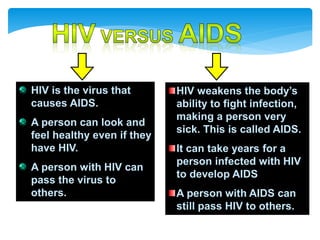
HIV is the virus that
causes AIDS.
A person can look and
feel healthy even if they
have HIV.
A person with HIV can
pass the virus to
others.
HIV weakens the body’s
ability to fight infection,
making a person very
sick. This is called AIDS.
It can take years for a
person infected with HIV
to develop AIDS
A person with AIDS can
still pass HIV to others.
 Born on 1982 in Africa, origin from monkeys/
chimpanzees…How to humans??? God knows.
 Growth-- within no time; spreads faster than Air/ fire!!!
 So rapid is the growth—by the time its immunology is
described, it will be out dated..,
 Where is AIDS?????? At your home door !!! Close door !! Take
care.
 Has remarkable ability to cripple the host defenses.
1. Homosexuality:
2. Intravenous drug abusers:
3. Multiple sexual partners: heterosexual contacts:
4. Hemophiliacs: receiving f-VIII/IX
5. Recipients of blood/ blood components.
6. Transplacental:
How HIV spreads??
 In utero: Transplacental spread
 During delivery: through an infected birth canal
 After birth: ingestion of breast milk
 Chance of perinatal transmission: 25%
 With anti-retroviral treatment –reduced mother to
child transmission.
 HIV- 0.3%.., HbsAg-30%
 Antiretroviral treatment within 24 to 48 hours of needle stick
can reduce the risk of infection eightfold.
 Use universal safety precautions: Handle blood/body fluids as
if all cases are HIV positive !!
 Coughing
 Sneezing
 Insect bites
 Casual touch
 Hugging
 Public baths/ public telephones
 Hand shakes
 Sharing cups, glasses, plates or other utensils,
 Kissing
Remember: HIV is NOT transmitted by:
HIV can not be passed
through
“casual” contact
• Hugging, kissing, holding hands, or sharing
utensils is not risky
• Fluids like saliva, urine, or tears do not
transmit HIV
 Retrovirus; lentivirus family.
 HIV-1, and HIV-2.
 HIV-1 mc in US; HIV-2 mc in India, West Africa.
 Virion– Spherical; lipid envelope present outside is derived from
host cell membrane.
Structure of HIV:
 Major capsid protein- p24;
 p24– most readily detected viral antigen; and hence, the target
for diagnosis of HIV infection by ELISA.
 Three important viral enzymes—protease, reverse
transcriptase, and integrase.
 Two important viral glycoproteins—gp120 and gp41: critical
for viral infection of cells.
 Two major target organs for HIV: Immune system and Central
nervous system.
 Profound immunosuppression, primarily affecting cell-
mediated immunity, is the hallmark of HIV.
 Severe loss of CD4+ cells, and impaired function of surviving
T-cells.
 Also infects Dendritic cells and macrophages.
 Semen, vaginal secretions, cervical epithelium.
 Both within lymphocytes and cell free status
 Enters body through abrasion in skin/ oral mucosa/ rectal
mucosa.
 Enters circulation through blood vessels breached by
trauma, into Dendritic cells or CD4+cells within mucosa.
Where HIV is present??
 Acts as gate keeper for initial entry of virus.
 Acts as reservoir of infection.
 Site of multiplication : viral production factory!!
 Acts as safe vehicle for viral transport!!
 PROTOZOAL:
-Cryptosporidiosis
-Pnuemocytosis
-toxoplasmosis
 FUNGAL:
-Candidiasis
-Cryptococcosis
-Coccidiomycosis
-Histoplasmosis
 BACTERIAL:
Mycobacterial infection
Nocardiosis
Salmonella infection
 VIRAL:
CMV
HSV
Varicella Zoster virus
JC virus- PML.
 Kaposi sarcoma
 B-cell Non-Hodgkin lymphoma
 Body cavity lymphomas.
 Primary lymphoma of brain
 Invasive carcinoma of cervix
HIV
Counseling &
Testing
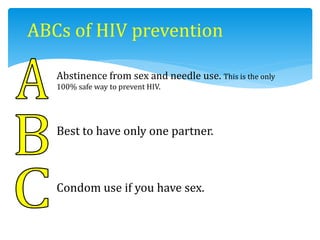
ABCs of HIV prevention
Abstinence from sex and needle use. This is the only
100% safe way to prevent HIV.
Best to have only one partner.
Condom use if you have sex.
4. hiv & aids  dr. sinhasan, mdzah

4. hiv & aids dr. sinhasan, mdzah

  • 2.
    “Disease caused byretrovirus human immunodeficiency virus (HIV) and characterized by profound immunosuppression that leads to opportunistic infections, secondary malignancies, and neurological manifestations”. AIDS:
  • 3.
    HIV is thevirus that causes AIDS. A person can look and feel healthy even if they have HIV. A person with HIV can pass the virus to others. HIV weakens the body’s ability to fight infection, making a person very sick. This is called AIDS. It can take years for a person infected with HIV to develop AIDS A person with AIDS can still pass HIV to others.
  • 4.
     Born on1982 in Africa, origin from monkeys/ chimpanzees…How to humans??? God knows.  Growth-- within no time; spreads faster than Air/ fire!!!  So rapid is the growth—by the time its immunology is described, it will be out dated..,  Where is AIDS?????? At your home door !!! Close door !! Take care.  Has remarkable ability to cripple the host defenses.
  • 5.
    1. Homosexuality: 2. Intravenousdrug abusers: 3. Multiple sexual partners: heterosexual contacts: 4. Hemophiliacs: receiving f-VIII/IX 5. Recipients of blood/ blood components. 6. Transplacental: How HIV spreads??
  • 6.
     In utero:Transplacental spread  During delivery: through an infected birth canal  After birth: ingestion of breast milk  Chance of perinatal transmission: 25%  With anti-retroviral treatment –reduced mother to child transmission.
  • 7.
     HIV- 0.3%..,HbsAg-30%  Antiretroviral treatment within 24 to 48 hours of needle stick can reduce the risk of infection eightfold.  Use universal safety precautions: Handle blood/body fluids as if all cases are HIV positive !!
  • 8.
     Coughing  Sneezing Insect bites  Casual touch  Hugging  Public baths/ public telephones  Hand shakes  Sharing cups, glasses, plates or other utensils,  Kissing Remember: HIV is NOT transmitted by:
  • 9.
    HIV can notbe passed through “casual” contact • Hugging, kissing, holding hands, or sharing utensils is not risky • Fluids like saliva, urine, or tears do not transmit HIV
  • 10.
     Retrovirus; lentivirusfamily.  HIV-1, and HIV-2.  HIV-1 mc in US; HIV-2 mc in India, West Africa.  Virion– Spherical; lipid envelope present outside is derived from host cell membrane. Structure of HIV:
  • 11.
     Major capsidprotein- p24;  p24– most readily detected viral antigen; and hence, the target for diagnosis of HIV infection by ELISA.  Three important viral enzymes—protease, reverse transcriptase, and integrase.  Two important viral glycoproteins—gp120 and gp41: critical for viral infection of cells.
  • 12.
     Two majortarget organs for HIV: Immune system and Central nervous system.  Profound immunosuppression, primarily affecting cell- mediated immunity, is the hallmark of HIV.  Severe loss of CD4+ cells, and impaired function of surviving T-cells.  Also infects Dendritic cells and macrophages.
  • 13.
     Semen, vaginalsecretions, cervical epithelium.  Both within lymphocytes and cell free status  Enters body through abrasion in skin/ oral mucosa/ rectal mucosa.  Enters circulation through blood vessels breached by trauma, into Dendritic cells or CD4+cells within mucosa. Where HIV is present??
  • 15.
     Acts asgate keeper for initial entry of virus.  Acts as reservoir of infection.  Site of multiplication : viral production factory!!  Acts as safe vehicle for viral transport!!
  • 17.
     PROTOZOAL: -Cryptosporidiosis -Pnuemocytosis -toxoplasmosis  FUNGAL: -Candidiasis -Cryptococcosis -Coccidiomycosis -Histoplasmosis BACTERIAL: Mycobacterial infection Nocardiosis Salmonella infection  VIRAL: CMV HSV Varicella Zoster virus JC virus- PML.
  • 18.
     Kaposi sarcoma B-cell Non-Hodgkin lymphoma  Body cavity lymphomas.  Primary lymphoma of brain  Invasive carcinoma of cervix
  • 19.
  • 21.
    ABCs of HIVprevention Abstinence from sex and needle use. This is the only 100% safe way to prevent HIV. Best to have only one partner. Condom use if you have sex.