Presentation Topic:
HIV (Human Immunodeficiency Virus)
Subject: Microbiology
Muhammad Abbas
MS MLS
BS MLT
Department Of Medical Technology (DMT), Baqai Medical
University Karachi
Main Signals of the Presentations
1. Define of HIV
2. Define AIDS
3. HIV & AIDS
4. HIV 1 & 2
5. Important properties of HIV
6. Transmission of HIV
7. HIV Myths
8. Pathogenesis & Immunity
9. Clinical findings
10. Symptoms Of HIV
11. Laboratory diagnoses
HIV
Human Immunodeficiency Virus
H = Infects only Human beings
I = Immunodeficiency virus weakens the immune system and
increases the risk of infection
V = Virus that attacks the body
AIDS
Acquired Immune Deficiency Syndrome
A = Acquired, not inherited
I = Weakens the Immune system
D = Creates a Deficiency of CD4+ cells in the immune system
S = Syndrome, or a group of illnesses taking place at the same time
HIV and AIDS
 When the immune system becomes weakened by HIV, the illness
progresses to AIDS.
 Human immunodeficiency virus (HIV) is the cause of acquired
immunodeficiency syndrome (AIDS). Both HIV-1 and HIV-2 cause
AIDS, but HIV-1 is found worldwide, whereas HIV-2 is found
primarily in West Africa.
HIV 1 and HIV 2
 HIV-1 is the most common type of Human
Immunodeficiency Virus. It attacks your body's immune system.
The virus destroys CD4 cells. These cells help your body fight
infections. HIV-1 can severely damage your immune system and
lead to Acquired Immune Deficiency Syndrome (AIDS).
 HIV-2, the virus that causes AIDS. AIDS is the most advanced stage
of HIV infection. HIV-2 infection is endemic to West Africa.
... HIV-2 infection generally takes longer to progress to
symptomatic HIV/AIDS than HIV-1
Important Properties of HIV
 HIV is one of the two important human T-cell lymphotropic
retroviruses (human T-cell leukemia virus is the other). HIV
preferentially infects and kills helper (CD4) T lymphocytes,
resulting in the loss of cell-mediated immunity and a high probability
that the host will develop opportunistic infections. Other cells (e.g.,
macrophages and monocytes) that have CD4 proteins on their surfaces
can be infected also.
 HIV belongs to the lentivirus subgroup of retroviruses, which cause
“slow” infections with long incubation periods
 HIV has a cylinder-shaped (type D) core surrounded by an envelope
containing virus-specific glycoproteins (gp120 and gp41) The HIV
genome is the most complex of the known retroviruses.
 In addition to the three typicalretroviral genes gag, pol, and env,
which encode the structural proteins, the genome RNA has six
regulatory genes.Two of these regulatory genes, tat and rev, are
required for replication, and the other four, nef, vif, vpr, andvpu, are
not required for replication and are termed “accessory”genes.
 The gag gene encodes the internal “core” proteins, the most important
of which is the p24 protein. It is important medically as it is the
antigen in the initial serological test that determines whether the
patient has antibody to HIV (i.e., has been infected with HIV or not)
Transmission of HIV
 HIV is transmitted by
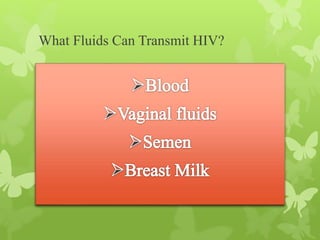
 Direct contact with infected blood
 Sexual contact: oral, anal, or vaginal
 Direct contact with semen or vaginal and
cervical secretions
 HIV-infected mothers to infants during
pregnancy, delivery, or breastfeeding
How is HIV Spread?
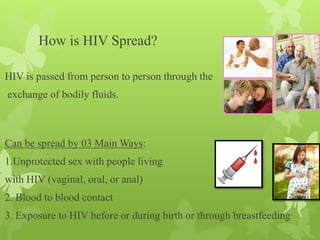
HIV is passed from person to person through the
exchange of bodily fluids.
Can be spread by 03 Main Ways:
1.Unprotected sex with people living
with HIV (vaginal, oral, or anal)
2. Blood to blood contact
3. Exposure to HIV before or during birth or through breastfeeding.
What Fluids Can Transmit HIV?
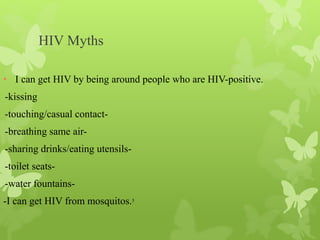
HIV Myths
• I can get HIV by being around people who are HIV-positive.
-kissing
-touching/casual contact-
-breathing same air-
-sharing drinks/eating utensils-
-toilet seats-
-water fountains-
-I can get HIV from mosquitos.5
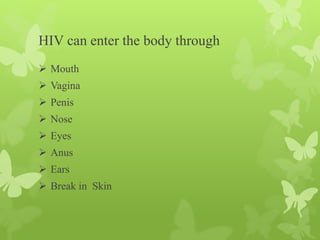
HIV can enter the body through
 Mouth
 Vagina
 Penis
 Nose
 Eyes
 Anus
 Ears
 Break in Skin
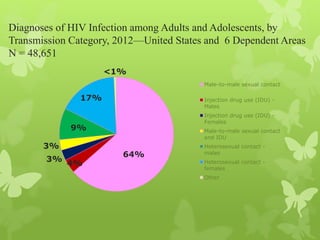
Diagnoses of HIV Infection among Adults and Adolescents, by
Transmission Category, 2012—United States and 6 Dependent Areas
N = 48,651
64%
4%
3%
3%
9%
17%
<1%
Male-to-male sexual contact
Injection drug use (IDU) -
Males
Injection drug use (IDU) -
Females
Male-to-male sexual contact
and IDU
Heterosexual contact -
males
Heterosexual contact -
females
Other
Pathogenesis & Immunity
 HIV infects helper T cells (CD4-positive cells) and kills them,
resulting in suppression of cell-mediated immunity. This predisposes
the host to various opportunistic infections and certain cancers such as
Kaposi’s sarcoma[1] and lymphoma. HIV does not directly cause these
tumors because HIV genes are not found in these cancer cells.
 The initial infection of the genital tract occurs in dendritic cells that
line the mucosa (Langerhans’ cells), after which the local CD4-
positive helper T cells become infected. HIV is first found in the blood
4 to 11 days after infection.
Pathogenesis & Immunity Cont…
 HIV infection also targets a subset of CD4-positive cells called Th17
cells. These cells are an important mediator of mucosal immunity,
especially in the gastrointestinal tract. Many mucosal Th17 cells are
killed early in HIV infection. Th17 cells produce interleukin-17 (IL-
17), which attracts neutrophils to the site of bacterial infection. The
loss of Th17 cells predisposes HIV-infected individuals to
bloodstream infections by bacteria in the normal flora of the colon,
such as Escherichia coli.
Pathogenesis & Immunity Cont…
 The main immune response to HIV infection consists of cytotoxic
CD8-positive lymphocytes. These cells respond to the initial infection
and control it for many years. Mutants of HIV, especially in the env
gene encoding gp120, arise, but new clones of cytotoxic T cells
proliferate and control the mutant strain.
 It is the ultimate failure of these cytotoxic T cells that results in the
clinical picture of AIDS. Cytotoxic T cells lose their effectiveness
because so many CD4 helper T cells have died; thus the supply of
lymphokines, such as interleukin-2 (IL-2), required to activate the
cytotoxic T cells is no longer sufficient.
 There is evidence that “escape” mutants of HIV are able to proliferate
unchecked because the patient has no clone of cytotoxic T cells
capable of responding to the mutant strain.
Clinical Findings
 The clinical picture of HIV infection can be divided into three stages:
an early, acute stage; a middle, latent stage; and a late,
immunodeficiency stage .In the acute stage, which usually begins 2 to
4 weeks after infection, a mononucleosis-like picture of fever,
lethargy, sore throat, and generalized lymphadenopathy occurs. A
maculopapular rash on the trunk, arms, and legs (but sparing the
palms and soles) is also seen. Leukopenia occurs may also occure.
 A high-level viremia typically occurs, and the infection is readily
transmissible during this acute stage. This acute stage typically
resolves spontaneously in about 2 weeks.
 Antibodies to HIV typically appear 10 to 14 days after infection, and
most patients will have seroconverted by 3 to 4 weeks after infection.
Note that the inability to detect antibodies prior to that time can result
in “false-negative” serologic tests (i.e., the person is infected, but
antibodies are not detectable at the time of the test).
 In the middle stage of HIV infection, a long latent period, measured in
years, usually ensues. In untreated patients, the latent period typically
lasts for 7 to 11 years.The patient is asymptomatic during this period.
 A syndrome called AIDS-related complex (ARC) can occur during the
latent period. The most frequent manifestations are persistent fevers,
fatigue, weight loss, and lymphadenopathy. ARC often progresses to
AIDS.
 The late stage of HIV infection is AIDS, manifested by a decline in
the number of CD4 cells to below 200/μL and an increase in the
frequency and severity of opportunistic infections.
Symptoms of HIV
Many people who are infected with HIV have NO symptoms at all for
10 years or more.
-Currently 300,000-500,000 in U.S. have HIV and do not know it.
-Symptoms vary.
Some people who are infected with HIV report having flu-like
symptoms 2-4 weeks after exposure.
• Fever
• Enlarged lymph nodes
• Sore throat
• Rash
Laboratory Diagnosis
 Detection of antibodies in the patient’s serum to the p24 protein of
HIV using the enzyme-linked immunosorbent assay (ELISA) test.
Because there are some falsepositive results with this test, the
definitive diagnosis is made by Western blot (also known as
Immunoblot) analysis.
 The PCR test is a very sensitive and specific technique that can be
used to detect HIV DNA within infected cells.
 During the first month after infection, antibody tests may be negative.
These false-negative tests are due to insufficient antibody being made
early in infection to be detected in the ELISA test.
 During the first month after infection, antibody tests may be negative.
These false-negative tests are due to insufficient antibody being made
early in infection to be detected in the ELISA test.
Hiv  infection

Hiv infection

  • 1.
    Presentation Topic: HIV (HumanImmunodeficiency Virus) Subject: Microbiology Muhammad Abbas MS MLS BS MLT Department Of Medical Technology (DMT), Baqai Medical University Karachi
  • 2.
    Main Signals ofthe Presentations 1. Define of HIV 2. Define AIDS 3. HIV & AIDS 4. HIV 1 & 2 5. Important properties of HIV 6. Transmission of HIV 7. HIV Myths 8. Pathogenesis & Immunity 9. Clinical findings 10. Symptoms Of HIV 11. Laboratory diagnoses
  • 3.
    HIV Human Immunodeficiency Virus H= Infects only Human beings I = Immunodeficiency virus weakens the immune system and increases the risk of infection V = Virus that attacks the body
  • 4.
    AIDS Acquired Immune DeficiencySyndrome A = Acquired, not inherited I = Weakens the Immune system D = Creates a Deficiency of CD4+ cells in the immune system S = Syndrome, or a group of illnesses taking place at the same time
  • 5.
    HIV and AIDS When the immune system becomes weakened by HIV, the illness progresses to AIDS.  Human immunodeficiency virus (HIV) is the cause of acquired immunodeficiency syndrome (AIDS). Both HIV-1 and HIV-2 cause AIDS, but HIV-1 is found worldwide, whereas HIV-2 is found primarily in West Africa.
  • 6.
    HIV 1 andHIV 2  HIV-1 is the most common type of Human Immunodeficiency Virus. It attacks your body's immune system. The virus destroys CD4 cells. These cells help your body fight infections. HIV-1 can severely damage your immune system and lead to Acquired Immune Deficiency Syndrome (AIDS).  HIV-2, the virus that causes AIDS. AIDS is the most advanced stage of HIV infection. HIV-2 infection is endemic to West Africa. ... HIV-2 infection generally takes longer to progress to symptomatic HIV/AIDS than HIV-1
  • 7.
    Important Properties ofHIV  HIV is one of the two important human T-cell lymphotropic retroviruses (human T-cell leukemia virus is the other). HIV preferentially infects and kills helper (CD4) T lymphocytes, resulting in the loss of cell-mediated immunity and a high probability that the host will develop opportunistic infections. Other cells (e.g., macrophages and monocytes) that have CD4 proteins on their surfaces can be infected also.  HIV belongs to the lentivirus subgroup of retroviruses, which cause “slow” infections with long incubation periods
  • 8.
     HIV hasa cylinder-shaped (type D) core surrounded by an envelope containing virus-specific glycoproteins (gp120 and gp41) The HIV genome is the most complex of the known retroviruses.  In addition to the three typicalretroviral genes gag, pol, and env, which encode the structural proteins, the genome RNA has six regulatory genes.Two of these regulatory genes, tat and rev, are required for replication, and the other four, nef, vif, vpr, andvpu, are not required for replication and are termed “accessory”genes.
  • 9.
     The gaggene encodes the internal “core” proteins, the most important of which is the p24 protein. It is important medically as it is the antigen in the initial serological test that determines whether the patient has antibody to HIV (i.e., has been infected with HIV or not)
  • 10.
    Transmission of HIV HIV is transmitted by  Direct contact with infected blood  Sexual contact: oral, anal, or vaginal  Direct contact with semen or vaginal and cervical secretions  HIV-infected mothers to infants during pregnancy, delivery, or breastfeeding
  • 11.
    How is HIVSpread? HIV is passed from person to person through the exchange of bodily fluids. Can be spread by 03 Main Ways: 1.Unprotected sex with people living with HIV (vaginal, oral, or anal) 2. Blood to blood contact 3. Exposure to HIV before or during birth or through breastfeeding.
  • 12.
    What Fluids CanTransmit HIV?
  • 13.
    HIV Myths • Ican get HIV by being around people who are HIV-positive. -kissing -touching/casual contact- -breathing same air- -sharing drinks/eating utensils- -toilet seats- -water fountains- -I can get HIV from mosquitos.5
  • 14.
    HIV can enterthe body through  Mouth  Vagina  Penis  Nose  Eyes  Anus  Ears  Break in Skin
  • 15.
    Diagnoses of HIVInfection among Adults and Adolescents, by Transmission Category, 2012—United States and 6 Dependent Areas N = 48,651 64% 4% 3% 3% 9% 17% <1% Male-to-male sexual contact Injection drug use (IDU) - Males Injection drug use (IDU) - Females Male-to-male sexual contact and IDU Heterosexual contact - males Heterosexual contact - females Other
  • 16.
    Pathogenesis & Immunity HIV infects helper T cells (CD4-positive cells) and kills them, resulting in suppression of cell-mediated immunity. This predisposes the host to various opportunistic infections and certain cancers such as Kaposi’s sarcoma[1] and lymphoma. HIV does not directly cause these tumors because HIV genes are not found in these cancer cells.  The initial infection of the genital tract occurs in dendritic cells that line the mucosa (Langerhans’ cells), after which the local CD4- positive helper T cells become infected. HIV is first found in the blood 4 to 11 days after infection.
  • 17.
    Pathogenesis & ImmunityCont…  HIV infection also targets a subset of CD4-positive cells called Th17 cells. These cells are an important mediator of mucosal immunity, especially in the gastrointestinal tract. Many mucosal Th17 cells are killed early in HIV infection. Th17 cells produce interleukin-17 (IL- 17), which attracts neutrophils to the site of bacterial infection. The loss of Th17 cells predisposes HIV-infected individuals to bloodstream infections by bacteria in the normal flora of the colon, such as Escherichia coli.
  • 18.
    Pathogenesis & ImmunityCont…  The main immune response to HIV infection consists of cytotoxic CD8-positive lymphocytes. These cells respond to the initial infection and control it for many years. Mutants of HIV, especially in the env gene encoding gp120, arise, but new clones of cytotoxic T cells proliferate and control the mutant strain.  It is the ultimate failure of these cytotoxic T cells that results in the clinical picture of AIDS. Cytotoxic T cells lose their effectiveness because so many CD4 helper T cells have died; thus the supply of lymphokines, such as interleukin-2 (IL-2), required to activate the cytotoxic T cells is no longer sufficient.  There is evidence that “escape” mutants of HIV are able to proliferate unchecked because the patient has no clone of cytotoxic T cells capable of responding to the mutant strain.
  • 19.
    Clinical Findings  Theclinical picture of HIV infection can be divided into three stages: an early, acute stage; a middle, latent stage; and a late, immunodeficiency stage .In the acute stage, which usually begins 2 to 4 weeks after infection, a mononucleosis-like picture of fever, lethargy, sore throat, and generalized lymphadenopathy occurs. A maculopapular rash on the trunk, arms, and legs (but sparing the palms and soles) is also seen. Leukopenia occurs may also occure.  A high-level viremia typically occurs, and the infection is readily transmissible during this acute stage. This acute stage typically resolves spontaneously in about 2 weeks.
  • 20.
     Antibodies toHIV typically appear 10 to 14 days after infection, and most patients will have seroconverted by 3 to 4 weeks after infection. Note that the inability to detect antibodies prior to that time can result in “false-negative” serologic tests (i.e., the person is infected, but antibodies are not detectable at the time of the test).  In the middle stage of HIV infection, a long latent period, measured in years, usually ensues. In untreated patients, the latent period typically lasts for 7 to 11 years.The patient is asymptomatic during this period.
  • 21.
     A syndromecalled AIDS-related complex (ARC) can occur during the latent period. The most frequent manifestations are persistent fevers, fatigue, weight loss, and lymphadenopathy. ARC often progresses to AIDS.  The late stage of HIV infection is AIDS, manifested by a decline in the number of CD4 cells to below 200/μL and an increase in the frequency and severity of opportunistic infections.
  • 22.
    Symptoms of HIV Manypeople who are infected with HIV have NO symptoms at all for 10 years or more. -Currently 300,000-500,000 in U.S. have HIV and do not know it. -Symptoms vary. Some people who are infected with HIV report having flu-like symptoms 2-4 weeks after exposure. • Fever • Enlarged lymph nodes • Sore throat • Rash
  • 23.
    Laboratory Diagnosis  Detectionof antibodies in the patient’s serum to the p24 protein of HIV using the enzyme-linked immunosorbent assay (ELISA) test. Because there are some falsepositive results with this test, the definitive diagnosis is made by Western blot (also known as Immunoblot) analysis.  The PCR test is a very sensitive and specific technique that can be used to detect HIV DNA within infected cells.  During the first month after infection, antibody tests may be negative. These false-negative tests are due to insufficient antibody being made early in infection to be detected in the ELISA test.
  • 24.
     During thefirst month after infection, antibody tests may be negative. These false-negative tests are due to insufficient antibody being made early in infection to be detected in the ELISA test.

Editor's Notes

  • #17 Kaposi's sarcoma is a type of cancer that forms in the lining of blood and lymph vessels. The tumors (lesions) of Kaposi's sarcoma typically appear as painless purplish spots on the legs, feet or face. Lesions can also appear in the genital area, mouth or lymph nodes.