Submitted to -
Dr. Pawas Goswami Sir
Submitted By -
Abhishek Bhargav
Tarannum Ansari
INTRODUCTION
• HIV stands for Human immunodeficiency virus. It is the virus that can lead to Acquired
immunodeficiency syndrome or AIDS if not treated. Unlike some other viruses, the human body can't
get rid of HIV completely, even with treatment. So once a person gets HIV, he/she will have it for life.
• HIV attacks the body's immune system, specifically the CD4 cells (T cells), which help the immune system
fight off infections. Untreated, HIV reduces the number of CD4 cells (T cells) in the body, making the
person more likely to get other infections or infection-related cancers.
• Over time, HIV can destroy so many of these cells that the body can't fight off infections and disease.
These opportunistic infections or cancers take advantage of a very weak immune system and signal that
the person has AIDS, the last stage of HIV infection.
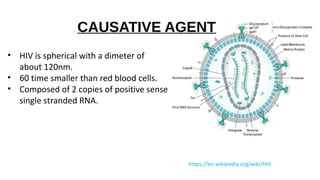
CAUSATIVE AGENT
• HIV is spherical with a dimeter of
about 120nm.
• 60 time smaller than red blood cells.
• Composed of 2 copies of positive sense
single stranded RNA.
https://en.wikipedia.org/wiki/HIV
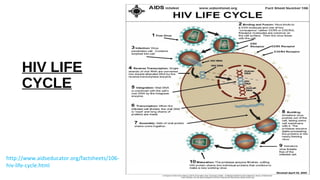
HIV LIFE
CYCLE
http://www.aidseducator.org/factsheets/106-
hiv-life-cycle.html
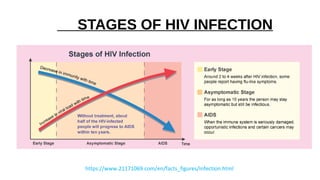
STAGES OF HIV INFECTION
https://www.21171069.com/en/facts_figures/infection.html
TRANSMISSION
• HIV can be transmitted via the exchange of a variety of body fluids
from infected individuals, such as blood, breast milk, semen and
vaginal secretions.
• Individuals cannot become infected through ordinary day-to-day
contact such as kissing, hugging, shaking hands, or sharing personal
objects, food or water.
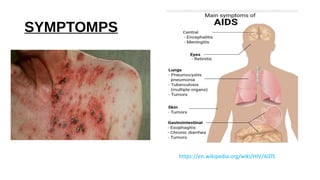
SYMPTOMPS
• The symptoms of HIV vary depending on the stage of infection. Though people living with
HIV tend to be most infectious in the first few months, many are unaware of their status
until later stages. The first few weeks after initial infection, individuals may experience no
symptoms or an influenza-like illness including fever, headache, rash, or sore throat.
• As the infection progressively weakens the immune system, an individual can develop
other signs and symptoms, such as swollen lymph nodes, weight loss, fever, diarrhea and
cough. Without treatment, they could also develop severe illnesses such as tuberculosis,
cryptococcal meningitis, severe bacterial infections and cancers such as lymphomas and
Kaposi's sarcoma.
SYMPTOMPS
https://en.wikipedia.org/wiki/HIV/AIDS
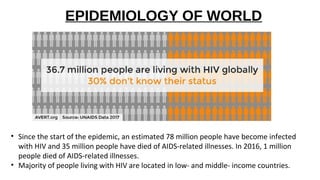
EPIDEMIOLOGY OF WORLD
• Since the start of the epidemic, an estimated 78 million people have become infected
with HIV and 35 million people have died of AIDS-related illnesses. In 2016, 1 million
people died of AIDS-related illnesses.
• Majority of people living with HIV are located in low- and middle- income countries.
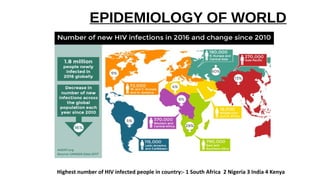
EPIDEMIOLOGY OF WORLD
Highest number of HIV infected people in country:- 1 South Africa 2 Nigeria 3 India 4 Kenya
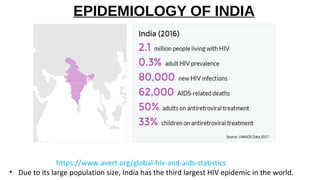
EPIDEMIOLOGY OF INDIA
https://www.avert.org/global-hiv-and-aids-statistics
• Due to its large population size, India has the third largest HIV epidemic in the world.
DIAGNOSIS
• Diagnosis can be done in 3 ways:-
1. Virus isolation:- HIV can be cultured from lymphocytes in peripheral
blood.
2. Serological determination of antiviral antibodies:-Test kit are
commercially available for measuring antibody by enzyme linked
immunosorbent assay (ELISA). Such as Western blot in which HIV
proteins of specific molecular weight can be detected. Some simple
test are based on agglutination or immunodot reaction.
3. Measurement of viral nucleic acid or antigens:- Amplification assays
are RT-PCR, DNA-PCR and bDNA tests are commonly used to detect
viral RNA in clinical specimen.
TREATMENT
• At this time, there is no cure for AIDS but medications are effective in
fighting HIV and Complication.
• Treatment are designed to reduce HIV in your body, keep your
immune system as healthy as possible and decrease the complications.
• Drug treatment help to reduce HIV in body:-
1. Nucleoside reverse transcriptase inhibitor(NRTI):- These drug
interrupt the virus from duplication which may slow the spread of
HIV in body. Ex:- Abacavir, Tenofovir
2. Protease inhibitors (PI):- These FDA approved drugs interrupt virus
replication at a later step in the virus life cycle.
Ex:- Indinavir, Lopinavir
Other medications:-
1. Fusion inhibitors :- These prevent the virus from fusing with inside of a
cell, preventing it from replicating. Ex- Fuzeon or T-20
2. High active antiretroviral therapy (HAART) :- It is the combination of 3
or more drugs, such as protease inhibitors and other antiretroviral
medications. The goal of
(HAART)is to reduce the amount of virus in your body, or
that viral load, to a level that can no longer be detected.
3. Non- nucleceside reverse transcriptase inhibitors(NNRTI):- These
block the infection of new cell by HIV. Ex- Delaviridine, Nevirapine.
PROPHYLAXIS AND CONTROL
1. The only way to avoid epidemic spread of HIV is to maintain a lifestyle that minimizes
or eliminate the high risk factors.
2. Almost all person will remain infected for life and will develop the disease if untreated.
3. Asymptomatic infected individual may transmit HIV to other.
4. Regular medical evolution and follow up are advised.
5. Infected person should refrain from donating blood, plasma, body organ, other tissue
or sperm.
6. The consistent and proper use of condoms can reduce transmission of the virus,
although protection is not absolute.
7. To be faithful to partner.
8. Do not share unsterile needles and syringes.
10. Toothbrush, razors and other implements that could become contaminated
with blood should not be shared.
11. Device that have punctured the skin, eg. Hypodermic and acupuncture
needle should be steam sterilized by autoclaving before reuse or safely
discarded.
12. Dental instrument should be heat sterilized.
13. HIV positive mother should avoid breast feeding.
14. Women having high risk of HIV should seek a HIV test befor becoming
pregnant.
REFERENCE
• Brooks G.F., Carroll K.C., Butel J.S., Morse S.A. and Mietzner, T.A.
(2013) Jawetz, Melnick and Adelberg’s Medical Microbiology. 26th
edition. McGraw Hill Publication
• www.ucsfhealth.org
• www.avert.org
• https://www.ncbi.nlm.nih.gov/books/NBK11782/
• http://www.who.int/mediacentre/factsheets/fs360/en/

AIDS

  • 1.
    Submitted to - Dr.Pawas Goswami Sir Submitted By - Abhishek Bhargav Tarannum Ansari
  • 2.
    INTRODUCTION • HIV standsfor Human immunodeficiency virus. It is the virus that can lead to Acquired immunodeficiency syndrome or AIDS if not treated. Unlike some other viruses, the human body can't get rid of HIV completely, even with treatment. So once a person gets HIV, he/she will have it for life. • HIV attacks the body's immune system, specifically the CD4 cells (T cells), which help the immune system fight off infections. Untreated, HIV reduces the number of CD4 cells (T cells) in the body, making the person more likely to get other infections or infection-related cancers. • Over time, HIV can destroy so many of these cells that the body can't fight off infections and disease. These opportunistic infections or cancers take advantage of a very weak immune system and signal that the person has AIDS, the last stage of HIV infection.
  • 3.
    CAUSATIVE AGENT • HIVis spherical with a dimeter of about 120nm. • 60 time smaller than red blood cells. • Composed of 2 copies of positive sense single stranded RNA. https://en.wikipedia.org/wiki/HIV
  • 4.
  • 5.
    STAGES OF HIVINFECTION https://www.21171069.com/en/facts_figures/infection.html
  • 6.
    TRANSMISSION • HIV canbe transmitted via the exchange of a variety of body fluids from infected individuals, such as blood, breast milk, semen and vaginal secretions. • Individuals cannot become infected through ordinary day-to-day contact such as kissing, hugging, shaking hands, or sharing personal objects, food or water.
  • 7.
    SYMPTOMPS • The symptomsof HIV vary depending on the stage of infection. Though people living with HIV tend to be most infectious in the first few months, many are unaware of their status until later stages. The first few weeks after initial infection, individuals may experience no symptoms or an influenza-like illness including fever, headache, rash, or sore throat. • As the infection progressively weakens the immune system, an individual can develop other signs and symptoms, such as swollen lymph nodes, weight loss, fever, diarrhea and cough. Without treatment, they could also develop severe illnesses such as tuberculosis, cryptococcal meningitis, severe bacterial infections and cancers such as lymphomas and Kaposi's sarcoma.
  • 8.
  • 9.
    EPIDEMIOLOGY OF WORLD •Since the start of the epidemic, an estimated 78 million people have become infected with HIV and 35 million people have died of AIDS-related illnesses. In 2016, 1 million people died of AIDS-related illnesses. • Majority of people living with HIV are located in low- and middle- income countries.
  • 10.
    EPIDEMIOLOGY OF WORLD Highestnumber of HIV infected people in country:- 1 South Africa 2 Nigeria 3 India 4 Kenya
  • 11.
    EPIDEMIOLOGY OF INDIA https://www.avert.org/global-hiv-and-aids-statistics •Due to its large population size, India has the third largest HIV epidemic in the world.
  • 12.
    DIAGNOSIS • Diagnosis canbe done in 3 ways:- 1. Virus isolation:- HIV can be cultured from lymphocytes in peripheral blood. 2. Serological determination of antiviral antibodies:-Test kit are commercially available for measuring antibody by enzyme linked immunosorbent assay (ELISA). Such as Western blot in which HIV proteins of specific molecular weight can be detected. Some simple test are based on agglutination or immunodot reaction. 3. Measurement of viral nucleic acid or antigens:- Amplification assays are RT-PCR, DNA-PCR and bDNA tests are commonly used to detect viral RNA in clinical specimen.
  • 13.
    TREATMENT • At thistime, there is no cure for AIDS but medications are effective in fighting HIV and Complication. • Treatment are designed to reduce HIV in your body, keep your immune system as healthy as possible and decrease the complications. • Drug treatment help to reduce HIV in body:- 1. Nucleoside reverse transcriptase inhibitor(NRTI):- These drug interrupt the virus from duplication which may slow the spread of HIV in body. Ex:- Abacavir, Tenofovir 2. Protease inhibitors (PI):- These FDA approved drugs interrupt virus replication at a later step in the virus life cycle. Ex:- Indinavir, Lopinavir
  • 14.
    Other medications:- 1. Fusioninhibitors :- These prevent the virus from fusing with inside of a cell, preventing it from replicating. Ex- Fuzeon or T-20 2. High active antiretroviral therapy (HAART) :- It is the combination of 3 or more drugs, such as protease inhibitors and other antiretroviral medications. The goal of (HAART)is to reduce the amount of virus in your body, or that viral load, to a level that can no longer be detected. 3. Non- nucleceside reverse transcriptase inhibitors(NNRTI):- These block the infection of new cell by HIV. Ex- Delaviridine, Nevirapine.
  • 15.
    PROPHYLAXIS AND CONTROL 1.The only way to avoid epidemic spread of HIV is to maintain a lifestyle that minimizes or eliminate the high risk factors. 2. Almost all person will remain infected for life and will develop the disease if untreated. 3. Asymptomatic infected individual may transmit HIV to other. 4. Regular medical evolution and follow up are advised. 5. Infected person should refrain from donating blood, plasma, body organ, other tissue or sperm. 6. The consistent and proper use of condoms can reduce transmission of the virus, although protection is not absolute. 7. To be faithful to partner.
  • 16.
    8. Do notshare unsterile needles and syringes. 10. Toothbrush, razors and other implements that could become contaminated with blood should not be shared. 11. Device that have punctured the skin, eg. Hypodermic and acupuncture needle should be steam sterilized by autoclaving before reuse or safely discarded. 12. Dental instrument should be heat sterilized. 13. HIV positive mother should avoid breast feeding. 14. Women having high risk of HIV should seek a HIV test befor becoming pregnant.
  • 17.
    REFERENCE • Brooks G.F.,Carroll K.C., Butel J.S., Morse S.A. and Mietzner, T.A. (2013) Jawetz, Melnick and Adelberg’s Medical Microbiology. 26th edition. McGraw Hill Publication • www.ucsfhealth.org • www.avert.org • https://www.ncbi.nlm.nih.gov/books/NBK11782/ • http://www.who.int/mediacentre/factsheets/fs360/en/

Editor's Notes

  • #4 <number>