Endosperm development
• Endosperm development generally precedes
embryo development
• The fate of endosperm depends upon the
species
• Beans, cotton or Brassicas
• Castor bean, tomato, carrot
• Cereal grains
Morphological variation of endosperms
T
obacco Endosperm
Embryo
Most dicots: large cotyledons, small endosperms.
Carrot seed
Types of endosperm formation
• Nuclear/non-cellular type: Free nuclear division
gives rise to many nuclei and walls may or not form
e.g., most of monocots and some dicots
• Cellular type: Cell walls form immediately after the
first nuclear division and continue to do so as the
endosperm grows e.g., most of dicots and some
monocots
• Helobial type: regarded as intermediate restricted
to few monocots
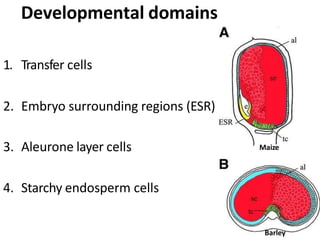
Developmental domains
1. Transfer cells
2. Embryo surrounding regions (ESR)
3. Aleurone layer cells
4. Starchy endosperm cells
Maize
Barley
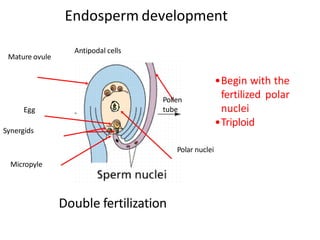
Endosperm development
•Begin with the
fertilized polar
nuclei
•Triploid
Micropyle
Antipodal cells
Polar nuclei
Synergids
Double fertilization
Egg
Mature ovule
Pollen
tube
The cereal endosperm coenocyte
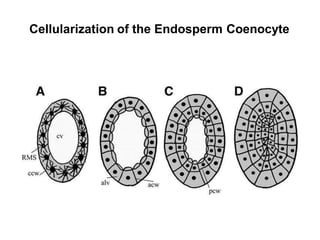
Cellularization of the Endosperm Coenocyte
Endosperm development in dicots
• Endosperm development in dicots is
ephemeral in many species
• Two views about evolution of endosperm
• Endosperm is derived from a primitive embryo
• Endosperm is thought to be comparable with
megagametophyte
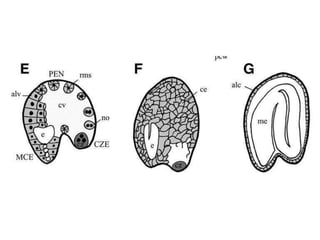
The Arabidopsis endosperm coenocyte
4. Endosperm development_3.pptx with basic terminalogies

4. Endosperm development_3.pptx with basic terminalogies

  • 1.
    Endosperm development • Endospermdevelopment generally precedes embryo development • The fate of endosperm depends upon the species • Beans, cotton or Brassicas • Castor bean, tomato, carrot • Cereal grains
  • 2.
    Morphological variation ofendosperms T obacco Endosperm Embryo Most dicots: large cotyledons, small endosperms. Carrot seed
  • 3.
    Types of endospermformation • Nuclear/non-cellular type: Free nuclear division gives rise to many nuclei and walls may or not form e.g., most of monocots and some dicots • Cellular type: Cell walls form immediately after the first nuclear division and continue to do so as the endosperm grows e.g., most of dicots and some monocots • Helobial type: regarded as intermediate restricted to few monocots
  • 5.
    Developmental domains 1. Transfercells 2. Embryo surrounding regions (ESR) 3. Aleurone layer cells 4. Starchy endosperm cells Maize Barley
  • 7.
    Endosperm development •Begin withthe fertilized polar nuclei •Triploid Micropyle Antipodal cells Polar nuclei Synergids Double fertilization Egg Mature ovule Pollen tube
  • 8.
  • 9.
    Cellularization of theEndosperm Coenocyte
  • 10.
    Endosperm development indicots • Endosperm development in dicots is ephemeral in many species • Two views about evolution of endosperm • Endosperm is derived from a primitive embryo • Endosperm is thought to be comparable with megagametophyte
  • 11.