Learning Objectives:
• Calculate the heart rate from an ECG of both
regular and irregular rhythms.
• Understand the meaning of the QRS axis, and be
able to determine it both qualitatively and
quantitatively.
DETERMINING RATE
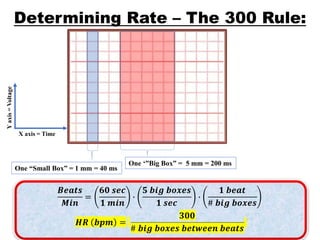
Determining Rate – The 300 Rule:
X axis = Time
Yaxis=Voltage
One “Small Box” = 1 mm = 40 ms
One ‘”Big Box” = 5 mm = 200 ms
𝑩𝒆𝒂𝒕𝒔
𝑴𝒊𝒏
=
𝟔𝟎 𝒔𝒆𝒄
𝟏 𝒎𝒊𝒏
∙
𝟓 𝒃𝒊𝒈 𝒃𝒐𝒙𝒆𝒔
𝟏 𝒔𝒆𝒄
∙
𝟏 𝒃𝒆𝒂𝒕
# 𝒃𝒊𝒈 𝒃𝒐𝒙𝒆𝒔
𝑯𝑹 𝒃𝒑𝒎 =
𝟑𝟎𝟎
# 𝒃𝒊𝒈 𝒃𝒐𝒙𝒆𝒔 𝒃𝒆𝒕𝒘𝒆𝒆𝒏 𝒃𝒆𝒂𝒕𝒔
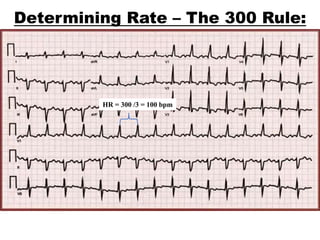
Determining Rate – The 300 Rule:
HR = 300 /3 = 100 bpm
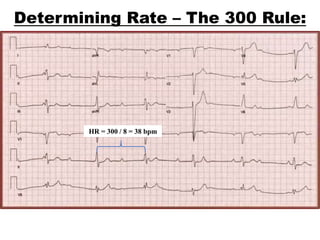
Determining Rate – The 300 Rule:
HR = 300 / 8 = 38 bpm
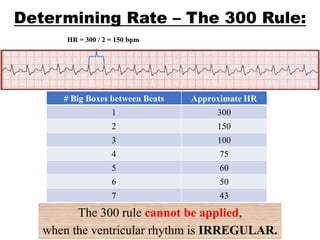
Determining Rate – The 300 Rule:
HR = 300 / 2 = 150 bpm
# Big Boxes between Beats Approximate HR
1 300
2 150
3 100
4 75
5 60
6 50
7 43
The 300 rule cannot be applied,
when the ventricular rhythm is IRREGULAR.
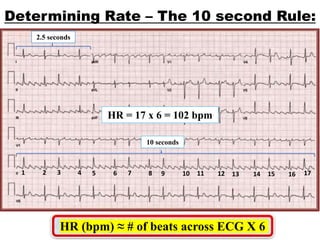
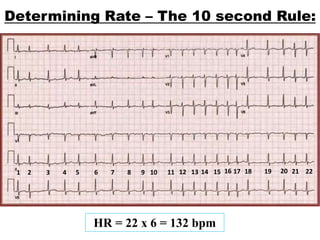
Determining Rate – The 10 second Rule:
2.5 seconds
10 seconds
HR (bpm) ≈ # of beats across ECG X 6
21 3 4 65 7 8 109 11 12 1413 15 16 17
HR = 17 x 6 = 102 bpm
Determining Rate – The 10 second Rule:
21 3 4 65 7 8 109 11 12 1413 15 16 17
HR = 22 x 6 = 132 bpm
18 19 20 21 22
DETERMINING AXIS
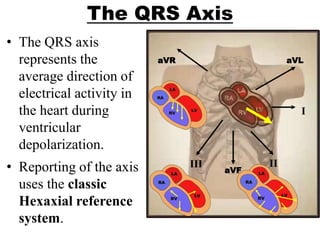
The QRS Axis
• The QRS axis
represents the
average direction of
electrical activity in
the heart during
ventricular
depolarization.
• Reporting of the axis
uses the classic
Hexaxial reference
system.
RA
LA
RV
LV
RA
LA
RV
LV
aVR aVL
I
III
aVF
II
RA
LA
RV
LV
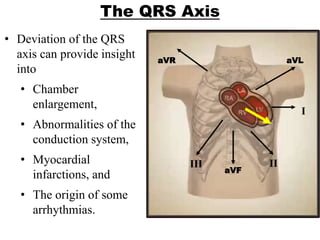
The QRS Axis
• Deviation of the QRS
axis can provide insight
into
• Chamber
enlargement,
• Abnormalities of the
conduction system,
• Myocardial
infarctions, and
• The origin of some
arrhythmias.
aVR aVL
I
III
aVF
II
Normal QRS Axis
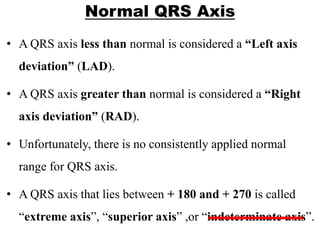
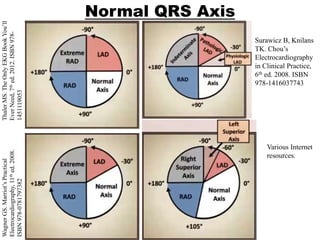
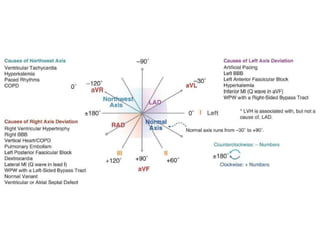
• A QRS axis less than normal is considered a “Left axis
deviation” (LAD).
• A QRS axis greater than normal is considered a “Right
axis deviation” (RAD).
• Unfortunately, there is no consistently applied normal
range for QRS axis.
• A QRS axis that lies between + 180 and + 270 is called
“extreme axis”, “superior axis” ,or “indeterminate axis”.
Normal QRS Axis
ThalerMS.TheOnlyEKGBookYou’ll
EverNeed,7thed.2012.ISBN978-
1451119053
WagnerGS.Marriot’sPractical
Electrocardiography,11thed.2008.
ISBN978-0781797382
Surawicz B, Knilans
TK. Chou’s
Electrocardiography
in Clinical Practice,
6th ed. 2008. ISBN
978-1416037743
Various Internet
resources.
Normal QRS Axis
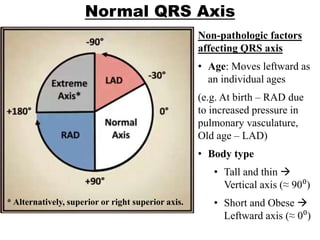
* Alternatively, superior or right superior axis.
Non-pathologic factors
affecting QRS axis
• Age: Moves leftward as
an individual ages
(e.g. At birth – RAD due
to increased pressure in
pulmonary vasculature,
Old age – LAD)
• Body type
• Tall and thin 
Vertical axis (≈ 90⁰)
• Short and Obese 
Leftward axis (≈ 0⁰)
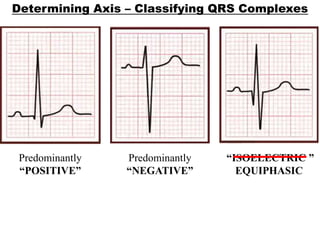
Determining Axis – Classifying QRS Complexes
Predominantly
“POSITIVE”
Predominantly
“NEGATIVE”
“ISOELECTRIC ”
EQUIPHASIC
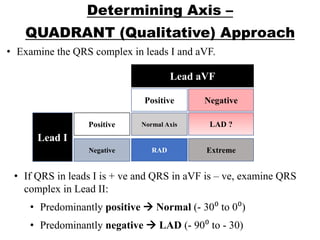
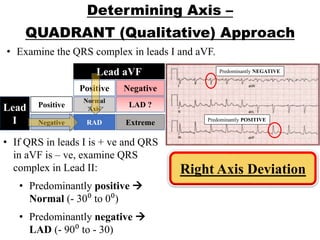
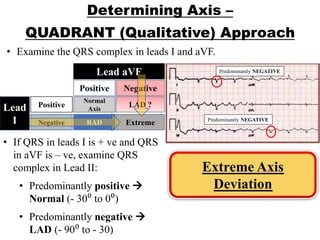
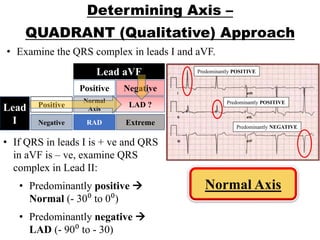
Determining Axis –
QUADRANT (Qualitative) Approach
Lead aVF
Positive Negative
Normal Axis LAD ?
RAD Extreme
Positive
Negative
Lead I
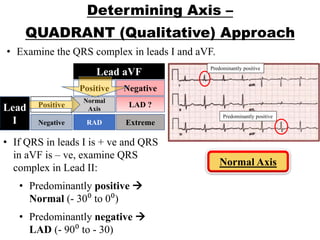
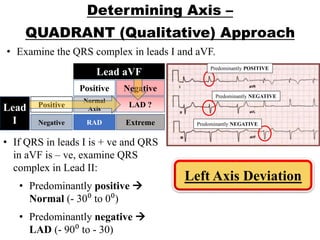
• Examine the QRS complex in leads I and aVF.
• If QRS in leads I is + ve and QRS in aVF is – ve, examine QRS
complex in Lead II:
• Predominantly positive  Normal (- 30⁰ to 0⁰)
• Predominantly negative  LAD (- 90⁰ to - 30)
Determining Axis –
QUADRANT (Qualitative) Approach
Lead aVF
Positive Negative
Normal
Axis
LAD ?
RAD Extreme
Positive
Negative
Lead
I
• Examine the QRS complex in leads I and aVF.
• If QRS in leads I is + ve and QRS
in aVF is – ve, examine QRS
complex in Lead II:
• Predominantly positive 
Normal (- 30⁰ to 0⁰)
• Predominantly negative 
LAD (- 90⁰ to - 30)
Predominantly positive
Normal Axis
Determining Axis –
QUADRANT (Qualitative) Approach
Lead aVF
Positive Negative
Normal
Axis
LAD ?
RAD Extreme
Positive
Negative
Lead
I
• Examine the QRS complex in leads I and aVF.
• If QRS in leads I is + ve and QRS
in aVF is – ve, examine QRS
complex in Lead II:
• Predominantly positive 
Normal (- 30⁰ to 0⁰)
• Predominantly negative 
LAD (- 90⁰ to - 30)
Predominantly POSITIVE
Predominantly NEGATIVE
Left Axis Deviation
Predominantly NEGATIVE
Determining Axis –
QUADRANT (Qualitative) Approach
Lead aVF
Positive Negative
Normal
Axis
LAD ?
RAD Extreme
Positive
Negative
Lead
I
• Examine the QRS complex in leads I and aVF.
• If QRS in leads I is + ve and QRS
in aVF is – ve, examine QRS
complex in Lead II:
• Predominantly positive 
Normal (- 30⁰ to 0⁰)
• Predominantly negative 
LAD (- 90⁰ to - 30)
Predominantly POSITIVE
Predominantly NEGATIVE
Right Axis Deviation
Determining Axis –
QUADRANT (Qualitative) Approach
Lead aVF
Positive Negative
Normal
Axis
LAD ?
RAD Extreme
Positive
Negative
Lead
I
• Examine the QRS complex in leads I and aVF.
• If QRS in leads I is + ve and QRS
in aVF is – ve, examine QRS
complex in Lead II:
• Predominantly positive 
Normal (- 30⁰ to 0⁰)
• Predominantly negative 
LAD (- 90⁰ to - 30)
Predominantly NEGATIVE
Extreme Axis
Deviation
Predominantly NEGATIVE
Determining Axis –
QUADRANT (Qualitative) Approach
Lead aVF
Positive Negative
Normal
Axis
LAD ?
RAD Extreme
Positive
Negative
Lead
I
• Examine the QRS complex in leads I and aVF.
• If QRS in leads I is + ve and QRS
in aVF is – ve, examine QRS
complex in Lead II:
• Predominantly positive 
Normal (- 30⁰ to 0⁰)
• Predominantly negative 
LAD (- 90⁰ to - 30)
Predominantly NEGATIVE
Normal Axis
Predominantly POSITIVE
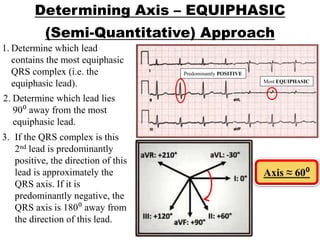
Determining Axis – EQUIPHASIC
(Semi-Quantitative) Approach
1. Determine which lead
contains the most equiphasic
QRS complex (i.e. the
equiphasic lead).
Axis ≈ 60⁰
Predominantly POSITIVE
Most EQUIPHASIC
2. Determine which lead lies
90⁰ away from the most
equiphasic lead.
3. If the QRS complex is this
2nd lead is predominantly
positive, the direction of this
lead is approximately the
QRS axis. If it is
predominantly negative, the
QRS axis is 180⁰ away from
the direction of this lead.
Determining Axis – EQUIPHASIC
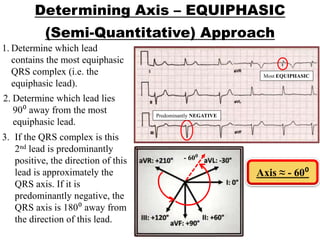
(Semi-Quantitative) Approach
Predominantly NEGATIVE
Axis ≈ - 60⁰
Most EQUIPHASIC
- 60⁰
1. Determine which lead
contains the most equiphasic
QRS complex (i.e. the
equiphasic lead).
2. Determine which lead lies
90⁰ away from the most
equiphasic lead.
3. If the QRS complex is this
2nd lead is predominantly
positive, the direction of this
lead is approximately the
QRS axis. If it is
predominantly negative, the
QRS axis is 180⁰ away from
the direction of this lead.
Determining Axis – EQUIPHASIC
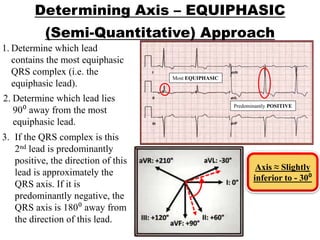
(Semi-Quantitative) Approach
Predominantly POSITIVE
Axis ≈ Slightly
inferior to - 30⁰
Most EQUIPHASIC
1. Determine which lead
contains the most equiphasic
QRS complex (i.e. the
equiphasic lead).
2. Determine which lead lies
90⁰ away from the most
equiphasic lead.
3. If the QRS complex is this
2nd lead is predominantly
positive, the direction of this
lead is approximately the
QRS axis. If it is
predominantly negative, the
QRS axis is 180⁰ away from
the direction of this lead.
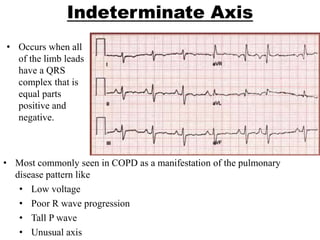
Indeterminate Axis
• Occurs when all
of the limb leads
have a QRS
complex that is
equal parts
positive and
negative.
• Most commonly seen in COPD as a manifestation of the pulmonary
disease pattern like
• Low voltage
• Poor R wave progression
• Tall P wave
• Unusual axis
4. ecg basics   rate and axis

4. ecg basics rate and axis

  • 3.
    Learning Objectives: • Calculatethe heart rate from an ECG of both regular and irregular rhythms. • Understand the meaning of the QRS axis, and be able to determine it both qualitatively and quantitatively.
  • 5.
  • 6.
    Determining Rate –The 300 Rule: X axis = Time Yaxis=Voltage One “Small Box” = 1 mm = 40 ms One ‘”Big Box” = 5 mm = 200 ms 𝑩𝒆𝒂𝒕𝒔 𝑴𝒊𝒏 = 𝟔𝟎 𝒔𝒆𝒄 𝟏 𝒎𝒊𝒏 ∙ 𝟓 𝒃𝒊𝒈 𝒃𝒐𝒙𝒆𝒔 𝟏 𝒔𝒆𝒄 ∙ 𝟏 𝒃𝒆𝒂𝒕 # 𝒃𝒊𝒈 𝒃𝒐𝒙𝒆𝒔 𝑯𝑹 𝒃𝒑𝒎 = 𝟑𝟎𝟎 # 𝒃𝒊𝒈 𝒃𝒐𝒙𝒆𝒔 𝒃𝒆𝒕𝒘𝒆𝒆𝒏 𝒃𝒆𝒂𝒕𝒔
  • 7.
    Determining Rate –The 300 Rule: HR = 300 /3 = 100 bpm
  • 8.
    Determining Rate –The 300 Rule: HR = 300 / 8 = 38 bpm
  • 9.
    Determining Rate –The 300 Rule: HR = 300 / 2 = 150 bpm # Big Boxes between Beats Approximate HR 1 300 2 150 3 100 4 75 5 60 6 50 7 43 The 300 rule cannot be applied, when the ventricular rhythm is IRREGULAR.
  • 10.
    Determining Rate –The 10 second Rule: 2.5 seconds 10 seconds HR (bpm) ≈ # of beats across ECG X 6 21 3 4 65 7 8 109 11 12 1413 15 16 17 HR = 17 x 6 = 102 bpm
  • 11.
    Determining Rate –The 10 second Rule: 21 3 4 65 7 8 109 11 12 1413 15 16 17 HR = 22 x 6 = 132 bpm 18 19 20 21 22
  • 12.
  • 13.
    The QRS Axis •The QRS axis represents the average direction of electrical activity in the heart during ventricular depolarization. • Reporting of the axis uses the classic Hexaxial reference system. RA LA RV LV RA LA RV LV aVR aVL I III aVF II RA LA RV LV
  • 14.
    The QRS Axis •Deviation of the QRS axis can provide insight into • Chamber enlargement, • Abnormalities of the conduction system, • Myocardial infarctions, and • The origin of some arrhythmias. aVR aVL I III aVF II
  • 15.
    Normal QRS Axis •A QRS axis less than normal is considered a “Left axis deviation” (LAD). • A QRS axis greater than normal is considered a “Right axis deviation” (RAD). • Unfortunately, there is no consistently applied normal range for QRS axis. • A QRS axis that lies between + 180 and + 270 is called “extreme axis”, “superior axis” ,or “indeterminate axis”.
  • 16.
    Normal QRS Axis ThalerMS.TheOnlyEKGBookYou’ll EverNeed,7thed.2012.ISBN978- 1451119053 WagnerGS.Marriot’sPractical Electrocardiography,11thed.2008. ISBN978-0781797382 SurawiczB, Knilans TK. Chou’s Electrocardiography in Clinical Practice, 6th ed. 2008. ISBN 978-1416037743 Various Internet resources.
  • 18.
    Normal QRS Axis *Alternatively, superior or right superior axis. Non-pathologic factors affecting QRS axis • Age: Moves leftward as an individual ages (e.g. At birth – RAD due to increased pressure in pulmonary vasculature, Old age – LAD) • Body type • Tall and thin  Vertical axis (≈ 90⁰) • Short and Obese  Leftward axis (≈ 0⁰)
  • 19.
    Determining Axis –Classifying QRS Complexes Predominantly “POSITIVE” Predominantly “NEGATIVE” “ISOELECTRIC ” EQUIPHASIC
  • 20.
    Determining Axis – QUADRANT(Qualitative) Approach Lead aVF Positive Negative Normal Axis LAD ? RAD Extreme Positive Negative Lead I • Examine the QRS complex in leads I and aVF. • If QRS in leads I is + ve and QRS in aVF is – ve, examine QRS complex in Lead II: • Predominantly positive  Normal (- 30⁰ to 0⁰) • Predominantly negative  LAD (- 90⁰ to - 30)
  • 21.
    Determining Axis – QUADRANT(Qualitative) Approach Lead aVF Positive Negative Normal Axis LAD ? RAD Extreme Positive Negative Lead I • Examine the QRS complex in leads I and aVF. • If QRS in leads I is + ve and QRS in aVF is – ve, examine QRS complex in Lead II: • Predominantly positive  Normal (- 30⁰ to 0⁰) • Predominantly negative  LAD (- 90⁰ to - 30) Predominantly positive Predominantly positive Normal Axis
  • 22.
    Determining Axis – QUADRANT(Qualitative) Approach Lead aVF Positive Negative Normal Axis LAD ? RAD Extreme Positive Negative Lead I • Examine the QRS complex in leads I and aVF. • If QRS in leads I is + ve and QRS in aVF is – ve, examine QRS complex in Lead II: • Predominantly positive  Normal (- 30⁰ to 0⁰) • Predominantly negative  LAD (- 90⁰ to - 30) Predominantly POSITIVE Predominantly NEGATIVE Left Axis Deviation Predominantly NEGATIVE
  • 23.
    Determining Axis – QUADRANT(Qualitative) Approach Lead aVF Positive Negative Normal Axis LAD ? RAD Extreme Positive Negative Lead I • Examine the QRS complex in leads I and aVF. • If QRS in leads I is + ve and QRS in aVF is – ve, examine QRS complex in Lead II: • Predominantly positive  Normal (- 30⁰ to 0⁰) • Predominantly negative  LAD (- 90⁰ to - 30) Predominantly POSITIVE Predominantly NEGATIVE Right Axis Deviation
  • 24.
    Determining Axis – QUADRANT(Qualitative) Approach Lead aVF Positive Negative Normal Axis LAD ? RAD Extreme Positive Negative Lead I • Examine the QRS complex in leads I and aVF. • If QRS in leads I is + ve and QRS in aVF is – ve, examine QRS complex in Lead II: • Predominantly positive  Normal (- 30⁰ to 0⁰) • Predominantly negative  LAD (- 90⁰ to - 30) Predominantly NEGATIVE Extreme Axis Deviation Predominantly NEGATIVE
  • 25.
    Determining Axis – QUADRANT(Qualitative) Approach Lead aVF Positive Negative Normal Axis LAD ? RAD Extreme Positive Negative Lead I • Examine the QRS complex in leads I and aVF. • If QRS in leads I is + ve and QRS in aVF is – ve, examine QRS complex in Lead II: • Predominantly positive  Normal (- 30⁰ to 0⁰) • Predominantly negative  LAD (- 90⁰ to - 30) Predominantly NEGATIVE Normal Axis Predominantly POSITIVE Predominantly POSITIVE
  • 26.
    Determining Axis –EQUIPHASIC (Semi-Quantitative) Approach 1. Determine which lead contains the most equiphasic QRS complex (i.e. the equiphasic lead). Axis ≈ 60⁰ Predominantly POSITIVE Most EQUIPHASIC 2. Determine which lead lies 90⁰ away from the most equiphasic lead. 3. If the QRS complex is this 2nd lead is predominantly positive, the direction of this lead is approximately the QRS axis. If it is predominantly negative, the QRS axis is 180⁰ away from the direction of this lead.
  • 27.
    Determining Axis –EQUIPHASIC (Semi-Quantitative) Approach Predominantly NEGATIVE Axis ≈ - 60⁰ Most EQUIPHASIC - 60⁰ 1. Determine which lead contains the most equiphasic QRS complex (i.e. the equiphasic lead). 2. Determine which lead lies 90⁰ away from the most equiphasic lead. 3. If the QRS complex is this 2nd lead is predominantly positive, the direction of this lead is approximately the QRS axis. If it is predominantly negative, the QRS axis is 180⁰ away from the direction of this lead.
  • 28.
    Determining Axis –EQUIPHASIC (Semi-Quantitative) Approach Predominantly POSITIVE Axis ≈ Slightly inferior to - 30⁰ Most EQUIPHASIC 1. Determine which lead contains the most equiphasic QRS complex (i.e. the equiphasic lead). 2. Determine which lead lies 90⁰ away from the most equiphasic lead. 3. If the QRS complex is this 2nd lead is predominantly positive, the direction of this lead is approximately the QRS axis. If it is predominantly negative, the QRS axis is 180⁰ away from the direction of this lead.
  • 29.
    Indeterminate Axis • Occurswhen all of the limb leads have a QRS complex that is equal parts positive and negative. • Most commonly seen in COPD as a manifestation of the pulmonary disease pattern like • Low voltage • Poor R wave progression • Tall P wave • Unusual axis