CARDIAC GLYCOSIDES
Presented by;
M Pharm (Pharmaceutical Chemistry) students
Gunturu .Aparna
Akshintala. Sree Gayatri
Thota. Madhu latha
Kamre. Sunil
Daram. Sekhar
University college of pharmaceutical sciences
Department of pharmaceutical chemistry
Acharya Nagarjuna University
Guntur
1
CARDIAC GLYCOSIDES
 These are an important class of naturally occurring drugs whose
actions include both beneficial and toxic effects on the heart.
 Plant glycosides with specific action on heart.
 Historical use:
 to assasinate people, arrow poisons
 Historical sources:
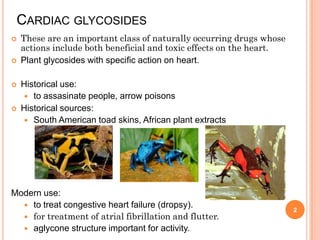
 South American toad skins, African plant extracts
Modern use:
 to treat congestive heart failure (dropsy).
 for treatment of atrial fibrillation and flutter.
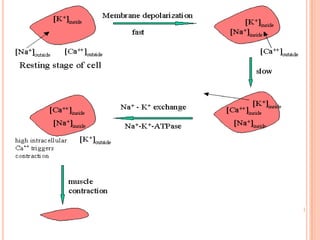
 aglycone structure important for activity.
2
SOURCES
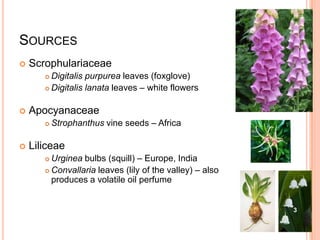
 Scrophulariaceae
 Digitalis purpurea leaves (foxglove)
 Digitalis lanata leaves – white flowers
 Apocyanaceae
 Strophanthus vine seeds – Africa
 Liliceae
 Urginea bulbs (squill) – Europe, India
 Convallaria leaves (lily of the valley) – also
produces a volatile oil perfume
3
Cardio-active Glycosides
•Group of steroidal glycosides act as cardiotonic agent.
•They increase tone, excitability and contractility of cardiac
muscles.
General properties of Cardiac Glycosides :
Amorphous powder
Bitter taste
Solubility in H2O
Insolubility in Organic solvents
Very toxic compounds
Odorless 4
PHYSICAL AND CHEMICAL PROPERTIES OF
CARDIAC GLYCOSIDES:
 Solubility:
 Glycosides are soluble in water and alcohols.
 Increase number of sugars increase water solubility.
 Aglycones soluble in CHCl3 and EtOAc.
 Stability:
 Acid hydrolysis:
 Split sugars from the aglycone first.
 Enzymatic hydrolysis:
 Split sugars stepwise starting from the terminal sugar.
 Elevated temperature:
 Cause dehydration by removal of C-14 OH group to give inactive
anhydro-form
5
CARDIO-ACTIVE GLYCOSIDES
 A small group of plant
glycosides act directly
on the heart muscle.
 These include (but are
not limited to cardiac
glycosides or
cardenolides)
 Cardenolides are
steroidal glycosides
 exert a slowing and
strengthening effect
on the failing cardiac
muscle.
6
CLASSIFICATIONS OF GLYCOSIDES:
According to their therapeutic effects:
CHF(congestive heart failure) and cardiac muscle
stimulators such as:
 Digitalis glycosides: digoxin, digitoxin, gitoxin (Fox
glove leaves).
 Ouabain: Strophanthus gratus seeds.
 K-strophanthin: Strophanthus kombe seeds.
 Scillaren A,B which isolated from red and white
Squill bulbs.
 Convolloside:Convallaria majalis: Lily of the Valley.
7
According to the type of lactone ring:
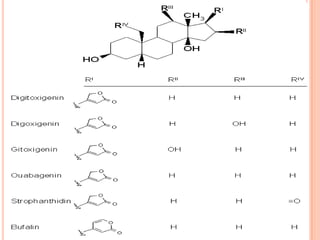
1. Cardenolide (one double bond, lactone ring) :
Has five member lactone ring (unsaturated) attached at C17 B position of
steroidal nucleus.
Examples:
Digitalis glycosides:
Digoxin
Digitoxin
Gitoxin
Strophanthus gratus glycoside :
Oubain
Strophanthus Kombe glycoside :
K- strophanthin
2. Bufadienolide: (contain two double bonds, lactone ring):
Has six member ( unsaturated ) lactone ring attached at C-17 alpha –
position
Example:
Squill bulb glycoside
Scillaren
8
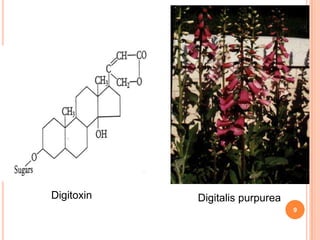
Digitalis purpureaDigitoxin
9
Nomenclature :
The cardiac glycosides occur mainly in plants from which the
names have been derived.
Digitalis purpurea,
Digitalis lanata,
Strophanthus kombe are the major sources of the
cardiac glycosides.
Aglycone moiety:
The term 'genin' at the end refers to only the aglycone portion
(without the sugar).
The aglycone portion of cardiac glycosides is more important
than the glycone portion.
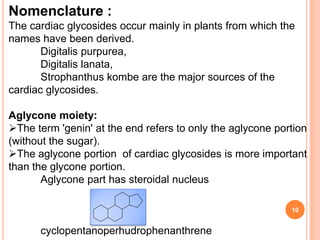
Aglycone part has steroidal nucleus
cyclopentanoperhudrophenanthrene
10
Sugar moiety(glycone) :
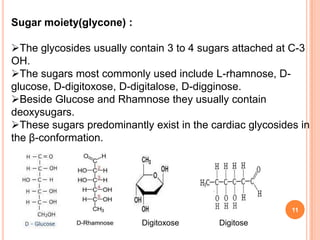
The glycosides usually contain 3 to 4 sugars attached at C-3
OH.
The sugars most commonly used include L-rhamnose, D-
glucose, D-digitoxose, D-digitalose, D-digginose.
Beside Glucose and Rhamnose they usually contain
deoxysugars.
These sugars predominantly exist in the cardiac glycosides in
the β-conformation.
Digitoxose Digitose
11
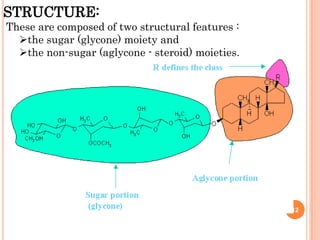
STRUCTURE:
These are composed of two structural features :
the sugar (glycone) moiety and
the non-sugar (aglycone - steroid) moieties.
12
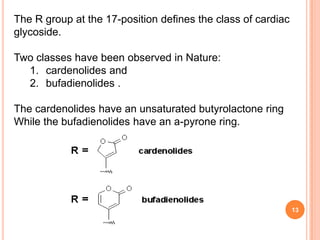
The R group at the 17-position defines the class of cardiac
glycoside.
Two classes have been observed in Nature:
1. cardenolides and
2. bufadienolides .
The cardenolides have an unsaturated butyrolactone ring
While the bufadienolides have an a-pyrone ring.
13
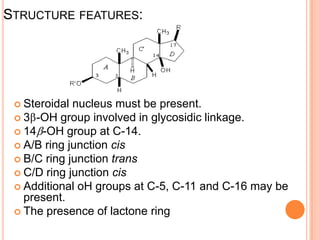
STRUCTURE FEATURES:
 Steroidal nucleus must be present.
 3 -OH group involved in glycosidic linkage.
 14 -OH group at C-14.
 A/B ring junction cis
 B/C ring junction trans
 C/D ring junction cis
 Additional oH groups at C-5, C-11 and C-16 may be
present.
 The presence of lactone ring
15
Structural actiity and relationship :-
1) The presence of OH group in C-14 position makes the
glycoside very active and gives rapid action in the body, but if
we change it to (H+) group the drug will be inactive or less
active.
2) The presence of Alpha & Beta unsaturated lactone ring
increases the activity of Cardiac Glycosides, but if we make it
saturated the Cardiac glycosides will lose its activity.
3) The ring junctions Cis, Trans, Cis make the nucleus very
stable so more active.
4) The sugar part increases absorption and distribution of
Cardiac glycoside in the body.
Sugar part : Glucose, Rhamnose, Cymarose, Digitoxose
16
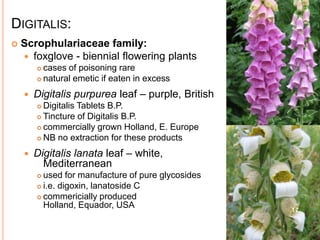
DIGITALIS:
 Scrophulariaceae family:
 foxglove - biennial flowering plants
 cases of poisoning rare
 natural emetic if eaten in excess
 Digitalis purpurea leaf – purple, British
 Digitalis Tablets B.P.
 Tincture of Digitalis B.P.
 commercially grown Holland, E. Europe
 NB no extraction for these products
 Digitalis lanata leaf – white,
Mediterranean
 used for manufacture of pure glycosides
 i.e. digoxin, lanatoside C
 commericially produced
Holland, Equador, USA 17
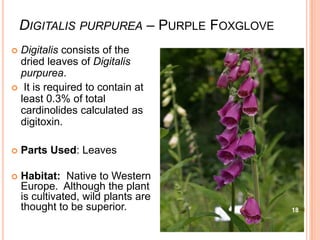
DIGITALIS PURPUREA – PURPLE FOXGLOVE
 Digitalis consists of the
dried leaves of Digitalis
purpurea.
 It is required to contain at
least 0.3% of total
cardinolides calculated as
digitoxin.
 Parts Used: Leaves
 Habitat: Native to Western
Europe. Although the plant
is cultivated, wild plants are
thought to be superior. 18
CHEMISTRY OF D.PURPUREA
 Glycosides
 purpurea glycoside A
 purpurea glycoside B
 Glucogitaloxin
 Steroid cardenolides
 contains 30 glycosides, 6 main ones
 only has 3 aglycones
 At C-3 of the genin: a linear chain of 3 digitoxose sugar moieties
terminated by glucose.
 On drying: enzyme degradation takes place  loss of the terminal
glucose. Produces
 Digitoxin
 Gitoxin
 Gitaloxin
 also contains anthraquinone glycosides
 Saponins
 Sopogenins
 Flavonoids
19
CHEMISTRY OF D.LANATA
 compounds belong to
cardenolide series
 5 membered lactone ring
 approx 96 compounds
 [1930-1950 Stroll
worked on structures]
R1 R2 Names 1y 2y
H H digitoxigenin A A digitoxin
H OH gitoxigenin B B gitoxin
OH H digoxigenin C C digoxin
OH OH diginatigenin D D diginatin
H formylester gitaloxigenin E E gitaloxin
*
* Acetyl group
confers crystalline
properties - makes
compounds more
easily isolated
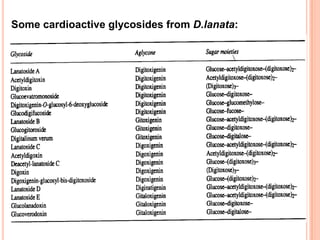
Some cardioactive glycosides from D.lanata:
21
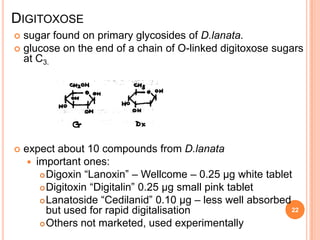
DIGITOXOSE
 sugar found on primary glycosides of D.lanata.
 glucose on the end of a chain of O-linked digitoxose sugars
at C3.
 expect about 10 compounds from D.lanata
 important ones:
Digoxin “Lanoxin” – Wellcome – 0.25 μg white tablet
Digitoxin “Digitalin” 0.25 μg small pink tablet
Lanatoside “Cedilanid” 0.10 μg – less well absorbed
but used for rapid digitalisation
Others not marketed, used experimentally
22
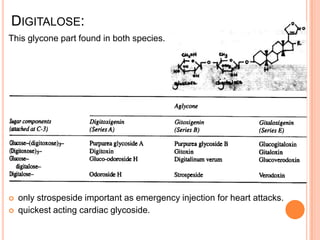
DIGITALOSE:
This glycone part found in both species.
 only strospeside important as emergency injection for heart attacks.
 quickest acting cardiac glycoside.
Biochemical Mechanism of Action:
The mechanism whereby cardiac glycosides cause a positive
inotropic effect.
Several mechanisms have been proposed.
but the most widely accepted involves the ability of cardiac
glycosides to inhibit the membrane bound Na+-K+-ATPase
pump responsible for Na+-K+ exchange.
The process of membrane depolarization / repolarization is
controlled by the movement of three cations, Na+, Ca+2, and
K+, in and out of the cell.
24
25
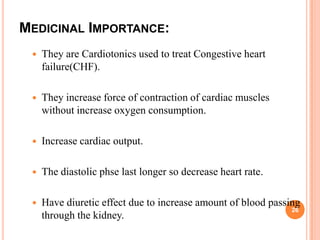
MEDICINAL IMPORTANCE:
 They are Cardiotonics used to treat Congestive heart
failure(CHF).
 They increase force of contraction of cardiac muscles
without increase oxygen consumption.
 Increase cardiac output.
 The diastolic phse last longer so decrease heart rate.
 Have diuretic effect due to increase amount of blood passing
through the kidney.
26
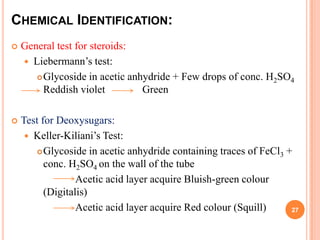
CHEMICAL IDENTIFICATION:
 General test for steroids:
 Liebermann’s test:
Glycoside in acetic anhydride + Few drops of conc. H2SO4
Reddish violet Green
 Test for Deoxysugars:
 Keller-Kiliani’s Test:
Glycoside in acetic anhydride containing traces of FeCl3 +
conc. H2SO4 on the wall of the tube
Acetic acid layer acquire Bluish-green colour
(Digitalis)
Acetic acid layer acquire Red colour (Squill) 27
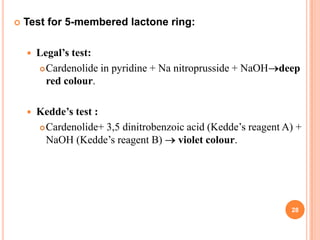
 Test for 5-membered lactone ring:
 Legal’s test:
Cardenolide in pyridine + Na nitroprusside + NaOH deep
red colour.
 Kedde’s test :
Cardenolide+ 3,5 dinitrobenzoic acid (Kedde’s reagent A) +
NaOH (Kedde’s reagent B) violet colour.
28

Cardiac glycosides

  • 1.
    CARDIAC GLYCOSIDES Presented by; MPharm (Pharmaceutical Chemistry) students Gunturu .Aparna Akshintala. Sree Gayatri Thota. Madhu latha Kamre. Sunil Daram. Sekhar University college of pharmaceutical sciences Department of pharmaceutical chemistry Acharya Nagarjuna University Guntur 1
  • 2.
    CARDIAC GLYCOSIDES  Theseare an important class of naturally occurring drugs whose actions include both beneficial and toxic effects on the heart.  Plant glycosides with specific action on heart.  Historical use:  to assasinate people, arrow poisons  Historical sources:  South American toad skins, African plant extracts Modern use:  to treat congestive heart failure (dropsy).  for treatment of atrial fibrillation and flutter.  aglycone structure important for activity. 2
  • 3.
    SOURCES  Scrophulariaceae  Digitalispurpurea leaves (foxglove)  Digitalis lanata leaves – white flowers  Apocyanaceae  Strophanthus vine seeds – Africa  Liliceae  Urginea bulbs (squill) – Europe, India  Convallaria leaves (lily of the valley) – also produces a volatile oil perfume 3
  • 4.
    Cardio-active Glycosides •Group ofsteroidal glycosides act as cardiotonic agent. •They increase tone, excitability and contractility of cardiac muscles. General properties of Cardiac Glycosides : Amorphous powder Bitter taste Solubility in H2O Insolubility in Organic solvents Very toxic compounds Odorless 4
  • 5.
    PHYSICAL AND CHEMICALPROPERTIES OF CARDIAC GLYCOSIDES:  Solubility:  Glycosides are soluble in water and alcohols.  Increase number of sugars increase water solubility.  Aglycones soluble in CHCl3 and EtOAc.  Stability:  Acid hydrolysis:  Split sugars from the aglycone first.  Enzymatic hydrolysis:  Split sugars stepwise starting from the terminal sugar.  Elevated temperature:  Cause dehydration by removal of C-14 OH group to give inactive anhydro-form 5
  • 6.
    CARDIO-ACTIVE GLYCOSIDES  Asmall group of plant glycosides act directly on the heart muscle.  These include (but are not limited to cardiac glycosides or cardenolides)  Cardenolides are steroidal glycosides  exert a slowing and strengthening effect on the failing cardiac muscle. 6
  • 7.
    CLASSIFICATIONS OF GLYCOSIDES: Accordingto their therapeutic effects: CHF(congestive heart failure) and cardiac muscle stimulators such as:  Digitalis glycosides: digoxin, digitoxin, gitoxin (Fox glove leaves).  Ouabain: Strophanthus gratus seeds.  K-strophanthin: Strophanthus kombe seeds.  Scillaren A,B which isolated from red and white Squill bulbs.  Convolloside:Convallaria majalis: Lily of the Valley. 7
  • 8.
    According to thetype of lactone ring: 1. Cardenolide (one double bond, lactone ring) : Has five member lactone ring (unsaturated) attached at C17 B position of steroidal nucleus. Examples: Digitalis glycosides: Digoxin Digitoxin Gitoxin Strophanthus gratus glycoside : Oubain Strophanthus Kombe glycoside : K- strophanthin 2. Bufadienolide: (contain two double bonds, lactone ring): Has six member ( unsaturated ) lactone ring attached at C-17 alpha – position Example: Squill bulb glycoside Scillaren 8
  • 9.
  • 10.
    Nomenclature : The cardiacglycosides occur mainly in plants from which the names have been derived. Digitalis purpurea, Digitalis lanata, Strophanthus kombe are the major sources of the cardiac glycosides. Aglycone moiety: The term 'genin' at the end refers to only the aglycone portion (without the sugar). The aglycone portion of cardiac glycosides is more important than the glycone portion. Aglycone part has steroidal nucleus cyclopentanoperhudrophenanthrene 10
  • 11.
    Sugar moiety(glycone) : Theglycosides usually contain 3 to 4 sugars attached at C-3 OH. The sugars most commonly used include L-rhamnose, D- glucose, D-digitoxose, D-digitalose, D-digginose. Beside Glucose and Rhamnose they usually contain deoxysugars. These sugars predominantly exist in the cardiac glycosides in the β-conformation. Digitoxose Digitose 11
  • 12.
    STRUCTURE: These are composedof two structural features : the sugar (glycone) moiety and the non-sugar (aglycone - steroid) moieties. 12
  • 13.
    The R groupat the 17-position defines the class of cardiac glycoside. Two classes have been observed in Nature: 1. cardenolides and 2. bufadienolides . The cardenolides have an unsaturated butyrolactone ring While the bufadienolides have an a-pyrone ring. 13
  • 14.
    STRUCTURE FEATURES:  Steroidalnucleus must be present.  3 -OH group involved in glycosidic linkage.  14 -OH group at C-14.  A/B ring junction cis  B/C ring junction trans  C/D ring junction cis  Additional oH groups at C-5, C-11 and C-16 may be present.  The presence of lactone ring
  • 15.
  • 16.
    Structural actiity andrelationship :- 1) The presence of OH group in C-14 position makes the glycoside very active and gives rapid action in the body, but if we change it to (H+) group the drug will be inactive or less active. 2) The presence of Alpha & Beta unsaturated lactone ring increases the activity of Cardiac Glycosides, but if we make it saturated the Cardiac glycosides will lose its activity. 3) The ring junctions Cis, Trans, Cis make the nucleus very stable so more active. 4) The sugar part increases absorption and distribution of Cardiac glycoside in the body. Sugar part : Glucose, Rhamnose, Cymarose, Digitoxose 16
  • 17.
    DIGITALIS:  Scrophulariaceae family: foxglove - biennial flowering plants  cases of poisoning rare  natural emetic if eaten in excess  Digitalis purpurea leaf – purple, British  Digitalis Tablets B.P.  Tincture of Digitalis B.P.  commercially grown Holland, E. Europe  NB no extraction for these products  Digitalis lanata leaf – white, Mediterranean  used for manufacture of pure glycosides  i.e. digoxin, lanatoside C  commericially produced Holland, Equador, USA 17
  • 18.
    DIGITALIS PURPUREA –PURPLE FOXGLOVE  Digitalis consists of the dried leaves of Digitalis purpurea.  It is required to contain at least 0.3% of total cardinolides calculated as digitoxin.  Parts Used: Leaves  Habitat: Native to Western Europe. Although the plant is cultivated, wild plants are thought to be superior. 18
  • 19.
    CHEMISTRY OF D.PURPUREA Glycosides  purpurea glycoside A  purpurea glycoside B  Glucogitaloxin  Steroid cardenolides  contains 30 glycosides, 6 main ones  only has 3 aglycones  At C-3 of the genin: a linear chain of 3 digitoxose sugar moieties terminated by glucose.  On drying: enzyme degradation takes place  loss of the terminal glucose. Produces  Digitoxin  Gitoxin  Gitaloxin  also contains anthraquinone glycosides  Saponins  Sopogenins  Flavonoids 19
  • 20.
    CHEMISTRY OF D.LANATA compounds belong to cardenolide series  5 membered lactone ring  approx 96 compounds  [1930-1950 Stroll worked on structures] R1 R2 Names 1y 2y H H digitoxigenin A A digitoxin H OH gitoxigenin B B gitoxin OH H digoxigenin C C digoxin OH OH diginatigenin D D diginatin H formylester gitaloxigenin E E gitaloxin * * Acetyl group confers crystalline properties - makes compounds more easily isolated
  • 21.
  • 22.
    DIGITOXOSE  sugar foundon primary glycosides of D.lanata.  glucose on the end of a chain of O-linked digitoxose sugars at C3.  expect about 10 compounds from D.lanata  important ones: Digoxin “Lanoxin” – Wellcome – 0.25 μg white tablet Digitoxin “Digitalin” 0.25 μg small pink tablet Lanatoside “Cedilanid” 0.10 μg – less well absorbed but used for rapid digitalisation Others not marketed, used experimentally 22
  • 23.
    DIGITALOSE: This glycone partfound in both species.  only strospeside important as emergency injection for heart attacks.  quickest acting cardiac glycoside.
  • 24.
    Biochemical Mechanism ofAction: The mechanism whereby cardiac glycosides cause a positive inotropic effect. Several mechanisms have been proposed. but the most widely accepted involves the ability of cardiac glycosides to inhibit the membrane bound Na+-K+-ATPase pump responsible for Na+-K+ exchange. The process of membrane depolarization / repolarization is controlled by the movement of three cations, Na+, Ca+2, and K+, in and out of the cell. 24
  • 25.
  • 26.
    MEDICINAL IMPORTANCE:  Theyare Cardiotonics used to treat Congestive heart failure(CHF).  They increase force of contraction of cardiac muscles without increase oxygen consumption.  Increase cardiac output.  The diastolic phse last longer so decrease heart rate.  Have diuretic effect due to increase amount of blood passing through the kidney. 26
  • 27.
    CHEMICAL IDENTIFICATION:  Generaltest for steroids:  Liebermann’s test: Glycoside in acetic anhydride + Few drops of conc. H2SO4 Reddish violet Green  Test for Deoxysugars:  Keller-Kiliani’s Test: Glycoside in acetic anhydride containing traces of FeCl3 + conc. H2SO4 on the wall of the tube Acetic acid layer acquire Bluish-green colour (Digitalis) Acetic acid layer acquire Red colour (Squill) 27
  • 28.
     Test for5-membered lactone ring:  Legal’s test: Cardenolide in pyridine + Na nitroprusside + NaOH deep red colour.  Kedde’s test : Cardenolide+ 3,5 dinitrobenzoic acid (Kedde’s reagent A) + NaOH (Kedde’s reagent B) violet colour. 28