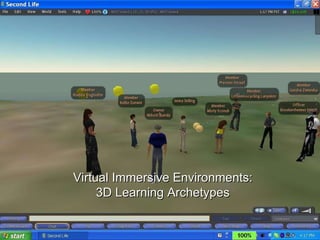
Virtual Immersive Environments: 3D Learning Archetypes
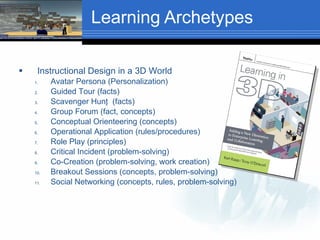
Learning   Archetypes Instructional Design in a 3D World Avatar Persona (Personalization) Guided Tour (facts) Scavenger Hunt  (facts) Group Forum (fact, concepts) Conceptual Orienteering (concepts) Operational Application (rules/procedures) Role Play (principles) Critical Incident (problem-solving)  Co-Creation (problem-solving, work creation) Breakout Sessions (concepts, problem-solving) Social Networking (concepts, rules, problem-solving)
Avatar Persona
 
Guided  Tour
Self-Guided  Tour
Scavenger Hunt
Group Forum
Conceptual Orienteering
Operational Application
Role Play
Role Play
Critical Incident
Co-Creation
Break Out Sessions
Social Networking
Designing 3D Learning Events Analysis Task Environmental  Design World Instructional Event Activities  Debriefing Develop  World Instructions Implement Technical Issues Navigational Instructions  Logistical Coordination Evaluation Debriefing Scoring or Grading Design Team: Programmer Graphic Artist Instructional Designer Subject Matter Expert
Analysis What are you tying to teach? What is best taught in a 3D environment? Why choose a 3D world over another tool? What tasks might be effectively taught in a 3D world?
Analysis Affective Domain (emotion) Stress Uncertainty/Unknown  Fear Requires Group Coordination Requires Real-Time Interaction Accomplishing Tasks Under Pressure Group and Individual Performance Rehearsal is Potentially Dangerous or Costly High Degree of Realism for Event
Analysis People-to-People Interaction People Make Bad Decisions People Get Mad People Say/Do Stupid Things Pressure Can Dull the Senses  Real-Time Interactions Add Pressure
Examples  Emergency Room Team Team Selling Combat First Responders Activities Compliance Activities Event Planning/Coordination Multiple Scenarios Security (Building, Ports)
Design World Where Does Event Take Place? How Realistic? What Needs to be Created? What Objects will be Manipulated? Can Items be Bought/Created?
Design Instructional Event What Happens First? How Do Learners Interact (Voice/Text)? Where Do You Want Event to Go? What are the Desired Learning Outcomes? Do You Add Pressure Elements (time, score)? How Realistic Do You Want Actions?
Design Activities What Do Learners Do? How Do They Receive Instructions? How Do They Know What to Do? How are the Learners Going to be Observed? Do You Adversely Impact Health? How Will You Score Success? How Explicit are Your Instructions?
Design Debriefing Who Conducts Debriefing? What Will be the Focus? How Does Instructor Observe? Is it Provided in a Written Format?
Develop Storyboard 3D World? What Elements Go into World? Instructions How Do the Learners Know What to Do? Are Instructions Text or Audio-Based? Does World “talk” to Learners?
Implement Implement Technical Issues Navigational Instructions  Logistical Coordination
Evaluation Debriefing Scoring Grading

3D Learning Archetypes

  • 1.
    Virtual Immersive Environments:3D Learning Archetypes
  • 2.
    Learning Archetypes Instructional Design in a 3D World Avatar Persona (Personalization) Guided Tour (facts) Scavenger Hunt  (facts) Group Forum (fact, concepts) Conceptual Orienteering (concepts) Operational Application (rules/procedures) Role Play (principles) Critical Incident (problem-solving) Co-Creation (problem-solving, work creation) Breakout Sessions (concepts, problem-solving) Social Networking (concepts, rules, problem-solving)
  • 3.
  • 4.
  • 5.
  • 6.
  • 7.
  • 8.
  • 9.
  • 10.
  • 11.
  • 12.
  • 13.
  • 14.
  • 15.
  • 16.
  • 17.
  • 18.
  • 19.
    Designing 3D LearningEvents Analysis Task Environmental Design World Instructional Event Activities Debriefing Develop World Instructions Implement Technical Issues Navigational Instructions Logistical Coordination Evaluation Debriefing Scoring or Grading Design Team: Programmer Graphic Artist Instructional Designer Subject Matter Expert
  • 20.
    Analysis What areyou tying to teach? What is best taught in a 3D environment? Why choose a 3D world over another tool? What tasks might be effectively taught in a 3D world?
  • 21.
    Analysis Affective Domain(emotion) Stress Uncertainty/Unknown Fear Requires Group Coordination Requires Real-Time Interaction Accomplishing Tasks Under Pressure Group and Individual Performance Rehearsal is Potentially Dangerous or Costly High Degree of Realism for Event
  • 22.
    Analysis People-to-People InteractionPeople Make Bad Decisions People Get Mad People Say/Do Stupid Things Pressure Can Dull the Senses Real-Time Interactions Add Pressure
  • 23.
    Examples EmergencyRoom Team Team Selling Combat First Responders Activities Compliance Activities Event Planning/Coordination Multiple Scenarios Security (Building, Ports)
  • 24.
    Design World WhereDoes Event Take Place? How Realistic? What Needs to be Created? What Objects will be Manipulated? Can Items be Bought/Created?
  • 25.
    Design Instructional EventWhat Happens First? How Do Learners Interact (Voice/Text)? Where Do You Want Event to Go? What are the Desired Learning Outcomes? Do You Add Pressure Elements (time, score)? How Realistic Do You Want Actions?
  • 26.
    Design Activities WhatDo Learners Do? How Do They Receive Instructions? How Do They Know What to Do? How are the Learners Going to be Observed? Do You Adversely Impact Health? How Will You Score Success? How Explicit are Your Instructions?
  • 27.
    Design Debriefing WhoConducts Debriefing? What Will be the Focus? How Does Instructor Observe? Is it Provided in a Written Format?
  • 28.
    Develop Storyboard 3DWorld? What Elements Go into World? Instructions How Do the Learners Know What to Do? Are Instructions Text or Audio-Based? Does World “talk” to Learners?
  • 29.
    Implement Implement TechnicalIssues Navigational Instructions Logistical Coordination
  • 30.