A Better Way to Design and Build Immersive e-Learning  Robert Penn [email_address] (800) 690-4259 x203
Agenda: Design principles Design principles Methodology for creating effective e-learning Demonstration of the process
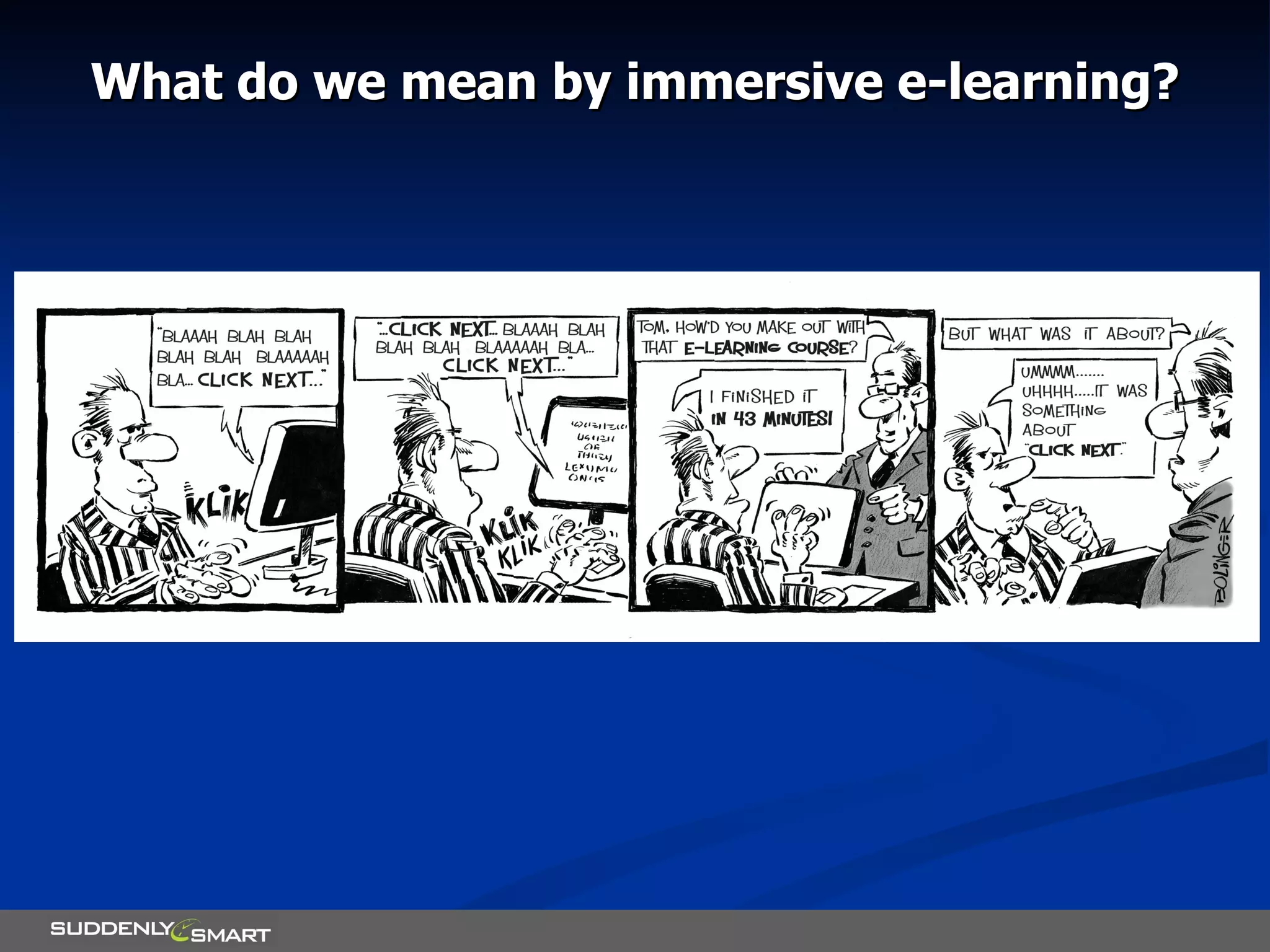
What do we mean by immersive e-learning?
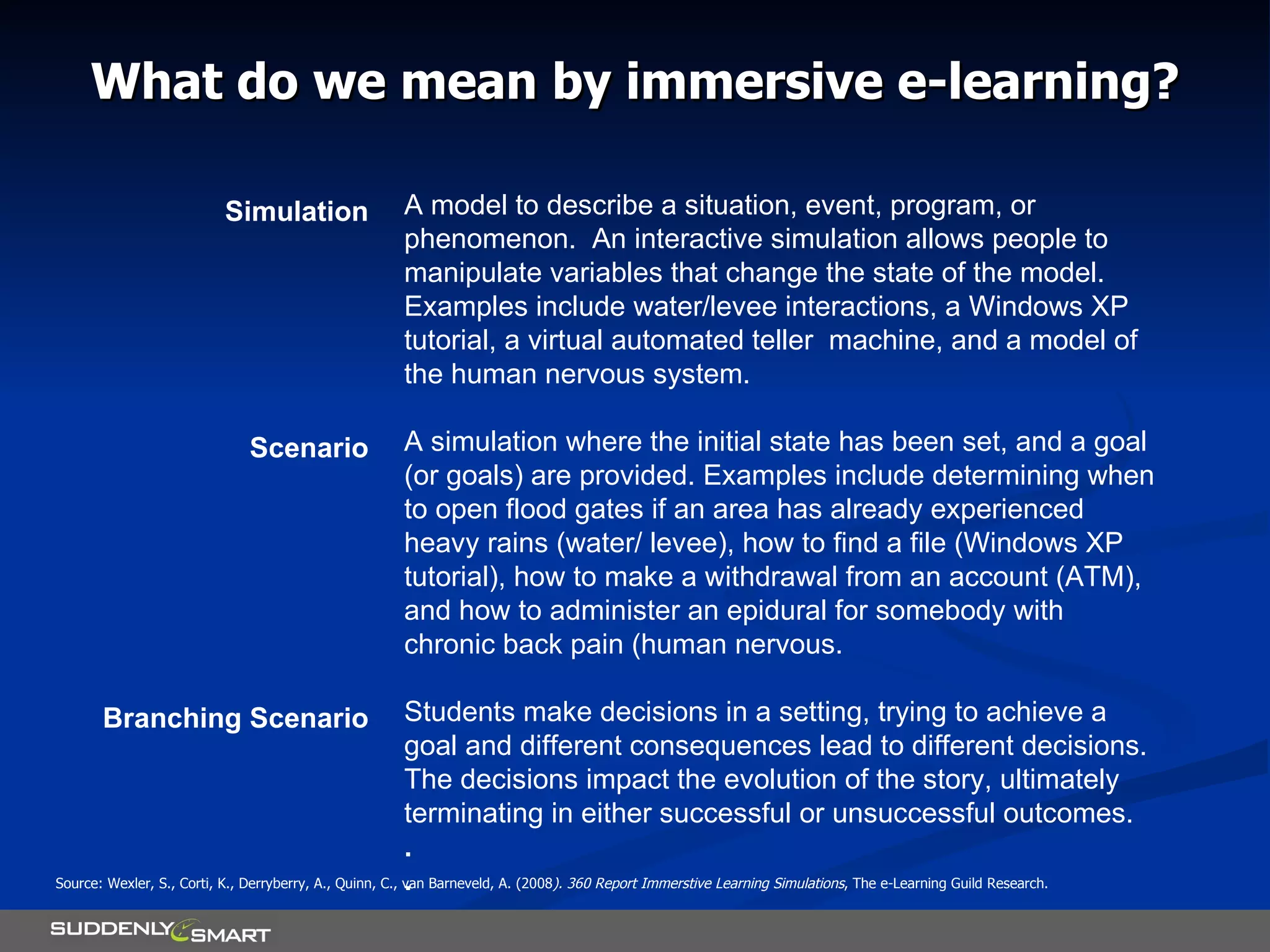
What do we mean by immersive e-learning? A model to describe a situation, event, program, or phenomenon.  An interactive simulation allows people to manipulate variables that change the state of the model. Examples include water/levee interactions, a Windows XP tutorial, a virtual automated teller  machine, and a model of the human nervous system. A simulation where the initial state has been set, and a goal (or goals) are provided. Examples include determining when to open flood gates if an area has already experienced heavy rains (water/ levee), how to find a file (Windows XP tutorial), how to make a withdrawal from an account (ATM), and how to administer an epidural for somebody with chronic back pain (human nervous. Students make decisions in a setting, trying to achieve a goal and different consequences lead to different decisions. The decisions impact the evolution of the story, ultimately terminating in either successful or unsuccessful outcomes. . . Simulation Scenario Branching Scenario Source: Wexler, S., Corti, K., Derryberry, A., Quinn, C., van Barneveld, A. (2008 ). 360 Report Immerstive Learning Simulations , The e-Learning Guild Research.
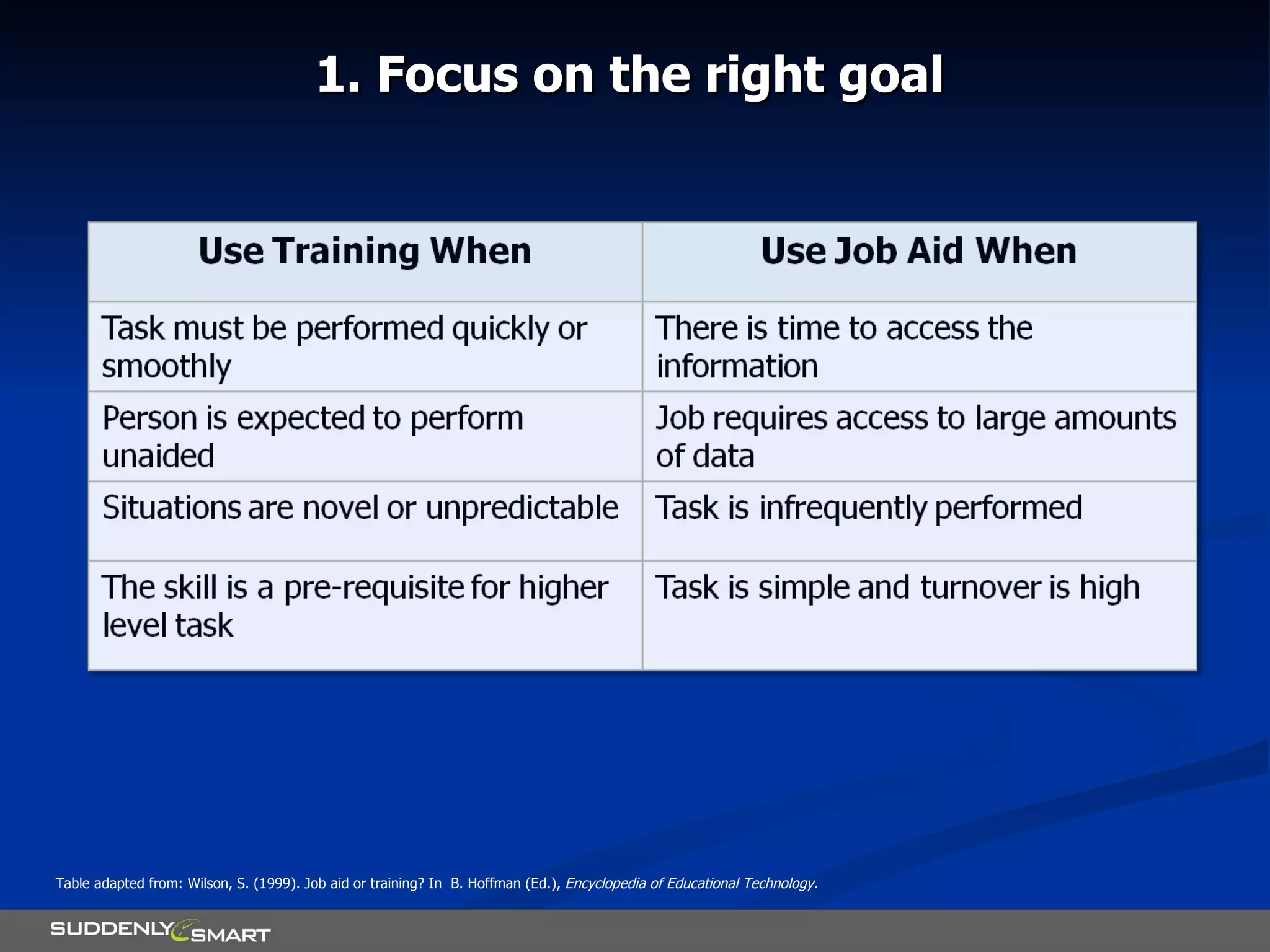
1. Focus on the right goal Table adapted from: Wilson, S. (1999). Job aid or training? In  B. Hoffman (Ed.),  Encyclopedia of Educational Technology.
1. Focus on the right goal (cont’d) Knowledge (facts/data) vs. Applied  Knowledge “ What do we want the learners to  do ?”
A Scene from  The Matrix: After a big fight, it’s time for the getaway…
A Scene from  The Matrix: After a big fight, it’s time for the getaway… Can you fly that thing?
A Scene from  The Matrix: After a big fight, it’s time for the getaway… Not yet…
Operator. Rrrring… Tank, I need a pilot program for a V2-12 helicopter.
Hurry!
Whirring computer sounds…
Let’s go
2. Hook your learners with your intro What techniques can be used to “hook” your learners? Please type your answers into the Chat pod
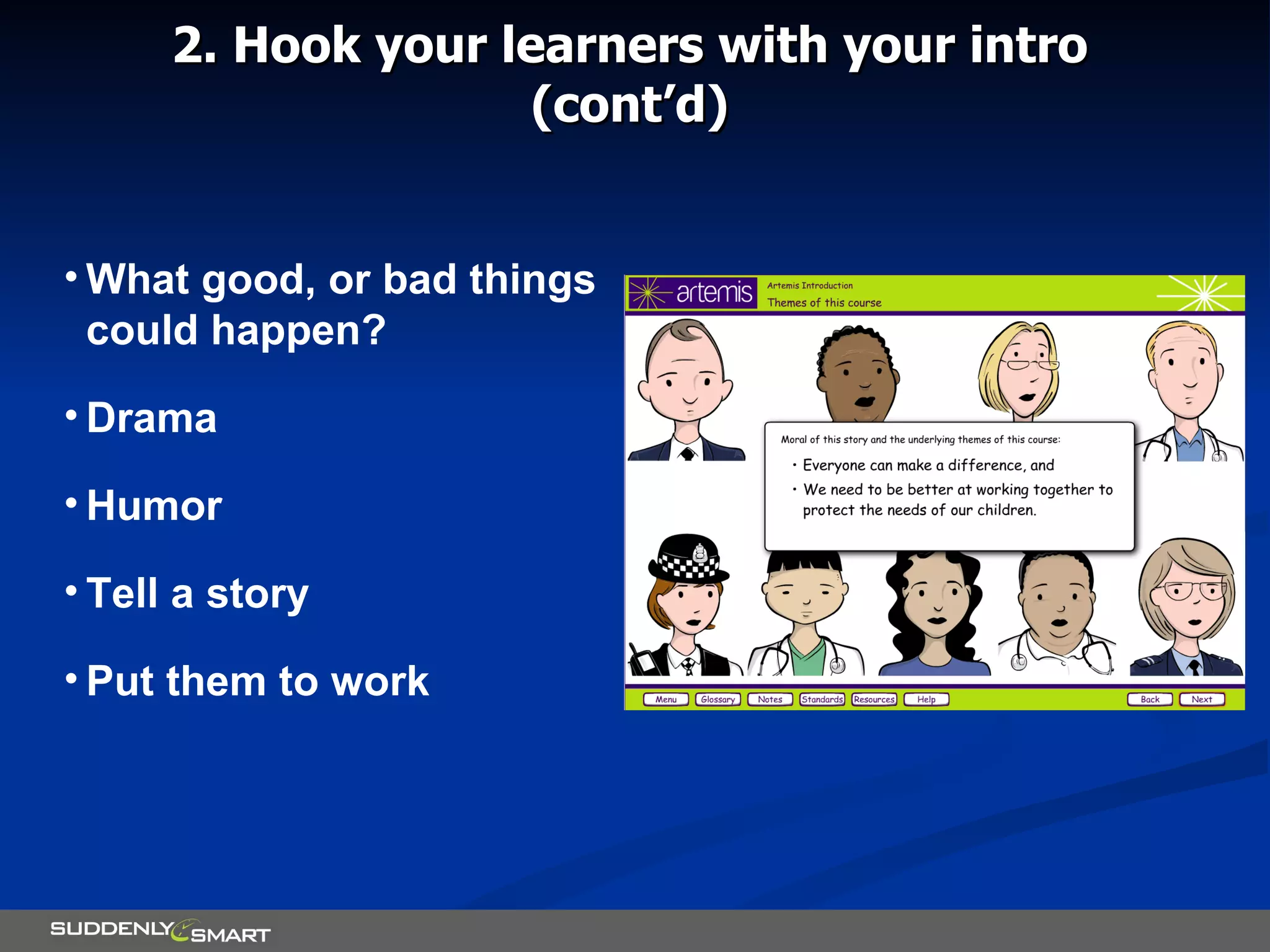
2. Hook your learners with your intro (cont’d) What good, or bad things could happen? Drama Humor Tell a story Put them to work
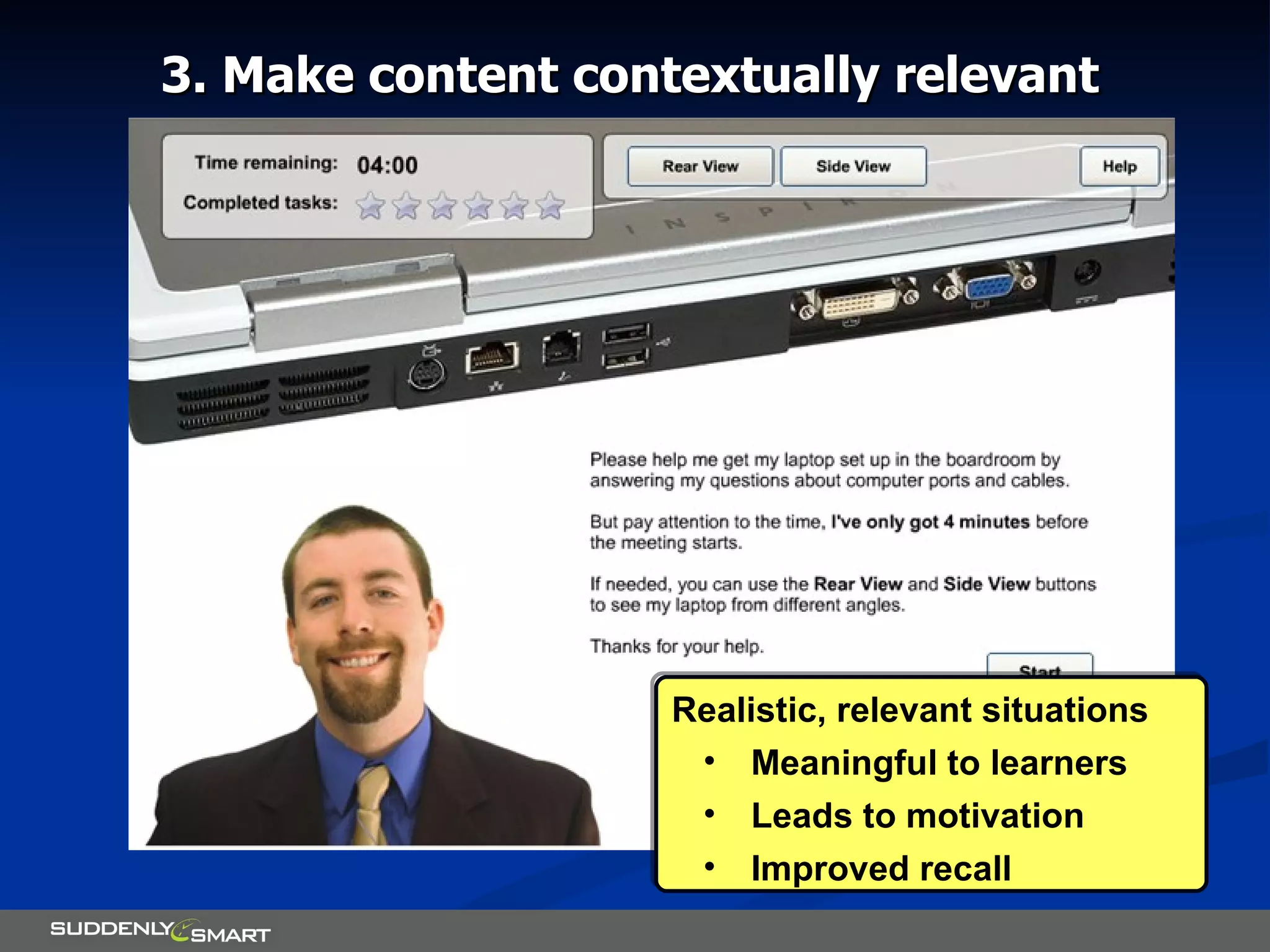
3. Make content contextually relevant Realistic, relevant situations Meaningful to learners  Leads to motivation Improved recall 3. Make content contextually relevant
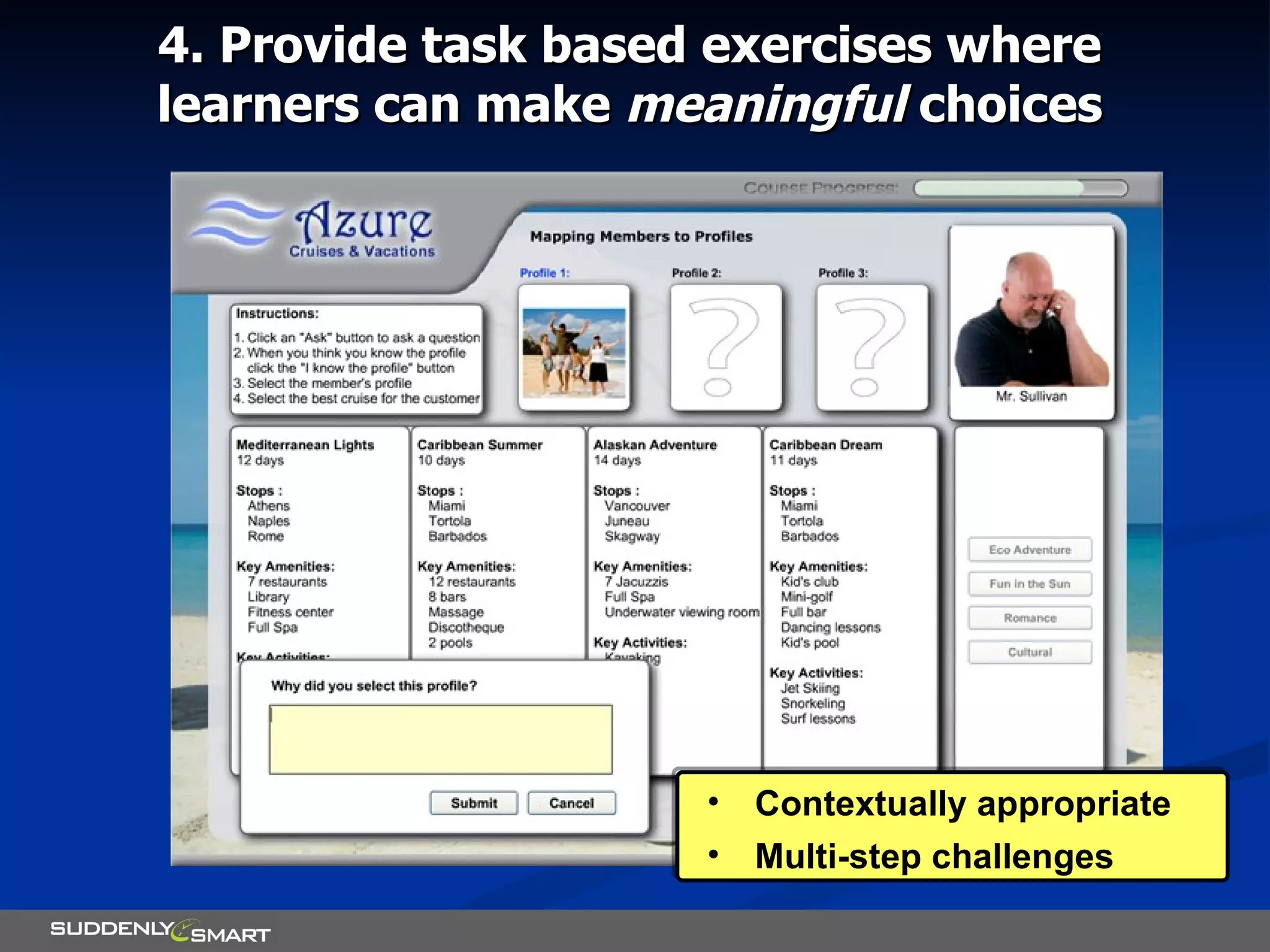
4. Provide task based exercises where learners can make  meaningful  choices Contextually appropriate Multi-step challenges
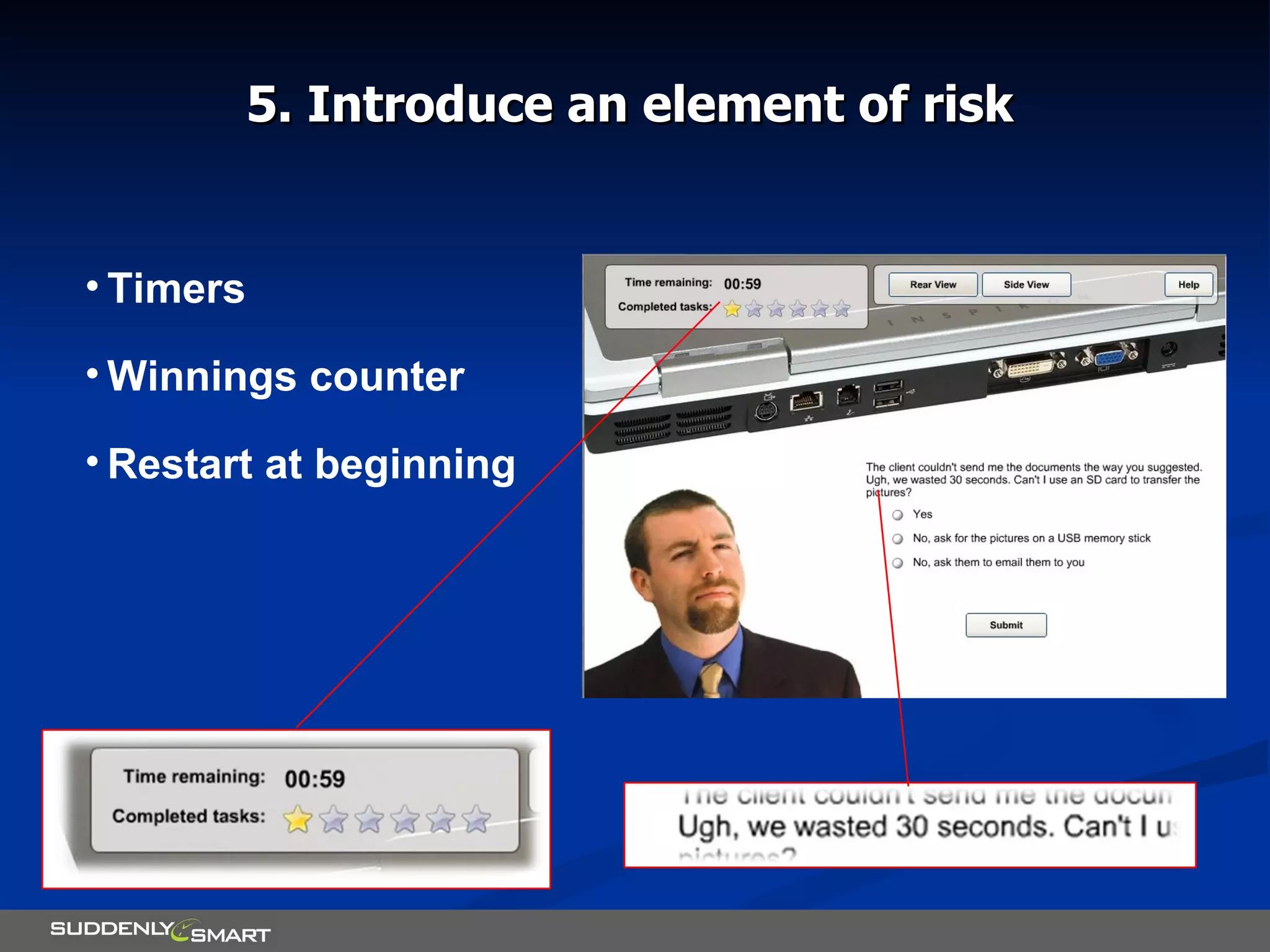
5. Introduce an element of risk What techniques can be used to add risk to an interaction? Please type your answers into the Chat pod
5. Introduce an element of risk Timers Winnings counter Restart at beginning
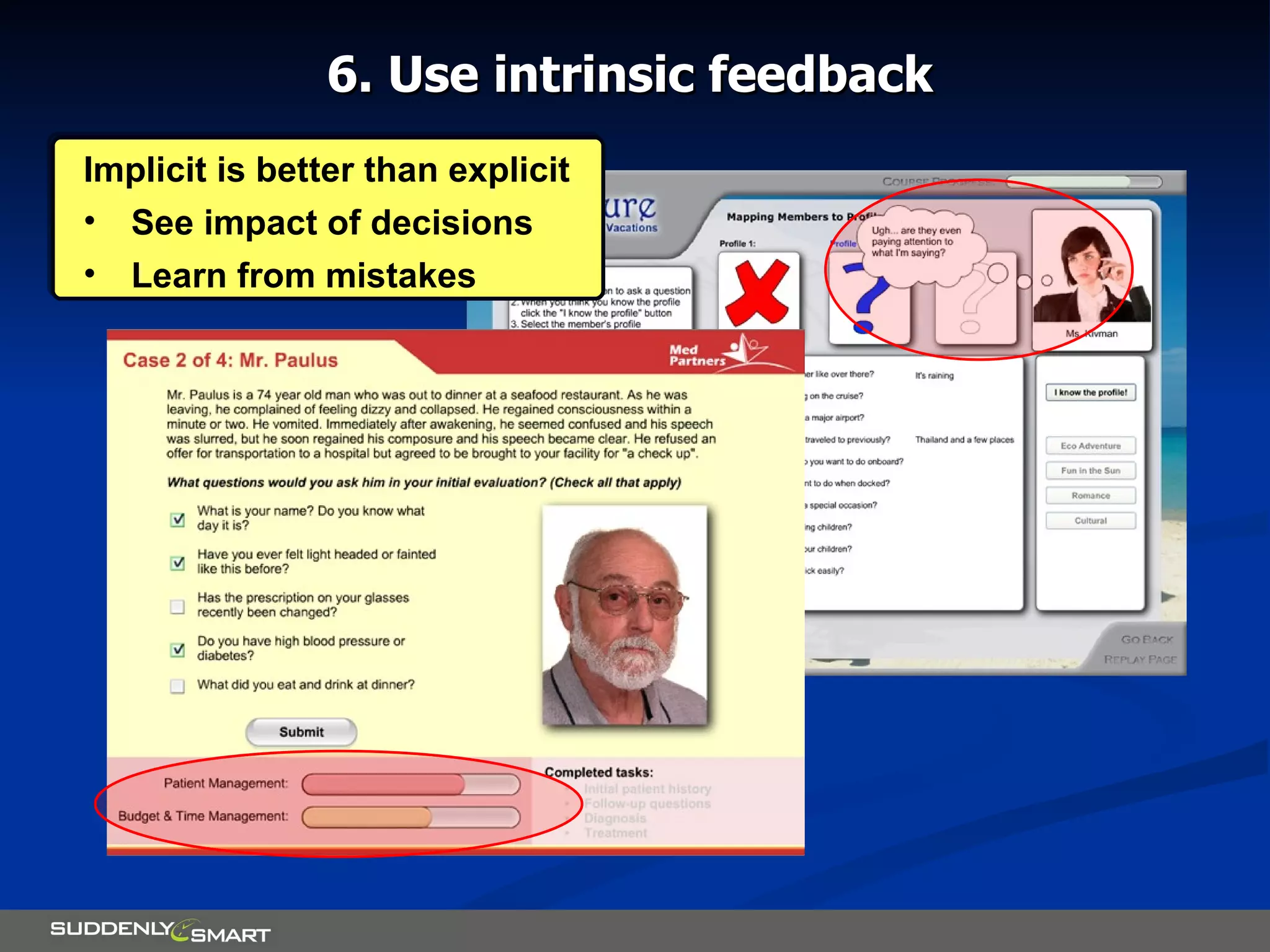
6. Use intrinsic feedback Implicit is better than explicit See impact of decisions Learn from mistakes
Agenda: Design principles Design principles Methodology for creating effective e-learning Demonstration of the process
Questions? Any questions about the 6 design principles before we move on? Focus on the right goal – not just knowledge but applied knowledge Hook your learners with your intro Make content contextually relevant Provide task-based exercises where learners can make meaningful decisions Introduce an element of risk Use intrinsic feedback Please type your questions into the Chat pod
Agenda: Methodology for creating effective e-learning Design principles Methodology for creating effective e-learning Demonstration of the process
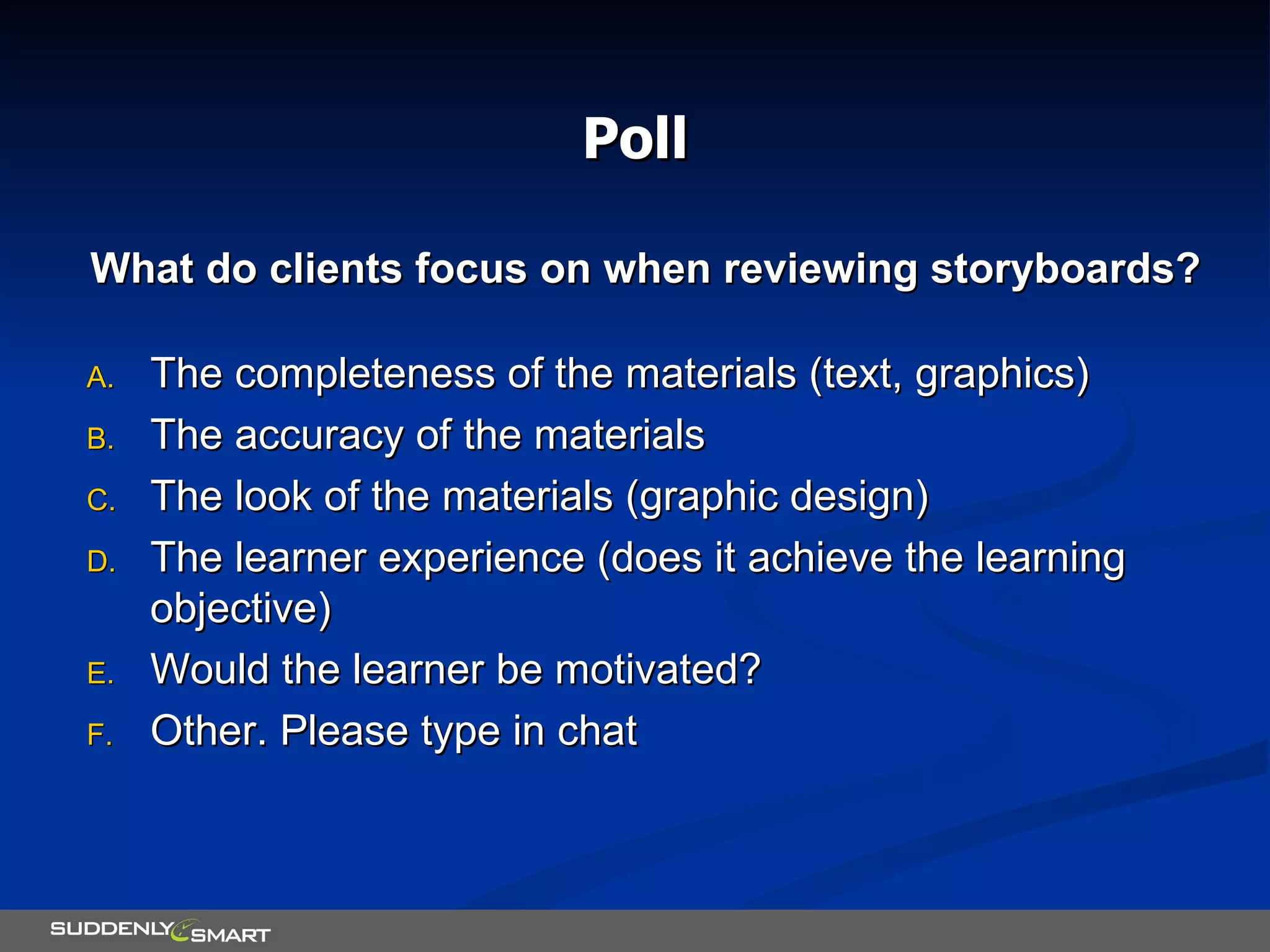
Poll What do clients focus on when reviewing storyboards? The completeness of the materials (text, graphics) The accuracy of the materials The look of the materials (graphic design) The learner experience (does it achieve the learning objective) Would the learner be motivated? Other. Please type in chat
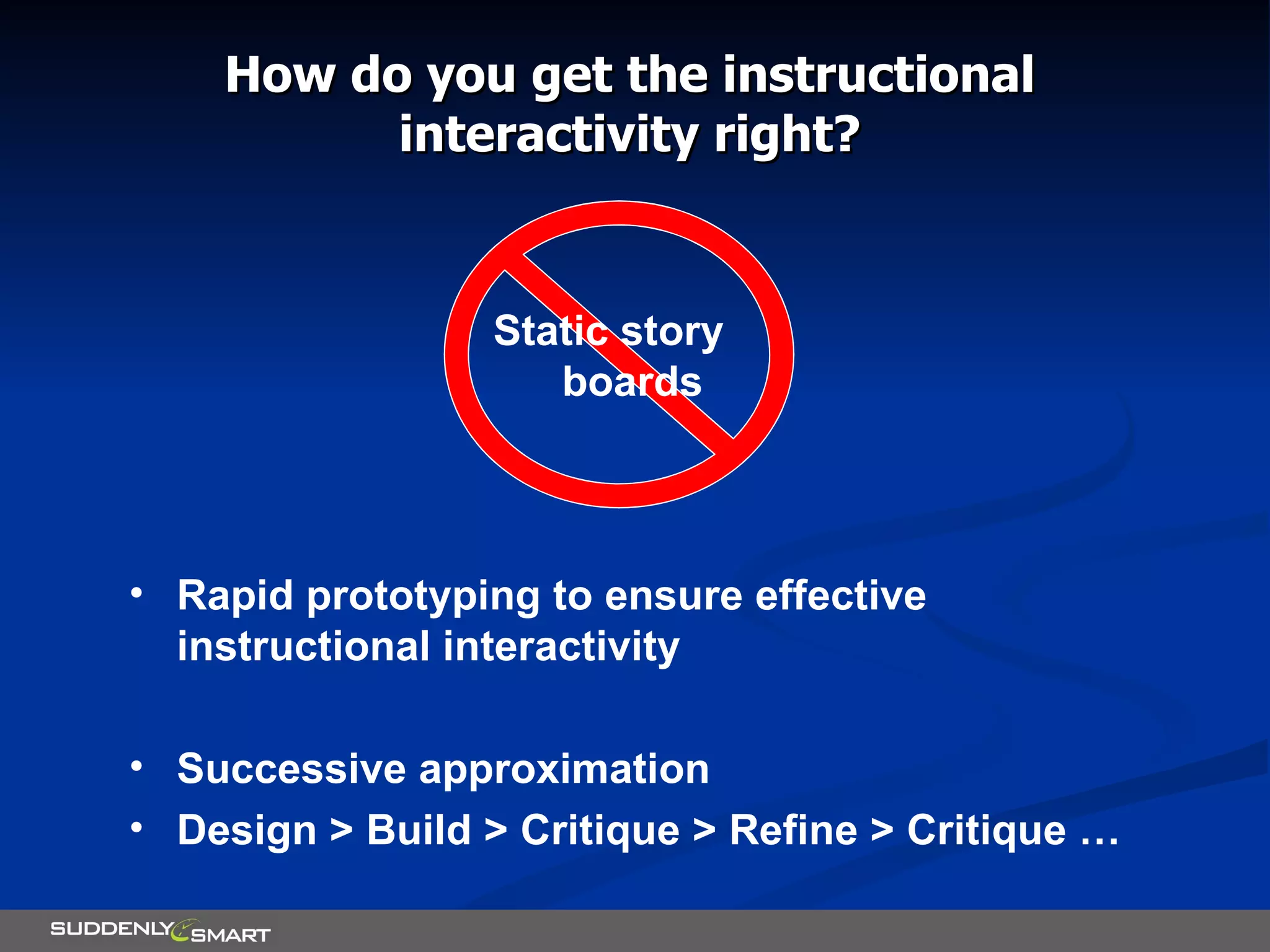
How do you get the instructional interactivity right? Rapid prototyping to ensure effective instructional interactivity Successive approximation Design > Build > Critique > Refine > Critique … Static story boards
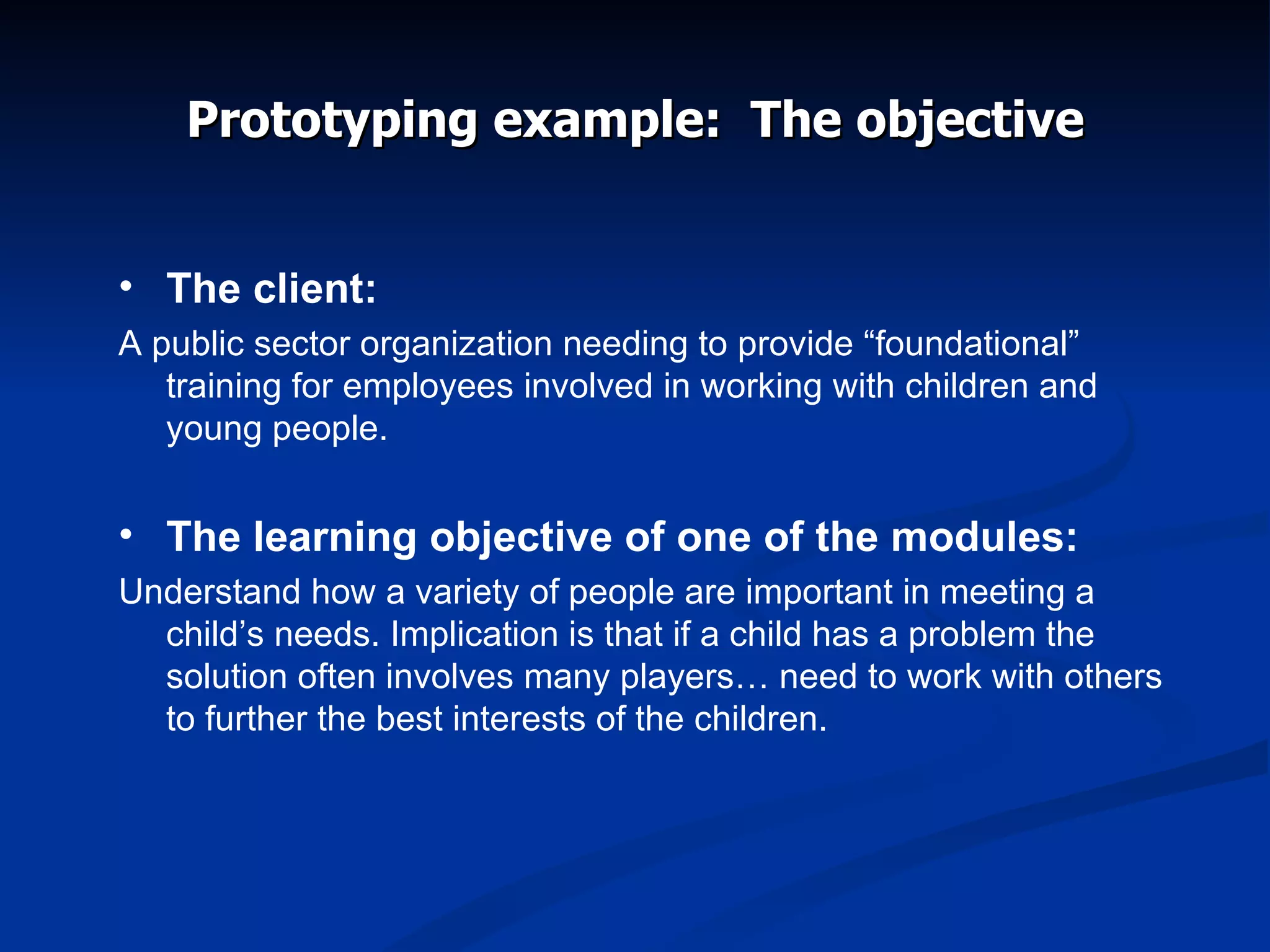
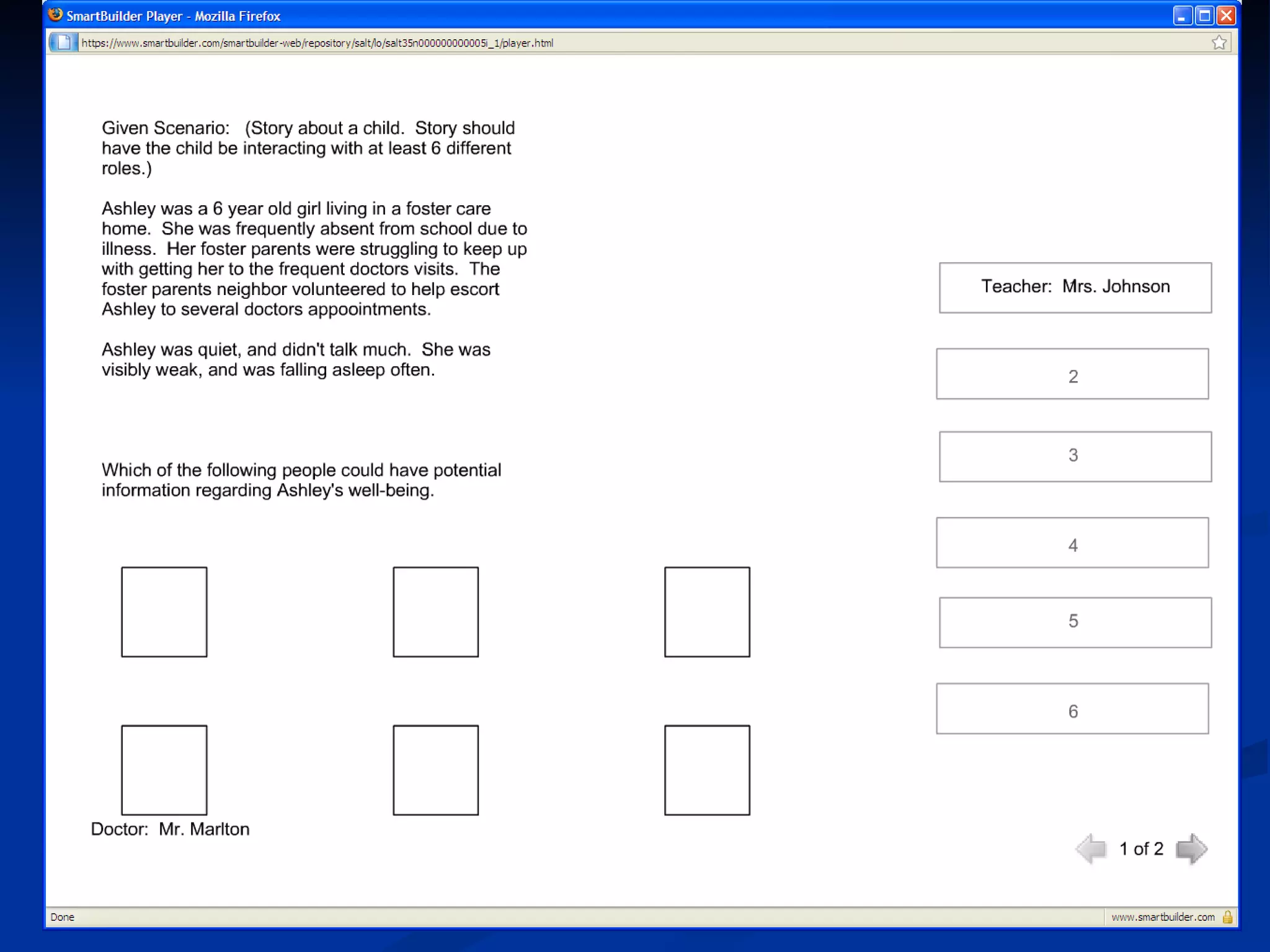
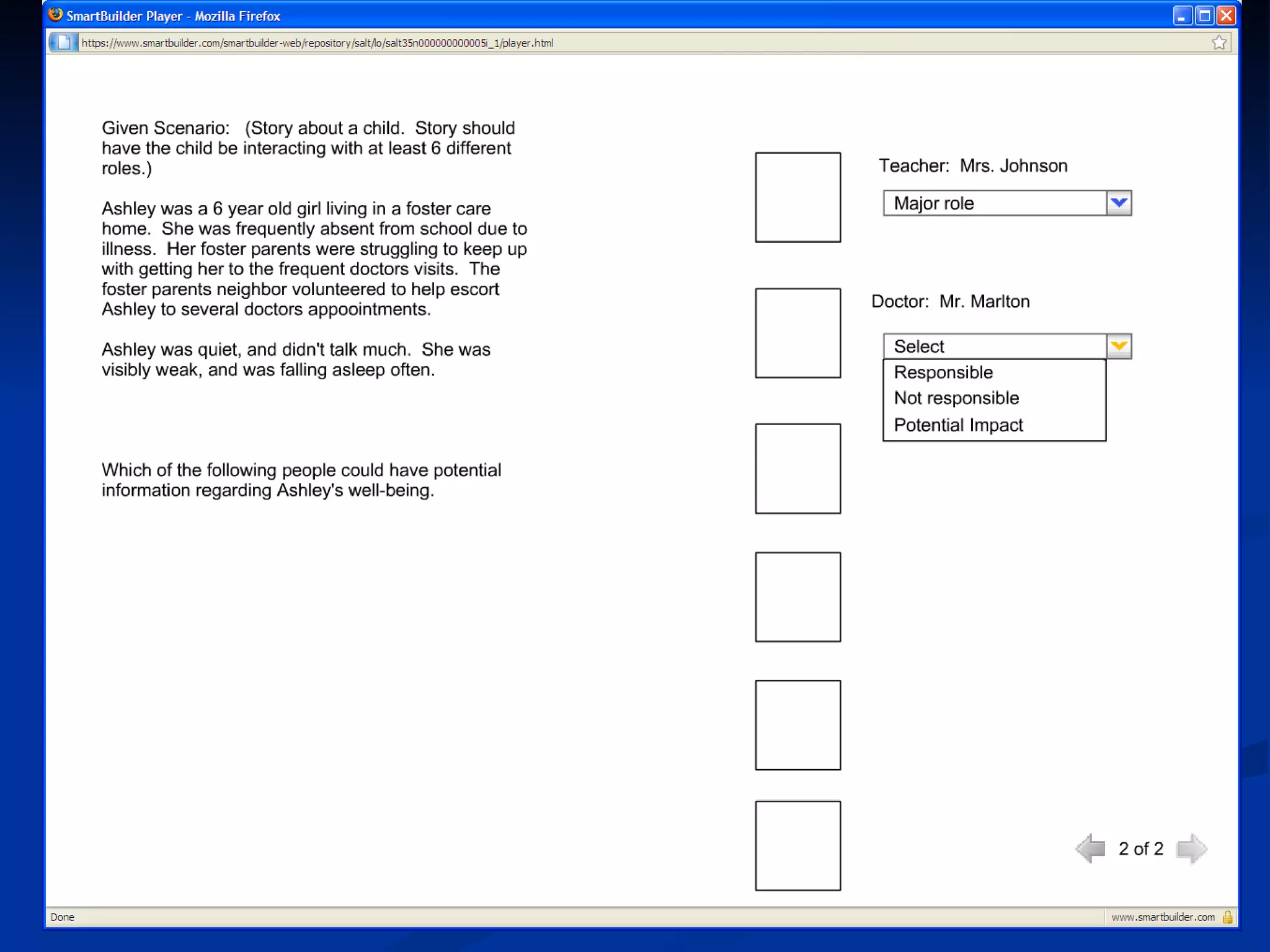
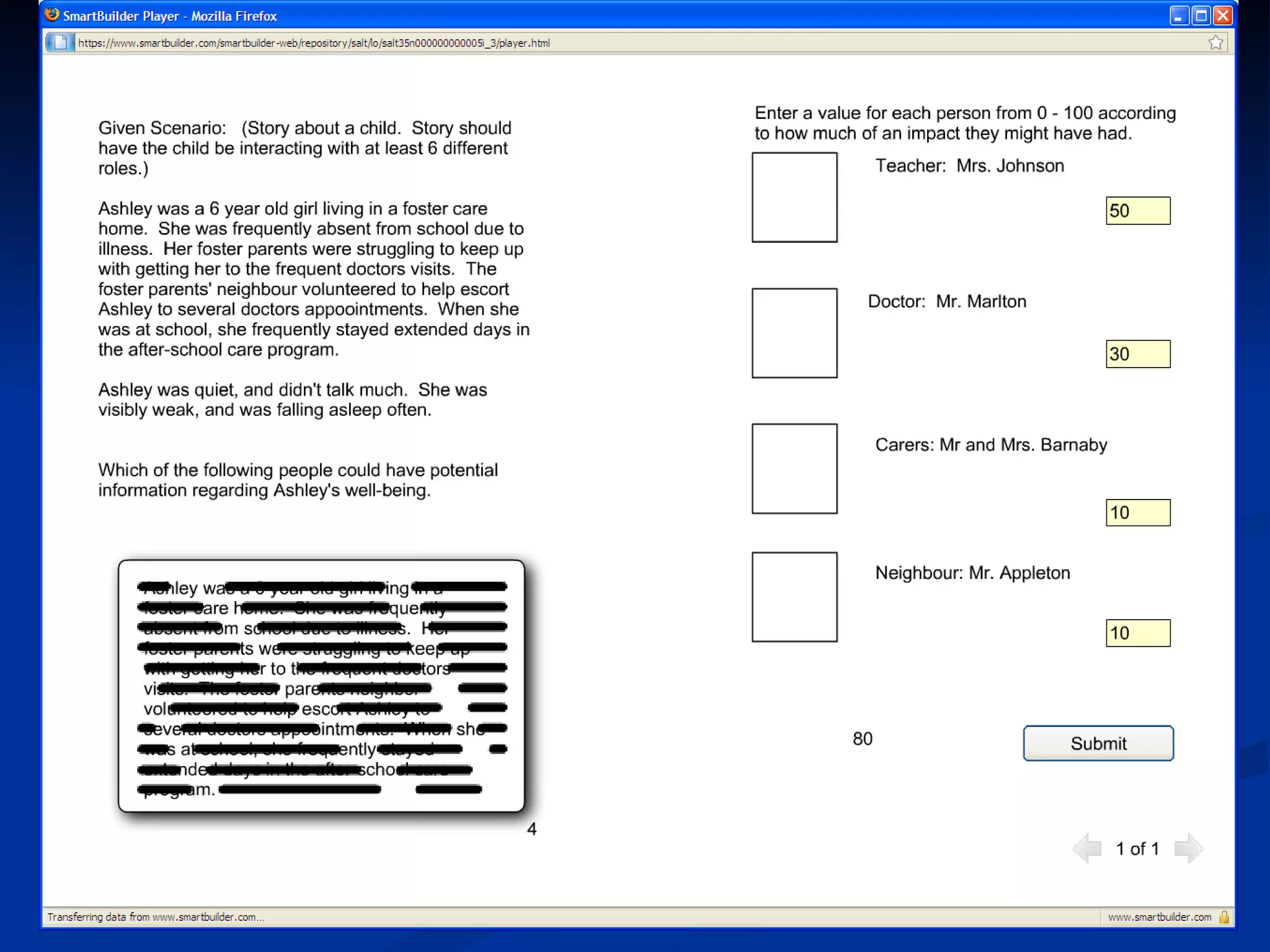
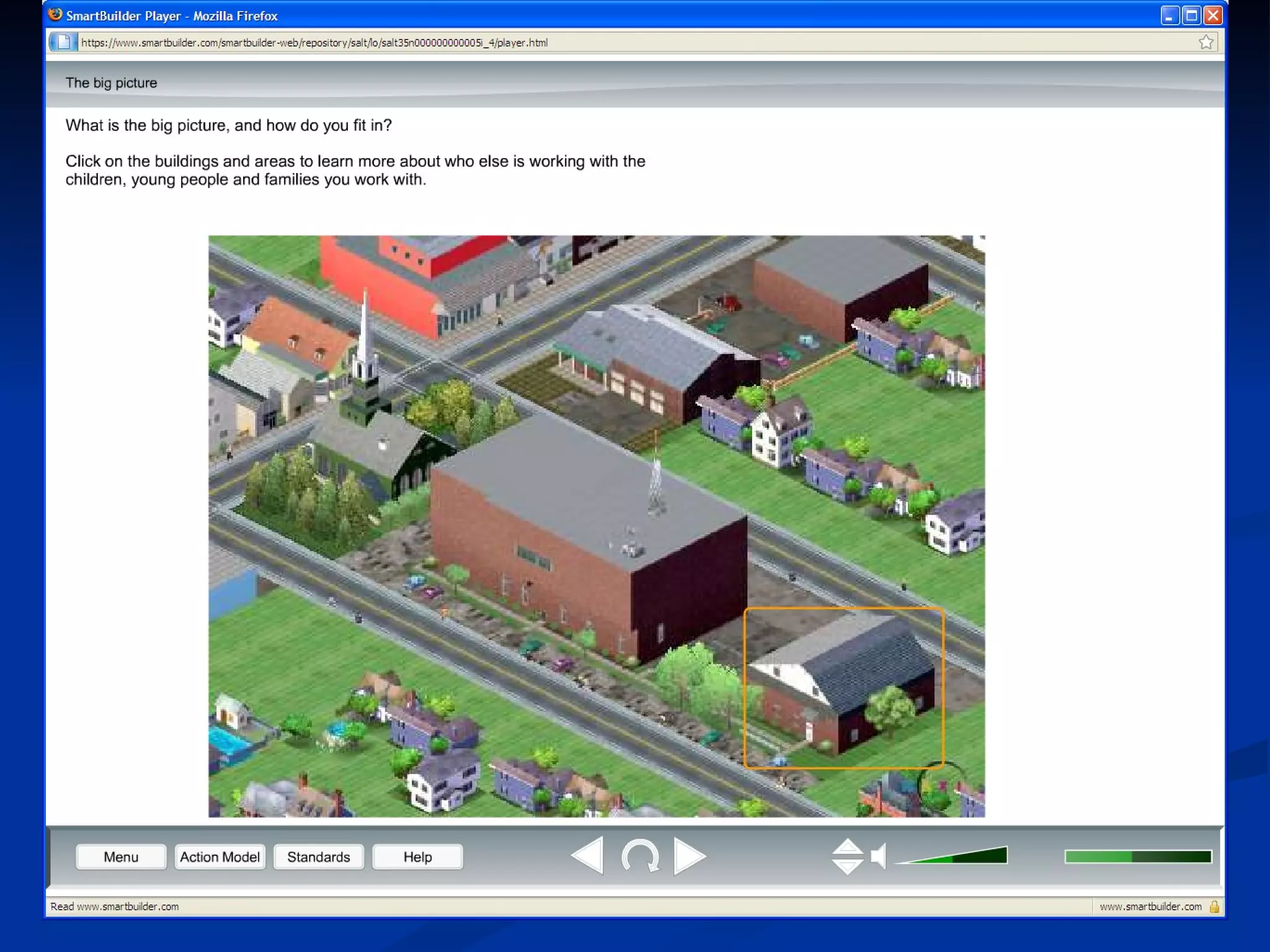
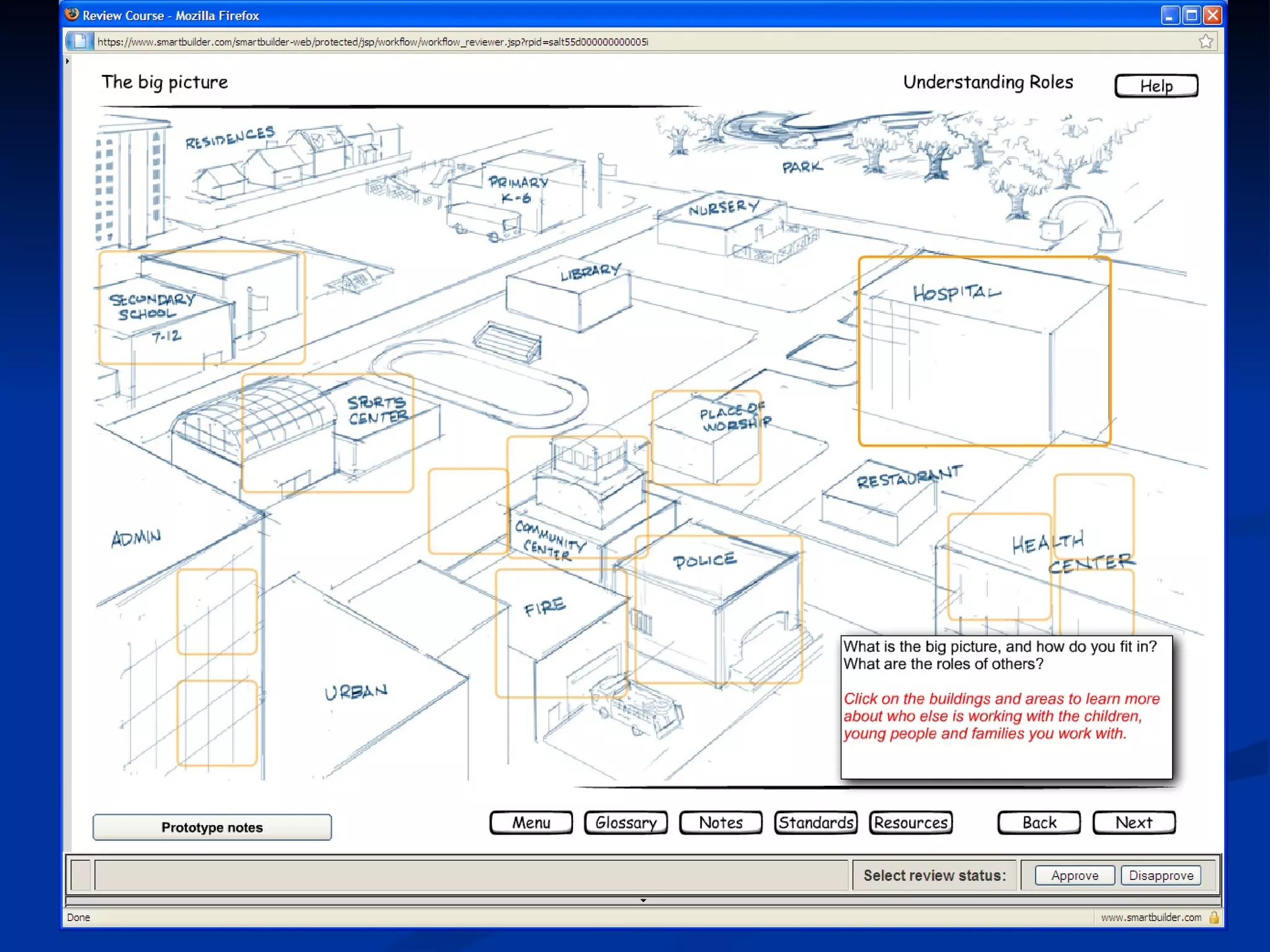
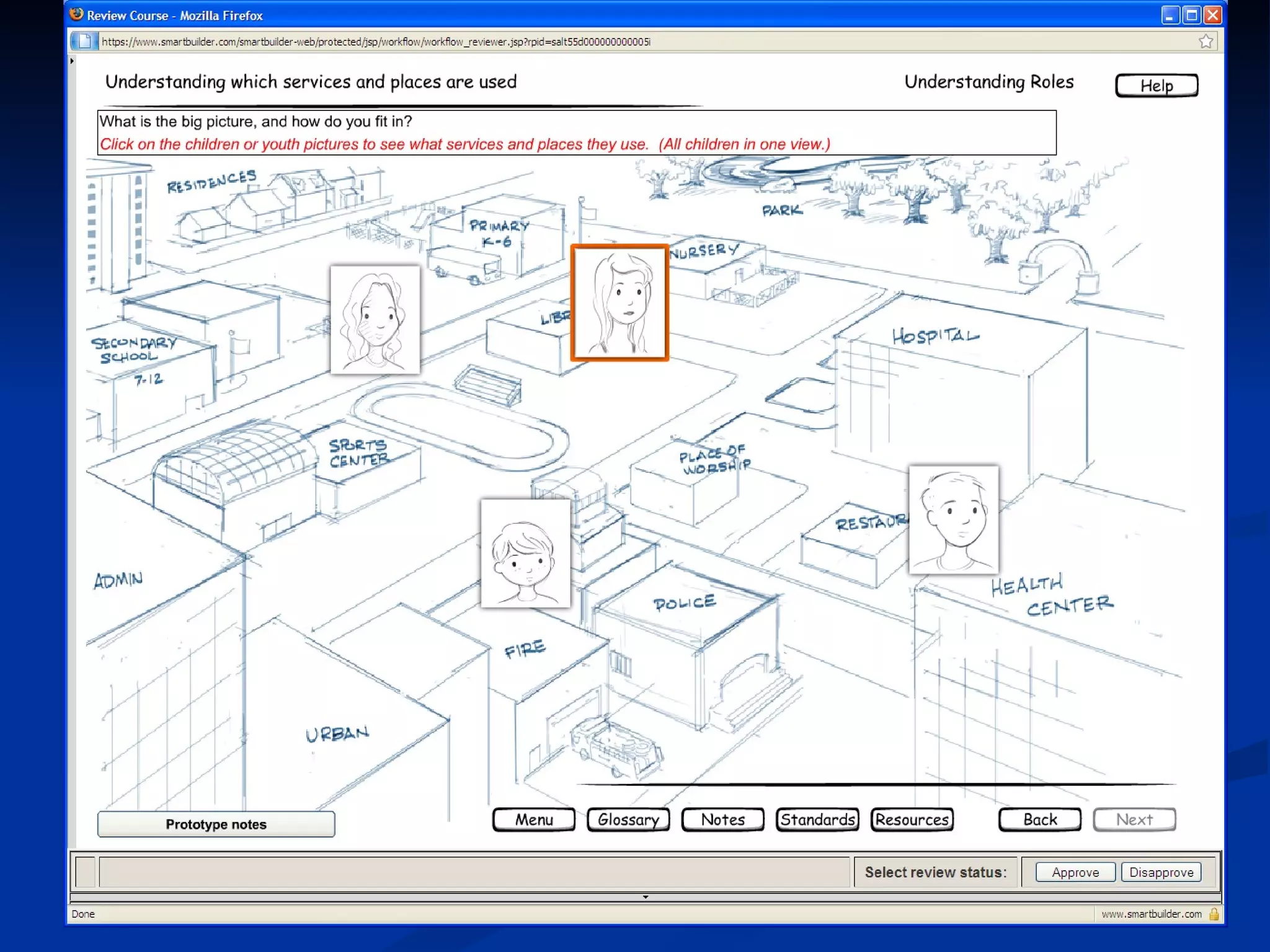
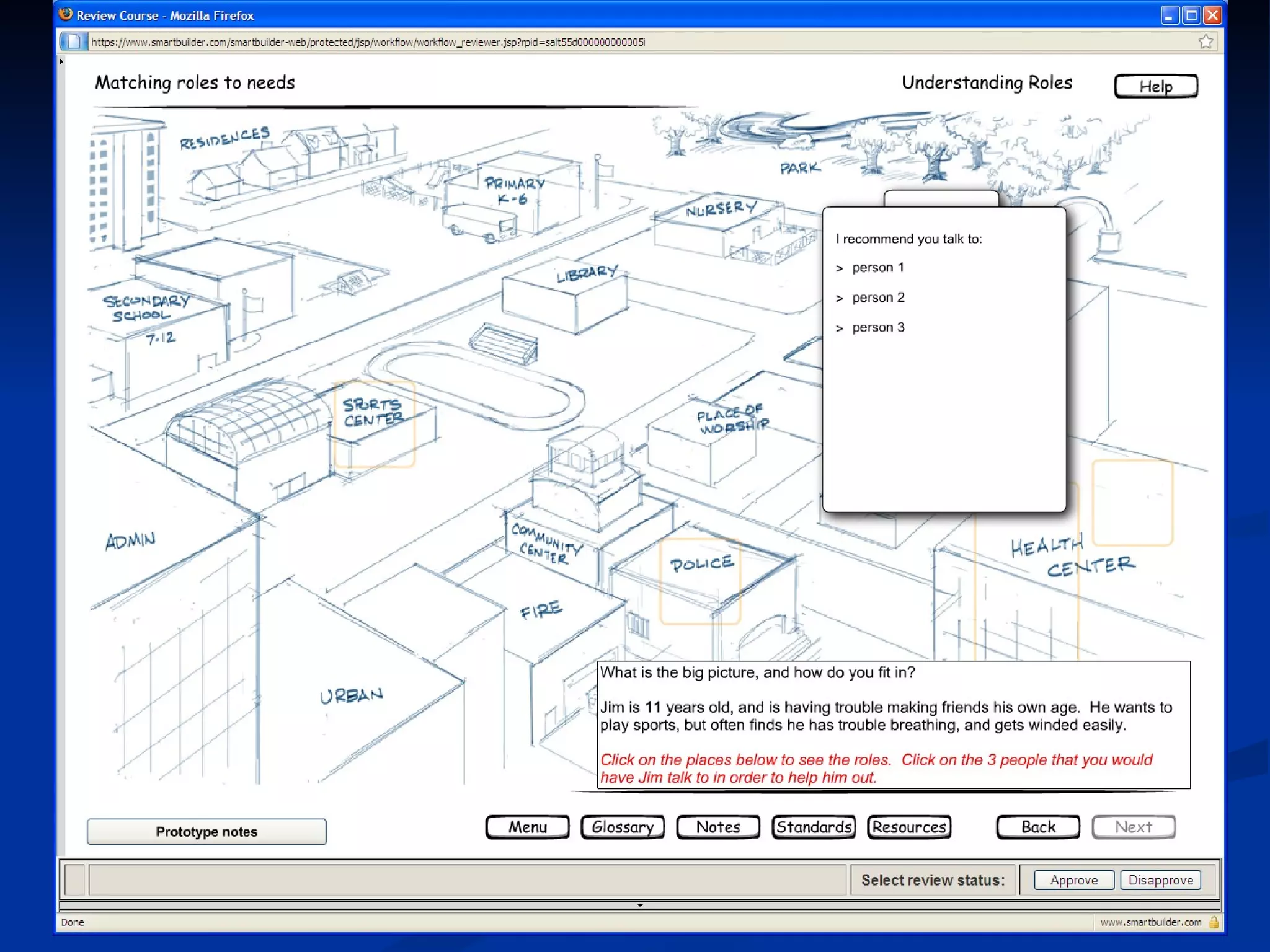
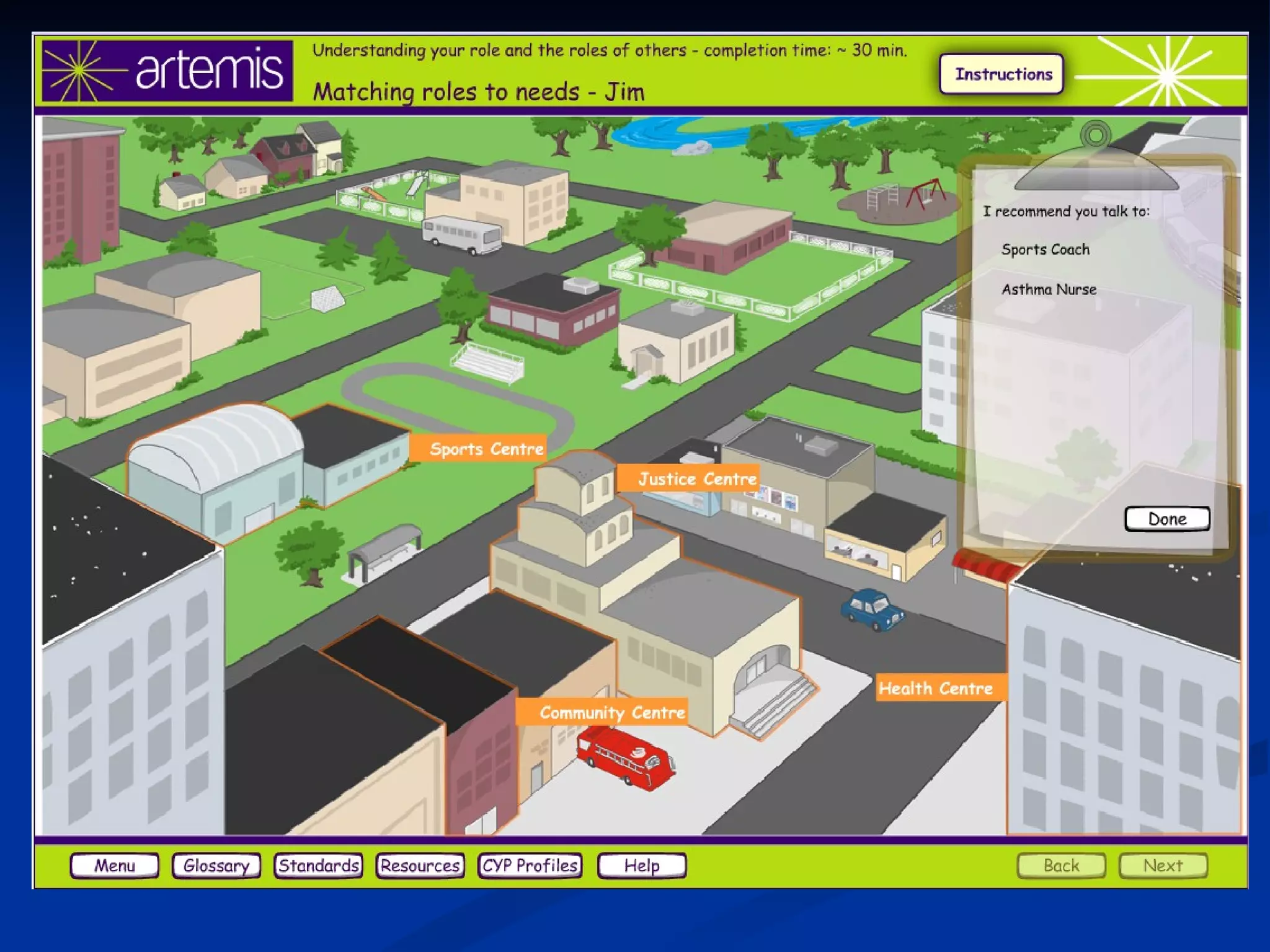
Prototyping example:  The objective The client: A public sector organization needing to provide “foundational” training for employees involved in working with children and young people. The learning objective of one of the modules: Understand how a variety of people are important in meeting a child’s needs. Implication is that if a child has a problem the solution often involves many players… need to work with others to further the best interests of the children.
Round 1 Prototype A
Round 1 Prototype B
Round 2 Prototype
Round 3 Prototype
Round 4 Prototype A
Round 4 Prototype B
Round 4 Prototype C
 
Summary on successive approximation methodology Prototypes should be quick, dirty, and incomplete Design, develop, review and revise…repeat until satisfied Ideally, review prototypes with: A diverse audience In person Within a short time span
Agenda: Methodology for creating effective e-learning Design principles Methodology for creating effective e-learning Demonstration of the process

A Better Way to Design & Build Immersive E Learning

  • 1.
    A Better Wayto Design and Build Immersive e-Learning Robert Penn [email_address] (800) 690-4259 x203
  • 2.
    Agenda: Design principlesDesign principles Methodology for creating effective e-learning Demonstration of the process
  • 3.
    What do wemean by immersive e-learning?
  • 4.
    What do wemean by immersive e-learning? A model to describe a situation, event, program, or phenomenon. An interactive simulation allows people to manipulate variables that change the state of the model. Examples include water/levee interactions, a Windows XP tutorial, a virtual automated teller machine, and a model of the human nervous system. A simulation where the initial state has been set, and a goal (or goals) are provided. Examples include determining when to open flood gates if an area has already experienced heavy rains (water/ levee), how to find a file (Windows XP tutorial), how to make a withdrawal from an account (ATM), and how to administer an epidural for somebody with chronic back pain (human nervous. Students make decisions in a setting, trying to achieve a goal and different consequences lead to different decisions. The decisions impact the evolution of the story, ultimately terminating in either successful or unsuccessful outcomes. . . Simulation Scenario Branching Scenario Source: Wexler, S., Corti, K., Derryberry, A., Quinn, C., van Barneveld, A. (2008 ). 360 Report Immerstive Learning Simulations , The e-Learning Guild Research.
  • 5.
    1. Focus onthe right goal Table adapted from: Wilson, S. (1999). Job aid or training? In  B. Hoffman (Ed.), Encyclopedia of Educational Technology.
  • 6.
    1. Focus onthe right goal (cont’d) Knowledge (facts/data) vs. Applied Knowledge “ What do we want the learners to do ?”
  • 7.
    A Scene from The Matrix: After a big fight, it’s time for the getaway…
  • 8.
    A Scene from The Matrix: After a big fight, it’s time for the getaway… Can you fly that thing?
  • 9.
    A Scene from The Matrix: After a big fight, it’s time for the getaway… Not yet…
  • 10.
    Operator. Rrrring… Tank,I need a pilot program for a V2-12 helicopter.
  • 11.
  • 12.
  • 13.
  • 14.
    2. Hook yourlearners with your intro What techniques can be used to “hook” your learners? Please type your answers into the Chat pod
  • 15.
    2. Hook yourlearners with your intro (cont’d) What good, or bad things could happen? Drama Humor Tell a story Put them to work
  • 16.
    3. Make contentcontextually relevant Realistic, relevant situations Meaningful to learners Leads to motivation Improved recall 3. Make content contextually relevant
  • 17.
    4. Provide taskbased exercises where learners can make meaningful choices Contextually appropriate Multi-step challenges
  • 18.
    5. Introduce anelement of risk What techniques can be used to add risk to an interaction? Please type your answers into the Chat pod
  • 19.
    5. Introduce anelement of risk Timers Winnings counter Restart at beginning
  • 20.
    6. Use intrinsicfeedback Implicit is better than explicit See impact of decisions Learn from mistakes
  • 21.
    Agenda: Design principlesDesign principles Methodology for creating effective e-learning Demonstration of the process
  • 22.
    Questions? Any questionsabout the 6 design principles before we move on? Focus on the right goal – not just knowledge but applied knowledge Hook your learners with your intro Make content contextually relevant Provide task-based exercises where learners can make meaningful decisions Introduce an element of risk Use intrinsic feedback Please type your questions into the Chat pod
  • 23.
    Agenda: Methodology forcreating effective e-learning Design principles Methodology for creating effective e-learning Demonstration of the process
  • 24.
    Poll What doclients focus on when reviewing storyboards? The completeness of the materials (text, graphics) The accuracy of the materials The look of the materials (graphic design) The learner experience (does it achieve the learning objective) Would the learner be motivated? Other. Please type in chat
  • 25.
    How do youget the instructional interactivity right? Rapid prototyping to ensure effective instructional interactivity Successive approximation Design > Build > Critique > Refine > Critique … Static story boards
  • 26.
    Prototyping example: The objective The client: A public sector organization needing to provide “foundational” training for employees involved in working with children and young people. The learning objective of one of the modules: Understand how a variety of people are important in meeting a child’s needs. Implication is that if a child has a problem the solution often involves many players… need to work with others to further the best interests of the children.
  • 27.
  • 28.
  • 29.
  • 30.
  • 31.
  • 32.
  • 33.
  • 34.
  • 35.
    Summary on successiveapproximation methodology Prototypes should be quick, dirty, and incomplete Design, develop, review and revise…repeat until satisfied Ideally, review prototypes with: A diverse audience In person Within a short time span
  • 36.
    Agenda: Methodology forcreating effective e-learning Design principles Methodology for creating effective e-learning Demonstration of the process

Editor's Notes

  • #14 Though our company is called Suddenly Smart, we haven’t quite perfected the direct download to brain technique. With current technology, we can’t push the skills into someone’s head, it’s more of a pull process…learners need to want to learn – so having a motivational introduction to your course is crucial .
  • #15 Though our company is called Suddenly Smart, we haven’t quite perfected the direct download to brain technique. With current technology, we can’t push the skills into someone’s head, it’s more of a pull process…learners need to want to learn – so having a motivational introduction to your course is crucial .
  • #23 First off, let’s recap the 6 design principles to make our first point: Focus on the right goal – not just knowledge but applied knowledge Hook your learners with your intro Make content contextually relevant Provide task-based exercises where learners can make meaningful decisions Introduce an element of risk Use intrinsic feedback