PERSPECTIVES AT HELP
Zvonimir Durcevic
@zvonimir
INTRODUCTIONS
THE PURPOSE
The purpose of this workshop is to introduce
you, the participants, to the concepts of the
Integral Agile Transformation Framework™
(IATF) and the power of Powerful Questions.
THE AGENDA
Part 1
1. Introductions
2. What do we observe?
3. Overview
4. Perspectives & IATF
5. Powerful Questions
Break (14:15 – 14:25)
Part 2
1. Choosing a situation
2. Describing the situation
3. Collaborative questions
4. Closing
EXERCISE – INTRODUCTION
1. Prepare for 1 minute to answer following questions:
What is your name?
Where are you coming from (country, city, company)?
What is the best thing that happened to you this week?
2. You will have 30 seconds to introduce yourself to the
rest of the group.
WHAT DO WE OBSERVE?
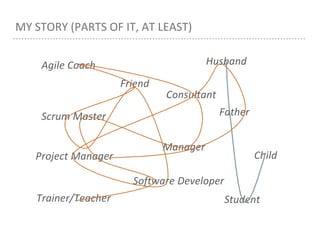
MY STORY (PARTS OF IT, AT LEAST)
Trainer/Teacher
Software Developer
Project Manager
Manager
Scrum Master
Consultant
Agile Coach Husband
Father
Friend
Child
Student
OUR STORIES CONNECTED
WHAT DO WE OBSERVE?
Self
Individuals
Teams
Program
Organization
MARKETPLACE
STEP BACK - MAKE SPACE
Organization
Program
Individuals
Teams
SelfSeparate
Reflect
Take Time
MARKETPLACE
OVERVIEW
USE PERSPECTIVES & QUESTIONS
Organization
Program
Individuals
Teams
Self
Integral Agile
Transformation
Framework™️
Powerful
Questions
MARKETPLACE
PERSPECTIVES & IATF
EXERCISE – CHANGE PERSPECTIVE
1. Please, change the chair in the circle.
2. What has changed for you?
3. What has changed for others?
“A point of view, in philosophy, is an attitude–how
one sees or thinks:[1] a specified (or stated) manner
of consideration[2] as in "my personal point of view".
https://en.wikipedia.org/wiki/Point_of_view_(philosophy)
Mushki Brichta cc CC BY-SA 4.0
PERSPECTIVES BY MICHAEL SPAYD & MICHELE MADORE
©️2018 Trans4mation, LLC
Mindset, Beliefs,
Values, Intentions
Skills,
Competencies,
Performance,
Individual Results
Systems,
Structures, Value
Flow, Governance,
Policies
Mental Models,
Shared Values,
Common Vision
“I” Quadrant “IT” Quadrant
“ITS” Quadrant“WE” Quadrant
MICHAEL SPAYD & MICHELE MADORE
TRANS4MATION.COACH
POWERFUL QUESTIONS
“There are three characteristics that typically
distinguish powerful questions: they invite
exploration, resist easy answers, and invoke strong
passions. In essence, powerful questions affect the
way we gather information by helping us move
beyond simple intellectual analysis to create a more
holistic view of the challenge.
Critical Reflections, How Groups Can Learn from Success and Failure: Chris Ernst, Andre Martin
“What are the patterns? …
What‘s interesting, unique, beautiful, or unusual about
this? …
What is one hope you have going into this? …
How do you feel about this at a deep down gut level? …
What is this like? …
What questions are we neglecting to act? …
What would be positives if we failed? …
What are we doing right? …
The Leader's Edge: Charles J. Palus, David M. Horth
POWERFUL QUESTIONS
Search: Co-Active Coaching & Powerful Questions
https://learn.coactive.com/hubfs/2019%20Toolkit/Co-Active-Coaching-Toolkit-POWERFUL%20QUESTIONS.pdf
POWERFUL QUESTIONS - EXERCISE
Search: Co-Active Coaching & Powerful Questions
https://learn.coactive.com/hubfs/2019%20Toolkit/Co-Active-Coaching-Toolkit-POWERFUL%20QUESTIONS.pdf
1. Find a partner and sit near each other
2. Everybody will have 1 minute to think about one
problem/challenge currently facing.
3. For 4 minutes one partner is asking powerful
questions (use the link provided) and only powerful
questions. Asking partner waits until the question is
answered to ask another powerful question.
4. After these 4 minutes partners change the role.
5. What has changed for you? What did you notice?
MAIN EXERCISE
WORKSHOP EXERCISE
Event /
Situation
Story Telling
“I” Quadrant
Questions
“IT” Quadrant
Questions
“ITS” Quadrant
Questions
“WE” Quadrant
Questions
1. Collectively choose 1 event/situation
5 min: conversation in a group
2. Describe the event/situation
5 min: tell a story about the specific event, if you
all share the same story, each can tell part of it
(Fill in the center of the flip-chart)
3. Collectively write questions you would ask
from a specific quadrant’s PERSPECTIVE to create
a MEANING, to clarify the event/situation.
5 min for each quadrant: in total 20 min
THANK YOU FOR
BEING HERE!
Zvonimir Durcevic
@zvonimir
FLIPCHARTS – MAIN EXCERCISE
AGILE COACHING - AREAS OF WORK & DEVELOPMENT
Individuals
Self
Teams
Program
Organization
Source: ICAgile Learning Roadmap Agile Coaching Track
The International Consortium for Agile (ICAgile)
CC License: https://creativecommons.org/licenses/by/4.0/legalcode
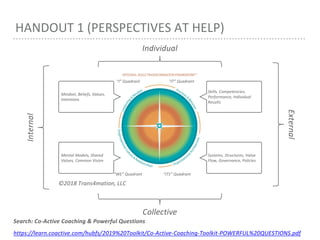
HANDOUT 1 (PERSPECTIVES AT HELP)
©️2018 Trans4mation, LLC
Mindset, Beliefs, Values,
Intentions
Skills, Competencies,
Performance, Individual
Results
Systems, Structures, Value
Flow, Governance, Policies
Mental Models, Shared
Values, Common Vision
“I” Quadrant “IT” Quadrant
“ITS” Quadrant“WE” Quadrant
Search: Co-Active Coaching & Powerful Questions
https://learn.coactive.com/hubfs/2019%20Toolkit/Co-Active-Coaching-Toolkit-POWERFUL%20QUESTIONS.pdf
Individual
Collective
External
Internal
HANDOUT 2 (CASE SCENARIOS)
1. The keynote of Agile Tour Vienna 2019
The advantage of this case scenario is that all, or at least the majority of the
group members share this experience.
2. A successful product or feature launch.
3. A successful meeting where the outcome benefited the whole organization.
4. A meeting where the outcome of the meeting completely missed the target.
5. Conflict in the team based on the interpretation of roles (example: developer
in a conflict with an architect, …)
Some of you will have similar experiences. If possible, take one of your
experiences and share it with a group in a form of a story (what happened,
where were you, what did you feel, what was the impact of the event).
This is a list of possible case scenarios you can use for the main exercise. As a
group, select one of these scenarios and decide who will provide a specific
details of the event or situation.
RESOURCES
Integral Agile Transformation Framework™️: Michael Spayd & Michele Madore
Agile Transformational Leader Workshop: Michael Spayd & Michele Madore
(http://www.trans4mation.coach)
Co-Active Coaching 2nd Edition: Laura Whitwort, et. al.
ICAgile Learning Roadmap Agile Coaching Track Version 2.0: The
International Consortium for Agile (ICAgile)
Ken Wilber: Theory of Everything, Shambhala (2001)
Ken Wilber: Brief History of Everything, Shambhala (2017)
Christopher T. Ernst, Andre Martin: Critical Reflections: How Groups Can Learn
from Success and Failure, Center for Creative Leadership (2007)
Charles J. Palus, David M. Horth: The Leader's Edge: Six Creative Competencies
for Navigating Complex Challenges, Jossey-Bass (2002)

Perspectives At Help

  • 1.
  • 2.
  • 3.
    THE PURPOSE The purposeof this workshop is to introduce you, the participants, to the concepts of the Integral Agile Transformation Framework™ (IATF) and the power of Powerful Questions.
  • 4.
    THE AGENDA Part 1 1.Introductions 2. What do we observe? 3. Overview 4. Perspectives & IATF 5. Powerful Questions Break (14:15 – 14:25) Part 2 1. Choosing a situation 2. Describing the situation 3. Collaborative questions 4. Closing
  • 5.
    EXERCISE – INTRODUCTION 1.Prepare for 1 minute to answer following questions: What is your name? Where are you coming from (country, city, company)? What is the best thing that happened to you this week? 2. You will have 30 seconds to introduce yourself to the rest of the group.
  • 6.
    WHAT DO WEOBSERVE?
  • 7.
    MY STORY (PARTSOF IT, AT LEAST) Trainer/Teacher Software Developer Project Manager Manager Scrum Master Consultant Agile Coach Husband Father Friend Child Student
  • 8.
  • 9.
    WHAT DO WEOBSERVE? Self Individuals Teams Program Organization MARKETPLACE
  • 10.
    STEP BACK -MAKE SPACE Organization Program Individuals Teams SelfSeparate Reflect Take Time MARKETPLACE
  • 11.
  • 12.
    USE PERSPECTIVES &QUESTIONS Organization Program Individuals Teams Self Integral Agile Transformation Framework™️ Powerful Questions MARKETPLACE
  • 13.
  • 14.
    EXERCISE – CHANGEPERSPECTIVE 1. Please, change the chair in the circle. 2. What has changed for you? 3. What has changed for others?
  • 15.
    “A point ofview, in philosophy, is an attitude–how one sees or thinks:[1] a specified (or stated) manner of consideration[2] as in "my personal point of view". https://en.wikipedia.org/wiki/Point_of_view_(philosophy) Mushki Brichta cc CC BY-SA 4.0
  • 16.
    PERSPECTIVES BY MICHAELSPAYD & MICHELE MADORE ©️2018 Trans4mation, LLC Mindset, Beliefs, Values, Intentions Skills, Competencies, Performance, Individual Results Systems, Structures, Value Flow, Governance, Policies Mental Models, Shared Values, Common Vision “I” Quadrant “IT” Quadrant “ITS” Quadrant“WE” Quadrant
  • 17.
    MICHAEL SPAYD &MICHELE MADORE TRANS4MATION.COACH
  • 18.
  • 19.
    “There are threecharacteristics that typically distinguish powerful questions: they invite exploration, resist easy answers, and invoke strong passions. In essence, powerful questions affect the way we gather information by helping us move beyond simple intellectual analysis to create a more holistic view of the challenge. Critical Reflections, How Groups Can Learn from Success and Failure: Chris Ernst, Andre Martin
  • 20.
    “What are thepatterns? … What‘s interesting, unique, beautiful, or unusual about this? … What is one hope you have going into this? … How do you feel about this at a deep down gut level? … What is this like? … What questions are we neglecting to act? … What would be positives if we failed? … What are we doing right? … The Leader's Edge: Charles J. Palus, David M. Horth
  • 21.
    POWERFUL QUESTIONS Search: Co-ActiveCoaching & Powerful Questions https://learn.coactive.com/hubfs/2019%20Toolkit/Co-Active-Coaching-Toolkit-POWERFUL%20QUESTIONS.pdf
  • 22.
    POWERFUL QUESTIONS -EXERCISE Search: Co-Active Coaching & Powerful Questions https://learn.coactive.com/hubfs/2019%20Toolkit/Co-Active-Coaching-Toolkit-POWERFUL%20QUESTIONS.pdf 1. Find a partner and sit near each other 2. Everybody will have 1 minute to think about one problem/challenge currently facing. 3. For 4 minutes one partner is asking powerful questions (use the link provided) and only powerful questions. Asking partner waits until the question is answered to ask another powerful question. 4. After these 4 minutes partners change the role. 5. What has changed for you? What did you notice?
  • 23.
  • 24.
    WORKSHOP EXERCISE Event / Situation StoryTelling “I” Quadrant Questions “IT” Quadrant Questions “ITS” Quadrant Questions “WE” Quadrant Questions 1. Collectively choose 1 event/situation 5 min: conversation in a group 2. Describe the event/situation 5 min: tell a story about the specific event, if you all share the same story, each can tell part of it (Fill in the center of the flip-chart) 3. Collectively write questions you would ask from a specific quadrant’s PERSPECTIVE to create a MEANING, to clarify the event/situation. 5 min for each quadrant: in total 20 min
  • 25.
    THANK YOU FOR BEINGHERE! Zvonimir Durcevic @zvonimir
  • 26.
  • 31.
    AGILE COACHING -AREAS OF WORK & DEVELOPMENT Individuals Self Teams Program Organization Source: ICAgile Learning Roadmap Agile Coaching Track The International Consortium for Agile (ICAgile) CC License: https://creativecommons.org/licenses/by/4.0/legalcode
  • 32.
    HANDOUT 1 (PERSPECTIVESAT HELP) ©️2018 Trans4mation, LLC Mindset, Beliefs, Values, Intentions Skills, Competencies, Performance, Individual Results Systems, Structures, Value Flow, Governance, Policies Mental Models, Shared Values, Common Vision “I” Quadrant “IT” Quadrant “ITS” Quadrant“WE” Quadrant Search: Co-Active Coaching & Powerful Questions https://learn.coactive.com/hubfs/2019%20Toolkit/Co-Active-Coaching-Toolkit-POWERFUL%20QUESTIONS.pdf Individual Collective External Internal
  • 33.
    HANDOUT 2 (CASESCENARIOS) 1. The keynote of Agile Tour Vienna 2019 The advantage of this case scenario is that all, or at least the majority of the group members share this experience. 2. A successful product or feature launch. 3. A successful meeting where the outcome benefited the whole organization. 4. A meeting where the outcome of the meeting completely missed the target. 5. Conflict in the team based on the interpretation of roles (example: developer in a conflict with an architect, …) Some of you will have similar experiences. If possible, take one of your experiences and share it with a group in a form of a story (what happened, where were you, what did you feel, what was the impact of the event). This is a list of possible case scenarios you can use for the main exercise. As a group, select one of these scenarios and decide who will provide a specific details of the event or situation.
  • 34.
    RESOURCES Integral Agile TransformationFramework™️: Michael Spayd & Michele Madore Agile Transformational Leader Workshop: Michael Spayd & Michele Madore (http://www.trans4mation.coach) Co-Active Coaching 2nd Edition: Laura Whitwort, et. al. ICAgile Learning Roadmap Agile Coaching Track Version 2.0: The International Consortium for Agile (ICAgile) Ken Wilber: Theory of Everything, Shambhala (2001) Ken Wilber: Brief History of Everything, Shambhala (2017) Christopher T. Ernst, Andre Martin: Critical Reflections: How Groups Can Learn from Success and Failure, Center for Creative Leadership (2007) Charles J. Palus, David M. Horth: The Leader's Edge: Six Creative Competencies for Navigating Complex Challenges, Jossey-Bass (2002)