Jeffrey Funk
Technology Consultant,
Retired from National University of Singapore
For information on other technologies, see http://www.slideshare.net/Funk98/presentations
Primary and Secondary Schools are Failing
 Many books have addressed this issue
 A great one is Dumbing Us Down: The Hidden
Curriculum of Compulsory Schooling, by John Gatto
 Here’s his summary of what schools teach students
 Confusion – everything taught out of context
 Students must stay in the class where they belong
 Students shouldn’t care much about anything
 Surrender their will to the predestinated chain of
command
 Wait for a teacher to tell them what to do
 Kid’s self-respect should depend on expert opinion
 Students are always being watched by teachers
Isn’t There Another Way?
 Can’t we organize schools differently, to provide more
context for learning?
 School choice might provide alternatives, but will they
be good ones?
 Entrepreneurs may not offer anything different
 Or something worse
 We need to rethink education, beginning with how
children have learned over the previous centuries
 We need to rethink the types of people society needs for
teaching and the types of training that is required
 Can we learn something from the past?
How Did Children Used to Learn?
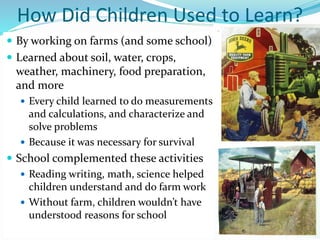
 By working on farms (and some school)
 Learned about soil, water, crops,
weather, machinery, food preparation,
and more
 Every child learned to do measurements
and calculations, and characterize and
solve problems
 Because it was necessary for survival
 School complemented these activities
 Reading writing, math, science helped
children understand and do farm work
 Without farm, children wouldn’t have
understood reasons for school
Context was the Key
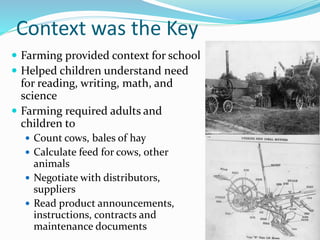
 Farming provided context for school
 Helped children understand need
for reading, writing, math, and
science
 Farming required adults and
children to
 Count cows, bales of hay
 Calculate feed for cows, other
animals
 Negotiate with distributors,
suppliers
 Read product announcements,
instructions, contracts and
maintenance documents
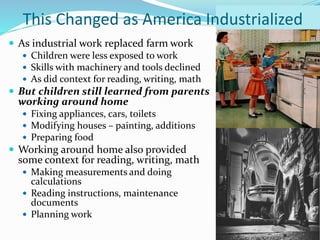
 As industrial work replaced farm work
 Children were less exposed to work
 Skills with machinery and tools declined
 As did context for reading, writing, math
 But children still learned from parents
working around home
 Fixing appliances, cars, toilets
 Modifying houses – painting, additions
 Preparing food
 Working around home also provided
some context for reading, writing, math
 Making measurements and doing
calculations
 Reading instructions, maintenance
documents
 Planning work
This Changed as America Industrialized
Farming Remained Important Source of
Engineers Even in 2nd-Half of 20th Century
 The Idea Factory: How Bell Labs Invented the
Future, by John Gertner
 Book shows that farmers and ranchers were over-
represented in post-war Bell Labs
 Farming and ranching
 Made children curious about physical world
 Provided context for school work
 Helped them learn about science and engineering,
including instruments, tools, and machinery
 Motivated them to learn
 Also provided them with physical exercise
Learning is Very Different Now
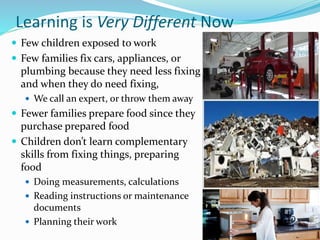
 Few children exposed to work
 Few families fix cars, appliances, or
plumbing because they need less fixing
and when they do need fixing,
 We call an expert, or throw them away
 Fewer families prepare food since they
purchase prepared food
 Children don’t learn complementary
skills from fixing things, preparing
food
 Doing measurements, calculations
 Reading instructions or maintenance
documents
 Planning their work
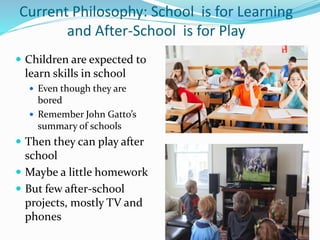
 Children are expected to
learn skills in school
 Even though they are
bored
 Remember John Gatto’s
summary of schools
 Then they can play after
school
 Maybe a little homework
 But few after-school
projects, mostly TV and
phones
Current Philosophy: School is for Learning
and After-School is for Play
Without Context School Makes Little Sense
 Context is needed for children to compare
school lessons with real world
 Helps them build their
own map of world
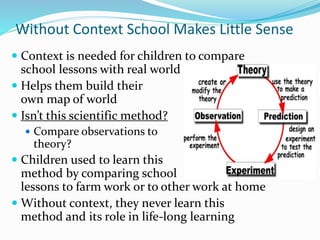
 Isn’t this scientific method?
 Compare observations to
theory?
 Children used to learn this
method by comparing school
lessons to farm work or to other work at home
 Without context, they never learn this
method and its role in life-long learning
Many Children Can’t Distinguish
Between Real and Make-Believe
 Their lives filled with make-believe TV
programs, movies, YouTube videos, toys
 How can they understand physical
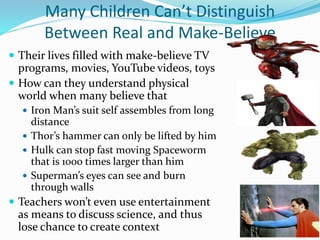
world when many believe that
 Iron Man’s suit self assembles from long
distance
 Thor’s hammer can only be lifted by him
 Hulk can stop fast moving Spaceworm
that is 1000 times larger than him
 Superman’s eyes can see and burn
through walls
 Teachers won’t even use entertainment
as means to discuss science, and thus
lose chance to create context
Some Parents Fight back
 Explain differences between real and make-believe
 Help children make things, fix them, prepare food
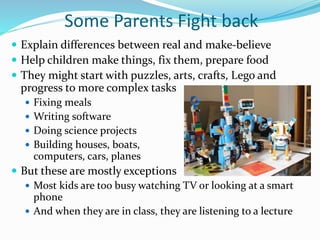
 They might start with puzzles, arts, crafts, Lego and
progress to more complex tasks
 Fixing meals
 Writing software
 Doing science projects
 Building houses, boats,
computers, cars, planes
 But these are mostly exceptions
 Most kids are too busy watching TV or looking at a smart
phone
 And when they are in class, they are listening to a lecture
Most Parents Go With the Flow
 Most parents are too busy to help their kids learn
 Partly because they were raised in a household that
didn’t emphasize learning at home
 Most parents want to think learning should be out-
sourced to schools and other organizations
 But they forget that children used to learn most
things at home, before technological change made
our lives simpler
 but this technological change has reduced learning
opportunities for children
 And schools haven’t’ introduced context to
compensate for reduced learning opportunities
outside of school
Reality of Education:
Little Learning is Done in Context
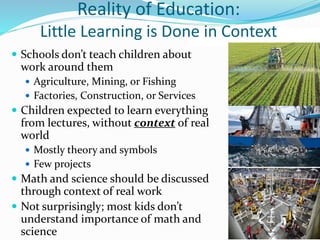
 Schools don’t teach children about
work around them
 Agriculture, Mining, or Fishing
 Factories, Construction, or Services
 Children expected to learn everything
from lectures, without context of real
world
 Mostly theory and symbols
 Few projects
 Math and science should be discussed
through context of real work
 Not surprisingly; most kids don’t
understand importance of math and
science
Without Context, Learning Consists
Mostly of Rules and Facts
 Rules of mathematics, science, medicine
 Facts of history
 Definitions, formulas, calculations
 Names of people, places, diseases, things, body
parts, theories
 Dates of events – including new leaders, laws,
inventions, cultural changes
 But how does this help people solve problems?
Either now or in the future?
Without Context, Life-Long Learning is Difficult
 Without context, how can people rethink rules and
opinions and learn new approaches to problem solving
 Although they might learn new skills, they will be
unlikely to change their views towards economics,
psychology, inter-personal relations, technologies, or
political philosophies
 Instead they keep roughly the same views
 Conservatives remain conservatives
 Liberals remain liberals
 Even developing new skills is hard because their views
towards economics and technologies largely
determines the skills they think are important
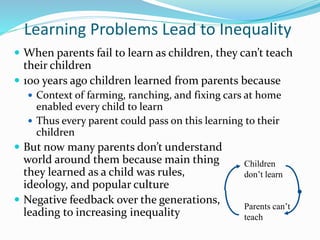
Learning Problems Lead to Inequality
 When parents fail to learn as children, they can’t teach
their children
 100 years ago children learned from parents because
 Context of farming, ranching, and fixing cars at home
enabled every child to learn
 Thus every parent could pass on this learning to their
children
 But now many parents don’t understand
world around them because main thing
they learned as a child was rules,
ideology, and popular culture
 Negative feedback over the generations,
leading to increasing inequality
Children
don’t learn
Parents can’t
teach
What Context Do Schools Need?
 All science and math must be learned within the context of
the real world
 How do crops grow?
 How are materials mined and used?
 How do fish breed and grow in oceans and farms?
 How do factories work including global logistic supply chains
 How do phones, computers, displays, electricity generation,
and other technologies work?
 Science and math problems should be used to deepen
student’s understanding of these types of questions
 Objective is not to cram an ideology down student’s
throats, but to help them understand all facets of human
activity
 Students shouldn’t know teachers’ political ideologies
Learning Requires All Five Senses
 Children should be touching, smelling, and tasting things
 Not just seeing and listening
 Most schools, museums and parents don’t allow touching,
smelling, and tasting
 Too dangerous! they think
 Museums and gardens are frightened of children touching
things, even if the things aren’t valuable or dangerous
 Why can’t staff help children do things, and not just enforce
rules
 Children used to
 Touch, smell, and taste crops
 Touch machinery and tools (and also smell oil and other
aspects of machinery)
 Valuable sources of learning
Projects are Needed
 Projects that involve all five senses and that help
students understand:
 How crops grow?
 How materials are mined and used?
 How fish breed and grow in oceans and farms?
 How factories work including global logistic supply
chains
 How phones, computers, displays, electricity
generation, and other technologies work?
 School must go beyond words and symbols and
enable students to use their hands and minds
An Historical Context is Also Needed
 How have agriculture, mining, fishing, factories, and
other industries changed over the last 200 years?
 How has productivity increased?
 How have increases in productivity impacted on standards
of living?
 Roles of new products and services, innovation,
technology, science, companies, and finance
 What are the current challenges?
 Slowing productivity growth
 Rising energy use and environmental impact
 Further need for innovation
 Science and math should help address these questions
Students Must Also Understand Current Work
 Banking, insurance, health care, telecommunications,
logistics, retail, wholesale, information technology
 What are they? What do they consist of? Who creates
these systems? What skills are needed to create these
systems? What are roles of science and math?
 All of them involve machines, mostly computers,
sometimes connected to other machines
 These machines include hardware and software
 Most work of the future involves the design,
implementation, operation, and maintenance of
systems
 Software is a key aspect of the systems, but the context
for this must be explained
A New Type of Teacher is Needed
 One who can help children
 understand the world around them
 do projects with them
 These skills can probably be taught in lectures, but
most people learn them through experience
 Perhaps the best teachers are people over 50 years
old who have experience:
 Professional work
 Raising children
 Traveling
 Other experiences
 What if a school hired these types of teachers?
Benefits
 Students learn about the real world including
 Work
 A context for science and math
 Life, family, and friends
 Teachers require less formal training
 Thus lower costs for teacher training and thus lower pay
is needed
 Teachers need certain amount of work experience and
college training that can be evaluated with a few tests
 Reduce unemployment of older people
 Older people have opportunity to share their
experiences with young people
Entrepreneurs
 Who wants to change the world?

Putting Context Back Into Learning

  • 1.
    Jeffrey Funk Technology Consultant, Retiredfrom National University of Singapore For information on other technologies, see http://www.slideshare.net/Funk98/presentations
  • 2.
    Primary and SecondarySchools are Failing  Many books have addressed this issue  A great one is Dumbing Us Down: The Hidden Curriculum of Compulsory Schooling, by John Gatto  Here’s his summary of what schools teach students  Confusion – everything taught out of context  Students must stay in the class where they belong  Students shouldn’t care much about anything  Surrender their will to the predestinated chain of command  Wait for a teacher to tell them what to do  Kid’s self-respect should depend on expert opinion  Students are always being watched by teachers
  • 3.
    Isn’t There AnotherWay?  Can’t we organize schools differently, to provide more context for learning?  School choice might provide alternatives, but will they be good ones?  Entrepreneurs may not offer anything different  Or something worse  We need to rethink education, beginning with how children have learned over the previous centuries  We need to rethink the types of people society needs for teaching and the types of training that is required  Can we learn something from the past?
  • 4.
    How Did ChildrenUsed to Learn?  By working on farms (and some school)  Learned about soil, water, crops, weather, machinery, food preparation, and more  Every child learned to do measurements and calculations, and characterize and solve problems  Because it was necessary for survival  School complemented these activities  Reading writing, math, science helped children understand and do farm work  Without farm, children wouldn’t have understood reasons for school
  • 5.
    Context was theKey  Farming provided context for school  Helped children understand need for reading, writing, math, and science  Farming required adults and children to  Count cows, bales of hay  Calculate feed for cows, other animals  Negotiate with distributors, suppliers  Read product announcements, instructions, contracts and maintenance documents
  • 6.
     As industrialwork replaced farm work  Children were less exposed to work  Skills with machinery and tools declined  As did context for reading, writing, math  But children still learned from parents working around home  Fixing appliances, cars, toilets  Modifying houses – painting, additions  Preparing food  Working around home also provided some context for reading, writing, math  Making measurements and doing calculations  Reading instructions, maintenance documents  Planning work This Changed as America Industrialized
  • 7.
    Farming Remained ImportantSource of Engineers Even in 2nd-Half of 20th Century  The Idea Factory: How Bell Labs Invented the Future, by John Gertner  Book shows that farmers and ranchers were over- represented in post-war Bell Labs  Farming and ranching  Made children curious about physical world  Provided context for school work  Helped them learn about science and engineering, including instruments, tools, and machinery  Motivated them to learn  Also provided them with physical exercise
  • 8.
    Learning is VeryDifferent Now  Few children exposed to work  Few families fix cars, appliances, or plumbing because they need less fixing and when they do need fixing,  We call an expert, or throw them away  Fewer families prepare food since they purchase prepared food  Children don’t learn complementary skills from fixing things, preparing food  Doing measurements, calculations  Reading instructions or maintenance documents  Planning their work
  • 9.
     Children areexpected to learn skills in school  Even though they are bored  Remember John Gatto’s summary of schools  Then they can play after school  Maybe a little homework  But few after-school projects, mostly TV and phones Current Philosophy: School is for Learning and After-School is for Play
  • 10.
    Without Context SchoolMakes Little Sense  Context is needed for children to compare school lessons with real world  Helps them build their own map of world  Isn’t this scientific method?  Compare observations to theory?  Children used to learn this method by comparing school lessons to farm work or to other work at home  Without context, they never learn this method and its role in life-long learning
  • 11.
    Many Children Can’tDistinguish Between Real and Make-Believe  Their lives filled with make-believe TV programs, movies, YouTube videos, toys  How can they understand physical world when many believe that  Iron Man’s suit self assembles from long distance  Thor’s hammer can only be lifted by him  Hulk can stop fast moving Spaceworm that is 1000 times larger than him  Superman’s eyes can see and burn through walls  Teachers won’t even use entertainment as means to discuss science, and thus lose chance to create context
  • 12.
    Some Parents Fightback  Explain differences between real and make-believe  Help children make things, fix them, prepare food  They might start with puzzles, arts, crafts, Lego and progress to more complex tasks  Fixing meals  Writing software  Doing science projects  Building houses, boats, computers, cars, planes  But these are mostly exceptions  Most kids are too busy watching TV or looking at a smart phone  And when they are in class, they are listening to a lecture
  • 13.
    Most Parents GoWith the Flow  Most parents are too busy to help their kids learn  Partly because they were raised in a household that didn’t emphasize learning at home  Most parents want to think learning should be out- sourced to schools and other organizations  But they forget that children used to learn most things at home, before technological change made our lives simpler  but this technological change has reduced learning opportunities for children  And schools haven’t’ introduced context to compensate for reduced learning opportunities outside of school
  • 14.
    Reality of Education: LittleLearning is Done in Context  Schools don’t teach children about work around them  Agriculture, Mining, or Fishing  Factories, Construction, or Services  Children expected to learn everything from lectures, without context of real world  Mostly theory and symbols  Few projects  Math and science should be discussed through context of real work  Not surprisingly; most kids don’t understand importance of math and science
  • 15.
    Without Context, LearningConsists Mostly of Rules and Facts  Rules of mathematics, science, medicine  Facts of history  Definitions, formulas, calculations  Names of people, places, diseases, things, body parts, theories  Dates of events – including new leaders, laws, inventions, cultural changes  But how does this help people solve problems? Either now or in the future?
  • 16.
    Without Context, Life-LongLearning is Difficult  Without context, how can people rethink rules and opinions and learn new approaches to problem solving  Although they might learn new skills, they will be unlikely to change their views towards economics, psychology, inter-personal relations, technologies, or political philosophies  Instead they keep roughly the same views  Conservatives remain conservatives  Liberals remain liberals  Even developing new skills is hard because their views towards economics and technologies largely determines the skills they think are important
  • 17.
    Learning Problems Leadto Inequality  When parents fail to learn as children, they can’t teach their children  100 years ago children learned from parents because  Context of farming, ranching, and fixing cars at home enabled every child to learn  Thus every parent could pass on this learning to their children  But now many parents don’t understand world around them because main thing they learned as a child was rules, ideology, and popular culture  Negative feedback over the generations, leading to increasing inequality Children don’t learn Parents can’t teach
  • 18.
    What Context DoSchools Need?  All science and math must be learned within the context of the real world  How do crops grow?  How are materials mined and used?  How do fish breed and grow in oceans and farms?  How do factories work including global logistic supply chains  How do phones, computers, displays, electricity generation, and other technologies work?  Science and math problems should be used to deepen student’s understanding of these types of questions  Objective is not to cram an ideology down student’s throats, but to help them understand all facets of human activity  Students shouldn’t know teachers’ political ideologies
  • 19.
    Learning Requires AllFive Senses  Children should be touching, smelling, and tasting things  Not just seeing and listening  Most schools, museums and parents don’t allow touching, smelling, and tasting  Too dangerous! they think  Museums and gardens are frightened of children touching things, even if the things aren’t valuable or dangerous  Why can’t staff help children do things, and not just enforce rules  Children used to  Touch, smell, and taste crops  Touch machinery and tools (and also smell oil and other aspects of machinery)  Valuable sources of learning
  • 20.
    Projects are Needed Projects that involve all five senses and that help students understand:  How crops grow?  How materials are mined and used?  How fish breed and grow in oceans and farms?  How factories work including global logistic supply chains  How phones, computers, displays, electricity generation, and other technologies work?  School must go beyond words and symbols and enable students to use their hands and minds
  • 21.
    An Historical Contextis Also Needed  How have agriculture, mining, fishing, factories, and other industries changed over the last 200 years?  How has productivity increased?  How have increases in productivity impacted on standards of living?  Roles of new products and services, innovation, technology, science, companies, and finance  What are the current challenges?  Slowing productivity growth  Rising energy use and environmental impact  Further need for innovation  Science and math should help address these questions
  • 22.
    Students Must AlsoUnderstand Current Work  Banking, insurance, health care, telecommunications, logistics, retail, wholesale, information technology  What are they? What do they consist of? Who creates these systems? What skills are needed to create these systems? What are roles of science and math?  All of them involve machines, mostly computers, sometimes connected to other machines  These machines include hardware and software  Most work of the future involves the design, implementation, operation, and maintenance of systems  Software is a key aspect of the systems, but the context for this must be explained
  • 23.
    A New Typeof Teacher is Needed  One who can help children  understand the world around them  do projects with them  These skills can probably be taught in lectures, but most people learn them through experience  Perhaps the best teachers are people over 50 years old who have experience:  Professional work  Raising children  Traveling  Other experiences  What if a school hired these types of teachers?
  • 24.
    Benefits  Students learnabout the real world including  Work  A context for science and math  Life, family, and friends  Teachers require less formal training  Thus lower costs for teacher training and thus lower pay is needed  Teachers need certain amount of work experience and college training that can be evaluated with a few tests  Reduce unemployment of older people  Older people have opportunity to share their experiences with young people
  • 25.
    Entrepreneurs  Who wantsto change the world?