Dr. Shahnawaz Alam
MCh-Neurosurgery
Moderated by:
Dr. V. C. Jha
HOD, Deptt. of Neurosurgery
Frontotemporal Craniotomy with
Orbitozygomatic Osteotomy
• The FTOZ approach was popularized by Pellerin et al. and Hakuba et al. in
the 1980s to access parasellar and interpeduncular lesions with minimal brain
retraction in skull base surgery.
• Pterional craniotomy, popularized by Yasargil in 1976, is the most used
surgical route in neurosurgery. It exposes transylvian and lateral subfrontal
views.
• The orbitozygomatic approach an adjunct to pterional craniotomy that
allows greater rostral trajectory to midline structures.
• It combines the advantages of the pterional and the pretemporal
approaches. It allows greater working area and angle of attack from
inferior to superior compared to the pterional approach.
• By removing the superior and lateral bony orbit, one gains a more
anterior and inferior starting point for the approach than would be possible
with a conventional pterional craniotomy.
• Removal of the zygomatic arch enables inferior displacement of the
temporalis muscle, allowing for a lower starting point for subtemporal
visualization.
• The MacCarty keyhole and inferior orbital fissure are major surgical
landmarks.
• It provides the best view for brain diseases at optic chiasm, third ventricle
floor, high carotid artery bifurcation, high basilar tip artery bifurcation,
anterior communicating artery aneurysms pointed posteriorly, and any
other lesions at sellar and parasellar regions or interpeduncular region.
• This approach can even access the sphenoidal, frontal, and ethmoidal sinuses,
the components of the orbit, the cavernous sinus and the remaining structures
of the middle cranial fossa.
• This approach may be used for several pathologies, such as pituitary
macroadenomas, chordomas, sphenoid wing meningiomas, orbital
meningiomas, petroclival meningiomas, trigeminal neurinomas, basilar tip
aneurysms, anterior communicating artery aneurysms, and lesions of the
cavernous sinus
CONTRAINDICATIONS
• If a midline view of the suprasellar region is needed, a bifrontal craniotomy
may be a better approach.
• Access to the petrous apex and retrosellar space is limited and requires a
long reach.
 Anatomical Considerations:
• One of the first bony landmarks encountered is
FZS.
• It can be followed medially to identify the
junction of FZS, FSS, and SZS. This 3 suture
junction will be important for accurately
placing the MacCarty keyhole (found at mean
distances of 6.8 mm superior and 4.5 mm
posterior to FZS.
• In addition, the sutures can be used to locate
intraorbital landmarks that are referenced
during the osteotomy, including IOF and SOF.
• SZS can be followed inferiorly from 3 suture jt.
to reach the IOF, and FZS can be followed
medially from an intraorbital perspective to
reach the superolateral portion of the SOF.
• The IOF can also be visualized extracranially
through the superior and medial portions of the
infratemporal fossa.
Posterolateral perspective of the skull
 The zygomaticofacial foramen is the anteroinferior limit of the FTOZ osteotomy
that serves as a landmark for the cut across the zygoma, above the malar
eminence, and into the lateral edge of the IOF.
• It is located in the lateral surface of the zygomatic bone close to the orbital rim and
transmits the zygomaticofacial nerve, a branch of the maxillary nerve (V2).
 Intracranially, special attention should be given to the meningo-orbital band
(MOB) that lies in the superolateral aspect of the optic canal. The MOB is a dural
fold that binds the frontotemporal basal dura to the periorbita via the SOF.
• For most parasellar lesions, the MOB is the medial limit of drilling. However, if
an extradural anterior clinoidectomy is necessary, the MOB can be safely
detached by peeling the dura propria from the temporal lobe
PLANNING AND POSITIONING
• After pinning, the head is usually positioned such that the lateral orbital ridge and
keyhole region is the highest point on the patient’s head.
 The head is positioned by first elevating the head above the heart in the "sniffing
position."
 Second, the head is rotated up to 30 degrees to the contralateral side depending on
the intended operation.
 Third, the neck is extended so that the vertex is angled down 10 to 30 degrees,
allowing for self-retraction of the frontal lobe off the anterior cranial fossa floor.
• When the head is ideally positioned, the malar eminence of the zygomatic bone should
be the highest point in the operative field.
 Skin incision :
• For most cases, particularly cases focused at
the parasellar skull base and circle of Willis,
a simple C-shaped incision beginning at the
widow’s peak and extending posterolaterally
back to the root of the zygomatic arch suffices.
 Soft tissue elevation and identification
of landmarks:
• The frontalis branch of the facial nerve runs in
a posteroinferior to anterosuperior direction in
a large subcutaneous fat pad that sits on the
outside of the temporalis fascia and connects
the skin to the temporalis fascia just behind the
lateral orbital rim.
PROCEDURE
 To expose the lateral orbit and
maxillary buttress safely and
adequately, the scalp and fat pad
must be separated from the
temporalis muscle and reflected
anteriorly to enter the lateral orbit-
suprafascial / subfascial approach.
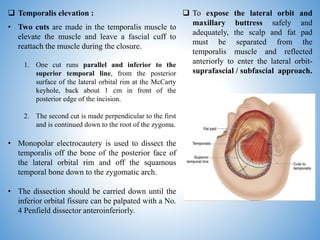
 Temporalis elevation :
• Two cuts are made in the temporalis muscle to
elevate the muscle and leave a fascial cuff to
reattach the muscle during the closure.
1. One cut runs parallel and inferior to the
superior temporal line, from the posterior
surface of the lateral orbital rim at the McCarty
keyhole, back about 1 cm in front of the
posterior edge of the incision.
2. The second cut is made perpendicular to the first
and is continued down to the root of the zygoma.
• Monopolar electrocautery is used to dissect the
temporalis off the bone of the posterior face of
the lateral orbital rim and off the squamous
temporal bone down to the zygomatic arch.
• The dissection should be carried down until the
inferior orbital fissure can be palpated with a No.
4 Penfield dissector anteroinferiorly.
 Periorbital dissection and bony
exposure:
• A small dissector is used to elevate the
scalp off of the orbital rim from just
medial to the supraorbital rim, down
over the frontozygomatic suture, onto
the maxilla and zygomatic arch.
• After releasing the supraorbital nerve,
the periorbita is gently dissected away
from the inner bony surface of the
superior and lateral orbit.
• Dissection continues in the orbit in a
lateral and inferior direction until the
inferior orbital fissure is able to be
palpated with a No. 4 Penfield.
 Craniotomy
• The two-piece FTOZ involves the removal of the standard pterional bone flap,
followed by the orbitozygomatic bone flap.
• The first burr hole is drilled superior to the zygomatic arch in the temporal
squamosal bone. The second burr hole should be placed at the MacCarty
keyhole.
• The MacCarty keyhole exposes the frontal lobe dura in the upper half and
periorbita in the lower half of the keyhole with the orbital roof in between.
 Frontotemporal craniotomy:
• The burr hole placed at the
McCarty keyhole should be placed
slightly more anterior than is
typical.
• Ideally, the burr hole should expose
the lateral orbit because two cuts
involved in the orbitozygomatic
osteotomy terminate in this burr
hole.
• Also, it is important that the
craniotomy cuts on the forehead
come as anterior as possible.
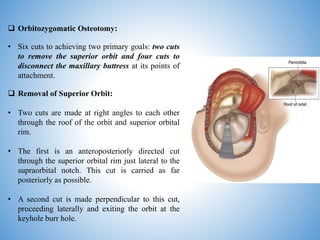
 Orbitozygomatic Osteotomy:
• Six cuts to achieving two primary goals: two cuts
to remove the superior orbit and four cuts to
disconnect the maxillary buttress at its points of
attachment.
 Removal of Superior Orbit:
• Two cuts are made at right angles to each other
through the roof of the orbit and superior orbital
rim.
• The first is an anteroposteriorly directed cut
through the superior orbital rim just lateral to the
supraorbital notch. This cut is carried as far
posteriorly as possible.
• A second cut is made perpendicular to this cut,
proceeding laterally and exiting the orbit at the
keyhole burr hole.
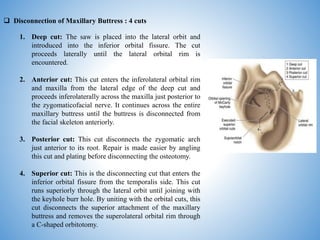
 Disconnection of Maxillary Buttress : 4 cuts
1. Deep cut: The saw is placed into the lateral orbit and
introduced into the inferior orbital fissure. The cut
proceeds laterally until the lateral orbital rim is
encountered.
2. Anterior cut: This cut enters the inferolateral orbital rim
and maxilla from the lateral edge of the deep cut and
proceeds inferolaterally across the maxilla just posterior to
the zygomaticofacial nerve. It continues across the entire
maxillary buttress until the buttress is disconnected from
the facial skeleton anteriorly.
3. Posterior cut: This cut disconnects the zygomatic arch
just anterior to its root. Repair is made easier by angling
this cut and plating before disconnecting the osteotomy.
4. Superior cut: This is the disconnecting cut that enters the
inferior orbital fissure from the temporalis side. This cut
runs superiorly through the lateral orbit until joining with
the keyhole burr hole. By uniting with the orbital cuts, this
cut disconnects the superior attachment of the maxillary
buttress and removes the superolateral orbital rim through
a C-shaped orbitotomy.
 Additional craniotomy:
• To eliminate bony obstruction to viewing angles.
• The superior orbit should be removed with a rongeur to as
close to the orbital apex and sphenoid wing as possible.
• Additionally, after using the additional temporalis retraction
made possible by the zygomatic arch removal, the
squamous temporal bone should be removed down to the
floor of the middle fossa.
• If necessary, the lesser sphenoid wing should be drilled
until no bony elevation exists between the globe and the
anterior clinoid process.
• The dura is opened in a C-shaped fashion across the sylvian
fissure, with the ends of the "C" roughly bifurcating the
exposed portion of the frontal and temporal lobes, and
carried as anteriorly as possible.
• The dura is flapped anteriorly to retract the periorbita and
eye out of the field and is sutured to the scalp, with the
stitches into the dura placed as low as possible to retract the
dura as flat and out of the working view as possible.
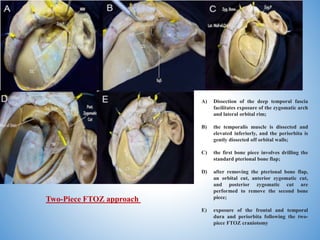
A) Dissection of the deep temporal fascia
facilitates exposure of the zygomatic arch
and lateral orbital rim;
B) the temporalis muscle is dissected and
elevated inferiorly, and the periorbita is
gently dissected off orbital walls;
C) the first bone piece involves drilling the
standard pterional bone flap;
D) after removing the pterional bone flap,
an orbital cut, anterior zygomatic cut,
and posterior zygomatic cut are
performed to remove the second bone
piece;
E) exposure of the frontal and temporal
dura and periorbita following the two-
piece FTOZ craniotomy
Two-Piece FTOZ approach
One-piece FTOZ craniotomy
 It involve drilling the temporal burr hole and MacCarty keyhole to expose the periorbita and
frontal dura. 4 bony cuts are made:
1. Starts at the temporal burr hole and extends posteriorly above the superior temporal line to the
superior orbital rim;
2. Connects the temporal burr hole to MacCarty keyhole;
3. Made across the posterior roof the zygomatic arch;
4. Made across the inferolateral margin of the zygoma and frontozygomatic process.
 It reduce surgical time and achieve good cosmetic results; but provide limited exposure of
the inferior orbital fissure due to the temporalis muscle mass; With a smaller removal of the
orbital roof, it can also lead to reduced visualization of the basal frontal lobe.
Three-piece FTOZ
• Popularized Campero et al. to obtain better exposure of MCF floor, lateral orbital rim, and the IOF.
• The first bone piece involves the zygomatic arch, which is vertically cut at two ends: 1) anterior cut
that is posterior to the zygomaticotemporal suture, and 2) posterior cut that is anterior to the
temporomandibular joint.
• The second bone piece is the standard pterional bone flap. The orbital roof and lateral wall of the orbit
are additionally drilled in preparation for removing the third bone piece, which involves the orbital
rim, orbital roof, and lateral wall.
• Three cuts are performed in this region to release the orbitozygomatic bone flap, as described in the
standard two-piece FTOZ.
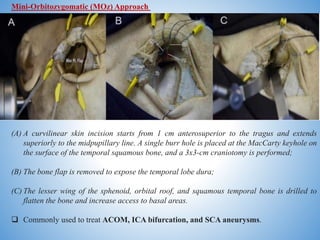
(A) A curvilinear skin incision starts from 1 cm anterosuperior to the tragus and extends
superiorly to the midpupillary line. A single burr hole is placed at the MacCarty keyhole on
the surface of the temporal squamous bone, and a 3x3-cm craniotomy is performed;
(B) The bone flap is removed to expose the temporal lobe dura;
(C) The lesser wing of the sphenoid, orbital roof, and squamous temporal bone is drilled to
flatten the bone and increase access to basal areas.
 Commonly used to treat ACOM, ICA bifurcation, and SCA aneurysms.
Mini-Orbitozygomatic (MOz) Approach
TIPS FROM THE MASTERS
• Placing the incision as close to the tragus as possible can complicate closure
but is probably cosmetically superior.
• It is wise to attempt to spare the superficial temporal artery (STA) for
several reasons. First, delayed bleeding from the STA is a frequent source of
postoperative epidural hematomas requiring evacuation, and dealing with STA
bleeding can often consume more time than it takes to spare the artery.
• Additionally, the STA is the principal blood supply to the scalp flap, and
maintaining good scalp blood flow likely improves wound healing.
• Finally, the anterior branch of the STA runs roughly parallel and posterior to the
frontalis branch of the facial nerve in the scalp and is a good indicator of how
far the scalp can be separated from the temporalis fascia before the frontalis
nerve needs to be separated from the temporalis muscle and protected.
• The STA typically lies in the subgaleal space above the temporalis fascia just
anterior to the tragus. Metzenbaum scissors are used to dissect the galea away
from the temporalis fascia to identify the STA before cutting it with the scissors.
• Care should be taken to preserve the periorbita because violation of this
protective covering not only risks injury to the intraorbital contents, but also
makes visualization of the reciprocating saw during the orbital osteotomy much
more difficult.
References:
• Youmans and Winn neurological surgery 7th edition
• Ramamurthi & Tandon's textbook of neurosurgery 3rd edition
• Seven Aneurysms Tenets and Techniques for Clipping ;Michael T. Lawton
• Internet
THANK YOU

Frontotemporal FTOZ craniotomy

  • 1.
    Dr. Shahnawaz Alam MCh-Neurosurgery Moderatedby: Dr. V. C. Jha HOD, Deptt. of Neurosurgery Frontotemporal Craniotomy with Orbitozygomatic Osteotomy
  • 2.
    • The FTOZapproach was popularized by Pellerin et al. and Hakuba et al. in the 1980s to access parasellar and interpeduncular lesions with minimal brain retraction in skull base surgery. • Pterional craniotomy, popularized by Yasargil in 1976, is the most used surgical route in neurosurgery. It exposes transylvian and lateral subfrontal views. • The orbitozygomatic approach an adjunct to pterional craniotomy that allows greater rostral trajectory to midline structures. • It combines the advantages of the pterional and the pretemporal approaches. It allows greater working area and angle of attack from inferior to superior compared to the pterional approach.
  • 3.
    • By removingthe superior and lateral bony orbit, one gains a more anterior and inferior starting point for the approach than would be possible with a conventional pterional craniotomy. • Removal of the zygomatic arch enables inferior displacement of the temporalis muscle, allowing for a lower starting point for subtemporal visualization. • The MacCarty keyhole and inferior orbital fissure are major surgical landmarks.
  • 4.
    • It providesthe best view for brain diseases at optic chiasm, third ventricle floor, high carotid artery bifurcation, high basilar tip artery bifurcation, anterior communicating artery aneurysms pointed posteriorly, and any other lesions at sellar and parasellar regions or interpeduncular region. • This approach can even access the sphenoidal, frontal, and ethmoidal sinuses, the components of the orbit, the cavernous sinus and the remaining structures of the middle cranial fossa. • This approach may be used for several pathologies, such as pituitary macroadenomas, chordomas, sphenoid wing meningiomas, orbital meningiomas, petroclival meningiomas, trigeminal neurinomas, basilar tip aneurysms, anterior communicating artery aneurysms, and lesions of the cavernous sinus
  • 5.
    CONTRAINDICATIONS • If amidline view of the suprasellar region is needed, a bifrontal craniotomy may be a better approach. • Access to the petrous apex and retrosellar space is limited and requires a long reach.
  • 6.
     Anatomical Considerations: •One of the first bony landmarks encountered is FZS. • It can be followed medially to identify the junction of FZS, FSS, and SZS. This 3 suture junction will be important for accurately placing the MacCarty keyhole (found at mean distances of 6.8 mm superior and 4.5 mm posterior to FZS. • In addition, the sutures can be used to locate intraorbital landmarks that are referenced during the osteotomy, including IOF and SOF. • SZS can be followed inferiorly from 3 suture jt. to reach the IOF, and FZS can be followed medially from an intraorbital perspective to reach the superolateral portion of the SOF. • The IOF can also be visualized extracranially through the superior and medial portions of the infratemporal fossa. Posterolateral perspective of the skull
  • 7.
     The zygomaticofacialforamen is the anteroinferior limit of the FTOZ osteotomy that serves as a landmark for the cut across the zygoma, above the malar eminence, and into the lateral edge of the IOF. • It is located in the lateral surface of the zygomatic bone close to the orbital rim and transmits the zygomaticofacial nerve, a branch of the maxillary nerve (V2).  Intracranially, special attention should be given to the meningo-orbital band (MOB) that lies in the superolateral aspect of the optic canal. The MOB is a dural fold that binds the frontotemporal basal dura to the periorbita via the SOF. • For most parasellar lesions, the MOB is the medial limit of drilling. However, if an extradural anterior clinoidectomy is necessary, the MOB can be safely detached by peeling the dura propria from the temporal lobe
  • 8.
    PLANNING AND POSITIONING •After pinning, the head is usually positioned such that the lateral orbital ridge and keyhole region is the highest point on the patient’s head.  The head is positioned by first elevating the head above the heart in the "sniffing position."  Second, the head is rotated up to 30 degrees to the contralateral side depending on the intended operation.  Third, the neck is extended so that the vertex is angled down 10 to 30 degrees, allowing for self-retraction of the frontal lobe off the anterior cranial fossa floor. • When the head is ideally positioned, the malar eminence of the zygomatic bone should be the highest point in the operative field.
  • 9.
     Skin incision: • For most cases, particularly cases focused at the parasellar skull base and circle of Willis, a simple C-shaped incision beginning at the widow’s peak and extending posterolaterally back to the root of the zygomatic arch suffices.  Soft tissue elevation and identification of landmarks: • The frontalis branch of the facial nerve runs in a posteroinferior to anterosuperior direction in a large subcutaneous fat pad that sits on the outside of the temporalis fascia and connects the skin to the temporalis fascia just behind the lateral orbital rim. PROCEDURE
  • 10.
     To exposethe lateral orbit and maxillary buttress safely and adequately, the scalp and fat pad must be separated from the temporalis muscle and reflected anteriorly to enter the lateral orbit- suprafascial / subfascial approach.  Temporalis elevation : • Two cuts are made in the temporalis muscle to elevate the muscle and leave a fascial cuff to reattach the muscle during the closure. 1. One cut runs parallel and inferior to the superior temporal line, from the posterior surface of the lateral orbital rim at the McCarty keyhole, back about 1 cm in front of the posterior edge of the incision. 2. The second cut is made perpendicular to the first and is continued down to the root of the zygoma. • Monopolar electrocautery is used to dissect the temporalis off the bone of the posterior face of the lateral orbital rim and off the squamous temporal bone down to the zygomatic arch. • The dissection should be carried down until the inferior orbital fissure can be palpated with a No. 4 Penfield dissector anteroinferiorly.
  • 11.
     Periorbital dissectionand bony exposure: • A small dissector is used to elevate the scalp off of the orbital rim from just medial to the supraorbital rim, down over the frontozygomatic suture, onto the maxilla and zygomatic arch. • After releasing the supraorbital nerve, the periorbita is gently dissected away from the inner bony surface of the superior and lateral orbit. • Dissection continues in the orbit in a lateral and inferior direction until the inferior orbital fissure is able to be palpated with a No. 4 Penfield.
  • 12.
     Craniotomy • Thetwo-piece FTOZ involves the removal of the standard pterional bone flap, followed by the orbitozygomatic bone flap. • The first burr hole is drilled superior to the zygomatic arch in the temporal squamosal bone. The second burr hole should be placed at the MacCarty keyhole. • The MacCarty keyhole exposes the frontal lobe dura in the upper half and periorbita in the lower half of the keyhole with the orbital roof in between.
  • 13.
     Frontotemporal craniotomy: •The burr hole placed at the McCarty keyhole should be placed slightly more anterior than is typical. • Ideally, the burr hole should expose the lateral orbit because two cuts involved in the orbitozygomatic osteotomy terminate in this burr hole. • Also, it is important that the craniotomy cuts on the forehead come as anterior as possible.
  • 14.
     Orbitozygomatic Osteotomy: •Six cuts to achieving two primary goals: two cuts to remove the superior orbit and four cuts to disconnect the maxillary buttress at its points of attachment.  Removal of Superior Orbit: • Two cuts are made at right angles to each other through the roof of the orbit and superior orbital rim. • The first is an anteroposteriorly directed cut through the superior orbital rim just lateral to the supraorbital notch. This cut is carried as far posteriorly as possible. • A second cut is made perpendicular to this cut, proceeding laterally and exiting the orbit at the keyhole burr hole.
  • 15.
     Disconnection ofMaxillary Buttress : 4 cuts 1. Deep cut: The saw is placed into the lateral orbit and introduced into the inferior orbital fissure. The cut proceeds laterally until the lateral orbital rim is encountered. 2. Anterior cut: This cut enters the inferolateral orbital rim and maxilla from the lateral edge of the deep cut and proceeds inferolaterally across the maxilla just posterior to the zygomaticofacial nerve. It continues across the entire maxillary buttress until the buttress is disconnected from the facial skeleton anteriorly. 3. Posterior cut: This cut disconnects the zygomatic arch just anterior to its root. Repair is made easier by angling this cut and plating before disconnecting the osteotomy. 4. Superior cut: This is the disconnecting cut that enters the inferior orbital fissure from the temporalis side. This cut runs superiorly through the lateral orbit until joining with the keyhole burr hole. By uniting with the orbital cuts, this cut disconnects the superior attachment of the maxillary buttress and removes the superolateral orbital rim through a C-shaped orbitotomy.
  • 16.
     Additional craniotomy: •To eliminate bony obstruction to viewing angles. • The superior orbit should be removed with a rongeur to as close to the orbital apex and sphenoid wing as possible. • Additionally, after using the additional temporalis retraction made possible by the zygomatic arch removal, the squamous temporal bone should be removed down to the floor of the middle fossa. • If necessary, the lesser sphenoid wing should be drilled until no bony elevation exists between the globe and the anterior clinoid process. • The dura is opened in a C-shaped fashion across the sylvian fissure, with the ends of the "C" roughly bifurcating the exposed portion of the frontal and temporal lobes, and carried as anteriorly as possible. • The dura is flapped anteriorly to retract the periorbita and eye out of the field and is sutured to the scalp, with the stitches into the dura placed as low as possible to retract the dura as flat and out of the working view as possible.
  • 17.
    A) Dissection ofthe deep temporal fascia facilitates exposure of the zygomatic arch and lateral orbital rim; B) the temporalis muscle is dissected and elevated inferiorly, and the periorbita is gently dissected off orbital walls; C) the first bone piece involves drilling the standard pterional bone flap; D) after removing the pterional bone flap, an orbital cut, anterior zygomatic cut, and posterior zygomatic cut are performed to remove the second bone piece; E) exposure of the frontal and temporal dura and periorbita following the two- piece FTOZ craniotomy Two-Piece FTOZ approach
  • 18.
    One-piece FTOZ craniotomy It involve drilling the temporal burr hole and MacCarty keyhole to expose the periorbita and frontal dura. 4 bony cuts are made: 1. Starts at the temporal burr hole and extends posteriorly above the superior temporal line to the superior orbital rim; 2. Connects the temporal burr hole to MacCarty keyhole; 3. Made across the posterior roof the zygomatic arch; 4. Made across the inferolateral margin of the zygoma and frontozygomatic process.  It reduce surgical time and achieve good cosmetic results; but provide limited exposure of the inferior orbital fissure due to the temporalis muscle mass; With a smaller removal of the orbital roof, it can also lead to reduced visualization of the basal frontal lobe.
  • 19.
    Three-piece FTOZ • PopularizedCampero et al. to obtain better exposure of MCF floor, lateral orbital rim, and the IOF. • The first bone piece involves the zygomatic arch, which is vertically cut at two ends: 1) anterior cut that is posterior to the zygomaticotemporal suture, and 2) posterior cut that is anterior to the temporomandibular joint. • The second bone piece is the standard pterional bone flap. The orbital roof and lateral wall of the orbit are additionally drilled in preparation for removing the third bone piece, which involves the orbital rim, orbital roof, and lateral wall. • Three cuts are performed in this region to release the orbitozygomatic bone flap, as described in the standard two-piece FTOZ.
  • 20.
    (A) A curvilinearskin incision starts from 1 cm anterosuperior to the tragus and extends superiorly to the midpupillary line. A single burr hole is placed at the MacCarty keyhole on the surface of the temporal squamous bone, and a 3x3-cm craniotomy is performed; (B) The bone flap is removed to expose the temporal lobe dura; (C) The lesser wing of the sphenoid, orbital roof, and squamous temporal bone is drilled to flatten the bone and increase access to basal areas.  Commonly used to treat ACOM, ICA bifurcation, and SCA aneurysms. Mini-Orbitozygomatic (MOz) Approach
  • 21.
    TIPS FROM THEMASTERS • Placing the incision as close to the tragus as possible can complicate closure but is probably cosmetically superior. • It is wise to attempt to spare the superficial temporal artery (STA) for several reasons. First, delayed bleeding from the STA is a frequent source of postoperative epidural hematomas requiring evacuation, and dealing with STA bleeding can often consume more time than it takes to spare the artery. • Additionally, the STA is the principal blood supply to the scalp flap, and maintaining good scalp blood flow likely improves wound healing. • Finally, the anterior branch of the STA runs roughly parallel and posterior to the frontalis branch of the facial nerve in the scalp and is a good indicator of how far the scalp can be separated from the temporalis fascia before the frontalis nerve needs to be separated from the temporalis muscle and protected.
  • 22.
    • The STAtypically lies in the subgaleal space above the temporalis fascia just anterior to the tragus. Metzenbaum scissors are used to dissect the galea away from the temporalis fascia to identify the STA before cutting it with the scissors. • Care should be taken to preserve the periorbita because violation of this protective covering not only risks injury to the intraorbital contents, but also makes visualization of the reciprocating saw during the orbital osteotomy much more difficult.
  • 23.
    References: • Youmans andWinn neurological surgery 7th edition • Ramamurthi & Tandon's textbook of neurosurgery 3rd edition • Seven Aneurysms Tenets and Techniques for Clipping ;Michael T. Lawton • Internet THANK YOU