Mergesort
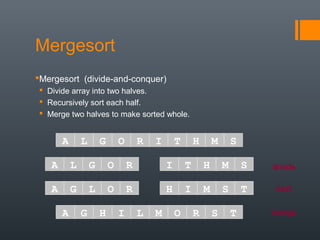
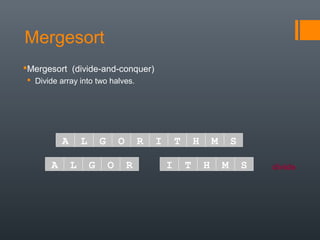
Mergesort (divide-and-conquer)
 Divide array into two halves.
A L G O R I T H M S
divideA L G O R I T H M S
Mergesort
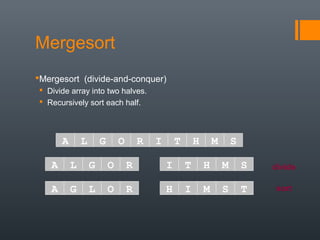
Mergesort (divide-and-conquer)
 Divide array into two halves.
 Recursively sort each half.
sort
A L G O R I T H M S
divideA L G O R I T H M S
A G L O R H I M S T
Mergesort
Mergesort (divide-and-conquer)
 Divide array into two halves.
 Recursively sort each half.
 Merge two halves to make sorted whole.
merge
sort
A L G O R I T H M S
divideA L G O R I T H M S
A G L O R H I M S T
A G H I L M O R S T
auxiliary array
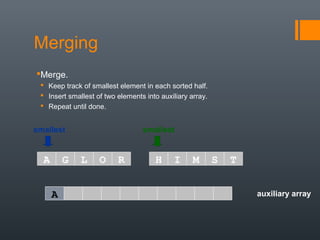
smallest smallest
A G L O R H I M S T
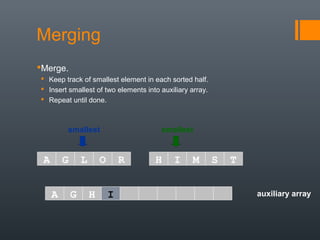
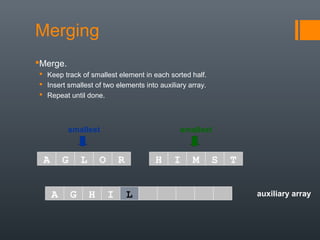
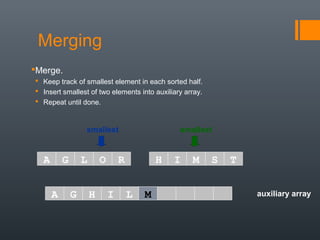
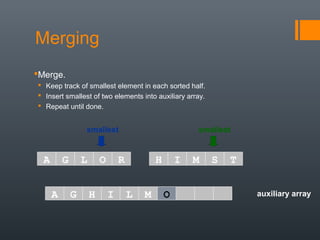
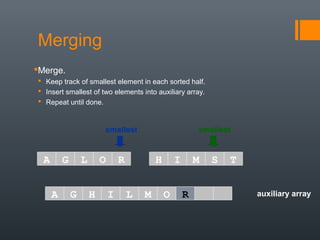
Merging
Merge.
 Keep track of smallest element in each sorted half.
 Insert smallest of two elements into auxiliary array.
 Repeat until done.
A
auxiliary array
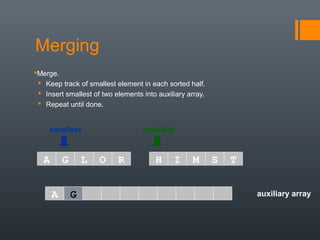
smallest smallest
A G L O R H I M S T
A
Merging
Merge.
 Keep track of smallest element in each sorted half.
 Insert smallest of two elements into auxiliary array.
 Repeat until done.
G
auxiliary array
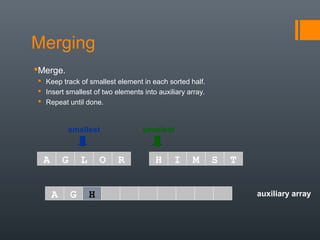
smallest smallest
A G L O R H I M S T
A G
Merging
Merge.
 Keep track of smallest element in each sorted half.
 Insert smallest of two elements into auxiliary array.
 Repeat until done.
H
auxiliary array
smallest smallest
A G L O R H I M S T
A G H
Merging
Merge.
 Keep track of smallest element in each sorted half.
 Insert smallest of two elements into auxiliary array.
 Repeat until done.
I
auxiliary array
smallest smallest
A G L O R H I M S T
A G H I
Merging
Merge.
 Keep track of smallest element in each sorted half.
 Insert smallest of two elements into auxiliary array.
 Repeat until done.
L
auxiliary array
smallest smallest
A G L O R H I M S T
A G H I L
Merging
Merge.
 Keep track of smallest element in each sorted half.
 Insert smallest of two elements into auxiliary array.
 Repeat until done.
M
auxiliary array
smallest smallest
A G L O R H I M S T
A G H I L M
Merging
Merge.
 Keep track of smallest element in each sorted half.
 Insert smallest of two elements into auxiliary array.
 Repeat until done.
O
auxiliary array
smallest smallest
A G L O R H I M S T
A G H I L M O
Merging
Merge.
 Keep track of smallest element in each sorted half.
 Insert smallest of two elements into auxiliary array.
 Repeat until done.
R
auxiliary array
first half
exhausted smallest
A G L O R H I M S T
A G H I L M O R
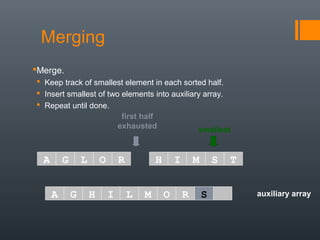
Merging
Merge.
 Keep track of smallest element in each sorted half.
 Insert smallest of two elements into auxiliary array.
 Repeat until done.
S
auxiliary array
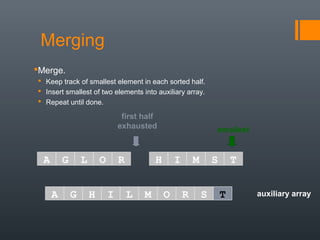
first half
exhausted smallest
A G L O R H I M S T
A G H I L M O R S
Merging
Merge.
 Keep track of smallest element in each sorted half.
 Insert smallest of two elements into auxiliary array.
 Repeat until done.
T
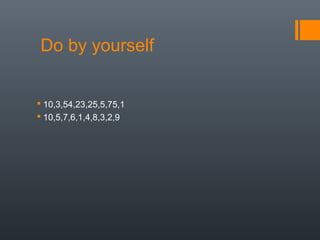
Do by yourself
 10,3,54,23,25,5,75,1
 10,5,7,6,1,4,8,3,2,9
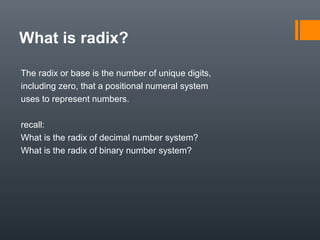
What is radix?
The radix or base is the number of unique digits,
including zero, that a positional numeral system
uses to represent numbers.
recall:
What is the radix of decimal number system?
What is the radix of binary number system?
RADIX SORT
RadixSort
•Radix = “The base of a number system”
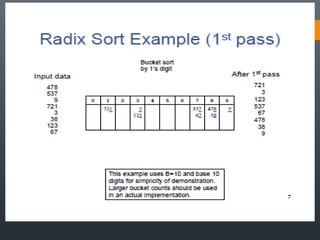
•Idea: Bucket Sort on each digit, bottom up.
17
What is a Radix?
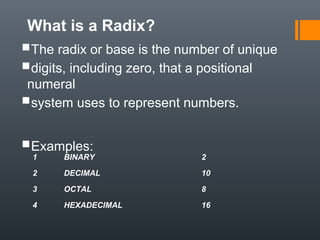
What is a Radix?
The radix or base is the number of unique
digits, including zero, that a positional
numeral
system uses to represent numbers.
Examples:
1 BINARY 2
2 DECIMAL 10
3 OCTAL 8
4 HEXADECIMAL 16
RADIX SORT
• non - comparative sorting algorithm (the
keys are not compared as such)
• sorts the keys by soring individual digits of
the keys which share the same significant
position and value
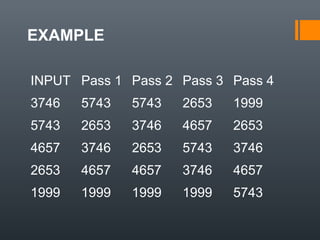
EXAMPLE
INPUT Pass 1 Pass 2 Pass 3 Pass 4
3746 5743 5743 2653 1999
5743 2653 3746 4657 2653
4657 3746 2653 5743 3746
2653 4657 4657 3746 4657
1999 1999 1999 1999 5743
RADIX SORT - PSEUDO CODE
void radixsort()
{
 max = A[0], exp = 1;
 for (i = 0; i < n; i++) { if (A[i] > max) max = A[i]; }

 while (max / exp > 0)
 {
 for (i=0; i<=9; i++) bucket [ i ] =0;
 for (i = 0; i < n; i++) bucket [ A[i] / exp % 10 ]++;
 for (i = 1; i <=9; i++) bucket [ i ] += bucket [i - 1];
 for (i = n-1; i >= 0; i--) B [--bucket[A[i] / exp % 10]] =
A[i];
 for (i = 0; i < n; i++) A [ i ] = B [ i ];
Radix Sort
A[0], A[1], …, A[N-1] are strings
Very common in practice
Each string is:
cd-1cd-2…c1c0,
where c0, c1, …, cd-1 ∈{0, 1, …, M-1}
M = 128
Other example: decimal numbers
27
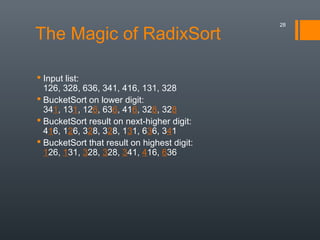
The Magic of RadixSort
 Input list:
126, 328, 636, 341, 416, 131, 328
 BucketSort on lower digit:
341, 131, 126, 636, 416, 328, 328
 BucketSort result on next-higher digit:
416, 126, 328, 328, 131, 636, 341
 BucketSort that result on highest digit:
126, 131, 328, 328, 341, 416, 636
28
Radix Sort 29
35 53 55 33 52 32 25
Q[0] Q[1] Q[2] Q[3] Q[4] Q[5] Q[6] Q[7] Q[8] Q[9]
53 33 35 55 25
52 32 53 33 35 55 25
52 32
Q[0] Q[1] Q[2] Q[3] Q[4] Q[5] Q[6] Q[7] Q[8] Q[9]
32 33 3525 52 53 55
25 32 33 35 52 53 55
A=
A=
A=
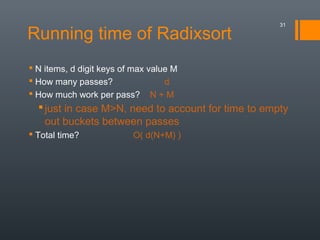
Running time of Radixsort
 N items, d digit keys of max value M
 How many passes?
 How much work per pass?
 Total time?
30
Running time of Radixsort
 N items, d digit keys of max value M
 How many passes? d
 How much work per pass? N + M
just in case M>N, need to account for time to empty
out buckets between passes
 Total time? O( d(N+M) )
31
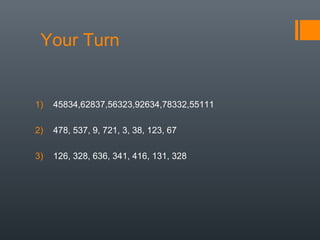
Your Turn
1) 45834,62837,56323,92634,78332,55111
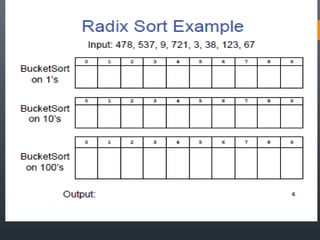
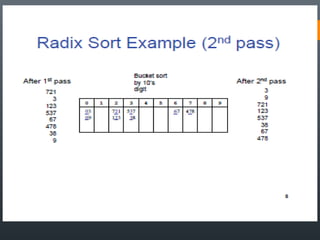
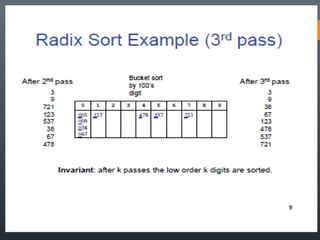
2) 478, 537, 9, 721, 3, 38, 123, 67
3) 126, 328, 636, 341, 416, 131, 328
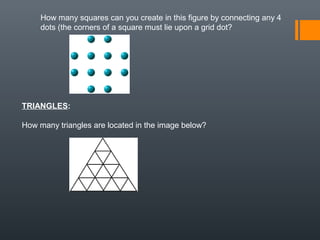
How many squares can you create in this figure by connecting any 4
dots (the corners of a square must lie upon a grid dot?
TRIANGLES:
How many triangles are located in the image below?
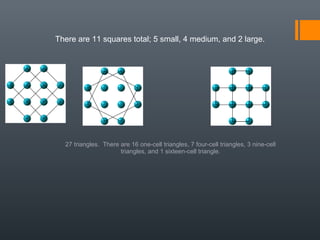
There are 11 squares total; 5 small, 4 medium, and 2 large.
27 triangles. There are 16 one-cell triangles, 7 four-cell triangles, 3 nine-cell
triangles, and 1 sixteen-cell triangle.
GUIDED READING
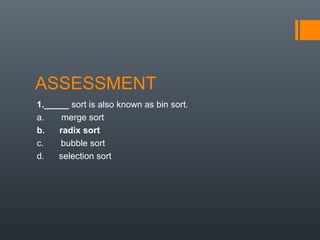
ASSESSMENT
1._____ sort is also known as bin sort.
a. merge sort
b. radix sort
c. bubble sort
d. selection sort
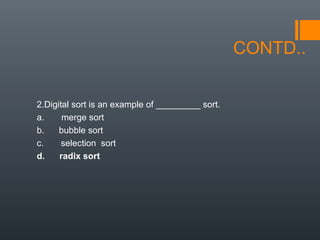
CONTD..
2.Digital sort is an example of _________ sort.
a. merge sort
b. bubble sort
c. selection sort
d. radix sort
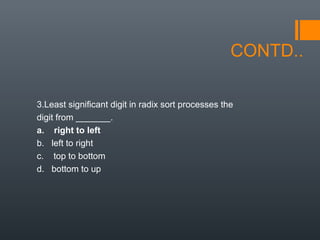
CONTD..
3.Least significant digit in radix sort processes the
digit from _______.
a. right to left
b. left to right
c. top to bottom
d. bottom to up

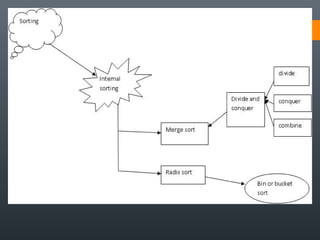
3.5 merge sort

  • 1.
    Mergesort Mergesort (divide-and-conquer)  Dividearray into two halves. A L G O R I T H M S divideA L G O R I T H M S
  • 2.
    Mergesort Mergesort (divide-and-conquer)  Dividearray into two halves.  Recursively sort each half. sort A L G O R I T H M S divideA L G O R I T H M S A G L O R H I M S T
  • 3.
    Mergesort Mergesort (divide-and-conquer)  Dividearray into two halves.  Recursively sort each half.  Merge two halves to make sorted whole. merge sort A L G O R I T H M S divideA L G O R I T H M S A G L O R H I M S T A G H I L M O R S T
  • 4.
    auxiliary array smallest smallest AG L O R H I M S T Merging Merge.  Keep track of smallest element in each sorted half.  Insert smallest of two elements into auxiliary array.  Repeat until done. A
  • 5.
    auxiliary array smallest smallest AG L O R H I M S T A Merging Merge.  Keep track of smallest element in each sorted half.  Insert smallest of two elements into auxiliary array.  Repeat until done. G
  • 6.
    auxiliary array smallest smallest AG L O R H I M S T A G Merging Merge.  Keep track of smallest element in each sorted half.  Insert smallest of two elements into auxiliary array.  Repeat until done. H
  • 7.
    auxiliary array smallest smallest AG L O R H I M S T A G H Merging Merge.  Keep track of smallest element in each sorted half.  Insert smallest of two elements into auxiliary array.  Repeat until done. I
  • 8.
    auxiliary array smallest smallest AG L O R H I M S T A G H I Merging Merge.  Keep track of smallest element in each sorted half.  Insert smallest of two elements into auxiliary array.  Repeat until done. L
  • 9.
    auxiliary array smallest smallest AG L O R H I M S T A G H I L Merging Merge.  Keep track of smallest element in each sorted half.  Insert smallest of two elements into auxiliary array.  Repeat until done. M
  • 10.
    auxiliary array smallest smallest AG L O R H I M S T A G H I L M Merging Merge.  Keep track of smallest element in each sorted half.  Insert smallest of two elements into auxiliary array.  Repeat until done. O
  • 11.
    auxiliary array smallest smallest AG L O R H I M S T A G H I L M O Merging Merge.  Keep track of smallest element in each sorted half.  Insert smallest of two elements into auxiliary array.  Repeat until done. R
  • 12.
    auxiliary array first half exhaustedsmallest A G L O R H I M S T A G H I L M O R Merging Merge.  Keep track of smallest element in each sorted half.  Insert smallest of two elements into auxiliary array.  Repeat until done. S
  • 13.
    auxiliary array first half exhaustedsmallest A G L O R H I M S T A G H I L M O R S Merging Merge.  Keep track of smallest element in each sorted half.  Insert smallest of two elements into auxiliary array.  Repeat until done. T
  • 14.
    Do by yourself 10,3,54,23,25,5,75,1  10,5,7,6,1,4,8,3,2,9
  • 15.
    What is radix? Theradix or base is the number of unique digits, including zero, that a positional numeral system uses to represent numbers. recall: What is the radix of decimal number system? What is the radix of binary number system?
  • 16.
  • 17.
    RadixSort •Radix = “Thebase of a number system” •Idea: Bucket Sort on each digit, bottom up. 17
  • 18.
    What is aRadix?
  • 19.
    What is aRadix? The radix or base is the number of unique digits, including zero, that a positional numeral system uses to represent numbers. Examples: 1 BINARY 2 2 DECIMAL 10 3 OCTAL 8 4 HEXADECIMAL 16
  • 20.
    RADIX SORT • non- comparative sorting algorithm (the keys are not compared as such) • sorts the keys by soring individual digits of the keys which share the same significant position and value
  • 21.
    EXAMPLE INPUT Pass 1Pass 2 Pass 3 Pass 4 3746 5743 5743 2653 1999 5743 2653 3746 4657 2653 4657 3746 2653 5743 3746 2653 4657 4657 3746 4657 1999 1999 1999 1999 5743
  • 22.
    RADIX SORT -PSEUDO CODE void radixsort() {  max = A[0], exp = 1;  for (i = 0; i < n; i++) { if (A[i] > max) max = A[i]; }   while (max / exp > 0)  {  for (i=0; i<=9; i++) bucket [ i ] =0;  for (i = 0; i < n; i++) bucket [ A[i] / exp % 10 ]++;  for (i = 1; i <=9; i++) bucket [ i ] += bucket [i - 1];  for (i = n-1; i >= 0; i--) B [--bucket[A[i] / exp % 10]] = A[i];  for (i = 0; i < n; i++) A [ i ] = B [ i ];
  • 27.
    Radix Sort A[0], A[1],…, A[N-1] are strings Very common in practice Each string is: cd-1cd-2…c1c0, where c0, c1, …, cd-1 ∈{0, 1, …, M-1} M = 128 Other example: decimal numbers 27
  • 28.
    The Magic ofRadixSort  Input list: 126, 328, 636, 341, 416, 131, 328  BucketSort on lower digit: 341, 131, 126, 636, 416, 328, 328  BucketSort result on next-higher digit: 416, 126, 328, 328, 131, 636, 341  BucketSort that result on highest digit: 126, 131, 328, 328, 341, 416, 636 28
  • 29.
    Radix Sort 29 3553 55 33 52 32 25 Q[0] Q[1] Q[2] Q[3] Q[4] Q[5] Q[6] Q[7] Q[8] Q[9] 53 33 35 55 25 52 32 53 33 35 55 25 52 32 Q[0] Q[1] Q[2] Q[3] Q[4] Q[5] Q[6] Q[7] Q[8] Q[9] 32 33 3525 52 53 55 25 32 33 35 52 53 55 A= A= A=
  • 30.
    Running time ofRadixsort  N items, d digit keys of max value M  How many passes?  How much work per pass?  Total time? 30
  • 31.
    Running time ofRadixsort  N items, d digit keys of max value M  How many passes? d  How much work per pass? N + M just in case M>N, need to account for time to empty out buckets between passes  Total time? O( d(N+M) ) 31
  • 32.
    Your Turn 1) 45834,62837,56323,92634,78332,55111 2)478, 537, 9, 721, 3, 38, 123, 67 3) 126, 328, 636, 341, 416, 131, 328
  • 33.
    How many squarescan you create in this figure by connecting any 4 dots (the corners of a square must lie upon a grid dot? TRIANGLES: How many triangles are located in the image below?
  • 34.
    There are 11squares total; 5 small, 4 medium, and 2 large. 27 triangles. There are 16 one-cell triangles, 7 four-cell triangles, 3 nine-cell triangles, and 1 sixteen-cell triangle.
  • 35.
  • 37.
    ASSESSMENT 1._____ sort isalso known as bin sort. a. merge sort b. radix sort c. bubble sort d. selection sort
  • 38.
    CONTD.. 2.Digital sort isan example of _________ sort. a. merge sort b. bubble sort c. selection sort d. radix sort
  • 39.
    CONTD.. 3.Least significant digitin radix sort processes the digit from _______. a. right to left b. left to right c. top to bottom d. bottom to up