ANKIT S. CHITNAVIS
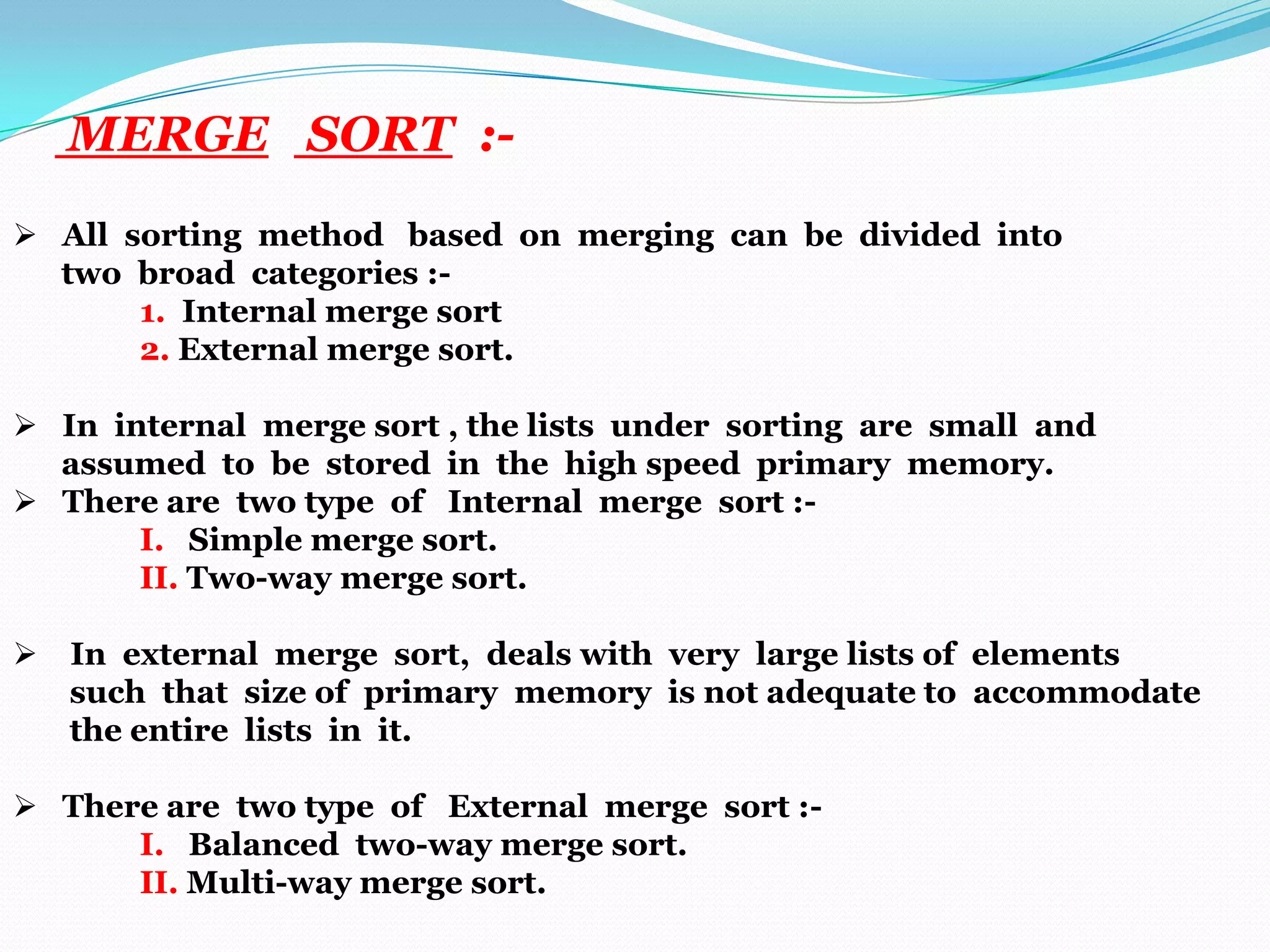
MERGE SORT : All sorting method based on merging can be divided into
two broad categories :1. Internal merge sort
2. External merge sort.
 In internal merge sort , the lists under sorting are small and
assumed to be stored in the high speed primary memory.
 There are two type of Internal merge sort :I. Simple merge sort.
II. Two-way merge sort.


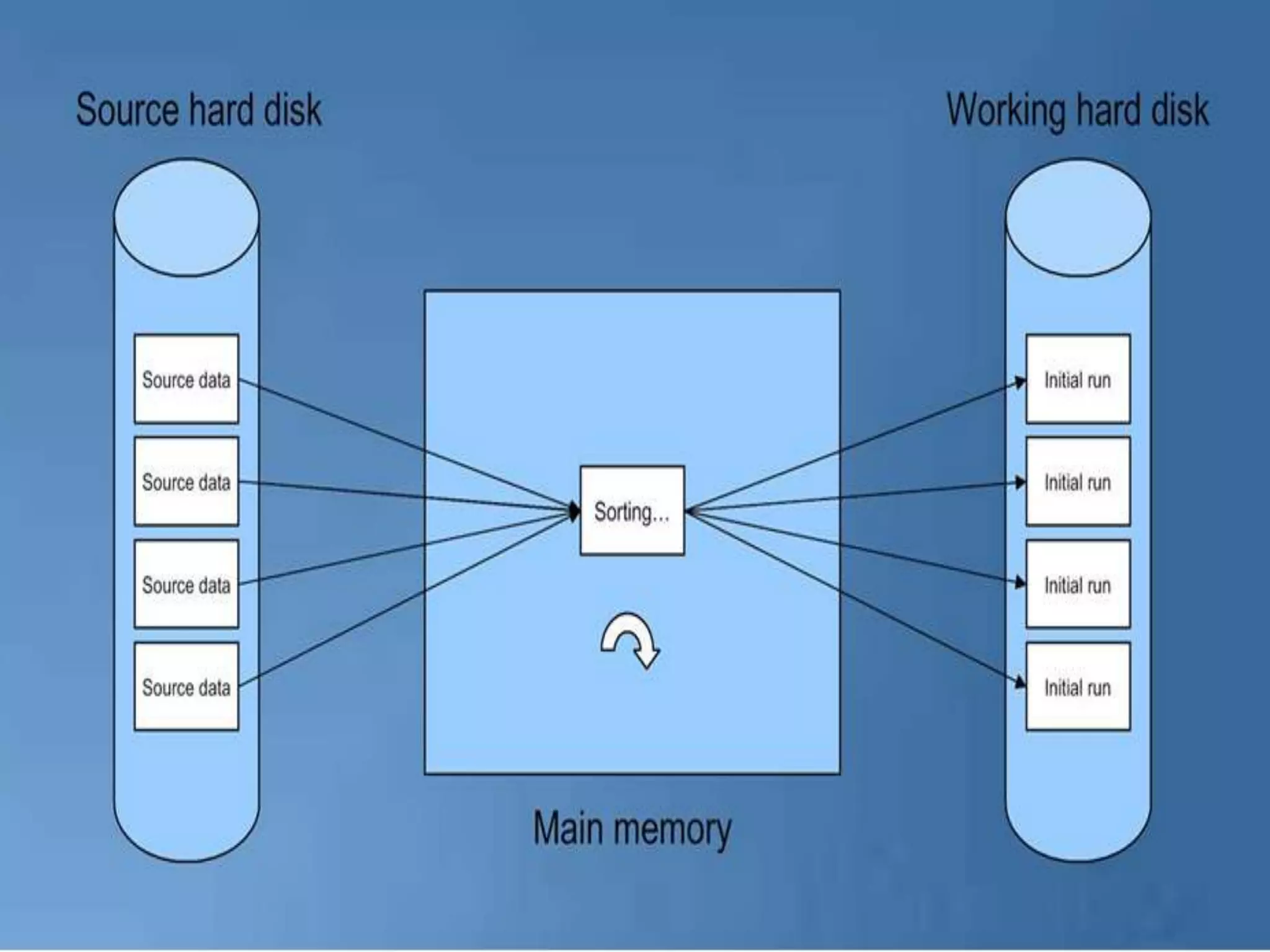
In external merge sort, deals with very large lists of elements
such that size of primary memory is not adequate to accommodate
the entire lists in it.

 There are two type of External merge sort :I. Balanced two-way merge sort.
II. Multi-way merge sort.
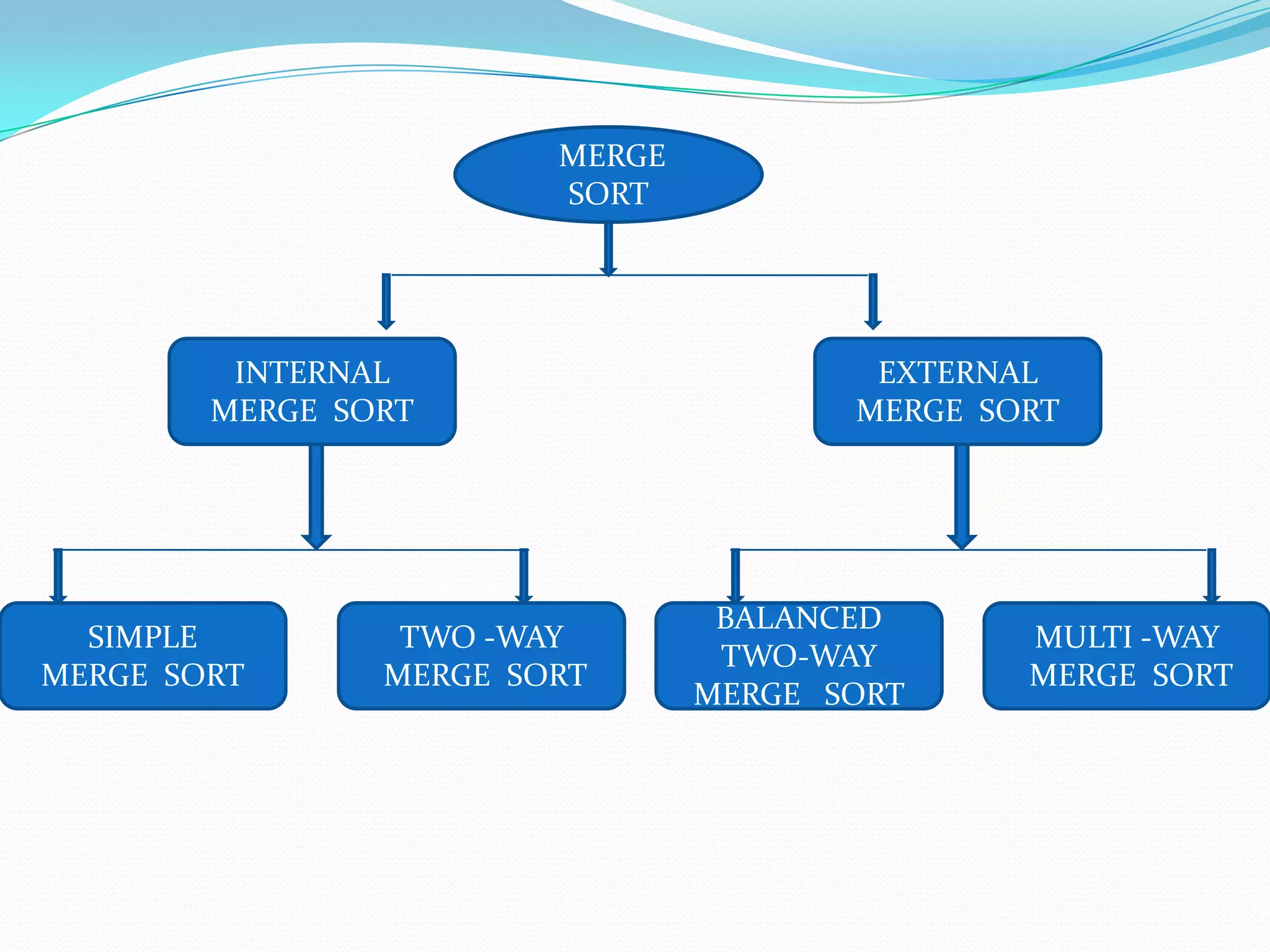
MERGE
SORT

INTERNAL
MERGE SORT

SIMPLE
MERGE SORT

TWO -WAY
MERGE SORT

EXTERNAL
MERGE SORT

BALANCED
TWO-WAY
MERGE SORT

MULTI -WAY
MERGE SORT
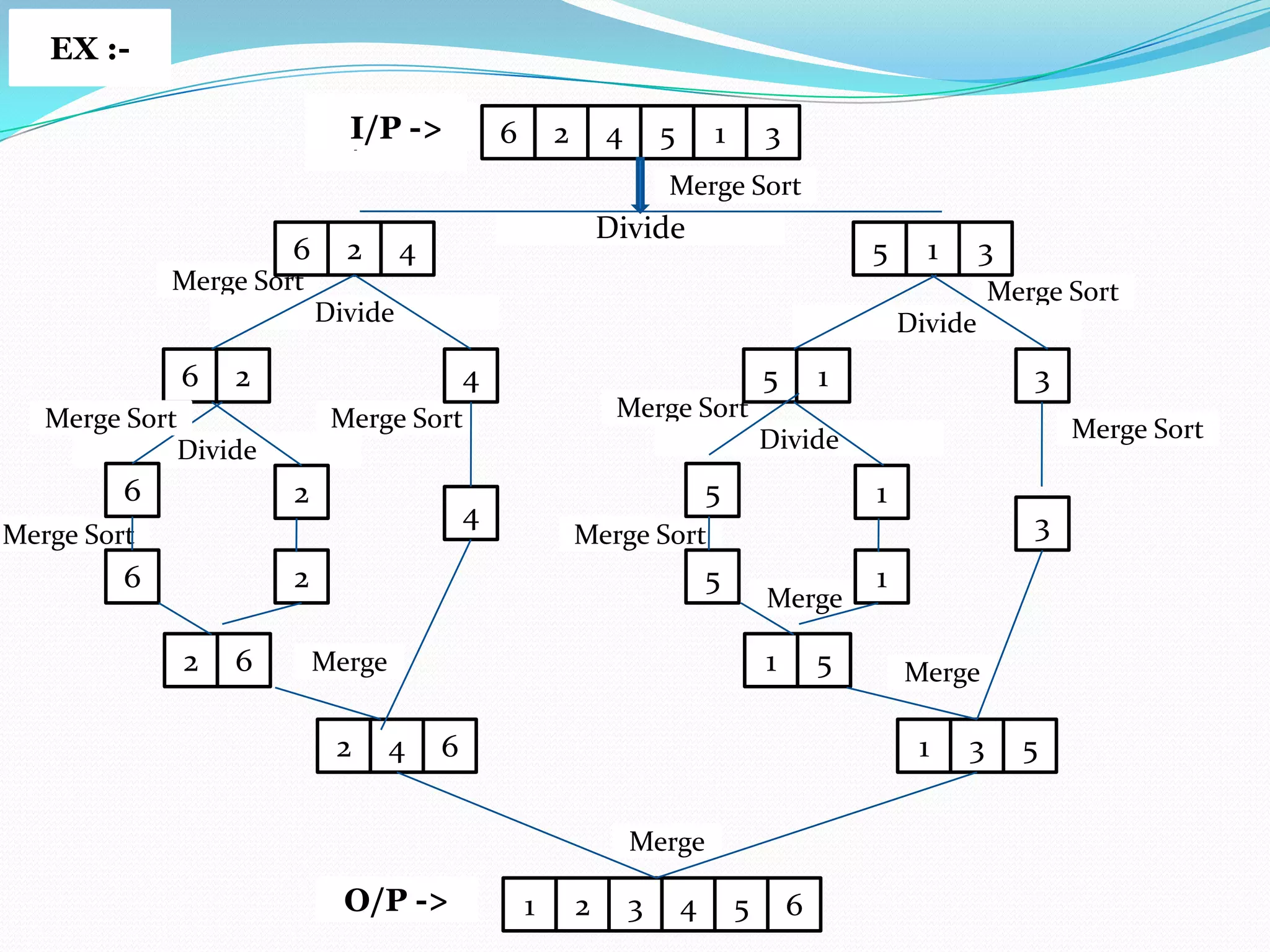
SIMPLE MERGE SORT : The simple merge sort (or merge sort) technique closely follows the
divide –and-conqure paradigm.
 let a list of n elements to be sorted with l and r being the position
of leftmost and rightmost element in the list.
 The three tasks in this divided-and-conqure technique are as
followed :-

[

]

1. Divide :- Partition the list midway ,that is ,at (l+r)/2 into two
sub lists with (n/2) elements in each, if n is even or
[n/2] and [n/2]-1 element if n is odd .
2. Conquer :- Sort the two lists recursively using the merge sort.
3. Combine :- Merge the sort sub listed to obtain the sorted output.
Combine

Conqure

Divide

l

r
.........................................................................
.
[(l+r)/2]
.................................. ..................................
.
.

Sort this left-part by merge sort Sort this right-part by merge sort

...................................

...................................

Merge the two list

Sorted List

Fig. Divide-and-conqure strategy in the merge
sort
EX :I/P ->
I/P ->

6

2

4

5

1

3

Merge Sort

6

2

Divide

4

5

1

3

Merge Sort

Merge Sort

Divide

6

Divide

2

4

Merge Sort
Divide

6

5

6

1

5

Merge

1

Merge

2

4

5

6

3

1
Merge

1
Merge

O/P ->

Merge Sort

Merge Sort

2
2

3

Divide

4

Merge Sort

1

Merge Sort

Merge Sort

2

6

5

1

2

3

4

5

6

3

5
Algorithm Merge sort
Input :- An array A[l…r] where l and r are the lower and upper index
of A.
Output :- Array a[l…r] with all element arranged in ascending order .
Steps:
1. if(r<=l) then
2.
Return
3. else
4.
Mid=[(l+r)/2]
5.
MergeSort(A[l…mid])
6.
MergeSort(A[mid+1…r])
7.
Merge(A,L,mid,r)
8. Endif
9. Stop
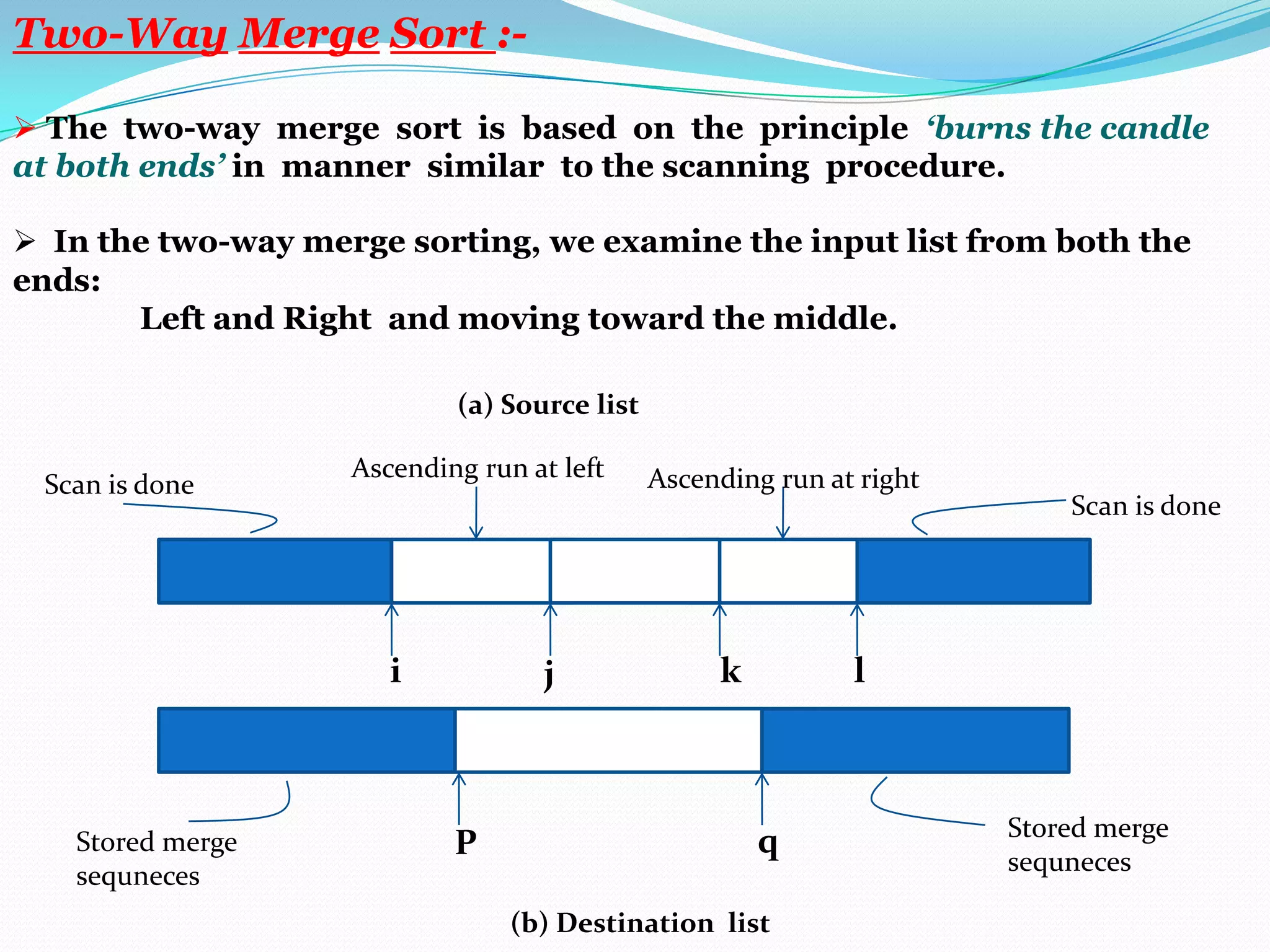
Two-Way Merge Sort : The two-way merge sort is based on the principle ‘burns the candle
at both ends’ in manner similar to the scanning procedure.
 In the two-way merge sorting, we examine the input list from both the
ends:
Left and Right and moving toward the middle.
(a) Source list

Scan is done

Ascending run at left

i

Stored merge
sequneces

j

P

Ascending run at right

k

Scan is done

l

q
(b) Destination list

Stored merge
sequneces
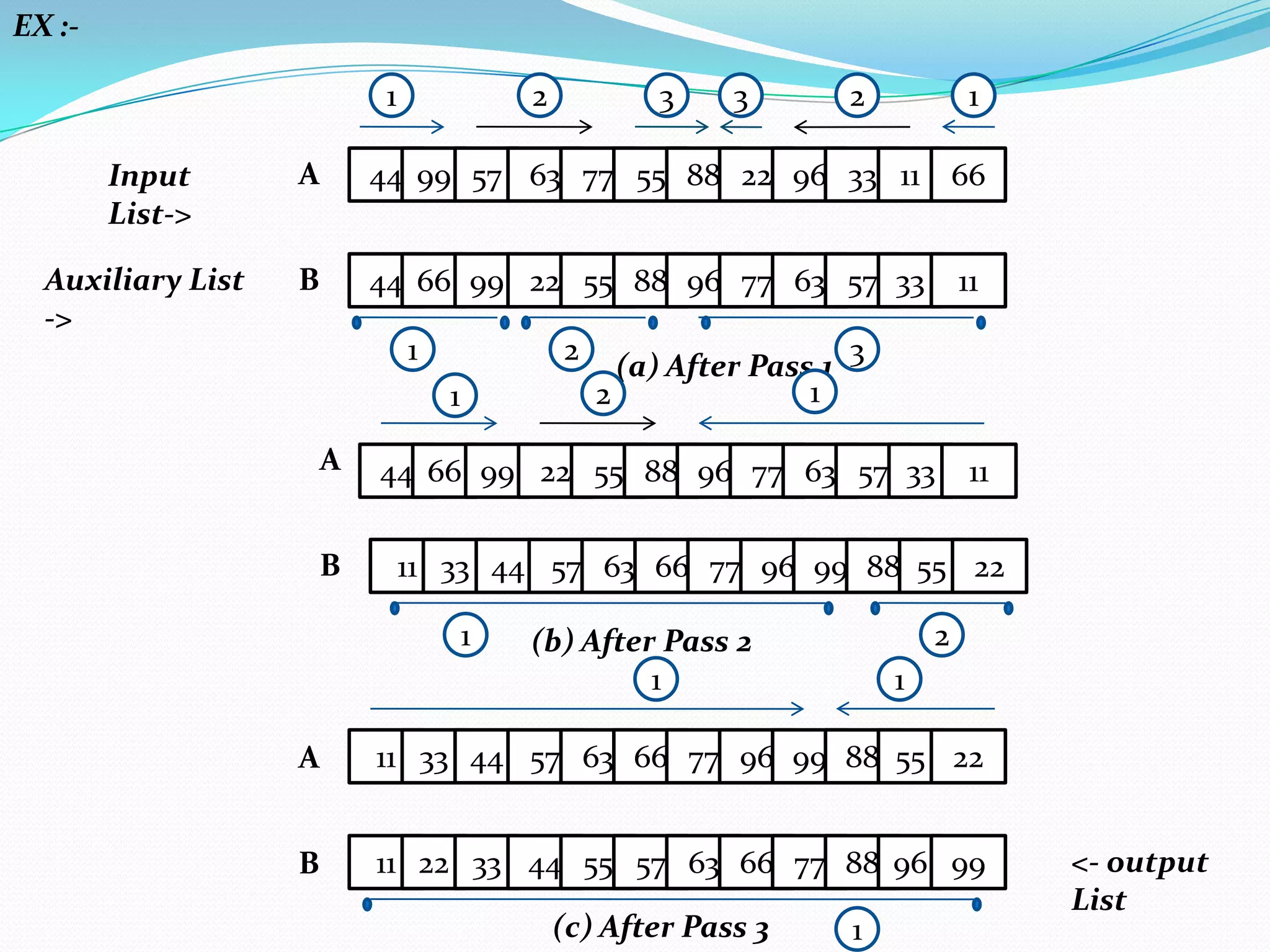
EX :-

1

2

3

3

2

1

Input
List->

A

44 99 57 63 77 55 88 22 96 33 11 66

Auxiliary List
->

B

44 66 99 22 55 88 96 77 63 57 33
1

2
1

A
B

(a) After Pass 1
1
2

11

3

44 66 99 22 55 88 96 77 63 57 33

11

11 33 44 57 63 66 77 96 99 88 55 22
1

2

(b) After Pass 2
1

1

A

11 33 44 57 63 66 77 96 99 88 55 22

B

11 22 33 44 55 57 63 66 77 88 96 99
(c) After Pass 3

1

<- output
List
BALANCED TOW-WAY MERGE SORT :-

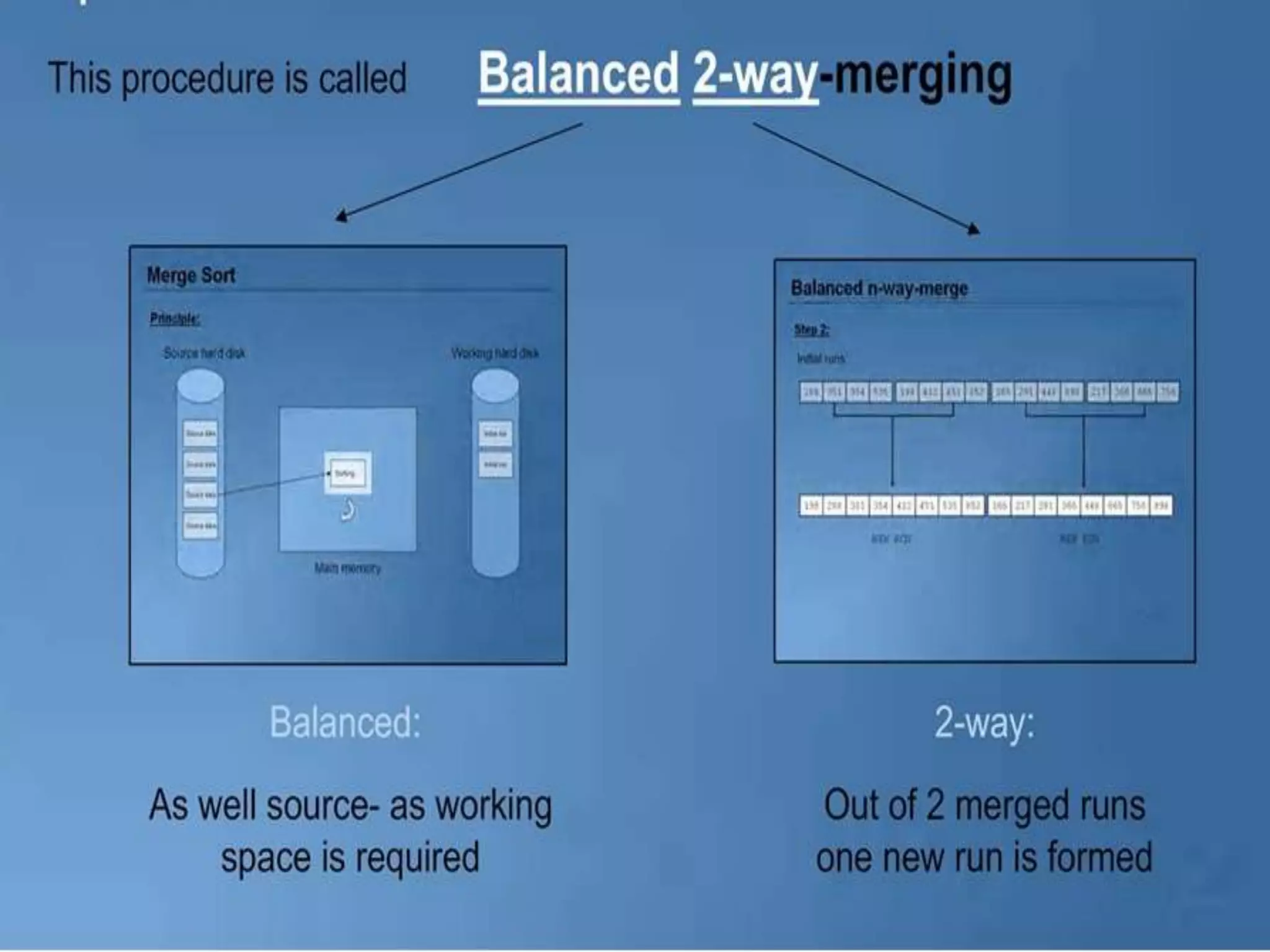
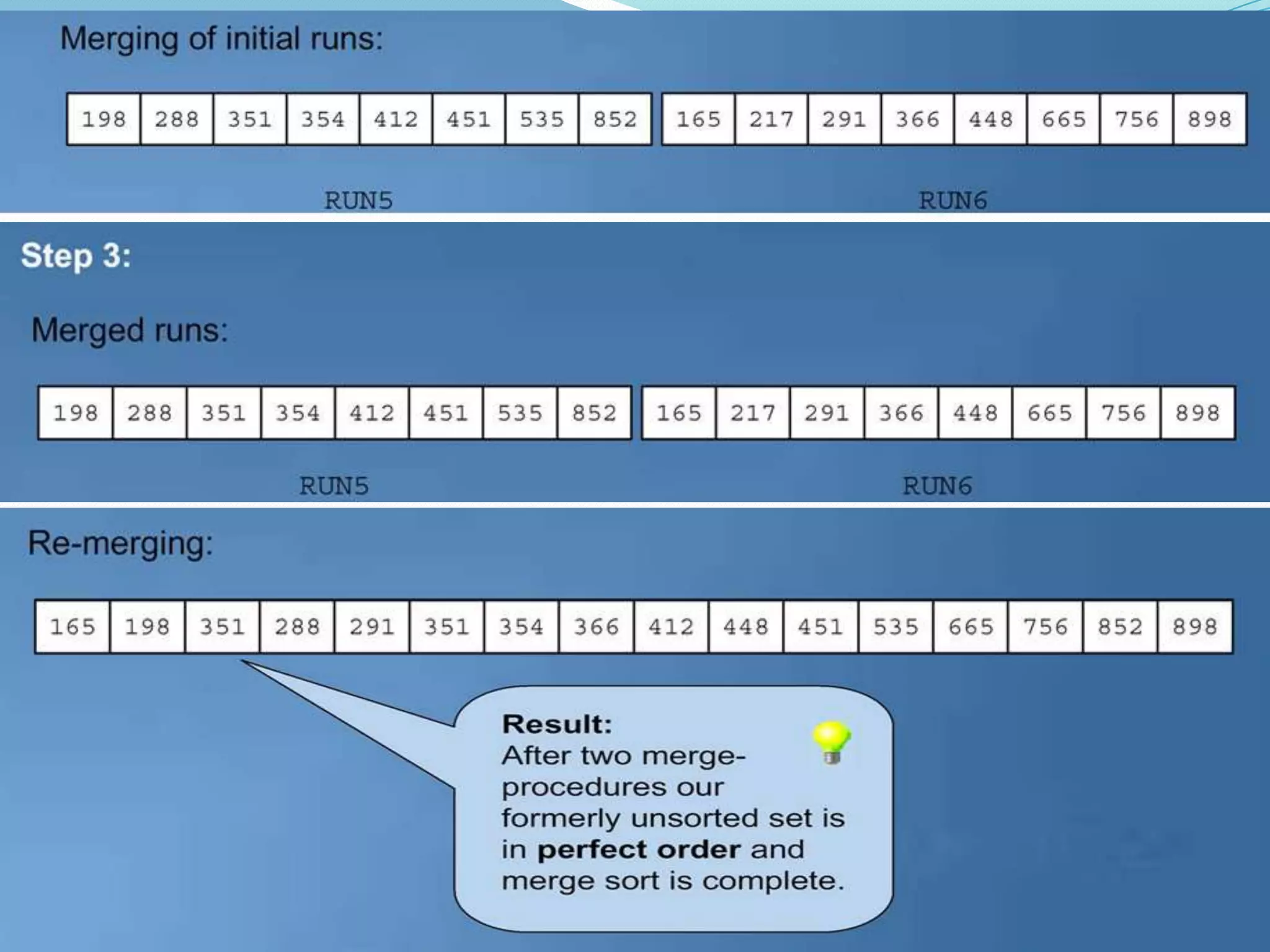
 The balanced two-way merge is based on combining two ascending runs
into a single ascending run.
The merging-procedure can be applied to more than two runs at
each time.
 That why it is two way merging.
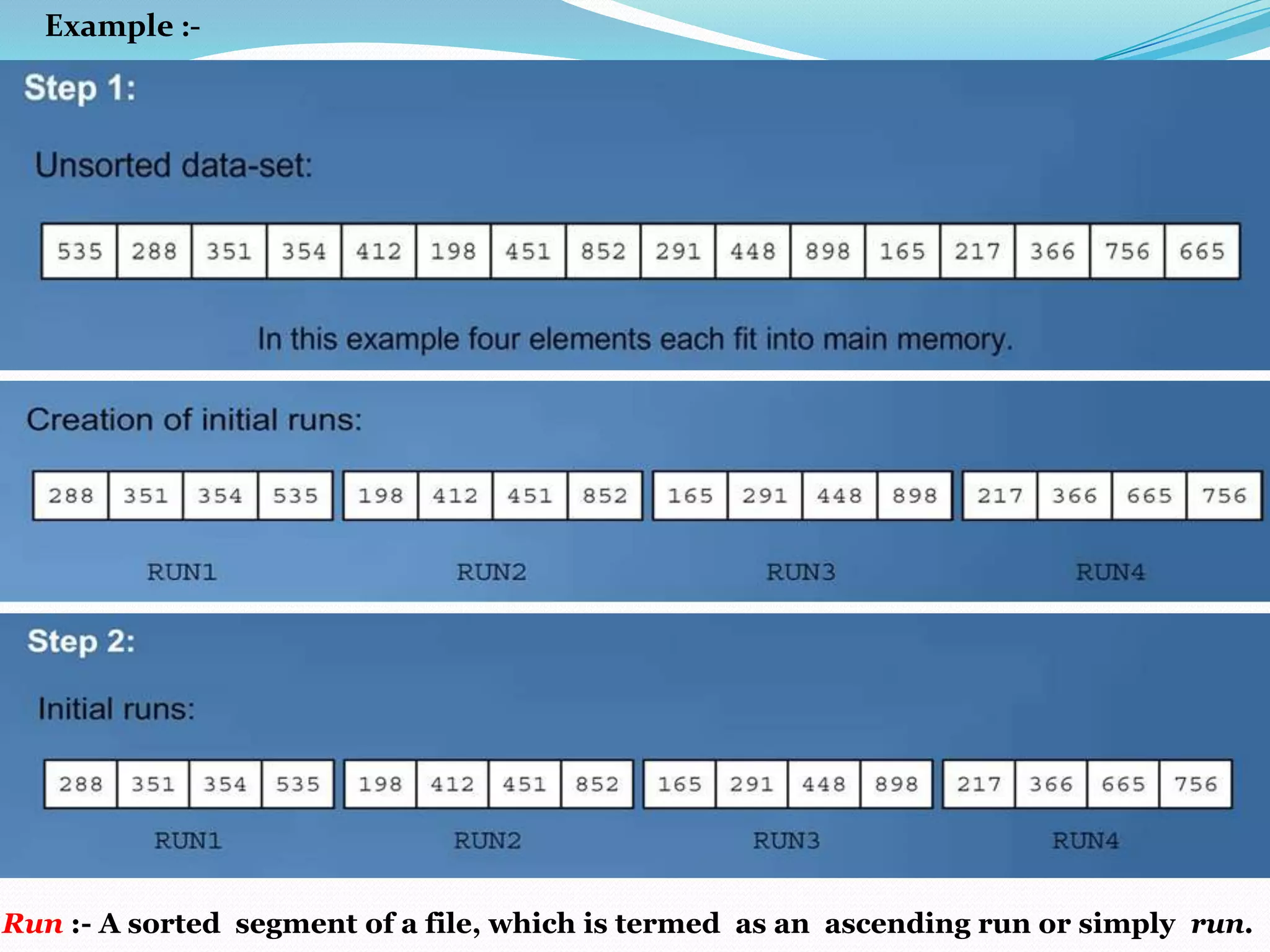
 In external balanced two-way merge all intial intial runs of equal
length possibly not the last run.
 This why the ‘ balanced’ tag is used in this technique.
Example :-

Run :- A sorted segment of a file, which is termed as an ascending run or simply run.
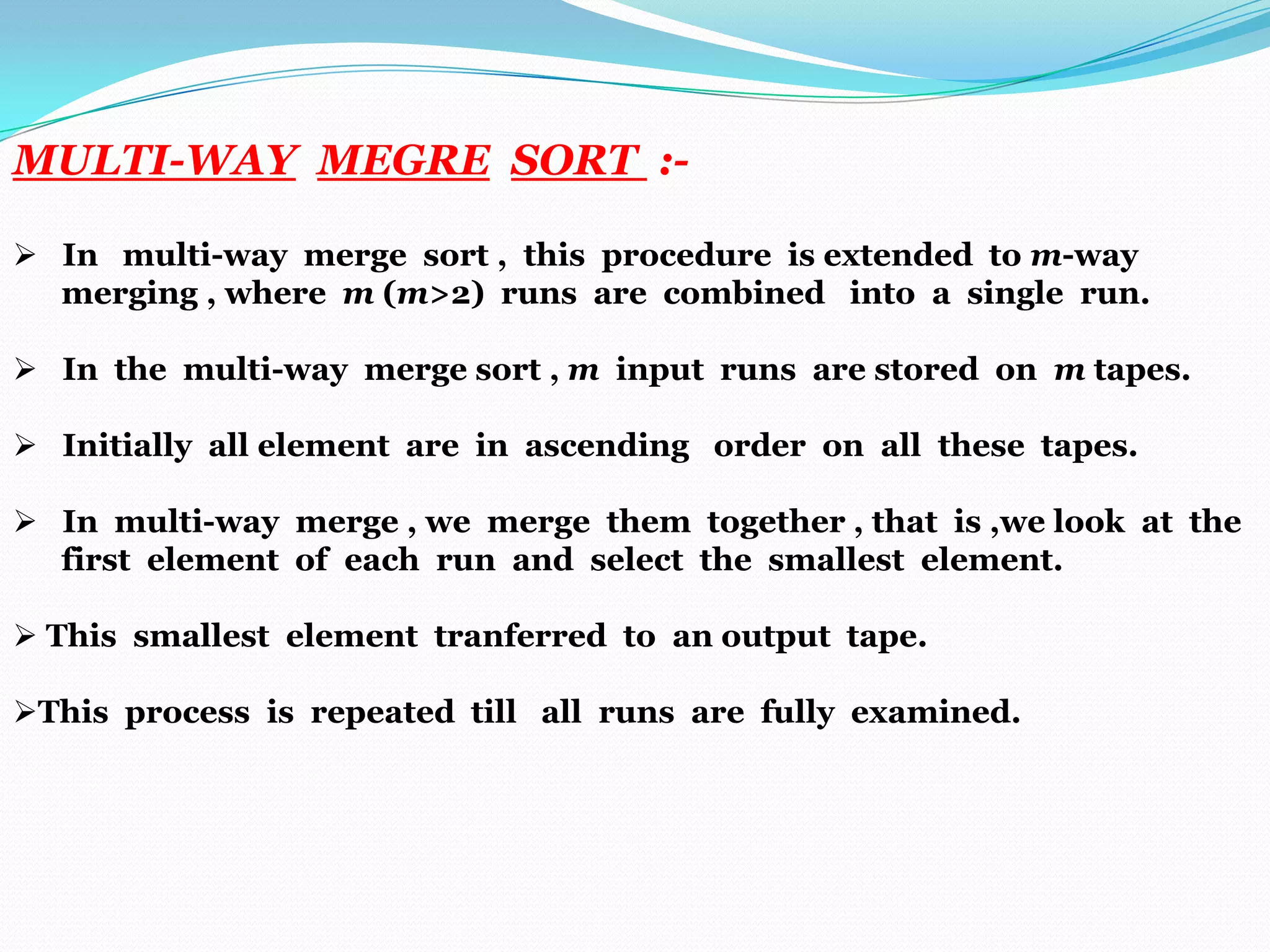
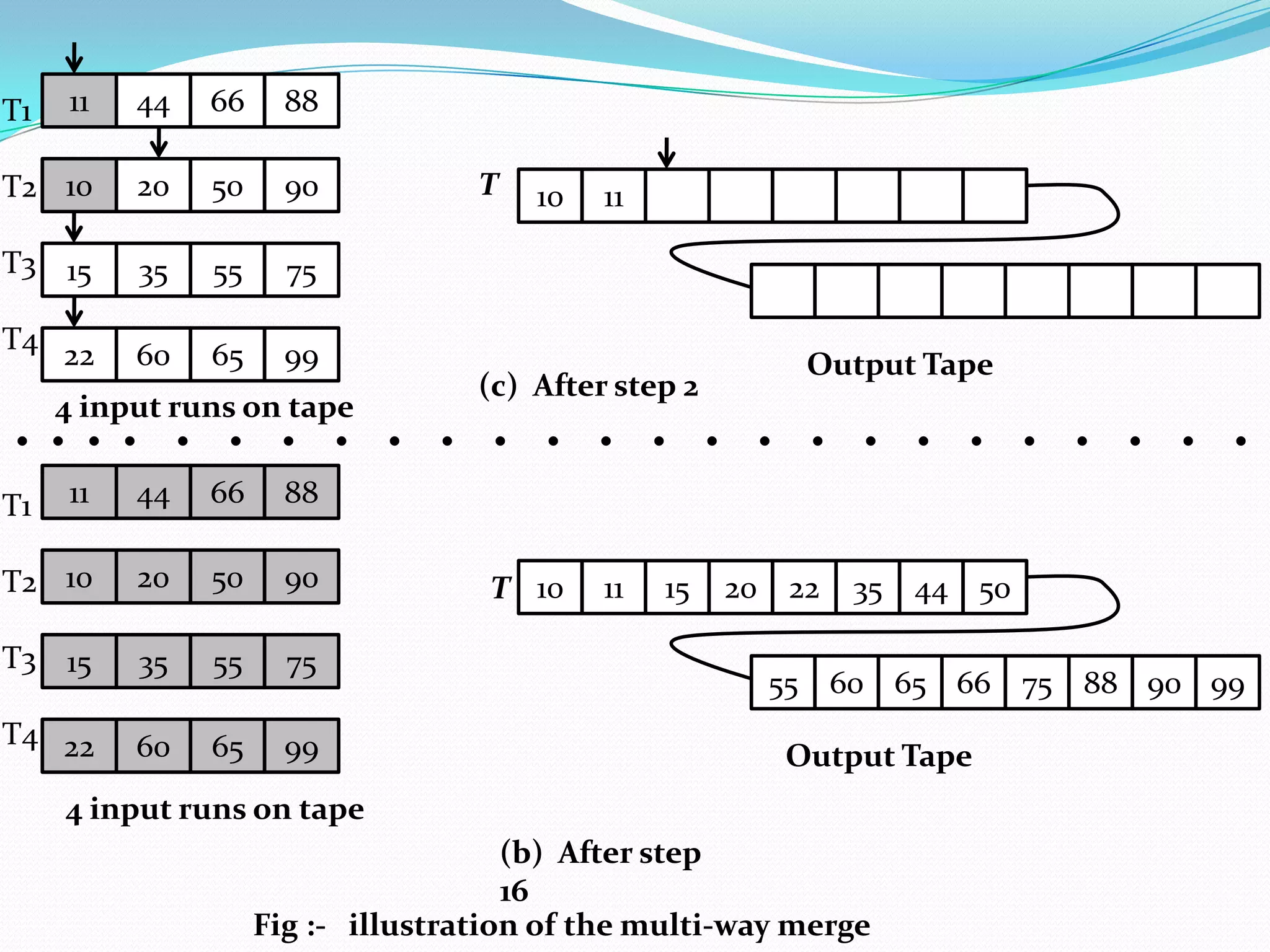
MULTI-WAY MEGRE SORT : In multi-way merge sort , this procedure is extended to m-way
merging , where m (m>2) runs are combined into a single run.
 In the multi-way merge sort , m input runs are stored on m tapes.
 Initially all element are in ascending order on all these tapes.
 In multi-way merge , we merge them together , that is ,we look at the
first element of each run and select the smallest element.
 This smallest element tranferred to an output tape.
This process is repeated till all runs are fully examined.
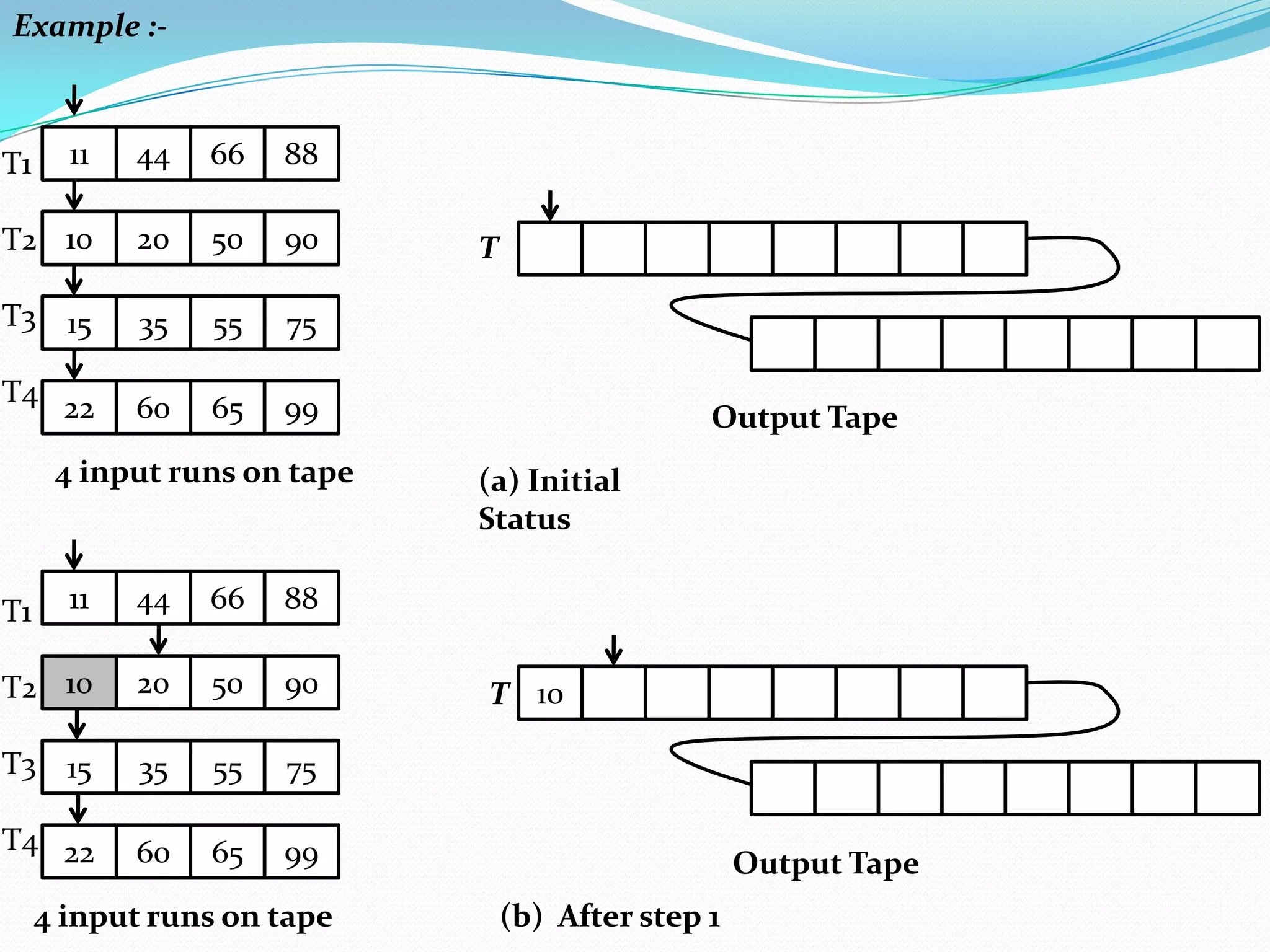
Example :-

11

44

66

88

T2 10

20

50

90

T3 15

35

55

75

T4 22

60

65

99

T1

4 input runs on tape

11

44

66

20

50

90

T3 15

35

55

60

65

(a) Initial
Status

75

T4 22

Output Tape

88

T2 10

T

99

T1

4 input runs on tape

T 10

Output Tape

(b) After step 1
11

44

66

88

T2 10

20

50

90

T3 15

35

55

75

T4 22

60

65

99

T1

T

10

11

Output Tape

(c) After step 2

.... . . . . . . . . . . . . . . . . . . . . .
4 input runs on tape
11

44

66

88

T2 10

20

50

90

T3 15

35

55

75

T4 22

60

65

99

T1

T 10

11

15

20

22

35

44 50

55 60 65 66 75 88 90 99

Output Tape

4 input runs on tape
(b) After step
16
Fig :- illustration of the multi-way merge
THANK
YOU

Marge Sort

  • 1.
  • 2.
    MERGE SORT :All sorting method based on merging can be divided into two broad categories :1. Internal merge sort 2. External merge sort.  In internal merge sort , the lists under sorting are small and assumed to be stored in the high speed primary memory.  There are two type of Internal merge sort :I. Simple merge sort. II. Two-way merge sort.  In external merge sort, deals with very large lists of elements such that size of primary memory is not adequate to accommodate the entire lists in it.  There are two type of External merge sort :I. Balanced two-way merge sort. II. Multi-way merge sort.
  • 3.
    MERGE SORT INTERNAL MERGE SORT SIMPLE MERGE SORT TWO-WAY MERGE SORT EXTERNAL MERGE SORT BALANCED TWO-WAY MERGE SORT MULTI -WAY MERGE SORT
  • 5.
    SIMPLE MERGE SORT: The simple merge sort (or merge sort) technique closely follows the divide –and-conqure paradigm.  let a list of n elements to be sorted with l and r being the position of leftmost and rightmost element in the list.  The three tasks in this divided-and-conqure technique are as followed :- [ ] 1. Divide :- Partition the list midway ,that is ,at (l+r)/2 into two sub lists with (n/2) elements in each, if n is even or [n/2] and [n/2]-1 element if n is odd . 2. Conquer :- Sort the two lists recursively using the merge sort. 3. Combine :- Merge the sort sub listed to obtain the sorted output.
  • 6.
    Combine Conqure Divide l r ......................................................................... . [(l+r)/2] .................................. .................................. . . Sort thisleft-part by merge sort Sort this right-part by merge sort ................................... ................................... Merge the two list Sorted List Fig. Divide-and-conqure strategy in the merge sort
  • 7.
    EX :I/P -> I/P-> 6 2 4 5 1 3 Merge Sort 6 2 Divide 4 5 1 3 Merge Sort Merge Sort Divide 6 Divide 2 4 Merge Sort Divide 6 5 6 1 5 Merge 1 Merge 2 4 5 6 3 1 Merge 1 Merge O/P -> Merge Sort Merge Sort 2 2 3 Divide 4 Merge Sort 1 Merge Sort Merge Sort 2 6 5 1 2 3 4 5 6 3 5
  • 8.
    Algorithm Merge sort Input:- An array A[l…r] where l and r are the lower and upper index of A. Output :- Array a[l…r] with all element arranged in ascending order . Steps: 1. if(r<=l) then 2. Return 3. else 4. Mid=[(l+r)/2] 5. MergeSort(A[l…mid]) 6. MergeSort(A[mid+1…r]) 7. Merge(A,L,mid,r) 8. Endif 9. Stop
  • 9.
    Two-Way Merge Sort: The two-way merge sort is based on the principle ‘burns the candle at both ends’ in manner similar to the scanning procedure.  In the two-way merge sorting, we examine the input list from both the ends: Left and Right and moving toward the middle. (a) Source list Scan is done Ascending run at left i Stored merge sequneces j P Ascending run at right k Scan is done l q (b) Destination list Stored merge sequneces
  • 10.
    EX :- 1 2 3 3 2 1 Input List-> A 44 9957 63 77 55 88 22 96 33 11 66 Auxiliary List -> B 44 66 99 22 55 88 96 77 63 57 33 1 2 1 A B (a) After Pass 1 1 2 11 3 44 66 99 22 55 88 96 77 63 57 33 11 11 33 44 57 63 66 77 96 99 88 55 22 1 2 (b) After Pass 2 1 1 A 11 33 44 57 63 66 77 96 99 88 55 22 B 11 22 33 44 55 57 63 66 77 88 96 99 (c) After Pass 3 1 <- output List
  • 11.
    BALANCED TOW-WAY MERGESORT :-  The balanced two-way merge is based on combining two ascending runs into a single ascending run. The merging-procedure can be applied to more than two runs at each time.  That why it is two way merging.  In external balanced two-way merge all intial intial runs of equal length possibly not the last run.  This why the ‘ balanced’ tag is used in this technique.
  • 13.
    Example :- Run :-A sorted segment of a file, which is termed as an ascending run or simply run.
  • 15.
    MULTI-WAY MEGRE SORT: In multi-way merge sort , this procedure is extended to m-way merging , where m (m>2) runs are combined into a single run.  In the multi-way merge sort , m input runs are stored on m tapes.  Initially all element are in ascending order on all these tapes.  In multi-way merge , we merge them together , that is ,we look at the first element of each run and select the smallest element.  This smallest element tranferred to an output tape. This process is repeated till all runs are fully examined.
  • 16.
    Example :- 11 44 66 88 T2 10 20 50 90 T315 35 55 75 T4 22 60 65 99 T1 4 input runs on tape 11 44 66 20 50 90 T3 15 35 55 60 65 (a) Initial Status 75 T4 22 Output Tape 88 T2 10 T 99 T1 4 input runs on tape T 10 Output Tape (b) After step 1
  • 17.
    11 44 66 88 T2 10 20 50 90 T3 15 35 55 75 T422 60 65 99 T1 T 10 11 Output Tape (c) After step 2 .... . . . . . . . . . . . . . . . . . . . . . 4 input runs on tape 11 44 66 88 T2 10 20 50 90 T3 15 35 55 75 T4 22 60 65 99 T1 T 10 11 15 20 22 35 44 50 55 60 65 66 75 88 90 99 Output Tape 4 input runs on tape (b) After step 16 Fig :- illustration of the multi-way merge
  • 18.