Mini Project Report 2016 Remote Controlled Fan Regulator
Department of ECE 1 KMCTCE
CHAPTER 1
INTRODUCTION
A circuit that allows total control over your equipments without having to move around
is a revolutionary concept. Total control over the speed of the fan is a boon to many. This
product brings to you this very concept.
Remote control facilitates the operation of fan regulators around the home or office
from a distance. It provides a system that is simple to understand and also to operate, a system
that would be cheap and affordable, a reliable and easy to maintain system of remote control
and durable system irrespective of usage. It adds more comfort to everyday living by removing
the inconvenience of having to move around to operate a fan regulator. The system seeks to
develop a system that is cost effective while not undermining the need for efficient working.
The first remote control, called “lazy bones” was developed in 1950 by Zenith
Electronics Corporation (then known as Zenith Radio Corporation). The device was developed
quickly, and it was called “Zenith space command”, the remote went into production in the fall
of 1956, becoming the first practical wireless remote control device. Today, remote control is a
standard on electronic products, including VCRs, cable and satellite boxes, digital video disc
players and home audio players. In the year 2000, more than 99 percent of all TV set and 100
percent of all VCR and DVD players sold are equipped with remote controls. The average
individual these days probably picks up a remote control at least once or twice a day.
Basically, a remote control works in the following manner. A button is pressed. This
completes a specific connection which produces a Morse code line signal specific to that
button. The transistor amplifies the signal and sends it to the LED which translates the signal
into infrared light. The sensor on the appliance detects the infrared light and reacts
appropriately.
The remote control’s function is to wait for the user to press a key and then translate
that into infrared light signals that are received by the receiving appliance. The carrier
frequency of such infrared signals is typically around 36 kHz.
Mini Project Report 2016 Remote Controlled Fan Regulator
Department of ECE 2 KMCTCE
The aim of this work is to design and construct a remote control for a fan regulator. The
remote control device sends an infra-red beam, which is received by the infra-red sensor on the
regulator and the speed of the fan is increased.
One of the primary objectives of an engineer is to endeavor to deliver the best product
or the most efficient services at the lowest cost to the end user. The system was found to meet
the expected results.
Mini Project Report 2016 Remote Controlled Fan Regulator
Department of ECE 3 KMCTCE
CHAPTER 2
BLOCKDIAGRAM & DESCRIPTION
Here is the block diagram and its description of Remote Controlled Fan Regulator
Fig.2.1: Block diagram of remote controlled fan regulator
2.1 INFRARED RECEIVER MODULE
Infrared receiver module is used for receiving the signals transmitted by the remote
control.
The TSOP17… – Series are miniaturized receivers for infrared remote control systems.
PIN diode and preamplifier are assembled on lead frame, the epoxy package is designed as IR
filter. The demodulated output signal can directly be decoded by a microprocessor. TSOP17…
is the standard IR remote control receiver series, supporting all major transmission codes
Here, TSOP 1738 is used as infrared receiver Module. It is capable of receiving signals
up to 38 KHz.
Mini Project Report 2016 Remote Controlled Fan Regulator
Department of ECE 4 KMCTCE
Fig.2.2: Infrared Receiver module
2.2 MONOSTABLE MULTIVIBRATOR
A multivibrator is an electronic circuit used to implement a variety of simple two-state
systems such as oscillators, timers and flip-flops. A monostable multivibrator, as its name
indicates, has a stable state and a quasi-stable state. An external trigger must be applied to
change from the stable state to the quasi-stable state.
Here, two NE555 ICs are wired as monostable multivibrators. The trigger to the first
multivibrator is the signals from the infrared receiver module. This multivibrator is used to
delay the clock pulse of the decade counter. The second multivibrator is triggered by the opto
coupler.
Fig.2.3: Monostable mode of operation of NE555 IC
Mini Project Report 2016 Remote Controlled Fan Regulator
Department of ECE 5 KMCTCE
Fig.2.4: Output of Monostable mode of operation
2.3 DECADE COUNTER
In digital logic and computing, a counter is a device which stores (and sometimes
displays) the number of times a particular event or process has occurred, often in relationship
to a clock signal. Decade counter is a counter that counts through 10 states. It is also known as
a mod-10 counter.
Here, CD 4017 is used as decade counter. Here actually ten outputs are there from
which five are used (Q0 to Q4), Q5 is not used and Q6 is used to reset. The output of
monostable multivibrator (IC1) is used to delay the clock pulse of the decade counter.
Fig.2.5: Timing diagram of CD4017 Decade Counter IC
Mini Project Report 2016 Remote Controlled Fan Regulator
Department of ECE 6 KMCTCE
2.4 REGULATOR SECTION
A voltage regulator is designed to automatically maintain a constant voltage level. A
voltage regulator may be a simple "feed-forward" design or may include negative feedback
control loops. It may use an electromechanical mechanism, or electronic components.
Depending on the design, it may be used to regulate one or more AC or DC voltages.
Electronic voltage regulators are found in devices such as computer power supplies
where they stabilize the DC voltages used by the processor and other elements. In automobile
alternators and central power station generator plants, voltage regulators control the output of
the plant. In an electric power distribution system, voltage regulators may be installed at a
substation or along distribution lines so that all customers receive steady voltage independent
of how much power is drawn from the line.
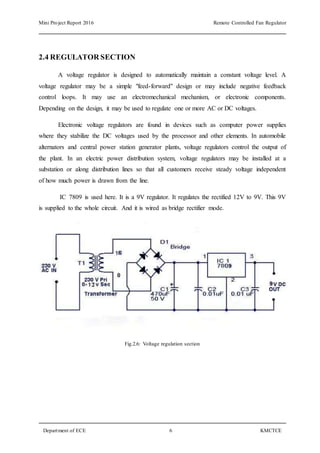
IC 7809 is used here. It is a 9V regulator. It regulates the rectified 12V to 9V. This 9V
is supplied to the whole circuit. And it is wired as bridge rectifier mode.
Fig.2.6: Voltage regulation section
Mini Project Report 2016 Remote Controlled Fan Regulator
Department of ECE 7 KMCTCE
CHAPTER 3
CIRCUIT DIAGRAM & EXPLANATION
From the Fig. 3.1 the 230 V from AC mains is stepped down to 12V and Regulated by
IC7809, capacitor and Diodes to 9V. This filtered 9V is used for providing supply to the entire
circuit. Any button of remote control can be used to control the speed of the fan. The remote
control produces infrared rays which is received by the TSOP infrared receives module. The
TSOP used here is TSOP 1738. It is capable for receiving signals up to 38 KHZ. The infrared
rays are received by the TSOP sensor and its output is given as a trigger to the first monostable
multivibrator NE555 through a LED and Resistor R4.
Fig.3.1: Circuit diagram of Remote controlled fan regulator
This NE555 which is wired as Monostable multivibrator is used to delay the clock to
decade counter CD 4017. We can directly give the output of TSOP to decade counter, but
while doing so all the small pulse or noises may also act as clock to counter and counter starts
counting. The decade counter has ten outputs from Q0 to Q9. But here we are using only Q0 to
Q4. Q5 is not used and Q6 is used to reset the counter. The output of decade counter is taken
Mini Project Report 2016 Remote Controlled Fan Regulator
Department of ECE 8 KMCTCE
through Resistors R5 to R9. The resistor R5 to R9 and capacitor C5 controls the pulse width
which is actually determining the speed of the fan. If the Q0 output is high the capacitor C5 is
charged through R5, if Q1 is high capacitor C5 is charged through R6 and so on, thereby
controlling the speed of the fan accordingly. Here we are controlling the speed of the fan in
five levels that is why we are taking five outputs (Q0 to Q4).
Another NE 555 is used here which is also wired as monostable multivibrator. This
monostable multivibrator is triggered by pulses from opto-coupler MCT2E. It is wired as Zero
crossing detector. The output from decade counter is given toNE555 and this is given to the
transistor BC548. It is given to the Opto-isolator MOC 3021. It is used for driving the TRIAC
BT136. TRIAC is a type of thyristor. Here the resistor R13 (470hm) and capacitor C7 (0.01µF)
combination is used as snubber network for the TRIAC.
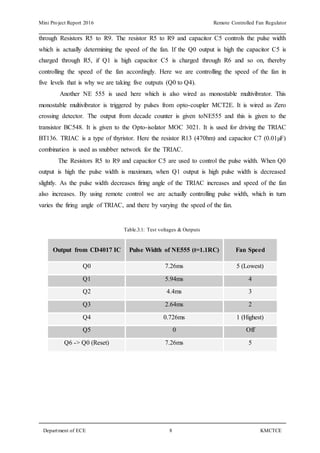
The Resistors R5 to R9 and capacitor C5 are used to control the pulse width. When Q0
output is high the pulse width is maximum, when Q1 output is high pulse width is decreased
slightly. As the pulse width decreases firing angle of the TRIAC increases and speed of the fan
also increases. By using remote control we are actually controlling pulse width, which in turn
varies the firing angle of TRIAC, and there by varying the speed of the fan.
Table.3.1: Test voltages & Outputs
Output from CD4017 IC Pulse Width of NE555 (t=1.1RC) Fan Speed
Q0 7.26ms 5 (Lowest)
Q1 5.94ms 4
Q2 4.4ms 3
Q3 2.64ms 2
Q4 0.726ms 1 (Highest)
Q5 0 Off
Q6 -> Q0 (Reset) 7.26ms 5
Mini Project Report 2016 Remote Controlled Fan Regulator
Department of ECE 9 KMCTCE
CHAPTER 4
COMPONENTS LIST
In this chapter we discuss about the components used in this project.
Table.4.1: Component list
Semiconductors
IC1, IC3 NE555 timer IC
IC2 CD4017 Decade Counter
IC4 MOC3021 Opto isolator
IC5 MCT2E Opto coupler
IC6 7809 9V voltage regulator
ZD1 Zener diode 5.1V
D1 – D6 1N4007 Diode
D7 – D11 1N4148 Diode
LED1 5mm LED
IRX1 TSOP 1738 IR Reciever
T1 Transistor BC548
TRIAC1 TRIAC BT136
Resistors
R1, R11 1 KΩ
R2 47 KΩ
R3 100 KΩ
Mini Project Report 2016 Remote Controlled Fan Regulator
Department of ECE 10 KMCTCE
R4 330 Ω
R5 33 KΩ
R6 27 KΩ
R7 20 KΩ
R8 12 KΩ
R9 3.3 KΩ
R10, R14 470 Ω
R12, R13 47 Ω
R15 10 KΩ
R16 5.6 KΩ
Capacitors
C1 4.7 µF, 16v Electrolytic capacitor
C2 10 µF, 16V Electrolytic capacitor
C3 1 µF, 16V Electrolytic capacitor
C9 470 µF, 50V Electrolytic capacitor
C4, C6, C7 0.01 µF Ceramic capacitor
C5 0.22 µF Ceramic capacitor
C8 0.1 µF Ceramic capacitor
Miscellaneous
X1 230V AC primary to 12V-0-12V, 250mA secondary
transformer
Mini Project Report 2016 Remote Controlled Fan Regulator
Department of ECE 11 KMCTCE
4.1 TSOP 1738
The TSOP17… series are miniaturized receivers for infrared remote control systems.
PIN diode and preamplifier are assembled on lead frame, the epoxy package is designed as IR
filter. The demodulated output signal can directly be decoded by a microprocessor. TSOP17…
is the standard IR remote control receiver series, supporting all major transmission codes.
Fig.4.1: Pin configuration of TSOP 1738
4.2 NE555 TIMER IC
The 555 timer IC is an integrated circuit (chip) used in a variety of timer, pulse
generation, and oscillator applications. The 555 can be used to provide time delays, as an
oscillator, and as a flip-flop element. Derivatives provide up to four timing circuits in one
package.
The IC 555 has three operating modes:
4.2.1Bistable mode or Schmitt trigger
The 555 can operate as a flip-flop, if the DIS pin is not connected and no capacitor is
used. Uses include bounce-free latched switches.
4.2.2 Monostable mode
In this mode, the 555 functions as a "one-shot" pulse generator. Applications include
timers, missing pulse detection, bounce-free switches, touch switches, frequency divider,
capacitance measurement, pulse-width modulation (PWM) and so on.
4.2.3 Astable (free-running) mode
The 555 can operate as an electronic oscillator. Uses include LED and lamp flashers,
pulse generation, logic clocks, tone generation, security alarms, pulse position modulation and
so on. The 555 can be used as a simple ADC, converting an analog value to a pulse length
(e.g., selecting a thermistor as timing resistor allows the use of the 555 in a temperature sensor
and the period of the output pulse is determined by the temperature). The use of a
Mini Project Report 2016 Remote Controlled Fan Regulator
Department of ECE 12 KMCTCE
microprocessor-based circuit can then convert the pulse period to temperature, linearize it and
even provide calibration means.
Fig.4.2: NE555 timer IC
4.3 OPTO COUPLER
An Opto-coupler is used to transmit either analog or digital information from one
voltage potential to another while maintaining isolation of potentials. It is used for low
voltages.
MCT2E is the opto-coupler used here. MCT2E is NPN silicon planar phototransistor
optically coupled to a gallium arsenide infrared emitting diode. It is used to trigger the
monostable multivibrator (IC3).
Fig.4.3: Internal structure of MC2TE
Mini Project Report 2016 Remote Controlled Fan Regulator
Department of ECE 13 KMCTCE
4.4 OPTO-ISOLATOR
The main purpose of an Opto-isolator is to prevent high voltages or rapidly changing
voltages on one side of the circuit from damaging components or distorting transmissions on
the other side. In our project we use a MOC3021 opto-isolator IC to control the 230V AC
voltage on the load using a low voltage signal from the second multivibrator. However, the two
stages have a complete electrical isolation.
Fig.4.4: Internal structure of MOC3021
4.5 VOLTAGE REGULATOR
A voltage regulator is an electrical regulator designed to automatically maintain a
constant voltage level.
IC 7809 is used here. It is a 9V regulator. It regulates the rectified 12V to 9V. This 9V
is supplied to the whole circuit.
Fig.4.5: IC 7809 Voltage regulator
Mini Project Report 2016 Remote Controlled Fan Regulator
Department of ECE 14 KMCTCE
4.6 DECADE COUNTER
A counter is a device which stores (and sometimes displays) the number of times a particular
event or process has occurred, often in relationship to a clock signal. The most common type
is a sequential digital logic circuit with an input line called the "clock" and multiple output
lines. The values on the output lines represent a number in the binary or BCD number system.
Each pulse applied to the clock input increments or decrements the number in the counter.
Fig.4.6: CD4017B Counter IC
4.7 TRANSFORMER
A transformer is an electrical device that transfers electrical energy between two or
more circuits through electromagnetic induction. Electromagnetic induction produces an
electromotive force within a conductor which is exposed to time varying magnetic fields.
Transformers are used to increase or decrease the alternating voltages in electric power
applications.
A varying current in the transformer's primary winding creates a varying magnetic flux
in the transformer core and a varying field impinging on the transformer's secondary winding.
This varying magnetic field at the secondary winding induces a varying electromotive force
(EMF) or voltage in the secondary winding due to electromagnetic induction. Making use of
Faraday's Law (discovered in 1831) in conjunction with high magnetic permeability core
properties, transformers can be designed to efficiently change AC voltages from one voltage
level to another within power networks.
The transformer used here is a 230/ (12V-0-12V) step down transformer.
Mini Project Report 2016 Remote Controlled Fan Regulator
Department of ECE 15 KMCTCE
Fig.4.7: Step down Transformer
4.8 LED
A light-emitting diode (LED) is a two-lead semiconductor light source. It is a p–n
junction diode, which emits light when activated. When a suitable voltage is applied to the
leads, electrons are able to recombine with electron holes within the device, releasing energy in
the form of photons.
Fig.4.8: Light Emitting Diode
4.9 DIODES
A diode is a two-terminal electronic component that conducts primarily in one direction
(asymmetric conductance); it has low (ideally zero) resistance to the flow of current in one
direction, and high (ideally infinite) resistance in the other. A semiconductor diode, the most
common type today, is a crystalline piece of semiconductor material with a p–n junction
connected to two electrical terminals. A vacuum tube diode has two electrodes, a plate (anode)
and a heated cathode. Semiconductor diodes were the first semiconductor electronic devices.
Mini Project Report 2016 Remote Controlled Fan Regulator
Department of ECE 16 KMCTCE
Most diodes are made of silicon, but other semiconductors such as selenium or germanium are
sometimes used.
Fig.4.9: Diodes 1N4007 and 1N4148
4.10 ZENER DIODES
A Zener diode allows current to flow from its anode to its cathode like a normal
semiconductor diode, but it also permits current to flow in the reverse direction when its "Zener
voltage" is reached. Zener diodes have a highly doped p-n junction. Normal diodes will also
break down with a reverse voltage but the voltage and sharpness of the knee are not as well
defined as for a Zener diode. Also normal diodes are not designed to operate in the breakdown
region, but Zener diodes can reliably operate in this region.
Zener reverse breakdown is due to electron quantum tunneling caused by a high
strength electric field. However, many diodes described as "Zener" diodes rely instead on
avalanche breakdown. Both breakdown types are used in Zener diodes with the Zener effect
predominating under 5.6 V and avalanche breakdown above.
Fig.4.10: Zener diodes
Mini Project Report 2016 Remote Controlled Fan Regulator
Department of ECE 17 KMCTCE
4.11 TRANSISTORS
A transistor is a semiconductor device used to amplify or switch electronic signals and
electrical power. It is composed of semiconductor material usually with at least three terminals
for connection to an external circuit. A voltage or current applied to one pair of the transistor's
terminals changes the current through another pair of terminals. Because the controlled (output)
power can be higher than the controlling (input) power, a transistor can amplify a signal.
Today, some transistors are packaged individually, but many more are found embedded in
integrated circuits.
Fig.4.11: Pin configuration of transistor BC548
Mini Project Report 2016 Remote Controlled Fan Regulator
Department of ECE 18 KMCTCE
4.12 TRIAC BT 136
A TRIAC or TRIode for Alternating Current is an electronic component approximately
equivalent to two silicon-controlled rectifiers (SCRs/thyristors) joined in inverse parallel
(paralleled but with the polarity reversed) and with their gates connected together. The formal
name for a TRIAC is bidirectional triode thyristor. This results in a bidirectional electronic
switch which can conduct current in either direction when it is triggered (turned on) and thus
doesn't have any polarity. It can be triggered by either a positive or a negative voltage being
applied to its gate electrode (with respect to A1, otherwise known as MT1). Once triggered, the
device continues to conduct until the current through it drops below a certain threshold value,
the holding current, such as at the end of a half-cycle of alternating current (AC) mains power.
In addition, applying a trigger pulse at a controllable point in an AC cycle allows one to control
the percentage of current that flows through the TRIAC to the load (phase control).
The TRIAC used here is BT136. It is thyristor with a firing angle nearly 45o. A snubber
circuit consisting of a resistor and capacitor is used to control the firing angle of TRIAC. This
firing angle determines the speed of the fan.
Fig.4.12: TRIAC IC BT136
Mini Project Report 2016 Remote Controlled Fan Regulator
Department of ECE 19 KMCTCE
4.13 RESISTORS
A resistor is a passive two-terminal electrical component that implements electrical
resistance as a circuit element. Resistors may be used to reduce current flow, and, at the same
time, may act to lower voltage levels within circuits. In electronic circuits, resistors are used to
limit current flow, to adjust signal levels, bias active elements, and terminate transmission lines
among other uses. High-power resistors, that can dissipate many watts of electrical power as
heat, may be used as part of motor controls, in power distribution systems, or as test loads for
generators. Fixed resistors have resistances that only change slightly with temperature, time or
operating voltage. Variable resistors can be used to adjust circuit elements (such as a volume
control or a lamp dimmer), or as sensing devices for heat, light, humidity, force, or chemical
activity.
Fig.4.13: Resistors
4.14 CAPACITORS
A capacitor (originally known as a condenser) is a passive two-terminal electrical
component used to store electrical energy temporarily in an electric field. The forms of
practical capacitors vary widely, but all contain at least two electrical conductors (plates)
separated by a dielectric (i.e. an insulator that can store energy by becoming polarized). The
conductors can be thin films, foils or sintered beads of metal or conductive electrolyte, etc. The
nonconducting dielectric acts to increase the capacitor's charge capacity. Materials commonly
used as dielectrics include glass, ceramic, plastic film, air, vacuum, paper, mica, and oxide
layers. Capacitors are widely used as parts of electrical circuits in many common electrical
Mini Project Report 2016 Remote Controlled Fan Regulator
Department of ECE 20 KMCTCE
devices. Unlike a resistor, an ideal capacitor does not dissipate energy. Instead, a capacitor
stores energy in the form of an electrostatic field between its plates.
When there is a potential difference across the conductors (e.g., when a capacitor is
attached across a battery), an electric field develops across the dielectric, causing positive
charge +Q to collect on one plate and negative charge −Q to collect on the other plate. If a
battery has been attached to a capacitor for a sufficient amount of time, no current can flow
through the capacitor. However, if a time-varying voltage is applied across the leads of the
capacitor, a displacement current can flow.
Fig.4.14: Capacitors
Mini Project Report 2016 Remote Controlled Fan Regulator
Department of ECE 21 KMCTCE
CHAPTER 5
PCB LAYOUT AND FABRICATION METHODS
5.1 PCB LAYOUT & COMPONENT LAYOUT
The following figure shows the PCB layout and component layout of remote controlled
fan regulator.
Fig.5.1: PCB Layout
Mini Project Report 2016 Remote Controlled Fan Regulator
Department of ECE 22 KMCTCE
Fig.5.2: Component Layout
5.2 PCB PREPARATION
You need to generate a positive (copper black) UV translucent art work film. You will
never get the best possible quality at this stage. The most important thing is to get a clear sharp
image with a very solid opaque black. Art work is done using ORCAD software. It is
absolutely essential that your PCB software prints holes in the middle of pads, which will act as
centre marks when drilling. It is virtually impossible to accurately hand-drill boards without
these holes. If you are looking to buy PCB software at any cost level and want to do hand-
prototyping of boards before production, check that this facility is available when defining pad
and line shapes, the minimum size recommended (through-linking holes) for reliable result is
50mil, assuming 0.8mm drill size;1 mil=(1/1000th ) of an inh. You can go smaller drill sizes,
but through linking will be harder65mil round or square pads for normal components.
Mini Project Report 2016 Remote Controlled Fan Regulator
Department of ECE 23 KMCTCE
Fig.5.2.1: Copper Clad Laminate
ICs, with 0.8mm hole, will allow a 12.5mil, down to 10mil if you really need to.
Center-to-centre spacing of 12.5mil tracks should be 25mil-slightly less may be possible if
your printer can manage it. Take care to preserve the correct diagonal track-track spacing on
mitered corners; grid is 25mil and track width 12.5mil. The art work must be printed such that
the printed side is in contact with PCB surface when exposing, to avoid blurred edges. In
practice, this means that if you design the board as seen from the component side, the bottom
(solder side) layer should be printed the ‘correct’ way round, and top side of the double-sided
board must be printed mirrored.
5.2.1 ETCHING
Ferric chloride etchant is a messy stuff, but easily available and cheaper than most
alternatives. It attacks any metal including stainless steel. So when setting up a PCB etching
area, use a plastic or ceramic sink, with plastic fitting and screws wherever possible, and seal
any metal screws with silicon. Copper water pipes may be splashed or dripped-on, so sleeve or
cover them in plastic; heat-shrink sleeve is great if you are installing new pipes. Fume
extraction is not normally required, although a cover over the tank or tray when not in use is a
good idea. You should always use the hex hydrate type of ferric chloride, which should be
dissolved in warm water until saturation. Adding a teaspoon of table salt helps to make the
etchant clearer for easier inspection. Avoid anhydrous ferric chloride. It creates a lot of heat
Mini Project Report 2016 Remote Controlled Fan Regulator
Department of ECE 24 KMCTCE
when dissolved. So always add the powder very slow to water; do not add water to the powder,
and use gloves and safety glasses. The solution made from anhydrous ferric chloride doesn’t
etch at all, so you need to add a small amount of hydrochloric acid and leave it for a day or
two. Always take extreme care to avoid splashing when dissolving either type of ferric
chloride, acid tends to clump together and you often get a big chunks coming out of the
container and splashing into the solution. It can damage eyes and permanently stain clothing. If
you are making PCBs in a professional environment where time is money you should get a
headed bubble-etch tank. With fresh hot ferric chloride, the PCB will etch in well under 5
minutes. Fast etching produces better edge –quality and consistent line widths. If you aren’t
using a bubble tank, you need to agitate frequently to ensure even etching. Warm the etchant
by putting the etching tray inside a larger tray filled with boiling water.
5.2.2 DRILLING
If you have fibre glass (FR4) board, you must use tungsten carbide drill bits. Fiber glass
eats normal high-speed steel (HSS) bits very rapidly, although HSS drills are alright for older
larger sizes (> 2mm). Carbide drill bits are available as straight-shank or thick-shank. In
straight shank, the hole bit is the diameter of the hole, and in thick shank, a standard size
(typically about 3.5mm) shank tapers down to the hole size. The straight-shank drills are
usually preferred because they break less easily and are usually cheaper. The longer thin
section provides more flexibility. Small drills for PCB use usually come with either a set of
collets of various sizes or a three-jaw chuck. Sometimes the 3-jaw chuck is an optional extra
and is worth getting for the time it saves on changing collets. For accuracy, however, 3-jaw
chucks are not brilliant, and small drill sizes below 1mm quickly formed grooves in the jaws,
preventing good grip. Below 1mm, you should use collets, and buy a few extra of the smallest
ones; keeping one collect per drill size as using a larger drill in a collet will open it out and it
no longer grips smaller drills well. You need a good strong light on the board when drilling, to
ensure accuracy. A dichroic halogen lamp, under run at 9V to reduce brightness, can be
mounted on a microphone gooseneck for easy positioning. It can be useful to raise the working
surface above 15cm above the normal desk height for more comfortable viewing. Dust
extraction is nice, but not essential and occasional blow does the trick! A foot-pedal control to
switch the drill ‘off’ and ‘on’ is very convenient, especially when frequently changing bits.
Avoid hole size less than 0.8mm unless you really need them. When making two identical
boards, drill them both together to save time. To do this, carefully drill 0.8mm hole in the pad
Mini Project Report 2016 Remote Controlled Fan Regulator
Department of ECE 25 KMCTCE
near each corner of each of the two boards, getting the centre as accurately as possible. For
larger boards, drill a hole near the centre of each side as well. Lay the boards on the top of each
other and insert a 0.8mm track pin in two opposite corners, using the pins as pegs to line the
PCBs up. Squeeze or hammer the pins into boards, and then into the remaining holes.
Fig.5.2.2: Drilling
5.2.3 SOLDERING
Soldering is the joining together of two materials to give physical bonding and good
electrical conductivity. It is used primarily in electrical and electronic circuitry. Solder is a
combination of metals, which are solid at normal room temperatures and become liquid
between 180 and 200 degree Celsius. Solder bonds well to various metals, extremely well to
copper. Soldering is a necessary skill you need to learn to successfully build electronics
circuits. To solder you need a soldering iron. A modern basic electrical soldering iron consists
of a heating element, a soldering bit (often called a trip), a handle and a power cord. The
heating element can be either a resistance element printed on to a ceramic base. The element is
then insulated and placed into a metal tube for strength and protection. This is then thermally
insulated from the handle. The heating element of soldering iron usually reaches temperatures
of around 370 to 400 degree Celsius (higher than need to melt the solder). The strength or
power of a soldering iron is usually expressed in watts. Irons generally used in electronics are
typically in the range of 12 to 15 watts. Higher powered iron will not run hotter. Most irons are
available in a variety of voltages; 12V, 24V, 115V and 230V are most popular. Today most
laboratories and repair shops use soldering irons, which operate at 24V. You should always use
this low voltage where possible, as it much safer. For advanced soldering work, you will need a
soldering iron with temperature that lead does not vaporize at the temperature control. In this
Mini Project Report 2016 Remote Controlled Fan Regulator
Department of ECE 26 KMCTCE
type of soldering irons, the temperature may be usually set between 200 and 450 degree
Celsius.
Fig.5.2.3: Soldering
Many temperature controls soldering iron designed for electronics have a power
rating of around 40 to 50 watts. They will heat fast and give enough power for operation, but
are mechanically small.
Currently, the best commonly available, workable, and safe solder alloy is 63/37. That
is, 63% lead, 37% tin. It is also known as eutectic solder. Its most desirable characteristics is
that it solids (‘pasty’) state, and its liquid state occur at the same temperature -361 degree
Fahrenheit. The combination of 63% lead and 37% tin melts at the lowest possible temperature.
Nowadays there is a tendency to move to use lead free solders, but it will take years until they
catch on normal soldering work. Lead free solders are nowadays available, but they are
generally more expensive or harder to work on than traditional solders that they have lead in
them.
The metals involved are not the only things to consider in a solder. Flux is vital to good
solder joint. Flux is an aggressive chemical that removes oxide and impurities from the parts to
be soldered. The chemical reactions at the point(s) of connection must take place for the metal
to fuse. RMA type flux (Rosin Mildly Active) is the least corrosive of the readily available
materials, and adequate oxide removal.
In electronic, a 60/40 fixed core solder is used. This consists of 60% lead and 40% tin,
with flux cores added to the length of solder. There are certain safety measures which you
should keep in mind when soldering. The tin material used in soldering contains dangerous
substances like lead (40-60% of typical soldering tins are lead and lead is poisonous). Also the
Mini Project Report 2016 Remote Controlled Fan Regulator
Department of ECE 27 KMCTCE
various fumes from the soldering flux can be dangerous. While it is true that lead does not
vaporize at the temperature at which soldering is typically done.
When soldering, keep the room well ventilated and use a small fan or fume trap. A
proper fume trap of a fan will keep the most pollution away from your face. Professional
electronic workshops use expensive fume extraction systems to protect their workers. Those
fume extraction devices have a special filter which filters out the dangerous fumes. If you can
connect a duct to the output from the trap to the outside, that would be great.
Always wash hand prior to shopping, eating, drinking or going to the bathroom. When
you handle soldering tin, your hands will pick up lead, which needs to be washed out from it
before it gets to your body. Do not eat, drink or smoke while working with soldering iron. Do
not place cups, glasses or a plate of food near your working area.
Wash also the table sometimes. As you solder, at times there will be a bit of spitting or
sputtering. If you look you will see tiny balls of solder that shoot out and can be found on your
soldering table.
Mini Project Report 2016 Remote Controlled Fan Regulator
Department of ECE 28 KMCTCE
CHAPTER 6
ADVANTAGES & DISADVANTAGES
6.1 ADVANTAGES
 The circuit uses commonly available components and thus the ultimate production cost
will be cheaper than other substitutes available in the market.
 The circuit uses the whole bandwidth of remote IR, and hence can be controlled by any
kind remote.
 The range of remote IR is quite large. Thus the regulator can be controlled across a large
room.
 Even though we have used five speed levels, 10 different speed levels can be incorporated,
with only some minor changes.
 The net power consumption of the circuit is very low due to the usage of digital
components in the main modules. The power components like the voltage regulator, SCR,
Opto- isolator and Opto-coupler have very low thermal dissipation losses, which will help
to increase the lifetime of the module.
 There is no subsequent cost after the installation of the circuit.
 The circuit is maintenance free. When there is a defect, the whole PCB can be replaced.
 The circuit can be powered from the 230V AC line itself.
 It can be assembled with ease.
6.2 DISADVANTAGES
 IR radiation from remotes is designed to spread to large area. If the regulator sensor is
placed near the television/AC, then the fan speed can be changed whenever the remote is
pressed for controlling the other device.
Mini Project Report 2016 Remote Controlled Fan Regulator
Department of ECE 29 KMCTCE
CHAPTER 7
APPLICATION
 Remote controlled Fan Regulator is used to control the speed of fan from our bed or couch.
 The same circuit finds its use to control the Intensity of light at various levels.
 This circuit also finds it use for switching ON and OFF any electronic circuit.
Mini Project Report 2016 Remote Controlled Fan Regulator
Department of ECE 30 KMCTCE
CHAPTER 8
IMPLEMENTATION AND RESULT
The circuit is implemented on the bread board by referring the circuit diagram and
connections are done.
Fig.8.1: Circuit Model
Designed and set up the circuit for remote controlled fan regulator and studied its
various applications.
Mini Project Report 2016 Remote Controlled Fan Regulator
Department of ECE 31 KMCTCE
CHAPTER 9
CONCLUSION
With the knowledge of new techniques in ‘Electronics’ we are able to make our life
more comfortable. One such application of electronics is used in “Remote Controlled Fan
Regulator”.
The same circuit finds its use in many more applications. By this the intensity of light
can be controlled using a remote. The intensity of light can be controlled in five levels from off
position to maximum intensity possible. So it finds use as a night lamp by keeping the intensity
of lamp in low level.
The circuit also finds its use for switching ON and OFF any electronic circuitry. Our
normal T.V remote can be used for all these purposes. So it is very useful or a real help to old
age and sick people, since they can control the speed from the place where they are sitting.
We feel that our product serves something good to this world and we like to present it
before this prosperous world.
Mini Project Report 2016 Remote Controlled Fan Regulator
Department of ECE 32 KMCTCE
CHAPTER 10
REFERENCES
[1] http://electronicsforu.com/electronics-projects/remote-controlled-fan-regulator
[2] https://www.scribd.com/doc/17064878/Remote-Controlled-Fan-Regulator
[3] http://www.instructables.com/id/Cheap-and-reliable-remote-control-fan-regulator/
[4] http://2.bp.blogspot.com/gRuYnRpo5CI/VS_EDCmFmoI/AAAAAAAAJ_c/3qQB8_z2d
-Y/s1600/infrared%2Bfan%2Bdimmer%2Bcircuit/
[5] Forrest M. Mims III, Engineer’s Mini Notebook, Volume I. Timer, Op Amp &
Optoelectronic Circuits & Projects, 1st Ed., Master Publishing, 1986.
[6] Amos S.W., James M. Principles of transistor circuit: Introduction to the Design of
Amplifiers, Receivers and Digital Circuits, 6th Ed., Hartnolls Ltd., 1981.

3) Remote Controlled Fan Regulator

  • 1.
    Mini Project Report2016 Remote Controlled Fan Regulator Department of ECE 1 KMCTCE CHAPTER 1 INTRODUCTION A circuit that allows total control over your equipments without having to move around is a revolutionary concept. Total control over the speed of the fan is a boon to many. This product brings to you this very concept. Remote control facilitates the operation of fan regulators around the home or office from a distance. It provides a system that is simple to understand and also to operate, a system that would be cheap and affordable, a reliable and easy to maintain system of remote control and durable system irrespective of usage. It adds more comfort to everyday living by removing the inconvenience of having to move around to operate a fan regulator. The system seeks to develop a system that is cost effective while not undermining the need for efficient working. The first remote control, called “lazy bones” was developed in 1950 by Zenith Electronics Corporation (then known as Zenith Radio Corporation). The device was developed quickly, and it was called “Zenith space command”, the remote went into production in the fall of 1956, becoming the first practical wireless remote control device. Today, remote control is a standard on electronic products, including VCRs, cable and satellite boxes, digital video disc players and home audio players. In the year 2000, more than 99 percent of all TV set and 100 percent of all VCR and DVD players sold are equipped with remote controls. The average individual these days probably picks up a remote control at least once or twice a day. Basically, a remote control works in the following manner. A button is pressed. This completes a specific connection which produces a Morse code line signal specific to that button. The transistor amplifies the signal and sends it to the LED which translates the signal into infrared light. The sensor on the appliance detects the infrared light and reacts appropriately. The remote control’s function is to wait for the user to press a key and then translate that into infrared light signals that are received by the receiving appliance. The carrier frequency of such infrared signals is typically around 36 kHz.
  • 2.
    Mini Project Report2016 Remote Controlled Fan Regulator Department of ECE 2 KMCTCE The aim of this work is to design and construct a remote control for a fan regulator. The remote control device sends an infra-red beam, which is received by the infra-red sensor on the regulator and the speed of the fan is increased. One of the primary objectives of an engineer is to endeavor to deliver the best product or the most efficient services at the lowest cost to the end user. The system was found to meet the expected results.
  • 3.
    Mini Project Report2016 Remote Controlled Fan Regulator Department of ECE 3 KMCTCE CHAPTER 2 BLOCKDIAGRAM & DESCRIPTION Here is the block diagram and its description of Remote Controlled Fan Regulator Fig.2.1: Block diagram of remote controlled fan regulator 2.1 INFRARED RECEIVER MODULE Infrared receiver module is used for receiving the signals transmitted by the remote control. The TSOP17… – Series are miniaturized receivers for infrared remote control systems. PIN diode and preamplifier are assembled on lead frame, the epoxy package is designed as IR filter. The demodulated output signal can directly be decoded by a microprocessor. TSOP17… is the standard IR remote control receiver series, supporting all major transmission codes Here, TSOP 1738 is used as infrared receiver Module. It is capable of receiving signals up to 38 KHz.
  • 4.
    Mini Project Report2016 Remote Controlled Fan Regulator Department of ECE 4 KMCTCE Fig.2.2: Infrared Receiver module 2.2 MONOSTABLE MULTIVIBRATOR A multivibrator is an electronic circuit used to implement a variety of simple two-state systems such as oscillators, timers and flip-flops. A monostable multivibrator, as its name indicates, has a stable state and a quasi-stable state. An external trigger must be applied to change from the stable state to the quasi-stable state. Here, two NE555 ICs are wired as monostable multivibrators. The trigger to the first multivibrator is the signals from the infrared receiver module. This multivibrator is used to delay the clock pulse of the decade counter. The second multivibrator is triggered by the opto coupler. Fig.2.3: Monostable mode of operation of NE555 IC
  • 5.
    Mini Project Report2016 Remote Controlled Fan Regulator Department of ECE 5 KMCTCE Fig.2.4: Output of Monostable mode of operation 2.3 DECADE COUNTER In digital logic and computing, a counter is a device which stores (and sometimes displays) the number of times a particular event or process has occurred, often in relationship to a clock signal. Decade counter is a counter that counts through 10 states. It is also known as a mod-10 counter. Here, CD 4017 is used as decade counter. Here actually ten outputs are there from which five are used (Q0 to Q4), Q5 is not used and Q6 is used to reset. The output of monostable multivibrator (IC1) is used to delay the clock pulse of the decade counter. Fig.2.5: Timing diagram of CD4017 Decade Counter IC
  • 6.
    Mini Project Report2016 Remote Controlled Fan Regulator Department of ECE 6 KMCTCE 2.4 REGULATOR SECTION A voltage regulator is designed to automatically maintain a constant voltage level. A voltage regulator may be a simple "feed-forward" design or may include negative feedback control loops. It may use an electromechanical mechanism, or electronic components. Depending on the design, it may be used to regulate one or more AC or DC voltages. Electronic voltage regulators are found in devices such as computer power supplies where they stabilize the DC voltages used by the processor and other elements. In automobile alternators and central power station generator plants, voltage regulators control the output of the plant. In an electric power distribution system, voltage regulators may be installed at a substation or along distribution lines so that all customers receive steady voltage independent of how much power is drawn from the line. IC 7809 is used here. It is a 9V regulator. It regulates the rectified 12V to 9V. This 9V is supplied to the whole circuit. And it is wired as bridge rectifier mode. Fig.2.6: Voltage regulation section
  • 7.
    Mini Project Report2016 Remote Controlled Fan Regulator Department of ECE 7 KMCTCE CHAPTER 3 CIRCUIT DIAGRAM & EXPLANATION From the Fig. 3.1 the 230 V from AC mains is stepped down to 12V and Regulated by IC7809, capacitor and Diodes to 9V. This filtered 9V is used for providing supply to the entire circuit. Any button of remote control can be used to control the speed of the fan. The remote control produces infrared rays which is received by the TSOP infrared receives module. The TSOP used here is TSOP 1738. It is capable for receiving signals up to 38 KHZ. The infrared rays are received by the TSOP sensor and its output is given as a trigger to the first monostable multivibrator NE555 through a LED and Resistor R4. Fig.3.1: Circuit diagram of Remote controlled fan regulator This NE555 which is wired as Monostable multivibrator is used to delay the clock to decade counter CD 4017. We can directly give the output of TSOP to decade counter, but while doing so all the small pulse or noises may also act as clock to counter and counter starts counting. The decade counter has ten outputs from Q0 to Q9. But here we are using only Q0 to Q4. Q5 is not used and Q6 is used to reset the counter. The output of decade counter is taken
  • 8.
    Mini Project Report2016 Remote Controlled Fan Regulator Department of ECE 8 KMCTCE through Resistors R5 to R9. The resistor R5 to R9 and capacitor C5 controls the pulse width which is actually determining the speed of the fan. If the Q0 output is high the capacitor C5 is charged through R5, if Q1 is high capacitor C5 is charged through R6 and so on, thereby controlling the speed of the fan accordingly. Here we are controlling the speed of the fan in five levels that is why we are taking five outputs (Q0 to Q4). Another NE 555 is used here which is also wired as monostable multivibrator. This monostable multivibrator is triggered by pulses from opto-coupler MCT2E. It is wired as Zero crossing detector. The output from decade counter is given toNE555 and this is given to the transistor BC548. It is given to the Opto-isolator MOC 3021. It is used for driving the TRIAC BT136. TRIAC is a type of thyristor. Here the resistor R13 (470hm) and capacitor C7 (0.01µF) combination is used as snubber network for the TRIAC. The Resistors R5 to R9 and capacitor C5 are used to control the pulse width. When Q0 output is high the pulse width is maximum, when Q1 output is high pulse width is decreased slightly. As the pulse width decreases firing angle of the TRIAC increases and speed of the fan also increases. By using remote control we are actually controlling pulse width, which in turn varies the firing angle of TRIAC, and there by varying the speed of the fan. Table.3.1: Test voltages & Outputs Output from CD4017 IC Pulse Width of NE555 (t=1.1RC) Fan Speed Q0 7.26ms 5 (Lowest) Q1 5.94ms 4 Q2 4.4ms 3 Q3 2.64ms 2 Q4 0.726ms 1 (Highest) Q5 0 Off Q6 -> Q0 (Reset) 7.26ms 5
  • 9.
    Mini Project Report2016 Remote Controlled Fan Regulator Department of ECE 9 KMCTCE CHAPTER 4 COMPONENTS LIST In this chapter we discuss about the components used in this project. Table.4.1: Component list Semiconductors IC1, IC3 NE555 timer IC IC2 CD4017 Decade Counter IC4 MOC3021 Opto isolator IC5 MCT2E Opto coupler IC6 7809 9V voltage regulator ZD1 Zener diode 5.1V D1 – D6 1N4007 Diode D7 – D11 1N4148 Diode LED1 5mm LED IRX1 TSOP 1738 IR Reciever T1 Transistor BC548 TRIAC1 TRIAC BT136 Resistors R1, R11 1 KΩ R2 47 KΩ R3 100 KΩ
  • 10.
    Mini Project Report2016 Remote Controlled Fan Regulator Department of ECE 10 KMCTCE R4 330 Ω R5 33 KΩ R6 27 KΩ R7 20 KΩ R8 12 KΩ R9 3.3 KΩ R10, R14 470 Ω R12, R13 47 Ω R15 10 KΩ R16 5.6 KΩ Capacitors C1 4.7 µF, 16v Electrolytic capacitor C2 10 µF, 16V Electrolytic capacitor C3 1 µF, 16V Electrolytic capacitor C9 470 µF, 50V Electrolytic capacitor C4, C6, C7 0.01 µF Ceramic capacitor C5 0.22 µF Ceramic capacitor C8 0.1 µF Ceramic capacitor Miscellaneous X1 230V AC primary to 12V-0-12V, 250mA secondary transformer
  • 11.
    Mini Project Report2016 Remote Controlled Fan Regulator Department of ECE 11 KMCTCE 4.1 TSOP 1738 The TSOP17… series are miniaturized receivers for infrared remote control systems. PIN diode and preamplifier are assembled on lead frame, the epoxy package is designed as IR filter. The demodulated output signal can directly be decoded by a microprocessor. TSOP17… is the standard IR remote control receiver series, supporting all major transmission codes. Fig.4.1: Pin configuration of TSOP 1738 4.2 NE555 TIMER IC The 555 timer IC is an integrated circuit (chip) used in a variety of timer, pulse generation, and oscillator applications. The 555 can be used to provide time delays, as an oscillator, and as a flip-flop element. Derivatives provide up to four timing circuits in one package. The IC 555 has three operating modes: 4.2.1Bistable mode or Schmitt trigger The 555 can operate as a flip-flop, if the DIS pin is not connected and no capacitor is used. Uses include bounce-free latched switches. 4.2.2 Monostable mode In this mode, the 555 functions as a "one-shot" pulse generator. Applications include timers, missing pulse detection, bounce-free switches, touch switches, frequency divider, capacitance measurement, pulse-width modulation (PWM) and so on. 4.2.3 Astable (free-running) mode The 555 can operate as an electronic oscillator. Uses include LED and lamp flashers, pulse generation, logic clocks, tone generation, security alarms, pulse position modulation and so on. The 555 can be used as a simple ADC, converting an analog value to a pulse length (e.g., selecting a thermistor as timing resistor allows the use of the 555 in a temperature sensor and the period of the output pulse is determined by the temperature). The use of a
  • 12.
    Mini Project Report2016 Remote Controlled Fan Regulator Department of ECE 12 KMCTCE microprocessor-based circuit can then convert the pulse period to temperature, linearize it and even provide calibration means. Fig.4.2: NE555 timer IC 4.3 OPTO COUPLER An Opto-coupler is used to transmit either analog or digital information from one voltage potential to another while maintaining isolation of potentials. It is used for low voltages. MCT2E is the opto-coupler used here. MCT2E is NPN silicon planar phototransistor optically coupled to a gallium arsenide infrared emitting diode. It is used to trigger the monostable multivibrator (IC3). Fig.4.3: Internal structure of MC2TE
  • 13.
    Mini Project Report2016 Remote Controlled Fan Regulator Department of ECE 13 KMCTCE 4.4 OPTO-ISOLATOR The main purpose of an Opto-isolator is to prevent high voltages or rapidly changing voltages on one side of the circuit from damaging components or distorting transmissions on the other side. In our project we use a MOC3021 opto-isolator IC to control the 230V AC voltage on the load using a low voltage signal from the second multivibrator. However, the two stages have a complete electrical isolation. Fig.4.4: Internal structure of MOC3021 4.5 VOLTAGE REGULATOR A voltage regulator is an electrical regulator designed to automatically maintain a constant voltage level. IC 7809 is used here. It is a 9V regulator. It regulates the rectified 12V to 9V. This 9V is supplied to the whole circuit. Fig.4.5: IC 7809 Voltage regulator
  • 14.
    Mini Project Report2016 Remote Controlled Fan Regulator Department of ECE 14 KMCTCE 4.6 DECADE COUNTER A counter is a device which stores (and sometimes displays) the number of times a particular event or process has occurred, often in relationship to a clock signal. The most common type is a sequential digital logic circuit with an input line called the "clock" and multiple output lines. The values on the output lines represent a number in the binary or BCD number system. Each pulse applied to the clock input increments or decrements the number in the counter. Fig.4.6: CD4017B Counter IC 4.7 TRANSFORMER A transformer is an electrical device that transfers electrical energy between two or more circuits through electromagnetic induction. Electromagnetic induction produces an electromotive force within a conductor which is exposed to time varying magnetic fields. Transformers are used to increase or decrease the alternating voltages in electric power applications. A varying current in the transformer's primary winding creates a varying magnetic flux in the transformer core and a varying field impinging on the transformer's secondary winding. This varying magnetic field at the secondary winding induces a varying electromotive force (EMF) or voltage in the secondary winding due to electromagnetic induction. Making use of Faraday's Law (discovered in 1831) in conjunction with high magnetic permeability core properties, transformers can be designed to efficiently change AC voltages from one voltage level to another within power networks. The transformer used here is a 230/ (12V-0-12V) step down transformer.
  • 15.
    Mini Project Report2016 Remote Controlled Fan Regulator Department of ECE 15 KMCTCE Fig.4.7: Step down Transformer 4.8 LED A light-emitting diode (LED) is a two-lead semiconductor light source. It is a p–n junction diode, which emits light when activated. When a suitable voltage is applied to the leads, electrons are able to recombine with electron holes within the device, releasing energy in the form of photons. Fig.4.8: Light Emitting Diode 4.9 DIODES A diode is a two-terminal electronic component that conducts primarily in one direction (asymmetric conductance); it has low (ideally zero) resistance to the flow of current in one direction, and high (ideally infinite) resistance in the other. A semiconductor diode, the most common type today, is a crystalline piece of semiconductor material with a p–n junction connected to two electrical terminals. A vacuum tube diode has two electrodes, a plate (anode) and a heated cathode. Semiconductor diodes were the first semiconductor electronic devices.
  • 16.
    Mini Project Report2016 Remote Controlled Fan Regulator Department of ECE 16 KMCTCE Most diodes are made of silicon, but other semiconductors such as selenium or germanium are sometimes used. Fig.4.9: Diodes 1N4007 and 1N4148 4.10 ZENER DIODES A Zener diode allows current to flow from its anode to its cathode like a normal semiconductor diode, but it also permits current to flow in the reverse direction when its "Zener voltage" is reached. Zener diodes have a highly doped p-n junction. Normal diodes will also break down with a reverse voltage but the voltage and sharpness of the knee are not as well defined as for a Zener diode. Also normal diodes are not designed to operate in the breakdown region, but Zener diodes can reliably operate in this region. Zener reverse breakdown is due to electron quantum tunneling caused by a high strength electric field. However, many diodes described as "Zener" diodes rely instead on avalanche breakdown. Both breakdown types are used in Zener diodes with the Zener effect predominating under 5.6 V and avalanche breakdown above. Fig.4.10: Zener diodes
  • 17.
    Mini Project Report2016 Remote Controlled Fan Regulator Department of ECE 17 KMCTCE 4.11 TRANSISTORS A transistor is a semiconductor device used to amplify or switch electronic signals and electrical power. It is composed of semiconductor material usually with at least three terminals for connection to an external circuit. A voltage or current applied to one pair of the transistor's terminals changes the current through another pair of terminals. Because the controlled (output) power can be higher than the controlling (input) power, a transistor can amplify a signal. Today, some transistors are packaged individually, but many more are found embedded in integrated circuits. Fig.4.11: Pin configuration of transistor BC548
  • 18.
    Mini Project Report2016 Remote Controlled Fan Regulator Department of ECE 18 KMCTCE 4.12 TRIAC BT 136 A TRIAC or TRIode for Alternating Current is an electronic component approximately equivalent to two silicon-controlled rectifiers (SCRs/thyristors) joined in inverse parallel (paralleled but with the polarity reversed) and with their gates connected together. The formal name for a TRIAC is bidirectional triode thyristor. This results in a bidirectional electronic switch which can conduct current in either direction when it is triggered (turned on) and thus doesn't have any polarity. It can be triggered by either a positive or a negative voltage being applied to its gate electrode (with respect to A1, otherwise known as MT1). Once triggered, the device continues to conduct until the current through it drops below a certain threshold value, the holding current, such as at the end of a half-cycle of alternating current (AC) mains power. In addition, applying a trigger pulse at a controllable point in an AC cycle allows one to control the percentage of current that flows through the TRIAC to the load (phase control). The TRIAC used here is BT136. It is thyristor with a firing angle nearly 45o. A snubber circuit consisting of a resistor and capacitor is used to control the firing angle of TRIAC. This firing angle determines the speed of the fan. Fig.4.12: TRIAC IC BT136
  • 19.
    Mini Project Report2016 Remote Controlled Fan Regulator Department of ECE 19 KMCTCE 4.13 RESISTORS A resistor is a passive two-terminal electrical component that implements electrical resistance as a circuit element. Resistors may be used to reduce current flow, and, at the same time, may act to lower voltage levels within circuits. In electronic circuits, resistors are used to limit current flow, to adjust signal levels, bias active elements, and terminate transmission lines among other uses. High-power resistors, that can dissipate many watts of electrical power as heat, may be used as part of motor controls, in power distribution systems, or as test loads for generators. Fixed resistors have resistances that only change slightly with temperature, time or operating voltage. Variable resistors can be used to adjust circuit elements (such as a volume control or a lamp dimmer), or as sensing devices for heat, light, humidity, force, or chemical activity. Fig.4.13: Resistors 4.14 CAPACITORS A capacitor (originally known as a condenser) is a passive two-terminal electrical component used to store electrical energy temporarily in an electric field. The forms of practical capacitors vary widely, but all contain at least two electrical conductors (plates) separated by a dielectric (i.e. an insulator that can store energy by becoming polarized). The conductors can be thin films, foils or sintered beads of metal or conductive electrolyte, etc. The nonconducting dielectric acts to increase the capacitor's charge capacity. Materials commonly used as dielectrics include glass, ceramic, plastic film, air, vacuum, paper, mica, and oxide layers. Capacitors are widely used as parts of electrical circuits in many common electrical
  • 20.
    Mini Project Report2016 Remote Controlled Fan Regulator Department of ECE 20 KMCTCE devices. Unlike a resistor, an ideal capacitor does not dissipate energy. Instead, a capacitor stores energy in the form of an electrostatic field between its plates. When there is a potential difference across the conductors (e.g., when a capacitor is attached across a battery), an electric field develops across the dielectric, causing positive charge +Q to collect on one plate and negative charge −Q to collect on the other plate. If a battery has been attached to a capacitor for a sufficient amount of time, no current can flow through the capacitor. However, if a time-varying voltage is applied across the leads of the capacitor, a displacement current can flow. Fig.4.14: Capacitors
  • 21.
    Mini Project Report2016 Remote Controlled Fan Regulator Department of ECE 21 KMCTCE CHAPTER 5 PCB LAYOUT AND FABRICATION METHODS 5.1 PCB LAYOUT & COMPONENT LAYOUT The following figure shows the PCB layout and component layout of remote controlled fan regulator. Fig.5.1: PCB Layout
  • 22.
    Mini Project Report2016 Remote Controlled Fan Regulator Department of ECE 22 KMCTCE Fig.5.2: Component Layout 5.2 PCB PREPARATION You need to generate a positive (copper black) UV translucent art work film. You will never get the best possible quality at this stage. The most important thing is to get a clear sharp image with a very solid opaque black. Art work is done using ORCAD software. It is absolutely essential that your PCB software prints holes in the middle of pads, which will act as centre marks when drilling. It is virtually impossible to accurately hand-drill boards without these holes. If you are looking to buy PCB software at any cost level and want to do hand- prototyping of boards before production, check that this facility is available when defining pad and line shapes, the minimum size recommended (through-linking holes) for reliable result is 50mil, assuming 0.8mm drill size;1 mil=(1/1000th ) of an inh. You can go smaller drill sizes, but through linking will be harder65mil round or square pads for normal components.
  • 23.
    Mini Project Report2016 Remote Controlled Fan Regulator Department of ECE 23 KMCTCE Fig.5.2.1: Copper Clad Laminate ICs, with 0.8mm hole, will allow a 12.5mil, down to 10mil if you really need to. Center-to-centre spacing of 12.5mil tracks should be 25mil-slightly less may be possible if your printer can manage it. Take care to preserve the correct diagonal track-track spacing on mitered corners; grid is 25mil and track width 12.5mil. The art work must be printed such that the printed side is in contact with PCB surface when exposing, to avoid blurred edges. In practice, this means that if you design the board as seen from the component side, the bottom (solder side) layer should be printed the ‘correct’ way round, and top side of the double-sided board must be printed mirrored. 5.2.1 ETCHING Ferric chloride etchant is a messy stuff, but easily available and cheaper than most alternatives. It attacks any metal including stainless steel. So when setting up a PCB etching area, use a plastic or ceramic sink, with plastic fitting and screws wherever possible, and seal any metal screws with silicon. Copper water pipes may be splashed or dripped-on, so sleeve or cover them in plastic; heat-shrink sleeve is great if you are installing new pipes. Fume extraction is not normally required, although a cover over the tank or tray when not in use is a good idea. You should always use the hex hydrate type of ferric chloride, which should be dissolved in warm water until saturation. Adding a teaspoon of table salt helps to make the etchant clearer for easier inspection. Avoid anhydrous ferric chloride. It creates a lot of heat
  • 24.
    Mini Project Report2016 Remote Controlled Fan Regulator Department of ECE 24 KMCTCE when dissolved. So always add the powder very slow to water; do not add water to the powder, and use gloves and safety glasses. The solution made from anhydrous ferric chloride doesn’t etch at all, so you need to add a small amount of hydrochloric acid and leave it for a day or two. Always take extreme care to avoid splashing when dissolving either type of ferric chloride, acid tends to clump together and you often get a big chunks coming out of the container and splashing into the solution. It can damage eyes and permanently stain clothing. If you are making PCBs in a professional environment where time is money you should get a headed bubble-etch tank. With fresh hot ferric chloride, the PCB will etch in well under 5 minutes. Fast etching produces better edge –quality and consistent line widths. If you aren’t using a bubble tank, you need to agitate frequently to ensure even etching. Warm the etchant by putting the etching tray inside a larger tray filled with boiling water. 5.2.2 DRILLING If you have fibre glass (FR4) board, you must use tungsten carbide drill bits. Fiber glass eats normal high-speed steel (HSS) bits very rapidly, although HSS drills are alright for older larger sizes (> 2mm). Carbide drill bits are available as straight-shank or thick-shank. In straight shank, the hole bit is the diameter of the hole, and in thick shank, a standard size (typically about 3.5mm) shank tapers down to the hole size. The straight-shank drills are usually preferred because they break less easily and are usually cheaper. The longer thin section provides more flexibility. Small drills for PCB use usually come with either a set of collets of various sizes or a three-jaw chuck. Sometimes the 3-jaw chuck is an optional extra and is worth getting for the time it saves on changing collets. For accuracy, however, 3-jaw chucks are not brilliant, and small drill sizes below 1mm quickly formed grooves in the jaws, preventing good grip. Below 1mm, you should use collets, and buy a few extra of the smallest ones; keeping one collect per drill size as using a larger drill in a collet will open it out and it no longer grips smaller drills well. You need a good strong light on the board when drilling, to ensure accuracy. A dichroic halogen lamp, under run at 9V to reduce brightness, can be mounted on a microphone gooseneck for easy positioning. It can be useful to raise the working surface above 15cm above the normal desk height for more comfortable viewing. Dust extraction is nice, but not essential and occasional blow does the trick! A foot-pedal control to switch the drill ‘off’ and ‘on’ is very convenient, especially when frequently changing bits. Avoid hole size less than 0.8mm unless you really need them. When making two identical boards, drill them both together to save time. To do this, carefully drill 0.8mm hole in the pad
  • 25.
    Mini Project Report2016 Remote Controlled Fan Regulator Department of ECE 25 KMCTCE near each corner of each of the two boards, getting the centre as accurately as possible. For larger boards, drill a hole near the centre of each side as well. Lay the boards on the top of each other and insert a 0.8mm track pin in two opposite corners, using the pins as pegs to line the PCBs up. Squeeze or hammer the pins into boards, and then into the remaining holes. Fig.5.2.2: Drilling 5.2.3 SOLDERING Soldering is the joining together of two materials to give physical bonding and good electrical conductivity. It is used primarily in electrical and electronic circuitry. Solder is a combination of metals, which are solid at normal room temperatures and become liquid between 180 and 200 degree Celsius. Solder bonds well to various metals, extremely well to copper. Soldering is a necessary skill you need to learn to successfully build electronics circuits. To solder you need a soldering iron. A modern basic electrical soldering iron consists of a heating element, a soldering bit (often called a trip), a handle and a power cord. The heating element can be either a resistance element printed on to a ceramic base. The element is then insulated and placed into a metal tube for strength and protection. This is then thermally insulated from the handle. The heating element of soldering iron usually reaches temperatures of around 370 to 400 degree Celsius (higher than need to melt the solder). The strength or power of a soldering iron is usually expressed in watts. Irons generally used in electronics are typically in the range of 12 to 15 watts. Higher powered iron will not run hotter. Most irons are available in a variety of voltages; 12V, 24V, 115V and 230V are most popular. Today most laboratories and repair shops use soldering irons, which operate at 24V. You should always use this low voltage where possible, as it much safer. For advanced soldering work, you will need a soldering iron with temperature that lead does not vaporize at the temperature control. In this
  • 26.
    Mini Project Report2016 Remote Controlled Fan Regulator Department of ECE 26 KMCTCE type of soldering irons, the temperature may be usually set between 200 and 450 degree Celsius. Fig.5.2.3: Soldering Many temperature controls soldering iron designed for electronics have a power rating of around 40 to 50 watts. They will heat fast and give enough power for operation, but are mechanically small. Currently, the best commonly available, workable, and safe solder alloy is 63/37. That is, 63% lead, 37% tin. It is also known as eutectic solder. Its most desirable characteristics is that it solids (‘pasty’) state, and its liquid state occur at the same temperature -361 degree Fahrenheit. The combination of 63% lead and 37% tin melts at the lowest possible temperature. Nowadays there is a tendency to move to use lead free solders, but it will take years until they catch on normal soldering work. Lead free solders are nowadays available, but they are generally more expensive or harder to work on than traditional solders that they have lead in them. The metals involved are not the only things to consider in a solder. Flux is vital to good solder joint. Flux is an aggressive chemical that removes oxide and impurities from the parts to be soldered. The chemical reactions at the point(s) of connection must take place for the metal to fuse. RMA type flux (Rosin Mildly Active) is the least corrosive of the readily available materials, and adequate oxide removal. In electronic, a 60/40 fixed core solder is used. This consists of 60% lead and 40% tin, with flux cores added to the length of solder. There are certain safety measures which you should keep in mind when soldering. The tin material used in soldering contains dangerous substances like lead (40-60% of typical soldering tins are lead and lead is poisonous). Also the
  • 27.
    Mini Project Report2016 Remote Controlled Fan Regulator Department of ECE 27 KMCTCE various fumes from the soldering flux can be dangerous. While it is true that lead does not vaporize at the temperature at which soldering is typically done. When soldering, keep the room well ventilated and use a small fan or fume trap. A proper fume trap of a fan will keep the most pollution away from your face. Professional electronic workshops use expensive fume extraction systems to protect their workers. Those fume extraction devices have a special filter which filters out the dangerous fumes. If you can connect a duct to the output from the trap to the outside, that would be great. Always wash hand prior to shopping, eating, drinking or going to the bathroom. When you handle soldering tin, your hands will pick up lead, which needs to be washed out from it before it gets to your body. Do not eat, drink or smoke while working with soldering iron. Do not place cups, glasses or a plate of food near your working area. Wash also the table sometimes. As you solder, at times there will be a bit of spitting or sputtering. If you look you will see tiny balls of solder that shoot out and can be found on your soldering table.
  • 28.
    Mini Project Report2016 Remote Controlled Fan Regulator Department of ECE 28 KMCTCE CHAPTER 6 ADVANTAGES & DISADVANTAGES 6.1 ADVANTAGES  The circuit uses commonly available components and thus the ultimate production cost will be cheaper than other substitutes available in the market.  The circuit uses the whole bandwidth of remote IR, and hence can be controlled by any kind remote.  The range of remote IR is quite large. Thus the regulator can be controlled across a large room.  Even though we have used five speed levels, 10 different speed levels can be incorporated, with only some minor changes.  The net power consumption of the circuit is very low due to the usage of digital components in the main modules. The power components like the voltage regulator, SCR, Opto- isolator and Opto-coupler have very low thermal dissipation losses, which will help to increase the lifetime of the module.  There is no subsequent cost after the installation of the circuit.  The circuit is maintenance free. When there is a defect, the whole PCB can be replaced.  The circuit can be powered from the 230V AC line itself.  It can be assembled with ease. 6.2 DISADVANTAGES  IR radiation from remotes is designed to spread to large area. If the regulator sensor is placed near the television/AC, then the fan speed can be changed whenever the remote is pressed for controlling the other device.
  • 29.
    Mini Project Report2016 Remote Controlled Fan Regulator Department of ECE 29 KMCTCE CHAPTER 7 APPLICATION  Remote controlled Fan Regulator is used to control the speed of fan from our bed or couch.  The same circuit finds its use to control the Intensity of light at various levels.  This circuit also finds it use for switching ON and OFF any electronic circuit.
  • 30.
    Mini Project Report2016 Remote Controlled Fan Regulator Department of ECE 30 KMCTCE CHAPTER 8 IMPLEMENTATION AND RESULT The circuit is implemented on the bread board by referring the circuit diagram and connections are done. Fig.8.1: Circuit Model Designed and set up the circuit for remote controlled fan regulator and studied its various applications.
  • 31.
    Mini Project Report2016 Remote Controlled Fan Regulator Department of ECE 31 KMCTCE CHAPTER 9 CONCLUSION With the knowledge of new techniques in ‘Electronics’ we are able to make our life more comfortable. One such application of electronics is used in “Remote Controlled Fan Regulator”. The same circuit finds its use in many more applications. By this the intensity of light can be controlled using a remote. The intensity of light can be controlled in five levels from off position to maximum intensity possible. So it finds use as a night lamp by keeping the intensity of lamp in low level. The circuit also finds its use for switching ON and OFF any electronic circuitry. Our normal T.V remote can be used for all these purposes. So it is very useful or a real help to old age and sick people, since they can control the speed from the place where they are sitting. We feel that our product serves something good to this world and we like to present it before this prosperous world.
  • 32.
    Mini Project Report2016 Remote Controlled Fan Regulator Department of ECE 32 KMCTCE CHAPTER 10 REFERENCES [1] http://electronicsforu.com/electronics-projects/remote-controlled-fan-regulator [2] https://www.scribd.com/doc/17064878/Remote-Controlled-Fan-Regulator [3] http://www.instructables.com/id/Cheap-and-reliable-remote-control-fan-regulator/ [4] http://2.bp.blogspot.com/gRuYnRpo5CI/VS_EDCmFmoI/AAAAAAAAJ_c/3qQB8_z2d -Y/s1600/infrared%2Bfan%2Bdimmer%2Bcircuit/ [5] Forrest M. Mims III, Engineer’s Mini Notebook, Volume I. Timer, Op Amp & Optoelectronic Circuits & Projects, 1st Ed., Master Publishing, 1986. [6] Amos S.W., James M. Principles of transistor circuit: Introduction to the Design of Amplifiers, Receivers and Digital Circuits, 6th Ed., Hartnolls Ltd., 1981.