Under Guidence
        Prof. Mrs S. P. Thote
Lect. Deptt .Of Electrical Engineering
           G. P. Gadchiroli
Index
   Introduction
   Block Diagram
   Circuit Diagram
   IR Transmitter
   IR Receiver Circuit
   Microcontroller
   Digital Controller
   Power Supply
   Conclusion
   Advantages
   Reference
Introduction
   As in today needs the major aspect is to save the power that is bug
    issues in day to day work by saving bit by bit power by ever person
    can save a good amount of electrical power so keeping in mind we
    had tried to develop.
   An project which will automatically save the power by sensing the
    person in the elevatorit is based on microcontroller
   Which counts the person entering in the Mall elevator                an
    accordingly
   It will switch the light ON and start counting the number of person
    entering insides the room. When this person leaves the elevatorit will
    count the person leavening the room.
   This Project “Automatic Mall Elevator ” is a reliable circuit that takes
    over the task of controlling the Mall elevator .
   When somebody enters into the elevator in the Mall will be ON and
    when any one leaves the elevator then is stop.
Block Diagram
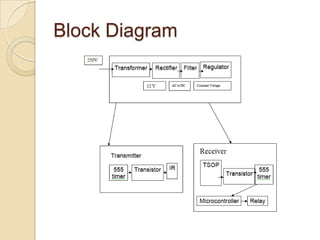
DESCRIPTION OF BLOCK
DIAGRAM
The typical block diagram of the proposed project is
   shown
in the figure.
The block diagram consists of five parts.
 Regulated DC power supply.
 Microcontroller.
 Interfacing circuit.
 Motor and devices.
1)Regulated DC Power Supply:-
              It is used to provide the supply to the interfacing circuit. The
  whole arrangement is as shown in the block diagram.
2)Micro Controller:-
            For controlling of the circuit the PC controller is provided. The
  PC controller is nothing but the keyboard. All the control can be done by
  keyboard.

3)Interfacing Circuit:-
               Interfacing circuit consist of two circuit. First is switching
   circuit and second is speed controller circuit.

4)Motor and Devices:-
             Motor is connected to the speed controller circuit and devices
  are connected to switching circuit.
Circuit Diagram
Circuit Explanation
   IR emits the rays amplified by transistor and generated by
    555 timer.
   TSOP sense the signal and sends to the transistor Which has
    555 timer sends to the microcontroller will has the
    programming which sends to decoder which trigger the relay
    Through which it will trigger the relay ON.
   Certain frequency and ignores all other IR received.
   The best frequency for the job is between 30 and 60kHz, the
    most used is around 36kHz.
   So, remote controls use the 36kHz (or around) to transmit
    information.
     InfraRed light emitted by IR Diodes is pulsated at 36
    thousand times per second, when transmitting logic level "1"
    and silence for "0".
   To generate a 36kHz pulsating infrared is quite easy, more
    difficult is to receive and identify this frequency.
   This is why some companies produce infrared receives, that
    contains the filters, decoding circuits and the output shaper, that
    delivers a square wave, meaning the existence or not of the
    36kHz incoming pulsating infrared.
   When switch S1 is in „on‟ position, the transmitter circuit, IR
    receiver module TSOP1738, which is commonly used in colors
    televisions for sensing the IR signals transmitted from the TV
    remote, is used as the sensor.
   IR signals transmitted from the TV remote, is used as the sensor.
    The IR beams transmitted by IR LED1 and LED2 fall on infrared
    receiver module IR RX1 of the receiver circuit to produce a low
    output at its pin 2. This keeps transistor T1 in non-conduction
    mode. Now when anyone enters through the gate to interrupt the
    IR beam, the IR receiver module produces a high output at its pin
    3.
IR TRANSMITTER
   IC 555 is used as an Multivibrator.
   This is a free running oscillator and the frequency can be
    adjusted using 100k preset (variable resistor).
   Free running oscillator means, it is itself starting circuit which
    outputs a waveform that repeats itself without being either
    triggered or re-triggered.
   The output of the oscillator is periodic (i.e. repeats itself
    regularly) pulse or wave train.
   In a periodic signal the wave repeats itself indefinitely until the
    circuit is either turned off or otherwise inhibited.
   In this mode of operation, the capacitor charges and
    discharges between 1/3 Vcc and 2/3 Vcc.
   As in the triggered mode, the charge and discharge times and
    therefore the frequency are independent of the supply
    voltage.
IR RECEIVER CIRCUIT
   when IR signals does not falls on the TSOP 1738 its output pin
    no.3 goes high.
   R14 resistance is used to limit the current at the output of the
    TSOP and fed to pin1 of the NOT gate ic which has internal 6 not
    gate.
   1st not gate invert its output and its output is again inverted by
    another not gate and increases its output current to switch the
    switching transistor 2N2222A or SL100 which is NPN switching
    transistor.
   The ground signal is generated by the transistor is fed.
   Receiver circuit operated at 5V DC and it is drive from power
    supply circuit.
   Transformer converts 230V AC to 12V AC and the 12V AC is
    converted into DC by Diode D1 & D2 it filtered by Capacitor
    C1, IC3 gives.
   Regulated 5V DC to other circuit. Infra-red receiver module
    detected 38 kHz signal this is transmitted from transmitter circuit.
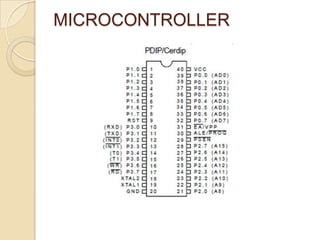
MICROCONTROLLER
   Microcontrollers are used in automatically controlled products
    and devices, such as automobile engine control systems,
    remote controls, office machines, appliances, power tools,
    and toys.
   By reducing the size and cost compared to a design that uses
    a separate microprocessor, memory, and input/output
    devices, microcontrollers make it economical to digitally
    control even more devices and processes.
   Mixed signal microcontrollers are common, integrating analog
    components needed to control non-digital electronic systems.
   The Light control of street is very crucial especially in
    applications where precision are of importance.
   This work investigates and implements a microcontroller-
    based adjustable system for a energy.
INFRARED IN ELECTRONICS

   Infra-Red is interesting, because it is easily generated and
    doesn't suffer electromagnetic interference, so it is nicely
    used to communication and control, but it is not perfect, some
    other light emissions could contains infrared as well, and that
    can interfere in this communication.
   The adventure of using lots of infra-red in TV/VCR remote
    controls and other applications, brought infra-red diodes
    (emitter and receivers) at very low cost at the market.
   This light can means something to the receiver, the "on or off"
    radiation can transmit different meanings.
   Lots of things can generate infrared, anything that radiate
    heat do it, including out body, lamps, stove, oven, friction your
    hands together, even the hot water at the faucet.
DIGITAL CONTROL

   Efficient control of motor and other electrical devices
    becomes critical where high precision, accuracy, flexibility;
    reliability and faster response are of paramount importance.
   Therefore for efficient control electronics and digital control
    are employed in which a solid state semiconductor are used.
   In advance we can use a software programming in which
    electronics circuit are interfaced with computers.
   By using software program there is less possibility of
    irregularity.
Advantages of Digital Control

   Digital control gives the high precision and accuracy.

   Digital control gives better speed regulation.

   Digital control gives faster response and flexibility.

   It gives better time response and improved performance.

   It has easy software control.

   It is economical and reliable.

   The greatest advantages of digital control is that by changing the program desired
    control technique can be implemented without any change in the hardware
BLOCK DIAGRAM OF POWER
SUPPLY
POWER SUPPLY
   Power supply is the first and most important part of our project.
   In the proposed project the power supply circuit is used to provide
    the regulated supply to the IC`s used in the project.
   Power supply circuit consists of step down transformer, rectifier
    circuit, filter circuit and regulator IC.


    Step Down Transformer
o    Transformers are static device which convert the electrical energy
    from one circuit to another circuit without any change in frequency
    and power.
o   Step down transformer means the transformer which reduces the
    supply voltage to the desired value.
o   In our project we need 12 volt DC supply, therefore in this project 12-
    0-12, 500mA transformer is used.
Rectifier Circuit
o   Rectifier is a circuit which converts the AC electrical energy into Dc electrical
    energy.
o    For operating of semiconductor devices used in this project we need
    regulated DC supply.
o    In this project we use centre tap full wave rectifier.
o    Full wave rectifier circuit is capable of converting sinusoidal input into a
    unidirectional output.
o   The circuit diagram is as shown in the figure.

Filter Circuit
o   It is seen that the output of the rectifier is not pure DC, because it contain
    some amount of AC component which is called as ripple factor.
o   This circuit is connected after the rectifier circuit. In our project capacitor input
    filter is used.
o   The circuit is as shown in the figure.
                     The capacitor is connected in parallel to minimize the ripple
    factor.
Regulator Circuit
o        In our project for the operation of IC we need +5 volt regulated
    supply is necessary therefore a voltage regulator circuit is used.
o    A voltage regulator is a circuit that supplies constant voltages
    regardless of change in the load current. IC voltage regulators are
    versatile and generally used.
o   The 7800 series consist of three terminal positive voltage
    regulators. These ICs are designed as fixed voltage regulator and
    adequate heat sink.
o    It can be deliver output current in access of 1A.
o   These devices do not required external component.
o    These ICs has internal terminal overload protection and internal
    short circuit and current limiting protection.
CONCLUSION

   In the designing of our projects, we have kept in mind the
    user in the implementation part which interacting with the
    user we had given lot of guideline to user with various
    massages.
•   It has powerful control with which you can easily implement
    various facilities in our projects .the screen are very user
    friendly.
ADVANTAGES
   Only single man can control the all over industry from one
    place with single unit control.

   The operation and working are performed very accurately as
    compared with existing technology.

   It saves the valuable time as well as man power.

   Chances of physical and mental stress on the worker are
    minimized.
APPLICATION
 It is used in Mall elevator for power
  saving.
 It is used in hotel
 It used in seminar hall
 It used in cinema hall
 It used in air ports
 It is used in Offices
Reference
   Power electronics laboratory
                    O. P. Arora
                   Wheezes publication, New Delhi.
   Power electronics and drive
                   G. k. Dubey and C. Rao
                   Tata Mc. Graw hill international ltd.
   Integrated electronics
                    J. Millan and C. Halkias
                   Tata Mc. Graw hill international ltd.
   Electrical technology volume 2
                    B. l. Thereja and A. k. Thereja
                    S. Chand Publication.
   www.efy.com
Automatic mall elevator

Automatic mall elevator

  • 1.
    Under Guidence Prof. Mrs S. P. Thote Lect. Deptt .Of Electrical Engineering G. P. Gadchiroli
  • 2.
    Index  Introduction  Block Diagram  Circuit Diagram  IR Transmitter  IR Receiver Circuit  Microcontroller  Digital Controller  Power Supply  Conclusion  Advantages  Reference
  • 3.
    Introduction  As in today needs the major aspect is to save the power that is bug issues in day to day work by saving bit by bit power by ever person can save a good amount of electrical power so keeping in mind we had tried to develop.  An project which will automatically save the power by sensing the person in the elevatorit is based on microcontroller  Which counts the person entering in the Mall elevator an accordingly  It will switch the light ON and start counting the number of person entering insides the room. When this person leaves the elevatorit will count the person leavening the room.  This Project “Automatic Mall Elevator ” is a reliable circuit that takes over the task of controlling the Mall elevator .  When somebody enters into the elevator in the Mall will be ON and when any one leaves the elevator then is stop.
  • 4.
  • 5.
    DESCRIPTION OF BLOCK DIAGRAM Thetypical block diagram of the proposed project is shown in the figure. The block diagram consists of five parts.  Regulated DC power supply.  Microcontroller.  Interfacing circuit.  Motor and devices.
  • 6.
    1)Regulated DC PowerSupply:- It is used to provide the supply to the interfacing circuit. The whole arrangement is as shown in the block diagram. 2)Micro Controller:- For controlling of the circuit the PC controller is provided. The PC controller is nothing but the keyboard. All the control can be done by keyboard. 3)Interfacing Circuit:- Interfacing circuit consist of two circuit. First is switching circuit and second is speed controller circuit. 4)Motor and Devices:- Motor is connected to the speed controller circuit and devices are connected to switching circuit.
  • 7.
  • 9.
    Circuit Explanation  IR emits the rays amplified by transistor and generated by 555 timer.  TSOP sense the signal and sends to the transistor Which has 555 timer sends to the microcontroller will has the programming which sends to decoder which trigger the relay Through which it will trigger the relay ON.  Certain frequency and ignores all other IR received.  The best frequency for the job is between 30 and 60kHz, the most used is around 36kHz.  So, remote controls use the 36kHz (or around) to transmit information.  InfraRed light emitted by IR Diodes is pulsated at 36 thousand times per second, when transmitting logic level "1" and silence for "0".
  • 10.
    To generate a 36kHz pulsating infrared is quite easy, more difficult is to receive and identify this frequency.  This is why some companies produce infrared receives, that contains the filters, decoding circuits and the output shaper, that delivers a square wave, meaning the existence or not of the 36kHz incoming pulsating infrared.  When switch S1 is in „on‟ position, the transmitter circuit, IR receiver module TSOP1738, which is commonly used in colors televisions for sensing the IR signals transmitted from the TV remote, is used as the sensor.  IR signals transmitted from the TV remote, is used as the sensor.  The IR beams transmitted by IR LED1 and LED2 fall on infrared receiver module IR RX1 of the receiver circuit to produce a low output at its pin 2. This keeps transistor T1 in non-conduction mode. Now when anyone enters through the gate to interrupt the IR beam, the IR receiver module produces a high output at its pin 3.
  • 11.
    IR TRANSMITTER  IC 555 is used as an Multivibrator.  This is a free running oscillator and the frequency can be adjusted using 100k preset (variable resistor).  Free running oscillator means, it is itself starting circuit which outputs a waveform that repeats itself without being either triggered or re-triggered.  The output of the oscillator is periodic (i.e. repeats itself regularly) pulse or wave train.  In a periodic signal the wave repeats itself indefinitely until the circuit is either turned off or otherwise inhibited.  In this mode of operation, the capacitor charges and discharges between 1/3 Vcc and 2/3 Vcc.  As in the triggered mode, the charge and discharge times and therefore the frequency are independent of the supply voltage.
  • 12.
    IR RECEIVER CIRCUIT  when IR signals does not falls on the TSOP 1738 its output pin no.3 goes high.  R14 resistance is used to limit the current at the output of the TSOP and fed to pin1 of the NOT gate ic which has internal 6 not gate.  1st not gate invert its output and its output is again inverted by another not gate and increases its output current to switch the switching transistor 2N2222A or SL100 which is NPN switching transistor.  The ground signal is generated by the transistor is fed.  Receiver circuit operated at 5V DC and it is drive from power supply circuit.  Transformer converts 230V AC to 12V AC and the 12V AC is converted into DC by Diode D1 & D2 it filtered by Capacitor C1, IC3 gives.  Regulated 5V DC to other circuit. Infra-red receiver module detected 38 kHz signal this is transmitted from transmitter circuit.
  • 13.
  • 14.
    Microcontrollers are used in automatically controlled products and devices, such as automobile engine control systems, remote controls, office machines, appliances, power tools, and toys.  By reducing the size and cost compared to a design that uses a separate microprocessor, memory, and input/output devices, microcontrollers make it economical to digitally control even more devices and processes.  Mixed signal microcontrollers are common, integrating analog components needed to control non-digital electronic systems.  The Light control of street is very crucial especially in applications where precision are of importance.  This work investigates and implements a microcontroller- based adjustable system for a energy.
  • 15.
    INFRARED IN ELECTRONICS  Infra-Red is interesting, because it is easily generated and doesn't suffer electromagnetic interference, so it is nicely used to communication and control, but it is not perfect, some other light emissions could contains infrared as well, and that can interfere in this communication.  The adventure of using lots of infra-red in TV/VCR remote controls and other applications, brought infra-red diodes (emitter and receivers) at very low cost at the market.  This light can means something to the receiver, the "on or off" radiation can transmit different meanings.  Lots of things can generate infrared, anything that radiate heat do it, including out body, lamps, stove, oven, friction your hands together, even the hot water at the faucet.
  • 16.
    DIGITAL CONTROL  Efficient control of motor and other electrical devices becomes critical where high precision, accuracy, flexibility; reliability and faster response are of paramount importance.  Therefore for efficient control electronics and digital control are employed in which a solid state semiconductor are used.  In advance we can use a software programming in which electronics circuit are interfaced with computers.  By using software program there is less possibility of irregularity.
  • 17.
    Advantages of DigitalControl  Digital control gives the high precision and accuracy.  Digital control gives better speed regulation.  Digital control gives faster response and flexibility.  It gives better time response and improved performance.  It has easy software control.  It is economical and reliable.  The greatest advantages of digital control is that by changing the program desired control technique can be implemented without any change in the hardware
  • 18.
    BLOCK DIAGRAM OFPOWER SUPPLY
  • 19.
    POWER SUPPLY  Power supply is the first and most important part of our project.  In the proposed project the power supply circuit is used to provide the regulated supply to the IC`s used in the project.  Power supply circuit consists of step down transformer, rectifier circuit, filter circuit and regulator IC. Step Down Transformer o Transformers are static device which convert the electrical energy from one circuit to another circuit without any change in frequency and power. o Step down transformer means the transformer which reduces the supply voltage to the desired value. o In our project we need 12 volt DC supply, therefore in this project 12- 0-12, 500mA transformer is used.
  • 20.
    Rectifier Circuit o Rectifier is a circuit which converts the AC electrical energy into Dc electrical energy. o For operating of semiconductor devices used in this project we need regulated DC supply. o In this project we use centre tap full wave rectifier. o Full wave rectifier circuit is capable of converting sinusoidal input into a unidirectional output. o The circuit diagram is as shown in the figure. Filter Circuit o It is seen that the output of the rectifier is not pure DC, because it contain some amount of AC component which is called as ripple factor. o This circuit is connected after the rectifier circuit. In our project capacitor input filter is used. o The circuit is as shown in the figure. The capacitor is connected in parallel to minimize the ripple factor.
  • 21.
    Regulator Circuit o In our project for the operation of IC we need +5 volt regulated supply is necessary therefore a voltage regulator circuit is used. o A voltage regulator is a circuit that supplies constant voltages regardless of change in the load current. IC voltage regulators are versatile and generally used. o The 7800 series consist of three terminal positive voltage regulators. These ICs are designed as fixed voltage regulator and adequate heat sink. o It can be deliver output current in access of 1A. o These devices do not required external component. o These ICs has internal terminal overload protection and internal short circuit and current limiting protection.
  • 22.
    CONCLUSION  In the designing of our projects, we have kept in mind the user in the implementation part which interacting with the user we had given lot of guideline to user with various massages. • It has powerful control with which you can easily implement various facilities in our projects .the screen are very user friendly.
  • 23.
    ADVANTAGES  Only single man can control the all over industry from one place with single unit control.  The operation and working are performed very accurately as compared with existing technology.  It saves the valuable time as well as man power.  Chances of physical and mental stress on the worker are minimized.
  • 24.
    APPLICATION  It isused in Mall elevator for power saving.  It is used in hotel  It used in seminar hall  It used in cinema hall  It used in air ports  It is used in Offices
  • 25.
    Reference  Power electronics laboratory O. P. Arora Wheezes publication, New Delhi.  Power electronics and drive G. k. Dubey and C. Rao Tata Mc. Graw hill international ltd.  Integrated electronics J. Millan and C. Halkias Tata Mc. Graw hill international ltd.  Electrical technology volume 2 B. l. Thereja and A. k. Thereja S. Chand Publication.  www.efy.com