REGENERATION 
HEALING
LEARNING OBJECTIVES 
• Review the normal physiology and concepts 
of cell proliferation, cell growth, cell “cycle”, 
and cell differentiation 
• Understand the basic factors of tissue 
regeneration 
• Understand the relationships between cells 
and their ExtraCellular Matrix (ECM) 
• Understand the roles of the major players of 
healing---angiogenesis, growth factors 
(GFs), and fibrosis 
• Differentiate 1st & 2nd intention healing
DEFINITIONS: 
•REGENERATION: Growth of 
cells to replace lost tissues 
•HEALING: A reparative tissue 
response to a wound, inflammation or necrosis, 
often leads to fibrosis 
• GRANULATION TISSUE 
• “ORGANIZING” INFLAMATION
REGENERATION 
• Replacement of lost structures 
• Is dependent on the type of 
normal turnover the original 
tissue has 
• Can be differentiated from 
“compensatory” growth
HEALING 
• Needs a wound, inflammatory process, or 
necrosis 
• Many disease appearances anatomically are 
the result of “healing” such as 
atherosclerosis 
• Often ends with a scar 
• Fibrosis, as one of the 3 possible outcomes 
of inflammation, follows “healing” 
• Requires a connective tissue “scaffold” 
• Fibrosis occurs in proportion to the damage 
of the ECM
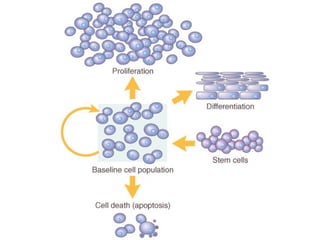
Cell Population Fates 
• PROLIFERATION 
– Hormonal, especially steroid hormones 
– eg., EPO, CSF 
• DIFFERENTIATION* 
– UNIDIRECTIONAL, GAIN and LOSS 
• APOPTOSIS 
*One of the most KEY concepts in neoplasia
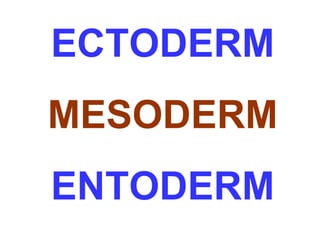
ECTODERM 
MESODERM 
ENTODERM
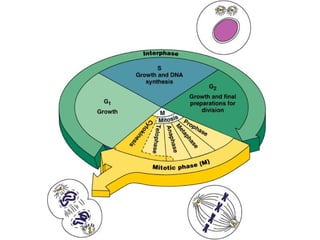
CELL CYCLE 
• G0 
– Quiescent (not a very long or dominent phase) 
• G1 
– PRE-synthetic, but cell GROWTH taking place 
• S 
– Cells which have continuous “turnover” have 
longer, or larger S-phases, i.e., DNA synthesis 
– S-phase of TUMOR CELLS can be prognostic 
• G2 
– PRE-mitotic 
• M (Mitotic:, P,M,A,T, Cytokinesis)
CELL TYPES 
• Labile: eg., marrow, GI 
• Quiescent: liver, kidney 
• NON-mitotic: neuron, 
striated muscle
STEM CELLS 
(TOTIPOTENTIAL*) 
•EMBRYONIC 
•ADULT
EMBRYONIC 
STEM CELLS 
• DIFFERENTIATION 
• KNOCKOUT MICE 
• REPOPULATION OF DAMAGED 
TISSUES, in research
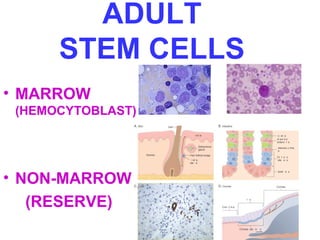
ADULT 
STEM CELLS 
• MARROW 
(HEMOCYTOBLAST) 
• NON-MARROW 
(RESERVE)
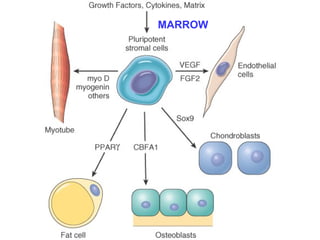
MARROW
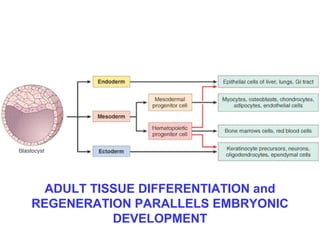
ADULT TISSUE DIFFERENTIATION and 
REGENERATION PARALLELS EMBRYONIC 
DEVELOPMENT
Growth Factors (GFs) 
• Polypeptides 
• Cytokines 
• LOCOMOTION 
• CONTRACTILITY 
• DIFFERENTIATION 
• ANGIOGENESIS
Growth Factors (GFs) 
• Epidermal 
• Transforming (alpha, beta) 
• Hepatocyte 
• Vascular Endothelial 
• Platelet Derived 
• Fibroblast 
• Keratinocyte 
• Cytokines (TNF, IL-1, Interferons)
CELL PLAYERS 
(source AND targets) 
• Lymphocytes, especially T-cells 
• Macrophages 
• Platelets 
• Endothelial cells 
• Fibroblasts 
• Keratinocytes 
• “Mesenchymal” cells 
• Smooth muscle cells
E(Epidermal) GF 
• Made in platelets, macrophages 
• Present in saliva, milk, urine, plasma 
• Acts on keratinocytes to migrate, 
divide 
• Acts on fibroblasts to produce 
“granulation” tissue
T(Transforming) GF-alpha 
• Made in macrophages, T-cells, 
keratinocytes 
• Similar to EGF, also effect on 
hepatocytes
H(Hepatocyte) GF 
• Made in “mesenchymal” cells 
• Proliferation of epithelium, 
endothelium, hepatocytes 
• Effect on cell “motility”
VE(Vascular Endothelial) GF 
• Made in mesenchymal cells 
• Increases vascular permeability 
• Mitogenic for endothelial cells 
• KEY substance in promoting 
“granulation” tissue
PD(Platelet Derived) GF 
• Made in platelets, but also MANY 
other cell types 
• Chemotactic for MANY cells 
• Mitogen for fibroblasts 
• Angiogenesis 
• Another KEY player in granulation 
tissue
F(Fibroblast) GF 
• Made in MANY cells 
• Chemotactic and mitogenic, for 
fibroblasts and keratinocytes 
• Angiogenesis, wound 
contraction
T(Transforming) GF-beta 
• Made in MANY CELLS 
• Chemotactic for PMNs and MANY 
other types of cells
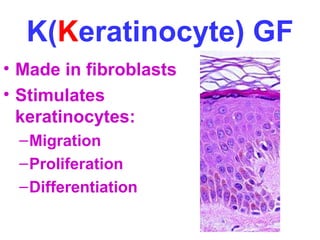
K(Keratinocyte) GF 
• Made in fibroblasts 
• Stimulates 
keratinocytes: 
–Migration 
–Proliferation 
–Differentiation
I(Insulin-like) GF-1 
• Made in macrophages, fibroblasts 
• Stimulates: 
–Sulfated proteoglycans 
–Collagen 
–Keratinocyte migration 
–Fibroblast proliferation 
• Action similar to GH (Pituitary 
Growth Hormone)
TNF (Tumor Necrosis Factor) 
• Made in macrophages, mast 
cells, T-cells 
• Activates macrophages 
• KEY influence on other 
cytokines
Interleukins 
• Made in macrophages, mast cells, 
T-cells, but also MANY other cells 
• MANY functions: 
–Chemotaxis 
–Angiogenesis 
–REGULATION of other cytokines
INTERFERONS 
• Made by lymphocytes, 
fibroblasts 
• Activates MACROPHAGES 
• Inhibits FIBROBLASTS 
• REGULATES other cytokines
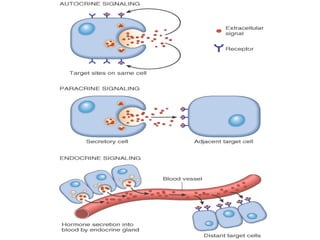
SIGNALING • Autocrine (same cell) 
• Paracrine (next door neighbor) 
(many GFs) 
• Endocrine (far away, delivered 
by blood, steroid hormones)
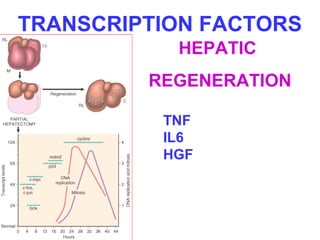
TRANSCRIPTION FACTORS 
HEPATIC 
REGENERATION 
TNF 
IL6 
HGF
ExtraCellular Matrix (ECM) 
• Collagen(s) I-XVIII 
• Elastin 
• Fibrillin 
• CAMs (Cell Adhesion Molecules) 
– Immunoglobulins, cadherins, integrins, 
selectins 
• Proteoglycans 
• Hyaluronic Acid
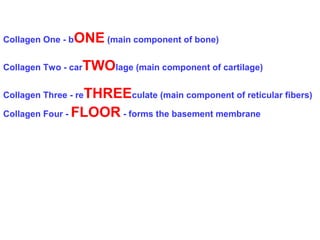
Collagen One - bONE (main component of bone) 
Collagen Two - carTWOlage (main component of cartilage) 
Collagen Three - reTHREEculate (main component of reticular fibers) 
Collagen Four - FLOOR - forms the basement membrane
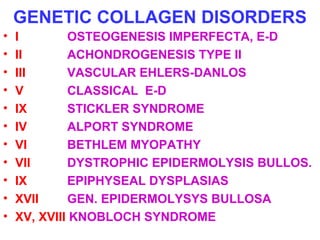
GENETIC COLLAGEN DISORDERS 
• I OSTEOGENESIS IMPERFECTA, E-D 
• II ACHONDROGENESIS TYPE II 
• III VASCULAR EHLERS-DANLOS 
• V CLASSICAL E-D 
• IX STICKLER SYNDROME 
• IV ALPORT SYNDROME 
• VI BETHLEM MYOPATHY 
• VII DYSTROPHIC EPIDERMOLYSIS BULLOS. 
• IX EPIPHYSEAL DYSPLASIAS 
• XVII GEN. EPIDERMOLYSYS BULLOSA 
• XV, XVIII KNOBLOCH SYNDROME
DEFINITIONS: 
•REGENERATION: 
Growth of cells to replace lost tissues 
•HEALING: A reparative tissue 
response to a wound, inflammation or 
necrosis
HEALING • FOLLOWS INFLAMMATION 
• PROLIFERATION and MIGRATION of 
connective tissue cells 
• ANGIOGENESIS (Neovascularization) 
• Collagen, other ECM protein synthesis 
• Tissue Remodeling 
• Wound contraction 
• Increase in wound strength (scar = fibrosis)
ANGIOGENESIS 
(NEOVASCULARIZATION) 
• From endothelial precursor cells 
• From PRE-existing vessels 
• Stimulated/Regulated by GF’s, 
especially VEGF, FGF 
• Also regulated by ECM proteins 
• aka, “GRANULATION”, “GRANULATION 
TISSUE”, “ORGANIZATION”, 
“ORGANIZING INFLAMMATION”
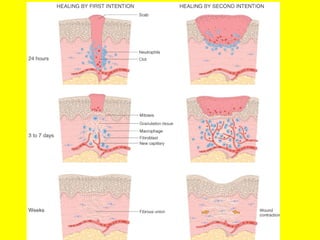
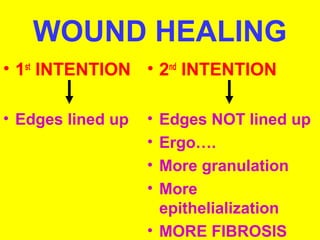
WOUND HEALING 
• 1st INTENTION 
• Edges lined up 
• 2nd INTENTION 
• Edges NOT lined up 
• Ergo…. 
• More granulation 
• More 
epithelialization 
• MORE FIBROSIS
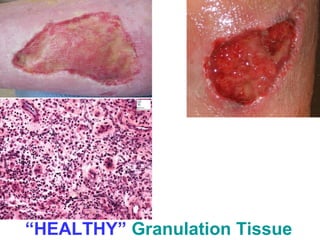
“HEALTHY” Granulation Tissue
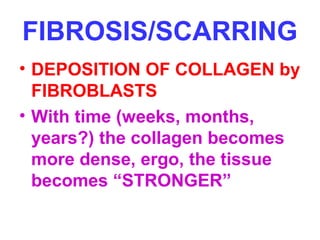
FIBROSIS/SCARRING 
• DEPOSITION OF COLLAGEN by 
FIBROBLASTS 
• With time (weeks, months, 
years?) the collagen becomes 
more dense, ergo, the tissue 
becomes “STRONGER”
Wound RETARDING factors 
(LOCAL) 
• DECREASED Blood supply 
• Denervation 
• Local Infection 
• FB 
• Hematoma 
• Mechanical stress 
• Necrotic tissue
Wound RETARDING factors 
(SYSTEMIC) 
• DECREASED Blood supply 
• Age 
• Anemia 
• Malignancy 
• Malnutrition 
• Obesity 
• Infection 
• Organ failure

3 regen

  • 1.
  • 2.
    LEARNING OBJECTIVES •Review the normal physiology and concepts of cell proliferation, cell growth, cell “cycle”, and cell differentiation • Understand the basic factors of tissue regeneration • Understand the relationships between cells and their ExtraCellular Matrix (ECM) • Understand the roles of the major players of healing---angiogenesis, growth factors (GFs), and fibrosis • Differentiate 1st & 2nd intention healing
  • 3.
    DEFINITIONS: •REGENERATION: Growthof cells to replace lost tissues •HEALING: A reparative tissue response to a wound, inflammation or necrosis, often leads to fibrosis • GRANULATION TISSUE • “ORGANIZING” INFLAMATION
  • 4.
    REGENERATION • Replacementof lost structures • Is dependent on the type of normal turnover the original tissue has • Can be differentiated from “compensatory” growth
  • 5.
    HEALING • Needsa wound, inflammatory process, or necrosis • Many disease appearances anatomically are the result of “healing” such as atherosclerosis • Often ends with a scar • Fibrosis, as one of the 3 possible outcomes of inflammation, follows “healing” • Requires a connective tissue “scaffold” • Fibrosis occurs in proportion to the damage of the ECM
  • 7.
    Cell Population Fates • PROLIFERATION – Hormonal, especially steroid hormones – eg., EPO, CSF • DIFFERENTIATION* – UNIDIRECTIONAL, GAIN and LOSS • APOPTOSIS *One of the most KEY concepts in neoplasia
  • 8.
  • 10.
    CELL CYCLE •G0 – Quiescent (not a very long or dominent phase) • G1 – PRE-synthetic, but cell GROWTH taking place • S – Cells which have continuous “turnover” have longer, or larger S-phases, i.e., DNA synthesis – S-phase of TUMOR CELLS can be prognostic • G2 – PRE-mitotic • M (Mitotic:, P,M,A,T, Cytokinesis)
  • 11.
    CELL TYPES •Labile: eg., marrow, GI • Quiescent: liver, kidney • NON-mitotic: neuron, striated muscle
  • 12.
    STEM CELLS (TOTIPOTENTIAL*) •EMBRYONIC •ADULT
  • 13.
    EMBRYONIC STEM CELLS • DIFFERENTIATION • KNOCKOUT MICE • REPOPULATION OF DAMAGED TISSUES, in research
  • 14.
    ADULT STEM CELLS • MARROW (HEMOCYTOBLAST) • NON-MARROW (RESERVE)
  • 15.
  • 16.
    ADULT TISSUE DIFFERENTIATIONand REGENERATION PARALLELS EMBRYONIC DEVELOPMENT
  • 17.
    Growth Factors (GFs) • Polypeptides • Cytokines • LOCOMOTION • CONTRACTILITY • DIFFERENTIATION • ANGIOGENESIS
  • 18.
    Growth Factors (GFs) • Epidermal • Transforming (alpha, beta) • Hepatocyte • Vascular Endothelial • Platelet Derived • Fibroblast • Keratinocyte • Cytokines (TNF, IL-1, Interferons)
  • 20.
    CELL PLAYERS (sourceAND targets) • Lymphocytes, especially T-cells • Macrophages • Platelets • Endothelial cells • Fibroblasts • Keratinocytes • “Mesenchymal” cells • Smooth muscle cells
  • 21.
    E(Epidermal) GF •Made in platelets, macrophages • Present in saliva, milk, urine, plasma • Acts on keratinocytes to migrate, divide • Acts on fibroblasts to produce “granulation” tissue
  • 22.
    T(Transforming) GF-alpha •Made in macrophages, T-cells, keratinocytes • Similar to EGF, also effect on hepatocytes
  • 23.
    H(Hepatocyte) GF •Made in “mesenchymal” cells • Proliferation of epithelium, endothelium, hepatocytes • Effect on cell “motility”
  • 24.
    VE(Vascular Endothelial) GF • Made in mesenchymal cells • Increases vascular permeability • Mitogenic for endothelial cells • KEY substance in promoting “granulation” tissue
  • 25.
    PD(Platelet Derived) GF • Made in platelets, but also MANY other cell types • Chemotactic for MANY cells • Mitogen for fibroblasts • Angiogenesis • Another KEY player in granulation tissue
  • 26.
    F(Fibroblast) GF •Made in MANY cells • Chemotactic and mitogenic, for fibroblasts and keratinocytes • Angiogenesis, wound contraction
  • 27.
    T(Transforming) GF-beta •Made in MANY CELLS • Chemotactic for PMNs and MANY other types of cells
  • 28.
    K(Keratinocyte) GF •Made in fibroblasts • Stimulates keratinocytes: –Migration –Proliferation –Differentiation
  • 29.
    I(Insulin-like) GF-1 •Made in macrophages, fibroblasts • Stimulates: –Sulfated proteoglycans –Collagen –Keratinocyte migration –Fibroblast proliferation • Action similar to GH (Pituitary Growth Hormone)
  • 30.
    TNF (Tumor NecrosisFactor) • Made in macrophages, mast cells, T-cells • Activates macrophages • KEY influence on other cytokines
  • 31.
    Interleukins • Madein macrophages, mast cells, T-cells, but also MANY other cells • MANY functions: –Chemotaxis –Angiogenesis –REGULATION of other cytokines
  • 32.
    INTERFERONS • Madeby lymphocytes, fibroblasts • Activates MACROPHAGES • Inhibits FIBROBLASTS • REGULATES other cytokines
  • 33.
    SIGNALING • Autocrine(same cell) • Paracrine (next door neighbor) (many GFs) • Endocrine (far away, delivered by blood, steroid hormones)
  • 35.
    TRANSCRIPTION FACTORS HEPATIC REGENERATION TNF IL6 HGF
  • 36.
    ExtraCellular Matrix (ECM) • Collagen(s) I-XVIII • Elastin • Fibrillin • CAMs (Cell Adhesion Molecules) – Immunoglobulins, cadherins, integrins, selectins • Proteoglycans • Hyaluronic Acid
  • 37.
    Collagen One -bONE (main component of bone) Collagen Two - carTWOlage (main component of cartilage) Collagen Three - reTHREEculate (main component of reticular fibers) Collagen Four - FLOOR - forms the basement membrane
  • 38.
    GENETIC COLLAGEN DISORDERS • I OSTEOGENESIS IMPERFECTA, E-D • II ACHONDROGENESIS TYPE II • III VASCULAR EHLERS-DANLOS • V CLASSICAL E-D • IX STICKLER SYNDROME • IV ALPORT SYNDROME • VI BETHLEM MYOPATHY • VII DYSTROPHIC EPIDERMOLYSIS BULLOS. • IX EPIPHYSEAL DYSPLASIAS • XVII GEN. EPIDERMOLYSYS BULLOSA • XV, XVIII KNOBLOCH SYNDROME
  • 39.
    DEFINITIONS: •REGENERATION: Growthof cells to replace lost tissues •HEALING: A reparative tissue response to a wound, inflammation or necrosis
  • 40.
    HEALING • FOLLOWSINFLAMMATION • PROLIFERATION and MIGRATION of connective tissue cells • ANGIOGENESIS (Neovascularization) • Collagen, other ECM protein synthesis • Tissue Remodeling • Wound contraction • Increase in wound strength (scar = fibrosis)
  • 41.
    ANGIOGENESIS (NEOVASCULARIZATION) •From endothelial precursor cells • From PRE-existing vessels • Stimulated/Regulated by GF’s, especially VEGF, FGF • Also regulated by ECM proteins • aka, “GRANULATION”, “GRANULATION TISSUE”, “ORGANIZATION”, “ORGANIZING INFLAMMATION”
  • 44.
    WOUND HEALING •1st INTENTION • Edges lined up • 2nd INTENTION • Edges NOT lined up • Ergo…. • More granulation • More epithelialization • MORE FIBROSIS
  • 46.
  • 47.
    FIBROSIS/SCARRING • DEPOSITIONOF COLLAGEN by FIBROBLASTS • With time (weeks, months, years?) the collagen becomes more dense, ergo, the tissue becomes “STRONGER”
  • 48.
    Wound RETARDING factors (LOCAL) • DECREASED Blood supply • Denervation • Local Infection • FB • Hematoma • Mechanical stress • Necrotic tissue
  • 49.
    Wound RETARDING factors (SYSTEMIC) • DECREASED Blood supply • Age • Anemia • Malignancy • Malnutrition • Obesity • Infection • Organ failure

Editor's Notes

  • #4 Regeneration is a normal process, “healing” follows damage
  • #7 Cells derived from stem cells can do only three things: 1) multiply 2) differentiate, or 3) die (apoptosis)
  • #9 Cells from these three areas behave similarly and look similarly, basically, epithelium vs. connective tissue.
  • #10 Four Phases of the Cell Cycle: Growth (G1), DNA synthesis (S-phase), Premitotic (G2), and Mitotic (P, M, A, T)
  • #13 Differentiate TOTI- from OMNI- from PLEURI- potent cells. These terms are often used interchangeably, but perhaps not totally correctly
  • #15 Adult stem cells, or “near” stem cells, are often given the term “totipotential”, and are ubiquitous, even in blood.
  • #16 Diagram for the ever mysterious concept of “cell differentiation”, ellucidated by “growth factors”.
  • #19 EGF, TGF, HGF, VEGF, PDGF, FGF, FGF, KGF, Cytokines. You really should KNOW what each one primarily does.
  • #29 KEY interplay between mesoderm and ectoderm, like embryonic “induction”
  • #35 Autocrine, paracrine, endocrine concepts
  • #36 Transcription factors take orders from GFs, in humans “compensatory growth”, i.e., regeneration of places which were not even removed, can take place.
  • #37 The ever increasing cast of ECMs: CAMs=ImmunoGlobulin Super Family (IGSF), Cadherins, Selectins, Integrins 18 types of collagen of which Type-I is the most common
  • #39 Ehlers-Danlos: Hyperelastic skin Achondrogenesis, Ib, 2: Small body, short limbs Stickler syndrome: distinctive facial appearance, eye abnormalities, hearing loss, and joint problems, myopia, absent nasal bridge, hyperelasticity Alport syndrome: glomerulonephritis, endstage kidney disease, and hearing loss Bethlem myopathy: progressive myopathy, ankles fingers, joints Dystrophic epidermolysis bullosa: a blistering disease Knobloch syndrome: ophthalmic, retinal abnormalities
  • #41 Healing starts BEFORE the end of inflammation.
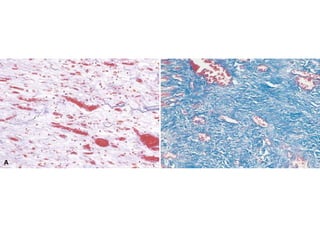
  • #43 Granulation on the left (many blood vessels), fibrosis on the right (trichrome stain stains collagen blue-green)
  • #44 Healing by SECOND intention involves a much greater destruction of the ECM, so therefore it is more likely to produce a greater amount of FIBROSIS
  • #45 The main difference between 1st and 2nd intention is: Are the edges of the wound lined up (1st), or not (2nd).
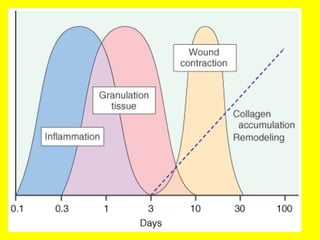
  • #46 These processes also parallel the appearance and regression of cells, namely, in order, neutrophils, macrophages, endothelial cells, fibroblasts. This is my favorite graph.
  • #47 OFTEN, totally HEALTHY granulation tissue can be described as “INFECTED”. Don’t get caught making this mistake.