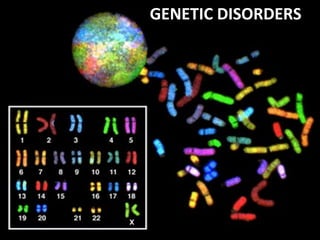
GGEENNEETTIICC DDIISSOORRDDEERRSS
DISEASES 
•GENETIC 
•ENVIRONMENTAL 
•BOTH
MUTATIONS 
• PERMANENT change in DNA 
–GENOME MUTATION: (whole 
chromosome) 
–CHROMOSOME MUTATION: (visible 
chromosome change) 
–GENE MUTATION: (may, and often, result 
in a single base error)
GENE MUTATION 
• DELETION OF A SINGLE BASE 
• SUBSTITUTION OF A SINGLE BASE
POINT MUTATION
GENE MUTATION 
• POINT MUTATION within a coding sequence: 
VAL-GLU 
• MUTATIONS in NON-coding sequences 
defective transcription 
• DELETIONS/INSERTIONS frameshift 
mutation, involvement is NOT a multiple of 3 
• Tri-nucleotide REPEATS, e.g., CGG repeats 
many times in fragile X syndrome
GENE MUTATIONS 
• INTERFERE with protein synthesis 
• SUPPRESS transcription, DNARNA 
• PRODUCE abnormal mRNA 
• DEFECTS carried over into TRANSLATION 
• ABNORMAL proteins WITHOUT 
impairing syntheses
GENETIC DISORDERS 
• SINGLE gene mutations, following 
classical MENDELIAN inheritance 
patterns 
• MULTIFACTORIAL inheritance 
• CHROMOSOMAL disorders
MENDELIAN inheritance patterns 
• AUTOSOMAL DOMINANT 
• AUTOSOMAL RECESSIVE 
• SEX-LINKED (recessive), involving 
“X” chromosome
AUTOSOMAL DOMINANT 
• Disease is in HETEROZYGOTES 
• NEITHER parent may have the disease (NEW 
mut.) 
• REDUCED PENETRANCE (env?, other genes?) 
• VARIABLE EXPRESSIVITY (env?, other 
genes?) 
• May have a DELAYED ONSET 
• Usually result in a REDUCED PRODUCTION 
or INACTIVE protein
AUTOSOMAL DOMINANT 
• HUNTINGTON DISEASE 
• NEUROFIBROMATOSIS 
• MYOTONIC DYSTROPHY 
• TUBEROUS SCLEROSIS 
• POLYCYSTIC KIDNEY 
• HEREDITARY SPHEROCYTOSIS 
• VON WILLEBRAND DISEASE 
• MARFAN SYNDROME 
• EHLERS-DANLOS SYNDROMES(some) 
• OSTEOGENESIS IMPERFECTA 
• ACHONDROPLASIA 
• FAMILIAL HYPERCHOLESTEROLEMIA 
• ACUTE INTERMITTENT PORPHYRIA
AUTOSOMAL DOMINANT PEDIGREE 
1) BOTH SEXES INVOLVED 
2) GENERATIONS NOT SKIPPED
AUTOSOMAL RECESSIVE 
• Disease is in HOMOZYGOTES 
• More UNIFORM expression than AD 
• Often COMPLETE PENETRANCE 
• Onset usually EARLY in life 
• NEW mutations rarely detected clinically 
• Proteins show LOSS of FUNCTION 
• Include ALL inborn errors of metabolism 
• MUCH more common that autosomal dominant
AUTOSOMAL RECESSIVE 
• CF 
• PKU 
• GALACTOSEMIA 
• HOMOCYSTINURIA 
• LYSOSOMAL STORAGE 
• Α-1 ANTITRYPSIN 
• WILSON DISEASE 
• HEMOCHROMATOSIS 
• GLYCOGEN STORAGE 
DISEASES 
Hgb S 
THALASSEMIAS 
CONG. ADRENAL HYPERPLASIA 
EHLERS-DANLOS (some) 
ALKAPTONURIA 
NEUROGENIC MUSC. 
ATROPHIES 
FRIEDREICH ATAXIA 
SPINAL MUSCULAR ATROPHY
AUTOSOMAL RECESSIVE PEDIGREE 
1) BOTH SEXES 
INVOLVED 
2) GENERATIONS 
SKIPPED
SEX (“X”) LINKED 
• MALES ONLY 
• HIS SONS are OK 
• ALL his DAUGHTERS are CARRIERS 
• The “Y” chromosome is NOT homologous to 
the “X”, i.e., the concept of 
dominant/recessive has no meaning here 
• HETEROZYGOUS FEMALES have no 
phenotypic expression (carriers)
SEX (“X”) LINKED 
• DUCHENNE MUSCULAR DYSTROPHY 
• HEMOPHILIA , A and B 
• G6PD DEFICIENCY 
• AGAMMAGLOBULINEMIA 
• WISKOTT-ALDRICH SYNDROME 
• DIABETES INSIPIDUS 
• LESCH-NYHAN SYNDROME 
• FRAGILE-X SYNDROME
SEX LINKED PEDIGREE 
1) MALES ONLY 
2) GENERATION SKIPPING DOESN’T MATTER
SINGLE GENE DISORDERS 
• ENZYME DEFECT (Most of them, e.g., PKU) 
– Accumulation of substrate 
– Lack of product 
– Failure to inactivate a protein which causes damage 
• RECEPTOR/TRANSPORT PROTEIN DEFECT (Familial 
Hypercholesterolemia) 
• STRUCTURAL PROTEIN DEFECT (Marfan, Ehl-Dan) 
– Structure 
– Function 
– Quantity 
• ENZYME DEFECT WHICH INCREASES DRUG 
SUSCEPTIBILITY: G6PDPrimaquine
STRUCTURAL PROTEIN DEFECTS 
• Marfan Syndrome 
– Fibrillin-1 defect 
– Tall, dislocated lens, aortic arch aneurysms, etc. 
– Abraham Lincoln?, Osama bin-Laden 
• Ehlers-Danlos Syndromes (AD, AR) 
– Multiple (6?) different types 
– Classical, Hypermob., Vasc., KyphoSc., ArthChal., Derm 
– Various collagen defects 
– Hyperelastic skin, hyperextensible joints
RECEPTOR PROTEIN DEFECTS 
• FAMILIAL HYPERCHOLESTEROLEMIA 
– LDL RECEPTOR defect 
– Cholesterol TRANSPORT across liver cell impaired 
– ergo, CHOLESTEROL BUILDUP IN BLOOD 
• “Scavenger System” for CHOL kicks in, i.e., 
MACROPHAGES 
• YOU KNOW THE REST OF THE STORY 
• YOU KNOW WHY MACROPHAGES are “FOAMY”
ENZYME DEFICIENCIES 
• BY FAR, THE LARGEST KNOWN 
CATEGORY 
– SUBSTRATE BUILDUP 
– PRODUCT LACK 
– SUBSTRATE could be HARMFUL 
• LYSOSOMAL STORAGE DISEASES 
comprise MOST of them
LYSOSOMAL STORAGE DISEASES 
• GLYCOGEN STORAGE DISEASES 
• SPHINGOLIPIDOSES (Gangliosides) 
• SULFATIDOSES 
• MUCOPOLYSACCHARIDOSES 
• MUCOLIPIDOSES 
• OTHER 
– Fucosidosis, Mannosidosis, Aspartylglycosaminuria 
– WOLMAN, Acid phosphate deficiency
GLYCOGEN STORAGE DISEASES 
• MANY TYPES (at least 10) 
• Type 2 (Pompe), von Gierke, McArdle, most 
studied and discussed, and referred to 
• Storage sites: Liver, Muscle, Heart
SPHINGOLIPIDOSES 
• MANY types, Tay-Sachs most often referred to 
– GANGLIOSIDES are ACCUMULATED 
– Ashkenazi Jews (1/30 are carriers) 
– CNS neurons a site of accumulation 
– CHERRY RED spot in Macula
SULFATIDOSES 
• MANY types, but the metachromatic 
leukodystrophies (CNS), Krabbe, Fabry, 
Gaucher, and Niemann-Pick (A and B) are 
most commonly referred to 
• SULFATIDES, CEREBROSIDES, 
SPHINGOMYELIN are the accumulations
NIEMANN-PICK 
• TYPES A, B, C 
• SPHINGOMYELIN 
• MASSIVE SPLENOMEGALY 
• ALSO in ASHKANAZI JEWS 
• OFTEN FATAL in EARLY LIFE, CNS, ORGANOMEGALY
GAUCHER DISEASE 
• GLUCOCEREBROSIDE BUILDUP 
• 99% are type I, NO CNS involvement 
• ALL MACROPHAGES, liv, spl, nodes, marrow
MUCOPOLYSACCHARIDOSES 
• HURLER/HUNTER, for I and II, respectively 
• DERMATAN sulfate, HEPARAN sulfate buildup 
– coarse facial features 
– clouding of the cornea 
– joint stiffness 
–mental retardation 
– URINARY EXCRETION of SULFATES COMMON
OTHER LYSOSOMAL STORAGE DIS. 
• FUCOSIDOSIS 
• MANNOSIDOSIS 
• ASPARTYLGLYCOSAMINURIA 
• WOLMAN (CHOL., TRIGLYCERIDES) 
• ACID PHOSPHATE DEFICIENCY (PHOS. 
ESTERS)
ALCAPTONURIA 
• NOT a LYSOSOMAL ENZYME DISEASE 
• FIRST ONE TO BE DESCRIBED 
• HOMOGENTISIC ACID 
• HOMOGENTISIC ACID OXIDASE 
–BLACK URINE 
–BLACK NAILS (OCHRONOSIS), SKIN 
–BLACK JOINT CARTILAGE (SEVERE ARTHRITIS)
NEUROFIBROMATOSIS 
• 1 and 2 
• 1-von Recklinghausen 
• 2- “acoustic” neurofibromatosis 
• 1 
– Neurofibromas, café-au-lait, Lisch nodules
NEUROFIBROMATOSIS 
• 1 and 2 
• 1-von Recklinghausen 
• 2- “acoustic” neurofibromatosis 
• 2 
– Bilateral acoustic neuromas and multiple meningiomas
MULTIFACTORIAL INHERITANCE 
• Multi-”FACTORIAL”, not just multi-GENIC 
• “SOIL” theory 
• Common phenotypic expressions governed by 
“multifactorial” inheritance 
– Hair color 
– Eye color 
– Skin color 
– Height 
– Intelligence 
– Diabetes, type II
FEATURES of 
multifactorial inheritance 
• Expression determined by NUMBER of genes 
• Overall 5% chance of 1st degree relatives having it 
• Identical twins >>>5%, but WAY less than 100% 
• This 5% is increased if more children have it 
• Expression of CONTINUOUS traits (e.g., height) vs. 
DISCONTINUOUS traits (e.g., diabetes)
“MULTIFACTORIAL” 
DISORDERS 
• Cleft lip, palate 
• Congenital heart disease 
• Coronary heart disease 
• Hypertension 
• Gout 
• Diabetes 
• Pyloric stenosis 
• MANY, MANY, MANY, MANY MORE
KARYOTYPING 
• Defined as the study of CHROMOSOMES 
• 46 = (22x2) + X = Y 
• Conventional notation is “46,XY” or “46,XX” 
• G(iemsa)-banding, 500 bands per haploid 
recognizable 
• Short (“p”-etit) arm = p, other (long) arm = q
More KARYOTYPING info 
• A,B,C,D,E,F,G depends on chromosome length 
– A longest 
– G shortest 
• Groups within these letters depend on the p/q 
ratio 
• ARMREGIONBANDSub-BAND, 
numbering from the centromere progressing 
distad
F.I.S.H. 
greatly enhances G-banding 
• Fluorescent In- 
Situ 
Hybridization 
• Uses fluorescent 
labelled DNA 
fragments, ~10,000 
base pairs, to bind (or 
not bind) to its 
complement
FISH 
• SUBTLE MICRODELETIONS 
• COMPLEX TRANSLOCATIONS 
• AND TELOMERE ALTERATIONS
TRIPLE CHROMOSOME #20 A DELETION in 
CHROMOSOME #22
SPECTRAL KARYOTYPING
CYTOGENETIC DISORDERS 
• DEFINITIONS: 
– EUPLOID 
– ANEUPLOID (NOT AN EXACT MULTIPLE OF 23) 
–MONOSOMY, AUTOSOME OR SEX 
– TRISOMY, AUTOSOME OR SEX 
–DELETION 
– BREAKAGE
MORE DEFINITIONS
COMMON CYTOGENETIC DISEASES 
• AUTOSOMES 
– TRISOMY-21 (DOWN SYNDROME) 
– 8, 9, 13 (Patau), 18 (Edwards), 22 
– 22q.11.2 deletion 
• SEX CHROMOSOMES 
–KLINEFELTER: XXY, XXXY, etc. 
–TURNER: XO
TRISOMY-21
TRISOMY-21 
• Most trisomies (monosomies, aneuploidy) are 
from maternal non-disjunction 
• (non-disjunction or anaphase lag are BOTH 
possible) 
• #1 cause of mental retardation 
• Maternal age related 
• Congenital Heart Defects, risk for acute leukemias, 
GI atresias 
• Most LOVABLE of all God’s children
Chromosome 22q11.2 
Deletion Syndrome 
• Because of a DELETION, this cannot be 
detected by standard karyotyping and 
needs FISH 
• Cardiac defects, DiGeorge syndrome, 
velocardiofacial
SEX CHROMOSOME DISORDERS 
• Problems related to sexual development and 
fertility 
• Discovered at time of puberty 
• Retardation related to the number of X 
chromosomes 
• If you have at least ONE “Y” chromosome, 
you are male
KLINEFELTER (XXY, XXXY, etc.) 
• Hypogonadism found at puberty 
• #1 cause of male infertility 
• NO retardation unless more X’s 
• 47, XXY 82% of the time 
• L----O----N----G legs, atrophic testes, 
small penis
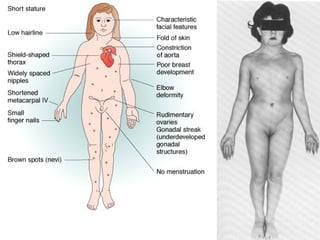
TURNER (XO) 
• 45, X is the “proper” designation 
• Mosaics common 
• Often, the WHOLE chromosome is not 
missing, but just part 
• NECK “WEBBING” 
• EDEMA of HAND DORSUM 
• CONGENITAL HEART DEFECTS most 
FEARED
HERMAPHRODITES 
• GENETIC SEX is determined by the PRESENCE or ABSENCE 
of a “Y” chromosome, but there is also, GONADAL 
(phenotypic), and DUCTAL sex 
• TRUE HERMAPHRODITE: OVARIES AND TESTES, often on 
opposite sides 
• PSEUDO-HERMAPHRODITE: 
– MALE: TESTES with female characteristics (Y-) 
– FEMALE: OVARIES with male characteristics (XX)
SINGLE GENE, NON-Mendelian 
• Triplet repeats 
–Fragile X (CGG) 
–Others: ataxias, myotonic dystrophy 
• Mitochondrial Mutations: (maternal) 
(LEBER HEREDITARY OPTIC NEUROPATHY) 
• Genomic “IMPRINTING”: (Inactivation of 
maternal or paternal allele) 
• Gonadal “MOSAICISM”: (only gametes have 
mutated cells)
MOLECULAR DX by DNA PROBES 
• BIRTH DEFECTS, PRE- or POST- NATAL 
• TUMOR CELLS 
• CLASSIFICATIONS of TUMORS 
• IDENTIFICATION of PATHOGENS 
• DONOR COMPATIBILITY 
• PATERNITY 
• FORENSIC

5.genetics

  • 1.
  • 2.
  • 3.
    MUTATIONS • PERMANENTchange in DNA –GENOME MUTATION: (whole chromosome) –CHROMOSOME MUTATION: (visible chromosome change) –GENE MUTATION: (may, and often, result in a single base error)
  • 4.
    GENE MUTATION •DELETION OF A SINGLE BASE • SUBSTITUTION OF A SINGLE BASE
  • 5.
  • 6.
    GENE MUTATION •POINT MUTATION within a coding sequence: VAL-GLU • MUTATIONS in NON-coding sequences defective transcription • DELETIONS/INSERTIONS frameshift mutation, involvement is NOT a multiple of 3 • Tri-nucleotide REPEATS, e.g., CGG repeats many times in fragile X syndrome
  • 7.
    GENE MUTATIONS •INTERFERE with protein synthesis • SUPPRESS transcription, DNARNA • PRODUCE abnormal mRNA • DEFECTS carried over into TRANSLATION • ABNORMAL proteins WITHOUT impairing syntheses
  • 8.
    GENETIC DISORDERS •SINGLE gene mutations, following classical MENDELIAN inheritance patterns • MULTIFACTORIAL inheritance • CHROMOSOMAL disorders
  • 9.
    MENDELIAN inheritance patterns • AUTOSOMAL DOMINANT • AUTOSOMAL RECESSIVE • SEX-LINKED (recessive), involving “X” chromosome
  • 10.
    AUTOSOMAL DOMINANT •Disease is in HETEROZYGOTES • NEITHER parent may have the disease (NEW mut.) • REDUCED PENETRANCE (env?, other genes?) • VARIABLE EXPRESSIVITY (env?, other genes?) • May have a DELAYED ONSET • Usually result in a REDUCED PRODUCTION or INACTIVE protein
  • 11.
    AUTOSOMAL DOMINANT •HUNTINGTON DISEASE • NEUROFIBROMATOSIS • MYOTONIC DYSTROPHY • TUBEROUS SCLEROSIS • POLYCYSTIC KIDNEY • HEREDITARY SPHEROCYTOSIS • VON WILLEBRAND DISEASE • MARFAN SYNDROME • EHLERS-DANLOS SYNDROMES(some) • OSTEOGENESIS IMPERFECTA • ACHONDROPLASIA • FAMILIAL HYPERCHOLESTEROLEMIA • ACUTE INTERMITTENT PORPHYRIA
  • 12.
    AUTOSOMAL DOMINANT PEDIGREE 1) BOTH SEXES INVOLVED 2) GENERATIONS NOT SKIPPED
  • 13.
    AUTOSOMAL RECESSIVE •Disease is in HOMOZYGOTES • More UNIFORM expression than AD • Often COMPLETE PENETRANCE • Onset usually EARLY in life • NEW mutations rarely detected clinically • Proteins show LOSS of FUNCTION • Include ALL inborn errors of metabolism • MUCH more common that autosomal dominant
  • 14.
    AUTOSOMAL RECESSIVE •CF • PKU • GALACTOSEMIA • HOMOCYSTINURIA • LYSOSOMAL STORAGE • Α-1 ANTITRYPSIN • WILSON DISEASE • HEMOCHROMATOSIS • GLYCOGEN STORAGE DISEASES Hgb S THALASSEMIAS CONG. ADRENAL HYPERPLASIA EHLERS-DANLOS (some) ALKAPTONURIA NEUROGENIC MUSC. ATROPHIES FRIEDREICH ATAXIA SPINAL MUSCULAR ATROPHY
  • 15.
    AUTOSOMAL RECESSIVE PEDIGREE 1) BOTH SEXES INVOLVED 2) GENERATIONS SKIPPED
  • 16.
    SEX (“X”) LINKED • MALES ONLY • HIS SONS are OK • ALL his DAUGHTERS are CARRIERS • The “Y” chromosome is NOT homologous to the “X”, i.e., the concept of dominant/recessive has no meaning here • HETEROZYGOUS FEMALES have no phenotypic expression (carriers)
  • 17.
    SEX (“X”) LINKED • DUCHENNE MUSCULAR DYSTROPHY • HEMOPHILIA , A and B • G6PD DEFICIENCY • AGAMMAGLOBULINEMIA • WISKOTT-ALDRICH SYNDROME • DIABETES INSIPIDUS • LESCH-NYHAN SYNDROME • FRAGILE-X SYNDROME
  • 18.
    SEX LINKED PEDIGREE 1) MALES ONLY 2) GENERATION SKIPPING DOESN’T MATTER
  • 19.
    SINGLE GENE DISORDERS • ENZYME DEFECT (Most of them, e.g., PKU) – Accumulation of substrate – Lack of product – Failure to inactivate a protein which causes damage • RECEPTOR/TRANSPORT PROTEIN DEFECT (Familial Hypercholesterolemia) • STRUCTURAL PROTEIN DEFECT (Marfan, Ehl-Dan) – Structure – Function – Quantity • ENZYME DEFECT WHICH INCREASES DRUG SUSCEPTIBILITY: G6PDPrimaquine
  • 20.
    STRUCTURAL PROTEIN DEFECTS • Marfan Syndrome – Fibrillin-1 defect – Tall, dislocated lens, aortic arch aneurysms, etc. – Abraham Lincoln?, Osama bin-Laden • Ehlers-Danlos Syndromes (AD, AR) – Multiple (6?) different types – Classical, Hypermob., Vasc., KyphoSc., ArthChal., Derm – Various collagen defects – Hyperelastic skin, hyperextensible joints
  • 21.
    RECEPTOR PROTEIN DEFECTS • FAMILIAL HYPERCHOLESTEROLEMIA – LDL RECEPTOR defect – Cholesterol TRANSPORT across liver cell impaired – ergo, CHOLESTEROL BUILDUP IN BLOOD • “Scavenger System” for CHOL kicks in, i.e., MACROPHAGES • YOU KNOW THE REST OF THE STORY • YOU KNOW WHY MACROPHAGES are “FOAMY”
  • 22.
    ENZYME DEFICIENCIES •BY FAR, THE LARGEST KNOWN CATEGORY – SUBSTRATE BUILDUP – PRODUCT LACK – SUBSTRATE could be HARMFUL • LYSOSOMAL STORAGE DISEASES comprise MOST of them
  • 23.
    LYSOSOMAL STORAGE DISEASES • GLYCOGEN STORAGE DISEASES • SPHINGOLIPIDOSES (Gangliosides) • SULFATIDOSES • MUCOPOLYSACCHARIDOSES • MUCOLIPIDOSES • OTHER – Fucosidosis, Mannosidosis, Aspartylglycosaminuria – WOLMAN, Acid phosphate deficiency
  • 24.
    GLYCOGEN STORAGE DISEASES • MANY TYPES (at least 10) • Type 2 (Pompe), von Gierke, McArdle, most studied and discussed, and referred to • Storage sites: Liver, Muscle, Heart
  • 25.
    SPHINGOLIPIDOSES • MANYtypes, Tay-Sachs most often referred to – GANGLIOSIDES are ACCUMULATED – Ashkenazi Jews (1/30 are carriers) – CNS neurons a site of accumulation – CHERRY RED spot in Macula
  • 26.
    SULFATIDOSES • MANYtypes, but the metachromatic leukodystrophies (CNS), Krabbe, Fabry, Gaucher, and Niemann-Pick (A and B) are most commonly referred to • SULFATIDES, CEREBROSIDES, SPHINGOMYELIN are the accumulations
  • 27.
    NIEMANN-PICK • TYPESA, B, C • SPHINGOMYELIN • MASSIVE SPLENOMEGALY • ALSO in ASHKANAZI JEWS • OFTEN FATAL in EARLY LIFE, CNS, ORGANOMEGALY
  • 28.
    GAUCHER DISEASE •GLUCOCEREBROSIDE BUILDUP • 99% are type I, NO CNS involvement • ALL MACROPHAGES, liv, spl, nodes, marrow
  • 29.
    MUCOPOLYSACCHARIDOSES • HURLER/HUNTER,for I and II, respectively • DERMATAN sulfate, HEPARAN sulfate buildup – coarse facial features – clouding of the cornea – joint stiffness –mental retardation – URINARY EXCRETION of SULFATES COMMON
  • 30.
    OTHER LYSOSOMAL STORAGEDIS. • FUCOSIDOSIS • MANNOSIDOSIS • ASPARTYLGLYCOSAMINURIA • WOLMAN (CHOL., TRIGLYCERIDES) • ACID PHOSPHATE DEFICIENCY (PHOS. ESTERS)
  • 31.
    ALCAPTONURIA • NOTa LYSOSOMAL ENZYME DISEASE • FIRST ONE TO BE DESCRIBED • HOMOGENTISIC ACID • HOMOGENTISIC ACID OXIDASE –BLACK URINE –BLACK NAILS (OCHRONOSIS), SKIN –BLACK JOINT CARTILAGE (SEVERE ARTHRITIS)
  • 34.
    NEUROFIBROMATOSIS • 1and 2 • 1-von Recklinghausen • 2- “acoustic” neurofibromatosis • 1 – Neurofibromas, café-au-lait, Lisch nodules
  • 35.
    NEUROFIBROMATOSIS • 1and 2 • 1-von Recklinghausen • 2- “acoustic” neurofibromatosis • 2 – Bilateral acoustic neuromas and multiple meningiomas
  • 36.
    MULTIFACTORIAL INHERITANCE •Multi-”FACTORIAL”, not just multi-GENIC • “SOIL” theory • Common phenotypic expressions governed by “multifactorial” inheritance – Hair color – Eye color – Skin color – Height – Intelligence – Diabetes, type II
  • 37.
    FEATURES of multifactorialinheritance • Expression determined by NUMBER of genes • Overall 5% chance of 1st degree relatives having it • Identical twins >>>5%, but WAY less than 100% • This 5% is increased if more children have it • Expression of CONTINUOUS traits (e.g., height) vs. DISCONTINUOUS traits (e.g., diabetes)
  • 38.
    “MULTIFACTORIAL” DISORDERS •Cleft lip, palate • Congenital heart disease • Coronary heart disease • Hypertension • Gout • Diabetes • Pyloric stenosis • MANY, MANY, MANY, MANY MORE
  • 39.
    KARYOTYPING • Definedas the study of CHROMOSOMES • 46 = (22x2) + X = Y • Conventional notation is “46,XY” or “46,XX” • G(iemsa)-banding, 500 bands per haploid recognizable • Short (“p”-etit) arm = p, other (long) arm = q
  • 41.
    More KARYOTYPING info • A,B,C,D,E,F,G depends on chromosome length – A longest – G shortest • Groups within these letters depend on the p/q ratio • ARMREGIONBANDSub-BAND, numbering from the centromere progressing distad
  • 43.
    F.I.S.H. greatly enhancesG-banding • Fluorescent In- Situ Hybridization • Uses fluorescent labelled DNA fragments, ~10,000 base pairs, to bind (or not bind) to its complement
  • 44.
    FISH • SUBTLEMICRODELETIONS • COMPLEX TRANSLOCATIONS • AND TELOMERE ALTERATIONS
  • 45.
    TRIPLE CHROMOSOME #20A DELETION in CHROMOSOME #22
  • 46.
  • 47.
    CYTOGENETIC DISORDERS •DEFINITIONS: – EUPLOID – ANEUPLOID (NOT AN EXACT MULTIPLE OF 23) –MONOSOMY, AUTOSOME OR SEX – TRISOMY, AUTOSOME OR SEX –DELETION – BREAKAGE
  • 48.
  • 49.
    COMMON CYTOGENETIC DISEASES • AUTOSOMES – TRISOMY-21 (DOWN SYNDROME) – 8, 9, 13 (Patau), 18 (Edwards), 22 – 22q.11.2 deletion • SEX CHROMOSOMES –KLINEFELTER: XXY, XXXY, etc. –TURNER: XO
  • 50.
  • 51.
    TRISOMY-21 • Mosttrisomies (monosomies, aneuploidy) are from maternal non-disjunction • (non-disjunction or anaphase lag are BOTH possible) • #1 cause of mental retardation • Maternal age related • Congenital Heart Defects, risk for acute leukemias, GI atresias • Most LOVABLE of all God’s children
  • 53.
    Chromosome 22q11.2 DeletionSyndrome • Because of a DELETION, this cannot be detected by standard karyotyping and needs FISH • Cardiac defects, DiGeorge syndrome, velocardiofacial
  • 55.
    SEX CHROMOSOME DISORDERS • Problems related to sexual development and fertility • Discovered at time of puberty • Retardation related to the number of X chromosomes • If you have at least ONE “Y” chromosome, you are male
  • 56.
    KLINEFELTER (XXY, XXXY,etc.) • Hypogonadism found at puberty • #1 cause of male infertility • NO retardation unless more X’s • 47, XXY 82% of the time • L----O----N----G legs, atrophic testes, small penis
  • 58.
    TURNER (XO) •45, X is the “proper” designation • Mosaics common • Often, the WHOLE chromosome is not missing, but just part • NECK “WEBBING” • EDEMA of HAND DORSUM • CONGENITAL HEART DEFECTS most FEARED
  • 60.
    HERMAPHRODITES • GENETICSEX is determined by the PRESENCE or ABSENCE of a “Y” chromosome, but there is also, GONADAL (phenotypic), and DUCTAL sex • TRUE HERMAPHRODITE: OVARIES AND TESTES, often on opposite sides • PSEUDO-HERMAPHRODITE: – MALE: TESTES with female characteristics (Y-) – FEMALE: OVARIES with male characteristics (XX)
  • 61.
    SINGLE GENE, NON-Mendelian • Triplet repeats –Fragile X (CGG) –Others: ataxias, myotonic dystrophy • Mitochondrial Mutations: (maternal) (LEBER HEREDITARY OPTIC NEUROPATHY) • Genomic “IMPRINTING”: (Inactivation of maternal or paternal allele) • Gonadal “MOSAICISM”: (only gametes have mutated cells)
  • 62.
    MOLECULAR DX byDNA PROBES • BIRTH DEFECTS, PRE- or POST- NATAL • TUMOR CELLS • CLASSIFICATIONS of TUMORS • IDENTIFICATION of PATHOGENS • DONOR COMPATIBILITY • PATERNITY • FORENSIC

Editor's Notes

  • #6 Classical concept of a point mutation
  • #41 The “official” notation for the normal male pattern is: “47, XY”
  • #53 You do not have to see many trisomy-21 patients until you can recognize them very quickly and easily