3. Polynomials
Introduction
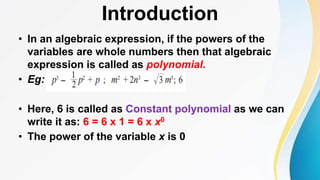
• In an algebraic expression, if the powers of the
variables are whole numbers then that algebraic
expression is called as polynomial.
• Eg:
• Here, 6 is called as Constant polynomial as we can
write it as: 6 = 6 x 1 = 6 x x0
• The power of the variable x is 0
Degree of polynomial in one variable
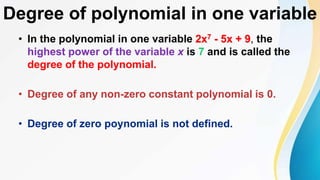
• In the polynomial in one variable 2x7 - 5x + 9, the
highest power of the variable x is 7 and is called the
degree of the polynomial.
• Degree of any non-zero constant polynomial is 0.
• Degree of zero poynomial is not defined.
Degree of a polynomial in more than
one variable
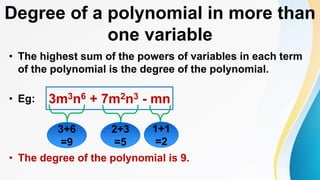
• The highest sum of the powers of variables in each term
of the polynomial is the degree of the polynomial.
• Eg:
• The degree of the polynomial is 9.
3m3n6 + 7m2n3 - mn
3+6
=9
2+3
=5
1+1
=2
Forms of polynomial
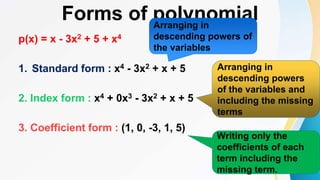
p(x) = x - 3x2 + 5 + x4
1. Standard form : x4 - 3x2 + x + 5
2. Index form : x4 + 0x3 - 3x2 + x + 5
3. Coefficient form : (1, 0, -3, 1, 5)
Arranging in
descending powers of
the variables
Arranging in
descending powers
of the variables and
including the missing
terms
Writing only the
coefficients of each
term including the
missing term.
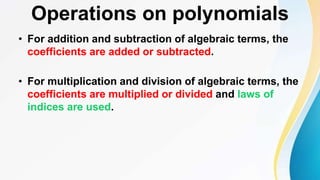
Operations on polynomials
• For addition and subtraction of algebraic terms, the
coefficients are added or subtracted.
• For multiplication and division of algebraic terms, the
coefficients are multiplied or divided and laws of
indices are used.
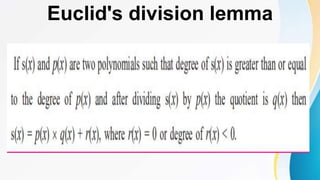
Euclid's division lemma
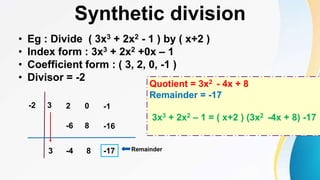
Synthetic division
• Eg : Divide ( 3x3 + 2x2 - 1 ) by ( x+2 )
• Index form : 3x3 + 2x2 +0x – 1
• Coefficient form : ( 3, 2, 0, -1 )
• Divisor = -2
3 2
-2
-4
3 8
-6 8
-17
0
-16
-1
Remainder
Quotient = 3x2 - 4x + 8
Remainder = -17
3x3 + 2x2 – 1 = ( x+2 ) (3x2 -4x + 8) -17
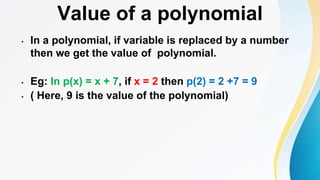
Value of a polynomial
• In a polynomial, if variable is replaced by a number
then we get the value of polynomial.
• Eg: In p(x) = x + 7, if x = 2 then p(2) = 2 +7 = 9
• ( Here, 9 is the value of the polynomial)
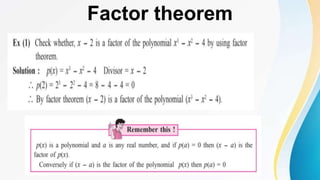
Factor theorem
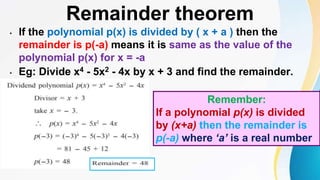
Remainder theorem
• If the polynomial p(x) is divided by ( x + a ) then the
remainder is p(-a) means it is same as the value of the
polynomial p(x) for x = -a
• Eg: Divide x4 - 5x2 - 4x by x + 3 and find the remainder.
Remember:
If a polynomial p(x) is divided
by (x+a) then the remainder is
p(-a) where ‘a’ is a real number
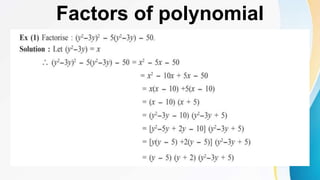
Factors of polynomial
3. Polynomials

3. Polynomials

  • 1.
  • 2.
    Introduction • In analgebraic expression, if the powers of the variables are whole numbers then that algebraic expression is called as polynomial. • Eg: • Here, 6 is called as Constant polynomial as we can write it as: 6 = 6 x 1 = 6 x x0 • The power of the variable x is 0
  • 4.
    Degree of polynomialin one variable • In the polynomial in one variable 2x7 - 5x + 9, the highest power of the variable x is 7 and is called the degree of the polynomial. • Degree of any non-zero constant polynomial is 0. • Degree of zero poynomial is not defined.
  • 5.
    Degree of apolynomial in more than one variable • The highest sum of the powers of variables in each term of the polynomial is the degree of the polynomial. • Eg: • The degree of the polynomial is 9. 3m3n6 + 7m2n3 - mn 3+6 =9 2+3 =5 1+1 =2
  • 7.
    Forms of polynomial p(x)= x - 3x2 + 5 + x4 1. Standard form : x4 - 3x2 + x + 5 2. Index form : x4 + 0x3 - 3x2 + x + 5 3. Coefficient form : (1, 0, -3, 1, 5) Arranging in descending powers of the variables Arranging in descending powers of the variables and including the missing terms Writing only the coefficients of each term including the missing term.
  • 8.
    Operations on polynomials •For addition and subtraction of algebraic terms, the coefficients are added or subtracted. • For multiplication and division of algebraic terms, the coefficients are multiplied or divided and laws of indices are used.
  • 9.
  • 10.
    Synthetic division • Eg: Divide ( 3x3 + 2x2 - 1 ) by ( x+2 ) • Index form : 3x3 + 2x2 +0x – 1 • Coefficient form : ( 3, 2, 0, -1 ) • Divisor = -2 3 2 -2 -4 3 8 -6 8 -17 0 -16 -1 Remainder Quotient = 3x2 - 4x + 8 Remainder = -17 3x3 + 2x2 – 1 = ( x+2 ) (3x2 -4x + 8) -17
  • 11.
    Value of apolynomial • In a polynomial, if variable is replaced by a number then we get the value of polynomial. • Eg: In p(x) = x + 7, if x = 2 then p(2) = 2 +7 = 9 • ( Here, 9 is the value of the polynomial)
  • 12.
  • 13.
    Remainder theorem • Ifthe polynomial p(x) is divided by ( x + a ) then the remainder is p(-a) means it is same as the value of the polynomial p(x) for x = -a • Eg: Divide x4 - 5x2 - 4x by x + 3 and find the remainder. Remember: If a polynomial p(x) is divided by (x+a) then the remainder is p(-a) where ‘a’ is a real number
  • 14.