 The need for Production Planning
 Demand Forecasting
 Aggregate Production Planning
 Strategies of Aggregate Planning
 Scheduling
 Workforce Planning
 Materials Requirement Planning
 Capacity Planning
 Production Control using JIT
 Shop-Floor Control
2May-16
Addresses decisions on
Acquisition
Utilization
Allocation of limited production resources
Resources include the production facilities, labor
and materials.
Constraints include the availability of resources,
delivery times for the products and management
policies.
3May-16
Main objective is to take appropriate decisions.
Typical decisions
Work force level
Production lot sizes
Assignment of overtime
Sequencing of production runs
4May-16
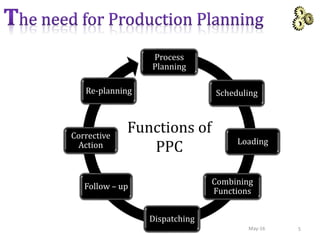
Process
Planning
Scheduling
Loading
Combining
Functions
Dispatching
Follow – up
Corrective
Action
Re-planning
Functions of
PPC
5May-16
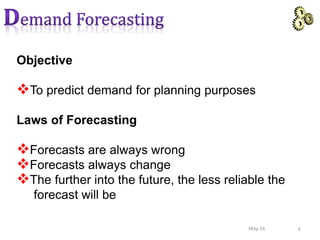
Objective
To predict demand for planning purposes
Laws of Forecasting
Forecasts are always wrong
Forecasts always change
The further into the future, the less reliable the
forecast will be
6May-16
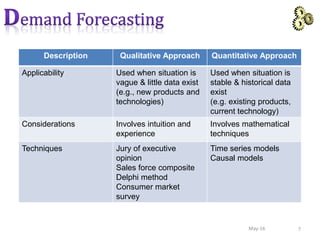
7May-16
Description Qualitative Approach Quantitative Approach
Applicability Used when situation is
vague & little data exist
(e.g., new products and
technologies)
Used when situation is
stable & historical data
exist
(e.g. existing products,
current technology)
Considerations Involves intuition and
experience
Involves mathematical
techniques
Techniques Jury of executive
opinion
Sales force composite
Delphi method
Consumer market
survey
Time series models
Causal models
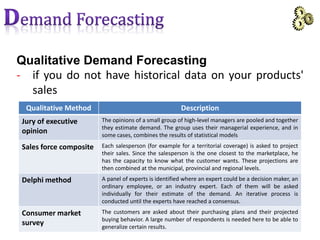
Qualitative Demand Forecasting
- if you do not have historical data on your products'
sales
8May-16
Qualitative Method Description
Jury of executive
opinion
The opinions of a small group of high-level managers are pooled and together
they estimate demand. The group uses their managerial experience, and in
some cases, combines the results of statistical models
Sales force composite Each salesperson (for example for a territorial coverage) is asked to project
their sales. Since the salesperson is the one closest to the marketplace, he
has the capacity to know what the customer wants. These projections are
then combined at the municipal, provincial and regional levels.
Delphi method A panel of experts is identified where an expert could be a decision maker, an
ordinary employee, or an industry expert. Each of them will be asked
individually for their estimate of the demand. An iterative process is
conducted until the experts have reached a consensus.
Consumer market
survey
The customers are asked about their purchasing plans and their projected
buying behavior. A large number of respondents is needed here to be able to
generalize certain results.
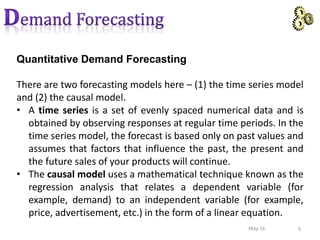
Quantitative Demand Forecasting
There are two forecasting models here – (1) the time series model
and (2) the causal model.
• A time series is a set of evenly spaced numerical data and is
obtained by observing responses at regular time periods. In the
time series model, the forecast is based only on past values and
assumes that factors that influence the past, the present and
the future sales of your products will continue.
• The causal model uses a mathematical technique known as the
regression analysis that relates a dependent variable (for
example, demand) to an independent variable (for example,
price, advertisement, etc.) in the form of a linear equation.
9May-16
• operational activity that does an aggregate plan
for the production process, to give an idea to
management as to what quantity of materials and
other resources are to be procured and when, so
that the total cost of operations of the
organization is kept to the minimum over that
period
10May-16
Objective
To generate a medium-term production plan
To establish rough product mix
To anticipates bottlenecks
To align capacity and workforce plans.
Demand changes over a period of time at a faster
rate than the resources. Aggregate planning offers
strategies to absorb these fluctuations.
11May-16
Guidelines for Aggregate Planning
Determine demand for each period
Consider company policies that may have impact
Determine capacities for each period
Regular time, overtime, subcontracting, etc.
Identify backorder or inventory amount
Determine costs of operation
Continue through time horizon to calculate total cost
Develop alternate plans and compute cost for each
Select the plan that meets objectives
12May-16
13
Output of Aggregate Planning
Production quantity from regular time, overtime
and subcontracted time
Inventory held for determination of how much
warehouse space and working capital is needed
Backlog or stock-out quantity for determining the
customer service levels
May-16
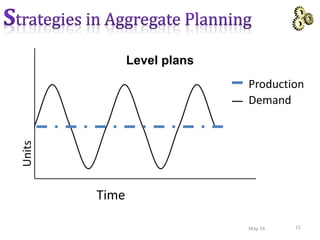
Level plans
Use a constant workforce & produce similar
quantities each time period
Use inventories and backorders to absorb
demand peaks & valleys
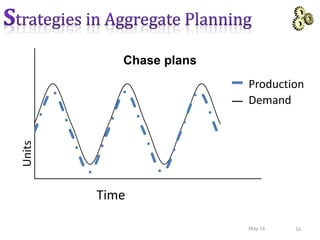
Chase plans
Minimize finished good inventories by trying to keep
pace with demand fluctuations
14May-16
Production
Demand
15
Units
Time
May-16
Level plans
Units
Time
Series1
16May-16
Production
Demand
Chase plans
Series1
Hybrid or Mixed Strategies
Build-up inventory ahead of rising demand and
use backorders to level extreme peaks
Layoff or furlough workers during lulls
Subcontract production or hire temporary
workers to cover short-term peaks
Reassign workers to preventive maintenance
during lulls
Influencing Demand
17May-16
• process of arranging, controlling and optimizing
work and workloads in a production process or
manufacturing process
• used to allocate plant and machinery resources,
plan human resources, plan production processes
and purchase materials
18May-16
Concerned with timetable of production
Scheduling arranges the different manufacturing
operations in order of priority, fixing the time & date
for the commencement & completion of each
operation.
19May-16
• continual process used to align the needs and priorities of
the organization with those of its workforce to ensure it
can meet its legislative, regulatory, service and production
requirements and organizational objectives
• enables evidence based workforce development
strategies
To find out and direct
Right people
Right place
Right time
Right price
20May-16
Issues
Basic Staffing Calculations and labor hours
Working Environment
Flexibility/Agility
Quality
21May-16
MRP is a production planning and inventory control
system used to manage manufacturing processes.
An MRP system has 3 major objectives
Ensure materials are available for production and
products are available for delivery to customers
Maintain the lowest possible level of inventory
Plan manufacturing activities, delivery schedules
and purchasing activities
22May-16
MRP steps
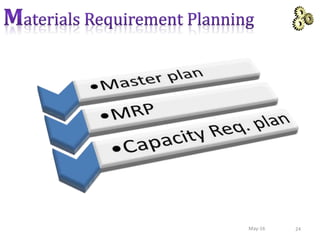
Takes output from the planning phase (master plan)
Combines that with the information from the
inventory record and product structure records
Determines a schedule of timing and quantities for
each item
The basic idea is to get the right materials to the right
place at the right time.
23May-16
24May-16
25May-16
The process of determining the production
capacity needed to meet changing demands
Maximum amount of work that an organization is
capable of completing in a given period of time
26May-16
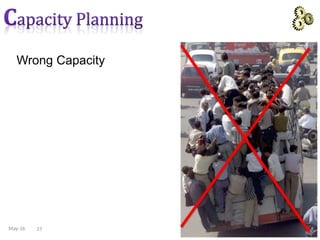
Wrong Capacity
27May-16
Classes of capacity planning
Lead strategy
Lag strategy
Match strategy
28May-16
Issues
Stand-alone capacities and congestion effects
Capacity Strategy
Make-or-Buy
Flexibility
Scalability and learning curves
29May-16
JIT is the technique for reducing inventories and
elimination of waste in the production system.
Objectives
To eliminate waste
To improve quality
To minimize lead time
To reduce costs
To improve productivity
30May-16
Pull production and kanban
JIT is associated with pull systems.
Toyota was the first developer of kanban system.
Examples
McDonalds'
Office Xerox Paper
31May-16
Issues
JIT Interdependencies
Implementing Issues
JIT purchasing
Expected Outcomes
32May-16
• comprises the methods and systems used to
prioritize, track, and report against production orders
and schedules.
• includes the procedures used to evaluate current
resource status, labor, machine usage, and other
information required to support the overall planning,
scheduling, and costing systems related to shop floor
operation.
• typically calculates work in process based on a
percentage of completion for each order and
operation that is useful in inventory valuations and
materials planning.
33May-16
Objective
To control flow of work through plant and coordinate
with other activities (e.g., quality control, preventive
maintenance, etc.)
34May-16
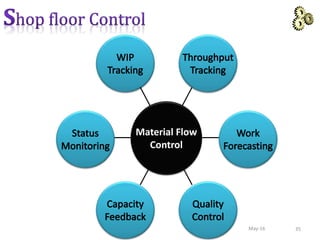
Material Flow
Control
35May-16
Functions
Gross Capacity Control
Match line to demand by staffing (workers/shifts)
Varying length of work week (or work day)
Using outside vendors to augment capacity
Contd…
36May-16
Functions
Bottleneck Planning
Handling of bottlenecks
Cost of capacity is the key
Stable bottlenecks are easier to manage
Span of Control
Physically or logically decompose system
Span of labor and process management
37May-16
Issues
Customization
SFC is often the most highly customized activity in
a plant.
Information Collection
SFC represents the interface with the actual
production processes and is therefore a good
place to collect data. Contd…
38May-16
Issues
Simplicity
Departures from simple mechanisms must be
carefully justified.
39May-16
THANK YOU!
41May-16
Management Science II, by Dr.T.T. Narendran, IIT
Madras (pdf format)
Shop floor Control, by Wallace J Hopp and Mark
J Spearman, 1996-2000
www.factory-physics.com
Production Planning and Control, Lesson 8, Abha
Kumar
Production and Inventory Control, by Dr. Lotfi K.
Gaafar, 2005 (ppt format)
Manufacturing Planning and Control, by Stephen
C. Graves, MIT Boston, Nov1999 (pdf format)
42May-16
http://en.wikipedia.org/wiki/Aggregate_planning
http://www.slideshare.net/birubiru/aggregate-
planning-2069281
http://www.buec.udel.edu/murphys/2009%20SLIDE
%20PACKET/Chapter13AggPlanFINAL.pdf
http://www.scribd.com/doc/11590350/Aggregate-
Planning
Production Planning and Inventory Control, 2nd Edition,
by Seetharama L. Narasimhan, Dennis W. Mcleavey and
Peter J. Billington

Production planning and control

  • 2.
     The needfor Production Planning  Demand Forecasting  Aggregate Production Planning  Strategies of Aggregate Planning  Scheduling  Workforce Planning  Materials Requirement Planning  Capacity Planning  Production Control using JIT  Shop-Floor Control 2May-16
  • 3.
    Addresses decisions on Acquisition Utilization Allocationof limited production resources Resources include the production facilities, labor and materials. Constraints include the availability of resources, delivery times for the products and management policies. 3May-16
  • 4.
    Main objective isto take appropriate decisions. Typical decisions Work force level Production lot sizes Assignment of overtime Sequencing of production runs 4May-16
  • 5.
  • 6.
    Objective To predict demandfor planning purposes Laws of Forecasting Forecasts are always wrong Forecasts always change The further into the future, the less reliable the forecast will be 6May-16
  • 7.
    7May-16 Description Qualitative ApproachQuantitative Approach Applicability Used when situation is vague & little data exist (e.g., new products and technologies) Used when situation is stable & historical data exist (e.g. existing products, current technology) Considerations Involves intuition and experience Involves mathematical techniques Techniques Jury of executive opinion Sales force composite Delphi method Consumer market survey Time series models Causal models
  • 8.
    Qualitative Demand Forecasting -if you do not have historical data on your products' sales 8May-16 Qualitative Method Description Jury of executive opinion The opinions of a small group of high-level managers are pooled and together they estimate demand. The group uses their managerial experience, and in some cases, combines the results of statistical models Sales force composite Each salesperson (for example for a territorial coverage) is asked to project their sales. Since the salesperson is the one closest to the marketplace, he has the capacity to know what the customer wants. These projections are then combined at the municipal, provincial and regional levels. Delphi method A panel of experts is identified where an expert could be a decision maker, an ordinary employee, or an industry expert. Each of them will be asked individually for their estimate of the demand. An iterative process is conducted until the experts have reached a consensus. Consumer market survey The customers are asked about their purchasing plans and their projected buying behavior. A large number of respondents is needed here to be able to generalize certain results.
  • 9.
    Quantitative Demand Forecasting Thereare two forecasting models here – (1) the time series model and (2) the causal model. • A time series is a set of evenly spaced numerical data and is obtained by observing responses at regular time periods. In the time series model, the forecast is based only on past values and assumes that factors that influence the past, the present and the future sales of your products will continue. • The causal model uses a mathematical technique known as the regression analysis that relates a dependent variable (for example, demand) to an independent variable (for example, price, advertisement, etc.) in the form of a linear equation. 9May-16
  • 10.
    • operational activitythat does an aggregate plan for the production process, to give an idea to management as to what quantity of materials and other resources are to be procured and when, so that the total cost of operations of the organization is kept to the minimum over that period 10May-16
  • 11.
    Objective To generate amedium-term production plan To establish rough product mix To anticipates bottlenecks To align capacity and workforce plans. Demand changes over a period of time at a faster rate than the resources. Aggregate planning offers strategies to absorb these fluctuations. 11May-16
  • 12.
    Guidelines for AggregatePlanning Determine demand for each period Consider company policies that may have impact Determine capacities for each period Regular time, overtime, subcontracting, etc. Identify backorder or inventory amount Determine costs of operation Continue through time horizon to calculate total cost Develop alternate plans and compute cost for each Select the plan that meets objectives 12May-16
  • 13.
    13 Output of AggregatePlanning Production quantity from regular time, overtime and subcontracted time Inventory held for determination of how much warehouse space and working capital is needed Backlog or stock-out quantity for determining the customer service levels May-16
  • 14.
    Level plans Use aconstant workforce & produce similar quantities each time period Use inventories and backorders to absorb demand peaks & valleys Chase plans Minimize finished good inventories by trying to keep pace with demand fluctuations 14May-16
  • 15.
  • 16.
  • 17.
    Hybrid or MixedStrategies Build-up inventory ahead of rising demand and use backorders to level extreme peaks Layoff or furlough workers during lulls Subcontract production or hire temporary workers to cover short-term peaks Reassign workers to preventive maintenance during lulls Influencing Demand 17May-16
  • 18.
    • process ofarranging, controlling and optimizing work and workloads in a production process or manufacturing process • used to allocate plant and machinery resources, plan human resources, plan production processes and purchase materials 18May-16
  • 19.
    Concerned with timetableof production Scheduling arranges the different manufacturing operations in order of priority, fixing the time & date for the commencement & completion of each operation. 19May-16
  • 20.
    • continual processused to align the needs and priorities of the organization with those of its workforce to ensure it can meet its legislative, regulatory, service and production requirements and organizational objectives • enables evidence based workforce development strategies To find out and direct Right people Right place Right time Right price 20May-16
  • 21.
    Issues Basic Staffing Calculationsand labor hours Working Environment Flexibility/Agility Quality 21May-16
  • 22.
    MRP is aproduction planning and inventory control system used to manage manufacturing processes. An MRP system has 3 major objectives Ensure materials are available for production and products are available for delivery to customers Maintain the lowest possible level of inventory Plan manufacturing activities, delivery schedules and purchasing activities 22May-16
  • 23.
    MRP steps Takes outputfrom the planning phase (master plan) Combines that with the information from the inventory record and product structure records Determines a schedule of timing and quantities for each item The basic idea is to get the right materials to the right place at the right time. 23May-16
  • 24.
  • 25.
  • 26.
    The process ofdetermining the production capacity needed to meet changing demands Maximum amount of work that an organization is capable of completing in a given period of time 26May-16
  • 27.
  • 28.
    Classes of capacityplanning Lead strategy Lag strategy Match strategy 28May-16
  • 29.
    Issues Stand-alone capacities andcongestion effects Capacity Strategy Make-or-Buy Flexibility Scalability and learning curves 29May-16
  • 30.
    JIT is thetechnique for reducing inventories and elimination of waste in the production system. Objectives To eliminate waste To improve quality To minimize lead time To reduce costs To improve productivity 30May-16
  • 31.
    Pull production andkanban JIT is associated with pull systems. Toyota was the first developer of kanban system. Examples McDonalds' Office Xerox Paper 31May-16
  • 32.
    Issues JIT Interdependencies Implementing Issues JITpurchasing Expected Outcomes 32May-16
  • 33.
    • comprises themethods and systems used to prioritize, track, and report against production orders and schedules. • includes the procedures used to evaluate current resource status, labor, machine usage, and other information required to support the overall planning, scheduling, and costing systems related to shop floor operation. • typically calculates work in process based on a percentage of completion for each order and operation that is useful in inventory valuations and materials planning. 33May-16
  • 34.
    Objective To control flowof work through plant and coordinate with other activities (e.g., quality control, preventive maintenance, etc.) 34May-16
  • 35.
  • 36.
    Functions Gross Capacity Control Matchline to demand by staffing (workers/shifts) Varying length of work week (or work day) Using outside vendors to augment capacity Contd… 36May-16
  • 37.
    Functions Bottleneck Planning Handling ofbottlenecks Cost of capacity is the key Stable bottlenecks are easier to manage Span of Control Physically or logically decompose system Span of labor and process management 37May-16
  • 38.
    Issues Customization SFC is oftenthe most highly customized activity in a plant. Information Collection SFC represents the interface with the actual production processes and is therefore a good place to collect data. Contd… 38May-16
  • 39.
    Issues Simplicity Departures from simplemechanisms must be carefully justified. 39May-16
  • 40.
  • 41.
    41May-16 Management Science II,by Dr.T.T. Narendran, IIT Madras (pdf format) Shop floor Control, by Wallace J Hopp and Mark J Spearman, 1996-2000 www.factory-physics.com Production Planning and Control, Lesson 8, Abha Kumar Production and Inventory Control, by Dr. Lotfi K. Gaafar, 2005 (ppt format) Manufacturing Planning and Control, by Stephen C. Graves, MIT Boston, Nov1999 (pdf format)
  • 42.