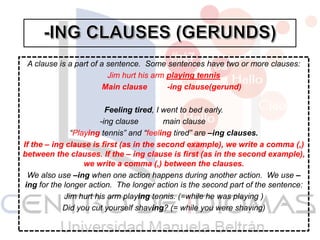
A clause is a part of a sentence. Some sentences have two or more clauses:
Jim hurt his arm playing tennis
Main clause -ing clause(gerund)
Feeling tired, I went to bed early.
-ing clause main clause
“Playing tennis” and “feeling tired” are –ing clauses.
If the – ing clause is first (as in the second example), we write a comma (,)
between the clauses. If the – ing clause is first (as in the second example),
we write a comma (,) between the clauses.
We also use –ing when one action happens during another action. We use –
ing for the longer action. The longer action is the second part of the sentence:
Jim hurt his arm playing tennis. (=while he was playing )
Did you cut yourself shaving? (= while you were shaving)
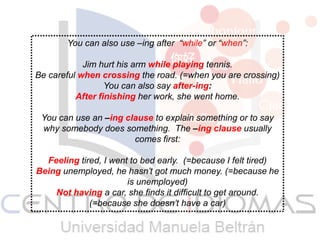
You can also use –ing after “while” or “when”:
Jim hurt his arm while playing tennis.
Be careful when crossing the road. (=when you are crossing)
You can also say after-ing:
After finishing her work, she went home.
You can use an –ing clause to explain something or to say
why somebody does something. The –ing clause usually
comes first:
Feeling tired, I went to bed early. (=because I felt tired)
Being unemployed, he hasn’t got much money. (=because he
is unemployed)
Not having a car, she finds it difficult to get around.
(=because she doesn’t have a car)

ING clauses (gerunds)

  • 1.
    A clause isa part of a sentence. Some sentences have two or more clauses: Jim hurt his arm playing tennis Main clause -ing clause(gerund) Feeling tired, I went to bed early. -ing clause main clause “Playing tennis” and “feeling tired” are –ing clauses. If the – ing clause is first (as in the second example), we write a comma (,) between the clauses. If the – ing clause is first (as in the second example), we write a comma (,) between the clauses. We also use –ing when one action happens during another action. We use – ing for the longer action. The longer action is the second part of the sentence: Jim hurt his arm playing tennis. (=while he was playing ) Did you cut yourself shaving? (= while you were shaving)
  • 2.
    You can alsouse –ing after “while” or “when”: Jim hurt his arm while playing tennis. Be careful when crossing the road. (=when you are crossing) You can also say after-ing: After finishing her work, she went home. You can use an –ing clause to explain something or to say why somebody does something. The –ing clause usually comes first: Feeling tired, I went to bed early. (=because I felt tired) Being unemployed, he hasn’t got much money. (=because he is unemployed) Not having a car, she finds it difficult to get around. (=because she doesn’t have a car)