Sentence Structure, Grammar
and Mechanics
Lawrence Cleary, Co-director
Regional Writing Centre, UL
www.ul.ie/rwc
Clauses
• A clause, at minimum, has a subject, a tensed verb and makes
sense:
– ‘Jesus wept.’ (S+Vi)
– ‘The sky is blue.’ (S+Vl+C)
– ‘I fixed my bike.’ (S + Vt + Od)
– ‘I gave Mary the keys.’ (S +Vt + Oi + Od)
• There are two kinds of clauses:
– Clauses that have a subject and a verb and make sense are
independent clauses. They don’t need additional information in
order to make sense.
– Dependent clauses cannot stand alone: ‘
• ‘After I get the tickets.’ (S+Vt + Od, but needs an independent clause to
help it make sense):
• ‘I’ll call you after I get the tickets.’ (‘I’ll call you’ makes sense all by
itself. ‘after I get the tickets’ needs additional information)
Dependent Clauses
• Dependent clauses can function as either nouns,
adjectives or adverbs:
– Noun clause:
• ‘That I don’t believe you should concern you.’
• I can’t believe that it’s already Christmas!
– Adjective clause:
• ‘That woman who is waving is my mother.’
• ‘That woman, who is waving, is my mother.’
– Adverb clause:
• ‘After the match was won, the fans celebrated in the
streets.’
• The fans celebrated in the streets after the match was won.’
Sentences
• Four kinds of sentences:
– Simple (a single independent clause)
– Compound (two independent clauses joined by a
coordinator)
– Complex (one dependent clause connected to an
independent clause by a subordinator)
– Compound-Complex (a sentence containing at
least two independent clauses and one or more
dependent clauses)
Simple Sentences
• A single, independent clause
• An independent clause, at minimum, has a subject, a
tensed verb and makes sense:
– ‘Jesus wept.’ (S+Vi)
• However, an independent clause may have
– two subjects: ‘Jack and Jill went up the hill.’ (S+S+Vi)
– two verbs: ‘Mary both swims and plays football.’ (S+Vi+Vt)
– an adverbial: ‘Derek reads slowly.’ (S+Vi+Adv) or ‘Before
the wedding, the bride got sloshed!’ (Adv Ph+ S+Vl + C)
– Etc.
Compound Sentences
• Two independent clauses joined by a coordinator.
• Coordinators join two things of equal value:
– For, and, nor, but, or, yet, so and ;.
• ‘Compound sentences contain two independent clauses,
and they are connected by a coordinator.’
• ‘Because they are of equal value and because one
independent clause introduces a second independent
clause, the first clause is set off by a comma and is followed
by a coordinator.’
• Any time any word, phrase or clause precedes the main
clause, that word, phrase or clause is set off by a comma:
– ‘Unsurprisingly, nobody valued vomit as sidewalk art.’
Complex Sentences
• An independent clause joined to a dependent
clause by a subordinator.
– ‘I decided not to go (as the weather took a turn
for the worse).’
– ‘(Because the exam was so important to his
grade), Jerry studied all night.’
• Subordinating conjunctions link independent
clauses to noun, adjective or adverb clauses;
therefore, subordinators are numerous.
Compound-Complex Sentences
• At least two independent clauses linked to one or
more subordinate clauses:
– (I wanted to travel) (after I graduated); (however, I had to
go to work immediately).
– ‘Sir Thomas, meanwhile, went on with his own hopes, and
his own observations, still feeling a right, by all his
knowledge of human nature, to expect to see the effect of
the loss of power and consequence, on his niece’s spirits,
and the past attentions of the lover producing a craving for
their return; and he was soon afterwards able to account
for his not yet completely and indubitably seeing all of
this, by the prospect of another visitor, whose approach
he could allow to be quite enough to support the spirits
he was watching’ (Mansfield Park, 249).
Subordinators for Noun Clauses
• That clauses:
– ‘Do you believe (something) (that we can‘t get into
the concert)?’
• If/whether clauses:
– ‘I can’t remember (something) (if I locked the door).’
– Whether, whether…or not, if, if…or not
• Question (word) clauses:
– We should ask when the train leaves.
– Who, whoever, whom, which, what, where, when,
why, how, how much, how many, how long, how
often, etc.
Subordinators for Adj. Clauses
• To refer to people: who, whom, whose
– ‘People (who live in glass houses) shouldn’t throw
stones.’
• To refer to animals and things: which, that
– ‘My new computer, (which I just bought), has just
crashed!’
• To refer to a time or place: when, where
– The library is a place (where they store books).
Subordinators for Adv. Clauses
• Time (when?) after, as, just as, as long as, before, since, until, when,
whenever, while
• Place (where?) where, wherever, anywhere everywhere
• Manner (how?) as, just as, as if, as though
• Distance (how far or near or close?) as + adv + as
• Frequency (how often?) as often as
• Reason (why?) as, because, since
• Purpose (for what purpose?) so that, in order that
• Result (with what result?) so + adj + that, so + adv + that, such a(n)
+ noun + that, so much/many/little/few + noun + that
• Condition (under what condition?) if, unless
• Concession (partial contrast) although, even though, though
• Contrast (direct opposition) while, whereas
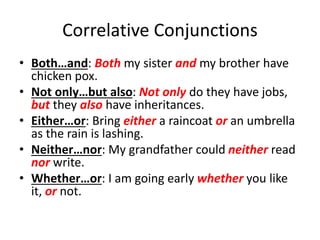
Correlative Conjunctions
• Both…and: Both my sister and my brother have
chicken pox.
• Not only…but also: Not only do they have jobs,
but they also have inheritances.
• Either…or: Bring either a raincoat or an umbrella
as the rain is lashing.
• Neither…nor: My grandfather could neither read
nor write.
• Whether…or: I am going early whether you like
it, or not.
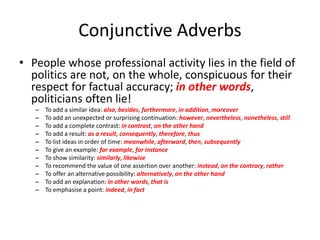
Conjunctive Adverbs
• People whose professional activity lies in the field of
politics are not, on the whole, conspicuous for their
respect for factual accuracy; in other words,
politicians often lie!
– To add a similar idea: also, besides, furthermore, in addition, moreover
– To add an unexpected or surprising continuation: however, nevertheless, nonetheless, still
– To add a complete contrast: in contrast, on the other hand
– To add a result: as a result, consequently, therefore, thus
– To list ideas in order of time: meanwhile, afterward, then, subsequently
– To give an example: for example, for instance
– To show similarity: similarly, likewise
– To recommend the value of one assertion over another: instead, on the contrary, rather
– To offer an alternative possibility: alternatively, on the other hand
– To add an explanation: in other words, that is
– To emphasise a point: indeed, in fact
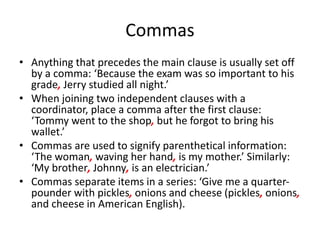
Commas
• Anything that precedes the main clause is usually set off
by a comma: ‘Because the exam was so important to his
grade, Jerry studied all night.’
• When joining two independent clauses with a
coordinator, place a comma after the first clause:
‘Tommy went to the shop, but he forgot to bring his
wallet.’
• Commas are used to signify parenthetical information:
‘The woman, waving her hand, is my mother.’ Similarly:
‘My brother, Johnny, is an electrician.’
• Commas separate items in a series: ‘Give me a quarter-
pounder with pickles, onions and cheese (pickles, onions,
and cheese in American English).
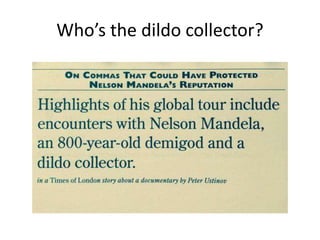
Who’s the dildo collector?
More ambiguity and confusion
• “Most of the time travellers worry about their
luggage”
• “This initial workshop identified the work
scopes and phasing generated several
different sourcing strategies for those work
scopes and proposed selection criteria to
compare the sourcing strategies to best
benefit the project.”
Semi-colon
• Like the coordinator, the semi-colon separates
things of equal value:
– My father was a teacher; his father was a teacher.
– Table 5 ordered a Chicken Caesar with extra
croutons, no onions and blue-cheese dressing; a
bottle of sparkling water, an aperitif and a glass of
Burgundy; and a lemon-ice, an expresso and a
pony of Anisette for dessert.
Colon
• The colon should introduce examples or elaborations:
– "Grammar Girl has two favorite hobbies: watching clouds and
seeing how long she can stand on one foot." - See more at:
http://www.quickanddirtytips.com/education/grammar/colons#sthash.hdh4BMiu.dpuf
– All three of their children are involved in the arts: Richard is a
sculptor, Diane is a pianist, and Julie is a theatre director.
– In a playscript:
• “FRANCISCO: You come most carefully upon your hour.
• BERNARDO: 'Tis now struck twelve; get thee to bed, Francisco.”
– Telling time: 10:25am
– Ratios: 3:1
– The main point is presented in a sentence; the ideas placed
after the colon follow logically from or elaborate on the main
point.
Other punctuation?
• Ellipses …
• Exclamations !
• Questions ?
• Dashes en dash: – em dash — hyphen: -
• Parentheses ( )
• Forward/backward slashes / 
• http://www.grammarbook.com/punctuation_
rules.asp
Spelling
• http://www.oxforddictionaries.com/words/sp
elling-rules-and-tips
• https://www.logicofenglish.com/resources/sp
elling-rules
• Spell-check
Capitalisation
• http://www.oxforddictionaries.com/words/usi
ng-capital-letters
• http://www.grammarbook.com/punctuation/
capital.asp
Last word
Every choice
has an impact
on how your text
means.

Sentence Structure, Grammar and Mechanics_2017.pptx

  • 1.
    Sentence Structure, Grammar andMechanics Lawrence Cleary, Co-director Regional Writing Centre, UL www.ul.ie/rwc
  • 2.
    Clauses • A clause,at minimum, has a subject, a tensed verb and makes sense: – ‘Jesus wept.’ (S+Vi) – ‘The sky is blue.’ (S+Vl+C) – ‘I fixed my bike.’ (S + Vt + Od) – ‘I gave Mary the keys.’ (S +Vt + Oi + Od) • There are two kinds of clauses: – Clauses that have a subject and a verb and make sense are independent clauses. They don’t need additional information in order to make sense. – Dependent clauses cannot stand alone: ‘ • ‘After I get the tickets.’ (S+Vt + Od, but needs an independent clause to help it make sense): • ‘I’ll call you after I get the tickets.’ (‘I’ll call you’ makes sense all by itself. ‘after I get the tickets’ needs additional information)
  • 3.
    Dependent Clauses • Dependentclauses can function as either nouns, adjectives or adverbs: – Noun clause: • ‘That I don’t believe you should concern you.’ • I can’t believe that it’s already Christmas! – Adjective clause: • ‘That woman who is waving is my mother.’ • ‘That woman, who is waving, is my mother.’ – Adverb clause: • ‘After the match was won, the fans celebrated in the streets.’ • The fans celebrated in the streets after the match was won.’
  • 4.
    Sentences • Four kindsof sentences: – Simple (a single independent clause) – Compound (two independent clauses joined by a coordinator) – Complex (one dependent clause connected to an independent clause by a subordinator) – Compound-Complex (a sentence containing at least two independent clauses and one or more dependent clauses)
  • 5.
    Simple Sentences • Asingle, independent clause • An independent clause, at minimum, has a subject, a tensed verb and makes sense: – ‘Jesus wept.’ (S+Vi) • However, an independent clause may have – two subjects: ‘Jack and Jill went up the hill.’ (S+S+Vi) – two verbs: ‘Mary both swims and plays football.’ (S+Vi+Vt) – an adverbial: ‘Derek reads slowly.’ (S+Vi+Adv) or ‘Before the wedding, the bride got sloshed!’ (Adv Ph+ S+Vl + C) – Etc.
  • 6.
    Compound Sentences • Twoindependent clauses joined by a coordinator. • Coordinators join two things of equal value: – For, and, nor, but, or, yet, so and ;. • ‘Compound sentences contain two independent clauses, and they are connected by a coordinator.’ • ‘Because they are of equal value and because one independent clause introduces a second independent clause, the first clause is set off by a comma and is followed by a coordinator.’ • Any time any word, phrase or clause precedes the main clause, that word, phrase or clause is set off by a comma: – ‘Unsurprisingly, nobody valued vomit as sidewalk art.’
  • 7.
    Complex Sentences • Anindependent clause joined to a dependent clause by a subordinator. – ‘I decided not to go (as the weather took a turn for the worse).’ – ‘(Because the exam was so important to his grade), Jerry studied all night.’ • Subordinating conjunctions link independent clauses to noun, adjective or adverb clauses; therefore, subordinators are numerous.
  • 8.
    Compound-Complex Sentences • Atleast two independent clauses linked to one or more subordinate clauses: – (I wanted to travel) (after I graduated); (however, I had to go to work immediately). – ‘Sir Thomas, meanwhile, went on with his own hopes, and his own observations, still feeling a right, by all his knowledge of human nature, to expect to see the effect of the loss of power and consequence, on his niece’s spirits, and the past attentions of the lover producing a craving for their return; and he was soon afterwards able to account for his not yet completely and indubitably seeing all of this, by the prospect of another visitor, whose approach he could allow to be quite enough to support the spirits he was watching’ (Mansfield Park, 249).
  • 9.
    Subordinators for NounClauses • That clauses: – ‘Do you believe (something) (that we can‘t get into the concert)?’ • If/whether clauses: – ‘I can’t remember (something) (if I locked the door).’ – Whether, whether…or not, if, if…or not • Question (word) clauses: – We should ask when the train leaves. – Who, whoever, whom, which, what, where, when, why, how, how much, how many, how long, how often, etc.
  • 10.
    Subordinators for Adj.Clauses • To refer to people: who, whom, whose – ‘People (who live in glass houses) shouldn’t throw stones.’ • To refer to animals and things: which, that – ‘My new computer, (which I just bought), has just crashed!’ • To refer to a time or place: when, where – The library is a place (where they store books).
  • 11.
    Subordinators for Adv.Clauses • Time (when?) after, as, just as, as long as, before, since, until, when, whenever, while • Place (where?) where, wherever, anywhere everywhere • Manner (how?) as, just as, as if, as though • Distance (how far or near or close?) as + adv + as • Frequency (how often?) as often as • Reason (why?) as, because, since • Purpose (for what purpose?) so that, in order that • Result (with what result?) so + adj + that, so + adv + that, such a(n) + noun + that, so much/many/little/few + noun + that • Condition (under what condition?) if, unless • Concession (partial contrast) although, even though, though • Contrast (direct opposition) while, whereas
  • 12.
    Correlative Conjunctions • Both…and:Both my sister and my brother have chicken pox. • Not only…but also: Not only do they have jobs, but they also have inheritances. • Either…or: Bring either a raincoat or an umbrella as the rain is lashing. • Neither…nor: My grandfather could neither read nor write. • Whether…or: I am going early whether you like it, or not.
  • 13.
    Conjunctive Adverbs • Peoplewhose professional activity lies in the field of politics are not, on the whole, conspicuous for their respect for factual accuracy; in other words, politicians often lie! – To add a similar idea: also, besides, furthermore, in addition, moreover – To add an unexpected or surprising continuation: however, nevertheless, nonetheless, still – To add a complete contrast: in contrast, on the other hand – To add a result: as a result, consequently, therefore, thus – To list ideas in order of time: meanwhile, afterward, then, subsequently – To give an example: for example, for instance – To show similarity: similarly, likewise – To recommend the value of one assertion over another: instead, on the contrary, rather – To offer an alternative possibility: alternatively, on the other hand – To add an explanation: in other words, that is – To emphasise a point: indeed, in fact
  • 14.
    Commas • Anything thatprecedes the main clause is usually set off by a comma: ‘Because the exam was so important to his grade, Jerry studied all night.’ • When joining two independent clauses with a coordinator, place a comma after the first clause: ‘Tommy went to the shop, but he forgot to bring his wallet.’ • Commas are used to signify parenthetical information: ‘The woman, waving her hand, is my mother.’ Similarly: ‘My brother, Johnny, is an electrician.’ • Commas separate items in a series: ‘Give me a quarter- pounder with pickles, onions and cheese (pickles, onions, and cheese in American English).
  • 15.
  • 16.
    More ambiguity andconfusion • “Most of the time travellers worry about their luggage” • “This initial workshop identified the work scopes and phasing generated several different sourcing strategies for those work scopes and proposed selection criteria to compare the sourcing strategies to best benefit the project.”
  • 17.
    Semi-colon • Like thecoordinator, the semi-colon separates things of equal value: – My father was a teacher; his father was a teacher. – Table 5 ordered a Chicken Caesar with extra croutons, no onions and blue-cheese dressing; a bottle of sparkling water, an aperitif and a glass of Burgundy; and a lemon-ice, an expresso and a pony of Anisette for dessert.
  • 18.
    Colon • The colonshould introduce examples or elaborations: – "Grammar Girl has two favorite hobbies: watching clouds and seeing how long she can stand on one foot." - See more at: http://www.quickanddirtytips.com/education/grammar/colons#sthash.hdh4BMiu.dpuf – All three of their children are involved in the arts: Richard is a sculptor, Diane is a pianist, and Julie is a theatre director. – In a playscript: • “FRANCISCO: You come most carefully upon your hour. • BERNARDO: 'Tis now struck twelve; get thee to bed, Francisco.” – Telling time: 10:25am – Ratios: 3:1 – The main point is presented in a sentence; the ideas placed after the colon follow logically from or elaborate on the main point.
  • 19.
    Other punctuation? • Ellipses… • Exclamations ! • Questions ? • Dashes en dash: – em dash — hyphen: - • Parentheses ( ) • Forward/backward slashes / • http://www.grammarbook.com/punctuation_ rules.asp
  • 20.
  • 21.
  • 22.
    Last word Every choice hasan impact on how your text means.

Editor's Notes

  • #2 This presentation assumes that punctuation signals sometimes grammatical and sometimes semantic relationships between parts of a sentence and between sentences.
  • #3 S + V (and makes sense)= a clause. Here, the verb ‘wept’ is intransitive. It does not take an object. If we say ‘Jesus wept wildly’ (S + V + Adj.), then we see that the verb can be modified by an adverb. In ‘The sky is blue.’, blue is an adjective that modifies the subject, ‘sky’. Sometimes, the complement is another noun: ‘The sky is the limit’. We call these complement clauses. The verb ‘to be’ is a linking verb; it links the subject with the modifier. In ‘I fixed my bike.’, the verb is transitive: it takes an object, in this case ‘my bike’. In ‘I gave Mary the keys.’, ‘keys’ is the direct object of the verb ‘give’; ‘Mary’ is the indirect object, the person to whom the keys are given. Independent clauses stand alone. They make sense all by themselves. Dependent clauses need a main clause to make sense of them. If I came into the room and said ‘after I get the tickets’, those in the room who heard me would think, ‘What are you talking about? What happens after you get the tickets? And what tickets are you talking about?’ Just to complicate the situation, there’s this sentence: ‘That you wish you had a Ferrari is what many would say is the wish of a man in a fur coat and no knickers’. Here, ‘That you wish you had a Ferrari’ is the subject of this sentence, but it is in the form of a dependent clause—it doesn’t stand alone. The complement, ‘what many would say’ is a dependent clause that functions as the subject of a larger dependent clause that together function as the complement of the subject, with ‘is’ as the verb that links them. So our independent clause, here, is made up of a number of dependent clauses that only make sense when combined.
  • #4 We can substitute the word ‘something’ for the noun clause: ‘Something’ should concern you. I can’t believe ‘something’. What is it you cannot believe? That it’s already Christmas! Noun clauses are subordinated to main clauses and linked to the main clause by subordinators such as that, if/whether or who, what, when, where or how. “How I got into this mess remains to be determined.” (something remains to be determined.) “Whether you accept it or not is not important to me.” (Something is not important to me.) ______________________________________________________________________________________________________ The adjective clause modifies a noun. ‘who is waving’ in the first example the adjective clause is defining. There are many women there, but only one is waving. In the second case, ‘,who is waving,’ is extra information. There is only one woman there to see. It couldn’t be anyone else. Words that we use to link adjective clauses to an independent clause are words like who, that and which. We call these relative pronouns because they double as subjects of the adjective clause: “I love chili that is super spicy.” Here, the word ‘that’ is a pronoun substitute for ‘chili’, which is what is being described by the adjective clause. (See what I did? ) ____________________________________________________________________________________________________ The adverb clause modifies a verb. There are a lot of different kinds of adverbs: adverbs of time, place, manner, purpose or reason, concession or contrast, quantity or degree and affirmation or negation. The two examples are adverb clauses expressing time. “Most people shop where they get the lowest prices.” (place) “Fire had destroyed the trees in the forest as far as the eye could see.” (distance) “I do not visit my parents as often as they would like.” (frequency) “The bus’s engine sounds as if it is going to stall.” (manner) “I took the day off because I felt unwell.” (reason) “Her cookies contain so few calories that even people on diets can enjoy them.” (result) “Farmers use chemical pesticides so that they can get the highest yield.” (purpose) “If you don’t hand over the document, I’ll be forced to get a subpoena.” (conditional)
  • #5 Coordinators join things of equal value (two nouns, two adjectives, two verbs, two noun, adjective or adverb phrases, two dependent clauses or two independent clauses). There are seven coordinators: for, and, nor, but, or, yet, so. In Ireland, some might view ‘while’ as a coordinator. Subordinators join two things of unequal value such as an independent and dependent clause. Subordinators are many, but include: after, as, just as, as long as, before, as soon as, since, until, when, whenever, while, where, wherever, anywhere, everywhere, as if, as though, because, so that, in order that, if, unless, although, even though, though, whereas, who, whom, whose, that, which, whether, whether or not, how, why, how much, how often, how long, etc. “He didn’t care how long the list was” is a complex sentence. ‘how long the list was’ is a subordinate clause, functioning like a noun, answering the question, ‘what did he not care about? ‘how long the list was’.
  • #6 Get students to identify simple sentences in their writing. What are its components? S+V, S+V+Adv., S+V+Oi+Od? Subject, verb—what kind of verb? Transitive (takes an object), intransitive (doesn’t take an object), linking (followed by a complement)? Ask for sentences in the student writing that they find problematic and put them on the board and study them. Do the students have many examples of simple sentences in their texts? What is the effect? Is it a pleasant effect? How could they disturb the rhythm? English speakers need jazz, unpredictable, swinging rhythms if they want their audiences to stay with them.
  • #7 Get some samples of compound sentences from the students. Put on the board. Call attention to the role of the comma. Anytime something introduces an independent clause, even if it is another independent clause, the introductory clause is set off with a comma. Call attention to the relationships created by the coordinators: for introduces a reason or explanation for something; and signifies addition; nor signifies negative addition—not this and not that; but signifies contrast; or introduces an alternative; yet signifies concession; so introduces consequences; and ; joins two or more things of equal value, used only when the relationship is so clear that we don’t even need to state it.
  • #8 Try to get students to give examples of complex sentences that include a noun or an adjective or an adverb clause. Look at the relationships set up by subordinators. Many of the same relations expressed by coordinators are also expressed by subordinators. ‘as’ is introducing a reason. ‘because’ is also introducing a reason. Although is something like yet, introducing a concession, a weak contrast. Whereas might introduce an alternative as does or. Because and as are functioning above as for, and therefore functions like so. Neither functions like nor. Moreover expresses the same relationship as and. On the other hand functions similarly to but. There are many other functions performed by subordinators, though, including most notably time, space and manner. The difference is that coordinators join things of equal value, subordinators things of unequal value.
  • #9 Check to see if anyone has a sample compound-complex sentence to study. Do the writers employ many of these rather long sentences? What is the effect? Is it appropriate to the style of the audience they hope to capture?
  • #12 After we ate lunch, we decided to go shopping. I try to shop wherever there is a sale. You looked as if you had seen a ghost. The child sat as close as she could to her mother. I call my parents as often as I can. I take evening classes because I work late at night. Many people emigrate in order that their children can have better lives. It was such an easy test that most of the students got As. We will not go hiking unless the weather is perfect. I love my brother even though we disagree on almost everything. He is very conservative, whereas I am a bleeding-heart liberal.
  • #13 Like coordinators, correlative conjunctions join things of equal value: both + noun phrase + and + noun phrase; not only + independent clause + but also + independent clause; either + noun phrase + or + noun phrase; neither + verb + nor + verb; whether + independent clause + or + ellipted independent clause.
  • #14 This structure: independent clause; conjunctive adverb, independent clause. Adverbs have a quality unlike nouns, verbs and adjectives: adverbs can move around the sentence: yesterday, I went to the zoo; I went to the zoo yesterday; I went, yesterday, to the zoo. Conjunctive adverbs also have some mobility: People whose professional activity lies in the field of politics are not, on the whole, conspicuous for their respect for factual accuracy; politicians, in other words, often lie!
  • #15 If the commas were not inserted into the third sentence, the information would define the woman. I recall an article written by Margaret Ward of Clear Ink that appeared, if I am not mistaken, in the Irish Times back during the national elections in 2007. The article may have appeared in 2006. I am not sure, but I can no longer find a trace of it. In the article, there was some disparaging of the grammar and punctuation in election posters. And in that commentary was the claim that commas should appear where speakers need to breathe. This I thought absurd as some of us need to take breaths more often than others, and with asthmatics, there could be a comma after every word. Commas are usually grammatical. They signify a relationship that has consequences for the meaning of the statement. Commas are, though, occasionally stylistic. For instance, the Oxford comma was employed as a way of eliminating confusion about how items in a list should be grouped in the minds of readers. ‘…vanilla, chocolate and strawberry’ could be misconstrued as two items, at least the question could be asked about how these three items are grouped. ‘…vanilla, chocolate, and strawberry’ clearly group three separate items. See the next slide for a better example.
  • #16 This is not an argument for the Oxford comma so much as it is an argument for using commas to clear up confusions or ambiguities. Other examples: see next slide.
  • #20 Ellipses are used to say that what follows is a logical progression that may go on for some time. Three dots, not four or five. An increase in the number of dots does not communicate an increase the duration of the progression. Similarly, more than one exclamation mark does not make for a more emphatic exclamation. En and Em dashes: they are interchangeable for the most part. In most writing, you can use one or the other, but be consistent in your usage. A punctuation not mentioned is speech marks or quotation marks. Generally, in British English, the single inverted comma is preferred. In the US it is the double inverted comma. If you begin with a single inverted comma, any usage requiring speech marks within that portion of the text enclosed by single inverted commas would need to be enveloped by double inverted commas, etc. ‘................”………………….’…….’……………..”……………….’. We use speech marks for many things: to indicate the verbatim words of others (a quote), to indicate the titles of minor works, to indicate when words or phrases are a special usage as when indicating that something is the ‘definition’ of something else, when a words is being used ironically or when it is jargon. We sometimes do this with illicisation as well.
  • #21 Go through how to set up the spell check on Word. Spelling rules might be helpful for recalling how to spell; useful if you do not have time to run the handwritten text through a computer before submitting.
  • #22 We capitalise proper nouns, first letter of sentence initial words. The trick is knowing when something is a proper noun. Example: I attend the University of Limerick’s MA in Creative Writing. Many students in the university are interested in creative writing, but might be hesitant to engage in a formal study of the subject.