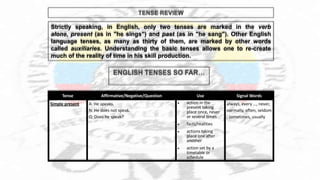
TENSE REVIEW
Strictly speaking, in English, only two tenses are marked in the verb
alone, present (as in "he sings") and past (as in "he sang"). Other English
language tenses, as many as thirty of them, are marked by other words
called auxiliaries. Understanding the basic tenses allows one to re-create
much of the reality of time in his skill production.
ENGLISH TENSES SO FAR…
Tense Affirmative/Negative/Question Use Signal Words
Simple present A: He speaks.
N: He does not speak.
Q: Does he speak?
action in the
present taking
place once, never
or several times
facts/realities
actions taking
place one after
another
action set by a
timetable or
schedule
always, every …, never,
normally, often, seldom
, sometimes, usually
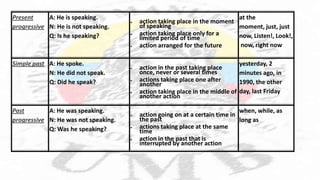
Present
progressive
A: He is speaking.
N: He is not speaking.
Q: Is he speaking?
action taking place in the moment
of speaking
action taking place only for a
limited period of time
action arranged for the future
at the
moment, just, just
now, Listen!, Look!,
now, right now
Simple past A: He spoke.
N: He did not speak.
Q: Did he speak?
action in the past taking place
once, never or several times
actions taking place one after
another
action taking place in the middle of
another action
yesterday, 2
minutes ago, in
1990, the other
day, last Friday
Past
progressive
A: He was speaking.
N: He was not speaking.
Q: Was he speaking?
action going on at a certain time in
the past
actions taking place at the same
time
action in the past that is
interrupted by another action
when, while, as
long as
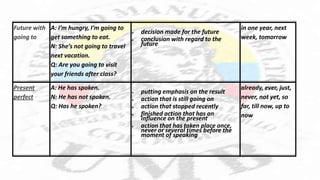
Future with
going to
A: I’m hungry, I’m going to
get something to eat.
N: She’s not going to travel
next vacation.
Q: Are you going to visit
your friends after class?
decision made for the future
conclusion with regard to the
future
in one year, next
week, tomorrow
Present
perfect
A: He has spoken.
N: He has not spoken.
Q: Has he spoken?
putting emphasis on the result
action that is still going on
action that stopped recently
finished action that has an
influence on the present
action that has taken place once,
never or several times before the
moment of speaking
already, ever, just,
never, not yet, so
far, till now, up to
now
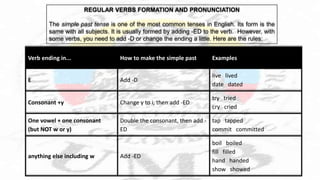
REGULAR VERBS FORMATION AND PRONUNCIATION
The simple past tense is one of the most common tenses in English. Its form is the
same with all subjects. It is usually formed by adding -ED to the verb. However, with
some verbs, you need to add -D or change the ending a little. Here are the rules:
Verb ending in... How to make the simple past Examples
E Add -D
live lived
date dated
Consonant +y Change y to i, then add -ED
try tried
cry cried
One vowel + one consonant
(but NOT w or y)
Double the consonant, then add -
ED
tap tapped
commit committed
anything else including w Add -ED
boil boiled
fill filled
hand handed
show showed

Tense review

  • 1.
    TENSE REVIEW Strictly speaking,in English, only two tenses are marked in the verb alone, present (as in "he sings") and past (as in "he sang"). Other English language tenses, as many as thirty of them, are marked by other words called auxiliaries. Understanding the basic tenses allows one to re-create much of the reality of time in his skill production. ENGLISH TENSES SO FAR… Tense Affirmative/Negative/Question Use Signal Words Simple present A: He speaks. N: He does not speak. Q: Does he speak? action in the present taking place once, never or several times facts/realities actions taking place one after another action set by a timetable or schedule always, every …, never, normally, often, seldom , sometimes, usually
  • 2.
    Present progressive A: He isspeaking. N: He is not speaking. Q: Is he speaking? action taking place in the moment of speaking action taking place only for a limited period of time action arranged for the future at the moment, just, just now, Listen!, Look!, now, right now Simple past A: He spoke. N: He did not speak. Q: Did he speak? action in the past taking place once, never or several times actions taking place one after another action taking place in the middle of another action yesterday, 2 minutes ago, in 1990, the other day, last Friday Past progressive A: He was speaking. N: He was not speaking. Q: Was he speaking? action going on at a certain time in the past actions taking place at the same time action in the past that is interrupted by another action when, while, as long as
  • 3.
    Future with going to A:I’m hungry, I’m going to get something to eat. N: She’s not going to travel next vacation. Q: Are you going to visit your friends after class? decision made for the future conclusion with regard to the future in one year, next week, tomorrow Present perfect A: He has spoken. N: He has not spoken. Q: Has he spoken? putting emphasis on the result action that is still going on action that stopped recently finished action that has an influence on the present action that has taken place once, never or several times before the moment of speaking already, ever, just, never, not yet, so far, till now, up to now
  • 4.
    REGULAR VERBS FORMATIONAND PRONUNCIATION The simple past tense is one of the most common tenses in English. Its form is the same with all subjects. It is usually formed by adding -ED to the verb. However, with some verbs, you need to add -D or change the ending a little. Here are the rules: Verb ending in... How to make the simple past Examples E Add -D live lived date dated Consonant +y Change y to i, then add -ED try tried cry cried One vowel + one consonant (but NOT w or y) Double the consonant, then add - ED tap tapped commit committed anything else including w Add -ED boil boiled fill filled hand handed show showed