Gerunds
       BY>
KAISI MUHAMMAD
Verbals- What Are They,
         Even?
• A verbal is a noun or an adjective formed
  from a verb.
• There are three kinds of verbals: gerunds,
  participles, and infinitives.
• Verbals express an action or state of being.
• The difference between verbals and other
  nouns and adjectives is that verbals can take
  their own objects even though they are not
  verbs.
Gerunds… say what?
• A gerund is a verbal that ends in –ing
  and functions as a noun.
• Gerunds can be used as a subject,
  direct object, subject complement,
  and object of preposition because it
  functions as a noun.
Gerunds as a Subject
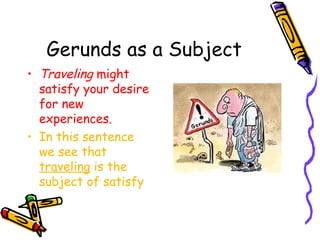
• Traveling might
  satisfy your desire
  for new
  experiences.
• In this sentence
  we see that
  traveling is the
  subject of satisfy
Gerund as a Direct
          Object
• They appreciate         GERUNDS are

  my singing.
                          super! Without
                          them, verbs
                          couldn’t be nouns!
• Singing is used as a
  direct object
  because it answers
  the question of the
  verb (what are
  they appreciating?
  Singing)
Gerunds as a Subject
       Complement
• My mom’s favorite
  activity is running.
• Running is
  explaining the
  subject in this
  sentence (what
  activity? Running.)
Gerunds as an Object of
       Preposition
• The police arrested
  him for speeding.
• Speeding is the object
  of for in this example
  because it is
  explaining the
  prepostion (for what?
  For speeding.)
Gerund Phrase
• A gerund phrase consists of a
  gerund plus a modifier, object,
  and/or complement.
• Finding a needle in a haystack
  would be easier than what we're
  trying to do.
• Finding is the gerund in the
  italicized phrase.
• Needle is the direct object, and
  in a haystack is the prepositional
  phrase within the gerund phrase.
QUIZ TIME!
 Aren’t you glad you were paying attention?!
• Daniel started doing his homework at
  12:30 PM.
• He apologized for being late.
• He insisted on speaking to the manager
  because there was a fly in his soup.
• Bonus: She made plans for leaving home to
  go to Fiji.
Answers!
            Cross your fingers!
•   Doing
•   Being                     Life would
•   Speaking                    be
                                empty
•   Leaving- object of          without
    preposition                 Gerunds

Gerunds

  • 1.
    Gerunds BY> KAISI MUHAMMAD
  • 2.
    Verbals- What AreThey, Even? • A verbal is a noun or an adjective formed from a verb. • There are three kinds of verbals: gerunds, participles, and infinitives. • Verbals express an action or state of being. • The difference between verbals and other nouns and adjectives is that verbals can take their own objects even though they are not verbs.
  • 3.
    Gerunds… say what? •A gerund is a verbal that ends in –ing and functions as a noun. • Gerunds can be used as a subject, direct object, subject complement, and object of preposition because it functions as a noun.
  • 4.
    Gerunds as aSubject • Traveling might satisfy your desire for new experiences. • In this sentence we see that traveling is the subject of satisfy
  • 5.
    Gerund as aDirect Object • They appreciate GERUNDS are my singing. super! Without them, verbs couldn’t be nouns! • Singing is used as a direct object because it answers the question of the verb (what are they appreciating? Singing)
  • 6.
    Gerunds as aSubject Complement • My mom’s favorite activity is running. • Running is explaining the subject in this sentence (what activity? Running.)
  • 7.
    Gerunds as anObject of Preposition • The police arrested him for speeding. • Speeding is the object of for in this example because it is explaining the prepostion (for what? For speeding.)
  • 8.
    Gerund Phrase • Agerund phrase consists of a gerund plus a modifier, object, and/or complement. • Finding a needle in a haystack would be easier than what we're trying to do. • Finding is the gerund in the italicized phrase. • Needle is the direct object, and in a haystack is the prepositional phrase within the gerund phrase.
  • 9.
    QUIZ TIME! Aren’tyou glad you were paying attention?! • Daniel started doing his homework at 12:30 PM. • He apologized for being late. • He insisted on speaking to the manager because there was a fly in his soup. • Bonus: She made plans for leaving home to go to Fiji.
  • 10.
    Answers! Cross your fingers! • Doing • Being Life would • Speaking be empty • Leaving- object of without preposition Gerunds